Using the physical properties of artefacts
to manage throughlife knowledge flows
in the built environment : an initial
exploration
Rooke, CN, Rooke, JA, Koskela, LJ and Tzortzopoulos, P
http://dx.doi.org/10.1080/01446193.2010.489925
Title Using the physical properties of artefacts to manage throughlife knowledge flows in the built environment : an initial exploration Authors Rooke, CN, Rooke, JA, Koskela, LJ and Tzortzopoulos, P
Type Article
URL This version is available at: http://usir.salford.ac.uk/11300/ Published Date 2010
USIR is a digital collection of the research output of the University of Salford. Where copyright permits, full text material held in the repository is made freely available online and can be read, downloaded and copied for noncommercial private study or research purposes. Please check the manuscript for any further copyright restrictions.
Using the physical properties of artefacts to manage through-life
knowledge flows in the built environment: an initial exploration
Clementinah N. Rooke, John A. Rooke, Lauri, J. Koskela & Patricia Tzortzopoulos
Author's draft, published as:
Rooke, C. N., Rooke, J. A., Koskela, L. J. & Tzortzopoulos, P. (2010) 'Using the physical properties of artefacts to manage through-life knowledge flows in the built environment: an initial exploration', in M. Bresnen & C. Harty (Eds.) Construction Management & Economics: Special Issue on Objects, Knowledge Sharing and Knowledge Transformation in Projects 28(6):601-13.
Abstract
The KIM Grand Challenge project attempted to develop an approach to through-life management of
built facilities based on a dichotomous conception of knowledge, which proved to be deficient.
Here, a tri-partite analysis is offered, suggesting that knowledge can be analysed as a flow, consisting
of social practices, information and physical properties. Literature on physical properties from
design studies, production management and ethnomethodology is briefly reviewed to demonstrate
the information bearing functions of physical properties.
Fieldwork conforming to the UA requirement was carried out in several settings. Safety barriers on
construction sites were found to have informational properties beyond their function as a physical
barrier. The quality of information delivered by wayfinding signs was found to depend upon the
physical placement of the signs in relation to the surrounding environment and the physical layout of
the sign itself. It was found that social practices are institutionalised to support knowledge flow
when the signs fail. The flow of information necessary for the maintenance of an oxygen cylinder in
Elements of knowledge management, ethnomethodology, production management and design
studies might be integrated to form a hybrid discipline.
Keywords
Knowledge Management, Design, Through Life Management, Ethnomethodology, Production
Theory, Product-Service.
Introduction: through life knowledge management (KM) in the built environment
It has been observed that: “organizations across all sectors are increasingly being asked not only to
provide products in the first instance, but also to support them throughout their service life” (KIM
2006). This means that the burden of maintenance and upgrade would no longer lie with the
customer but with the product-service provider (Oliva and Kallenberg 2003). Thus, the emphasis is
on maintaining and upgrading products to meet developing customer needs at various stages of the
product life-cycle (Stark, 2006). Models that represent product life-cycles, for example, from
design to final recycling have been suggested (Tavcar, and Duhovnik, 2004). The project, Immortal
Information and Through Life Knowledge Management (KIM) specifically explores issues
concerning knowledge management for the through life support of products within a product
service paradigm. It is founded on the recognition that designing, servicing, maintaining and
upgrading of products are all knowledge intensive activities (Eckert, Jower & Clarkson 2007). The
built environment has been a major focus of this approach and major obstacles to the transfer of
knowledge across different life-cycle stages have been identified (Hughes, Yohannes & Hillig
2007; Johnstone, Dainty, & Wilkinson 2007). Attention has also been given to the changing
configuration of product-service stakeholders through the various stages of the life-cycle
This paper addresses an aspect of a more generic question: by what means can knowledge transfer
can be achieved through time? The emphasis, therefore, is on how knowledge can be effectively
stored over time and delivered in a timely and easily understood manner to those who need it. The
particular focus is on the role of physical properties of artefacts in achieving this transfer.
KIM takes a dichotomous approach, making a distinction between knowledge and information
which relies heavily on a further distinction between tacit and explicit knowledge (Davenport &
Prusak 1998; Quintas 2005; KIM 2006). However, these distinctions do not offer a clear basis upon
which to proceed, particularly with regard to how we understand the communicative physical
properties of the artefacts that constitute the built and human environment itself. Thus, beginning
afresh from a Wittgensteinian and ethnomethodological standpoint, we seek to re-explore the
concept of knowledge in such a way as to make room for the meanings that are communicated
through these physical properties. As a result of these inquiries, we offer a tri-partite conception of
knowledge. This redefines the informational and practical aspects of knowledge, combining them
with a conception of physical objects and environments as information carrying entities which are
constituted, recognised and used in the course of social practice. Thus, the formulation includes: [1]
information; [2] social practice; [3] the physical properties of objects in which knowledge can be
embedded. .
This conception is further informed by a production theory approach which directs our attention to,
focuses our research on, and offers resources for the resolution of the practical problems of creating
value in the built environment (Koskela 1992, 2000). However, these research aims are pursued
through ethnomethodological procedures that eschew any reliance on pre-formulated theoretical
resources to explicate the constitution of the research setting. These procedures require
conformance to the Unique Adequacy (UA) requirement of methods, in researching and reporting
members of that setting themselves have of it over the theoretically informed understandings that
researchers bring to that setting from outside (Garfinkel 1984; Garfinkel & Weider 1996; Garfinkel
2002). The consequences of the application of UA in management studies have been previously
explored in Rooke & Kagioglou (2007) and Rooke, Koskela & Kagioglou (2009). The major
consequence in the current context is that, while lean knowledge management would seek to
minimise the waste that occurs through loss of knowledge, these efforts are to be initiated and
evaluated in terms that are provided by (and within) the setting for which they are intended.
In what follows, we attempt to bring together previous work from various disciplinary standpoints
(design studies, production management and ethnomethodology) which addresses the knowledge
bearing capacities of the physical properties of artefacts. We also present a series of
ethnomethodological case studies which highlight these capacities and the problems of knowledge
flow that can arise pertaining to them. Our aim is to provide foundations to a larger study, which
will attempt to systematize principles for the lean through-life management of knowledge via
ethnomethodologically informed design.
Problems of knowledge in Knowledge Management
Tacit and explicit knowledge
Prusak and Davenport characterise knowledge as “broader, deeper, and richer than data, or
information” (1998:5), stating that information should be thought of as “data that makes a
difference” (1998:3) They point out that originally 'to inform' meant 'to give shape to' and quote
Drucker to the effect that it is “data endowed with relevance and purpose” (1998:2). Knowledge,
on the other hand, is much richer, it is:
provides a framework for evaluating and incorporating new experiences and information. It
originates and is applied in the minds of knowers. In organizations, it often becomes
embedded not only in documents or repositories but also in organizational routines,
processes, practices, and norms.” (1998:5)
Thus, a dichotomy between knowledge on the one hand and information/data on the other is
established. Nonaka and Takeuchi's argument that a key knowledge management process is the
“conversion of tacit knowledge to explicit knowledge” (1995:11) has been widely influential,
though generally misunderstood (Snowden 2002). To all intents and purposes, explicit knowledge
is taken to be synonymous with information/data, the function of knowledge management thus
being to convert the hidden tacit knowledge held by individuals into communicable information
(Snowden 2002; Keane & Mason 2006).
Keane and Mason (2006) identify two key errors underlying this view of knowledge management:
misunderstandings of the relationships between tacit and explicit knowledge on the one hand and
between knowledge and information on the other. They point out that Polanyi, the originator of the
distinction between tacit and explicit knowledge, does not refer to these as types of knowledge, but
as dimensions of knowledge. Indeed, for Polanyi (1983) all knowledge has both tacit and explicit
dimensions. Thus, the dichotomy between knowledge and information/data is weaker than is
generally thought, information being simply the explicit dimension of a knowledge which also has a
tacit dimension. Thus, for Keane and Mason, the function of knowledge management is
straightforward, to capture and preserve the explicit informational dimension of knowledge,
including sufficient detail of the context of its use.
Keane and Mason's close reading of Polanyi cannot easily be gainsaid and their clarification of the
information capture process is likely to free the designers of information technology systems from a
for those who would take a broader view of the scope of knowledge management systems.
Snowden (2002), for instance, also wishes to distance himself from what he terms the 'second age'
of knowledge management, the focus on converting tacit to explicit knowledge. However, he does
not see this as a matter of abandoning current practice, but of adding to it through practices that
promote 'descriptive self awareness'. Indeed, there may be some difficulty in distinguishing Keane
and Mason's approach from that described by Snowden as 'first age' knowledge management, in
which the structure and flow of information are the sole concerns.
We are left then with two questions. First, how can it be that the proposal to convert knowledge to
information is based on a philosophical error? Second, what are the implications of this for
knowledge management practice; is knowledge management thus reduced to information
management after all?
Is knowledge management built on a philosophical error?
Wittgenstein provides a method of analysing language use in such a way as to reveal philosophical
puzzles as questions about linguistic practice (Wittgenstein 1958; Searle & Magee 1987). The main
thrust of his later philosophy is a critique of the often implicit view that the function of language is
simply to represent reality. Thus, he rejects the idea that linguistic terms necessarily correspond to
activities and objects in the world, arguing that the relationship between language and reality is
more active; it is a means by which people do things. This position is explained through the
metaphor of “language games”, models of particular uses of language which consist of “language
and actions into which it is woven” (Wittgenstein 1958:#7). These games are used to point out the
essentially social and practical nature of language. Wittgenstein stresses that they are not
autonomous, but are integrated into ways of life (1958:#23). Also, that they are models, that is to
occasions of language use. Another powerful metaphor which Wittgenstein uses is that of language
as a toolbox. Thus, he tells us, linguistic expressions are like tools, they do not necessarily
correspond to objects or events in the world, but they may be used in various ways to do things in
the world.
By contrast, Polanyi's analysis of the structure of knowledge assumes a correspondence view of
language: that the term 'knowledge' corresponds to mental objects and activities which can be
studied in themselves. The knowledge management view of knowledge also makes this
assumption; but rather than following Polanyi into a deep analysis of the structure of knowledge,
knowledge management seeks only to produce a taxonomy for management purposes. Thus,
Davenport & Prusak recognise that their definition of knowledge is no more than a convenient
working definition. Like their definitions of data and information, which are technical definitions
deriving their use in the field of computer technology (data in, information out), this is a definition
that is useful for a particular task, rather than an exploration of the full range of possible uses of the
term.
There is no need, therefore, to examine the full range of possible uses of terms such as 'knowledge'
or 'information', however, it is necessary to ensure that those uses required within the field of
knowledge management are fully recognised. The KIM project attempted to include such a usage
under the heading of 'communities of practice' (Wenger 2000). This useful concept stresses the
practical and social nature of knowledge which is highlighted in Wittgenstein's conception of
language. This aspect is recognised by Polanyi (1983), but is not identical to his tacit/explicit
distinction. However, the Wittgensteinian tradition provides us with precisely such a distinction in
the work of Ryle (1963). Ryle points out that when we use mental terms (such as knowledge), we
are not usually pointing to hidden objects and activities which exist or take place in our minds, but
Thus, for instance, if, in the course of allocating workload, we say that a quantity surveyor knows
the Civil Engineering Standard Method of Measurement (Institution of Civil Engineers 1991) we are
saying that they are capable of pricing a civil engineering job.
Ryle observes that there are two distinct ways in which we talk about knowledge: we may refer to a
person's cognitive repertoire of facts and theories (their knowing that); or we may discuss their
abilities and performance (their knowing how). Unlike Polanyi's tacit and explicit dimensions, these
are types of knowledge. Thus, it is possible to use the terms to classify knowledge: thus, some
things we call knowledge can be classified as 'knowing that', while others can be classified as
'knowing how'. This is not the case with 'tacit' and 'explicit', which are different aspects of
knowledge. Indeed, with his focus on linguistic usage, Ryle does not share Polanyi's interest in the
structure of knowledge, being concerned rather with the role that the concept plays in the practical
activities of everyday life. Indeed, it is worth noting that Polanyi (1983) asserts that 'knowing how'
and 'knowing that' have similar structures, though he does not go on to claim that they are therefore
identical forms of knowing. The 'knowing that' category of knowledge covers facts, theories,
narratives, mathematical equations, etc.; 'knowing how' refers to practices and abilities. This
distinction allows us to clarify the logical relationships between the concepts and answer the two
questions posed at the end of the previous section. The philosophical problem can be seen to have
arisen from the conflation of a fundamental linguistic distinction (between knowing how and
knowing that) with a doctrine pertaining to the structure of knowledge (tacit and explicit
dimensions of knowledge). Were knowledge management to draw on Ryle, rather than Polanyi, the
problem would not arise. For the practical purposes of knowledge management, the distinction
between knowledge as social practice on the one hand and knowledge as information and theory on
the other, is an important one, since, while it is unproblematic to record the latter in electronic form,
The knowledge bearing capacity of physical properties of artefacts: an ethnomethodological
approach
This re-framing of the informational and practical concepts of knowledge allows for the
identification of two clearly distinguishable, though intimately related, categories of knowledge:
information, on the one hand; social practice on the other. While practice and information/theory
constitute two forms of knowledge that it is important to manage, the focus of this paper is on a
third form: knowledge embedded in the physical properties of objects. Thus the conception of
physical objects and environments as information carrying entities which are constituted,
recognised and used in the course of social practices provides for the formulation of a third
overlapping category: the physical qualities of objects in which knowledge can be embedded.
This third form of knowledge has been a focus of ethnomethodological studies. Ethnomethodology
is a sociological approach distinct from traditional sociological approaches in that it concerns itself
solely with observable features of social life, eschewing attempts to theorise those features (Francis
and Hester, 2004). It focuses on how observable social activities are produced, accomplished and
understood by ordinary members of society. Put in a different way: it sets out to investigate how
members of society (individuals within organizations) make sense of and function in society by
creating social facts or understandings of how society works. Ethnomethodology seeks to explicate
this achievement by specifying the local, situated methods used in the production of observable
social activities.
Ethnomethodology provides the Unique Adequacy (UA) requirement of methods as a guide to
study. This set of criteria demands that the methods used to produce a description of a situation,
should be those which originate from the situation they describe. Two unique adequacy criteria are
suggested; a strong one and a weak one. The weak requirement is that:
accountability of the phenomenon" (Garfinkel & Wieder 1992:182)
Thus, to analyse a setting adequately, the researcher must learn what any member to that setting
would ordinarily know about that setting. Thus, the researcher must achieve the ability to perform
relevant activities within that setting without their actions being censured or corrected by other
members. Garfinkel & Wieder (1992) state that this might be taken as a criterion for adequate
ethnography. The strong requirement concerns the reporting of research (Rooke & Kagioglou,
2007). It demands that the methods of analysis used to report on a setting should be derived from
that setting. In effect, it stipulates the application of a policy of 'ethnomethodological indifference':
a refusal to evaluate, describe or explain the activities that constitute the setting using criteria,
concepts or theories that are not a part of that setting. Lynch (1999) points out that the research
practices upon which the achievement of strong UA are based are in themselves skilful practices
which researchers must learn.
There now follows an initial ethnomethodological observation on the knowledge bearing capacity
of the physical properties of artefacts, derived from the reading of Health and Safety Executive
literature and several months participant observation on construction sites.
Health and safety regulations require that, on construction sites, “guard rails, toe boards and other
similar barriers should be provided wherever someone could fall 2 m or more.” Detailed
instructions are specified for the erection of such safety barriers (HSE 1996:27-8). These barriers
can be seen to provide physical constraints which will prevent people and objects from falling.
However, these physical constraints are only one aspect of the preventative role of safety barriers.
Workers can and do easily climb over them, exposing themselves to risk. This regularly occurs in
practice and if it were not to, the work of the site might well become impossible. It is, then, a
controlled by the individual expertise of the construction worker, whose level of alertness will vary
according to the level of perceived risk. A second aspect is therefore constituted in their readability
as warnings, or reminders, of the presence of a hazard and a clear indication of its location. The
fact that they are built near edges where a dangerous fall could occur and only in such places, serves
to remind members of the risk of such a fall in the particular location. Thus, the physical
constitution of the safety barrier acts as an information bearing medium. It is worth noting that the
top guard rail, as specified in the regulations, is almost a metre closer to eye level than the
dangerous edge that it guards and is consequently more noticeable.
On occasions, when a worker climbs a barrier, it acts as a sign that demarcates the transition from
safety to exposure. Ideally, this will prompt the use of a safety harness and related equipment,
though, in practice, this may not be the case. What may occur instead is a change in the worker's
level of alertness. This involves the maintaining an awareness of and an orientation towards one's
position in relation to the dangerous edge. Experienced site personnel know that they cannot
remain over-long in a situation where they are exposed to a risk of falling, as they will become tired
and their concentration will wane.
It is clear then that the physical properties of safety barriers constitute vital information bearing
media at the construction stage of the built environment life cycle. Literature reviewed below
indicates a far broader application. These lead us to propose a tri-partite conception of knowledge,
as: practice; information; and physical artefact. However, it should be made clear that for
ethnomethodology this can function only as a sensitising concept, useful for making the researcher
aware of possible analytic features of the setting. To adopt the concept as a pre-formulated analytic
Approaches to the communication of knowledge through the physical properties of artefacts
Notwithstanding the relative neglect in knowledge management studies of the active role played by
artefacts in the transfer of knowledge, communication rendered via physical properties has received
attention from a range of other disciplinary approaches. In the section below we briefly survey
three of these design studies, production management and ethnomethodology, exploring their
potential for the facilitation of a more inclusive approach to knowledge management in the built
environment.
Design
Design studies pay particular attention to what is termed the 'readability' of physical properties. In
the environmental, architectural, and product design fields, for example, there is a focus on specific
user related knowledge such as graphical information, architectural clues and other forms of visual
and tactile cues (Arthur & Passini 1992). Carpman and Grant (2001) emphasise the need for more
legible physical settings. Lawson (2001) observes that artefacts are seen as social objects and not
simply artistic, technical or economic ones. He asserts that spaces that belong to us or come under
our control communicate with us through their physical properties, arguing that this 'human
language of space' should be a basic a tool of the trade for architects. Norman (1998) pays
particularly close attention to the interaction between artefact and user. He points out that the
physical properties of a device can provide critical clues as to its proper operation and argues that
the art of the designer is to ensure that the actions relevant to an artefact are readily perceivable, a
quality he calls 'perceived affordance'. Thus, we know that knobs are for turning and handles on
doors for pulling while metal plates are for pushing. Other concepts provided by Norman include
physical, logical and cultural constraints and feedback. He recognizes that cultural constraints can
points to considerable confusion in the use of these terms (Norman 1999). According to Norman
(1998), well designed objects should be easy to interpret and understand, containing visible clues as
to how they should be operated without the need for words or symbols. Thus, the design of a door
should provide not only for the visibility of functional parts such as handles, but also communicate
their correct use, informing the user as to whether the door opens inwards or outwards for instance.
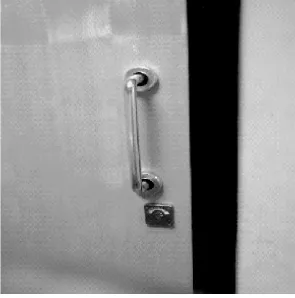
A door with a vertical plate on one side (fig 1) and a handle on the other (fig 2) immediately
communicates this, providing a good example of how knowledge can be embedded in artefacts at
[image:14.595.53.354.288.583.2]design stage.
Fig 2: Same door with metal handle on the other side
A crucial aspect of the design studies examined here is that they focus on information bearing
qualities of artefacts. Thus, they are in a sense already studies in knowledge management. One
consequence of a tri-partite conception is to recognise them as such. Furthermore, with this
recognition comes the realisation that these studies directly address the transfer of knowledge across
different stages of the product life-cycle.
Production management
In production and operations management, attention has been given to the rendering of information
in visual form and providing 'transparency' to the work situation (Galsworth 1997; Formoso, Dos
Santos & Powell 2002; Hines, Francis & Found 2005), especially stimulated by the example of the
network of information and the hierarchical structure of order giving (Greif 1991), which in
classical organization theory are identical. The goal is thus to substitute self-control for formal
control with consequential changes in methods of information gathering. Generally, it can be
assumed that lack of transparency increases the propensity to err, reduces the visibility of errors,
and diminishes motivation for improvement. Tactile properties have been less researched, though
important industrial applications have been developed. The kanban system uses physical placement
of documents (cards or tags) to facilitate improved production flow. Poka yoke (mistake proofing)
involves the physical embodiment of assembly and operation knowledge in components and
products (Shingo 1988).
As with the design studies examined above, it can be said that the focus in production and
operations management is also on the information bearing qualities of artefacts. A similar argument
for relevance to knowledge management and a tri-partite conception of knowledge can thus be
made.
Koskela (1992, 2000) has theorised aspects of production management, highlighting the realisation
that production involves the flow of materials and products through a series of work stations and
stages of production. Simultaneously, thinkers in knowledge management, such as Gupta &
Govindarajan (1991) and Nissen & Levitt (2002), have also treated knowledge as a flow. The
production management approach focuses on the elimination of waste (Shingo 1988; Koskela 1992,
2000). It is concerned with the management and improvement of processes by considering customer
needs, eliminating waste and maximizing value. Applying this thinking to knowledge management
focuses attention on the communication of knowledge. Thus, lean knowledge management would
imply minimising the waste that occurs through loss of knowledge and the most efficient use of
knowledge to increase customer value. The aim should be, therefore, to design artefacts which
for upgrading, thus transferring knowledge through objects or environments across the successive
stages of the built environment life-cycle.
This focus on flows emphasises the importance of the media through which knowledge is
communicated. In this context, the function of the tri-partite conception can be clearly seen. Each
element of the concept – practice, information, physical artefact – represents such a mode of
communication. The concept thus acts as a high level guide to the management of knowledge
through the product life-cycle; each element of the concept pointing towards a different disciplinary
approach to the management of knowledge: organizational practice; information storage and
retrieval; design of physical artefacts.
Towards an ethnomethodologically informed hybrid study
Ethnomethodology has previously addressed the knowledge bearing characteristics of physical
properties of artefacts in relation to the field of computer supported co-operative work (CSCW),
including: the interpretation of visual cues in virtual environments (Crabtree, Rouncefield &
Hughes 2000); the performance of everyday tasks (Crabtree 2004); the co-ordinating functions of
artefacts (Schmidt & Wagner 2004); and the facilitation of 'awareness' (Kirk, Crabtree & Rodden
2005). More broadly, the constitution of scientific and professional 'vision' has been addressed
(Lynch 1990; Goodwin 2000).
In CSCW, these studies have contributed to the design of collaborative systems by reporting to
engineers on the activities of work groups. Such reports constitute a detailed analysis that can
inform effective design, supplying unnoticed but vital features that might be overlooked in less
empirically grounded approaches (Rooke 1997). Button and Dourish (1996) note that this
informing process has occurred in two ways: either through designers learning from
and ethnomethodologists who are experienced in the setting of interest. They suggest that
ethnomethodology should develop a more active role in the design process, in which it provides
concepts as well as observations to the design process.
Button & Dourish's suggestion amounts to a proposal for an ethnomethodologically informed
hybrid discipline of design (Crabtree 2002). A similar approach has been suggested with regard to
management studies (Rooke & Seymour 2005). The key to such hybrid disciplines would be to
maintain observance of the UA requirement of methods, together with an interest in the aims of the
discipline with which ethnomethodology is to be hybridised. Thus, Dourish & Button (1998) seek
to propose design concepts that arise directly from the UA analysis of settings.
Here we propose a hybrid discipline of ethnomethodologically informed knowledge management
through design. Such a discipline would focus on the management of knowledge flows through a
design practice informed by ethnomethodological studies. The first self-conscious offering of this
nascent discipline is the tri-partite conception of knowledge. However, the design and visual
management studies cited above would clearly be candidates for inclusion.
Some ethnomethodological observations on knowledge bearing physical properties of artefacts in the built environment
Below we offer a series of ethnomethodologically informed fieldwork reports, intended to illustrate
some leading aspects of the relationship between the three elements of the tri-partite conception. In
line with the UA requirement, these observations derive their veracity from the situated
understanding of the researcher as a member of the particular setting reported and a descriptive
analysis of the research setting conforming to the strong requirement of UA is presented. The first
two are derived respectively from current fieldwork in a hospital and the recent experience of one of
working as a nurse in a mental health facility. In these examples, the principle method of research
was for the researchers to reflect upon and report on their own experiences as competent members
of a particular setting. Francis and Hester (2004) refer to this as self-reflection and point out that
this is not about thinking about oneself but turning one's experiences into topics of inquiry. They
point out that a researcher who is experienced in a setting is a competent member of that setting,
accomplishing social activities in the same way that any other ordinary member of that setting does.
As such s/he can take her own experiences and actions as data and turn them into topics for
analysis.
Signs 1: the coherence of physical properties, information and practice
The first observation derives from data collected and recorded in the form of photographs,
remembered conversations and personal experiences from fieldwork in a hospital. The purpose of
this work was to investigate problems of wayfinding in the hospital and it consisted of a series of
visits, each with the aim of finding a specific department (e.g. dermatology, radiology, maternity,
outpatients department etc.) from a pre-determined entrance to the site which had been identified by
hospital staff as presenting difficulties for visitors. Each destination was previously unknown to the
researcher. In undertaking these journeys, the researcher was a visitor to the hospital, who was
unfamiliar with the hospital lay-out. As such, she was in the same position as any other newcomer
to the setting, whether patient, visitor, or new staff member. This approach clearly has its
limitations, as with each visit familiarity with the site layout increases. It may also be the case that
the researcher's generic wayfinding skills also improve, while her natural sensitivity to wayfinding
problems is consequently diminished. However, these initial experiences have proved a rich source
of data. In addition to personally identifying and experiencing wayfinding problems, the researcher
supplemented by conversations with other visitors to the hospital and with members of staff and
hospital voluntary workers.
The setting described here is encountered on a journey through a complex building to an A&E
department.
Figures 3 to 6 show what wayfinders see as they walk through a set of double doors at the end of a
short corridor. Both the stairs and the door (fig 3) are in full view as are the signs above and to the
right of the door (fig 4). On the sign above the door are written the names of two destinations
(A&E and Entrance/Way Out). To the right of this text is an upward pointing arrow indicating
direction. But what direction is it indicating?
The two signs on the wall also indicate two destinations (Way Out and ECDU), this time the
arrows point to the right. A short corridor leading to the right ends in a left turn in front of a floor
to ceiling window through which signs announcing the location of the ECDU can be seen (fig 6, the
signs beyond the glass are not visible in the photo).
The researcher's own experience, the observed behaviour of other wayfinders and spontaneous
conversations occurring in the setting make it possible for us to gain a clear understanding of how
these various signs are interpreted by wayfinders. In the first instance, the sign above the door is
typically read by wayfinders as meaning straight ahead through the door, a reading that relies upon
the understanding that, a sign above a door indicates that the destination written on the sign is to be
reached through that door. Users can be seen walking up to the door and looking first at the sign
above the door then immediately to the ones on the wall and back again. This is followed by an
expression of frustration once one discovers that going through the door is not an option because
Fig 3. Stairs with door to right
[image:21.595.101.498.394.694.2]Fig 5. Stairs with 'No Entry' sign
A second interpretation, relying on the omission of the A&E destination from the signs on the wall,
read in conjunction with the upward pointing arrow above the door, is that the A&E is on the next
floor up and can be accessed via the stairs. However, at the top of the first flight of stairs is a sign
forbidding entry (fig 5). While the text on this sign is quite small, the pictogram is clear from the
bottom of the stairs, but the sign itself is not visible until one approaches the stairs.
This ambiguous relationship between the physical properties of the built environment and the
encoded information on the sign is apparent in the behaviour of users of the setting, who issue
spontaneous expressions of frustration or irritation, pacing up and down looking this way and that.
The wayfinder is left with three options: going back the way they came; following the corridor on
the right; or soliciting help from staff or from other visitors more experienced in the setting, who
sometimes offer spontaneous help when it is apparent that someone is lost.
Signs 2: subtle effects of physical properties on the interpretation of information
The second observation arises from the recent experience of one of the authors in a hotel. It is
noticeable that this observation required no elaborate methodological preparation. The author was a
hotel guest whose only objective was to find his room. His report is thus validated as the reported
experience of a guest attempting to wayfind in the hotel. The ubiquitous availability of cell phone
cameras enabled the easy capture of data in a setting that was spontaneously re-framed as a research
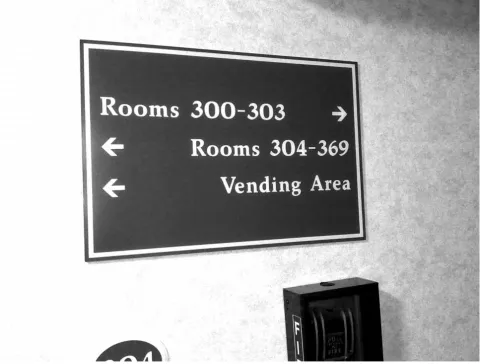
field. The resulting photograph (Fig 7) illustrates how the physical relationship between the printed
words and arrows on the sign provide for its interpretation. Like the other photographs presented
here, it is available for subsequent analysis by anyone who cares to take a few moments of their
Fig 7: Wayfinding sign in a hotel
The author, looking for room 342, took the right hand corridor, only to find out that this is the
wrong one, a mistake that he later repeated. The position of the numbers at the right hand side of
the sign immediately communicated to the author that he should go to the right. Crucially, he did
not read the sign as a linear text, but took it in at a glance, in order to gather only the information
required.
How did this breakdown in information flow occur? We suggest that there is a kind of practical
grammar at work here. A wayfinder, seeking directions to a particular destination, will seek two
separate elements: first, an identification of the destination sought; then, an indication of the
direction in which to travel in order to arrive there. The temporal priority of these two pieces of
identified destination attached to it. Thus, finding first the identifier '304-369', the wayfinder then
looks for a directional indicator. In this case, the position of the identifier in relation to the layout
of the sign as a whole was taken to be the significant indicator.
A closer examination of the sign reveals additional features that may obstruct effective wayfinding.
The physical layout of the text in relation to the arrows may also lead to error. Thus, the symbols
on the sign can be read in groups. In this reading, the phrase 'Rooms 304-369' is seen to belong to
the right-pointing arrow above it. Given this, at least two further reasons can be identified that may
contribute to a misreading: first, the right-pointing arrow is closest to the identifier; second, to find
the left-pointing arrow from the identifier, one has to read the sign from right to left, contrary to the
conventional Western practice in which text is read from left to right.
An oxygen cylinder: artefact and practice in the fate of information through life
The final observation arises from experience of one of the authors working for over eight years as a
healthcare professional. As indicated earlier, the observation derives its veracity from the situated
understanding of the researcher as a member of a particular healthcare establishment.
Healthcare professionals and organizations have an obligation to resuscitate a patient in the event of
a cardiac failure (Royal College of Anaesthetists et al 2004). Staff are therefore expected to ensure
that resuscitation equipment is kept up-to-date and ready to use in case of an emergency. The
oxygen cylinder is one of these devices. It must be adequately positioned within the built
environment of the medical facility, such that it is in a well ventilated area, isolated from possible
sources of heat and easily accessible in the event of emergency. It must also be checked for fullness
and freshness on a regular basis. A replacement is necessary when the cylinder is less than half full,
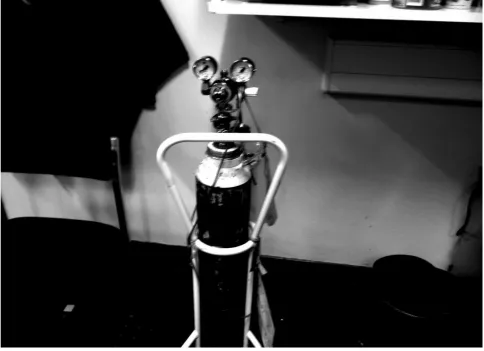
Fig 8: An oxygen cylinder in a healthcare setting
Checking for fullness must be done every day, either at the beginning or end of the day, in order to
ensure that no leakages have occurred. This information is observable via the left hand gauge that
can be seen in figure 8. The knob beneath the gauge must be turned in order to release oxygen from
the cylinder, so that the dial can register the current pressure. If the dial registers less than half full,
the cylinder must be replaced. During this exercise, the indicator on the second gauge will also be
lifted due to the escaping oxygen. Once the measurement has been taken and the left hand valve
closed again, the released oxygen must be evacuated from the pipe using the right hand knob,
returning the readings on both gauges to zero. Performing this procedure presents no problem to
staff, once it has been demonstrated during induction.
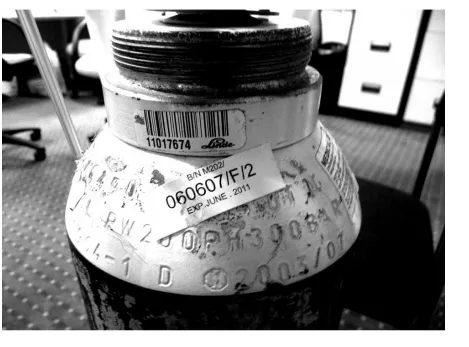
Checking the cylinder for freshness is more problematic. The life cycle of oxygen cylinders varies
the manufacturer (see fig 9). This label is situated at the top of the cylinder, behind the gauges on
the side facing the wall. It should be checked regularly, but unlike the pressure, no time period is
[image:27.595.67.536.147.494.2]specified for the interval between checks.
Fig 9: Date tag on the oxygen cylinder
On one occasion a cylinder was found to be out of date, prompting a review of the checking
procedure in a routine clinical governance meeting. A check list was introduced in order to
formalise these two procedures, among others, with the aim of reducing the propensity to err. This
required the expiry date to be checked daily. However, it was recognised that a daily visual check
on a fifteen year life cycle is not an ideal procedure. Since the date would be the same on each day
that it was checked, there was a high likelihood that the practice would soon fall into disuse.
the artefact and the practices they are intended to support. Effectively, it represents a problem of
how information can be accessed in an appropriate and timely manner. It is insufficient that the
information is adequately stored and easily accessed. The obstacle is that the mode of access does
not mesh well with what would constitute reasonable practice for busy healthcare professionals in a
working medical setting. In a sense, it is the very fact of the immortal physical availability of the
information that militates against the professionals' ability to access it in a timely manner. The
information is always there and almost always irrelevant. It seems inevitable that it will be
forgotten.
Discussion and conclusion
This paper represents only an initial attempt to develop a new approach to the problem of
implementing effective knowledge management through life in the built environment. The project
is ambitious. Beginning from a Wittgensteinian understanding of language and adopting an
ethnomethodological approach to the investigation of situated organizational phenomena, we have
suggested that elements may be combined from the diverse approaches of production management,
design studies and knowledge management into an ethnomethodologically founded discipline. The
utility of the UA requirement of knowledge is, in this regard, that in excluding theoretical
interpretations of the setting, it provides a standard for empirical reporting that is neutral to the
analyses provided by the design and production theories. In this way, it is possible to evaluate these
theoretical conceptions in the light of concepts that are drawn, not from theory, but from the
situated understandings of knowledge users.
The tri-partite conception of knowledge constitutes an initial disciplinary concept, differentiating
disciplinary approaches to the management of knowledge (organizational practice; information
knowledge management, to the possible benefit of both.
Take for example, Norman's (1998) observations on the simple task of opening a door. The
knowledge of how to open the door can be communicated through: (1) coded information (push or
pull sign); (2) social interaction (being told to push, or seeing someone else do it); (3) or the door's
physical properties (handle on one side of the door and vertical metal plate on the other). Thus, the
concept might provide support to design for knowledge management.
On the other hand, the tri-partite conception can act only as a sensitising concept in the conduct and
reporting of fieldwork. Our approach is to do UA studies of settings in order to learn about the
nature of knowledge and its attendant problems. An important aspect of this approach is the
production of clear and detailed descriptions of these settings that employ concepts that can be
derived from the setting under study. In this way, we have been able to show how physical objects
and environments have an important role to play in codifying, embedding and disseminating
knowledge. Even such an ostensibly physical barrier as a safety rail has been shown to carry with it
important information for users.
This approach has enabled us to present problems of knowledge management in the terms in which
they are encountered within their native settings. We have explored the sometimes problematic
relationship between practice, information and artefact, with an examination of wayfinding signs,
showing how spatial properties are integral to the interpretation of text. Apparent in our first
example is a complex relationship between social practice, information and physical properties. In
our first example, the physical placement of the information bearing signs is critical to their
interpretation. Inappropriate placement so affects the context in which the information is perceived
as to render it ambiguous, leading to a breakdown of the knowledge flow. The effects of this
breakdown and consequent efforts to repair it are directly observable within the setting and are thus
emerge as a solution to the breakdown have been formalised as hospital policy.
Our second wayfinding example illustrates further the relationship between property and
information, showing how the physical layout of the sign itself affects the way it is read.
We have also demonstrated with the study of the oxygen cylinder that the preservation, clarity and
accessibility of information can be insufficient where the physical properties of the communication
medium do not mesh with organizational practice.
Regarding this last point, it is instructive to draw further on elements of production theory and
practice. Applying this thinking to knowledge management focuses attention on the
communication of knowledge; relating it to a situated problem of knowledge, provides a clue to
how an ethnomethodologically informed design for lean knowledge management can work. Thus,
compare the date tag on the oxygen cylinder with a kanban card. The efficacy of the kanban system
lies in the fact that the physical positioning of the card ensures that the information it bears is only
available when that information is relevant to the ongoing work of the setting. Thus, the emphasis
on time in the flow conception of knowledge facilitates the insight that delivery of information not
timed to mesh with work practice is a source of waste. This is the critical feature that is missing
from the system for the maintenance of the oxygen cylinder.
Finally, this is an early report on work that is still in progress. The research question is being
pursued with particular attention to problems of wayfinding. In this stage of the study, the focus
will adjust to encompass decisions that contribute to the designing, producing, maintaining and
upgrading of wayfinding systems.
References
Bittner, E. (1973) ‘The Concept of Organization’ in G. Salaman & K. Thompson (Eds.) People
and Organisations, Longman, London, reprinted from (1965) Social Research 32(3):239-255.
Button, G. and Dourish, P. (1996) 'Technomethodology: Paradoxes and Possibilities,' in A. Miller (ed.) Proceedings of the ACM Conference on Human Factors in Computing Systems CHI'96, Vancouver, BC, 19-26 April. New York: ACM. http://www.ics.uci.edu/ %7Ejpd/publications/1996/chi96-technomethodology.pdf
Button, G. & Sharrock, W. W. (1995) ‘The Mundane Work of Writing Computer Code’ in G. Psathas & P. ten Have, eds., Situated Action, University Press of America.
Button, G. & Sharrock, W. W. (2002) Operating the Production Calculus: Ordering a Production System in the Print Industry. In British Journal of Sociology, 53(2):275-290.
Carpman, J., and Grant, M. (2001). Design that cares. San Francisco: Jossey-Bass Inc.
Crabtree, A. (2000) 'Remarks on the social organisation of space and place,' Journal of Mundane
Behaviour (1). Last accessed 09/10/2008. http://www.mundanebehavior.org/index2.htm
Crabtree, A. (2002) ‘Taking Technomethodology Seriously: Hybrid Change in the Ethnomethodology-Design Relationship’, Equator Interdisciplinary Research Collaboration, Technical Report Equator–02-036. http://www.mrl.nott.ac.uk/~axc/documents/ToCHI_2002.pdf
Crabtree, A. (2004) '“Finding out what users want” - articulation and translation at the library help desk,' in Proceedings of the 6th International Conference on Ubiquitous Computing, September 7th Nottingham, Springer, Berlin.
Crabtree, A., Rouncefield, M. & Hughes, J. (Eds.) (2000) Common Methodology: eSCAPE
Deliverable D4.3, Lancaster University.
Davenport, T. H. & Prusak, L. (1998) Working knowledge; how organizations manage what they
know, Harvard Business School Press, Boston, MA.
Dourish, P. & Button, G. (1998) ‘On “Technomethodology”: Foundational Relationships between Ethnomethodology and System Design’, in Human-Computer Interaction, 13(4):395-432.
Eckert, C. M., Jower, I. & Clarkson, P. J. (2007) 'Knowledge requirements over long product lifecycles', 16th International Conference on Engineering Design (ICED'07), 28-31 August, Paris.
Formoso, C. T., Dos Santos. A. & Powell. J. A. (2002) 'An exploratory study on the applicability of process transparency in construction sites', Journal of Construction Research, 3(1):35-54.
Francis, D. & Hester, S. (2004) An Invitation to Ethnomethodology; Language, Society and
Interaction, Sage, London.
Galsworth, G. D. (1997) Visual Systems:Harnessing the Power of a Visual Workplace, American Management Association, New York.
Garfinkel, H. (1984) '“Good organizational reasons for 'bad' clinical records,”' in Studies in
Ethnomethodology, Polity Press, Cambridge.
Garfinkel, H. (1996) 'Ethnomethodology's Program', in Social Psychology Quarterly, 59, 1:5-21.
Garfinkel, H. & Wieder, D. L. (1992) 'Two Incommensurable, Asymmetrically Alternate Technologies of Social Analysis', in G. Watson & R. M. Seiler (eds.), Text in Context, Sage, London, pp. 175-206.
Goodwin, C. (2000) 'Practices of Seeing: Visual Analysis: An Ethnomethodological Approach', in T. van Leeuwen & C. Jewitt (Eds.) Handbook of Visual Analysis, Sage, London, 157-182.
Greif, M. (1991) The Visual Factory, Productivity Press, Cambridge.
Gupta, A. K. & Govindarajan, V. (1991) 'Knowledge flows and the structure of control within multinational corporations', Academy of Management Review, 16(4):768-792.
Hines, P., Francis, M. & Found, P. (2005) 'Lean Lifecycle Management,' CUIMRC Working Paper
Series, University of Cardiff.
HSE (1996) Health and Safety in Construction, HSE Books, Sudbury.
Hughes, W., Yohannes, I. & Hillig, J-B (2007) 'Incentives in construction contracts: should we pay for performance?' in CIB World Building Congress; construction for development, 14th - 18th May, Cape Town International Convention Centre, Paper 253, 2272-2283.
Institution of Civil Engineers (1991) CESMM3: Civil Engineering Standard Method of
Measurement, Thomas Telford, London.
Johnstone, S., Dainty, A. & Wilkinson, A. (2007) 'Hunters and farmers? The HRM implications of “product-service” in construction,' in CIB World Building Congress; construction for development, 14th - 18th May, Cape Town International Convention Centre, Paper 073, 254-265.
Keane, B. T. & Mason, R. M. (2006) 'On the Nature of Knowledge: rethinking popular
assumptions', in Proceedings of the 39th Hawaii International Conference on System Sciences,
Track 7, p.162b.
KIM (2006) Knowledge and Information Management (KIM) Grand Challenge Project, Last accessed 13/04/2010 www.ukoln.ac.uk/projects/grand-challenge/
Kirk, D., Crabtree, A. & Rodden, T. (2005) 'Ways of the hand,' in Proceedings of the Ninth
European Conference on Computer-Supported Cooperative Work, H. Gellersen, K. Schmidt, M.
Beaudouin-Lafon & W. Mackay (Eds.), Springer, Dordrecht. http://www.ecscw.uni-siegen.de/2005/entire05.pdf
Koskela, L. (1992) ‘Application of the New Production Philosophy to Construction’, Technical
Report No 72, Centre for Integrated Facility Engineering, Stanford University, California.
Koskela, L. (2000). An exploration towards a production theory and its application to construction,
VTT Technical Research Centre of Finland, VTT Publication 408.
Lawson, B. (1999) The Language of Space, Architectural Press, Oxford.
Lynch, M. (1990) 'The Externalized Retina: Selection and Mathematization in the Visual
Documentation of Objects in the Life Sciences', in Representation in Scientific Practice, M. Lynch & S. Woolgar (Eds.) MIT Press, Cambridge MA, 153-186.
Lynch, M (1999) 'Silence in context: ethnomethodology and social theory,' in Human Studies
22():211-233.
McGrenere, J. & Ho, W. (2000) 'Affordances: Clarifying and evolving a concept', Proceedings of
McInerney, C. (2002) 'Knowledge Management and the Dynamic Nature of Knowledge', Journal
of the American Society for Information Science and Technology 53(12):1009-1018.
Nissen, M. & Levitt, R. (2002) 'Dynamic Models of Knowledge-Flow Dynamics', CIFE Working Paper #76, Center for Integrated Facility Engineering, Stanford University.
Nonaka, I. and Takeuchi, H., (1995) The Knowledge-Creating Company: How Japanese
Companies Create the Dynamics of Innovation, Oxford University Press, Oxford.
Norman, D. A. (1998) The design of everyday things, Basic Books, New York.
Norman, D. A. (1999) 'Affordance, conventions and design (Part 2)' originally published in
Interactions (May):38-43, accessed on line 08/02/2009
http://www.jnd.org/dn.mss/affordance_conv.html
Oliva, R. & Kallenberg, R. (2003) 'Managing the transition from products to services', International
Journal of Service Industry Management 14(2):160-172.
Polanyi, M. (1983) The Tacit Dimension, Peter Smith, Gloucester, Mass.
Quintas, P. (2005) 'The Nature and Dimensions of Knowledge Management' in C. Anumba, C. Egbu & P. Carillo (Eds.) Knowledge Management in Construction, Blackwell, Oxford.
Rooke, J. (1997) 'Developing a More Empirical Approach to Culture, Attitude and Motivation in Construction Management Research: A critique and a proposal,' in Journal of Construction
Procurement, 3(2):45-55.
Rooke, J. & Clark, L. (2005) ‘Learning, knowledge and authority on site: a case study of safety practice’, Building Research and Information, 33(6):561-570.
Rooke, J. & Kagioglou, M. (2007) 'Criteria for evaluating research: the unique adequacy requirement of methods,' Construction Management and Economics, 25(9):979-987.
Rooke, J. A., Koskela, L. J. & Kagioglou, M. (2009) 'Some suggestions for researching emergence and informality', Construction Management & Economics: Special Issue on Informality and
Emergence in Construction 27(10):913-22.
Rooke, J. & Seymour, D. (2005) ‘Studies of Work: Achieving Hybrid Disciplines in IT Design and Management Studies’, Human Studies 28(2):205-221.
Royal College of Anaesthetists, Royal College of Physicians of London, Intensive Care Society & Resuscitation Council (UK) (2004). Cardiopulmonary Resuscitation Standards For Clinical
Practice and Training, Resuscitation Council UK, London, Accessed on line 7th Feb 2009 http://www.resus.org.uk/pages/standard.htm
Ryle, G. (1963) The Concept of Mind, Penguin, Harmondsworth.
Schmidt, K. & Wagner, I. (2004) 'Ordering systems: coordinative practices and artefacts in architectural design and planning' in Computer Supported Cooperative Work, 13(5-6):349-408.
Searle, J. & Magee, B. (1987) 'Wittgenstein' in B. Magee (Ed.) The Great Philosophers, BBC Books, London.
Shingo, S. (1988) Non-stock production :the Shingo system for continuous improvement, Productivity Press, Cambridge Mass.
Lanka.
Snowden, D. (2002) 'Complex acts of knowing: paradox and descriptive self-awareness,' in Journal
of Knowledge Management, 6(2):100-111.
Stark, J. (2006) Product Lifecycle Management: 21st Century Paradigm for Product Realisation, Springer-Verlag, London.
Tavcar, J. Duhovnik, J. (2004) 'Product Life Cycle Management in a Serial Production', in
International Design Conference - Design 2004, Dubrovnik.
Tuomi,. I (2000) 'Data is More than Knowledge: Implications of the Reversed Knowledge Hierarchy for Knowledge Management and Organizational Memory,' Journal of Management Information Systems 16:103-117.
Wenger, E. (2000) 'Communities of practice and social learning systems', Organization 7(2) 225-246.
Winch, P. (1990) The Idea of a Social Science and its Relation to Philosophy (second edition) Routledge and Kegan Paul, London.
Wittgenstein, L. (1958) Philosophical Investigations (second edition) Blackwell, Oxford.