CONTROL OF A HYDROLYZER USING NEURAL-NETWORK
BASED CONTROLLER
*M. A. Hussain, M. K. Aroua and J. S. Lim
Department of Chemical Engineering,
University of Malaya, 50603 Kuala Lumpur, Malaysia *Email: [email protected]
ABSTRACT
Hydrolyzer is a commonly found unit operation in oleochemical industry. Control of hydrolyzer has to be done carefully since efficiency in the control of this unit will affect the yield of the process. At present conventional controllers such as PI and PID have been used to achieve the setpoint especially under presence of disturbances. In this study, neural network have been applied as an alternative to cope with the dynamics behavior of the hydrolyzer. Two types of control strategies namely, direct inverse controller (DIC) and internal model controller (IMC) were implemented in the control system. Two sets of data were used to develop the DIC and IMC. The controllers were evaluated on the ability to track set-points, load disturbance and noise disturbance test and the IMC was found to be the most versatile controller.
Keywords: Hydrolyzer, Process Control, Artificial Neural Network, Direct Inverse Controller, Internal Model Controller.
INTRODUCTION
Nowadays, continuous counter-current splitting process has been a common application in oleochemical industry to hydrolyze oil. Fat-splitting or hydrolysis is the process of decomposing fats into acids and glycerol by subjecting them in the presence of water to high temperature and corresponding pressure. This system involves counter flow of oil and water (as reactants), where reaction and mass transfer occur at the same time.
achieve the desired set-point especially under the presence of noise disturbances. Consequently, low quality of final product was produce and can be consider a loss in the oleochemical industry.
In recent years, an active interest in the development and application of nonlinear control methodologies has emerged. Upsurge in research on neural networks, had made it readily available as an attractive method for identifying nonlinear processes (Hussain, 1999). Most model-based control strategies made use of nonlinear black-box techniques to model the relationship between process input and output variables. This presents of advantage of bypassing the complexity and the uncertainty of physical systems (Chen et al, 2004).
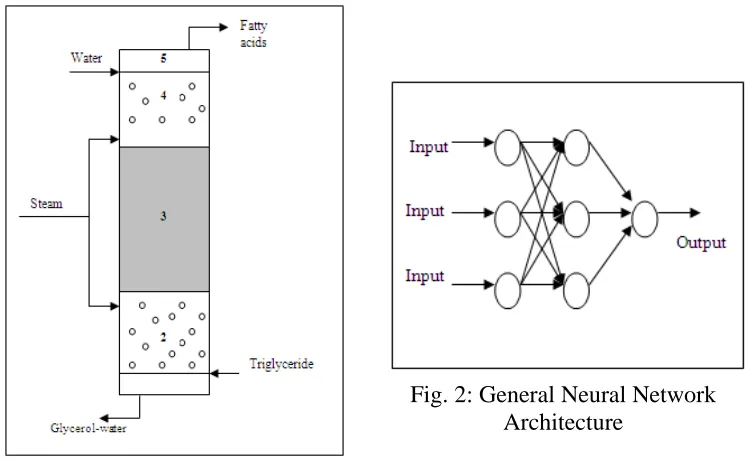
In this study, the neural network based controllers were used to manipulate the steam rates for both, the top and bottom of the column to control the temperature of the hydrolyzer. Two types of control strategies namely, Direct Inverse Controller (DIC) and Internal Model Controller (IMC) had been studied and applied to the system. The performances of the controllers were evaluated based on its ability to cope with setpoint tracking test, disturbance rejection test and noise disturbance test. In addition, the stability of the output responses of the controllers also had been evaluated as unstable responses will cause valve failure leading to production loss.
Fig. 1: Model of a Hydrolyzer
NEURAL NETWORK
[image:2.612.120.495.361.592.2]In human brain, neurons within nervous system interact in a complex fashion. Human senses detect stimuli and send this information to brain via neurons. Within the brain, other neurons are excited and they interact with each other. Based on the input, the brain reaches
a conclusion and sends an output in the form of an answer or response. Main function of input layer is to receive information from an external source and passes this information to the network. This information will be processed in the hidden layer. Then, processed information will be sent to the output layer. Finally, output layer transmit the result to external receptor. Figure 2 shows the general architecture for the neural network. Interconnection between layers of each neurons associate with network weights. From the modeling point of view, these weights are analogous to model parameters which regulate the influence of each variable on overall model performance. Thus, network weights serve as a measure for connection strength that controls the influence of each incoming signal to the recipient neuron.
Neural Network Model Development
In order to develop an accurate neural network model, sufficient data are required. Thus, the training of the input-output signals acquired in an open loop and the control signals was generated in a pseudo-random function. For this study, a mathematical model had been developed to generate data to train the network. Three sets of data were generated to develop neural-network based controllers.
Generally, development of a neural network consists of 3 stages. The first stage involved training of the network which was most time consuming. The network accomplished this mapping by first learning from a series of past examples defining sets of input and output corresponding for the given system. In the second stage, a set of input data introduced to the network for testing. The network then applied what it had learned to a new input pattern to predict the appropriate output (Barrati, 1997; Dirion, 1996). The output generated will be compared with the actual output. Once an acceptable error was obtained, another new set of data was introduced to the network in the final stage for validation. Objective of the last stage was to ensure the reliability of the network to simulate the require output.
Inverse model based controllers
Two types of controllers are used for the study, i.e. internal model control (IMC) and Direct Inverse Controller (DIC). The DIC strategy consists of neural network inverse model that act as a controller placed in series with the process under control (Daosaud et al., 2005). In this scheme, the desired set-point acts as the desired output which is fed to the network together with the past plant inputs and outputs to predict the desired current system input (Hussain, 1999). Since the control of temperature in a hydrolyzer involves control of the steam rate injected into the top and bottom of the system, two neural networks will be applied in the system as controllers.
being fed into the inverse model (Hussain, 1999). With the mismatch detection feature, the internal-model based controller can be used to drive the controlled parameter to desired set-point when noise disturbance introduce into the system. As two controllers are required, two IMC systems are needed to be developed. The details can be seen in (Hussain and Kershenbaum, 2000).
The neural inverse models had a 10-9-1 and 8-5-1 structure for the top and bottom control system respectively.
SIMULATION RESULTS
Main objective of this simulation study is to maintain the optimum process condition within the hydrolyzer. Steam rate at the top and bottom need to be manipulate in order to achieve this objective.
Set-Point Tracking Test
During start-up and shut-down operation of the hydrolyzer, the temperatures are required to change slowly. Drastic temperature changes may cause thermal shock scenario, where cracking of construction material may occur and become a safety issue in the plant. Hence, the temperature step change would be the best practice during start-up and shut-down of the system.
In the set point tracking study, the controller was subjected to several set point changes. First, the temperature was reduced from 250oC to 120oC which reflected the shut-down scenario of the system. Then, the temperature was increased from 120oC to 250oC, which represented the start-up scenario of the hydrolyzer. This set point tracking test applied to DIC and IMC designed for this system. Set-point tracking test was also applied on the conventional controller in order to compare the performance with the neural network based controller.
Fig. 3: Set-Point Tracking for the Top of the Hydrolyzer
Rejection Disturbance Test
In a hydrolyzer, the top and bottom temperatures will fluctuate due to the presence of process disturbances. The process disturbances include the changes in water temperature and water flow rate. Each of the test started at steady state condition and the state variable started to change at time = 1 min. The controllers were implemented into the system after the disturbance introduced into the system for 167 minutes. For the rejection disturbance test, the water temperature changed from 80oC to 92oC at time = 1 min. The values of other state variables remained the same throughout this test.
Figure 5 shows the performance of the controllers to control the hydrolyzer top temperature. When the PID implemented into the system, the temperature was able return to the set-point with minor overshoot and fluctuation. High fluctuation rate was observed at the steam flow rate control. In contrast the, DIC and IMC were able to control top temperature to the desired set-point with low fluctuation rate of steam flow rate.
[image:6.612.207.404.370.655.2]The change of water temperature did not affect the bottom temperature significantly. Figure 6 shows that the controllers were able to bring the temperature to desired set-point with minor complication. As the test concluded, both DIC and IMC were found to generate lower fluctuation rate compared to the PID.
Fig. 6: Results for Disturbance Test (Bottom Temperature)
Figure 7 shows the results for rejection of disturbance under noisy data, showing the IMC being most capable of handling the noise.
CONCLUSIONS
Based on evaluation the controller performance, the IMC and DIC have showed their ability in set point tracking and can be used as the control system during the start-up and shut-down of the hydrolyzer. Taking into consideration of the stability of the output signal, the response generated by the IMC is preferred as the output signal generated to control the steam flow rate is more stable and could minimize the failure of the steam control valve. The IMC was also able to cater for the noise disturbance and generated stable output signal compared to the PID and DIC. In conclusion, IMC was a more versatile controller since it capable of coping with set-point tracking, load disturbances and noise disturbance test.
ACKNOWLEDGEMENTS
The authors wish to acknowledge University of Malaya for awarding the Master’s Post Graduate Scholarship to the third author.
REFERENCES
Baratti, R. and Servida, A. (1997), A feedforward control strategy for distillation columns:
Artificial intelligence in engineering, 11, 405-412.
Chen, L., Hontoir, Y., Huang, D., Zhang, J. and Morris, A.J. (2004), Combining first principles with black box techniques for reaction system: Control Engineering Practice, 12, 819-826.
Daosud, W., Thitiyasook, P., Arpornwichanop, A., Kittisupakorn, P. and Hussain, M.A.(2005), Neural network inverse model based controller for the control of a steel pickling process, Computers and Chemical Engineering, 29, 2110-2119.
Dirion, J,-L, Cabassud, M., Le Lann, M.V. and Casamatta, G. (1996), Development of adaptive neural networks for flexible control of batch processes, The Chemical
Engineering Journal, 63, 65-77.
Hussain, M.A., (1999), Review of application of neural networks in chemical processes-Simulation and online implementation, Artificial Intelligence in Engineering, 13, 55-68. Hussain, M.A. and Kershenbaum, L. S., (2000), Implementation of an inverse model based
control strategy using neural networks on a partially simulated exothermic reactor, Trans