© 2016, IRJET | Impact Factor value: 4.45 | ISO 9001:2008 Certified Journal | Page 373
Performance analysis of 4 channel CWDM using EDFA based on
extinction ratio and fiber length
Mr. TusharKant Panda
1, Jyoti Poddar
2, Sonu Priya
3, Manisha kumari
41
Asst. Professor, Gandhi Institute Of Engineering and Technology, Gunupur
[email protected]
2
Under Graduate, Gandhi Institute Of Engineering and Technology, Gunupur
[email protected]
3
Under Graduate, Gandhi Institute Of Engineering and Technology, Gunupur
[email protected]
4
Under Graduate, Gandhi Institute Of Engineering and Technology, Gunupur
[email protected]
---***---Abstract -
In Wavelength-division multiplexing (WDM) weare combining multiple signals at various infrared (IR) wavelengths on laser beams for transmitting the signal along fiber optic media. Generally there are two WDM techniques one is CWDM and another one is DWDM. Coarse wavelength division multiplexing (CWDM) is a method which will combine multiple signals on laser beams at various wavelengths for transmission along fiber optic cables, such that the number of channels is less as compared with dense wavelength division multiplexing (DWDM). In metro and cable TV network CWDM is getting more attention because with low cost it can transmit more bandwidth.
In optical fiber communication system dispersion compensation is one of the most important feature because here the absence dispersion causes pulse spreading which results in overlapping of the signal in the receiver side. So, in order to compensate the dispersion here EDFA(Erbium doped fiber amplifier) is used. Erbium-doped fiber amplifiers (EDFA) are one of the most important fiber amplifiers in case of long-range optical fiber communication. They are capable of amplifying the light in the wavelength region of 1.5-μm, where telecom fibres experience minimum loss. Hence Erbium-Doped Fiber Amplifier (EDFA) is used for long distances. It is found that when we increased the value of extinction ratio, the threshold value will be decreases but eye height will increases.
Here in this optical design, 4 channels CWDM is simulated with various length of fiber. These days the demand for large bandwidth is continuously increasing. In order to fulfil this need, telecommunication companies have to investigate on increasing their channels capacity with the lowest cost possible
.
Key Words: Optical fiber, WDM( wavelength division multiplexing), CWDM(Coarse wavelength division multiplexing), DWDM(Dense wavelength division multiplexing), EDFA(Erbium doped fiber amplifier), RF(Radio frequency).
1.INTRODUCTION
In Fiber-optic communication information are transmitted from one place to another place by sending pulses of light through an optical fiber. The light forms an electromagnetic carrier wave whichis modulated to carry information. We are using it in high speed data transmission
In Fiber-optic communication information are transmitted from one place to another place by sending pulses of light through an optical fiber. The light forms an electromagnetic carrier wave which which is only possible due to its features and negligible transmission loss in fiber optic communication.
In Wavelength-division multiplexing (WDM) technique a number of optical carrier signals multiplexes onto a single optical fiber by the use of different wavelengths or colors of laser light. The modulation of each laser is done by an independent set of signals. This technique makes possible bidirectional communications over one strand of fiber, as well as multiplication of capacity. At the receiving end the wavelength-sensitive filters, IR analog of visible color filters are used.
© 2016, IRJET | Impact Factor value: 4.45 | ISO 9001:2008 Certified Journal | Page 374
(TDM). Each multiplexed IR channel is separated, ordemultiplexed, into the original signals at the destination. Using FDM or TDM in each IR channel in combination with WDM or several IR channels, data in different formats and at different speeds can be transmitted simultaneously on a single fiber.
Advances in optoelectronic components allowed design of systems that simultaneously transmitted multiple wavelengths of light over a single fiber. Multiple high-bit rate data streams of 2.5 Gb/s, 10 Gb/s and, more recently, 40 Gb/s and 100Gb/s could be multiplexed through divisions of several wavelengths. And so was born Wavelength Division Multiplexing (WDM).
Presently there are two types of wdm technology :CWDM(Coarse Wavelength Division Multiplexing) and DWDM(Dense Wavelength Division Multiplexing)
.
1.1 CWDM
Coarse wavelength division multiplexing (CWDM) is a method which will combine multiple signals on laser beams at various wavelengths for transmission along fiber optic cables, such that the number of channels is fewer than in dense wavelength division multiplexing (DWDM) but more than in standard wavelength division multiplexing (WDM).
CWDM systems have channels at wavelengths spaced 20 nanometers (nm) apart, compared with 0.4 nm spacing for DWDM. This allows the use of low-cost, uncooled lasers for CWDM. In a typical CWDM system, laser emissions occur on eight channels at eight defined wavelengths: 1610 nm, 1590 nm, 1570 nm, 1550 nm, 1530 nm, 1510 nm, 1490 nm, and 1470 nm. But up to 18 different channels are allowed, with wavelengths ranging down to 1270 nm.
The energy from the lasers in a CWDM system is spread out over a larger range of wavelengths than is the energy from the lasers in a DWDM system. The tolerance (extent of wavelength imprecision or variability) in a CWDM laser is up to ± 3 nm, whereas in a DWDM laser the tolerance is much tighter. Because of the use of lasers with lower precision, a CWDM system is less expensive and consumes less power than a DWDM system. However, the maximum realizable distance between nodes is smaller with CWDM.
1. 2 DWDM
Dense wavelength division multiplexing (DWDM) is a technology that puts data from different sources together on an optical fiber, with each signal carried at the same time on its own separate light wavelength. Using DWDM, up to 80 (and theoretically more) separate wavelengths or channels of data can be multiplexed into a light stream transmitted on a single optical fiber. Each channel carries a time division multiplexed (TDM) signal. In a system with each channel carrying 2.5 Gbps (billion bits per second), up to 200 billion bits can be delivered a second by the optical fiber. Since each channel is demultiplexed at the end of the transmission back into the original source, different data formats being transmitted at different data rates can be transmitted together.
2. DIFFERENT DISPERSION COMPENSATION
TECHNIQUES IN OPTICAL COMMUNICATION
The different dispersion compensation techniques in optical fiber communication system are:
1. Using Dispersion compensation fiber(DCF) 2. Using Fiber Bragg grating (FBG)
3. Using Erbium-Doped Fiber Amplifier (EDFA) 4. Using Electronic dispersion Compensation (EDC)
2.1 EDFA
An erbium-doped fiber amplifier (EDFA) is a device that is used for amplifying an optical fiber signal. We are generally using it in the field of telecommunications it is also used in various research fields. An EDFA is "doped" with a material called erbium. The "doping" term refers to the process of using chemical elements for facilitating results through the process of electron manipulation.
© 2016, IRJET | Impact Factor value: 4.45 | ISO 9001:2008 Certified Journal | Page 375
Fig1:-EDFA2.1.1Woking principle of EDFA
In general, the working principle of EDFA is based on the principle of stimulating the emission of photons. With EDFA, an erbium-doped optical fiber at the core is pumped with light from laser diodes. This type of setup in telecom systems can help with fiber optic communications, for example, boosting the power of a data transmitter. An EDFA may also be used to maintain long spans of a passive fiber network and may also be used for some types of equipment testing.
Pump lasers are the pumping bands which inserts dopants into the silica fiber, which results in a gain, or amplification. EDFA excites the erbium ions and amplification occurs at pump laser, which then reach a higher energy level. Photons are emitted as erbium ion levels decrease, or decay. This decaying process results an interaction between the phonons and the glass matrix, which are vibrating atomic elastic structures.
The EDFA rate, or amplification window, is based on the optical wavelength range of amplification and is determined by the dopant ions' spectroscopic properties, the optical fiber glass structure and the pump laser wavelength and power. As ions are sent into the optical fiber glass, energy levels broaden, which results in amplification window broadening and a light spectrum with a broad gain bandwidth of fiber optic amplifiers used for wavelength division multiplex communications. This single amplifier may be used with all optic fiber channel signals when signal wavelengths are in the amplification window. Optical isolator devices are placed on either side of the EDFA and serve as diodes, which prevent signals from traveling in more than one direction.
EDFAs are usually limited to no more than 10 spans covering a maximum distance of approximately 800 kilometers (km). Longer distances require an intermediate line repeater to retime and reshape the signal and filter accumulated noise
from various light dispersion forms from bends in the optical fiber. In addition, EDFAs cannot amplify wavelengths shorter
than 1525 nanometers (nm).
Fig2:-Working principle of EDFA
2.1.2 Advantages
1. Low noise figure
2. Polarisation independent
3. Large dynamic range
4. High power transfer efficiency
5. Suitable for long distance communication
6. Gain is relatively flat
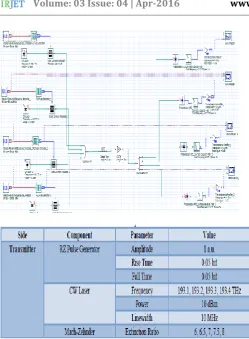
3.SIMULATION AND RESULTS
© 2016, IRJET | Impact Factor value: 4.45 | ISO 9001:2008 Certified Journal | Page 376
Table no 1:-simulation parameters of TX [image:4.595.311.489.278.463.2]Table no2:-simulation parameters of channel
Table no3:-simulation parameters of RX
4. RESULTS AND DISCUSSION
Eye Diagram
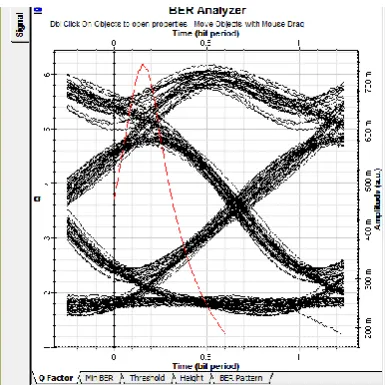
Eye diagram or also known as eye pattern in telecommunication is an old technique used in order to evaluate the received signal. Totally opened eye pattern represents the lowest level of distortion. BER analyzers create eye diagrams by making a pseudorandom arrangement of 1s and 0s in a symmetric rate but in an arbitrary manner. In Optisystem, eye diagram, which can be found in the BER analyzer show various traces of modulated signal in order to create an eye diagram. Because of the shape of the pattern that looks as if it is an eye, it is called an eye diagram.
Eye Diagram of 40km 8dB Using EDFA
Eye Diagram of 50km 6dB using EDFA
© 2016, IRJET | Impact Factor value: 4.45 | ISO 9001:2008 Certified Journal | Page 377
Eye Diagram of 50km 7dB using EDFATable no4:-output at different values of fiber length and extinction ratio
Fibre Lengt h
Extinctio n ratio
Q-Facto r
BER Eye Heigh t
Threshol d value
40 6 8.30 1.86e
-017
0.141 5
0.42284
6.5 8.421 1.862e
-017
0.169 9
0.33039
7 8.43 1.81e
-017
0.194 0.252
8 8.55 0.27e
-017
0.273 0.2429
50 6 7.657 1.919e
-015
0.133 0.484
6.5 7.80 1.936e
-015
0.158 0.387
7 7.856 1.989e
-015
0.181 9
0.30
8 7.867 1.92e
-015
0.213 0.22
60 6 7.11 5.34e
-013
0.159 0.472
6.5 6.86 3.36e -012
0.188 0.377
7 7.02 4.503e
-013
0.147 0.305
8 7.14 1.073e
-012
0.121 0.219
75 6 5.872 2.123e
-009
0.144 0.451
6.5 5.66 2.354
e-009
0.120 5
0.361
7 5.822 2.875
e-009
0.108 0.296
[image:5.595.36.229.335.528.2]© 2016, IRJET | Impact Factor value: 4.45 | ISO 9001:2008 Certified Journal | Page 378
e-009100 6 3.09 3.17 e
-005
0.058 0.39
6.5 3.75 8.495
e-005
0.041 0.322
7 3.80 3.841
e-005
0.044 0.268
8 3.95 6.917
e-005
0.034 0.202
5 .CONCLUSION
In this paper we enlightened the use of EDFA in order to compensate dispersion loss in optical fibers. From the above simulations we got some optimized value for 40,50,60,70,80 Km long distance communication. Optimized output can be achieved if the Fiber length is in between 40km-100km, power input 10dB, EDFA length 15km .At these values the important parameters like BER , eye height , Q-factor is found to be better and satisfactory for the real time application and the spectrum analyzer output is also found to be better and satisfactory . Hence error free signal can be achieved in the range of 40km. However, as the value of extinction ratio increased, eye height increased but threshold decreased.
REFERENCES
[1]https://en.wikipedia.org/wiki/Pseudorandom_binary_se quence
[2]https://en.wikipedia.org/wiki/Linear_feedback_shift_regi ster
[3] https://en.wikipedia.org/wiki/Return-to-zero
[4] https://en.wikipedia.org/wiki/Multiplexer
[5]https://www.techopedia.com/definition/24126/erbium-doped-fiber-amplifier-edfa
[6] https://www.comsol.co.in/model/mach-zehnder-modulator-15061
[7]https://en.wikipedia.org/wiki/Optical_fiber
[8]https://en.wikipedia.org/wiki/Gaussian_filter
[9]https://en.wikipedia.org/wiki/Bit_error_rate
[10]https://en.wikipedia.org/wiki/Avalanche_photodiode
[11]http://searchnetworking.techtarget.com/definition/coa rse-wavelength-division-multiplexing
[12]http://searchnetworking.techtarget.com/definition/wa velength-division-multiplexing
[13]https://en.wikipedia.org/wiki/Wavelength-division_multiplexing
[14]http://searchtelecom.techtarget.com/definition/dense-wavelength-division-multiplexing
[15]RanjitaRout,SubhrajitPradhanandSrikantaPatnaik “
“Role of DCF technique for enhancing optical fiber communication System utility”International Research Journal of Engineering and Technology (IRJET) e-ISSN: 2395-0056 Volume: 02 Issue: 07
[16]Mehtab Singh “Different Dispersion Compensation Techniques in Fiber Optic Communication System : A Survey” International Journal of Advanced Research in Electronics and Communication Engineering (IJARECE) Volume 4, Issue 8, August 2015