Strains from 16 Countries
Björn Herrmann,aJenny Isaksson,aMartin Ryberg,bJeanette Ta˚ngrot,cIsam Saleh,aBart Versteeg,dKirsten Gravningen,e Sylvia Bruisten,don behalf of TheChlamydia trachomatisMLST Study Group
Section of Clinical Bacteriology, Department of Medical Sciences, Uppsala University, Uppsala, Swedena
; Department of Organismal Biology, Uppsala University, Uppsala, Swedenb
; Bioinformatics Infrastructure for Life Sciences (BILS) and Computational Life Science Cluster (CLiC), Department of Molecular Biology, Umeå University, Umeå, Swedenc
; Public Health Laboratory, Public Health Service of Amsterdam, Amsterdam, the Netherlandsd
; Department of Microbiology and Infection Control, University Hospital of North Norway, Tromsø, Norwaye
The Uppsala UniversityChlamydia trachomatismultilocus sequence type (MLST) database (http://mlstdb.bmc.uu.se) is based on five target regions (non-housekeeping genes) and theompAgene. Each target has various numbers of alleles—hctB, 89; CT058, 51; CT144, 30; CT172, 38; andpbpB, 35— derived from 13 studies. Our aims were to perform an overall analysis of allC. trachomatisMLST sequence types (STs) in the database, examine STs with global spread, and evaluate the phylogenetic capabil-ity by using the five targets. A total of 415 STs were recognized from 2,089 specimens. The addition of 49ompAgene variants cre-ated 459 profiles. ST variation and their geographical distribution were characterized using eBURST and minimum spanning tree analyses. There were 609 samples from men having sex with men (MSM), with 4 predominating STs detected in this group, comprising 63% of MSM cases. Four other STs predominated among 1,383 heterosexual cases comprising, 31% of this group. The diversity index in ocular trachoma cases was significantly lower than in sexually transmitted chlamydia infections. Predomi-nating STs were identified in 12 availableC. trachomatiswhole genomes which were compared to 22C. trachomatisfull ge-nomes without predominating STs. No specific gene in the 12 gege-nomes with predominating STs could be linked to successful spread of certain STs. Phylogenetic analysis showed that MLST targets provide a tree similar to trees based on whole-genome analysis. The presented MLST scheme identifiedC. trachomatisstrains with global spread. It provides a tool for epidemiological investigations and is useful for phylogenetic analyses.
C
hlamydia trachomatis is one of the most common sexuallytransmitted infections (STIs) worldwide (1), and besides
uro-genital infections, it also causes lymphogranuloma venereum (LGV), which is a rare but more invasive sexually transmitted
disease. In addition,C. trachomatiscauses the eye infection
tra-choma, which is the major infectious cause of preventable blind-ness worldwide. Severe sequelae from urogenital chlamydia
infec-tions include ectopic pregnancy and infertility (2). In spite of
testing, treatment, partner notification, and counseling, huge public health efforts have not been able to control urogenital chla-mydia infections. Current knowledge about the role of repeated infections and transmission in sexual networks is still limited and needs to be extended to achieve a reduction in the rate of infec-tions.
In this context, it is important to have adequate tools for geno-typing to understand the epidemiology of chlamydia infections.
Traditional typing ofC. trachomatiswas based on serotyping of
the major outer membrane protein (MOMP) and, later on,
geno-typing of the ompA gene, which encodes MOMP. However,
neither MOMP nor ompA provides sufficient discriminatory
power for epidemiological purposes (3). In most countries, almost
half of all urogenital chlamydia infections are of serotype E, and
within this serotype theompAE/Bour genotype predominates (4–
8). Therefore, other typing methods were developed, such as
mul-tilocus variable-number tandem-repeat analysis (MLVA) (8, 9)
and multilocus sequence typing (MLST) (10–12).
MLST relies on PCR amplification and DNA sequencing of several genomic loci. There are three such schemes described for
C. trachomatis. Two of them are based on housekeeping genes,
have a resolution similar to that ofompA sequencing, and are
suitable for evolutionary studies (11,12). The third scheme was
developed by Klint et al. (10); it is intended for short-term clinical
epidemiology and outbreak investigations and is based on five
highly variable genomic loci (hctB [CT046], CT058, CT144,
CT172, andpbpB[CT682]). The MLST scheme has been slightly
modified to facilitate rational processing with only 1% loss of
dis-criminatory capacity (13), and the current setup can be found at
the Uppsala University C. trachomatis MLST database (http:
//mlstdb.bmc.uu.se).
Since its development in 2007, the scheme has been applied to a variety of clinical specimens, including samples from cases of
urogenital chlamydia (7, 13–21), LGV (22, 23), and trachoma
(24). It has been useful for different purposes: (i) identification of
clonal spread of LGV (22) and the new variant ofC. trachomatis
Received1 February 2015Returned for modification11 March 2015 Accepted21 April 2015
Accepted manuscript posted online29 April 2015
CitationHerrmann B, Isaksson J, Ryberg M, Ta˚ngrot J, Saleh I, Versteeg B, Gravningen K, Bruisten S, on behalf of TheChlamydia trachomatisMLST Study Group. 2015. Global multilocus sequence type analysis ofChlamydia trachomatis
strains from 16 countries. J Clin Microbiol 53:2172–2179. doi:10.1128/JCM.00249-15.
Editor:A. M. Caliendo
Address correspondence to Björn Herrmann, [email protected].
Supplemental material for this article may be found athttp://dx.doi.org/10.1128 /JCM.00249-15.
Copyright © 2015, American Society for Microbiology. All Rights Reserved.
doi:10.1128/JCM.00249-15
on May 16, 2020 by guest
http://jcm.asm.org/
serotype, E (7,17); (iii) differentiation of strains infecting men
who have sex with men (MSM) and heterosexuals (15,19); (iv)
investigation of the role of tissue tropism (21); and (v) molecular
epidemiology and antibiotic treatment of trachoma (24). At
pres-ent, our database comprises 415 unique sequence types (STs)
de-rived from 2,089C. trachomatisspecimens.
The aims of the current study were to (i) perform an overall
analysis of allC. trachomatisMLST STs in the current database,
(ii) identify and examine STs with global spread, and (iii) evaluate the use of the MLST targets for phylogenetic analysis.
MATERIALS AND METHODS
Specimens.A total of 2,089 entries were obtained from 13 studies with different objectives and are available at the Uppsala UniversityC. tracho-matisMLST database (http://mlstdb.bmc.uu.se).
Study populations.Samples from studies with specific objectives to investigate chlamydia infections in MSM are here designated samples from the compiled MSM population (15,19,22,23). Samples from stud-ies including clinics for STI, gynecology, and family planning (10,13–21) and screening among high school students (7) are here designated sam-ples from heterosexuals. However, a minor proportion of samsam-ples from heterosexuals may originate from MSM. In addition, one study com-prised samples from trachoma patients (24).
PCR amplification, sequencing, and genotyping.The currently used protocol for PCR amplification, sequencing, and genotyping of the five highly variable target regions included in this MLST scheme is available at the database above. Study sites could also use their own amplification and sequencing protocols as long as the trimmed sequences of the loci were complete from primer to primer. In addition to the five MLST targets, ompAsequence data were also included.
D.The diversity index (D) of a typing method refers to the probability that two unrelated strains sampled from the test population will be placed into different typing groups. The D was determined for entries in the MLST database using Hunter and Gaston’s modification of Simpson’s diversity index (25). A cluster was defined as a group of STs differing by not more than one locus from another ST.
eBURST analysis.eBURST v.3 (http://eburst.mlst.net/; Department of Infectious Disease Epidemiology, Imperial College London, United Kingdom) software was used to identify founders among the sequence types. A founder was defined as the ST with the largest number of single-locus variants in a group. An ST that appears to have diversified to pro-duce multiple single-locus variants is called a subgroup founder. A list of all STs was inserted into the single data set function at the eBURST web-site, and the number of loci was set to 5 (ompAnot included). The analysis was computed generating groups and predicted founders, and for each larger group a diagram was drawn.
MST analysis.BioNumerics software (version 7.0; Applied Maths, Sint-Martens-Latem, Belgium) was used to construct a minimum span-ning tree (MST) of all entries in the database. The sequence data for all 2,089 samples (ompAnot included) was entered into a database within the BioNumerics software. As the algorithm, we used the predefined template “MST for categorical data” plug-in, which uses the categorical coefficient to calculate the similarity matrix. This calculates a standard MST with single- and double-locus variants.
Whole-genome analysis.C. trachomatisgenomes were downloaded from GenBank (6 draft genomes and 122 complete genomes and plas-mids) and from the Ribosomal Multilocus Sequence Typing (rMLST) database (http://pubmlst.org/rmlst/, containing 397 genomes). MLST was performed on all genomes using the approach by Larsen et al. (26), with source code kindly provided by the authors and using our own MLST scheme. We selected a subset of genomes for further investigation. One to three representative full genomes were chosen for each of 5 founder STs (see Results), for a total of 12 genomes. The number of genomes for each
Complete genomes were selected preferably instead of draft genomes. We also selected 22 genomes with other STs, in order to have a large number of profiles represented for comparative analyses. See Table S1 in the sup-plemental material for a list of genomes in the subset. For the genomes lacking annotations, coding sequences were predicted using Prodigal ver-sion 2.6 (27).
Identifying clusters of genes.The program OrthoMCL version 2.0 (28) was used to cluster genes based on all-against-all blastp searches. As the genomes ofC. trachomatisare highly conserved between strains, a high level of similarity is expected within groups. The blast comparison was performed without filtering for sequences with low information content, to avoid artificially short matches of nearly identical sequences. We re-quired at least 90% sequence identity within groups and used an inflation index of 1.5 for the clustering. Members of the groups containing only sequences from genomes with founder STs were searched against the NCBI nucleotide database using blastp and standard settings. Typical best matches for each group, with 100% sequence identity in the aligned area when not otherwise stated, are listed in Table S2 in the supplemental material.
Phylogenetic analyses.Two data sets based on the MLST genes were analyzed and compared with the phylogenomic analysis in the work of Harris et al. (29). The first data set consisted of the MLST genes from the same strains as in the work of Harris et al. (referred to here as the Harris et al. data set). The second data set also included all unique STs in the MLST database (http://mlstdb.bmc.uu.se; referred to here as the high-resolution [hr]-CT-MLST data set). For both data sets the individual genes were aligned by eye using Seaview (30). Potential recombinations between strains within genes were detected using RDP4 at default settings. To reduce the number of ambiguously aligned regions and number of gap positions, the poly(G) and intron regions of CT172, and the repetitive elements ofhctBwere removed. CT144 was removed from further analysis since it included a large amount of potential recombinations in both data sets. A phylogenetic tree was constructed for each gene separately using RAxML (31) with the GTR plus gamma model. Support values were esti-mated with 100 rapid bootstraps. The trees were rooted using the L strains as the outgroup. Sequences in clades separated from the rest by long branches (⬎0.05) were excluded to reduce long-branch attraction, and the phylogenetic analysis was redone. For the Harris et al. data set, con-flicts between gene trees that had bootstrap support (BS) above 70 (in both gene trees) were identified and resolved by removing the least num-ber of gene sequences. The same was done for the hr-CT-MLST data set, but using a cutoff of 65 to include apparent conflicts that were not iden-tified using the cutoff of 70. The gene alignments were then concatenated and analyzed with RAxML. The GTR model and gamma distribution were used with parameters estimated separately for each gene. Support values were estimated using 10,000 rapid bootstraps. For the hr-CT-MLST data set, this analysis is referred to as “no conflict.”
Ethics.Ethic permissions were obtained for each individual study. The present study includes no information that could identify individual pa-tients.
RESULTS
The 2,089 entries in our database comprised 13 studies from 16 countries: the Netherlands (39%), Sweden (16%), Norway (12%), Suriname (8%), Tunisia (5%), China (4%), the United States (4%), Argentina (4%), Gambia and Senegal (4%), and France,
Chile, Denmark, Spain, Australia, and Germany (allⱕ1%). The
collection of clinical specimens spanned more than 19 years (1992 to 2011), and reference strains were isolated from 1958 onwards. Overall, 609 (29%) of the database samples originated from MSM (75% of samples from rectum), 1,383 (66%) urogenital samples were assumed to be from heterosexuals, and 75 (4%) ocular
on May 16, 2020 by guest
http://jcm.asm.org/
FIG
1
(A
and
B)
Minimum
spanning
tree
analysis
of
the
entire
database
based
on
the
five
MLST
target
regions
visualized
by
ompA
genovar
distribution
(A)
and
by
sexual
behavior
(B).
Sphere
sizes
indicate
the
numbers
of
samples
in
each
sphere.
Solid
branches
show
single-locus
variants,
and
dashed
branches
show
double-locus
variants.
The
most
common
ST
s
are
indicated
by
number.
(C)
Minimum
spanning
tree
showing
the
geographical
ST
distribution
of
1383
heterosexual
samples,
75
trachoma
samples
(Gambia
and
Senegal),
and
15
reference
strains
in
th
e
MLST
database.
Sphere
size
is
proportional
to
the
number
of
samples
of
each
sequence
type.
Solid
branches
show
single-locus
variants,
dashed
branches
show
double-locus
variants,
and
dotted
branches
show
triple-locus
variants.
on May 16, 2020 by guest
http://jcm.asm.org/
ples were from trachoma patients. In addition, 22C. trachomatis
reference strains representing 15 genovars were included.
The database comprised 415 unique STs derived from 2,089C.
trachomatisspecimens. Polymorphism of target regions was
re-flected in various numbers of alleles:hctB, 89; CT058, 51; CT144,
30; CT172, 38; andpbpB, 35. With the addition of 49ompAgene
variants, a total of 459 STs existed in December 2013.
High genetic variation, but with few STs predominating.The frequency distribution of STs ranged from 1 to 140. Most STs were represented by only a few samples; thus, 255 STs were found in a single sample (singletons) and 122 STs in 2 to 9 samples. All these uncommon STs represented by 1 to 9 samples comprised 33% of the total database. Thirty-one STs were medium sized, with 10 to 43 samples each, and constituted 25% of the database. The
distri-bution of STs andompAgenovars is shown inFig. 1A.
There were 8 STs that dominated the database, with numbers of samples ranging from 83 to 140, comprising a total of 868 sam-ples (42% of the database). These 8 STs were widely distributed in the different countries. Analysis with eBURST identified 3 of the 8 predominating profiles as founders and another 3 as subgroup founders. MST analysis placed these 6 large STs centrally in the
tree (Fig. 1B). The two large STs that were nonfounders were
LGV2b (ST58) and the new variantC. trachomatis(ST55), which
both have shown clonal spread in Europe in the last decade. Four of the 8 predominating STs were strongly associated with
MSM (ST52 [n⫽98], ST58 [n⫽97], ST108 [n⫽83], and ST109
[n⫽115]), with 97 to 100% of the samples coming from MSM
(Fig. 1B). In the other four large clusters (ST3 [n⫽128], ST12
[n⫽140], ST55 [n⫽84], and ST56 [n⫽123]), samples from
mostly heterosexuals comprised⬎90% of the samples. Studies
including urogenital samples from heterosexuals were performed in 8 countries (Sweden, Norway, the Netherlands, Tunisia, Suri-name, Argentina, Chile, and China). Of these, ST3 (genovar E) was found in all 8 countries, ST56 (genovar E) in 7 countries, and ST12 (genovars F, D, and J) in 5 countries. The geographical
dis-tribution of specimens from heterosexuals is illustrated inFig. 1C.
It shows that some STs are common and are spread on different continents on the globe.
The diversity index (D) was 0.975 (95% confidence interval [CI], 0.974 to 0.976) based on all 2089 entries in the database. The
Ds for different clusters are shown inTable 1. The D was smaller in
samples from MSM than from heterosexuals: 0.893 (0.887 to 0.899) and 0.968 (0.966 to 0.970), respectively. The three predom-inating non-LGV STs in MSM (ST52, ST108, and ST109) com-prised 47% of all non-LGV cases from MSM, while the four STs predominating among heterosexuals (ST3, ST12, ST55, and ST56)
comprised 31% of all cases from this group. InFig. 1Bit is also
shown that STs in MSM are predominantly confined to four clus-ters, while STs in heterosexuals are less clustered.
The present work is a compilation of 13 studies with different design and sampling strategies, and the study populations are not representative for the general sexually active population in the 16
countries. To compare theompA genotype distribution in our
study with theompA distribution in previous studies, we
per-formedompA sequencing of the 1,383 samples assumed to be
from heterosexuals, with the following results: E, 45% (n⫽617);
F, 16% (n⫽217); D, 13% (n⫽173); G, 10% (n⫽136); K, 5.8%
(n⫽80); I, 5.4% (n⫽75); J, 3.9% (n⫽54); H, 2.3% (n⫽32); and
B, 0.01% (n⫽10).
Differences betweenC. trachomatistyping results from MSM
and heterosexuals are summarized inTable 2.
The D for 75 trachoma specimens was lower (0.772 [0.742 to 0.803]) than for urogenital samples (0.968 [0.966 to 0.970]). The
number ofompAvariants was 10, and the number of STs using the
five target regions in MLST was 12, while a combination ofompA
and MLST resulted in 19 STs.
Whole-genome analysis of strains with predominating MLST STs.The distribution pattern of STs clearly shows that a few strains have been successful in global spread in different popula-tions. Concurrently, many strains are single-locus variants to the
Diversity index (95% CI)
All MSM (n⫽609)
MSM-associated cluster
All heterosexuals (n⫽1,383)
Heterosexual-associated cluster
Complete database (n⫽2,089) Cluster 52/108b
(n⫽247)
Cluster 109 (n⫽140)
Cluster 3 (n⫽180)
Cluster 12 (n⫽247)
Cluster 56 (n⫽247)
0.893 (0.887–0.899) 0.70 (0.69–0.72) 0.32 (0.27–0.38) 0.968 (0.966–0.970) 0.49 (0.44–0.54) 0.66 (0.63–0.69) 0.72 (0.69–0.75) 0.975 (0.974–0.976) aA cluster was defined as a group of STs allowing single locus variance of one step from the founder.
b
[image:4.585.39.544.81.145.2]Cluster 52/108 is a composite of two predominating STs since they differ only in thehctBlocus (Fig. 1B), where ST108 is 60 bp shorter than ST52 and has three point mutations.
TABLE 2Differences between MSM and heterosexuals inC. trachomatis genotypes and population structures
Parameter MSM populationa
Heterosexual population
Most predominantompA genovars
D (26%,n⫽160) D (12%,n⫽170); P⬍0.001 for the five serotypes E (5%,n⫽29) E (45%,n⫽617) G (29%,n⫽179) G (10%,n⫽134) F (4%,n⫽22) F (16%,n⫽215) J (14%,n⫽85) J (4%,n⫽53) No. clustersb A few large clusters Multiple clusters of
various size Overlap with clusters in the
other risk groupc
Almost absent A small proportion
Subpopulations within clusters
No Ethnicityd
Geographic variation within clusters
No Yese
aompAdata missing for 4 MSM. b
SeeFig. 1B.
cClusters in MST analysis with specimens from MSM (red inFig. 1B) have almost no
specimens from the suggested heterosexuals, while in clusters predominated by heterosexuals (blue), a smaller proportion of specimens come from MSM.
d
Exemplified by studies described in references18and20.
eSeeFig. 1C.
on May 16, 2020 by guest
http://jcm.asm.org/
[image:4.585.298.545.466.661.2]founders and subgroup founders identified by eBURST analysis and seem to be genetically closely related to the predominating
strains. TwelveC. trachomatisgenomes containing any of the
pre-dominating STs (ST3, ST12, ST52, ST56, and ST108), here
desig-nated founders, were compared with 22 other availableC.
tracho-matisgenomes to investigate if specific genes or proteins could be identified in the strains with founder STs. No genome containing ST109 was yet available in GenBank.
After OrthoMCL analysis, where the proteins of the 34 selected genomes were clustered into groups of orthologues, 17 groups of proteins were identified as unique for strains with any of the founder STs. However, no group contained proteins from all ge-nomes with founder STs. There were 13 groups containing pro-tein sequences from more than one genome. Four of these groups consisted of sequences that are fragments of longer proteins. Most of the groups are similar to hypothetical proteins; only three of
these are fromC. trachomatis, while the others are from eukaryotic
organisms (see Table S2 in the supplemental material). The anal-ysis could not identify any specific gene that was common for strains with predominating STs but missing in other strains.
Phylogenetic analysis.With regard to the Harris et al. data set,
B/TZ1A828/OT was on a long branch inpbpB, indicating highly
divergent sequences, and was therefore excluded for this gene. Three cases with conflicts between gene trees were identified. The placement of L1 1322-p2 was inconsistent between CT058 and CT172 and was removed from CT172. D/SotonD6 and G11222
clustered differently in CT058 andpbpBand were removed from
pbpB.
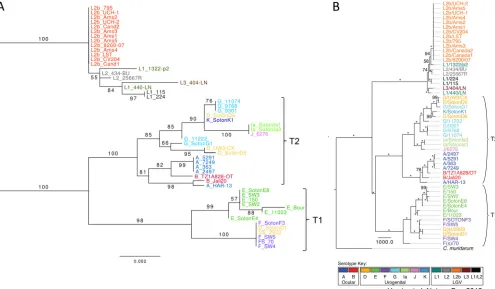
The concatenated tree was largely in agreement with the full
genome tree of Harris et al. (29), but with less resolution and lower
bootstrap support values (Fig. 2). There are, however, some
dif-ferences supported by bootstrap values of⬎70. In the Harris et al.
data set, F(s)/70 is the sister to a clade including E, F, and D strains, while it is nested within that clade in the MLST tree. A/HAR-13 and B/Jali20 form a clade for the MLST genes, while they consti-tute the basal grade to a clade dominated by A and B strains in the Harris et al. data set. There are several differences in the clade composing G, D, K, Ia, and J strains. In the clade with L strains, the MLST tree has a clade with L1/224, L1/115, L1/440/LN, and L1/ 404/LN, while these are part of a basal grade in the phylogeny of
Harris et al. (29).
The hr-CT-MLST data set resulted in a tree that has essentially the same topology as obtained when using the Harris et al. data set but with considerably more branches (see Fig. S1 in the supple-mental material).
DISCUSSION
This report is a unique summary of the most frequently used
high-resolution genotyping scheme forC. trachomatisto date with the
database including more than 2,000 samples from 16 countries worldwide. The distribution of STs clearly shows that a few strains have been successful in spreading in many countries among dif-ferent populations and thus appears to predominate in both space and time. Different STs predominate among MSM and heterosex-ual individheterosex-uals. Currently, multiple strains are single-locus vari-ants of the founders and subgroup founders identified by eBURST
FIG 2Comparison of phylogenetic trees obtained from 52 strains by maximum likelihood analysis after removal of recombination events. (A) MLST concate-mer of five targets; (B) whole-genome sequences (reproduced from reference29by permission from Macmillan Publishers Ltd.). Numbers on nodes represent percentage of bootstrap replicates supporting each clade. Asterisks indicate 100% support. The tree in panel A was rooted based on the previous study whose results are shown in panel B.
on May 16, 2020 by guest
http://jcm.asm.org/
[image:5.585.45.540.67.356.2]inating strains. However, the traits that contribute to successful spread may not be directly linked to the 5 MLST targets or the
ompAgene, but these targets may be biomarkers for other genes or
traits in strains that are successfully spread worldwide. Our com-parison of whole genomes from strains with and without founder STs could not identify any gene that was common for strains with predominating STs but missing in other strains.
The MLST scheme has been used in study populations and
provides high resolution for differentiation of C. trachomatis
strains (32). A major concern about a typing method is its
reliabil-ity. Since the 5 MLST targets are not housekeeping genes, but were selected from the most divergent genes in the few genomes avail-able in 2005, it has been questioned if the targets are stavail-able. In previous studies the stability of the included target regions has
been demonstrated in laboratory experiments (33) as well as in
longitudinal studies of the new variant ofC. trachomatisand
lym-phogranuloma venereum (16,17,22,34). The longitudinal
stud-ies also indicated thatompAwas more unstable, which is in
agree-ment with recent whole-genome studies that have shown
extensive recombination inompA (29,35, 36). Our MLST has
therefore proved suitable for use in epidemiological studies. Iden-tification of founders in eBURST analysis showed that ST12 was detected in a reference strain collected as early as 1960 (F/IC-cal3), a common and widespread genotype. This further indicates the stability of the MLST targets.
This MLST scheme has shown up to a 5-fold-higher resolution
thanompA(7). The D was 0.975 (95% CI, 0.974 to 0.976) when
calculated on all entries in the database. In previous studies of sexually transmitted chlamydia infections, the D varied between 0.84 and 0.97 depending on the degree of epidemiological
relat-edness between samples in the study populations (7,13,17,37).
By calculating an overall D for all 2,089 samples, epidemiological relatedness was eliminated. The obtained index was well above
0.95, an “ideal” cutoff value for a molecular typing method (38).
The lower D for the predominating clusters inTable 1is explained
by the inclusion of some epidemiologically related samples, espe-cially among MSM who may be connected via extended
interna-tional sexual networks (15,19).
Regarding trachoma, the MLST has been used only in a limited number of samples where many cases were epidemiologically linked, explaining why a low D (0.77) was obtained. The number
ofompAvariants was almost equal to the number of STs based on
the five MLST targets (24). This is in contrast to the case with
sexually transmitted chlamydia infections, for which up to 5-fold
more STs have been found compared toompAvariants (7).
As most of the 13 studies included STI clinics, these samples were not representative for samples from the general population.
However, the distribution ofompAgenotypes among the 1,383
assumed heterosexual samples is similar to that in other studies
(3) and indicates that our study reflects strain distribution in most
countries where genotyping ofC. trachomatishas been performed.
PreviousompAtyping studies have shown that specific
geno-types are frequently found in rectal samples from MSM (39–42),
and tissue tropism has been suggested as an explanation (35,43–
46), mainly based on genetic and cell biological findings.
How-ever, recent MLST data show that differing sexual network
struc-tures and distributions ofC. trachomatisstrains in MSM versus
heterosexual networks may be an important reason for the
find-ings of certain genotypes in rectum (21). This also explains the
erosexuals.
Maximum likelihood analysis showed that obtained trees were similar to trees obtained from whole-genome analysis by Harris et
al. (29), but bootstrap support values were lower. The phylogeny
based on the MLST targets is also in agreement with the four
identified lineages in whole-genome analysis by Joseph et al. (36).
Analyses of MLST targets are easier to perform than obtaining whole genome sequences and thereafter performing analyses. Us-ing MLST may therefore facilitate phylogenetic studies. We also applied phylogenetic analysis to the entire hr-CT-MLST data set and confirmed the results of the limited data set, but it also gave rise to more clades. A limitation is the occurrence of recombina-tions that disturb the phylogenetic analysis. Therefore, identified recombinations were removed which influenced the tree topol-ogy, but the major structure remained intact.
The MLST target genes used in this study were originally se-lected because of their sequence variation, which was thought to provide high resolution and to be suitable for short-term
investi-gations. Considering the conserved nature of theC. trachomatis
genomes, we expected that this MLST system would be saturated with a limited number of STs. However, in each new study popu-lation, several new STs have been identified. The number of
de-tected alleles provides a theoretical number of 8.8⫻109STs,
as-suming no linkage between targets, indicating that only a fraction of possible STs have been identified. More refined genetic analysis is needed to elucidate why a few STs predominate in space and time. To provide a better understanding of evolutionary changes forC. trachomatisand link it to short-term variations, it would be rewarding to combine our MLST system with data from a house-keeping-based MLST. Furthermore, the role of the host response to different infecting strains is not well understood.
The strength of this study is the size of the data set. Although the geographic representation is patchy and the separate studies have different objectives, the results provide an overall picture of
strain distribution forC. trachomatis in time and space and in
populations with different sexual behavior that has not been ob-served previously.
In summary, the presented MLST system provides high
reso-lution forC. trachomatisstrains, is useful for epidemiological
in-vestigations, has identified a few predominating strains that have spread successfully in several countries, and is beneficial for phy-logenetic analysis.
ACKNOWLEDGMENTS
The study was financed by local funds from Uppsala University Hospital, Sweden.
Additional members of The Chlamydia trachomatis MLST Study Group include Bertille de Barbeyrac and Olivia Peuchant (University of Bordeaux, Bordeaux, France), Reinier Bom (Municipal Health Service Amsterdam, Amsterdam, the Netherlands), Hans Fredlund (O¨ rebro Uni-versity Hospital, O¨ rebro, Sweden), Houda Gharsallah and Adnene Ham-mami (Habib Bourguiba University, Sfax, Tunisia), Charlotte A Gaydos (Johns Hopkins University, Baltimore, MD), David Mabey (London School of Hygiene and Tropical Medicine, London, United Kingdom), Servaas A Morré (VU University Medical Center, Amsterdam, the Neth-erlands), Marcelo Rodríguez Fermepin (University of Buenos Aires, Bue-nos Aires, Argentina), Julius Schachter (University of California, San Francisco, CA), Henry JC de Vries (Municipal Health Service Amsterdam, Amsterdam, the Netherlands), Qianqiu Wang (Institute of Dermatology,
on May 16, 2020 by guest
http://jcm.asm.org/
CAMS National Center for STD Control, Nanjing, China), and Fuquan Long (Shanghai Dermatology Hospital, China).
REFERENCES
1.World Health Organization.2012. Global incidence and prevalence of selected curable sexually transmitted infections—2008. World Health Or-ganization, Geneva, Switzerland.http://www.who.int/reproductivehealth /publications/rtis/2008_STI_estimates.pdf.
2.Haggerty CL, Gottlieb SL, Taylor BD, Low N, Xu F, Ness RB.2010. Risk of sequelae afterChlamydia trachomatis genital infection in women. J Infect Dis201(Suppl 2):S134 –S155.http://dx.doi.org/10.1086/652395. 3.Pedersen LN, Herrmann B, Møller JK.2009. TypingChlamydia
tracho-matis: from egg yolk to nanotechnology. FEMS Immunol Med Microbiol
55:120 –130.http://dx.doi.org/10.1111/j.1574-695X.2008.00526.x. 4.Jurstrand M, Falk L, Fredlund H, Lindberg M, Olcen P, Andersson S,
Persson K, Albert J, Bäckman A.2001. Characterization ofChlamydia trachomatis omp1genotypes among sexually transmitted disease patients in Sweden. J Clin Microbiol 39:3915–3919.http://dx.doi.org/10.1128 /JCM.39.11.3915-3919.2001.
5.Lysén M, O¨ sterlund A, Rubin C-J, Persson T, Persson I, Herrmann B.
2004. Characterization ofompAgenotypes by sequence analysis of DNA from all detected cases ofChlamydia trachomatisinfections during 1 year of contact tracing in a Swedish county. J Clin Microbiol42:1641–1647.
http://dx.doi.org/10.1128/JCM.42.4.1641-1647.2004.
6.Jónsdóttir K, Kristjn´sson M, HjaltalÍn Olafsson J, Steingrm´ sson O.
2003. The molecular epidemiology of genitalChlamydia trachomatisin the greater Reykjavik area, Iceland. Sex Transm Dis30:249 –256.http://dx.doi .org/10.1097/00007435-200303000-00015.
7.Gravningen K, Christerson L, Furberg A-S, Simonsen GS, O¨ dman K, Sta˚hlsten A, Herrmann B.2012. Multilocus sequence typing of genital Chlamydia trachomatisin Norway reveals multiple new sequence types and a large genetic diversity. PLoS One7(3):e34452.http://dx.doi.org/10 .1371/journal.pone.0034452.
8.Peuchant O, Le Roy C, Herrmann B, Clerc M, Bébéar C, de Barbeyrac B.2012. MLVA subtyping of genovar EChlamydia trachomatis individu-alizes the Swedish variant and anorectal isolates from men who have sex with men. PLoS One7(2):e31538.http://dx.doi.org/10.1371/journal.pone .0031538.
9.Pedersen LN, Pødenphant L, Møller JK.2008. Highly discriminative genotyping ofChlamydia trachomatisusingomp1and a set of variable number tandem repeats. Clin Microbiol Infect14:644 – 652.http://dx.doi .org/10.1111/j.1469-0691.2008.02011.x.
10. Klint M, Fuxelius H-H, Goldkuhl RR, Skarin H, Rutemark C, Ander-sson SGE, PerAnder-sson K, Herrmann B.2007. High-resolution genotyping of Chlamydia trachomatisstrains by multilocus sequence analysis. J Clin Mi-crobiol45:1410 –1414.http://dx.doi.org/10.1128/JCM.02301-06. 11. Dean D, Bruno WJ, Wan R, Gomes JP, Devignot S, Mehari T, de Vries
HJC, Morré SA, Myers G, Read TD, Spratt BG.2009. Predicting phe-notype and emerging strains amongChlamydia trachomatisinfections. Emerg Infect Dis 15:1385–1394. http://dx.doi.org/10.3201/eid1509 .090272.
12. Pannekoek Y, Morelli G, Kusecek B, Morré SA, Ossewaarde JM,
Langerak AA, van der Ende A.2008. Multi locus sequence typing of Chlamydiales: clonal groupings within the obligate intracellular bacteria Chlamydia trachomatis. BMC Microbiol8:42.http://dx.doi.org/10.1186 /1471-2180-8-42.
13. Bom RJM, Christerson L, Schim van der Loeff MF, Coutinho RA,
Herrmann B, Bruisten SM.2011. Evaluation of high-resolution typing methods forChlamydia trachomatisin samples from heterosexual cou-ples. J Clin Microbiol 49:2844 –2853. http://dx.doi.org/10.1128/JCM .00128-11.
14. Christerson L, de Vries HJC, Klint M, Herrmann B, Morré SA.2011. Multilocus sequence typing of urogenitalChlamydia trachomatisfrom patients with different degrees of clinical symptoms. Sex Transm Dis38:
490 – 494.http://dx.doi.org/10.1097/OLQ.0b013e31820b8be0.
15. Christerson L, Bom RJM, Bruisten SM, Yass R, Hardick J, Bratt G,
Gaydos CA, Morré SA, Herrmann B. 2012. Chlamydia trachomatis
strains show specific clustering for men who have sex with men compared to heterosexual populations in Sweden, the Netherlands, and the United States. J Clin Microbiol 50:3548 –3555. http://dx.doi.org/10.1128/JCM .01713-12.
16. Herrmann B, Törner A, Low N, Klint M, Nilsson A, Velicko I,
Söder-blom T, Blaxhult A.2008. Emergence and spread ofChlamydia tracho-matisvariant, Sweden. Emerg Infect Dis14:1462–1465.http://dx.doi.org /10.3201/eid1409.080153.
17. Jurstrand M, Christerson L, Klint M, Fredlund H, Unemo M,
Herrmann B.2010. Characterisation ofChlamydia trachomatisbyompA sequencing and multilocus sequence typing in a Swedish county before and after identification of the new variant. Sex Transm Infect86:56 – 60.
http://dx.doi.org/10.1136/sti.2009.037572.
18. Bom RJM, van der Helm JJ, Bruisten SM, Grünberg AW, Sabajo LOA, Schim van der Loeff MF, de Vries HJC.2013. The role of Surinamese migrants in the transmission ofChlamydia trachomatisbetween Paramar-ibo, Suriname and Amsterdam, The Netherlands. PLoS One8(11):
e77977.http://dx.doi.org/10.1371/journal.pone.0077977.
19. Bom RJM, van der Helm JJ, Schim van der Loeff MF, van Rooijen MS, Heijman T, Matser A, de Vries HJC, Bruisten S.2013. Distinct trans-mission networks ofChlamydia trachomatisin men who have sex with men and heterosexual adults in Amsterdam, The Netherlands. PLoS One
8(1):e53869.http://dx.doi.org/10.1371/journal.pone.0053869.
20. van der Helm JJ, Bom RJM, Grünberg AW, Bruisten SM, Schim van der Loeff MF, Sabajo LOA, de Vries HJC. 2013. Urogenital Chlamydia trachomatisinfections among ethnic groups in Paramaribo, Suriname; determinants and ethnic sexual mixing patterns. PLoS One8(7):e68698.
http://dx.doi.org/10.1371/journal.pone.0068698.
21. Versteeg B, van Rooijen MS, Schim van der Loeff MF, de Vries HJC, Bruisten SM.2014. No indication for tissue tropism in urogenital and anorectalChlamydia trachomatisinfections using high-resolution multi-locus sequence typing. BMC Infect Dis14:464.http://dx.doi.org/10.1186 /1471-2334-14-464.
22. Christerson L, de Vries HJC, de Barbeyrac B, Gaydos CA, Henrich B, Hoffmann S, Schachter J, Thorvaldsen J, Vall-Mayans M, Klint M, Herrmann B, Morré SA.2010. Typing of lymphogranuloma venereum Chlamydia trachomatisstrains. Emerg Infect Dis16:1777–1779.http://dx .doi.org/10.3201/eid1611.100379.
23. Vall-Mayans M, Isaksson J, Caballero E, Sallés B, Herrmann B.2014. Bubonic lymphogranuloma venereum with multidrug treatment failure. Int J STD AIDS25:306 –308.http://dx.doi.org/10.1177/0956462413501 158.
24. Harding-Esch EM, Christerson L, Grannas K, Molina S, Roberts CH, Holland MJ, Andreasen AA, Sillah A, Sarr B, Jeffries D, Grundy C, Bailey RL, Mabey DC, Herrmann B.2010. Multi-locus sequence typing: a useful tool for trachoma molecular epidemiology, p 55–58.InPaavonen J, Saikku P, Starnbach M, Stary A, Stephens RS, Timms P, Wyrick PB (ed), Chlamydial infections. Proceedings of the 12th International Symposium on Human Chlamydial Infections; Salzburg. International Chlamydia Symposium San Francisco, CA.
25. Hunter PR, Gaston MA.1988. Numerical index of the discriminatory ability of typing systems: an application of Simpson’s index of diversity. J Clin Microbiol26:2465–2467.
26. Larsen MV, Cosentino S, Rasmussen S, Friis C, Hasman H, Marvig RL, Jelsbak L, Sicheritz-Pontén T, Ussery DW, Aarestrup FM, Lund O.
2012. Multilocus sequence typing of total-genome-sequenced bacteria. J Clin Microbiol50:1355–1361.http://dx.doi.org/10.1128/JCM.06094-11. 27. Hyatt D, Chen G-L, Locascio PF, Land ML, Larimer FW, Hauser LJ.
2010. Prodigal: prokaryotic gene recognition and translation initiation site identification. BMC Bioinformatics 11:119. http://dx.doi.org/10.1186 /1471-2105-11-119.
28. Fischer S, Brunk BP, Chen F, Gao X, Harb OS, Iodice JB, Shanmugam D, Roos DS, Stoeckert CJ.2011. Using OrthoMCL to assign proteins to OrthoMCL-DB groups or to cluster proteomes into new ortholog groups. Curr Protoc Bioinformatics35:6.12.1– 6.12.19.http://dx.doi.org/10.1002 /0471250953.bi0612s35.
29. Harris SR, Clarke IN, Seth-Smith HMB, Solomon AW, Cutcliffe LT, Marsh P, Skilton RJ, Holland MJ, Mabey D, Peeling RW, Lewis DA, Spratt BG, Unemo M, Persson K, Bjartling C, Brunham R, de Vries HJ, Morré SA, Speksnijder A, Bébéar CM, Clerc M, de Barbeyrac B, Parkhill J, Thomson NR. 2012. Whole-genome analysis of diverseChlamydia trachomatisstrains identifies phylogenetic relationships masked by cur-rent clinical typing. Nat Genet44:413– 419, S1.http://dx.doi.org/10.1038 /ng.2214.
30. Gouy M, Guindon S, Gascuel O.2010. SeaView version 4: a multiplat-form graphical user interface for sequence alignment and phylogenetic tree building. Mol Biol Evol 27:221–224. http://dx.doi.org/10.1093 /molbev/msp259.
on May 16, 2020 by guest
http://jcm.asm.org/
post-analysis of large phylogenies. Bioinformatics30:1312–1313.http: //dx.doi.org/10.1093/bioinformatics/btu033.
32. de Vries HJ, Schim van der Loeff MF, Bruisten SM.2015. High resolu-tion typing of Chlamydia trachomatis: epidemiological and clinical uses. Curr Opin Infect Dis28:61–71.http://dx.doi.org/10.1097/QCO.0000000 000000129.
33. Labiran C, Clarke IN, Cutcliffe LT, Wang Y, Skilton RJ, Persson K, Bjartling C, Herrmann B, Christerson L, Marsh P.2012. Genotyping markers used for multi locus VNTR analysis withompA(MLVA-ompA) and multi sequence typing (MST) retain stability inChlamydia trachoma-tis. Front Cell Infect Microbiol2:68.http://dx.doi.org/10.3389/fcimb.2012 .00068.
34. Klint M, Hadad R, Christerson L, Loré B, Anagrius C, O¨ sterlund A,
Larsson I, Sylvan S, Fredlund H, Unemo M, Herrmann B. 2011.
Prevalence trends in Sweden for the new variant ofChlamydia trachoma-tis. Clin Microbiol Infect17:683– 689.http://dx.doi.org/10.1111/j.1469 -0691.2010.03305.x.
35. Jeffrey BM, Suchland RJ, Quinn KL, Davidson JR, Stamm WE, Rockey DD.2010. Genome sequencing of recent clinicalChlamydia trachomatis strains identifies loci associated with tissue tropism and regions of appar-ent recombination. Infect Immun 78:2544 –2553. http://dx.doi.org/10 .1128/IAI.01324-09.
36. Joseph SJ, Didelot X, Rothschild J, de Vries HJC, Morré SA, Read TD, Dean D.2012. Population genomics ofChlamydia trachomatis: insights on drift, selection, recombination, and population structure. Mol Biol Evol29:3933–3946.http://dx.doi.org/10.1093/molbev/mss198. 37. Ikryannikova LN, Shkarupeta MM, Shitikov EA, Il’ina EN, Govorun
VM.2010. Comparative evaluation of new typing schemes for urogenital Chlamydia trachomatisisolates. FEMS Immunol Med Microbiol59:188 – 196.http://dx.doi.org/10.1111/j.1574-695X.2010.00678.x.
38. Van Belkum A, Tassios PT, Dijkshoorn L, Haeggman S, Cookson B, Fry NK, Fussing V, Green J, Feil E, Gerner-Smidt P, Brisse S, Struelens M.
2007. European Society of Clinical Microbiology and Infectious Diseases (ESCMID) Study Group on Epidemiological Markers (ESGEM).
Guide-terial epidemiology. Clin Microbiol Infect13(Suppl 3):S1–S46. 39. Barnes RC, Rompalo AM, Stamm WE.1987. Comparison ofChlamydia
trachomatisserovars causing rectal and cervical infections. J Infect Dis
156:953–958.http://dx.doi.org/10.1093/infdis/156.6.953.
40. Bax CJ, Quint KD, Peters RPH, Ouburg S, Oostvogel PM, Mutsaers JA, Dörr PJ, Schmidt S, Jansen C, van Leeuwen AP, Quint WG, Trimbos JB, Meijer CJ, Morré SA.2011. Analyses of multiple-site and concurrent Chlamydia trachomatisserovar infections, and serovar tissue tropism for urogenital versus rectal specimens in male and female patients. Sex Transm Infect87:503–507.http://dx.doi.org/10.1136/sti.2010.048173. 41. Klint M, Löfdahl M, Ek C, Airell A, Berglund T, Herrmann B.2006.
Lymphogranuloma venereum prevalence in Sweden among men who have sex with men and characterization ofChlamydia trachomatis ompA genotypes. J Clin Microbiol 44:4066 – 4071. http://dx.doi.org/10.1128 /JCM.00574-06.
42. Morré S, Rozendaal L, Valkengoed I van, Boeke A, Voorst Vader PC, van Schirm J, de Blok S, van Den Hoek JA, van Doornum GJ, Meijer CJ, van Den Brule AJ.2000. UrogenitalChlamydia trachomatisserovars in men and women with a symptomatic or asymptomatic infection: an asso-ciation with clinical manifestations? J Clin Microbiol38:2292–2296. 43. Abdelsamed H, Peters J, Byrne GI.2013. Genetic variation inChlamydia
trachomatisand their hosts: impact on disease severity and tissue tropism. Future Microbiol8:1129 –1146.http://dx.doi.org/10.2217/fmb.13.80. 44. Almeida F, Borges V, Ferreira R, Borrego MJ, Gomes JP, Mota LJ.2012.
Polymorphisms in inc proteins and differential expression of inc genes amongChlamydia trachomatisstrains correlate with invasiveness and tro-pism of lymphogranuloma venereum isolates. J Bacteriol194:6574 – 6585.
http://dx.doi.org/10.1128/JB.01428-12.
45. Nunes A, Borrego MJ, Gomes JP.2013. Genomic features beyond Chla-mydia trachomatisphenotypes: what do we think we know? Infect Genet Evol16:392– 400.http://dx.doi.org/10.1016/j.meegid.2013.03.018.
46. Borges V, Nunes A, Ferreira R, Borrego MJ, Gomes JP. 2012.
Directional evolution ofChlamydia trachomatistowards niche-specific adaptation. J Bacteriol194:6143– 6153. http://dx.doi.org/10.1128/JB .01291-12.