AN ENERGY EFFICIENT MULTIPATH ROUTING PROTOCOL BASED ON
SIGNAL STRENGTH FOR MOBILE AD-HOC NETWORK
Muamer N. Mohammed, Nassir S. Kadhim and Waleed Kh. Ahmed
Faculty of Computer Systems & Software Engineering, University Malaysia Pahang Lebuhraya Tun Razak, Gambang, Pahang, Malaysia
E-Mail: [email protected]
ABSTRACT
In recent years, Mobile Ad-hoc Networks (MANETs) is one of the popular research areas due to low cost to employ the network, self-organization, freedom of location, and no base stations. Broadcast and data aggregation are crucial operations in MANETs. Due to the high mobility of nodes and the transmission distance, nodes may change their positions rapidly and thus not only change the network topology but also make it impossible to keep a durable and regular data routing between two nodes, that can cause link failure. Recently, it has been argued that layered architecture is not suitable for wireless network. In an effort to improve the performance of MANETs, there has been increased in protocols that rely on cross-layer interaction between different layers. In this paper, a new Cross-layer Design among Network and Physical layers, called Signal Strength Based Stability (SSBS) is proposed to reduce the broadcast redundancy, minimize the routing overhead and increase stability of the transmission link by measuring signal strength changes of neighbour nodes. SSBS will request selective forward nodes depend on its signal strength value. The proposed algorithm was simulated, and the packet delivery ratio including routing overhead was selected as the main performance evaluation metrics. The results show that the proposed algorithm has better performance over the conventional DSR protocol having implemented with blind flooding, and also improves the performance of on demand routing protocols of MANETs by reducing the communication overhead incurred during the route discovery process on DSR protocol.
Keywords: MANET, signal strength, link stability, DSR protocol.
1. INTRODUCTION
Wireless ad-hoc networks are used to provide a communication infrastructure in different areas as a fast, deployable, temporary replacement for destroying fixed network or in areas where wired LANs are impossible or only cost-intensive to deploy such as protected historical buildings, or the venue of a conference. At the beginning, wireless networks were mostly used only as a last-mile, which means a 1-hop extension of a wired LAN. However the proliferation of wireless communication devices, multi-hop wireless networks (MANETs) are gaining a practical relevance and acceptance with time [5]. They are providing a multi-hop extension to a wired backbone network, or a completely stand-alone network. In the scientific area, they have been under heavy research for quite some time. The "Ad hoc" aspect of the network makes some implicit assumptions. The communication medium is wireless, therefore the meaning of "Ad hoc" is different from an "Ad hoc" P2P network that can be established over wired links. The size and topology of the network are potentially unknown to individual nodes because nodes are mobile. Therefore "ad hoc" refers mainly to topology, which might change continuously. A mobile network might become disconnected, a case in which parts should be able to operate in a standalone manner, and this reinforces the argument against centralization. If the ad hoc portion is part of a larger networked structure, disconnection should be transparent. Heterogeneity of the devices implies that many of the machines participating in an ad hoc network will differ in power, communication, and computation capability, [10], [4], [6]. This means that the usual classification as client
discovery principle, we can classify them into either proactive or reactive. Proactive routing protocols update routes for every pair of nodes at regular intervals irrespective of their requirement. The reactive or on-demand routing protocols [7], determine route only when there is a need to transmit a data packet, using a broadcasting query-reply (RREQRREP) procedure. Most of these protocols use min-hop as the route selection metric. It is found that shortest path route has short lifetime, especially in highly dense ad hoc networks even with low mobility, due to edge effect. They do not address the issue of reducing the path breakage during data transmission. In most of the on-demand routing algorithms it will take some time to detect the link failure after which, route recovery and maintenance procedures are initiated These procedures consumes substantial amount of resources like bandwidth, power, processing capacity at nodes and also introduce extra delay. Selecting routes that endure long time reduce the possibility of route failure and route re-discovery process, which considerably improve the network performance of ad-hoc networks. Link stability indicates how stable the link is and stability based routing protocols tend to select paths that are long-lived route [7]. Signal strength, pilot signals, relative speed between nodes are the parameters used for the computation of link stability. Lifetime of network is considerably reduced by inefficient consumption of battery. Power-Aware routing ensures that the mean time to node failure is increased significantly [6]. In this paper, a new Cross-layer Design among Network and Physical layers, called Signal Strength Based Stability (SSBS) is proposed that considers the signal strength to select path for reliable data transmission across the network. It reduces the link failures as well increase the lifetime of Network through the distribution of traffic load.
2. THEORETICAL BACKGROUND
2.1.Routing protocols
In ad hoc networks, it is almost necessary to traverse several hops (multi-hops) before a packet reaches the destination. In traditional hop-by-hop routing solutions, each node in the network maintains a routing table that lists, for each known destination, the next node to which a packet for that destination should be sent. The problem of maintaining consistent and correct tables becomes harder in ad hoc networks, due to the high rate of topology changes [1], [2]. The challenge in creating a routing protocol for ad hoc networks is to design a single protocol that can adapt to the wide variety of conditions that are present in any ad hoc network over time. As ad hoc networks are characterized by a time-changing topology, use of wireless medium and limited bandwidth and power, there is a need to develop new different routing protocols than those for wired networks. Actually, a central challenge in the design of ad hoc networks is the development of dynamic routing protocols that can efficiently find routes between two communicating nodes. The routing protocols must be able to keep up with the
high degree of node mobility, the absence of established infrastructure, the absence of a centralized administration, the bandwidth and resources constraints. Wired networks routing protocols are designed for static topology, they try to maintain routes to all reachable destinations, and they are highly dependent on periodic control messages. These protocols are mainly classified into link state and distance vector protocols, requiring frequent exchange of link state tables or routing vectors.
2.2. Basic DSR route discovery
When some node S originates a new packet destined to some other node D, it places in the header of the packet a source route giving the sequence of hops that the packet should follow on its way to D. Normally, S will obtain a suitable source route by searching its Route Cache of routes previously learned, but if no route is found in its cache, it will initiate the Route Discovery protocol to dynamically find a new route to D [9] , [3] , [8]. In this case, it is called S the initiator and D the target of the Route Discovery.
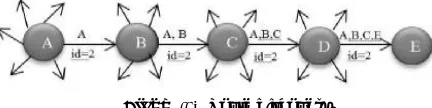
[image:2.612.320.536.516.570.2]Figure-1 illustrates the Route Discovery, in which a node A is attempting to discover a route to node E. To initiate the Route Discovery, A transmits a Route Request message as a single local broadcast packet, which is received by all nodes currently within wireless transmission range of A. Each Route Request message identifies the initiator and the target of the Route Discovery, and also contains a unique Request ID, determined by the initiator of the Request. Each Route Request also contains a record listing the address of each intermediate node through which this particular Request also contains a record listing the address of each intermediate node through which this particular copy of the Route Request message has been forwarded. This route record is initialized to an empty list by the initiator of the Route Discovery.
Figure-1. Route discovery.
Request message and propagates it by transmitting it as a local broadcast packet
3. PROPOSED METHOD
Many Ad hoc routing protocols uses broadcasting in route discovery, in which each node will be required to rebroadcast the packet whenever it receives the packet. Since the communication link between two transmitting nodes may break because one or both of the transmitter and the receiver node moves out of the transitions range of each other, this will cause a problem when one node is sending data to another node and then it moves away, so to solve this problem, Signal strength technique improves the Route Discovery by minimizing the number of transmissions needed for broadcasting by doing selective forwarding, where only a few selected nodes in the network do the broadcasting. The node is moving within the simulation range according to the random way mobility model. In the start of simulation each node starts at random position, it chooses a random destination position within the height and width of simulator, and chooses a random speed ranges from zero to maximum speed, after that node computes its direction of movement. The direction of movement is computed as in Eqn. (1) below:
(1) The distance is computed using the Eqn. (2) below:
(2)
Where (x1, y1) is the current position of node and (x2, y2) is the new destination position, X and Y as the x-axis and y-x-axis (since Dir is a vector) .The node then computes its arrival time to determine when to stop. If a node is in moving face, it continue computing its next position in the direction of the final destination, and moves to that location, when it reaches the final position, it will stop for a Stop Time and then repeats the process again as shown in Figure-2.
To select the transmitting nodes, it is assumed that each mobile node knows the received signal strength value of all its neighbours. Each node that wants to initiate the Route Discovery must map the signal strength of all its neighbours. The signal strength measurements value are: excellent, very good, good, low, very low depending on the distance between the node and its neighbour where the number of calculated samples of radio waves in the wireless transmission is decrease whenever the distance between the two nodes is increase. The node will make a decision on forwarding the Route Request messages. This decision rule is inserted in Route Discovery mechanism.
Figure-2. Forwarding the route request messages.
4. SIMULATION AND EVALUATION
In this section, we investigate the performance of the SSBS and it is compared with standard DSR protocol. The simulation environment is set as shown in Table-1.
Table-1. Simulation environment.
First a comparison between SSBS and DSR is made when the increase pause time. Then comparison the effect of increase in speed of nodes from (5 m/s) to (20 m/s). Finally, to compare the performance of protocols, two metrics are used:
4.1.Packet delivery ratio
protocol and the less the probability of dropping a data packet.
4.2.Routing overhead
The number of control packet is sent by all the nodes to discover and maintain routes. Routing overhead is an important metric for comparison of protocols because it measures its efficiency in terms of consuming node battery power.
5. SIMULATION RESULTS
This section will analyze and compare the performance of SSBS and DSR protocol based on three main parameters: the effects of changing mobility (pause time), speed of nodes, number of sources (also called connections) and finally increase in number of nodes.
5.1.Pause time (mobility)
Figure-3. Shows the packet delivery ratio performance of the two routing protocols as a function of pause time for 50 nodes, the speed of nodes is set to 1m/s. When nodes pause for larger times, the protocols deliver a greater percentage of the originated data packets. When there is no mobility all protocols achieve 100% packet delivery, when nodes get small pause time both protocols deliver about 90% of their packets at this movement speed. SSBS performs well in all cases, delivering an average of 98% of the data packets.
Figure-3. Impact of increase in mobility on Packet delivery ratio of SSBS & DSR for network with 50 nodes.
However, DSR Packet delivery ratio degrades to 89% as the pause time gets smaller, but as pause time increases the packets delivery increase reaches 95% at the end of simulation time. The reason for this height packet delivery ratio for SSBS is that it never uses stale route. If it doesn’t have a route for a destination, it finds one through Route Discovery and it also uses signal strength to ensure that only valid routes are stored at the nodes.The protocols impose different amounts of routing overhead, as shown in Figure-4. SSBS has the least routing overhead at all pause times and the routing overhead decreases as pause time increases; this is because it has use selective nodes. As the
movement of the nodes becomes less frequent the routes persist for larger duration of time and hence the number of Route Discovery packets decreases. For DSR, at low pause time there are many link changes and the hop between nodes increases. This change often results in route update being sent frequently. As the pause time increases the routes might not change, but each node has the continuously sent out periodic updates to indicate that it is still in the range of its neighbors. This is the reason that DSR has more routing overhead than SSBS.
Figure-4. Impact of increase in mobility on routing overhead of SSBS & DSR for network with 50 nodes.
5.2.Speed of nodes
This set of experiments studied the impact of speed of node on the performance metrics. The maximum speed ranges among (5, 10, 15 and 20 m/s). Figure-5. shows the results of packet delivery ratio of SSBS and DSR for network with 50 nodes. From the results it is evident that as speed of nodes increases; the performance of both SSBS and DSR decreases. But in all four values of speed, DSR performs better than DSR. The SSBS has approximately the same curve of packet delivery ratio at all speed ranges; the drop in data packet is less than 10% when speed increases from 5m /s to 20 m /s.
Figure-5. Impact of increase speed on packet delivery ratio for both SSBS & DSR protocol.
Figure-6. Shows the results of control overhead of SSBS and DSR for network with 50 nodes. The two protocols perform much better at low speed. SSBS seems to show a uniform rise in most cases with increasing speed.
Figure-6. Impact of increase in speed on routing overhead for both SSBS & DSR protocol.
This is because, at higher speeds there are more route changes resulting in more route discovery and route maintenance packets being sent. However, SSBS perform better than DSR. DSR is more sensible to the effects of speed of nodes. This is because that increase in maximum speed of nodes causes increased rate of change of metrics among the routes in the routing tables of the nodes along with a higher rate of change in sequence numbers resulting in more frequent transmission of incremental updates and ‘full dump’ packets. This means that more event-triggered updates were generated which means more routing overhead.
6. CONCLUSIONS
The results show that there is no need to implement Route Maintenance as in other reactive routing protocols. In addition, this method reduced the broadcast redundancy and minimize the search space in Route
Discovery by selecting partial neighbour nodes of the transmitting node instead of selecting all neighbour nodes for broadcasting Route Request messages when the signal strength of those neighbours are considered to avoid the link failure in MANETs. The proposed method based on Cross-Layer for solving link failure by reducing the broadcast redundancy, increase stability link and increase the time to network partition by using signal strength at Physical Layer and the required IP address at the Network Layer.
REFERENCES
[1] Ahyoung, L., Lavina, C. G., Caballero, J. and Ilkyeun, R. 2013. Performance Analysis of Ad-hoc Routing Protocols Based on Selective Forwarding Node Algorithms. International Conference on Information Science and Applications (ICISA), pp.1-4.
[2] Arora, D., Millman E. and Neville S.W. 2012. Assessing the Expected Performance of the OLSR Routing Protocol for Denser Urban Core Ad-hoc Network Deployments. 26th IEEE International
Conference on Advanced Information Networking and Applications, pp. 406-414.
[3] David, B., David A. and Josh, B. 1999. DSR: The Dynamic Source Routing Protocol for Multi-Hop Wireless Ad-hoc Networks. Carnegie Mellon University.
[4] Dragos, S.N. 2004. Forwarding and Positioning Problems in Ad-hoc Networks. In Graduate School New Brunswick Rutgers, PhD Thesis, The State University of New Jersey.
[5] Fathy, C., El-Hadidi, M.T. and El-Nasr, M.A. 2011. Fuzzy-based Adaptive Cross-Layer Routing Protocol for Mobile Ad-hoc Networks. 30th IEEE International
Performance Computing and Communications Conference, pp. 1-10.
[6] Hasnat, M.A., Dey, S. and Saha, A. 2011. A Novel Technique of Integrating the Conventional Algorithms for Broadcasting Protocols to Reduce the Redundancy in Wireless Ad-hoc Networks. 14th International Conference on Computer and Information Technology, pp. 664-669.
[7] Rango, F.D. and Guerriero, F., 2012. Link Stability and Energy Aware Routing Protocol in Distributed Wireless Networks", IEEE Transacations on Parallel and Distributed systems, vol .23(4).
[9] Unnikrishnan P. 2004. Introduction and Analysis of DSR Protocol. Helsinki University of Technology. pp. 1-5.