ISSN 2250-3153
How participation in the Awards can help Six Sigma?
K P Rao
Formerly with BITS, Pilani and Ultratech Cement Ltd.
Abstract-
Six Sigma, despite of far flung success and wide spread applications, has some limitations like any contemporary new change methodology, both in Theory and Practice as well as tools and methods available to achieve the Six Sigma performance. One such weakness is that, Leadership. A failure to achieve success in change is directly correlated to ineffective leadership. A subject which can help leaders overcome this weakness is regular participation in the Quality and Excellence Awards.
This paper takes a look at a few different Quality awards, compares it Six Sigma, attempts an integration and identifies areas where Six Sigma leadership can learn from the awards criterion.
Index Terms- Brazilian Quality award, Deming award, EFQM, MBNQA, Quality and Excellence awards, Six Sigma, Swedish Quality award,
1.0 Introduction
Change is a continuous process. The business environment is no exception in this regard. Thus, the complexion of business environment is also regularly changing and subsequently the business structures and processes are also regularly changing. Several top-notch corporate leaders representing most prominent business houses are following contemporary labeled programs like Total Productive Maintenance (TPM), Total Quality Control (TQC), Total Quality Management (TQM), or Company Wide Quality Control (CWQC), Business Process Reengineering (BPR) etc. to achieve manufacturing and service excellence. There have been many good and not so good quality techniques; however one technique, which has stood out, is the Six Sigma approach. This approach has enjoyed tremendous corporate attention, the kind that no other approach can quite claim for itself.
The history of Six Sigma can be traced to the American electronics giant, Motorola where a goal of improving all products - goods as well as services was established. To set a clear measure on the improvement work, the program called Six Sigma was launched in 1987, Klefsjo, Wiklund and Edgeman (2001). As a result of winning the Baldrige Award in 1988, Motorola was compelled to share its quality practices with others. The company’s approach to continuous improvement was based on a comparison of process performance and product specification, and aggressive efforts to drive down defects, Folaron (2003). Motorola changed the language of quality in America by beginning to measure defects out of opportunities or parts per million (and even billion), instead of parts per hundred, Raisch, Anderson, Krogman and Krueger (2001).
Six Sigma is a quality movement, a methodology, and a measurement. As a methodology, it is used to evaluate the capability of a process to perform defect-free, where a defect is defined as anything that results in customer dissatisfaction. Six Sigma is customer focused and has the potential to achieve exponential quality improvement through the reduction of variation in system processes, Black and Revere (2006). Six-sigma’s target is to achieve less than 3.4 defects or errors per million opportunities hence the name. Higher the number of Sigma, the more consistent is the process output or smaller is the variation, Karuppusami and Gandhinathan (2006). We can sum up Six Sigma as a defect reduction effort, a variation reduction mechanism, customer satisfactor, a profit enhancing device, a loss control method, a management philosophy and a data driven metric.
ISSN 2250-3153
quality together, a customer-centric Six Sigma can be achieved. They suggested developing leadership Triad among others. A subject which can help leaders overcome this weakness is regular participation in the Quality and Excellence Awards.
2.0 History of Quality and Excellence Awards
Over the past few decades, the quality gurus Crosby, Deming, Feigenbaum, Juran and others have developed and advocated certain prescriptions in the area of quality management. Their insights into quality management provide a good understanding of quality management principles, Karuppusami and Gandhinathan (2006). During the last decades, quality awards have been considered as an effective way to pursuit quality excellence in many industries worldwide. Companies have reported that their implementation not only improved quality but also has led to improvements in market share, customer satisfaction, profit, processes, supplier performance, employee morale and competitiveness, Miguel et al (2004).
In 1951, Japan began honouring quality practices through the establishment of the Deming Prize. Inspired by the successful development in Japan, several other countries established, at the end of the 1980s, programs to recognise quality practices taking place in organisations Worldwide, there are several Quality Awards, such as the Deming Prize in Japan, the European Quality Award (EQA) in Europe and the Malcolm Baldrige National Quality Award (MBNQA) in the USA. Presently, bodies responsible for industrial development, quality control, etc. in India like CII, QCFI, TPM, etc. have already started various awards at national and international level to propagate and inculcate quality culture in Indian organizations like the Indian Juran Award, Dr Shah Trust Award, etc. at national level, Kulkarni (2005). This author adds Rajiv Gandhi National Quality Award (RGNQA), Ramkrishna Bajaj National Quality Award (RBNQA), CII-EXIM award to that list. Following this trend, many other nations all over the world also have established quality awards programmes to recognise such performance excellence, Miguel et al (2004). In many countries, however, the development and use of national quality awards is still new or non-existent, Eriksson and Garvare (2005).
For 15 years, organizations worldwide have used the Malcolm Baldrige National Quality Award criteria to help build market competitiveness, improve performance excellence and bolster shareholder value In fact, the seven categories of the Baldrige criteria— leadership; strategic planning; customer and market focus; information, analysis and knowledge management; HR management; process management; and business results—have become synonymous with performance excellence. The criteria are routinely used as a framework to help firms assess their leadership competencies, their prowess in strategy development and deployment and their strengths in the arenas of customer care, product and service quality, operational efficiency, human resource management and financial accountability and management, Byrne and Norris (2003).
Excellence is defined as “ the outstanding practice in managing the organization and achieving results” . Truly Excellent organizations are those that strive to satisfy their stakeholders by what they achieve, how they achieve it, what they are likely to achieve and the confidence they have that the results will be sustained in the future (EFQM, 2005). Each award is based on a perceived model of TQM. They do not focus solely on the product, service perfection or traditional quality management methods, but consider a wide range of management activities, behaviour and processes which influence the quality of the final offerings.
Klefsjo et al (2001), point it out that Six Sigma is of great value in attainment of business excellence and measurement of that progress so that appropriately configured and deployed Six Sigma programs may be highly consistent with the results orientation underlying various international quality awards, such as the European Quality Award, America's Malcolm Baldrige National Quality Award, the Canada Excellence Awards, and the Australian Quality Award. ``Six Sigma is of great value in attainment of business excellence and measurement of that progress so that appropriately configured and deployed Six Sigma programs may be highly consistent with the results-orientation underlying various international quality awards.'' Klefsjo et al (2001). While it might be true, but the contention of this author is to investigate how this award criterion can help the Six Sigma cause, and what Six Sigma can learn from these, to strengthen it self.
2.1 The US Malcolm Baldrige Quality Award
ISSN 2250-3153
2.1.1 The Baldrige award criteria—an overview
The Malcolm Baldrige National Quality Award was created in 1987 under Public Law 100-107 and is being administered by the National Institute of Standards and Technology (NIST). The primary instrument of the award is the criteria for performance excellence. In addition to their use as the basis for making awards and for giving feedback to applicants, the criteria have three other important roles in strengthening U.S. competitiveness
• To help improve performance practices and capabilities
• To facilitate communication and sharing of best practices information among U.S. organizations of all types
• To serve as a working tool for understanding and managing performance, planning, training, and assessment” (NIST 2008) The Baldrige Award Criteria— Description
The Baldrige Award criteria are built upon a foundation of 11 core values and concepts, which are summarized as follows (NIST 2008):
1. Customer-driven quality. Quality is a strategic concept that is closely linked to customer satisfaction, customer retention, market share gain, and growth.
2. Leadership. Senior leaders need to set directions through strategic planning, clear and visible values, high expectations, and a customer focus. Through their personal involvement, they need to show commitment to the development and empowerment of the entire work force. They also need to show commitment to being a model corporate citizen.
3. Continuous improvement and learning. Continuous improvement and learning must be embedded in the way the company operates; that is, it must become a way of life in the company. A culture of continuous improvement and learning will enable the company to be more responsive, adaptive and efficient, and thus, more competitive.
4. Valuing employees. As a company’s success depends increasingly on the quality of its work force, the company must invest in its development through education, training, and opportunities for continued growth and participation.
5. Fast response. Faster and more flexible response to customers is now a more critical requirement. Also, many companies have found that reducing cycle-time often drives simultaneous improvements in organization, quality, and productivity, because cycle time reduction usually involves simplification of work units and processes.
6. Design quality and prevention. Costs of preventing problems at the design stage are usually much lower than costs of correcting problems that occur downstream. Costs include inspection, scrap, and rework.
7. Long-range view of the future. To maintain a competitive position, a company must have a strong future orientation that requires long-term commitments to all stakeholders—customers, employees, suppliers, stockholders, the public, and the community.
8. Management by fact. Increasingly, modern businesses must make decisions based on accurate and timely information, which is converted to key measurements. These measurements are derived from the company’s strategy and must provide critical indicators about key processes, outputs, and results.
9. Partnership development. Companies are finding that internal and external partnerships drive better cooperation and enhance overall capabilities.
10. Company responsibility and citizenship. A company needs to fulfill its responsibilities to the public, including ethical behavior, protection of public health, safety, and the environment.
11. Results focus. A company needs to focus on key results that address the balanced interests of all stakeholders—customers, employees, stock holders, suppliers and partners, the public, and the community.
A major boost to the growth of TQM is the promotion of quality award models in many countries and the success of quality programs such as Six Sigma, quality function deployment, and quality circle. Of the widely accepted international quality initiatives are ISO 9000 certification standards, ISO 14000 certification standards, Six Sigma, and the Malcolm Baldrige National Quality Award (MBNQA).
ISSN 2250-3153
worthy trophy, the program itself serves a vital purpose in emphasizing the importance of quality in the workplace and improving upon the enterprise’s quest for the competitive advantage.
2.2 The European TQM Model – the EFQM Quality Award Model
The quality award model most widely used in Europe is that developed by the European Foundation for Quality Management (EFQM). The EFQM was formed in 1988 by 14 leading European businesses, and it encourages European businesses to improve competitiveness through the use of TQM philosophy. The EFQM has provided a holistic model (termed “ business excellence” or the “ excellence model” ) to facilitate such a purpose. The model and the associated self-assessment process have given new direction to the quality movement and have driven deep and lasting changes into participating organizations. The EFQM’ s TQM model effected good performance in many European companies and the CEOs of the participating companies claimed that the excellence model brought great success in their business.
In April 1999, the EFQM revised the model and there was a noticeable switch in language from “ quality” to “ excellence” . Indeed, the word “ quality” does not appear in either the sub-criteria or the areas to address in the revised model. The name of the European Quality Award (EQA) was also changed to the EFQM excellence award, with the word “ quality” stripped out. This change in focus from TQM (or quality) to business excellence has led to considerable disquiet among traditional TQM practitioners. Whether quality is dead in Europe has become a topic of debate in the last few years, Sun, Li , Ho , Gertsen, Hansen and Frick (2004).
2.3 The Deming Prize
The Deming Prize is Japan’s national quality award for industry. It was established in 1951 by the Japanese Union of Scientists and engineers (JUSE) and it was named after W. Edwards Deming. He brought statistical quality control methodology to Japan after W.W.II. The Deming Prize is the world’s oldest and most prestigious of such awards. Its principles are a national competition to seek out and commend those organizations making the greatest strides each year in quality, or more specifically, TQC. The prize has three award categories. They are Individual person, the Deming Application Prizes, and the Quality Control Award for factory. The Deming Application prizes are awarded to private or public organizations and are subdivided into small enterprises, divisions of large corporations, and overseas companies. There are 143 companies who won the prize. Among them, only once has the Deming Prize been awarded to a non-Japanese company: Florida Power and Light in 1989 for the first time.
2.4. Swedish Quality Award
Since 1992 the Swedish Quality Award has been administrated by the Swedish Institute for Quality (SIQ), The SIQ has developed a model, called the SIQ Model for Performance Excellence, This organisation supports the quality award applicants with the planning, for example describing the formalities for the application and setting dates for handing in the application. The administrator also trains external examiners and supports them in their evaluation of the applicants’ description (the phase of study), The administrator might also support the applicants in their plan for improvement (the phase of act), Eriksson and Garvare (2005).
The SIQ Model for Performance Excellence, which is based on 13 core values and seven criteria. The core values of the SIQ Model (SIQ, 2008), are:
(1) Customer orientation. (2) Committed leadership. (3) Participation by everyone. (4) Competence development. (5) Long-range perspective. (6) Public responsibility. (7) Process orientation. (8) Prevention.
ISSN 2250-3153
The criteria of the SIQ Model have been inspired by, and are similar to, the criteria of the Malcolm Baldrige National Quality Award Model (NIST, 2008), This is, for example, illustrated by the fact that both criteria strongly emphasize organizational results. There are also differences between the criteria. For example, the SIQ Model has a stronger emphasis on evaluation, improvement, and societal impact. Since the year 2000 it has been possible to use the SIQ Model, the EFQM Model or the MBNQA Model in an application for the Swedish Quality Award. The activities were categorized according to the 13 core values of the SIQ Model for Performance Excellence. This data is presented in the comparative analysis.
2.5 The Brazilian National Quality Award (PNQ)
The Brazilian Quality Award, which has completed ten years in existence. During this period, it has contributed to a wide range of companies as winners or applicants. At present, the National Quality Award of Brazil is comparable to some of the major prizes Miguel, Morini and Pires (2004). The Brazilian National Quality Award (PNQ) is similar to the Malcolm Baldrige National Quality Award (MBNQA), but other awards have been considered in the annual update for the past years. The Brazilian Award is managed by the National Quality Award Foundation, a non-profit organization established in 1991 through an initiative of 39 leading national and transnational organizations. Five categories of companies can be awarded: large organizations, medium-size enterprises, small-sized companies, non-profit organizations and governmental institutions.
The National Quality Award of Brazil The primary purpose of the award is to support, encourage and recognize the development of effective total quality management by companies operating in Brazil. Its criteria and assessment stages are designed to help identify organizational strengths and areas for improvement. The award was officially launched in 1992 and, since then, a series of updates has been made periodically, Miguel et al (2004). The award criterion is built on a set of core values and concepts which are consistent with those of highly successful organizations. These core values and concepts include: leadership commitment, long-term view of the future, customer driven management, social responsibility, people valorization, management by processes and information, results orientation, proactive actions and rapid response, and learning. More details of these core values can be found in FPNQ (2002). The evaluation framework of the Brazilian Quality Award comprises seven evaluation criteria, sub-divided into 26 items.
3.0 Comparison between major awards and similarities to Six Sigma
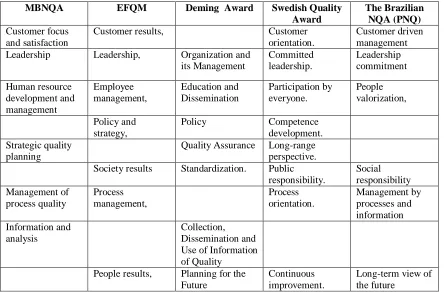
[image:5.612.35.480.444.739.2]The number of values varies between different sources. For example the European Quality Award is based on eight values and the Malcolm Baldrige National Quality Award is said to be based on 11 values. There are similarities between most national quality awards, regarding, for example, criteria and award processes. They are presented in Table No. 1
Table No. 1: Similarities of core values among the different award models.
MBNQA EFQM Deming Award Swedish Quality
Award
The Brazilian NQA (PNQ)
Customer focus and satisfaction
Customer results, Customer orientation.
Customer driven management Leadership Leadership, Organization and
its Management Committed leadership. Leadership commitment Human resource development and management Employee management, Education and Dissemination Participation by everyone. People valorization, Policy and strategy,
Policy Competence development.
Strategic quality
planning
Quality Assurance Long-range perspective.
Society results Standardization. Public
responsibility. Social responsibility Management of process quality Process management, Process orientation. Management by processes and information Information and analysis Collection, Dissemination and Use of Information of Quality
People results, Planning for the Future
Continuous improvement.
ISSN 2250-3153
Control Learning from others.
Learning Alliances and
resources,
Faster response. Proactive actions and rapid response Analysis Management by
facts. Interaction. Prevention. Quality and operational results
Key results Results Results orientation
From the above it can be summarized to about 14 core values that form the critical criterion for an award achievement. Hereinafter in this paper all the discussions are referred as the Award. It would be interesting to how they correspond to the Six Sigma philosophy. They are presented in Table 2.
Table 2: Core values that are critical for an Award, and how they correspond to Six Sigma
Core value of the Award Six Sigma Philosophy
1 Policy, and strategy, Six Sigma level performance in all spheres at a Business level.
2 Long-range perspective. Long-term view of the future, Planning for the Future, Alliances and resources,
The objective is very clear. From whatever is the present level, 3 or 4 sigma, to reach to 6 sigma levels.
3 Leadership, Leadership commitment, Committed leadership.
This is an area a learning is required. 4 Customer driven management, Customer focus
and satisfaction, Customer orientation, Customer results,
This is again totally customer focused, driven, works for eliminating all wastes in organization to deliver full value to the customer, in the process improving its own bottom line.
5 Organization and its Management, Management by facts. Management by processes and information, Management of process quality
Totally a data driven approach, and strives for improving the process capability.
6 Process management, Process orientation. Prevention. Proactive actions and rapid response, Faster response.
After analyze phase, the improve phase deals with all these preventive and proactive actions, followed y control activities for long term sustainability.
7 Quality and operational results, Strategic quality planning Quality Assurance
These are the whole crux of Six Sigma. 8 Continuous improvement Moving towards 6 sigma in itself is continuous
improvement. 9 Human resource development and
management, Employee management, Participation by everyone. People results, People valorization
The Six Sigma infrastructure helps in developing people. however, the target should be that every employee should be a minimum of a green belt. This is to be learnt.
10 Learning, Learning from others. Education and Dissemination, Competence development
The blackbelt, green belt trainings are followed in the organizations.
11 Collection, Dissemination and Use of Information of Quality, Information and analysis
Define, measure and analyze phases are totally information collection, measure and analysis. 12 Analysis, Control, Interaction. Standardization. Analysis, control are prime of DMAIC
philosophy. 13 Social responsibility, Public responsibility.
Society results
ISSN 2250-3153
4.0 Integration
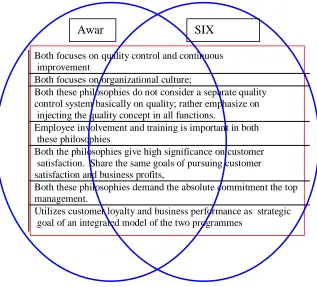
[image:7.612.48.365.175.462.2]With so many similarities, between the award criterion and Six Sigma we can see congruence of both the philosophies we can achieve an integration. The Integration model with an inbuilt some commonalities is presented in Fig. No.1.
Fig. 1:Integration model of the Awards and Six Sigma
5.0 What can Six Sigma learn from these award criterions?
We examine what Six Sigma can learn from each core value of award criterion. We shall see one by one. The views of Karathanos (1999), Byrne and Norris (2003), Miguel et al (2004), Eriksson and Garvare (2005), McCarthy and Greatbanks (2006), are also taken.
5.1 Leadership
The Quality/excellence award framework is concerned with examining and judging how an organization’s senior leaders establish and implement key organizational values, reinforce the importance of customer focus, set forth short and long-term direction, and establish and communicate performance expectations to employees.
• As part of this, the process seeks to identify how senior leaders empower employees, foster innovation, promote organizational nimbleness and promote organizational and employee learning.
• The assessments help organizations understand where their leadership skill gaps may lie—what needs to be done to improve leadership effectiveness and create a more customer centric culture. They can determine how, where and why top leadership must be involved in driving overall organizational performance and specific performance initiatives, practices and results. The awards’ framework clearly recognizes the need for visionary leadership. An organization’s senior leaders should set direction and create a customer focus, clear and visible values and high expectations
• Through their behavior and actions, senior leaders should serve as role models in planning, communications, coaching, development of future leaders, review of organizational performance and employee recognition.
Both focuses on quality control and continuous improvement
Both focuses on organizational culture;
Both these philosophies do not consider a separate quality control system basically on quality; rather emphasize on injecting the quality concept in all functions.
Employee involvement and training is important in both these philosophies
Both the philosophies give high significance on customer satisfaction. Share the same goals of pursuing customer satisfaction and business profits,
Both these philosophies demand the absolute commitment the top management.
Utilizes customer loyalty and business performance as strategic goal of an integrated model of the two programmes
ISSN 2250-3153
• Leadership must communicate new work expectations to employees (for example, by encouraging a fact based, measurable approach to identifying problems and improving how work gets done). Leaders must generate quick win opportunities from process improvement activities to give their projects momentum.
• And they must work to sustain success with process improvement activities and projects over the long term by driving changes in the organization’s culture (such as by creating new reward and recognition systems) to support new ways of working.
• These proven leadership practices can be readily applied to driving the achievement of quality or process improvement goals, identified as part of the award assessments. In fact, doing so will give those quality and process improvement initiatives increased vigor and likelihood of success.
• Here’s where the power of Six Sigma leadership principles can be brought directly into play as the machinery to help launch, manage and sustain quality or process improvement initiatives over time. This occurs readily because the Six Sigma methodology provides a clear and unmistakable path to drive robust enterprisewide quality and process improvement.
• But to ensure full success, they must also make a strong business case to their organizations about why change (Six Sigma process improvement, for example) is so critical to driving business results and ensuring customer loyalty.
• As leaders ask themselves some critical and embarrassing questions related to customers like Do we consistently fulfill customers’ requirements, or are there gaps in our performance? How do we precisely measure our customers’ view of value? Where does our business performance stand in relation to our competitors? Do we exceed customer expectations, or do we have significant problems with customer satisfaction, loyalty and retention? Do existing improvement initiatives and activities bring continuous, sustainable improvement to business processes (reductions in defects and cost or improvements in productivity and profitability)? Or, has the organization’s business performance plateaued? They not only become increasingly customer centric but also start to develop a finely tuned set of performance measures to drive organizational performance and successfully manage and monitor that performance going forward.
6.0 Conclusions
We have identified that one of the weaknesses of Six Sigma is leadership. From the above now we see that participation in awards can strengthen the leadership in planning organizing leading, controlling and the training of Six Sigma, a state of the art change methodology.
References
1 Black K and Revere L (2006), Six Sigma arises from the ashes of TQM with a twist, International Journal of Health Care Quality Assurance, 19 (3), 259-266.
2 Byrne G and Norris B (2003), Drive Baldrige Level Performance- Baldrige Provides The Framework, Six Sigma, The Methodology. Six Sigma Forum Magazine, May 2003, 13-21
3 Eriksson H and Garvare R (2005), Organisational performance improvement through quality award process participation, International Journal of Quality & Reliability Management, 22 ( 9), 894-912.
4 Folaron J (2003), The Evolution of Six Sigma, Six Sigma Forum Magazine, 2 (4), 38- 44.
5 Grover RA, Walker HF. (2003) Changing from Production to Quality: Application of the Situational Leadership and Transtheoretical Change Models, Quality Management Journal, 10 (3), 8-24.
6 http://www.efqm.org/the-efqm-excellence-model
7 http://www.fnq.org.br/english
8 http://www.nist.gov/baldrige/
9 http://www.siq.se/Home.htm
10 https://www.juse.or.jp/deming_en/award/
11 Jitpaiboon T and Rao S S (2007), A meta-analysis of quality measures in manufacturing system, International Journal of Quality & Reliability Management, 24 (1), 78-102.
12 Karathanos D, (1999),Using the Baldrige Award Criteria to Teach an MBA-Level TQM Course, QMJ, 6, ( 1), 20-28.
13 Karuppusami G and Gandhinathan R (2006), Pareto analysis of critical success factors of total quality management-A literature review and analysis, The TQM Magazine, 18(4), 372-385.
14 KlefsjoÈ B, Wiklund H and Edgeman R L. (2001), Six Sigma seen as a methodology for Total Quality Management, Measuring Business Excellence, 5(1), 31 -35.
15 Kuei CH, Madu CN. (2003) Customer-centric Six Sigma quality and reliability management, International Journal of Quality & Reliability Management, 20 (8), 954 - 964.
16 McCarthy G and Greatbanks R (2006), Impact of EFQM Excellence Model on leadership in German and UK organizations, International Journal of Quality & Reliability Management, 23 (9), 1068-1091.
ISSN 2250-3153
18 Raisch T, Anderson J, Krogman K and Krueger B (2001), Six Sigma, Current Quality Mini-Paper, Iowa State University, Ames, IA
19 Smith, M. (2003) Business Process Design: Correlates of Success and Failure, Quality Management Journal, Vol. 10, No. 2, pp. 38-49
20 Sun H, Li S, Ho K, Gertsen F, Hansen P and Frick J (2004), The trajectory of implementing ISO 9000 standards versus total quality management in Western Europe, International Journal of Quality & Reliability Management, 21(2), 131-153.
21 Tarı J J (2005), Components of successful total quality management, The TQM Magazine, 17 (2), 182-194
22 Wisner J D and Eakins S G. (1994), A Performance Assessment of the US Baldrige Quality Award Winners, International Journal of Quality & Reliability Management, 11 (2), 8-25.
Author –. K.P. Rao is a Mechanical Engineer with a Diploma in Business Management, Post Graduate Diplomas in Energy Conservation and Management, and Operations Research. He was a distance Doctoral Research student in Six Sigma from Birla Institute of Technology and Science (BITS), Pilani, India. He worked actively in Six Sigma projects for his former employer Ultratech cement Ltd, Rawan, India. He was a senior member of ASQ. He can be reached at [email protected].
Correspondence Author – K P Rao
E-mail address: [email protected]