ISSN 2250-3153
Environmental sustainability and corporate
performance: The shareholders` perception
TAIWO, Oluwasikemi Janet (Corresponding author)
Department of Accounting, School of Management Sciences, Babcock University, Ilishan Remo, Nigeria
E-mail: [email protected]
Tel: +234 8166610544
OWOLABI, Babatunde Ayodeji
Department of Accounting, School of Management Sciences, Babcock University, Ilishan Remo, Nigeria
E-mail: [email protected]
DOI: 10.29322/IJSRP.9.10.2019.p9464
http://dx.doi.org/10.29322/IJSRP.9.10.2019.p9464
ABSTRACT
This study examined the effect of environmental sustainability on corporate performance from shareholders perception. The activities of companies had usually adverse impacted the environment. Business organisation and the environment cannot exist in isolation without demands for each other. Sustaining the environment where businesses operate create value for the organisation. Theoretically, shareholders are concern about returns on the short term while environmental sustainability is concern about meeting future needs of the stakeholders based on present use of the ecosystem. Therefore, managers of manufacturing companies are concerned with how to maximize the wealth of shareholders while engaging in environmental sustainability. This necessitated the study. The study adopted
ex-post facto and content analysis research design. The population of this study is made up of 35 quoted manufacturing companies
listed on Nigerian Stock Exchange (NSE) as at the end of June, 2018. Purposive sampling technique was adopted in selecting the sample size of 12 companies that were able to meet up with the criteria. Secondary source of data was used. Corporate performance was measure by proxy of financial performance (EPS). Environmental sustainability was measured by considering guidelines as stated in GRI and NSE sustainability framework in relation with the environmental practices disclosed in the annual reports. Control variable is company size. The study adopted descriptive statistics and pooled Ordinary Least Square (OLS) to analyse the data. The result of the study indicated that there is a positive relationship between environmental sustainability and corporate performance. The study recommends that in making decisions on which organisation to invest in, investors should not consider individually environmental sustainability practices or the size of quoted manufacturing firms in Nigeria, rather, consider them alongside social sustainability practices, governance sustainability practices and other financial sustainability practices.
Keywords: environmental sustainability, corporate performance, EPS, shareholders` perception
1.0 Introduction
The environment where businesses operate is a dynamic and complex one which determines the goals and outlooks of the business
organisations. The business organisation and the environment cannot exist in isolation without demands for each other. Few years
back, there was an experience of climate change and global warming which were adverse effects of organisations` operations to the
environment (Haanaes, Arthur, Balagopal, Kong, Reeves, Velken, Hoppins & Kruschwitz, 2011). Sustainability involves satisfying
present needs in such a way that it will not adversely affect satisfying the needs of future generations. As well, environmental
ISSN 2250-3153
2018). It is necessary for businesses to operate within environmental standards so as to maintain continuous relationship with its
society.
Environmental sustainability can be ensured by firms, by analyzing the input and output indicators in the course of the supply chains
so as to minimize environmental impacts. Firms consider inputs such as energy, material and water as well as outputs such as wastes,
emissions and effluents in their operations (Gunathilaka & Gunawardana, 2015). Globally, there is increase in the pursuit for
sustainability and environmental awareness. Many companies are developing interests in environmental sustainability to enjoy
competitive advantage so as to enhance their corporate performance (Acti, Lyndon & Bingilar, 2013). However, the pursuit for
environmental sustainability is a bit low within the developing countries due to lack of organized pressure groups and weak
government regulations to regulate the behaviours of the companies (Vinayagamoorthi, Murugesan & Kasilingam, 2015).
In the 1800s, the business environment in Nigeria was exploited by some firms during the period of oil boom. The businesses used the
environment to their own advantages (Eruemegbe, 2015). In recent times, organizations realized that the natural resources can be
utilized in such a way that value will be created for its shareholders and other stakeholders, and there will still be minimum impact on
the environment. This is because a reduction of the environmental hazard or impact will lead to an increase in a firm`s profitability
(Gunathilaka & Gunawardana, 2015). From shareholders` perception, companies are to ensure environmental sustainability by
utilising its resources and recycling of wastes to minimize cost and increase profit so that on the long-run it can maximize
shareholders` wealth (Che-Ahmad, Osazuwa & Mgbame, 2015). Also, shareholders like to associate with companies that engage in
environmental protection activities. Studies such as Gunathilaka and Gunawardana (2015) suggested that companies that engage in
environmental protection should be recognised and additional significant value should be added to them.
Sustaining the environment where businesses operate create value for the stakeholders. The recycling of waste, treatment of liquid
effluents, reuse of materials, production of sustained quality goods and controlling emissions through reduction in furnace oil
consumption, all lead to innovation and cost savings for the companies. Nowadays, organizations try to differentiate themselves by
being environmentally concern which adds values to their products. Theoretically, shareholders are concern about returns on the short
term while environmental sustainability is concern about meeting future needs of the stakeholders based on present use of the
ecosystem. Therefore, shareholders are concerned with how managers of manufacturing companies can maximize their wealth while
engaging in environmental sustainability. This study seeks to determine the relationship between environmental sustainability and
shareholders` perception of corporate performance of quoted manufacturing firms in Nigeria.
The research hypothesis is stated as:
H0: Environmental sustainability has no significant relationship with corporate performance of quoted manufacturing firms in Nigeria
from shareholders` perception.
2.0 Literature Review
2.1 Conceptual Review
ISSN 2250-3153
Environment in totality can be referred to as the surroundings where a business operates. Environment consists of various factors and
conditions that affect the development of a business (Atsegbua, 2002). It determines what an individual or an organisation can
achieve. An organisation exists in the environment. No firm is an island or operates in vacuum and therefore needs environment to
survive its existence. Organizations are to consider the environment while setting their goals and carrying out their operations
(Eruemegbe, 2015). It provides inputs to the firms and receives their outputs. In a nutshell, environment provides all the elements a
firm needs to support its existence including the market for its products and services (Oginni & Adesanya, 2013).
Sustainability
Sustainability can be referred to as the ability to maintain something for future use. There are several definitions of sustainability
(Ehrenfeld, 2008). It also means not making the future generation suffers the adverse effect of the actions of previous generations. The
concept of sustainability development, corporate social responsibility, sustainability and triple bottom line are often used
synonymously though they have different historical backgrounds (Ucheagwu, 2019). However, they all aim at being ethically,
socially, environmentally and economically responsible. At firms` level, sustainability encompasses economic, social and environmental sustainability which can be translated into the ‘3Ps’ namely profit, people and planet respectively (Oginni & Adesanya,
2013).
Shareholders` perception of environmental sustainability and corporate performance
Environmental sustainability is a component of sustainability practices. From the explanations of environment and sustainability
above, environmental sustainability is the ability to meet the needs of individuals and firms in the environment without adversely
affecting the capacity to meet future needs. It is crucial to social, economic and governance sustainability. Specifically, environmental
sustainability means meeting the needs of current and future generations without jeopardizing the health of the ecosystem (Morelli,
2011). Organizations operate in ecological environment and their operations do have destructive impact on the ecosystem (Okafor,
2018). Some firms engage in proactive measures to ensure environmental management of pollutions and wastes while others don’t.
The proactive measures include emission reduction, waste treatment, reduction of pollution, production of quality products,
conservation of energy, reuse of materials and treatment of water. According to Agan, Acar and Borodin (2013), disposal of waste
without treatment can cause air pollution and contamination of ground water.
In the long-run, engaging in environmental sustainability will save companies some expenses. For instance, a firm that is energy
efficient will be able to save substantial amount from its energy expenses. In the modern business world, investors and customers are
aware of environmental and social issues. They will prefer to be associated with and invest in environmentally sustainable businesses
(Pettinger, 2018). Environmental sustainability will rather increase the profitability of companies than having a negative impact on
them. This is because there will be reduction in expenses (such as cost of compensating for destruction and cost of litigation) and
increase in competitive advantage (Failte Ireland, n.d).
ISSN 2250-3153
Prior to 1988, there were no mechanisms in Nigeria to ensure protection of environmental resources and enforce environmental laws.
An attempt by a foreign company to drop toxic waste in Niger Delta changed the situation and led to the establishment of Harmful
Waste Decree 42 of 1988 which makes dropping of harmful waste in Nigeria a criminal offence. This also led to the establishment of
an agency to oversee the protection of environment in Nigeria. The agency is Federal Environmental Protection Agency (FEPA) as
established through decree 58 of 1988 and decree 59 of 1992 (as amended) (NESREA, n.d). In 1999, FEPA and some other relevant
departments in other ministries were merged to form Federal Ministry of Environment though without an enabling law. Filling this
gap led to the establishment of National Environmental Standards and Regulations Enforcement Agency (NESREA) which annulled
the FEPA. All these were in respect of ensuring that Nigeria environment is protected and conserved (Acti, Lyndon & Bingilar, 2013).
Global Reporting Initiatives (GRI) and Nigerian Stock Exchange (NSE) Sustainability Framework.
The GRI guideline provides the principle for reporting and also, the standards to guide organizations in the disclosure and preparation
of sustainability reports. The guidelines also provide the manual for implementation of sustainability practices and reporting for firms
irrespective of their sector, size and location (Isa, 2014). The GRI guideline serves as international reference for firms that want to
disclose their economic, social, environmental and governance practices. The guideline was developed through a process of
multi-stakeholders involvement globally including the representatives of government agencies and regulators. The guideline aim at ensuring
that information disclosed in sustainability reports by firms are accurate, transparent and comparable for stakeholders` decision
making (GRI, 2011).
The Nigerian Stock Exchange (NSE) commenced the implementation phase for sustainability reporting in 2015. NSE sustainability
framework provides the guideline for disclosure of sustainability practices by its listed firms to provide the information to their
stakeholders for decision making. Also, the framework set out the indicators of economic, environmental, social and governance
practices that the quoted firms are to report in their annual reports. Reporting the sustainability indicators show that the companies
engaged in sustainability practices (NSE, 2016).
2.2 Theoretical Framework
Shareholders` Theory
The shareholders` theory was proposed by Friedman (1970). The theory holds that maximization of profit accruing to shareholders is
the primary objective of carrying on a business. The theory assumes that the aim of profit making makes the market vibrant and such
drives the well-being of the economy. The assumption of the theory is also that the role of a business in its existence is majorly to
increase the wealth of its shareholders through increase in dividend or increased share price. Therefore, any activity engaged in by the
ISSN 2250-3153
When firms engage in environmental sustainability, they carry out recycling of waste, treatment of liquid effluents, conservation of
energy, reuse of materials, production of sustained quality goods and controlling emissions through reduction in furnace oil
consumption. When such activities are done within the stipulation of the law, they results to strategic benefits for the firms.
Environmental sustainability leads to reduction in expenses/costs to the companies because resources will be used maximally and the
firms will have to incur no or minimum cost of compensating the environment for destructions. In the medium or long term, this will
accumulate to increase in profit for the organizations. The increased profit will result to increase in shareholders wealth, thereby;
managers are able to use environmental sustainability to satisfy shareholders` interest.
2.3 Empirical Review
Okafor (2018) studied the effect of environmental cost accounting and reporting on the financial performance of quoted oil companies
in Nigeria. The study found out that a significant and positive relationship exists between environmental cost accounting and reporting
on the financial performance. This implies that spending on matters of environment improves the financial performance of quoted oil
companies in Nigeria.
Hassel, Nilsson and Nyquist (2005) studied the effect of environmental information on the market value of listed companies in
Sweden. The study adopted a residual income valuation model. The findings show that there is value relevance for disclosure of
environmental responsibility done by the sampled companies. This is because the disclosure affects positively the future earnings of
the listed companies. The study recommended that companies that pollute the environment from their operations may be eroded of
their future solvency which will result to reduction in earnings.
The International Federation of Accountants (IFAC) (2005) in its guideline document stated that many firms are looking for creative
and cost-efficient ways of reducing environmental impacts due to environmental pressure. Companies realized that engaging in
reduction of environmental impacts through efficient use of raw materials, energy and water has its monetary rewards and as well
improves environmental performance.
Ezejiofor, John-Akamelu and Eucharia (2016) examined the effect of sustainability environmental cost accounting measure on the
performance of corporate organizations in Nigeria. The study adopted ex-post facto research design. Time series data were sourced
from annual reports of the company for the period 2009 to 2013.the data were analysed using regression analysis. The findings of the
study shows that environmental cost impact positively on revenue and profit generation of companies in Nigeria. The study
recommended that multinational and indigenous companies in Nigeria should ensure strict adherence to environmental policies so as
to have continuous increase in their performance.
Okoye and Ezejiofor (2013) also examined the impact of sustainability environmental accounting in enhancing corporate productivity
and economic performance. The study adopted Pearson Product Movement Correlation Co-efficient to test its hypotheses. The study
found out that sustainable environmental accounting has significant impact on corporate productivity of companies which as well
promote corporate growth.
Acti, Lyndon and Bingilar (2013) examined the effect of environmental cost on corporate performance of oil companies in the Niger
ISSN 2250-3153
for the period 2001 to 2011. The multiple regression analysis was adopted. Corporate performance was proxy with Return on Total
Asset (ROTA) and environmental practices was proxy with Community Development Cost (CDC), Waste Management Cost (WMC)
and Employee Health and Safety Cost (EHSC). The study found out that environmental cost and corporate performance has
significant relationship. Also, corporate conflict with the host communities can be resolved by engaging in environmental
sustainability. The study recommended that to have a peaceful atmosphere needed by companies to enhance their productivity and
performance, the oil companies should adopt an environmental costing system.
Gunathilaka and Gunawardana (2015) carried out a study on “an impact of environmental practices on financial performance: A literature review”. The study reviewed both quantitative and qualitative studies that examined the impact of environmental practices
on financial performance of firms. Total numbers of 120 previous studies were reviewed by considering the variables of
environmental practice and financial performance, the sample size, statistical methods and the findings of the studies. The findings of
the reviewed studies were mixed in nature, some has positive results, some has negative and some has no result with insignificant
relationships. From the sample studies, 52% has positive relationship while the remaining 48% showed negative or no relationship.
The study concluded that the inconsistency in outcomes of the studies reviewed may be due to absence of a framework that clearly
state what constitutes environmental practices.
The related studies reviewed above considered either environmental practices, financial performance or both variables. However, their
proxy for financial performance includes Return on Assets, Profit Margin and Tobin`s Q. The studies did not consider corporate
performance by looking at it from Shareholders perception. There is also scanty of studies focused mainly on environmental
sustainability as most recent researches focus on the entire dimensions of sustainability practices. This study has filled in these gaps
by considering the proxy Earnings Per Share (EPS) which is a financial aspect of corporate performance and focusing on
environmental sustainability.
3.0 Methodology
This study adopted ex-post facto and content analysis research design to examine the impact of environmental sustainability on
corporate performance from shareholders` perception. The population of this study is made up of 35 quoted manufacturing companies
(consisting of 21 consumer goods and 14 industrial goods companies) listed on Nigerian Stock Exchange (NSE) as at the end of June,
2018. Manufacturing sector is selected because of the frequent consumption of environmental inputs of energy, material and water as
well as frequent release of outputs such as wastes, emissions and effluents. Purposive sampling technique was adopted in selecting the
sample size. The technique was used to select the companies that meet up with the following criteria: (1) the company must have been
listed on NSE from 2008 to 2017 and (2) the company must have its annual report accessible on its website for the period under study
and it must contains report on environmental sustainability.
The sample size is made up of 12 companies (that is, 10 consumer goods companies and 2 industrial goods companies) that were able
to meet up with the criteria. The companies are listed out in Appendix 1. Secondary source of data was adopted for the study by
extracting data from the published annual reports of the sampled companies, Global Reporting Initiatives (GRI) framework and
Nigerian Stock Exchange (NSE) sustainability framework. The content analysis was used to generate a checklist on environmental
sustainability from both Global Reporting Initiatives (GRI) framework and Nigerian Stock Exchange (NSE). The environmental
sustainability practice includes: Product/service responsibility, water, energy, waste management and efficient, compliance,
ISSN 2250-3153
Corporate performance is measure by proxy of financial performance. This is because financial performance is a primary measure of
corporate performance to the shareholders. Therefore, financial performance was proxy with Earnings Per Share (EPS).
Environmental sustainability was measured by considering guidelines as stated in GRI and NSE sustainability framework in relation
with the environmental practices disclosed in the annual reports. Ching, Gerab and Toste (2017) method was adopted for
environmental sustainability where: (a) when all information is disclosed, a score of 1 is give; (b) when almost all information is
given, a score of 0.75 is given; (c) when information is partially disclosed a score of 0.50 is given; (d) when information is briefly
disclosed a score of 0.25 is given and (e) when there is no information given a score of 0 is given. With this, a final score is obtained
for each year of each company by obtaining the average score of the total score for the environmental sustainability indicators adhered
to as illustrated in Appendix 2. The control variable used for the study is company size represented by log of total assets. Earnings Per
Share (EPS) is calculated by using the formular:
EPS ₌ Profit After Tax less Preference dividend
Average Outstanding Shares
The model is specified as:
EPSit = β0 + β1ESit + β 2CSZit + Uit
Where:
EPS =Earnings Per Share (Dependent variable)
ES = Environmental Sustainability (Independent Variable)
CSZ = Company Size (Control Variable)
Uit = Error Term
4.0 Data Analysis and Interpretation
The data gathered from 2008 to 2017 annual reports of the 12 sampled companies on corporate performance (proxy with financial
performance, that is EPS), company`s size and environmental sustainability (measured with average compliance with indicators of
product and services responsibility, waste management, water, energy. emission, environment grievance mechanism and compliance)
were analyzed and the result is discussed below.
ISSN 2250-3153
The descriptive statistics shows the mean, maximum, minimum and standard deviation of the data collected from the 12 quoted
companies over 10 years (2008 to 2017) for the dependent variable (EPS), independent variable (Environmental sustainability) and
[image:8.612.30.517.160.248.2]control variable (Company’s Size).
Table 4.1: Summary of Descriptive Statistics
Variable Mean Max. Min. Std. Dev. Obs.
EPS 7.3548 291 -251 47.3991 120
ES .4135 .86 .11 .2595 120
CSZ 7.5493 8.99 -.33 1.5643 120
Source: Author`s computation (2019). Stata Output.
For EPS, the mean value is 7.3548. This means that on the average, the sampled manufacturing companies generated
high returns for their shareholders and therefore, they have the capacity for distributing high dividends. The standard
deviation of 47.3991 shows that there is high difference in the capacity of the sampled firms in generating profits.
The maximum value of 291 chows that some quoted manufacturing firms are generating high returns for their
shareholders while the minimum value of -251 shows that some firms are making losses.
For the ES, the mean is 0.4135. This means that on the average, the sampled manufacturing firms engaged in
environmental sustainability practices to the extent of 41% as contained in the Global Reporting Initiatives and
Nigerian Stock Exchange sustainability framework. The Standard deviation of 25.9% means that there`s low level of
disparity in practices of environmental sustainability by the sampled firms. The maximum and minimum values of
0.86 and 0.11 respectively means that some firms practices environmental sustainability on the high level while
some does it on the low level.
The CSZ is represented by the logarithm of total assets and it has the mean value of 7.5493. This implies that on the
average the assets of the sampled firms are enough to carry on their activities. The standard deviation of 1.5643
means that there is high dispersion in the volume of assets held by the firms. This is supported by the maximum and
minimum values of 8.99 and -0.33 respectively.
Regression Analysis
This aspect presents and discusses the regression result based on pooled Ordinary Least Square (OLS). Prior to the choice of using
pooled OLS, the study estimated the fixed and random effect models to capture the individual firm effects. Hausman test was
conducted to determine the efficient model from the fixed and random effect models. However, the Hausman test result indicated that
the model fitted on these data fails to meet the asymptotic assumptions of the Hausman test. This lead to the conduct of the
ISSN 2250-3153
pooled OLS will be used. The result of Breusch-Pagan Lagrangian multiplier test shows that Pob>chi2 is 1.0000 which is
[image:9.612.33.519.131.264.2]insignificant; therefore, pooled OLS was used for the analysis.
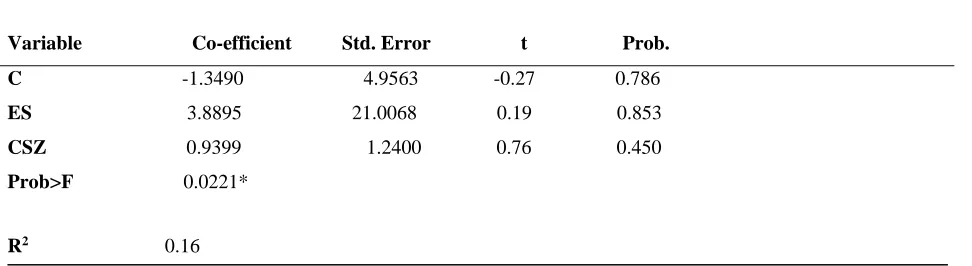
Table 4.2: Pooled OLS Result
Variable Co-efficient Std. Error t Prob.
C -1.3490 4.9563 -0.27 0.786
ES 3.8895 21.0068 0.19 0.853
CSZ 0.9399 1.2400 0.76 0.450
Prob>F 0.0221*
R2 0.16
Source: Author`s computation (2019). Stata Output.
*: significant at 5% level
Based on the pooled OLS result, the model can now be written as EPS = -1.3490+ 3.8895ES + 0.9399CSZ + ϵit. Table 4.2 provides
answer to the question of the study which seeks to determine the relationship between environmental sustainability and corporate
performance from shareholders` perception. The result indicates that the explanatory variables, which are the environmental
sustainability and company`s size of the 12 sampled manufacturing companies are positively related to earnings per share. This is
observed from the regression coefficients of 3.8895 and 0.9399 respectively. This implies that an increase in environmental
sustainability practices will lead to 388.95% increase in earnings per share. The coefficient of company`s size of 0.9399 implies that
an increase in firm`s size will leads to 93.99% increase in EPS. The result also shows that the explanatory variables are not
statistically significant with the dependent variable such that the Prob. of 0.853 and 0.450 are greater than 0.05 level of significant. In
addition, the R2 is 0.16%, this implies that environmental sustainability and company`s size are responsible for 0.16% variation in
EPS while some other factors are responsible for the remaining 99.84%. The insignificant of the explanatory variables and the low
level of the R2 means that when the shareholders are on the lookout for viable and sustainable companies to invest in, environmental
sustainability and company`s size individually are not significant factors for changes in corporate performance which is not different
from the view of Gunathilaka & Gunawardana, (2015). The Prob>F is used to explain the overall significance of the explanatory
variables. The F-statistics is 0.0221 which is significant at 5% level. This implies that the explanatory variables are jointly significant
in explaining the dependent variable (EPS).
Based on the results in table 4.1 and 4.2 above, environmental sustainability with the mediating role of company size has positive
significant relationship with corporate performance from shareholders` perception. This is as indicated by the coefficients and
F-statistics which is positive and significant at 5% level. This is not different from the views of Ezejiofor, et al. (2016) and Ucheagwu
(2019). Thus, the study rejects the null hypothesis that environmental sustainability does not have significant effect on corporate
performance of quoted manufacturing firms in Nigeria from shareholders` perception and accept the alternative hypothesis that
environmental sustainability has significant effect on corporate performance of quoted manufacturing firms in Nigeria from
ISSN 2250-3153
5.0 Conclusion and Recommendation
This study examined shareholders` perception of how environmental sustainability has been able to influence corporate performance
of quoted manufacturing firms in Nigeria. Earnings per share (EPS) was used to proxy corporate performance since it is suitable for
shareholders` perception. The result of the study indicated that there is a positive relationship between environmental sustainability
and corporate performance. The relationship is also statistically significant when the explanatory variables are jointly considered. The
study concludes that when manufacturing firms engage in environmental sustainability in line with the size of the firm, there will be
maximization of shareholders wealth which is also as stated by shareholders` theory.
Therefore, the study recommends that in making decisions on which organisation to invest in, investors should not consider
individually environmental sustainability practices or the size of quoted manufacturing firms in Nigeria, rather, consider them
alongside social sustainability practices, governance sustainability practices and other financial sustainability practices.
References
Acti, I. M., Lyndon, M. E. & Bingilar, P. F. (2013). The impact of environmental cost on corporate performance: A study of oil
companies in Niger Delta States of Nigeria. Journal of Business & Management, 2(2), 1-2.
Agan, Y., Acar, M. F. & Borodin, A. (2013). Drivers of environmental process and their impact on performance: A study of Turkish
SMEs. Journal of Cleaner Production. 5(1), 23-33.
Atsegbua, K. (2002). Changing organization: Essays on the development and evolution of human organization, New York:
McGraw-Hill Company.
Che-Ahmad, A., Osazuwa, N. P. & Mgbame, C. O. (2015). Environmental accounting and firm profitability in Nigeria: Do
firm-specific effects matter?. The IUP Journal of Accounting Research & Audit Practices, 14(1), 44.
Ching, H. Y., Gerab, F. & Toste, T. H. (2017). The quality of sustainability reports and corporate financial performance: Evidence
from Brazilian listed companies. Journal of SAGE Open, 1-9. DOI: 10.1177/2158244017712027.
Ehrenfeld, J. R. (2008). Sustainability needs to be attained, not managed, sustainability. Science, Practice, & Policy, 4 (2), 1-3.
Eruemegbe, G. O. (2015). Impact of business environment on organization performance in Nigeria: A study of Union bank of Nigeria.
European Scientific Journal, 1857 – 7881, 479-481.
Ezejiofor, R. A., John-Akamelu, R. & Eucharia, C. E. (2016). Effect of sustainability environmental cost accounting on financial
performance of Nigerian corporate organizations. International Journal of Scientific Research and Management, 4(8),
ISSN 2250-3153
Failte Ireland (n.d). Environmental sustainability in business. Wales Trade & Investment.
Global Reporting Initiative (2011). GRI G3: Sustainability reporting guideline.
Global Reporting Initiative (2015). GRI G4: Sustainability reporting guideline.
Gunathilaka, L. F. & Gunawardana, K. D. (2015, December). An impact of environmental practices on financial performance: A
literature review. Paper presented at the 12th International Conference on Business Management. Retrieved from
https://www.researchgate.net/profile/Kennedy_Gunawardana/publication/287311125_An_impact_of_environmental_practic
es_on_financial_performance_a_literature_review/links/56753ef508ae0ad265c00fac/an-impact-of-environmental-practices-on-financial-performance-a-literature-review.pdf?origin=publication_detail.
Haanaes, K., Arthur, D., Balagopal, B., Kong, M. T., Reeves, M., Velken, I., Hoppins, M. S. & Kruschwitz, N. (2011).
Sustainability: The ‘Embracers’ seize advantage. MIT Sloan Management Review Research Report, 1–28.
Hassel, L., Nilsson, H. & Nyquist, S. (2005). The value relevance of environmental performance. European Accounting Review,
14(1), 41-46.
International Federation of Accountants (2005). International Guideline Document: Environment Management Accounting. New
York.
Isa, M. A. (2014). Sustainability reporting among Nigeria food and beverages firms. International Journal of Agriculture and
Economic Development, 2(1), 3.
Morelli, J. (2011). Environmental sustainability: A definition for environmental professionals. Journal of Environmental
Sustainability, 1(1), 1-9.
NESREA (n.d). National Environmental Standards and Regulations Enforcement Agency: About us. Retrieved on 30th May, 2019
from https://www.nesrea.gov.ng/about-us/.
Nigerian Stock Exchange (NSE) (2016). Sustainability disclosure guideline. Retrieved on 30th May, 2019 from
http://www.nse.com.ng/regulationsite/IssuersRules/Sustainability%20 Disclosure%20Guidelines.pdf
Oginni, B. O. & Adesanya, A. S. (2013). Business environmental factors: Implications on the survival and growth of business
organisations in the manufacturing sector of Lagos metropolis. Business and Management Research, 2(3), 147-148.
Okafor, T. G. (2018). Environmental cost accounting and reporting on firm financial performance: A survey of quoted Nigerian oil
companies. International Journal of Finance and Accounting, 7(1), 1-6.
Okoye, P. V. C. & Ezejiofor, R. A. (2013). An appraisal of sustainability environmental accounting in enhancing corporate
productivity and economic performance. International Journal of Advanced Research 1( 8), 685-693.
Pettinger, T. (2018). Environmental sustainability: Definition and issues. Retrieved on 30th May, 2019 form
ISSN 2250-3153
Ucheagwu, C. J. (2019). Corporate sustainability practices and financial performance of firms listed on the Nigerian Stock Exchange
(Unpublished Ph.D`s thesis). Babcock University, Ilishan-remo, Ogun State.
Vinayagamoorthi, V., Murugesan, S. & Kasilingam, L. (2015). Impact of firms` profitability on environmental performance: Evidence
from companies in India. Mediterranean Journal of Social Sciences. 6 (1). 109–119.
APPENDIX 1
List of Sampled Companies
S/N Sampled Firm Sector
1. Dangote cement Industrial goods
2. Lafarge Nigeria Industrial goods
3. Dangote sugar refinery Nigeria Plc Consumer goods
4. Cadbury Nigeria Plc Consumer goods
5. Honeywell Flour Mills Plc Consumer goods
6. Flour Mills Nigeria Plc Consumer goods
7. Dangote flour Mills Plc Consumer goods
8. Guiness Nigeria Plc Consumer goods
9. PZ Cussons Nigeria Plc Consumer goods
ISSN 2250-3153
11. Nigeria breweries Plc Consumer goods
12. Nestle Nigeria Plc Consumer goods
Source: Researcher`s compilation (2019).
APPENDIX 2
Environmental Sustainability Indicators
S/N Indicators Year
1 Product/service responsibility
2 Water
3 Energy
4 Waste management and efficient
5 Compliance
6 Environmental grievance mechanism
7 Emissions
Total score
Average score
Source: Sustainability framework of GRI4 (2015) and NSE (2016)
APPENDIX 3
Variable | Obs Mean Std. Dev. Min Max ---+--- crossid | 120 6.5 3.466527 1 12 years | 120 2012.5 2.884324 2008 2017 eps | 120 7.354775 47.39914 -251 291 es | 120 .4135 .2595233 .11 .86 csz | 120 7.549333 1.564291 -.33 8.99
. hausman random fixed
---- Coefficients ----
| (b) (B) (b-B) sqrt(diag(V_b-V_B)) | random fixed Difference S.E.
ISSN 2250-3153
--- b = consistent under Ho and Ha; obtained from xtreg B = inconsistent under Ha, efficient under Ho; obtained from xtreg
Test: Ho: difference in coefficients not systematic
chi2(2) = (b-B)'[(V_b-V_B)^(-1)](b-B)
= -0.12 chi2<0 ==> model fitted on these data fails to meet the asymptotic assumptions of the Hausman test; see suest for a generalized test
. xttest0
Breusch and Pagan Lagrangian multiplier test for random effects
eps[crossid,t] = Xb + u[crossid] + e[crossid,t]
Estimated results:
| Var sd = sqrt(Var) ---+--- eps | 2246.679 47.39914 e | 2456.331 49.56139 u | 0 0
Test: Var(u) = 0
chibar2(01) = 0.00 Prob > chibar2 = 1.0000
. xtserial eps es csz
Wooldridge test for autocorrelation in panel data H0: no first order autocorrelation
F( 1, 11) = 449.613 Prob > F = 0.0000
. estat hettest
Breusch-Pagan / Cook-Weisberg test for heteroskedasticity Ho: Constant variance
Variables: fitted values of eps
chi2(1) = 11.16 Prob > chi2 = 0.0008
. reg eps es csz, robust
Linear regression Number of obs = 120 F(2, 117) = 3.94
Prob > F = 0.0221 R-squared = 0.0016 Root MSE = 47.763 --- | Robust
ISSN 2250-3153