Analysis on Mix Design of High Strength Concrete (HSC)
using IS: 10262-1982 and partial replacement of waste
marble aggregates as coarse aggregate
Debasmita Panda
*, Dr. (Prof.) P.K. Parhi
***
M.Tech Student, College of Engineering and Technology, Bhubaneswar
**
Professor, Department of civil Engineering, College of Engineering and Technology, Bhubaneswar
Abstract- This research paper includes the mix design of high strength concrete (HSC) concrete with specified characteristic compressive strength of 60N mm⁄ 2 according to IS-10262:1982. The waste marble chips are partially replaced as coarse aggregate. High strength concrete is a construction material with improved properties like strength, durability etc. than ordinary concrete. High strength concrete can be achieved through proper mix design process. Therefore, mix design plays an important role in the concrete technology. HSC can be achieved through using good quality of ingredient materials, following proper methods of casting and testing & calculations of mix design, and using comparatively low water-cement ratio. In this research, super-plasticizer is used as a chemical admixture to the concrete. This research is carried out to study the mix design of high strength concrete with partial replacement by waste marble chips.
Index Terms- Concrete, High Strength Concrete, IS: 10262-1982, Mix Design, Super-Plasticizer, Waste Marble Aggregates.
I. INTRODUCTION
Concrete is a most commonly used and preferred material for construction purpose throughout the world as it is durable, easy to make at constructional sites, easy to transport and place and it can be moulded into any desired shape and size. The main ingredients of concrete are easily available in most of the places. This makes concrete even more popular and preferred material for construction purposes.
According to IS 456:2000-Plain and Reinforced Concrete-code of practice, Concrete is generally classified as: Ordinary Concrete, Standard Concrete and High Strength Concrete (HSC). Ordinary concrete and Standard concrete may be defined as the concrete with specified characteristic compressive strength of 150 mm cube at 28 days between 10 to 20N mm⁄ 2 and 25 to 55 N mm⁄ 2 respectively. The high strength concrete may be defined as the concrete with specified characteristic compressive strength of 150 mm cube at 28 days between 60 to 80N mm⁄ 2.
Waste marbles are produced from marble industries. Every year, tons of marbles are getting wasted. Instead of using coarse aggregates, if these waste marbles can be utilized as coarse aggregate then the wastage amount can be minimized every year. By this, costs of construction can also be minimized as well as it can be better for our environment. The wastes of marbles can be
converted into aggregate by breaking it into small size pieces and can be used as replacement to coarse aggregate as well as it can be used as a replacement to fine aggregate by making its fine powder.
In this research, the concrete having grade M60 is mix designed and the waste marble aggregates are partially replaced in high strength concrete by 0%, 10%, 20% and 30% of weight of natural coarse aggregate used.
II. LITERATURE REVIEW
There are numerous research reports available on the mechanical and chemical properties of concrete. However, the research works carried out for the high strength concrete are found to be limited.
Mohammad Abdur Rashid and Mohammad Abul Mansur (2009) carried an experimental study on “Considerations in producing high strength concrete”. The targeted strengths of concretes were from 60 MPa to 130 MPa. A larger ratio of CA to FA (1.81) was considered in the study. While the variables considered were the water-cement ratio (from 0.34 to as low as 0.20). Test results are found to support the reviewed information on HSC production. Also, the water-cement ratio and the suitable admixtures with their optimum dosages are found to be the most important parameters for producing HSC.
According to Sanjay Srivastava, Dr S.S Jain, Dr M.P.S. Chauhan, (2014), in development of HSC, the aggregate of smaller size play very important role. Fineness modulus of aggregate play very important role in development of high strength concrete. It affects the strength greatly.
According to Mr. Sachin, Mr. Yudhvir Yadav (2016), in the mix design method for high strength concrete the smaller size aggregate plays very important role in the achievement of high compressive strength. With the increase of cement contents the strength of concrete increases.
III. MATERIALS USED
The ingredients of high strength concrete are: Cement, Fine aggregate, Coarse aggregate and water. Admixtures may be used to enhance some properties of the concrete. Here waste marble chips are replaced as coarse aggregate.
A. Cement
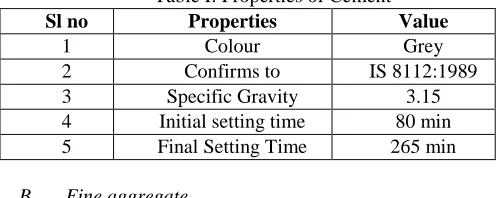
[image:2.612.315.556.210.264.2]It is one of the most important ingredients of concrete. It acts as a binder element in the concrete. In this research, Ramco OPC 43 grade cement is used. The properties of this cement are given in table below.
Table I: Properties of Cement
Sl no Properties Value
1 Colour Grey
2 Confirms to IS 8112:1989
3 Specific Gravity 3.15
4 Initial setting time 80 min
5 Final Setting Time 265 min
B. Fine aggregate
[image:2.612.36.287.226.325.2]In this research, River sand is used as fine aggregate. The properties of the river sand used are given in table below.
Table II: Properties of Fine Aggregate
Sl No Properties Value
1 Specific Gravity 2.74
2 Water Absorption 0.9%
3 Sieve Analysis Zone-III
4 Fineness Modulus 2.319
C. Coarse aggregate
[image:2.612.37.282.385.479.2]Stones made from Crushed rocks are used as coarse aggregate in this research work. The properties of coarse aggregate used are given in table below.
Table III: Properties of Coarse Aggregate
Sl No Properties Value
1 Specific Gravity 2.74
2 Water Absorption 0.5%
3 Sieve Analysis Confirming with
table-2 of IS-383:1970 4 Maximum size of
coarse aggregate
20 mm
D. Water
Water hydrates the cement in the concrete and makes the concrete workable.Water used in the preparation of concrete should be free from dirt and organic matters. Palatable water has been used throughout this research work.
E. Admixture
This is an additional ingredient in concrete. This may or may not be used. Admixture may be used in the concrete to enhance some properties like strength, durability, workability, to increase or decrease setting times etc. Here, Sikament Super-plasticizer is used as an admixture. It is dark brown coloured liquid. It increases the workability of the concrete, homogeneity and cohesiveness, strength & durability of concrete, water proofing property and decreases the final setting time of concrete. The properties of this super-plasticizer are given in table below.
Table IV: Properties of Super-Plasticizer
Sl No Properties Value
1 Specific Gravity 1.145
2 colour Dark brown
F. Waste marble aggregates
Waste marble pieces are broken into small pieces like aggregates. The nominal maximum size of marble aggregate used was 20 mm. the properties of the waste marble aggregates used are given in the table below.
Table V: Properties of Waste marble aggregates
Sl no properties Value
1 Specific gravity 2.77
2 Water absorption 0.5%
3 Fineness modulus 6.49
IV. MIX DESIGN
Mix Design is a process of selecting suitable ingredient materials of concrete and determining their relative proportions as economically as possible that would satisfy the desired properties of fresh and hardened concrete as well. For mix design purpose, the complete knowledge of the various properties of the ingredient materials and the conditions at the site should be known beforehand. In India, generally IS Codes are followed for designing a concrete mix. IS:10262-1982 - Indian Standard Recommended Guidelines for Concrete Mix design has been revised with Indian Standard code for concrete mix proportioning - Guidelines i.e., IS-10262:2009. But IS-10262:2009 is only applicable for ordinary and standard grade concrete.
In this research work, concrete with specified characteristic compressive strength of 60𝑁 𝑚𝑚⁄ 2 is mix designed according to IS: 10262-1982.
A. Data required
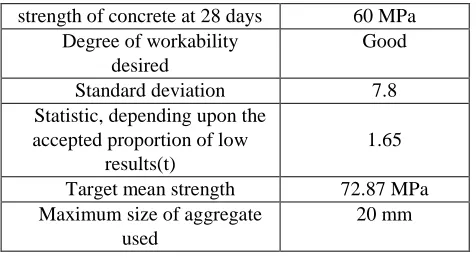
The basic data required for design of concrete mix of grade M60 are given in the table below.
Table VI: Basic data required for mix design
Basic Data Value
[image:2.612.36.285.546.670.2]strength of concrete at 28 days 60 MPa Degree of workability
desired
Good
Standard deviation 7.8
Statistic, depending upon the accepted proportion of low
results(t)
1.65
Target mean strength 72.87 MPa Maximum size of aggregate
used
20 mm
B. Compressive strength value
[image:3.612.40.278.56.186.2]The compressive strength values of concrete according to various ages are shown in table below.
Table VII: Compressive values of concrete according to various ages
Age of Concrete in
days
Percentage strength attained
Compressive strength value
in MPa
7 65% 47.36
28 99% 72.14
C. Estimation of air content
According to IS-10262:1982, approximate amount of entrapped air to be expected in normal concrete is taken as 2%.
D. Selection of water content and fine to total aggregate ratio
According to IS-10262:1982, for above M35, for 20 mm size aggregate, water content and sand as percent of total aggregate by absolute volume is taken as 180 kg per cubic meter of concrete and 25%.
E. Casting of samples for mix design
The size of the cube Specimen is (150x150x150) mm. A total of 5 trials for mix design were casted. In each trial 6 cubes are casted. A total of 30 cubes are casted for the mix design of high strength concrete.
F. Curing of samples
In the next day of casting, cube samples were de-moulded from the moulds and placed in curing tanks until they are taken out from it for further tests. 3 and 3cubes - from each trial are taken out in 7 day and 28 day respectively for compression test.
G. Mix proportions
[image:3.612.311.565.57.207.2] [image:3.612.40.285.274.344.2]The designed proportions are shown in the following table.
Table VIII: Mix Proportions
Trial Water Cement: Fine
Super-Mix no cement
ratio
aggregate: Corse aggregate
Plasticizer
1 0.35 1:0.79:2.59 0.8% of
cement
2 0.35 1:0.81:2.65 0.8% of
cement
3 0.30 1:0.62:2.15 0.8% of
cement
4 0.35 1:0.77:2.52 0.8% of
cement
5 0.35 1:0.76:2.47 0.8% of
cement
H. Distribution of ingredients in concrete
The distribution of ingredients in concrete of trial mix 1, trial mix 2, trial mix 3, trial mix 4 and trial mix 5 are shown in the following charts.
Chart I: Distribution of ingredients of concrete trial mix- 1
Chart II: Distribution of ingredients of concrete trial mix -2
1
0.79 2.56
0.35 0.008
trial 1
cement
fine aggregate
coarse aggregate
water
superplasticizer
1
0.81 2.65
0.35 0.008
trial 2
cement
fine aggregate
coarse aggregate
water
superplasticizer
1
0.62 2.15
0.3 0.008
trial 3
cement
fine aggregate
coarse aggregate
water
Chart III: Distribution of ingredients of concrete trial mix -3
Chart IV: Distribution of ingredients of concrete trial mix -4
Chart V: Distribution of ingredients of concrete in trial mix -5
V. RESULTS
A. Compression test result of trial 1
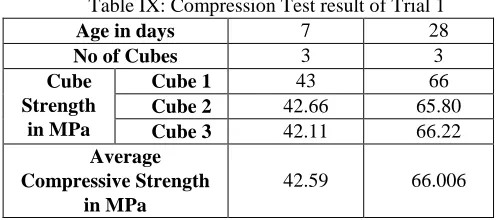
[image:4.612.320.564.56.97.2] [image:4.612.52.287.73.204.2]The 7-day and 28-day compressive test result of Trial-1 are given in the following table.
Table IX: Compression Test result of Trial 1
Age in days 7 28
No of Cubes 3 3
Cube Strength
in MPa
Cube 1 43 66
Cube 2 42.66 65.80
Cube 3 42.11 66.22
Average Compressive Strength
in MPa
42.59 66.006
B. Compression test result of trial 2
[image:4.612.320.564.169.283.2]The 7-day and 28-day compressive test result of Trial-2 are given in the following table.
Table X: Compression Test result of Trial 2
Age in days 7 28
No of Cubes 3 3
Cube Strength
in MPa
Cube 1 44 63.55
Cube 2 43.48 64.44
Cube 3 44.48 66.22
Average Compressive Strength in MPa
43.95 64.73
C. Compression test result of trial 3
The 7-day and 28-day compressive test result of Trial-3 are given in the following table.
Table XI: Compression Test result of Trial 3
Age in days 7 28
No of Cubes 3 3
Cube Strength
in MPa
Cube 1 48 70.34
Cube 2 46.86 71.23
Cube 3 45.20 70.82
Average Compressive Strength in MPa
46.68 70.79
D. Compression test result of trial 4
[image:4.612.51.288.235.360.2]The 7-day and 28-day compressive test result of Trial-4 are given in the following table.
Table XII: Compression Test result of Trial 4
Age in days 7 28
No of Cubes 3 3
Cube Strength
in MPa
Cube 1 47.35 73.20
Cube 2 46.89 72.68
Cube 3 48.37 73
Average Compressive Strength in MPa
47.53 72.62
E. Compression test result of trial 5
[image:4.612.320.564.357.466.2]The 7-day and 28-day compressive test result of Trial-5 are given in the following table.
Table XIII: Compression Test result of Trial 5
Age in days 7 28
No of Cubes 3 3
Cube Strength
in MPa
Cube 1 48.13 72.88
Cube 2 49.57 74.22
Cube 3 48.74 74.08
Average Compressive Strength in MPa
48.81 73.72
F. Comparison of results
The comparison of the compressive strength of concrete is given in the following table.
Table XIV: Comparison of results
1
0.77 2.52
0.35 0.008
trial 4
cement
fine aggregate
coarse aggregate
water
superplasticizer
1
0.76 2.47
0.35 0.008
trial 5
cement
fine aggregate
coarse aggregate
water
[image:4.612.39.289.482.592.2] [image:4.612.320.564.537.652.2] [image:4.612.43.287.666.740.2]Trials 7-day compressive test result in MPa
28-day compressive test result in MPa
Act
ua
l
E
x
pect
ed
Act
ua
l
E
x
pect
ed
T1 42.59 47.36 66.006 72.14
T2 43.95 47.36 64.73 72.14
T3 46.68 47.36 70.79 72.14
T4 47.53 47.36 72.62 72.14
T5 48.81 47.36 73.72 72.14
These comparisons of compressive test results can be shown as graph, given below.
Chart VI: Comparison of Compressive Test Result
VI. REPLACEMENT BY MARBLE AGGREGATES The trial mix-4 and 5 give satisfactory results. For further experiment, trial mix-5 is taken into consideration.
In the proportion obtained from trial mix-5, marble aggregates broken from waste marbles are partially replaced as coarse aggregate by 0%, 10%, 20% and 30%.
A. Casting and curing
[image:5.612.53.274.248.365.2]Four types of replacements are done and are denoted as C1, C2, C3 and C4. A total of 24 cubes were casted- 6 for each replacement trial. In the next day, the cube samples are de-moulded from the moulds of size (150x150x150) mm and placed in a curing tank until they are taken out for further tests.
Table XV: Replacement trials corresponding to coarse aggregate replacement percentage
Replacement Trials
Coarse Aggregate Replacement percentage
C1 0
C2 10
C3 20
C4 30
B. Distribution of ingredients of replacement samples
The distribution of ingredients in concrete of replacement samples are shown in the following charts.
Chart VII: distribution of ingredients of C1
Chart VIII: distribution of ingredients of C2
Chart IX: distribution of ingredients of C3
Chart X: distribution of ingredients of C4
0 10 20 30 40 50 60 70 80
Trial 1 trial 2 Trial 3 Trial 4 Trial 5expected
7day 28 day
1
0.76 2.47
0.35 0.008
C1
cement
fine aggregate
coarse aggregate
water
superplasticizer
1
0.76 2.223
0.247 0.35
0.008
C2
cementfine aggregate
coarse aggregate
marble aggregates
water
superplasticizer
1
0.76 1.976 0.494
0.35 0.008
C3
cementfine aggregate
coarse aggregate
marble aggregates
water
superplasticizer
1
0.76 1.729 0.741
0.35 0.008
C4
cementfine aggregate
coarse aggregate
marble aggregates
water
C. Results
[image:6.612.51.284.320.448.2]Test results of compressive strength of concrete after partially replacing coarse aggregate is shown below.
Table XVI: Test results of HSC after partial replacement of CA by waste marble aggregates
Trials
Coarse Aggregate Replacement percentage
Average Compressive test result in MPa
7day 28 day
C1 0 48.81 73.72
C2 10 50.79 74.60
C3 20 57.35 78.68
C4 30 60.29 81.47
D. Comparison of results
The comparisons between the results are shown in the graph below.
Chart XI: Comparison of Results
VII. CONCLUSION
The trial mix-5 with ingredients (cement: sand: coarse aggregate) ratio 1: 0.76: 2.47 with super-plasticizer 0.8% of cement used and water cement ratio 0.35 gives satisfactory result. This proportion gives compressive strength up to 73.72 MPa at 28 days. This proportion can be used to produce concrete of grade M60.
The high strength concrete can be achieved only by using good qualities of materials, taking relatively low water cement ratio, using proper prescribed methods and good supervision is necessary. The weather conditions should be taken into account while deciding the water quantity. The super-plasticizer should be added carefully. Excess amount of super-plasticizer may result in segregation of the concrete. So the amount of super-plasticizer used should be between 0.5% to 0.8% of the quantity
of cement.
The replacement of coarse aggregate by marble aggregates made from waste marbles also gives very satisfactory result. If marble wastes are available at site, then it should be replaced with coarse aggregates as it gives very impressive result than only using stones as coarse aggregate and it also reduces cost as it is made from waste marble pieces.
REFERENCES
[1] IS 456: 2000 code of practice for plain and reinforced concrete (third revision)
[2] IS 516: 1959 method of test for strength of concrete
[3] Shetty. M.s, (2010) “concrete technology” S.Chand and company Ltd, Delhi
[4] IS:10262-1982 Recommended Guidelines for Concrete mix design (Reaffirmed 2004)
[5] IS:383-1970 Specification for Coarse and Fine aggregates from Natural Sources for concrete (Second Revision) (Reaffirmed 2002) [6] IS:2386 (part-III)-1963 Methods of test for aggregates for concrete [7] Santhakumar.A.K.S, “concrete technology” Oxford Publication, New
Delhi, 2006
[8] Sanjay Srivastava, Dr S.S Jain, Dr M.P.S. Chauhan, “High Strength concrete of M60 grade for highway pavements for heavy vehicles” (2014)
[9] http://civilengineerblog.com/concrete-mix-design-secrets/ [online website]
[10] Jay P. Chotaliya, Kuldip B. Makwana, Pratik D. Tank, “Waste Marble Chips As Concrete Aggregate” (2016)
[11] Mr. Sachin, Mr. Yudhvir Yadav, “A research analysis on mix design for high strength concrete” (2016)
AUTHORS
First Author – Debasmita Panda, M.Tech Student, College of
Engineering and Technology, Bhubaneswar, E mail: [email protected]
Second Author – Dr. (Prof.) P.K. Parhi, Professor, Department
of civil Engineering, College of Engineering and Technology, Bhubaneswar, Email: [email protected]
0 20 40 60 80 100
7day