Lean Six Sigma Applications in Oil and Gas Industry:
Case Studies
Atanas J.P.*, Rodrigues C.C. **, Simmons, R.J.** *
Department of physics, The Petroleum Institute **
Department of Mechanical Engineering, The Petroleum Institute
Abstract- This paper presents a brief overview of Lean and Six
Sigma use and success in the oil and gas industry by using principles of enhanced productivity, safety and environment as well as process quality management in a well-defined framework. A literature review is also presented, including negative and positive opinions about Six Sigma implementations in industry. Lessons learned from successful implementation of Lean in oil and gas industry are analyzed and summarized. A positivistic approach with case studies of Lean as practiced in some major oil and gas companies in Abu Dhabi is being used. Methodology and process of application of Lean is also described. The study shows the importance of Six Sigma and Lean applications in three of the most important areas in oil and gas: Service quality drilling operations, customer satisfaction, and supply chain. Two successful case study projects are provided with step by step details and are organized around three main parts: the problem, the methodology and the lessons learned. Despite some misconception that some managers have about the implementation of Lean, it will stay the most efficient methodology to apply in the oil and gas business. Success of Lean depends also on top management decisions. Also, the application of these methodologies when applied successfully to projects can produce rewarding results. This paper will outline successful applications of Lean and Six Sigma by two major oil and gas industries in the United Arab Emirates.
Index Terms- Lean, Six Sigma, Drilling Operations, and
Management Decisions.
I. INTRODUCTION
ver the past years, the GCC (Gulf Cooperation Council) countries have experienced considerable growth in the oil and gas industry particularly exploration and production (E&P) activities. Oil and gas companies, in the UAE, are seeking to implement an efficient and reliable framework associated with the safety and operational excellence. With new technical advances, cheap extraction of shale oil is now becoming possible [Hamilton, 2009]. Hence, it becomes a necessity more than ever, to find an optimum way to stay competitive in the market. The question raised then is: which approach is most suitable or optimum for the framework required and how could it be achieved?
This framework must rely on efficient quality control and assurance methodologies such as Six Sigma, Lean and Kaizen to guarantee a position of being the largest global producer in the oil and gas business. Many examples of Six Sigma applications
could be found in the literature. However, only few of them have introduced Six Sigma to the Oil and Gas field. While researching the prevalence of Six Sigma adoption among major oil and gas companies, we were surprised to find that a number of oil companies in the GCC such as, Abu Dhabi Company for Onshore Oil Operations, Abu Dhabi Gas Liquefaction Company, Saudi Aramco, Saudi Electricity Company, Kuwait Gulf Oil Company, Kuwait Petroleum Corporation, Maersk Oil Qatar, Medco Energy, The Bahrain Petroleum Company, etc…) have already established Lean Six Sigma practices in place which are used to address the new challenges they face. Oil and gas companies should be looking to be shielded against barriers imposed by the advent of new shale oil technologies and should also look to boosting their Lean Six Sigma operations, to ensure that full potential is reached as the energy industry is facing its future challenges head on. Many experts from prestigious oil companies claim that Six Sigma is difficult to apply in the Oil and Gas industry. In addition, linking Lean Six Sigma with actual performance is difficult to establish. Data collected from a survey by “IndustryWeek”, conducted in 2007, showed 74% of respondents had made little or no progress in their Lean implementations, 24% made significant progress, and only 2% achieved world-class improvement.” Researchers such as Fursule et al., (2012) claim that despite the pervasiveness of Six Sigma program implementations, rising concerns about their failures are increasingly high. The same authors conclude that this failure is attributed mainly to the lack of experience and implementation strategies for these programs.
It is worth mentioning that top management also has a crucial role in the success of Six Sigma projects. These methodologies are useless if not backed up with firm decisions from top management. These strategic decisions are required for Six Sigma or Lean adoption [Lee and Choi, 2006]. In many cases, failure to apply Six Sigma is not incumbent to the methodology itself or its restriction of use in a particular industry, but rather to the complex management hierarchy of some companies or the lack of communication among all partners involved, stakeholders and top managers.
placed more emphasis on the importance of supply chain execution and the necessity of assigning skilled management in supply chain roles with the required insight to develop and grow supply-chain-specific assets.
It is essentially that, prior to embarking on any of these methodologies of improvements, current performance, management decisions and situations should be studied, approved and evaluated. Six Sigma and Lean or any other techniques is not necessary if companies already have in place an effective performance and process improvement effort that is consistently meeting customer-focused goals or is very similar in concept with Lean or Six Sigma. Many organizations find it difficult to migrate to new improvement programs, because it is a significant culture shift and can involve a significant amount of training time, timing for implementation may not be right if current conditions are already overwhelming people and resources. In the previous sections, definitions and methodologies pertaining to Six Sigma, Lean and Kaizen are presented. The appropriate methodology used in the case study is also explained. Two successful case studies about Lean implementations one in improving Rig-Move process, and the other, in enhancing the supply chain process in the oil and gas industry, are being described and analyzed, and finally conclusions about the lessons learned from case studies are also outlined.
In Introduction you can mention the introduction about your research.
II. METHODOLOGY
[image:2.612.320.578.62.200.2]Six Sigma is a management philosophy developed by Motorola in 1986 that requires setting extremely high objectives, collecting data, and analyzing results to reduce defects in products and services. Today, it is used in many industrial sectors. It is also referred to as a systematic approach to quality improvement of process outputs with variability minimization in manufacturing and business processes [Pyzdek 2003; Pyzdek and Keller, 2009]. The Lean principle had its origins in the Toyota Automobile Manufacturing Company. Lean Six Sigma is a methodology that relies on a collaborative team effort to improve performance by systematically removing waste combining lean manufacturing/lean enterprise and Six Sigma to eliminate the eight kinds of waste: Time, Inventory, Motion, Waiting, Over production, Over processing, Defects, and Skills. Kaizen means continuous improvement, and aims to eliminate waste by improving standardized activities and processes. Additional definitions and methodologies adopted in Six Sigma, Lean and Kaizen could be found elsewhere [George 2002 & Masaki 1986].
Figure 1 shows the five phases in Six Sigma methodology, the first holds the acronyms DMAIC (Define, Measure, Analyze,
Improve or optimize, Control) and the second is DMADV (Define, Measure, Analyze, Design, Verify) or DFSS (Design For Six Sigma). The DMADV instead of DMAIC should be used
when a product or process is inexistent and needs to be designed from scratch or when the existing product or process still does
not meet the level of customer specifications or Six Sigma
[image:2.612.366.522.394.527.2]DPMO level through the application of the DMAIC approach.
Figure 1: DMAIC and DMADV approaches
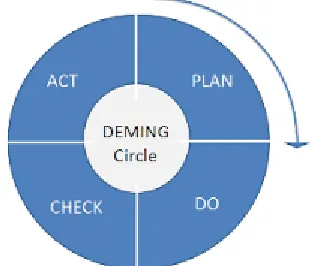
For more details about these approaches the reader can consult excellent reviews in references by George M.L., 2002, and De Feo, J. et al., 2005. Figure 2 shows Deming's circle Plan-Do-Check-Act as a four step process, which is more of a cycle (PLAN, DO, CHECK, ACT) for process and continuous improvement. Deming’s cycle constitute the basis of Kaizen methodology. The idea in the PLAN step is to define the process to improve. The DO step is implementing the plan and measuring its performance. The team then takes those measurements to assess whether they are getting the desired results. This is known as the CHECK step. The ACT step follows. The team decides on changes that need to be made to improve the process; then, the whole cycle starts again.
Figure 2: Deming’s circle, PLAN, DO, CHECK, ACT
Run and Evaluate). Kaizen is considered the corner stone of a long term strategic competitiveness for any organization [Masaaki, I., 1986]. In this paper, the first approach is being followed since most of the root causes are well identified from the beginning. The DMAIC approach concentrates more on
rigorous data-driven measurement and analysis than SCORE. However, Kaizen is being used when the “how-to” is often not quite clear, which is not the case for the case studies presented in the following sections.
III. STUDY CASES: RESULTS
Lean and Six Sigma have gained ground where other management approaches have failed, largely owing to word of mouth and the demonstration effect of industry success stories. The case studies presented in this paper to prove the efficiency of Lean Six Sigma methodology and its implementation in the oil and gas industry. The two case studies related to the implementation of Lean Six Sigma methodology one for rig-move optimization and the other for inventory optimization are described. A brief description of the problem is given to provide context. A detailed applied methodology is presented and the lessons learned are listed at the end of each of these case studies:
A. Case Study 1: Rig-Move optimization
The Problem:
One of the leading companies in oil and gas companies in the GCC realized that during years 2007-2011, the average rig-move time of its sample fleet that constituted of 8 top rigs was exceeding the business plan by 4 days, the maximum duration, by at least 25%. This exceedance fluctuated between 5 to 7 days during the period from 2007 to 2011. This prompted the implementation of Lean Six Sigma to optimize rig-move operations. A special task force team was assigned the task of identifying and reducing inefficiencies in the rig-move process. The Method:
The DMAIC five phases where applied with set deadlines to successfully solve the problem. In the “Define” phase, workflow as performed by the task force team was to define the project timeline, the project charter including resource plan, problem statement, project objectives and financial opportunities, and finally identify problem variables. Also, SIPOC (Suppliers, Inputs, Process, Outputs, and Customers) tool was applied to examine the five main variables of the business operation: The Suppliers: a national drilling company (i.e. the drilling contractor).
The Inputs: the capital invested by the company associated with the rig-down/rig-up operations.
The Process: time dependency of the rig-move operations from release to acceptance/spud.
The Outputs: the return-on-investment the company aims to achieve from the rig-move operations.
The Customers: the company itself since rig-move is serviced by a subcontractor, yet supervised and facilitated by the same company.
In the “Measure” phase, the DPMO (Defects per Million Opportunities, a measure of the error rate of a process was used to obtain an average sigma level of 0.81 (conversion from DPMO to Sigma levels can be found in (Pyzdek, 2003), for year 2012 only, where total rig-moves were 49 and those that went beyond the business plan were 37. The lower the value of the baseline sigma level, the more defects were present.
The “Analyze” phase was the core method to identify, assess and select root-causes of inefficiencies requiring appropriate
elimination. The team came up with an as-is process map for rig-move operation and was carried out in terms of added value and non-added value steps. Hence all deficiencies were identified allowing the team to concentrate on root-cause analysis. These inefficiencies found from the root cause analysis were addressed in the “improve” phase. A new “Should-be” process map for rig-move was established and introduced into the company’s policy. All root causes of inefficiencies were represented in a fishbone diagram where more than 40 causes along six main themes were reported. In the control phase changes implemented in the improve phase were sustained by monitoring improvements and providing recommendations for further actions.
As a consequence of this DMAIC approach, in Lean Six Sigma, 70 % of the new recommendations were put in effect immediately, with the remaining being put on hold for policy updates and training programs installations. In April 2013, new data were collected to calculate the new sigma level and the average move performance for the top 8 rigs, just to control the sustainability of the improvement. A clear reduction of 13% of defects was noticeable, where total rig-moves were 23 and those that went beyond the business plan were 3, thus, sigma levels improved from 0.81 to 2.62. A 61 % improvement in rig-move performance was achieved starting from 2012. Also it is important to note that an additional of 258 days for oil production opportunity was achieved for year 2013.
Lessons learned:
• Lean Six Sigma can be applied successfully to oil and gas industry in particular in drill operations for rig-move optimization.
• Controlling results was important to guarantee continuous improvements and defect reduction.
• Team hard work with continuous communication with management is essential for efficient success of the process.
• The process resulted in the development of new process map that was implemented immediately with care being taken for special policies that need updating or modifying before any immediate actions.
• Policies established in a company should not be considered as sacrosanct but rather should be revisited and updated on a continuous basis so as to achieve the highest benefits for the business.
B. Case Study 2: Inventory optimization
Based on its long term strategic vision a decision to enhance supply chain processes were been undertaken by the Company. The Problem:
Excess and obsolete inventory have a major negative effect on the efficiency of the supply chain and its management. Failures in inventory control management systems bear financial and managerial consequences. Lack of inventory visibility was observed since no one knew exactly how much inventory there was, in any of the rigs or storage areas. Inventory processes were not documented or well controlled. Inventory system needed to be redesigned to achieve accuracy, valuation, and optimization of order/demand processes from requisition to invoice. A special task force team was assigned the task of identifying and reducing inefficiencies in the supply chain process.
The Method:
The first step towards better implementation of the supply chain process was to develop a multi-year strategic roadmap. The idea of the roadmap is to reach the goal of building an efficient and better supply chain organization within a specific time frame. As previously the basic steps to follow are given by the DMAIC approach.
In the define phase, the inventory management systems and controls were not properly developed. Enhancement of the inventory visibility and accuracy is necessary. The SIPOC tool was also useful to identify the main variable of the supply chain inventory process.
The Suppliers: a list of all internal and external suppliers of the company (Companies name are omitted due to privacy requirements.)
The Inputs: the capital invested by the company associated with the rigs, data, application, parts, and raw material.
The Process: Procurement, movement and storage of raw materials, work-in-process inventory, and finished goods from point of origin to point of consumption.
The Outputs: the return-on-investment for the company, solve logistics issue, balance between movement and storage of accessories, inventory visibility and control, efficiency and accuracy of requisition and procurements , cost reduction in the inventory process, improved customer service efficiency, reduction of lead times.
The customers: vendors, suppliers, subcontractors, logistics partners
In the define phase, Project timeline, charter, statement, objectives and financial opportunities were well defined. The team was formed and interviews were conducted with the production manager revealing a change in the previous supply chain management process known as the back flush accounting. In this process, costing is delayed until goods are finished. Standard costs are then flushed backwards through the system to assign costs to products. In the “Measure” phase, assessment done revealed that cycle counting was not being performed. In one sentence, the inventory management systems and controls were not fully and properly designed. DPMO was used to measure defects related to time delay induced when long cycles of movement and storage of raw materials are involved. The “Analyze” phase was to identify the method to apply in the supply chain. A standard industrial engineering approach was followed and all processes were effectively mapped. Deficiencies such as parts and accessories being set up with date
driven order location points emerged during the analysis phase. As a result, recession was spooling up and parts are still being ordered based on date. All deficiencies were identified and addressed in the “improve” phase. The “improve “phase has resulted in increasing inventory visibility and control, requisitioning efficiency and accuracy as well as cycle counting which has been performed regularly and included as a process in the material requirements planning system. In 2012, the rollout of inventory management provided increased inventory visibility with improved cycle counting up to 50% over 2 years. The Supplier Relationship Management program drove suppliers to improve their on-time delivery performance and customer service, as well as increase communications with the Company. Lessons learned:
• Lean Six Sigma was applied successfully to supply chain issues in the oil and gas industry reducing consistently inventory and lead time.
• Processes related to back flush accounting were analyzed and improved.
• Greater inventory visibility and control over the process.
• Improvement of the on-time delivery performance and customer service in the company.
IV. CONCLUSION
Lean Six Sigma has many advantages when applied rigorously to the problem, regardless of its nature, whether operational, managerial, financial, logistic or other. Good results are guaranteed if all necessary conditions are met initially before taking the process any further.
• Many tools and concepts used in Lean Sigma are not new in the oil and gas business. It is also proven from the case studies that Lean framework when applied rigorously with the vision and leadership of change can yield effective results by choosing the existing knowledge and appropriate statistics tools.
• Use of Lean Six Sigma guarantees continuous improvements and defect reduction which is essential for any business success especially for oil and gas.
• Another key feature for success is the team cooperation and communication at all managerial and technical levels.
• Some policies could hinder the improvement or the progress of Lean Six Sigma approach. These policies should be relaxed, modified or even replaced. Managers should not fear any change in the company’s policies for the sake of its progress.
.
ACKNOWLEDGMENT
Authors are indebted and thankful to all professionals from ADNOC OPCOs who were involved in any way in the present work.
REFERENCES
[2] De Carlo, N., Lean Six Sigma, Alpha Books, New York, 2007.
[3] De Feo, J. A., Barnard W., Juran, J., Institute's Six Sigma Breakthrough and Beyond - Quality Performance Breakthrough Methods, McGraw-Hill, 2005. [4] Fursule, N., Bansod S. and Fursule S., understand the benefits and
limitations of Six Sigma Methodology. International Journal of Scientific and Research Publications, 2012, Volume 2, Issue 1.
[5] George M.L. Lean Six Sigma, New York, NY: McGraw-Hill, 2002. [6] Masaaki, I., Kaizen: The Key to Japan's Competitive Success. New York:
Random House. 1986.
[7] Hamilton, T., A Cheaper Way to Draw Oil from Shale, Energy news, MIT Technology reviews, 2009
[8] Inozu, B., Niccolai, M.J., Whitcomb, C.A., Mac Claren, B., Radovic, I. and Bourg, D., New horizons for ship building process improvement, Journal of Ship Production, 2006, Vol. 22 No. 2, pp. 87-98.
[9] Lee, K.C. and Choi, B., Six Sigma a vital improvement approach when applied to the right problems, in the right environment. Assembly Automation 26 (1), 10-18, 2006.
[10] Lu, Y., Zhou, L., Bruton, G., and Li, W. , Capabilities as a mediator linking resources and the international performance of entrepreneurial firms in an emerging economy. Journal of International Business Studies, 41, 419–436. doi:10.1057/jibs.2009.73
[11] Mortimer, A.L., Six Sigma: a vital improvement approach when applied to the right problems, in the right environment, Assembly Automation, Vol. 26 No. 1, pp. 10-17, 2006.
[12] Pyzdek T., Keller P., the Six Sigma Handbook, Third Edition, New York, NY: McGraw-Hill, 2009
[13] Pyzdek, T. The Six Sigma Handbook: The Complete Guide for Green Belts, Black Belts, and Managers at All Levels, Revised and Expanded Edition, McGraw-Hill, 2003.
[14] Roudini, A., and Hassan, M. O., Global economic crisis and entrepreneurship development, International Journal of Fundamental Psychology and Social Sciences, Volume 2, Issue 1, pp. 13–18, 2012.
AUTHORS
First Author – Atanas, Jean-Pierre, Ph.D. in physics, Project Management Certificate (CESI France), Six Sigma Yellow Belt, The Petroleum Institute, email: [email protected].
Second Author – Clarence Rodrigues Ph.D. in HSE Engineering, The Petroleum Institute, email: [email protected].
Third Author – Rodney Simmons, Ph.D. in industrial engineering, The Petroleum Institute, email: