2018 International Conference on Applied Mechanics, Mathematics, Modeling and Simulation (AMMMS 2018) ISBN: 978-1-60595-589-6
Research on Dynamic Optimization Operation of Optical Storage
Based on LSTM Load Forecasting
Xue-liang CHEN
1, Teng LI
1,*and Yong MU
21Beijing Jiaotong University, Beijing, China
2State Grid Hebei Power Co., Ltd. Tangshan Power Supply Company, Hebei, China
*Corresponding author
Keywords: Neural network, Load forecasting, Energy storage, Dynamic optimization.
Abstract. Affected by weather, geography and other factors, PV output has fluctuations and
intermittentness. It is not suitable to supply power to the load independently. It needs to be used together with the energy storage device. At the same time, the power load has a great influence on the energy storage configuration. Therefore, accurate load forecasting has Helps improve the stability and reliability of the power system, saves electricity costs, and facilitates dynamic optimization of optical storage. In this regard, this paper proposes a dynamic optimization strategy for optical storage based on long-term and short-term memory networks. Firstly, the long-short-term memory neural network method is used to predict the power load. Secondly, according to the power difference adjustment and the photovoltaic output result, the daily-time load is divided into four sections, and the different sections respectively correspond to specific control strategies. Finally, according to each, the interval control strategy optimizes the energy storage and discharge power in real time. The method stores excess photovoltaic energy and releases it in the form of electric energy when the user's power grid needs it. This can effectively suppress the power fluctuation of photovoltaic power generation, improve the utilization rate of photovoltaics, and perform peak clipping for the user grid Valley regulation.
Introduction
With the rapid development of the economy, the shortage of resources and the deterioration of the environment are becoming more and more serious. As a clean renewable energy source, solar energy has broad application prospects. However, affected by weather, geography and other factors, photovoltaic output has volatility and intermittent, affecting the grid power quality, which is not conducive to the effective consumption of photovoltaics. At the same time, the power load has a great impact on the energy storage configuration, predicting the load results. And study the optical storage dynamic optimization operation strategy, which can reduce the fluctuation of photovoltaic output, improve the utilization rate of photovoltaic power generation, and adjust the peak and valley of the user grid.
The application of energy storage technology can largely solve the randomness and volatility of photovoltaic power generation [9]. In [10], the paper discusses the functional control requirements of wind power/light/storage microgrid for the functional requirements of power grid clipping and valley filling and improving the utilization rate of renewable energy. Literature [11] analyzed the role of energy storage systems in peaking and valley filling, smoothing intermittent energy power fluctuations, improving voltage quality, and so on. In [12], the load standard deviation and the electricity tariff are used as the peaking and valley filling evaluation indicators to determine the charging and discharging power of the energy storage battery at various times. Literature [13] analyzed the relationship between the energy stored in the battery and the fluctuation of photovoltaic power generation, and proposed a strategy to optimize the energy storage and discharge of the battery. Literature [14] based on the characteristics of the user's electrical load, adopted a scheduling strategy for charging and discharging the battery energy storage system in a specific period of time. According to the user load situation, the literature [15] performs charging and discharging operations according to the peak demand. In [16], the energy storage system operation optimization model was built with the minimum variance of the battery, the lowest cost of electricity purchase and the minimum variance of the load curve after peak-cutting.
According to the power difference adjustment and PV output results, the load prediction results are divided into four sections, and the different sections correspond to specific control strategies for optical storage dynamic optimization.
Load Forecasting Based on LSTM
Comparison of Three Kinds of Neural Networks
In the traditional neural network model, from the input layer to the hidden layer to the output layer, the layers are fully connected, and the nodes between each layer are disconnected, that is, independent of each other, without continuity, so for many Timing issues are powerless. For the load forecasting problem, based on the load data of one day, when predicting the data at the latter time, the data of the previous moment is needed, because the data at the time before and after the day is related to each other. This paper uses the LSTM network in the cyclic neural network to solve the above problems.
Compared with the traditional neural network, the current output is related to the previous output. The specific form is that the network memorizes the previous information and applies it to the current output calculation. It not only includes the output of the input layer, but also the output of the hidden layer at the previous moment, that is, the nodes between the hidden layers are connected, so the cyclic neural network has a good prediction effect for each time of the day. However, there are some drawbacks in the recurrent neural network. The time of interconnection is relatively limited. As the prediction start time becomes less and less, the gradient disappears. Long-term and short-term memory networks in the circulatory neural network, because the long-term information is the default behavior, rather than the content of hard learning, this method can solve the long-term dependence problem under repeated operations.
LSTM Network Principle
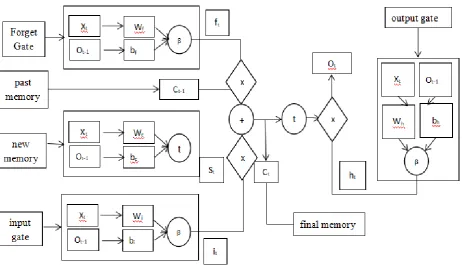
The reason why the LSTM network built in this paper is relatively strong is because, in addition to the same input layer, output layer and hidden layer as the traditional network, a processor that judges whether the information is useful or not is added to the algorithm and is processed. Three doors are placed in the device, called input gate, forgetting gate and output gate.
Figure 1. LSTM schematic.
The operation of the LSTM is divided into four steps. The first step is the “forget gate” section of the figure, which determines what information is discarded from the cell state. The output Ot-1 at the previous moment and the input Xt at this moment are used as new inputs. Then the β function judges how much the probability of retaining this part of the information. If the output is 1, it means
all reservations. If the output is 0, it means all give up. The expression of ft is
f t t f
t W [O,X ]b
f 1 (1)
The second step includes the "new memory" and "input gate" sections in the figure. The β
function determines which values to update, and the t function creates a new candidate vector St.
Expression is
i [ 1, ] i
it W Ot Xt b
(2)
c [ 1, ] c
t
St W Ot Xt b
(3) The third step is to update the state of the cell, which is the process from the "past memory" to
the "final memory" in the picture. The past memory Ct-1 Multiply by ft, discard the information we
determined to be discarded; plus the product of St and it. Expression is
t t t 1 -t
t C f i S
C
(4) The fourth step is the entire process of the "output gate" to the final output Ot. The beta layer
determines which part of the cell to output. Then, the t function processes the new cell state Ct to
obtain a new value. Finally, the new value is multiplied by the beta layer output value to obtain the
value Ot to be output. Expression is
h [ 1, ] h
ht W Ot Xt b
(5)
) ( t
ht t
t C
O
Optical storage dynamic optimization strategy
Objective Function and Constraints
Mathematically, the variance is used to measure the degree of deviation between a random variable and its mean. The variance can reflect the degree of dispersion of the load curve. The smaller the variance, the better the peak-filling effect of the load after dynamic optimization. In this paper, the variance of the load curve after dynamic optimization is selected as the objective function.
N N Pav P D 1 i 2 ) i ( ) p ( (7) Where: N is the number of mid-day load data points, determined by the predicted load data, Pi is the load at the time i after optimization, and Pav is the average value of the load after the peak-shaping.The overcharge and overdischarge of the energy storage battery will have a great impact on the battery life and battery performance. Therefore, in the dynamic optimization, the charge and discharge power of the energy storage battery and the influence of the battery SOC should also be considered.
(8)
Where: Smin and Smax are the lower and upper limits of the remaining battery power, respectively,
St is the battery power at the current time. P
c
min and P c
max are the lower and upper limits of the battery
charging power. Pc t is the current charging power. P
d
min and P d
max are the lower and upper limits of
battery discharge power, respectively. Pd t is the current discharge power.
Power Difference Adjustment
Using the power difference adjustment method, the lower limit power P1 of the load during the discharge of the energy storage system and the upper limit power P2 of the load at the time of charging are determined, and the dynamic optimization method according to the power difference is divided into three cases:
1) The definition of P2 or lower is valley. In order to achieve P2, the energy storage battery is charged.
2) P1 to P2 are neither charged nor discharged.
3) The portion larger than P1 is defined as the peak, and combined with the magnitude of the photovoltaic output power, determines whether the energy storage battery is discharged. Set the upper limit rate P2, photovoltaic power Ps.
Optimization Strategy
According to whether the photovoltaic output is equal, the daily load is divided into daytime and nighttime, and the lower limit power P1 of the load of the energy storage system and the upper limit power P2 of the load during charging are obtained based on the power difference adjustment, and compared with the real-time load data Pt, thereby The daily load is divided into peaks and valleys during the day and peaks and valleys at night.
Strategy 2: Because it is daytime, PV is also working normally, and because it is in the trough, in the case of meeting the constraints, the photovoltaic and the grid need to jointly charge the energy storage battery.
Strategy 3: Because it is night, the photovoltaics are not working, and they are at the peak. At this time, only the energy storage battery is needed to discharge the peak.
Strategy 4: Because it is night, the photovoltaics are not working, and are in the trough. This is to satisfy the constraints, only need to charge the energy storage battery to achieve the role of filling the valley.
Conclusion
Based on the load data of a region for three months, a long-term and short-term memory network model was built, with a total of 90% of the total data as the training set, and the remaining 10% was the test set for training.
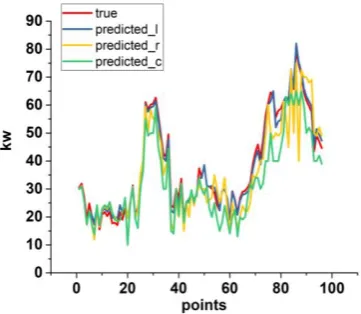
The built LSTM model consists of two layers of long-term and short-term memory layers and one layer of fully connected layers. The activation function is a linear activation function, the loss function is the mean square error (mse), the optimization algorithm is the rmsprop algorithm, the batch_size (the size of each batch of data) is 512, and the epoch (the number of trainings for all samples in the training set) is 150. The loss rate is 0.2. Build CNN, RNN under the same conditions. The comparison results are shown in Figure. 2.
[image:5.595.207.388.391.548.2]The maximum charge and discharge power of the battery of the energy storage system is 20 kW, the minimum value of the state of charge is 0.15, and the maximum value of the state of charge is 0.9. As shown in Figure. 3.
Figure 2. Comparison of three network results.
[image:5.595.181.414.575.757.2]It can be seen from Fig. 3 that the peak-to-valley difference is greatly reduced. It can also be seen that under the condition that the photovoltaic has no output, the load after dynamic optimization fluctuates, and it is basically stable after the photovoltaic output, and the dynamic optimization capability is improved.
Acknowledgement
This research was supported by the Fundamental Research Funds for the Central Universities.
References
[1]Taoye Zhu, Yingqiu Li, Ying Zhang, et al. A new algorithm of advancing weather adaptability
based on arima model for day-ahead power load forecasting[J]. Proceedings of the CSEE, 2006, 26(23): 14-19.
[2]Elattar E E, Goulermas J, Wu Q H. Electric Load Forcasting Based on Locally Weighted
Support Vector Regression[J]. IEEE Transactions on systems, Man, and Cybernetics, Part C (Applications and Reviews), 2010, 40(4): 438-447.
[3]Chenxi Li. Short-term electric load forecasting based on ARIMA model[J]. Jilin Electric Power,
2015, 43(6): 22-24.
[4]Ping Zhang, Xueping Pan, Wenchao Xue. Short-term load forecasting based on wavelet
decomposition fuzzy gray clustering and BP neural network[J]. Electric Power Automation Equipment, 2012, 32(11): 121-125, 141
[5]Fang Fang. Research on power load forecasting based on improved BP neural network [D].
Harbin: Harbin Institute of Technology, 2011.
[6]Ming Zeng, Chunquan Lü, Kuo Tian, et al. Least squares-support vector machine load
forecasting approach optimized by bacterial colony chemotaxis method [J]. Proceedings of the CSEE, 2011, 31(34): 93-99 (in Chinese).
[7]Ben Wang, Beixue Leng, Xihai Zhang, et al. Application of support vector machine in
short-term load forecasting[J]. Journal of Electric Power Systems and Automation, 2011, 23(4): 115-121.
[8]Hochreiter S, Schmidhuber J. Long Short-Term Memory [J]. Neural Computation, 1997, 9(8):
1735-1780.
[9]National Grid Corporation "Grid New Technology Prospect Research" project consulting group.
Analysis of application prospects of large-scale energy storage technology in power systems [J]. Automation of Electric Power Systems, 2013, 37(1): 3-8.
[10]Xiuqiong Huang, Jiyuan Lu, Huana Niu and so on. Wind/light/storage microgrid control
strategy for main network peak-filling and valley-filling scheduling[J].China Electric Power,2013(2):87-92.
[11]Yi You, Dong Liu, Qing Zhong et al. Multi-objective target optimization configuration of
active distribution network energy storage system[J]. Automation of Electric Power Systems, 2014, 38(18): 46-52.
[12]Yangtian Ning, Xiangjun Li, Xiufan Ma, Hui Dong. Research on peak-filling strategy of
[13]Wei Wang, Jinhua Xue, Jilei Ye, Xiaohua Wang, Fubao Wu, Bo Yang. Battery storage energy optimization control method based on SOC regulation for suppressing photovoltaic fluctuations[J]. Power System Protection and Control, 2014, (02): 75- 80.
[14]Rahimi A, Zarghami M, Vaziri M,et al.A simple and effiective approach for peak load shaving
using Battery Storage Systems[C]//North American Power Symposium (NAPS), 2013. IEEE, 2013:1-5.
[15]Purvins A, Papaioannou I T, Debarberis L. Application of battery-based storage systems in
household-demand smoothening in electricity-distributiongrids[J].Energy Conversion and Management, 2013, 65: 272-284.
[16]Mengmeng Li, Yufei Wang, Hua Xue. Economic Operation Strategy of Energy Storage System