R E S E A R C H
Open Access
Modified nonlinear conjugate gradient method
with sufficient descent condition for
unconstrained optimization
Jinkui Liu
*and Shaoheng Wang
* Correspondence: [email protected] School of Mathematics and Statistics, Chongqing Three Gorges University, Chongqing, Wanzhou, People’s Republic of China
Abstract
In this paper, an efficient modified nonlinear conjugate gradient method for solving unconstrained optimization problems is proposed. An attractive property of the modified method is that the generated direction in each step is always descending without any line search. The global convergence result of the modified method is established under the general Wolfe line search condition. Numerical results show that the modified method is efficient and stationary by comparing with the well-known Polak-Ribiére-Polyak method, CG-DESCENT method and DSP-CG method using the unconstrained optimization problems from More and Garbow (ACM Trans Math Softw7, 17-41, 1981), so it can be widely used in scientific computation.
Mathematics Subject Classification (2010)90C26 · 65H10
1 Introduction
The conjugate gradient method comprises a class of unconstrained optimization algo-rithms which is characterized by low memory requirements and strong local or global convergence properties. The purpose of this paper is to study the global convergence properties and practical computational performance of a modified nonlinear conjugate gradient method for unconstrained optimization without restarts, and with appropriate conditions.
In this paper, we consider the unconstrained optimization problem:
min{f(x)|x∈Rn}, (1:1)
wheref:Rn®Ris a real-valued, continuously differentiable function.
When applied to the nonlinear problem (1.1), a nonlinear conjugate gradient method generates a sequence {xk},k≥1, starting from an initial guessx1ÎRn, using the recur-rence
xk+1=xk+αkdk, (1:2)
where the positive step sizeakis obtained by some line search, and the search
direc-tiondkis generated by the rule:
dk=
−gk, for k= 1,
−gk+βkdk−1, for k≥2. (1:3)
where gk =▽f(xk) and bk is a scalar. Well-known formulas forbk are called
Liu-Storey (LS) formula, Polak-Ribiére-Polyak (PRP) formula, and are given by
βLS
k =− gT
kyk−1
gT k−1dk−1
(Liu−Storey [1]), (1:4)
βPRP
k =
gTkyk−1
gk−12
(Polak–Ribi´ere–Polyak [2, 3]), (1:5)
respectively, where symbol || ·|| denotes the Euclidean norm and yk-1 =gk- gk-1 . Their corresponding methods generally specified as LS and PRP conjugate gradient methods. Iffis a strictly convex quadratic function, the both methods are equivalent in the case that an exact line search is used. If fis non-convex, their behaviors may be distinctly different. In the past two decades, the convergence properties of LS and PRP methods have been intensively studied by many researchers (e.g., [1-5]).
In practical computation, the PRP method, which is generally believed to be the most efficient conjugate gradient methods, and has got meticulous in recent years. One remarkable property of the method is that they essentially perform a restart if a bad direction occurs (see [6]). However, Powell [7] constructed an example showed that the method can cycle infinitely without approaching any stationary point even if an exact line search is used. This counter-example also indicates that the method has a drawback that it is impossible to be convergent when the objective function is non-convex. Therefore, during the past few years, much effort has been investigated to cre-ate new formulae for bk, which not only possesses global convergence for general
func-tions but also is superior to original method from the computation point of view (see [8-17]).
In this paper, we further study the conjugate gradient method for the solution of unconstrained optimization problems. Meanwhile, we focus our attention on the scalar for bkwith [12]. We introduce a version of modified LS conjugate gradient method.
An attractive property of the proposed method is that the generated directions are always descending. Besides, this property is independent of line search used and the convexity of objective function. Under the general Wolfe line search condition, we establish the global convergence of the proposed method. We also do some numerical experiments by using a large set of unconstrained optimization problems from [18], which indicates the proposed method possesses better performances when compared with the classic PRP method, CG-DESCENT method and DSP-CG method. This paper is organized as follows. In section 2, we propose our algorithm, some assumptions on objective function and some lemmas. In section 3, global convergence analysis is pro-vided with the general Wolfe line search condition. In the last section, we perform the numerical experiments by using a set of large problems, and do some numerical com-parisons with PRP method, CG-DESCENT method and DSP-CG method.
2 The sufficient descent property
Algorithom 2.1:
Step 1: Data x1ÎRn,ε≥0. Setd1 =-g1, if ||g1||≤ε, then stop.
Step 2: Compute akby the general Wolfe line searches (s1 Î(δ, 1), s2 ≥0):
σ1gTkdk≤g(xk+αkdk)Tdk≤ −σ2gTkdk. (2:2)
Step 3: Let xk+1=xk+akdk,gk+1=g(xk+1), if ||gk+1||≤ε, then stop. Step 4: Generate dk+1by (1.3) in which bk+1is computed by
βVLS
k+1= max
βLS
k+1−u·
||yk||2
(gT kdk)
2·g
T k+1dk, 0
,
u> 1
4
. (2:3)
Step 5: Setk=k+ 1, go to step 2.
In this paper, we prove the global convergence of the new algorithm under the fol-lowing assumption.
Assumption (H):
(i) The level setΩ= {xÎRn| f(x)≤f(x1)} is bounded, wherex1is the starting point. (ii) In a neighborhood Vof Ω, fis continuously differentiable and its gradientg is Lipschitz continuous, namely, there exists a constantL >0 such that
||g(x)−g(y)|| ≤L||x−y||, ∀x, y∈V. (2:4)
Obviously, from the Assumption (H) (i), there exists a positive constantξ, so that
ξ = max{||x−y|| : ∀x,y∈}, (2:5)
whereξis the diameter ofΩ.
From Assumption (H) (ii), we also know that there exists a constant ˜r>0, such that
||g(x)|| ≤ ˜r, ∀x∈V. (2:6)
On some studies of the conjugate gradient methods, the sufficient descent condition
gTkdk≤ −c||gk||2, c>0.
plays an important role. Unfortunately, this condition is hard to hold. However, the following lemma proves the sufficient descent property of Algorithm 2.1 independent of any line search and the convexity of objective function.
Lemma 2.1Consider any method (1.2)-(1.3), whereβk=βkVLS. We get gTkdk≤ −
1− 1
4u
||gk||2, ∀k≥1. (2:7)
Proof. Multiplying (1.3) by gT
k, we have
gT
kdk=−||gk||2+ βkgTkdk−1. (2:8)
From (2.3), if bk= 0, then
gT
kdk=−||gk||2 ≤ −
1− 1 4u
||gk||2.
Ifβk=βkLS−u·
||yk−1||2
(gT k−1dk−1)
2 ·g
T
kdk−1, then from (1.4) and (2.8), we have
gTkdk=−||gk||2+
− gTkyk−1 gT
k−1dk−1
−u· ||yk−1|| 2
(gT k−1dk−1)
2· g T kdk−1
· gTkdk−1
=−g
T
kyk−1·gTk−1dk−1·gTkdk−1−u||yk−1||2· (gTkdk−1) 2
− ||gk||2· (gTk−1dk−1) 2
(gT k−1dk−1)
2 .
We apply the inequality
ATB≤ 1
2(||A||
2+||B||2)
to the first term in (2.9) with
AT= (−gk−√1dk−1) 2u g
T k, B=
√
2u(gTkdk−1)yk−1,
then we have
−gT
kyk−1·gTk−1dk−1·gTkdk−1=ATB≤
(−gT k−1dk−1)
2
4u ||gk||
2+ u(gT
kdk−1)2||yk−1||2.
From the above inequality and (2.9), we have
gTkdk≤ −
1− 1 4u
||gk||2.
From the above proof, we obtain that the conclusion (2.7) holds. □
3 Global convergence of the modified method
The conclusion of the following lemma, often called the Zoutendijk condition, is used to prove the global convergence of nonlinear conjugate gradient methods. It was ori-ginally given by Zoutendijk [19] under the Wolfe line searches. In the following lemma, we will prove the Zoutendijk condition under the general Wolfe line searches.
Lemma 3.1 Suppose Assumption (H) holds. Consider iteration of the form (1.2)-(1.3), where dksatisfies gT
kdk<0 forkÎ N
+
andaksatisfies the general Wolfe line
searches. Then
k≥1
(gT kdk)
2
||dk||2 <+∞. (3:1)
Proof. From (2.2) and Assumption (H) (ii), we have
−(1−σ1)dTkgk≤dTk(gk+1−gk)≤ ||dk|| · ||gk+1−gk|| ≤Lαk||dk||,
then
αk≥σ1− 1
L ·
dT kgk ||dk||2.
From (2.1) and the equality above, we get
f(xk)−f(xk+αkdk)≥ δ
(1−σ1)
L ·
(dT kgk)
2
||dk||2 .
From Assumption (H) (i), and combining this inequality, we have
k≥1
(gTkdk)2 ||dk||2 <+∞.
Lemma 3.2 Suppose Assumption (H) holds. Consider the method (1.2)-(1.3), where
βk=βkVLS, and aksatisfies the general Wolfe line searches. If there exists a positive
constantr, such that
||gk|| ≥r, ∀k≥1, (3:2)
then we have
||dk||≠0, for eachkand k≥2||uk−uk−1||2<+∞,
whereuk= ||ddkk||.
Proof. From (3.2), it follows from the descent property of Lemma 2.1 thatdk≠0 for eachk. Define
rk= − gk ||dk||, δk=
βVLS
k ||dk−1|| ||dk|| .
By (1.3), we have
uk= dk ||dk|| =
−gk+βkVLSdk−1
||dk|| =rk+δkuk−1. Since theukis unit vector, we have
||rk|| = ||uk−δkuk−1|| = ||δkuk−uk−1||.
Since δk≥0, it follows that
uk−uk−1 ≤(1 +δk)uk−uk−1 ≤ (1 +δk)uk−(1 +δk)uk−1
≤ uk−δkuk−1+δkuk−uk−1 ≤2rk.
(3:3)
From (3.1) and (3.2), we have
1− 1 4u
2
r2
k≥1,dk=0
rk2≤(1− 1 4u)
2
k≥1,dk=0
rk2gk2
=
1− 1 4u
2
k≥1,dk=0 gk4
dk2 ≤
k≥1,dk=0 (gTkdk)2
dk2 <+∞,
then
k≥1,dk=0
||rk||2<+∞.
By (3.3), we have
k≥2
||uk−uk−1||2<+∞.
□
Lemma 3.3 Suppose Assumption (H) holds. Consider the method (1.2)-(1.3), where
βk=βkVLS, and aksatisfies the general line searches. If (3.2) holds, we have βVLS
k ≤ρ, (3:4)
whereρ= L·ξ
Proof. Definesk-1 =xk- xk-1. From (2.2), we have
|gTkdk−1|
|gk−T 1dk−1| ≤
max{σ1,σ2}. (3:5)
By (1.4), (2.3), (2.4)-(2.7) and (3.5), we have
|βVLS
k | = |βkLS−u·
||yk−1||2
(gT k−1dk−1)
2 ·g
T
kdk−1| ≤ |βkLS|+ u·
||yk−1||2
(gT k−1dk−1)
2 · |g
T kdk−1|
≤||gk−gk−1||
|gT k−1dk−1|
(||gk||+ u·||
gk−gk−1||
|gT k−1dk−1|
· |gTkdk−1|)
≤ L · ||xk−xk−1||
(1−41u)||gk−1||2
˜
r+u·L · ||xk−xk−1|| ·
|gT kdk−1| |gT
k−1dk−1|
≤ L · ||sk−1||
(1− 1 4u)r2
(˜r+u·L · ||sk−1|| ·max{σ1,σ2})
≤ L·ξ
(1− 1 4u)r2
(˜r+uL·ξ·max{σ1,σ2}) =ρ.
□
Theorem 3.1Suppose Assumption (H) holds. Consider the method (1.2)-(1.3), where
βk=βkVLSandaksatisfies the general line searches, then eithergk= 0 for somekor lim inf
k→+∞ ||gk|| = 0.
Proof. If gk = 0 for some k, we have the conclusion. In the following, we suppose thatgk≠0 for allk, then (3.2) holds, and we can obtain a contradiction.
We also defineui= ||ddii||, then for anyl,kÎ Z+, and l > k, we have
xl−xk−1= l
i=k
||xi−xi−1|| · ui−1= l
i=k
||si−1|| · uk−1+ l
i=k
||si−1|| · (ui−1− uk−1).
By the triangle inequality, we have
l
i=k
||si−1|| ≤ ||xl−xk−1||+
l
i=k
||si−1||· ||ui−1−uk−1|| ≤ξ+
l
i=k
||si−1||· ||ui−1−uk−1||. (3:6)
Let Δbe a positive integer, chosen large enough that
≥4ρ, (3:7)
whereξandrappear in Lemma 3.3.
Since the conclusion of Lemma 3.2, there exits ak0large enough such that
i≥k0
||ui− ui−1||2<
1
4 . (3:8)
If∀iÎ[k+ 1,k+Δ], then by (3.7) and the Cauchy-Schwarz inequality, we have
||ui−1−uk−1|| ≤
i−1
j=k
||uj−uj−1|| ≤(i−k)12 ⎛ ⎝i−1
j=k
||uj−uj−1||2
⎞ ⎠ 1 2
Combining this inequality and (3.6), we have
l
i=k
||si−1|| ≤ξ+
1 2
l
i=k
||si−1||,
then
l
i=k
||si−1||<2ξ. (3:9)
when∀lÎ[k+ 1,k+Δ].
Defineλ= (1−L1 4u)r2
(r˜+uL·max{σ1,σ2}). From Lemma 3.3, we have
βVLS
k ≤λ||sk−1||.
DefineSi= 2l2||si||2. By (1.3) and (2.6), for∀l≥k0+ 1, we have
||dl||2= || −gl +βl·dl−1||2 ≤2||gl||2+ 2βl2||dl−1||2
≤2r˜2+ 2λ2||sl−1||2||dl−1||2 ≤ 2˜r2+Sl−1||dl−1||2.
From the inequality above, we have
||dl||2≤2r˜2 ⎛ ⎝˜l
i=k0+1 l−1
j=i Sj
⎞ ⎠+||dk0||
2
l−1
j=i
Sj. (3:10)
By the inequality above, the product is defined to be one whenever the index range is vacuous. Let us consider a product of ΔconsecutiveSi, wherek≥k0. Combining (2.5), (3.7) and (3.9), by the arithmetic-geometric mean inequality, we have
k+−1
j=k Sj=
k+−1
j=k
2λ2||si||2= ⎛ ⎝k+−1
j=k √
2λ||si|| ⎞ ⎠
2
≤
k+ −1
j=k √
2λ||si||2
≤
2√2λξ2 ≤
2√2ρ2 ≤ 1
2 ,
then the sum in (3.10) is bounded, independent ofl. From Lemma 3.2 and (3.2), we have
1− 1 4u
2 r4
k≥1,dk =0
1
||dk||2 ≤
1− 1 4u
2
k≥1,dk =0 ||gk||4 ||dk||2 ≤
k≥1,dk =0
(gT kdk)
2
||dk||2 <
+∞,
which contradicts the result of the Theorem 3.1 that the bound for ||dl||, indepen-dent ofl > k0. Hence,
lim inf
k→+∞ ||gk|| = 0.
□
4 Numerical results
0.5) method [17] in the average performance and the CPU time performance under the general Wolfe line search where δ= 0.01, s1 =s2 = 0.1 and u= 0.5. The tested 78 problems come from [18], and the termination condition of the experiments is ||gk||≤ 10-6, or It-max>9999 where It-max denotes the maximal number of iterations. All codes were written in Mat lab 7.0 and run on a PC with 2.0 GHz CPU processor and 512 MB memory and Windows XP operation system.
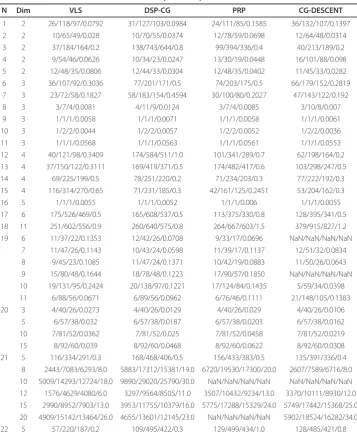
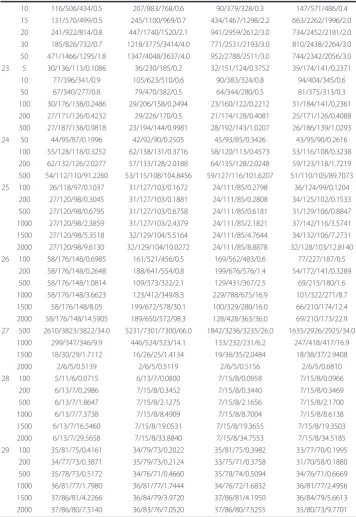
[image:8.595.118.476.293.732.2]The numerical results of our tests are reported in Table 1. The first column “N” represents the problem’s index which corresponds to“N” in Table 2. The detailed numerical results are listed in the form NI/NF/NG/CPU, where NI, NF, NG, CPU denote the number of iterations, function evaluations, gradient evaluations and the time of the CPU in seconds, respectively. “Dim”denotes the dimension of the test pro-blem. If the limit of iteration was exceeded the run was stopped, this is indicated by NaN. In the Table 2,“Problem”represents the problem’s name in [18].
Table 1 The numerical results of the VLS, DSP-CG, PRP and CG-DESCENT methods
N Dim VLS DSP-CG PRP CG-DESCENT 1 2 26/118/97/0.0792 31/127/103/0.0984 24/111/85/0.1585 36/132/107/0.1397
2 2 10/65/49/0.028 10/70/55/0.0374 12/78/59/0.0698 12/64/48/0.0314
3 2 37/184/164/0.2 138/743/644/0.8 99/394/336/0.4 40/213/189/0.2
4 2 9/54/46/0.0626 10/34/23/0.0247 13/30/19/0.0448 16/101/88/0.098
5 2 12/48/35/0.0806 12/44/33/0.0304 12/48/35/0.0402 11/45/33/0.0282
6 3 36/107/92/0.3036 77/201/171/0.5 74/203/175/0.5 66/179/152/0.2819
7 3 23/72/58/0.1827 58/183/154/0.4594 30/100/80/0.2027 47/143/122/0.192
8 3 3/7/4/0.0081 4/11/9/0.0124 3/7/4/0.0085 3/10/8/0.007
9 3 1/1/1/0.0058 1/1/1/0.0071 1/1/1/0.0058 1/1/1/0.0061
10 3 1/2/2/0.0044 1/2/2/0.0057 1/2/2/0.0052 1/2/2/0.0036
11 3 1/1/1/0.0568 1/1/1/0.0563 1/1/1/0.0561 1/1/1/0.0553
12 4 40/121/98/0.3409 174/584/511/1.0 101/341/289/0.7 62/198/164/0.2
13 4 37/150/122/0.3111 169/419/371/0.5 174/482/417/0.6 103/298/247/0.5
14 4 69/225/199/0.5 78/251/220/0.2 71/234/203/0.3 77/222/192/0.3
15 4 116/314/270/0.65 71/231/185/0.3 42/161/125/0.2451 53/204/162/0.3
16 5 1/1/1/0.0055 1/1/1/0.0052 1/1/1/0.006 1/1/1/0.0055
17 6 175/526/469/0.5 165/608/537/0.5 113/375/330/0.8 128/395/341/0.5
18 11 251/602/556/0.9 260/640/575/0.8 264/667/603/1.5 379/915/827/1.2
19 6 11/37/22/0.1353 12/42/26/0.0708 9/33/17/0.0696 NaN/NaN/NaN/NaN
7 11/47/26/0.1143 10/43/24/0.0598 11/39/17/0.1137 12/51/32/0.0834
8 9/45/23/0.1085 11/47/24/0.1371 10/42/19/0.0883 11/50/26/0.0643
9 15/80/48/0.1644 18/78/48/0.1223 17/90/57/0.1850 NaN/NaN/NaN/NaN
10 19/131/95/0.2424 20/138/97/0.1221 17/124/84/0.1435 5/59/34/0.0398
11 6/88/56/0.0671 6/89/56/0.0962 6/76/46/0.1111 21/148/105/0.1383
20 3 4/40/26/0.0273 4/40/26/0.0129 4/40/26/0.029 4/40/26/0.0106
5 6/57/38/0.032 6/57/38/0.0187 6/57/38/0.0203 6/57/38/0.0162
10 7/81/52/0.0362 7/81/52/0.025 7/81/52/0.0458 7/81/52/0.0219
15 8/92/60/0.039 8/92/60/0.0468 8/92/60/0.0622 8/92/60/0.0308
21 5 116/334/291/0.3 168/468/406/0.5 156/433/383/0.5 135/391/336/0.4
8 2443/7083/6293/8.0 5883/17312/15381/19.0 6720/19530/17300/20.0 2607/7589/6716/8.0 10 5009/14293/12724/18.0 9890/29020/25790/30.0 NaN/NaN/NaN/NaN NaN/NaN/NaN/NaN 12 1576/4629/4080/6.0 3297/9564/8505/11.0 3507/10432/9234/13.0 3370/10111/8930/12.0 15 2990/8952/7903/13.0 3953/11755/10379/16.0 5775/17288/15329/24.0 5749/17442/15368/25.0 20 4909/15142/13464/26.0 4655/13601/12145/23.0 NaN/NaN/NaN/NaN 5902/18524/16282/34.0
Firstly, in order to rank the average performance of all above conjugate gradient methods, one can compute the total number of function and gradient evaluation by the formula
[image:9.595.117.474.112.630.2]Ntota1 =N F+l∗N G, (4:1)
Table 1 The numerical results of the VLS, DSP-CG, PRP and CG-DESCENT methods (Continued)
10 116/506/434/0.5 207/883/768/0.6 90/379/328/0.3 147/571/486/0.4
15 131/570/499/0.5 245/1100/969/0.7 434/1467/1298/2.2 663/2262/1996/2.0 20 241/922/814/0.8 447/1740/1520/2.1 941/2959/2612/3.0 734/2452/2181/2.0 30 185/826/732/0.7 1218/3775/3414/4.0 771/2531/2193/3.0 810/2438/2264/3.0 50 471/1466/1295/1.8 1347/4048/3637/4.0 952/2788/2511/3.0 744/2342/2056/3.0 23 5 30/136/113/0.1086 36/230/185/0.2 32/151/124/0.3752 39/174/141/0.2371
10 77/396/341/0.9 105/623/510/0.6 90/383/324/0.8 94/404/345/0.6
50 67/340/277/0.8 79/470/382/0.5 64/344/280/0.5 81/375/313/0.3
100 30/176/138/0.2486 29/206/158/0.2494 23/160/122/0.2212 31/184/141/0.2361 200 27/171/126/0.4232 29/226/170/0.5 21/174/128/0.4081 25/171/126/0.4088 300 27/187/138/0.9818 23/194/144/0.9981 28/192/143/1.0207 26/186/139/1.0293
24 50 44/95/87/0.1996 42/92/90/0.2505 45/93/85/0.3426 43/95/90/0.2616
100 55/128/118/0.3252 62/138/131/0.3716 58/120/113/0.4573 53/116/108/0.3238 200 62/132/126/2.0277 57/133/128/2.0188 64/135/128/2.0248 59/123/118/1.7219 500 54/112/110/91.2260 53/115/108/104.8456 59/127/116/101.6207 51/110/105/89.7073 25 100 26/118/97/0.1037 31/127/103/0.1672 24/111/85/0.2798 36/124/99/0.1204
200 27/120/98/0.3045 31/127/103/0.1881 24/111/85/0.2808 34/125/102/0.1533 500 27/120/98/0.6795 31/127/103/0.6758 24/111/85/0.6181 31/129/106/0.8847 1000 27/120/98/2.3859 31/127/103/2.4379 24/111/85/2.1821 37/142/116/3.5741 1500 27/120/98/5.3518 32/129/104/5.5164 24/111/85/4.7644 34/132/106/7.2731 2000 27/120/98/9.6130 32/129/104/10.0272 24/111/85/8.8878 32/128/103/12.8140 26 100 58/176/148/0.6985 161/521/456/0.5 169/562/483/0.6 77/227/187/0.5
200 58/176/148/0.2648 188/641/554/0.8 199/676/576/1.4 54/172/141/0.3289 500 58/176/148/1.0814 109/373/322/2.1 129/431/367/2.5 69/215/180/1.6 1000 58/176/148/3.6623 123/412/349/8.3 229/788/675/16.9 101/322/271/8.7 1500 58/176/148/8.05 199/672/578/30.1 100/329/280/16.0 66/210/174/12.4 2000 58/176/148/14.5905 189/650/572/98.3 128/428/363/36.0 69/210/173/22.9 27 500 2610/3823/3822/34.0 5231/7301/7300/66.0 1842/3236/3235/26.0 1635/2926/2925/34.0
1000 299/347/346/9.9 446/524/523/14.1 133/232/231/6.2 247/418/417/16.9 1500 18/30/29/1.7112 16/26/25/1.4134 19/36/35/2.0484 18/38/37/2.9408
2000 2/6/5/0.5139 2/6/5/0.5119 2/6/5/0.5156 2/6/5/0.6810
28 100 5/11/6/0.0715 6/13/7/0.0800 7/15/8/0.0958 7/15/8/0.0966
200 6/13/7/0.2986 7/15/8/0.3452 7/15/8/0.3440 7/15/8/0.3469
500 6/13/7/1.8647 7/15/8/2.1275 7/15/8/2.1656 7/15/8/2.1700
1000 6/13/7/7.3738 7/15/8/8.4909 7/15/8/8.7004 7/15/8/8.6138
1500 6/13/7/16.5460 7/15/8/19.0531 7/15/8/19.3655 7/15/8/19.3503
2000 6/13/7/29.5658 7/15/8/33.8840 7/15/8/34.7553 7/15/8/34.5185
wherelis some integer. According to the results on automatic differentiation [20,21], the value of lcan be set to 5, i.e.
Ntota1 =N F+ 5∗N G. (4:2)
That is to say, one gradient evaluation is equivalent to five function evaluations if automatic differentiation is used.
By making used of (4.2), we compare the VLS method with DSP-CG method, PRP method and CG-DESCENT method as follows: for the ith problem, compute the total numbers of function evaluations and gradient evaluations required by the VLS method, DSP-CG method, PRP method and CG-DESCENT method by formula (4.2), and denote them by Ntotal,i (VLS),Ntotal,i(DSP-CG), Ntotal,i(PRP) and Ntotal,i
(CG-DES-CENT), respectively. Then we calculate the ratio
γi(DSP - CG) =
Ntotal,i(DSP - CG) Ntotal,i(VLS)
,
γi(PRP) =
Ntotal,i(PRP) Ntotal,i(VLS) ,
γi(CG - DESCENT) =
Ntotal,i(CG - DESCENT) Ntotal,i(VLS)
.
If the i0th problem is not run by the method, we use a constant l = max{gi
(method)|iÎ S1} instead ofγi0(the method), whereS1 denotes the set of the test pro-blems which can be run by the method. The geometric mean of these ratios for VLS method over all the test problems is defined by
γ(DSP - CG) =
i∈S
γi(DSP - CG) 1
|S|
,
γ(PRP) =
i∈S
γi(PRP) 1
|S|
,
γ(CG - DESCENT) =
i∈S
γi(CG - DESCENT) 1
|S|
,
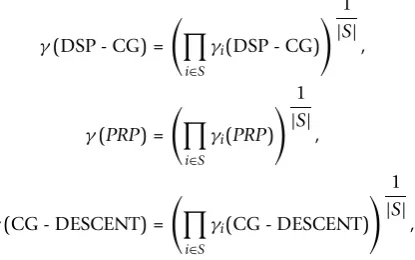
[image:10.595.149.357.529.659.2]where S denotes the set of the test problems, and |S| denotes the number of ele-ments in S. One advantage of the above rule is that, the comparison is relative and hence does not be dominated by a few problems for which the method requires a great deal of function evaluations and gradient functions.
Table 2 The list of the tested problems
N Problem N Problem N Problem N Problem N Problem
1 ROSE 7 BRAD 13 WOOD 19 JNSAM 25 ROSEX
2 FROTH 8 GAUSS 14 KOWOSB 20 VAEDIM 26 SINGX
3 BADSCP 9 MEYER 15 BD 21 WATSON 27 BV
4 BADSCB 10 GULF 16 OSB1 22 PEN2 28 IE
5 BEALE 11 BOX 17 BIGGS 23 PEN1 29 TRID
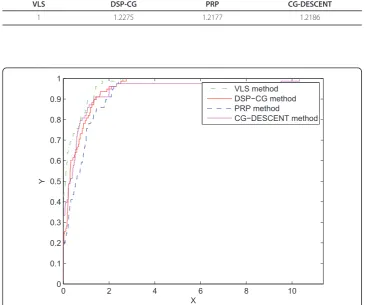
According to the above rule, it is clear thatg(VLS) = 1. The values ofg(DSP-CG),g (PRP) and g(CG-DESCENT) are listed in Table 3.
Secondly, we adopt the performance profiles by Dolan and Moré [22] to compare the VLS method to the DSP-CG method, PRP method and CG-DESCENT method in the CPU time performance (see Figure 1) In Figure 1,
X=τ, Y=P{log2(rp,s)≤τ : 1≤s≤ns}.
That is, for each method, we plot the fractionPof problems for which the method is within a factor τof the best time. The left side of the figure gives the percentage of the test problems for which a method is fastest; the right side gives the percentage of the test problems that were successfully solved by each of the methods. The top curve is the method that solved the most problems in a time that was within a factor τ of the best time. Since the top curve in Figure 1 corresponds to VLS method, this method is clearly fastest for this set for 78 test problems. In particular, the VLS method is fastest for about 60% of the test problems, and it ultimately solves 100% of the test problems.
[image:11.595.115.481.388.693.2]From Table 3 and Figure 1, it is clear that the VLS method performs better in the average performance and the CPU time performance, which implies that the proposed modified method is computationally efficient.
Table 3 Relative efficiency of the VLS, DSP-CG, PRP and CG-DESCENT methods
VLS DSP-CG PRP CG-DESCENT
1 1.2275 1.2177 1.2186
0 2 4 6 8 10
0 0.1 0.2 0.3 0.4 0.5 0.6 0.7 0.8 0.9 1
X
Y
VLS method DSP−CG method PRP method
CG−DESCENT method
Acknowledgements
The authors wish to express their heart felt thanks to the referees and Professor K. Teo for their detailed and helpful suggestions for revising the manuscript. At the same time, we are grateful for the suggestions of Lijuan Zhang. This work was supported by The Nature Science Foundation of Chongqing Education Committee (KJ091104, KJ101108) and Chongqing Three Gorges University (09ZZ-060).
Authors’contributions
Jinkui Liu carried out the new method studies, designed all the steps of proof in this research and drafted the manuscript. Shaoheng Wang participated in writing the all codes of the algorithm and suggested many good ideas that made this paper possible. All authors read and approved the final manuscript.
Competing interests
The authors declare that they have no competing interests.
Received: 3 March 2011 Accepted: 17 September 2011 Published: 17 September 2011
References
1. Liu, Y, Storey, C: Efficient generalized conjugate gradient algorithms. Part 1: theory. J Optim Theory Appl.69, 129–137 (1992) 2. Polak, E, Ribire, G: Note sur la convergence de directions conjugees. Rev Francaise Informat Recherche Operatinelle 3e
Annee.16, 35–43 (1969)
3. Polak, BT: The conjugate gradient method in extreme problems. USSR Comput Math Math Phys.9, 94–112 (1969). doi:10.1016/0041-5553(69)90035-4
4. Gaohang, Yu, Yanlin, Zhao, Zengxin, Wei: A descent nonlinear conjugate gradient method for large-scale unconstrained optimization. Appl Math Comput.187, 636–643 (2007). doi:10.1016/j.amc.2006.08.087
5. Jinkui, Liu, Xianglin, Du, Kairong, Wang: Convergence of descent methods with variable parameters. Acta Math Appl Sin 33, 222–230 (2010). (in Chinese)
6. Hager, WW, Zhang, H: A survey of nonlinear conjugate gradient methods. Pac J Optim.2, 35–58 (2006)
7. Powell, MJD: Nonconvex minimization calculations and the conjugate gradient method. In Numerical Analysis (Dundee, 1983). Lecture Notes in Mathematics, vol. 1066, pp. 122–141.Springer, Berlin (1984)
8. Andrei, N: Scaled conjugate gradient algorithms for unconstrained optimization. Comput Optim Appl.38, 401–416 (2007). doi:10.1007/s10589-007-9055-7
9. Andrei, N: Another nonlinear conjugate gradient algorithm for unconstrained optimization. Optim Methods Softw.24, 89–104 (2009). doi:10.1080/10556780802393326
10. Birgin, EG, Martínez, JM: A spectral conjugate gradient method for unconstrained optimization. Appl Math Optim.43, 117–128 (2001). doi:10.1007/s00245-001-0003-0
11. Dai, Y-H, Liao, L-Z: New conjugacy conditions and related nonlinear conjugate gradient methods. Appl Math Optim.43, 87–101 (2001). doi:10.1007/s002450010019
12. Hager, WW, Zhang, H: A new conjugate gradient method with guaranteed descent and an efficient line search. SIAM J Optim.16, 170–192 (2005). doi:10.1137/030601880
13. Li, G, Tang, C, Wei, Z: New conjugacy condition and related new conjugate gradient methods for unconstrained optimization. J Comput Appl Math.202, 523–539 (2007). doi:10.1016/j.cam.2006.03.005
14. Wei, Z, Li, G, Qi, L: New quasi-Newton methods for unconstrained optimization problems. Appl Math Comput.175, 1156–1188 (2006). doi:10.1016/j.amc.2005.08.027
15. Zhang, L, Zhou, W, Li, D-H: A descent modified Polak-Ribiére-Polyak conjugate gradient method and its global convergence. IMA J Numer Anal.26, 629–640 (2006). doi:10.1093/imanum/drl016
16. Yuan, G: modified nonlinear conjugate gradient method with sufficient descent property for large-scale optimization problems. Optim Lett.3, 11–21 (2009). doi:10.1007/s11590-008-0086-5
17. Gaohang, Yu, Lutai, Guan, Wufan, Chen: Spectral conjugate gradient methods with sufficient descent property for large-scale unconstrained optimization. Optim Methods Softw.23, 275–293 (2008). doi:10.1080/10556780701661344 18. More, JJ, Garbow, BS, Hillstrome, KE: Testing unconstrained optimization software. ACM Trans Math Softw.7, 17–41
(1981). doi:10.1145/355934.355936
19. Zoutendijk, G: Nonlinear programming, computational methods. In: Abadie J (ed.) Integer and Nonlinear Programming. pp. 37–86. North-Holland, Amsterdam (1970)
20. Dai, Y, Ni, Q: Testing different conjugate gradient methods for large-scale unconstrained optimization. J Comput Math. 213, 11–320 (2003)
21. Griewank, A: On automatic differentiation. In: Iri M, Tannabe K (eds.) Mathematical Programming: Recent Developments and Applications. pp. 84–108. Kluwer Academic Publishers, Dordrecht (1989)
22. Dolan, ED, Moré, JJ: Benchmarking optimization software with performance profiles. Math Program.91, 201–213 (2001)
doi:10.1186/1029-242X-2011-57
Cite this article as:Liu and Wang:Modified nonlinear conjugate gradient method with sufficient descent