2018 International Conference on Physics, Computing and Mathematical Modeling (PCMM 2018) ISBN: 978-1-60595-549-0
Simulation of Shell Drop
Jue TANG
*, Guo-xun JI and Guo-dong LI
Xi’an High-tech Research Institute, China *Corresponding author
Keywords: Shell, Drop, Posture, ANSYS workbench, safety.
Abstract. In order to study the impact of drop attitude on the impact of shell drop, the case of shell drop from different angles of the same height was simulated by ANSYS Workbench finite element simulation software, and the maximum stress distribution was analyzed. The results show that the falling attitude of the shell greatly affects the impact when the shell drops, and the greater the angle of falling shell, the more severe the local impact. The research results can provide important theoretical guidance for social engineering practice.
Introduction
Drop impact test is a necessary experiment before the product leaves the factory, in order to test whether the item's drop resistance is qualified or not. At a time when the logistics industry is highly developed, drop accidents occur frequently and bring a lot of losses to the national economy. However, many objects are difficult to test the drop due to the high experimental cost and the high hazard coefficient, so it is very necessary to simulate the drop. Jason Wu, Guoshu Song et al. Used finite element method to study the impact of portable communication equipment impact; Han Keming and other simulation methods used to analyze the mobile phone touch screen drop force; Sun Liang, Hu Ming Xi, gorgeous, Gong Snow et al. All used the finite element simulation method to make drop simulation analysis on pruners, packages, washers, goblets and other items, and obtained more reliable conclusions. Although the research on package items is more complete and comprehensive, there are few researches on the shell category, especially the study on the impact of falling posture on the shell safety is even more rare. In this paper, a military shell is taken as the research object, and its falling posture is simulated by using ANSYS Workbench finite element simulation software to analyze the impact of drop attitude on the safety of shell drop. The research results can provide guidance for the social engineering practice.
Theoretical Basis
The Basic Idea of Finite Element
The foundation of the finite element method is the variational principle and the weighted residual method. The basic idea is to divide the computational domain into a finite number of non-overlapping units. In each unit, select the appropriate node as the interpolation point of the solution function, and rewrite the variables in the differential equation into a linear expression composed of the node value of each variable or its derivative and the selected interpolation function, Subdivision principle or weighted residual method discrete solution of discrete equations. Specific problem-solving steps are as follows:
(1) Establish integral equation (2) Area unit segmentation
(3) Determine the unit basis function (4) Unit analysis
(5) Overall synthesis
CAE / CAD Software Seamless Integration
In the previous finite element analysis, all the models were built in the 3D drawing software, and the inherent format was saved and then imported into ANSYS finite element analysis software. The information of some models was easily distorted during the import process, and the operation is too much trouble; once the model needs to be modified, the workload is enormous. On this basis, the article will utilize Solidworks software and ANSYS workbench software, the Solidworks models directly transferred to the Workbench interface, while the changes in the Solidworks software model can be mapped directly to the Workbench, analysis, optimization The results can also drive the CAD model to make the appropriate updates, greatly improving the efficiency of the work.2.2 Elbow section of the local loss.
Shell Drop Theory Analysis
A shell of mass m falls from a height of h with a potential energy of mgh. Excluding air resistance, the speed of the shell when landing when the shell is suddenly restrained by the floor after it landed on the floor, an impact force is generated between the two. In the collision process can be divided into two stages. The first stage is the deformation stage. During the deformation stage, this part of the kinetic energy gradually transformed into shell and floor deformation energy, elastic deformation which can be stored in the shell and the floor, and plastic deformation absorbed energy is converted into heat dissipation. The second phase is the recovery phase. At the end of the recovery phase, the shell bounces upward at a rate less than that of landing.
Finite Element Model Establishment
Material Model Selection
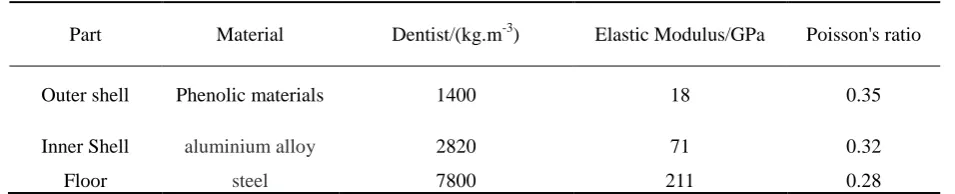
[image:2.595.60.538.542.639.2]In the finite element analysis, the choice of material model will directly affect the accuracy of the simulation results; therefore, the selection of the appropriate material model is essential. Shell is divided into two layers, heat-resistant layer and structure layer, heat-proof material is phenolic material, structural layer material is aluminum alloy material. Open the Workbench, double-click on the Explicit Dynamics display kinematics module, open the material library in the workspace, select the appropriate material model, aluminum. You can directly select from the material library, but not unusual such as phenolic Oh need to enter, click click, add new material, specific material parameters as shown below:
Table 1. Material parameters.
Part Material Dentist/(kg.m-3) Elastic Modulus/GPa Poisson's ratio
Outer shell Phenolic materials 1400 18 0.35
Inner Shell aluminium alloy 2820 71 0.32
Floor steel 7800 211 0.28
Meshing
Figure 1. The element model.
Apply Load
Therefore, it is necessary to simulate and analyze the shell when the multi-angle falls. According to the research, the drop height of the shell is generally 5 meters. In this paper, the drop height is 5 meters, but the drop analysis, the drop height is usually equivalent to the impact of the initial velocity, so the direction of the Y-axis negative direction to the shell, the size of 10m / s, right-click Initial Condition, select velocity, add the value of 10. For the first time, you need to apply a gravitational constraint on all objects. Click Inertial, select Standard earth gravity, and select the negative direction of the Y axis. Next, constrain the ground. Click Supports, select Fixed support and select the four faces of the ground. After the calculation can be completed, Click Solution to start calculating.
Simulation Calculation
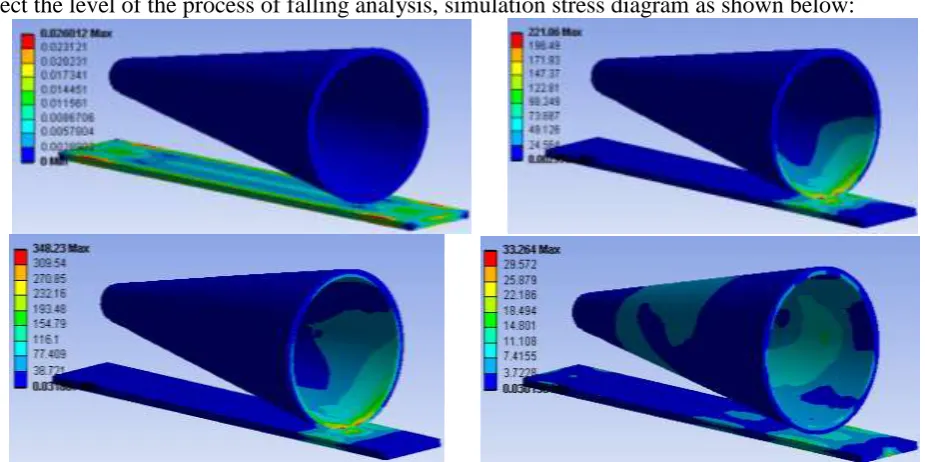
Select the level of the process of falling analysis, simulation stress diagram as shown below:
Figure 2. Drop simulation calculation.
Drop Gesture Analysis
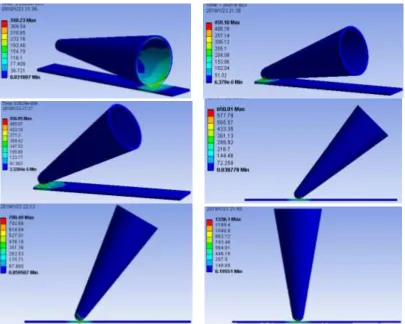
Select Different Posture Shell Drop Model
[image:3.595.72.535.426.657.2]
[image:4.595.110.503.69.417.2]
Figure 3. Different angles of the shell drop model.
Shell Drop Maximum Stress Cloud:
[image:4.595.103.509.454.778.2]
Results Analysis
From the simulation results, the impact of the drop on the impact of the shell larger. At the same speed drop from different angles, the impacts of the shell are not the same, the level of shell when the impact of the smallest drop, the maximum stress value of 348MPa. When the vertical drop, the impact on the shell is the most serious, and the maximum stress is 1338MPa. With the increase of the angle, the impact on the shell increases gradually. When the angle reaches 90°, the maximum stress of the shell reaches the maximum. Therefore, it can be concluded that when the shell drops from different angles of the same height, the impact on the shell gradually increases with the increase of the angle.
References
[1]Li Daokui, Li Haiyang, Wu Xiao, etc. Materials Mechanics. [M] Beijing: Higher Education Press, 2014.
[2]Wang B. Drop shock response of thin-walled cylinder structure. [D] Beijing: Beijing Institute of Technology, 2015.
[3]Pu Xue. An Electronic Product Drop Simulation Based on ANSYS / LS-DYNA [D]. Lanzhou: Lanzhou Jiaotong University, 2016.
[4]Li Dan, Zhao Ting-Yu, Wang Yong-hu. LN-DYNA Numerical Simulation of Full-size Mobile Phone Drop [J]. Journal of Yibin University, 2017: 1-6.