R E S E A R C H
Open Access
Stability of
k
-step fixed point iterative
methods for some Preši´c type contractive
mappings
Vasile Berinde
1*and M˘ad˘alina P˘acurar
2*Correspondence:
1Department of Mathematics and
Computer Science, North University of Baia Mare, Victorie1 76, Baia Mare, 430072, Romania
Full list of author information is available at the end of the article
Abstract
We introduce the concept of stability of ak-step fixed point iterative method xn+1=T(xn,xn–1,. . .,xn–k+1),n≥k– 1, and study the stability of this equation for
mappingsT:Xk→Xsatisfying some Preši´c type contraction conditions. Our results naturally extend various stability results of fixed point iterative methods in literature, from contractive self-mappingsT:X→Xto Preši´c type contractive mappings T:Xk→X. Illustrative examples of both stable and unstable fixed point iterations are also presented.
MSC: 47H09; 47H10; 54H25
Keywords: metric space; contractive mapping; fixed point;k-step fixed point iterative method; stability
1 Introduction
Let (X,d) be a metric space andT:X→Xa self-mapping. Denote byFix(T) :={x∈X: Tx=x}the set of fixed points ofT. If (X,d) is complete andTis a contraction,i.e., there exists a constantα∈[, ) such that
d(Tx,Ty)≤ad(x,y), for allx,y∈X, ()
then, by the well-known Banach contraction mapping principle, we know thatFix(T) ={p} and that, for anyx∈X, the Picard iteration, that is, the sequence defined byxn+=Txn,
n= , , . . . , converges top, asn→ ∞.
When applying contraction mapping principle for solving concrete nonlinear problems, because of rounding errors, numerical approximations of functions, derivatives or inte-grals, discretization etc., instead of the theoretical sequence{xn}∞n=, defined by the given iterative method, we practically work with anapproximate sequence{yn}∞n=, satisfying the following approximation bounds:
y:=x, d(y,Ty)≤, . . . , d(yn,Tyn–)≤n, . . . ,
where the positive quantityncan be interpreted as the ‘round-off error’ ofxn; see [].
Under these circumstances, the problem of thenumerical stabilityof Picard iteration is whether the approximate sequence{yn}∞n=still converges to the fixed pointpofT, pro-vided thatn→ or
∞
n=n<∞.
This question has been answered in the positive, in the case of contraction condition (), by Ostrowski [], who established the first stability result for a fixed point iteration proce-dure, by using the following estimate:
d(yn,p)≤
αn
–αd(x,x) +
n
k=
αn–kk, n= , , , . . . , ()
from which easily follows thatyn→p, providedn→.
In , Harder and Hicks [, ] introduced the notion of stability for a general fixed point iteration procedure and started a systematic study of this concept, thus obtaining various stability results for Picard iteration that extended Ostrowski’s theorem to map-pings satisfying more general contractive conditions and also established some stability results for other fixed point iteration procedures (Mann iteration, Ishikawa iteration, Kirk iteration) in the class of Banach contractions, Zamfirescu operators etc.
Further, some authors, see [, –], continued the study of the stability of Picard and some other fixed point iterations for various general classes of contractive self-mappings T. Very recently, Rus [, ] introduced some alternative concepts of stability for fixed point iterative methods.
On the other hand, the contraction mapping principle has been extended by Prešić [] to mappingsT:Xk→Xsatisfying a contractive condition that include () in the particular
casek= . Some other Prešić type fixed point theorems have been obtained in [–], in the caseTsatisfies more general contractive type conditions, while in [, ], and [], some applications to nonlinear cyclic systems of equations and difference equations are obtained.
As for thek-step fixed point iterative methods associated to Prešić type contractive con-ditions do not exist corresponding stability results, yet, the main aim of this paper is to fill this gap and to introduce an appropriate concept of stability and then establish some stability results. The relationship of our notion of stability to other existing concepts of stability, mainly drawn from the theory of difference equations, is also discussed.
The stability results we shall obtain in this way are extremely general. They unify, extend, generalize, enrich, and complement a multitude of related results from recent literature. Illustrative examples of both stable and unstable fixed point iterative sequences are given. The paper is organized as follows: in Section we summarize some fixed point theo-rems for mappings satisfying Prešić type contractive conditions, in Section we present the basic concepts and results concerning the stability of fixed point iteration procedures associated to self-mappings that satisfy explicit contractive conditions. In Section , the main stability results of this paper are presented. In Section , we end this paper by pre-senting three detailed examples of stable (Examples and ) and unstable (Example ) fixed point iterations.
2 Fixed point theorems for Preši´c type mappings
All the stability results mentioned in the previous section were basically established in connection with a corresponding fixed point theorem: Banach, Kannan, Chatterjea, Zam-firescu etc.; see for example [] for more details.
will be fundamental in establishing our stability results for k-step fixed point iterative methods in the present paper.
Theorem (Prešić [], ) Let(X,d)be a complete metric space,k a positive integer,
α,α, . . . ,αk∈R+, k
i=
αi=α< and T:Xk→X a mapping satisfying
dT(x, . . . ,xk–),T(x, . . . ,xk)
≤αd(x,x) +· · ·+αkd(xk–,xk), ()
for all x, . . . ,xk∈X.
Then:
() Thas a unique fixed pointx∗,that is,there exists a uniquex∗∈Xsuch that
f(x∗, . . . ,x∗) =x∗;
() the sequence{xn}n≥defined by
xn+=T(xn, . . . ,xn–k+), n=k– ,k,k+ , . . . ()
converges tox∗,for anyx, . . . ,xk–∈X.
It is easy to see that, in the particular casek= , from Theorem we get exactly the well-known Banach contraction mapping principle, while thek-step iterative method () reduces to Picard iteration:
xn+=T(xn), n= , , , , . . . . ()
Theorem and other similar results, like the ones in [, , , ], have important applications in the iterative solution of nonlinear equations, see [] and [, , ], as well as in the study of global asymptotic stability of the equilibrium for nonlinear difference equations; see the very recent paper [].
An important generalization of Theorem was proved by Rus [], for operatorsT ful-filling the more general condition
dT(x, . . . ,xk–),T(x, . . . ,xk)
≤ϕd(x,x), . . . ,d(xk–,xk)
, ()
for anyx, . . . ,xk∈X, whereϕ:Rk+→R+satisfies certain appropriate conditions. Another important generalization of Prešić’s result was recently obtained by Cirić and Prešić in [], where, instead of () and its generalization (), the following contraction condition is considered:
dT(x, . . . ,xk–),T(x, . . . ,xk)
≤λmaxd(x,x), . . . ,d(xk–,xk)
, ()
for anyx, . . . ,xk∈X, whereλ∈(, ).
3 Some useful lemmas
In order to obtain simple and short proofs for our main results in this paper we shall need some auxiliary lemmas. A proof of the following lemma can be found in []; see also [].
Lemma (Cauchy) Let{an}∞n=,{bn}∞n=be sequences of nonnegative numbers satisfying
(i) lim
n→∞an= ; (ii)
∞
k= bk<∞.
Then
lim n→∞
n
k=
akbn–k= .
We note that by Lemma we find that the second term in () converges to zero:
n
k=
αn–kk→ asn→ ∞.
Lemma Let k be a positive integer and{an}∞n=,{bn}∞n=two sequences of nonnegative real numbers satisfying the inequality
an+≤αan+αan–+· · ·+αkan–k++bn, n≥k– , ()
whereα, . . . ,αk∈[, )andα+· · ·+αk< .Iflimn→∞bn= ,thenlimn→∞an= .
Proof For simplicity, we prove lemma fork= , when we denoteα:=αandα:=β. All arguments used below work unchanged in the general case, too.
We first show that if the sequence{un}∞n=is given byu= ,u=αand
un+=αun+βun–, n≥, ()
then the series∞n=unconverges.
Indeed, the characteristic equation corresponding to the linear difference equation () has two distinct real roots,r,r∈(–, ), since, if we denotef(r) :=r–αr–β, we have f(–) > ,f() > .
Hence,un=crn+crn, wherec,care two constants, and so the convergence of
∞
n=un
follows by the convergence of the geometric progression series∞n=qn, with – <q< .
Note that in the general case, the characteristic equation
rk–αrk––· · ·–αk–r–αk=
has all its roots (not always real) in absolute value in the interval [, ), by virtue of a con-sequence of the Rouché theorem, see [], which reads as follows.
Letp(x) =a+ax+· · ·+anxnbe a polynomial with complex coefficientsa,a, . . . ,an
value less thanR, where
R=max
,|a|+|a|+· · ·+|an–|
|an|
.
Now, let’s come back to the inequality () withk= ,α:=αandα:=β. Take formally n:=iin () to obtain
ai+≤αai+βai–+bi,
then multiply both sides of this inequality byun–iand sum up all the inequalities obtained
fori= , , . . . ,nto get
≤an+≤aun+βaun–+
n–
k=
ukbn–k, n≥.
Now apply Lemma to get the desired conclusion.
Remark Note that fork= , by Lemma we obtain Theorem . in [], a result which is fundamental for obtaining short proofs of stability theorems for one step fixed point iterative methods that has been used in [, , ], and [].
4 Stability ofk-step fixed point iteration procedures
We first recall some concepts of stability for -step fixed point iteration procedures, before we consider the stability of ak-step fixed point iteration procedure.
Let (X,d) be a metric space,T: X→Xa self-operator withFix(T)=∅and let{xn}∞n= be a fixed point iteration procedure of the general form
xn+=f(T,xn), n= , , , . . . , ()
wheref(T,xn) is given, which converges to a fixed pointpofT (for example, in the case
of Picard iteration we havef(T,xn) :=Txn).
Definition (Harder and Hicks, []) Let{yn}∞n=be an arbitrary sequence inXand set
εn=d
yn+,f(T,yn)
, forn= , , , . . . . ()
We shall say that the fixed point iteration procedure () isT -stableorstable with respect to Tif
lim
n→∞εn= ⇒ n→∞limyn=p. ()
Definition (Osilike, []) Let (X,d) be a metric space,T: X→Xa self-operator with
Fix(T)=∅and let{xn}∞n=be a fixed point iteration procedure given by (), supposed to converge to a fixed pointpofT. Let{yn}n∞=be an arbitrary sequence inXand let{εn}be
defined by (). We shall say that the fixed point iteration procedure () isalmost T -stable oralmost stable with respect to Tif
∞
n=
εn<∞ ⇒ n→∞limyn=p. ()
Definition (Berinde, []) Let (X,d) be a metric space,T: X→Xa self-operator with
Fix(T)=∅and let{xn}∞n=be a fixed point iteration procedure given by (), supposed to converge to a fixed pointpofT. Let{yn}∞n=be an arbitrary sequence inX and let{εn}
be defined by (). We shall say that the fixed point iteration procedure () issummable almost T -stableorsummable almost stable with respect to Tif
∞
n=
εn<∞ ⇒ ∞
n=
d(yn,p) <∞. ()
It is clear from Definitions - that:
() any stable iteration procedure is almost stable;
() any summable almost stable procedure is almost stable,
but the reverses of these assertions are not generally true; see Example in []. Moreover, in general, the class of stable iteration procedures is independent of the class of summable almost stable procedures.
We introduce now the concept of stability for ak-step fixed point iteration procedure.
Definition Let (X,d) be a metric space,ka positive integer, T: Xk→X a mapping
withFix(T) ={x∈X:T(x, . . . ,x) =x} =∅and let{xn}∞n=be ak-step fixed point iteration procedure of the general form
xn+=f(T,xn,xn–, . . . ,xn–k+), n=k– ,k,k+ , . . . , ()
which converges to a fixed pointpofT. Let{yn}∞n=be an arbitrary sequence inXand set
εn=d
yn+,f(T,yn,yn–, . . . ,yn–k+)
, forn=k– ,k,k+ , . . . . ()
We shall say that the fixed point iteration procedure () isT -stableorstable with respect to Tif
lim
n→∞εn= ⇒ n→∞limyn=p. ()
Remark Fork= , by Definition we get exactly Definition .
Theorem Let(X,d)be a complete metric space,k a positive integer,a∈Ra constant such that <ak(k+ ) < and T:Xk→X a mapping satisfying the following contractive
type condition:
dT(x, . . . ,xk–),T(x, . . . ,xk)
≤a
k
i=
dxi,T(xi, . . . ,xi)
, ()
for any x,x, . . . ,xk∈X.
Then:
() Thas a unique fixed pointx∗,that is,there exists a uniquex∗∈Xsuch that
T(x∗, . . . ,x∗) =x∗;
() The sequence{xn}n≥withx, . . . ,xk–∈Xand
xn=T(xn–k,xn–k+, . . . ,xn–), n≥k, ()
converges tox∗;
() Thek-step iteration{xn}n≥given by()isT-stable.
Proof Items () and () follow by Theorem in []. Now let{yn}∞n=be an arbitrary se-quence inXand denote
εn=d
yn+,T(yn,yn–, . . . ,yn–k+)
, forn=k– ,k,k+ , . . . . ()
First, by triangle inequality, we have
dyn+,x∗
≤dyn+,T(yn,yn–, . . . ,yn–k+)
+dT(yn,yn–, . . . ,yn–k+),x∗
. ()
In view of the contractive condition (), we have
dT(yn,yn–, . . . ,yn–k+),x∗
=dT(yn, . . . ,yn–k+),T
x∗, . . . ,x∗
≤dT(yn, . . . ,yn–k+),T
yn–, . . . ,yn–k+,x∗
+dTyn–, . . . ,yn–k+,x∗
,Tyn–, . . . ,yn–k+,x∗,x∗
+· · ·+dTyn–k+, . . . ,x∗,x∗,x∗
,Tx∗, . . . ,x∗,x∗,x∗.
If we denoteF(x) :=T(x,x, . . . ,x), then by the above inequality we get
dT(yn,yn–, . . . ,yn–k+),x∗
≤adyn,T(yn)
+· · ·+dyn–k+,x∗
+dx∗,x∗
+adyn–,T(yn–)
+· · ·+dyn–k+,x∗
+dx∗,x∗+dx∗,x∗
+· · ·+adyn–k+,T(yn–k+)
+dx∗,x∗+· · ·+dx∗,x∗
=adyn,T(yn)
+ dyn–,T(yn–)
+· · ·+kdyn–k+,T(yn–k+)
On the other hand, for anyjwe have, by the triangle inequality,
dxj,F(xj)
≤dxj,x∗
+dx∗,F(xj)
. ()
Similarly to the way we obtained (), we get for anyx,y∈X,
dF(x),F(y)=dT(x,x, . . . ,x),T(y,y, . . . ,y)≤Adx,F(x)+dy,F(y), ()
where, by hypothesis,A=ak(k+)<.
Sincex∗is a fixed point ofT, by takingx:=x∗andy:=xjin () we have
dx∗,F(xj)
=dTx∗,x∗, . . . ,x∗,T(xj,xj, . . . ,xj)
≤Adxj,F(xj)
.
Now, by () we get
dxj,F(xj)
≤dxj,x∗
+Adxj,F(xj)
,
that is,
dxj,F(xj)
≤
–Ad
xj,x∗
. ()
Now, by (), (), and () we find that the sequence of non-negative real numbers
{d(yn,x∗)}satisfies the recurrence inequality
dyn+,x∗
≤αdyn,x∗
+· · ·+αkd
yn–k+,x∗
+n, n≥k– , ()
whereαj=–jaA. It is a simple task to show that
α+· · ·+αk=
a( + +· · ·+k)
–A =
A –A< ,
sinceA=ak(k+)<, by hypothesis.
Now, assumelimn→∞εn= . By applying Lemma withan:=d(yn,x∗) andbn:=εn, by
virtue of (), we conclude thatd(yn+,x∗)→ asn→ ∞, that is, thek-step iteration
{xn}n≥defined by () isT-stable.
A similar stability result can be obtained for mappingsTsatisfying a more general con-tractive condition than ().
DenoteFix(T) ={x∈X:T(x,x, . . . ,x) =x}.
Theorem Let(X,d)be a metric space,k a positive integer and T: Xk→X a mapping
with the property thatFix(T)=∅for which there existα,α, . . . ,αk∈R+,
k
i=αi=α<
satisfying
dT(x, . . . ,xk–),x∗
≤αdx,x∗+· · ·+αkd
xk–,x∗
, ()
Proof Let{yn}∞n=be an arbitrary sequence inXand denote
εn=d
yn+,T(yn,yn–, . . . ,yn–k+)
, forn=k– ,k,k+ , . . . .
By triangle inequality, we have
dyn+,x∗
≤dyn+,T(yn,yn–, . . . ,yn–k+)
+dT(yn,yn–, . . . ,yn–k+),x∗
()
and by () we obtain
dT(yn,yn–, . . . ,yn–k+),x∗
≤αdyn,x∗
+· · ·+αkd
yn–k+,x∗
which together with () yields
dyn+,x∗
≤αdyn,x∗
+· · ·+αkd
yn–k+,x∗
+n, n≥k– , ()
and the rest of the proof is similar to that of Theorem .
Remark It is clear by the proof of Theorem that ifTsatisfies () thenTalso satisfies (), but the reverse is not true, as shown by Example .
Another general stability result is given by the next theorem.
Theorem Let(X,d)be a metric space,k a positive integer and T: Xk→X a mapping with the property thatFix(T)=∅and for which there existα,α, . . . ,αk∈R+,
k
i=αi=α<
and a constant L> such that
dT(x, . . . ,xk–),T(x, . . . ,x)
≤αd(x,x) +· · ·+αkd(xk–,x) +Ld
x,T(x, . . . ,x), ()
for all x, . . . ,xk,x∈X.Then the k-step iteration{xn}n≥defined by()is T -stable.
Proof Let{yn}∞n=be an arbitrary sequence inXand denote
εn=d
yn+,T(yn,yn–, . . . ,yn–k+)
, forn=k– ,k,k+ , . . . .
Ifx:=x∗∈Fix(T) then by triangle inequality we get () and by takingx:=yn, . . . ,xk–:= yn–k+andx:=x∗∈Fix(T) in () we obtain
dT(yn,yn–, . . . ,yn–k+),x∗
≤αdyn,x∗
+· · ·+αkd
yn–k+,x∗
,
sincex∗=T(x∗, . . . ,x∗). The rest of the proof follows similarly to the proof of Theorem .
5 Examples and concluding remarks
Example ([], Example ) LetX= [, ] with the usual metric andT: X→Xbe de-fined by
T(x,y) =
, (x,y)∈
,
×[, ]; T(x,y) =
, (x,y)∈
,
×[, ].
Then, see the detailed proof in [],T satisfies () but does not satisfy (), () and (). Hence by Theorem it follows that thek-step fixed point iteration () isT-stable.
To show that () holds, while (), (), () do not hold; see the detailed proof in [].
Example LetX=Rwith the usual metric andT:X→Xbe defined by
T(x,y) =x+ y
, ∀(x,y)∈X .
It is easy to check thatT satisfies condition () (withα=,α=), condition () (with
ϕ(t,t) =t+t), condition () (withλ=) and condition () (withα=,α=) but does not satisfy ().
Assume condition () does hold and takex:=,x:=andx:= . We get
≤
a
⇔ ≤a,
a contradiction, since, by hypothesis,a<
. Hence by Theorem or Theorem (but not by Theorem ) it follows that thek-step fixed point iteration () isT-stable.
The next example illustrates unstable fixed point iterations, in the case neither () nor () is satisfied.
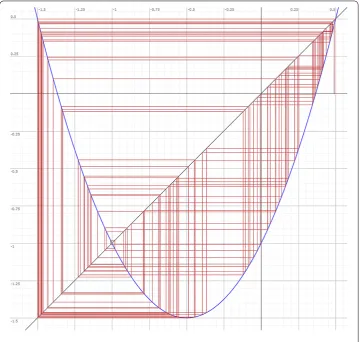
Example Consider the case k= (in order to graph the orbits),X= [–,] with the Euclidean norm and letT: X→Xbe given byTx= x+ x– , for allx∈X.
ThenT does not satisfy (), (), (), and (),Fix(T) ={–,}and the orbits ofx= . underTbehave chaotic; see Figure .
Indeed, assume that () holds,i.e.,
|Tx–Ty| ≤α|x–y|, ∀x,y∈X,
and takex= –,y= – to get the contradiction ≤α< . For the same values ofxandy, () and () are not satisfied. Now, assume that () holds forx∗= –,i.e.,
|Tx+ | ≤α|x+ |, ∀x∈X,
and takex= , to get the contradiction ≤α< .
Note that forx= . we obtain a convergent (and constant) sequence,xn= .,n≥,
while forxas close as possible to . but different of . we have always unstable orbits
Figure 1 Unstable orbits ofx0= 0.49 underTin Example 3.
Similar approaches to those in the present paper can be done for mappings defined on product spaces but adapted from the ones in the usual case; see the recent related fixed point results [–], and [].
Competing interests
The authors declare that they have no competing interests.
Authors’ contributions
The authors read and approved the final manuscript.
Author details
1Department of Mathematics and Computer Science, North University of Baia Mare, Victorie1 76, Baia Mare, 430072,
Romania. 2Department of Statistics, Analysis, Forecast and Mathematics, Faculty of Economics and Bussiness Administration, Babe¸s-Bolyai University of Cluj-Napoca, 56-60 T. Mihali St., Cluj-Napoca, 400591, Romania.
Acknowledgements
The authors research was supported by the Grant PN-II-RU-TE-2011-3-239 of the Romanian Ministry of Education and Research. The first author was also supported by the Grant PN-II-ID-PCE-2011-3-0087 of the Romanian Ministry of Education and Research.
Received: 7 December 2013 Accepted: 28 March 2014 Published:11 Apr 2014 References
1. Jachymski, JR: An extension of A. Ostrowski’s theorem on the round-off stability of iterations. Aequ. Math.53(3), 242-253 (1997)
2. Ostrowski, AM: The round-off stability of iterations. Z. Angew. Math. Mech.47, 77-81 (1967)
5. Rhoades, BE: Fixed point theorems and stability results for fixed point iteration procedures. Indian J. Pure Appl. Math.
21(1), 1-9 (1990)
6. Rhoades, BE: Some fixed point iteration procedures. Int. J. Math. Math. Sci.14(1), 1-16 (1991)
7. Rhoades, BE: Fixed point theorems and stability results for fixed point iteration procedures. II. Indian J. Pure Appl. Math.24(11), 691-703 (1993)
8. Osilike, MO: Stability results for fixed point iteration procedures. J. Niger. Math. Soc.14/15, 17-29 (1995/1996) 9. Osilike, MO: Stability of the Mann and Ishikawa iteration procedures forφ-strong pseudocontractions and nonlinear
equations of theφ-strongly accretive type. J. Math. Anal. Appl.227(2), 319-334 (1998)
10. Osilike, MO, Udomene, A: Short proofs of stability results for fixed point iteration procedures for a class of contractive-type mappings. Indian J. Pure Appl. Math.30(12), 1229-1234 (1999)
11. Zhou, HY, Chang, S-S, Cho, YJ: Weak stability of the Ishikawa iteration procedures forφ-hemicontractions and accretive operators. Appl. Math. Lett.14(8), 949-954 (2001)
12. Berinde, V: On the stability of fixed point iteration procedures. Bul. ¸Stiin¸t. - Univ. Baia Mare, Ser. B Fasc. Mat.-Inform.
18(1), 7-12 (2002)
13. Berinde, V: Summable almost stability of fixed point iteration procedures. Carpath. J. Math.19(2), 81-88 (2003) 14. Imoru, C, Olatinwo, MO: On the stability of Picard and Mann iteration processes. Carpath. J. Math.19(2), 155-160
(2003)
15. Berinde, V: Iterative Approximation of Fixed Points. Springer, Berlin (2007)
16. Qing, Y, Rhoades, BE:T-stability of Picard iteration in metric spaces. Fixed Point Theory Appl.2008, Article ID 418971 (2008)
17. Olatinwo, MO: Some stability results in complete metric space. Acta Univ. Palacki. Olomuc., Fac. Rerum Nat., Math.48, 83-92 (2009)
18. Rus, IA: An abstract point of view on iterative approximation of fixed points: impact on the theory of fixed point equations. Fixed Point Theory13(1), 179-192 (2012)
19. Rus, IA: Properties of the solutions of those equations for which Krasnoselskii iteration converges. Carpath. J. Math.
28(2), 329-336 (2012)
20. Preši´c, SB: Sur une classe d’inéquations aux différences finites et sur la convergence de certaines suites. Publ. Inst. Math. (Belgr.)5(19), 75-78 (1965)
21. Ciri´c, LB, Preši´c, SB: On Preši´c type generalization of the Banach contraction mapping principle. Acta Math. Univ. Comen.76(2), 143-147 (2007)
22. P˘acurar, M: Iterative Methods for Fixed Point Approximation, Risoprint, Cluj-Napoca (2010)
23. P˘acurar, M: A multi-step iterative method for approximating fixed points of Preši´c-Kannan operators. Acta Math. Univ. Comen.79(1), 77-88 (2010)
24. P˘acurar, M: Approximating common fixed points of Preši´c-Kannan type operators by a multi-step iterative method. An. Univ. “Ovidius” Constan¸ta, Ser. Mat.17(1), 153-168 (2009)
25. P˘acurar, M: Fixed points of almost Preši´c operators by ak-step iterative method. An. ¸Stiin¸t. Univ. ‘Al.I. Cuza’ Ia¸si, Mat.
57, 199-210 (2011)
26. Rus, IA: An iterative method for the solution of the equationx=f(x,. . .,x). Rev. Anal. Numér. Théor. Approx.10(1), 95-100 (1981)
27. Berinde, V, P˘acurar, M: An iterative method for approximating fixed points of Preši´c nonexpansive mappings. Rev. Anal. Numér. Théor. Approx.38(2), 144-153 (2009)
28. Berinde, V, P˘acurar, M: Two elementary applications of some Preši´c type fixed point theorems. Creative Math. Inform.
20(1), 32-42 (2011)
29. Chen, Y-Z: A Preši´c type contractive condition and its applications. Nonlinear Anal.71, e2012-e2017 (2009) 30. P˘av˘aloiu, I: Rezolvarea ecua¸tiilor prin interpolare. Editura Dacia, Cluj-Napoca (1981)
31. P˘av˘aloiu, I, Pop, N: Interpolare ¸si aplica¸tii. Risoprint, Cluj-Napoca (2005)
32. Berinde, V, P˘acurar, M: O metod˘a de tip punct fix pentru rezolvarea sistemelor ciclice. Gaz. Mat., Ser. B116(3), 113-123 (2011)
33. P˘acurar, M: A multi-step iterative method for approximating common fixed points of Preši´c-Rus type operators on metric spaces. Stud. Univ. Babe¸s–Bolyai, Math.55(1), 149-162 (2010)
34. Berinde, V: A note on a difference inequality used in the iterative approximation of fixed points. Creative Math. Inform.18(1), 6-9 (2009)
35. Rus, IA, ¸Serban, MA: Some generalizations of a Cauchy lemma and applications. In: Cobzas, S (ed.) Topics in Mathematics, Computer Science and Philosophy, pp. 173-181. Cluj University Press, Cluj-Napoca (2008) 36. Wikipedia: Properties of polynomial roots. http://en.wikipedia.org/wiki/Properties_of_polynomial_roots 37. Berinde, V: On a family of first order difference inequalities used in the iterative approximation of fixed points.
Creative Math. Inform.18(2), 110-122 (2009)
38. Berinde, V: Convergence theorems for fixed point iterative methods defined as admissible perturbations of a nonlinear operator. Carpath. J. Math.29(1), 9-18 (2013)
39. Choban, MM: Fixed points for mappings defined on pseudometric spaces. Creative Math. Inform.22(2), 173-184 (2013)
40. Harjani, J, Sabetghadam, F, Sadarangani, K: Fixed point theorems for cyclic weak contractions in partially ordered sets endowed with a complete metric. Carpath. J. Math.29(2), 179-186 (2013)
41. P˘acurar, M: Common fixed points for almost Preši´c type operators. Carpath. J. Math.28(1), 117-126 (2012) 42. Popa, V: On some fixed point theorems for implicit almost contractive mappings. Carpath. J. Math.29(2), 223-229
(2013)
43. Rus, IA, ¸Serban, M-A: Basic problems of the metric fixed point theory and the relevance of a metric fixed point theorem. Carpath. J. Math.29(2), 239-258 (2013)
10.1186/1029-242X-2014-149