2018 International Conference on Computational, Modeling, Simulation and Mathematical Statistics (CMSMS 2018) ISBN: 978-1-60595-562-9
Research on Modulation Recognition Algorithm of
Submarine Modulation Signal
Jing YANG
1, Nai-Ping CHENG
2, Shu-yan NI
3and Yu ZHANG
4Department of Electronic and Optical Engineering of the University of Space Engineering, No.1 Bayi Road, Huairou District, Beijing 101400, China
Keywords: Signal modulation recognition, Classification and recognition, Parameter extraction, MATLAB.
Abstract. By studying the characteristics of four modulation signals of CW, OOK, FSK and MSK, the pattern recognition method based on characteristic parameter extraction is used to identify, and three characteristic parameters of four modulation signals are extracted. The classification flow chart based on decision tree classifier is designed and simulated with MATLAB. The results show that the method can recognize the submarine signal effectively. When the signal to noise ratio is 10dB, the correct recognition rate of the signal is above 92.1%, especially, the MSK signal can be identified by 100%.
Introduction
Since the receiving end of the non-cooperative communication system knows little about the sender's information, the sender's signal needs to be subjected to receiving, parameter estimation, modulation identification, etc., in which parameter estimation and modulation method identification are the key [1]. Modulation and recognition of communication signals is the processing of
communication signals through some means. The modulation mode of decision signals provides useful information for signal analysis, identification, processing, and anti-jamming. It is widely used in many areas of civil and military applications such as spectrum monitoring, interference identification, and electronic countermeasures. In the complex electromagnetic environment, the submarine's good concealment and greater assault power make it play an important role in the modern informationized battlefield. Therefore, it is of great practical significance to modulate the signals of submarine targets. The automatic modulation recognition technology, which includes signal detection, feature parameter extraction, classification recognition, etc., can overcome the deficiencies of the artificial method, and has a strong inhibitory effect on external interference such as error estimation, noise, and fading. With the development of communication technology, automatic modulation recognition technology has been well applied and developed with higher accuracy and robustness.
Pattern Recognition Method Based on Feature Parameter Extraction
The basic methods of communication signal modulation recognition include [2]: maximum
likelihood method based on hypothesis testing and pattern recognition method based on feature extraction. Because the pattern recognition method identifies the signal debugging method according to the time domain, frequency domain characteristic parameters of the extracted signal and the parameters based on it, the form is simple and easy to implement, and this method is often used in practice. The pattern recognition method includes three processes: signal preprocessing, feature parameter extraction, and classifier, as shown in Figure1.
The purpose of Signal preprocessing is to provide suitable data for the next feature parameter extraction, such as signal down conversion, carrier frequency estimation, SNR estimation, and symbol synchronization. The feature parameter extraction is to extract useful information from the input signal, such as instantaneous amplitude, frequency and phase, spectrum, higher power spectrum, and the like. The classifier is to select the appropriate decision method and classifier structure to identify the modulation type of the signal. The commonly used classifiers include: decision tree classifier, artificial neural network classifier and support vector machine classifier.
Submarine communication mainly uses the VLF/SLF frequency band for communication. Commonly used modulation types include CW, OOK, FSK, and MSK. Both analog and digital signals have obvious time-domain and frequency-domain characteristics. Therefore, they are based on the signal time domain. Frequency domain basic statistical feature method and simple and intuitive decision tree classifiers are used to study modulation recognition of the four signals.
Feature Parameter Extraction and Classifier Design Feature Parameter Set
In order to extract the characteristic parameters of the above four kinds of signals, three parameters are proposed for identification. They are [3][4]: CW factor
CW
R , zero center normalized spectral density maximum of instantaneous magnitude
R
max, standard deviation of the absolute value of the instantaneous frequency of a normalized non-weak signal segment at zero center
af .(1) CW factor
Perform FFT on the mathematical expression of the signal to obtain the spectrum ( ), (1F n n N) Where N is the number of points in the Fourier transform. The CW factor is defined as the ratio of the maximum and the second highest value of the signal spectrum. That is:
max( ( )) / min( ( )) CW
R F n F n (1)
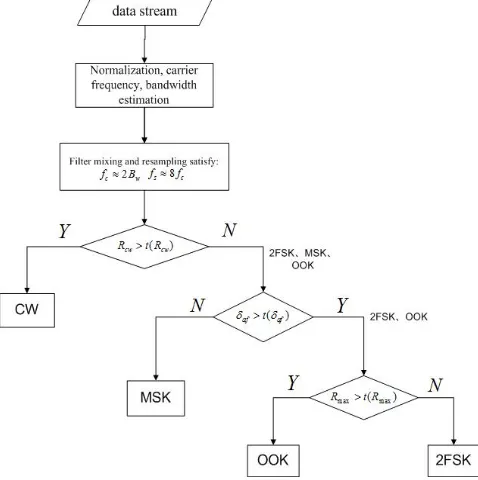
Since theRCWof the CW signal is large, when RCW is greater than a certain threshold value, it is
judged that the carrier signal is a CW signal.
(2) Zero center normalized spectral density maximum of instantaneous magnitude
R
max
2max FFT ( )
R
max acn i Ns (2)
( ) ( ) 1
a i a i
cn n (3)
N
sis the Sample points, acn( )i is the zero center normalized instantaneous magnitude when time
value isti fs,(i1, 2,... )Ns , fsis the Sampling frequency of the signal, a ( )i a i ma( )
n ,and
1 1 Ns ( ) a
i s
m a i
N
is the average of instantaneous amplitude. The effect of the gain of the channel onthe instantaneous amplitudea ( )i
n is eliminated.
max
R
is used to distinguish constant and non-constant envelope signals. The CW signal does not contain modulation information and is a constant envelope signal. The OOK signal is a non-constant envelope signal. There is no envelope change in the modulation process of 2FSk and MSK signals.
af is used to distinguish between MSK signals and other signals, and MSK has a smaller relative frequency deviation than other signals.Classification and Identification.
After obtaining the characteristic parameters of the signal, it is necessary to select an appropriate classifier section and classify it. In this paper, a decision tree classifier structure is adopted. Compared with other classifiers, the structure is simple, real-time and logical [5] [6]. The processing
steps are as follows:
[image:3.612.187.426.220.460.2]
Figure 2. Modulation recognition flow chart.
Simulation Analysis
The simulation test is conducted in the simulation environment of MATLAB R2014b. The signal generation can use the "dmod" function in MATLAB, and can also be written according to the mathematical model of the signal [7][8]. Assume that the carrier frequency F
c is 20000 Hz, the
sampling rate is 40000 Hz, the symbol rate Fd is 125 characters/sec, the number of symbols M is
Figure 3. Signal modulation identification interface.
[image:4.612.264.351.63.182.2]
Figure 4. Numerical display of parameters.
[image:4.612.181.433.199.302.2]After testing and statistics, the decision threshold for each parameter is shown in Table 1:
Table 1. Decision thresholds for characteristic parameters.
Characteristic
Parameters t R( CW)
t R
(
max)
t(af)Threshold 20000 7.5 1500
A large number of simulation tests were performed on four kinds of signals under the conditions of signal-to-noise ratios of 10 dB and 15 dB, respectively, and the correct and false recognition rates of each signal were counted and recorded as shown in Table 2:
Table 2. Correct Recognition Rate Statistics.
SNR OOK 2FSK CW MSK
10dB 93% 92.1% 93.8% 100%
15dB 95.7% 93% 95.3% 100%
From the above table, it can be seen that when the SNR is 15dB and 10dB respectively, the correct recognition rate of the signal is over 93% and 92.1%, and the correct recognition rate for the MSK signal can reach 100%.
Conclusions
[image:4.612.137.477.350.395.2]References
[1] Yong Huang. Simulation and realization of automatic modulation recognition algorithm for communication signals [D]. University of Electronic Science and Technology, 2013.
[2] Zhengdong Li. Typical signal modulation recognition method [D]. University of Electronic Science and Technology, 2013.
[3] Liyi Zhang. Signal detection and estimation [Second Edition]. Beijing Tsinghua University press.2014: pp. 87-95.
[4] Yonghong Kuo, Statistics and adaptive signal processing. First edition. Xi'an: Xi'an Electronic and Science University Press, 2012.8: 110-120.
[5] Fang Liu. Parameter estimation, modulation recognition and demodulation of baseband communication signals [D]. Shandong University, 2010.
[6] Chengzhen Ma. Design and implementation of automatic recognition method for digital communication signal modulation [D]. Southwest Jiao Tong University, 2011.
[7] Yafang Wang. MATLAB simulation and electronic information application [M]. People Post and Telecommunications Press, 2011.