2019 2nd International Conference on Informatics, Control and Automation (ICA 2019) ISBN: 978-1-60595-637-4
Stabilizing Controller Analysis for Delay-dependent
Networked Control Systems
Feng-zhen CHEN
*and Min ZHU
Department of Information Engineering, Meizhouwan Vocational Technology College, Putian, China *Corresponding author
Keywords: Network-induced Delay, LMI, Delay-dependent, NCSs.
Abstract. This work is devoted to analyse the stabilizing controller and stability in the case of delay-dependent networked control systems (NCSs). By considering the relationship between the network-induced delays and their bound, an improved stability criterion for NCSs is proposed in the derivative of Lyapunov function. A stabilizing state feedback controller is applied to generate the next control information for each subsystem using delayed sensing data in a free-weighting LMI formulation.
Introduction
Feedback control systems that are closed over a real-time communication network have more and more popular and hardware devices for networks have become cheaper and the internet has been more and more common. Although NCSs have several advantages such as low installation cost, easy maintenance and so on. The use of communication networks makes it necessary to deal with network-induced delays. These delays may be unknown and time-varying, and may deteriorate the closed-loop systems[1,2].
As for network-induced delays, they have been deal with by the control theory community in most research work. The performance and stability of control scheme strongly rely on the respect of the specified sampling rates and network-induced delays. Recently, the delay-dependent stabilizing method on the MADB has attracted much attention for the stability of NCSs with network-induced delays[3]. A free-weighting matrix approach[4] is reported to cover the results using Moon el al.’s inequality and the descriptor system approach[5]. As for NCSs, the delays are less than the sampling period for continuous-time systems based on sampling-rate method. Some methods to calculate the MADB for NCSs using Moon el al.’s inequality for both discrete-time plants are proposed in[6].
The stability analysis of controller is dealt with in the presence of the network-induced delays. The object is to prove stability and good performance for NCSs in the presence of timing uncertainties as communication delays. Thus, it can be useful to consider more dynamic solutions.
Stability Analysis
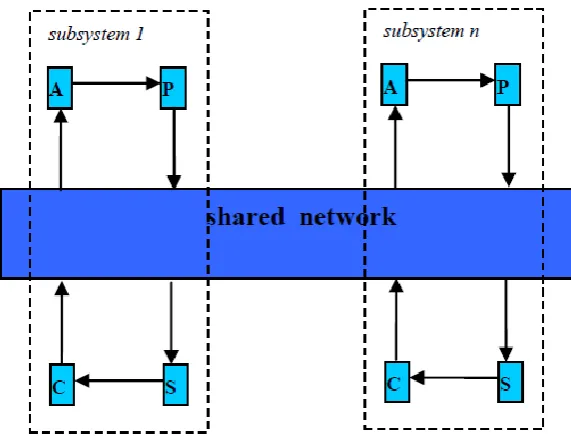
We are interested here in real-time control of systems with communication delays (see Fig.1). There are mainly two sources of delays from the network-induced delays in an NCS: device delays and
transmission delays. The computing delays include the time delay at the plant node (P) sou and the
controller node (C)des. The transmission delays include the time delay from sensor node(S) to
controller node(C) sc and from controller node (C) to actuator node (A) ca. The total time delay can
be expressed as follows
Figure 1. NCSs Control Structure.
Delay-dependent NCS Model
In this section, we will review and improve some results on the modeling of NCSs. We need the following assumptions:
Assumption 1. In an NCS, the total time delay is less than one sampling periodh.
Assumption 2. In an NCS, the NCS uses the way of single-packet transmission. The data packet loss and noise effect on the NCS are not considered.
Assumption 3. In an NCS, the sensor is assumed to be time-driven, whereas the controller and actuator are event-driven, and controller is time-invariant.
The discrete system equations can be written as:
( 1) ( ) ( )
x k A x k Bu k (2)
( ) 0
x k , ( k 0) (3) where, state vector x k( )n; control input vector u k( )m ; A ,A and B are real constant
matrices with appropriate dimensions. The total time delay satisfies:
1 2
(4) where,1and2are minimum and maximum time delay respectively and less than one sampling time.
The memoryless state feedback controller for the NCSs is
( ) ( )
u k Kx k (5) where u k( )0,k ( , 0).
Lemma 4. (Schur complements) Given constant matrices M, P and Q, where
T
PP andQQT 0, then, P MQ M 1 T 0, if only if P T M 0
Q M
, or 0
T Q M M P
Theorem 5. Given i 0
i1, 2
, if there exist constant matrices P ,Q ,Z , X ,N1,N2 ,where PPT 0 , QQT 0 , Z ZT 0 , 11 12
22
0 *
X X X
X
, N1 and N2 have appropriate
dimensions, hold,
11 12
22
( )
* 0
* *
T
T
A I H
A H H
(6)
11 12 1
22 2
* 0
* *
X X N
X X N
Z
(7)
then, the system(2) with the time-delay constant(4) is stable when ( )u k 0. where
11 ( 2 1 1) ( ) ( ) 1 1 2 11
T T
Q P A I A I P N N X
, 12 2 1 2 22
T
PA N N X
,
22 2 2 2 22
T
Q N N X
,H P 2Z . Proof. Giveny k( ) x k( 1) x k( ), then x k( 1) x k( )y k( ) .So,
1
( ) ( ) ( ) 0
n
k
x k x k y l
(8)Choose Lyapunov functional candidates as:
1 2 3
( ) ( ) ( ) ( )
V k V k V k V k
1( ) ( ) ( )
T
V k x k Px k
2
0 1
2
1 1
( ) ( ) ( )
k T l k
V k y l Zy l
1
2
1 1
3
1 1
( ) ( ) ( )
k T l k
V k x l Qx l
where PPT 0, T 0
QQ andZ ZT 0. Let V k( )V k( 1) V k( ), then
1( ) ( 1) ( 1) ( ) ( ) 2 ( ) ( ) ( ) ( )
T T T T
V k x k Px k x k Px k x k Py k y k Py k
1 1
2( ) 2 ( ) ( ) ( ) ( ) 2 ( ) ( ) ( ) ( )
T
k T T
k Tl k l k
V k y k Zy k y l Zy l y k Zy k y l Zy l
1
( ) ( 1) ( ) ( ) ( ) ( ) ( 1) ( ) ( ) ( ) ( )
T k
T T T V k x k Qx k x l Qx l x k Qx k x k Qx k
1
2 2 1
( ) 2 ( ) ( ) ( ) ( ) ( ) ( ) ( ) ( ) ( 1) ( ) ( )
( ) ( )
kT T T T T
l k T
V k x k Py k y k Py k y k Zy k y l Zy l x k Qx k
x k Qx k
Equation (8) and matrices N i1( 1, 2)are used, the written equation is was follows:
1
1 2
2 ( ) ( ) ( ) ( ) ( ) 0
k
T T
l k
x k N x k N x k x k y l
(9)On the other hand, as for any matrix 11 12
22 0 * X X X X
, the following equation holds:
2
1 1 1
1 ( ) ( ) 1 ( ) ( ) 2 1 ( ) ( ) 1 ( ) ( )
k T T
k T T T T
k T Tl k l k l k
l X l l X l l X l l X l
(10)
where, 1( ) ( ) ( )
T T
k x k x k
, add the left sides of equation(9) and equation(10) intoV k( ), hence we have
1
1 1 2 2
( ) ( ) ( ) ( ) ( )
k
T T
l k
V k k k k k
where
2( , ) 1 ( ) ( )
T
T T
k l k y l
, 11 12
22 12 ( ) ( ) ( ) ( ) T T
T T T
A I HA
A I H A I
A HA A H A I
.
So, an NCS is stable is only if 0and 0. According to Lemma 4, we know that 0is equal to 0.
Theorem 6. Giveni 0(i1, 2),if there exist constant matrices L, W, R, Y , M1, M2, V ,
where LLT 0 ,W WT 0 , RRT 0, 11 12
22 0 * Y Y Y Y
, M1 , M2 andV have appropriate
dimensions, holds:
12 2 11
11 12
22 23 2
2
*
0
*
*
0
*
*
*
TLA
L
R
(11)11 12 1
22 2
1
*
0
*
*
Y Y
M
Y
Y
M
LR L
(12)then, the system(2)with the time-delay constraint(4) can be controlled and 1
K VL . where
11 ( 2 1 1) 2
T T T
W AL LA L BV V B
1 1T 2 22
M M Y
, 12 2 1 2 12
T
A L M M Y
13 ( )
T T T
L A I V B
, 22 2 2 2 22
T
W M M Y
.
Proof. According to the proof of Theorem 5, the LMI (6) is changed by using Lemma 4.
2
11 12
22 2
2
(
)
(
)
*
0
*
*
0
*
*
*
T
T T
A I P
A I Z
A P
A Z
L
Z
(13)
Then, the NCSs(8) under the control of the memoryless state feedback controller and its state equation is
( 1) ( ) ( ) ( )
x k A BK x k A x k (14) As for the system (14), A BK is used to instead ofAin the LMI(13), then the LMI(13) is
2
11 12
2 22
2
(
)
(
)
*
0
*
*
0
*
*
*
T
T T
A BK I P
A BK I Z
A P
A Z
L
Z
(15)
where
11 ( 2 1 1) ( ) ( )
T
Q P A BK I A BK I P
1 1T 2 11
N N X
, 12 PA N2 N2T 2X12,
22 2 2 2 22
T
Q N N X
. So, the method of proof for Theorem 5 is used, then
1 1 1 1 1 1 1 1
{ , , , } { , , , } 0
diag P P P Z diag P P P Z (16)
1 1 1 1 1 1
{ , , } { , , } 0
diag P P P X diag P P P (17) where
1 1 1 1
{ , } { , }
Y diag P P X diag P P , 1
L P , WP QP1 1 , 1
RZ , M1 P N P1 1 1
,
1 1
2 2
M P N P , 1
V KP . The final conclusion is drawn by calculating the LMIs(16),(17).
Conclusions
The stability of NCSs is analysed through an improved stability criteria that proposed in the derivative of Lyapunov function and consider the relationship between the network-induced delay which is time-varying and its bound. A stabilizing state feedback controller is applied in each subsystem of NCSs in a free-weighting LMIs formulation.
[2] G. Che, Y. Jin, Online co-design of feedback control and real-time scheduling for embedded systems with communication delays, ICCSE 2009, pp. 618-623, 2009.
[3] E. Fridman, U. Shaked, Delay-dependent stability and H1 control: constant and time-varying delays, Int. J. Control, pp. 48-60, 2003.
[4] Y. He, M. Wu, J.H. She, G.P. Liu, Delay-dependent robust stability criteria for uncertain neural systems with mixed delays, Syst.Control Lett., pp. 57-65, 2004.
[5] Y. He, M. Wu, J.H. She, G.P. Liu, Paremeter-dependent Lyapunov functional for stability of time-delay systems with polytopic-type uncertainties, IEEE Trans.Autom. Control, pp. 828-832, 2004.
[6] H. Park, Y. Kim, D. Kim, W.H. Kwon, A scheduling method for network based control systems, IEEE Control Syst. Tech., pp. 318-330, 2002.
[7] Y.S.Lee, W.H.Kwon, Delay-dependent robust stabilization of uncertain discrete-time state-delayed systems, Proceeding of 15th IFAC Congress Automation and Control of Barcelona, 2002.