2019 International Conference on Computer Science, Communications and Big Data (CSCBD 2019) ISBN: 978-1-60595-626-8
Analysis of Elevator's Complaint Reporting Based on ABC Method
Xu-peng ZHANG
1and Jiang-hong JIN
2 1Beijing Special Equipment Inspection Center, Beijing, P.R. China
2
Beijing Municipal Institute of Labor Protection Beijing, P.R. China
Keywords: ABC Method, AHP, Elevator, Complaints, Hotline data.
Abstract. In this paper, the elevator complaint hotline data for a certain city in a certain year is been analyzed by ABC method, improved ABC method and ABC+AHP method respectively. The results are used to find the most concerned and concentrated problem in elevator complaints. It can be used as the basis for elevator safety management decision-making, and the basis for the design of elevator information construction.
Introduction
To meet the people's requirements for the increasing safety and comfort of elevators, advanced technical means and management mode methods are used to improve the efficiency of elevator safety management. With the development of the city life, the elevator has become an essential means of transportation for the people. For the potential dangers of elevator, people attempt to improve the quality of elevator management, and to make the elevator function safely. Since the establishment of the 12315 complaint hotline in Beijing, elevator complaints have been the majority. One reason is the large number of elevators in Beijing, which are more than 220,000 elevators. Another reason is exposed the public's opinion on elevators [1][2]. In this paper, the date of 12315 elevator complaints in a certain year has been analyzed and classified. The problem is most concerned about the public complaints elevator. The elevator problem are concentrated, as a basis for decision making elevator safety supervision department.it is conducive to timely resolution of the problem to resolve all Contradictions, to promote scientific and democratic decision-making, to improve work efficiency. It can be used as the basis for the design of the elevator information construction in Beijing.
Elevator Complaint Management Based on ABC Classification
The ABC classification (Activity Based Classification), also known as the Pareto rule or contribution analysis, is also named because the method divides objects into three categories: A, B, and C. The core of the ABC taxonomy is to distinguish between primary and secondary factors in the factors that determine things, and to identify key minority and minor majority differently. For a product, most of the contribution often comes from a small part, while most other products only make a small contribution. By reasonably allocating time and resources to the A-category, the key minority, for the minor majority—B and C—get much less time and resources than the A [3]-[7]. The same is true for elevator safety management, application contribution analysis, focusing on improving the contribution part, or focusing on the part of the most influential function.
General Method for Elevator Complaints Based on ABC Classification
In a certain year, 12365 reflected 1,323 complaints about special equipment safety complaints, reflecting 1012 complaints about elevator safety, accounting for 94.3% of the total number of complaints [8].
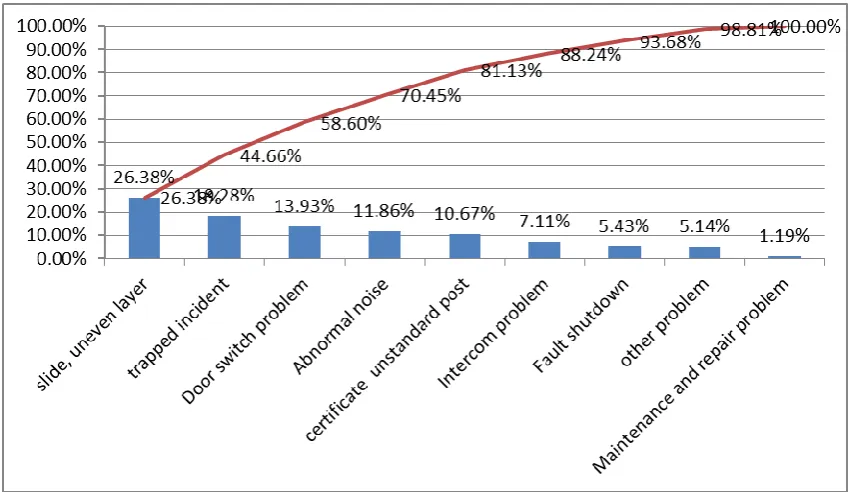
[image:2.595.85.514.196.442.2]The cause of the fault is arranged, and the percentage of the total complaint is further obtained. The percentage of the low in the table is added to all the percentages above, and the cumulative Pareto analysis result is obtained. Through statistics, the number, proportion and Pareto percentage of various complaints are obtained, as shown in Figure 1.
Figure 1. Proportion of elevator safety complaints and Pareto distribution.
It can be seen from Figure 1 that the main influencing factors of residents' complaints, including the annual inspection certificate involving management, include slide, uneven layer, Trapped incident and the door switch problem. Since the door switch problem is not sensitive to 70.45%, it is quite close to the A-type interval, and also serves as the main influencing factor. Abnormal noise and Fault shutdown is located in the 70%~90% range, which is a secondary factor affecting residents' complaints. Maintenance and repair problem, intercom questions and other issues, which in the 90% to 100% range, are the general influencing factors for residents' complaints. According to the ABC classification idea, Class A is the main influencing factors, should be the focus of elevator management, to spend a lot of energy to solve. For Class C being general influencing factors, it is not necessary to spend so much energy because of the small number, to process them after important problems are solved.
Improved Method Based on ABC Classification
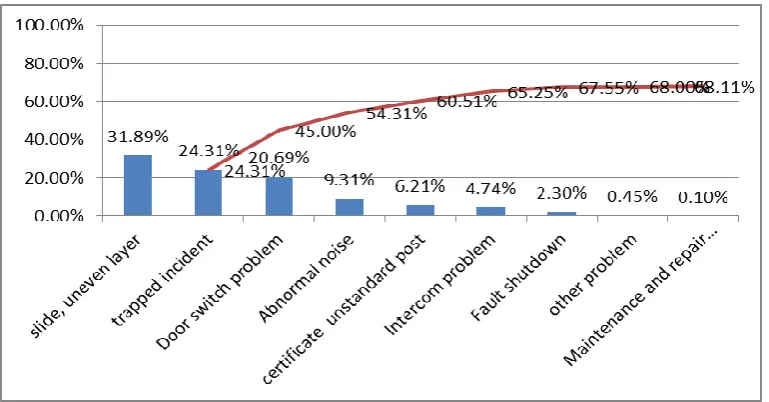
method and increasing the weight of each influencing factor can make the classification of various factors of elevator complaint management more realistic. The degree of hazard of each influencing factor can be referred to the accident risk index used in MIL-STD-882, and the degree of hazard of each influencing factor in the complaint is defined as “catastrophic”, “serious”, “mild”, “slight”. . According to the degree of hazard of each influencing factor, multiply the defined weights [0.2, 0.1, 0.01], arrange the cause of the fault in descending order, and obtain the percentage of the total complaint according to the method in the previous section. And Pareto analysis results, as shown in Figure 3.
Figure 3. Improved elevator safety complaints and Pareto distribution.
As can be seen from Figure 3, slide, uneven layer, trapped incident is the main influencing factor of residents' complaints; the door switch problem, abnormal noise is the secondary influencing factor of residents' complaints; fault shut down, intercom problem, Maintenance and repair problem, the un-posted annual inspection certificate is general influencing factor for residents' complaints.
Improved Methods Based on ABC and AHP
The weight of the hazard level of each influencing factor can also be layered by the Analytic Hierarchy Process (AHP) method and the weight of each layer can be analyzed. The AHP method divides complex problems into ordered levels according to the order of total goals and sub-goals, and uses scale theory and subjective and objective judgment methods to determine the relative importance of each factor through two-two comparisons. The advantage of the analytic hierarchy process is its quantitative analysis ability, which is more suitable for decision problems with hierarchical interlaced evaluation indicators and difficult to quantitatively describe the target values [9][10].
By the theory of AHP to establish three aspects, s the problems are divided into three aspects: serious faults, general faults, and management problems. Serious faults include slides, uneven layers and trapped incident; general faults include door switch problems, abnormal noise, intercom problems; management problems include fault shutdown, maintenance and repair are not timely, certificate posting is not standardized and other issues.
1) Establish a criterion layer judgment matrix as follows:
11 12 13 1 5 7
21 22 23 1/ 5 1 2
31 32 33 1/ 7 1/ 2 1
r r r
R r r r
r r r
Calculate the maximum eigenvalue max=3.0142, After been normalized, A0=(0.7380 0.1676
2) Establish a severe fault sub-criteria layer judgment matrix as follows:
11 12 1 2
21 22 1/ 2 1
r r R r r
After been normalized, B10=(0.677 0.333).
3) Establish a general fault sub-criteria layer judgment matrix as follows:
11 12 13 1 2 8
21 22 23 1/ 2 1 2
31 32 33 1/ 8 1/ 2 1
r r r
R r r r
r r r
After been normalized, B11=(0.6380 0.2584 0.1036).
4) Establish a management sub-criteria layer judgment matrix as follows:
11 12 13 14 1 2 5 8
21 22 23 24 1/ 2 1 4 5
31 32 33 34 1/ 5 1/ 4 1 1
41 42 43 44 1/ 8 1/ 5 1 1
r r r r
r r r r
R
r r r r
r r r r
After been normalized, B10=(0.5289 0.3152 0.0849 0.0710).
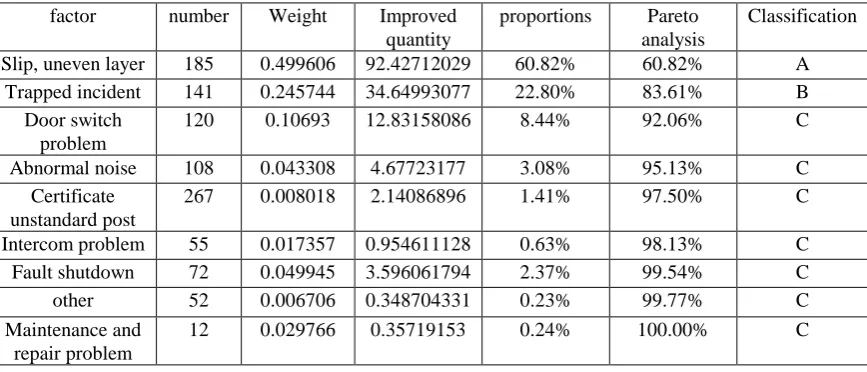
[image:4.595.90.504.408.570.2]According to the method in the previous section, the percentage of the total complaints and the Pareto analysis results are obtained, as shown in Table 1, Table 2 and Figure 5.
Table 1. Table of the weight of criteria layer and sub-criteria layer and the composite weight. Criteria
layer
sub-criteria layer criterion layer weight
sub-criteria layer weight
composite weight severe fault slides, uneven layers 0.7380 0.667 0.499606056
trapped incident 0.333 0.24574419
general fault door switch problems, 0.1676 0.638028638 0.10692984 abnormal noise 0.258408258 0.043307702 intercom problems 0.103563104 0.017356566 management shutdown 0.0944 0.528883535 0.049945303
Maintenance and repair problem
0.315199343 0.029765961
certificate unstandard post
0.084907142 0.008018236
other problems 0.071009981 0.006705853 Table 2. Table of complaint ratio and Pareto distribution based on improved methods of ABC and AHP.
factor number Weight Improved quantity
proportions Pareto analysis
Classification
Slip, uneven layer 185 0.499606 92.42712029 60.82% 60.82% A Trapped incident 141 0.245744 34.64993077 22.80% 83.61% B
Door switch problem
120 0.10693 12.83158086 8.44% 92.06% C
Abnormal noise 108 0.043308 4.67723177 3.08% 95.13% C Certificate
unstandard post
267 0.008018 2.14086896 1.41% 97.50% C
Intercom problem 55 0.017357 0.954611128 0.63% 98.13% C Fault shutdown 72 0.049945 3.596061794 2.37% 99.54% C
other 52 0.006706 0.348704331 0.23% 99.77% C
Maintenance and repair problem
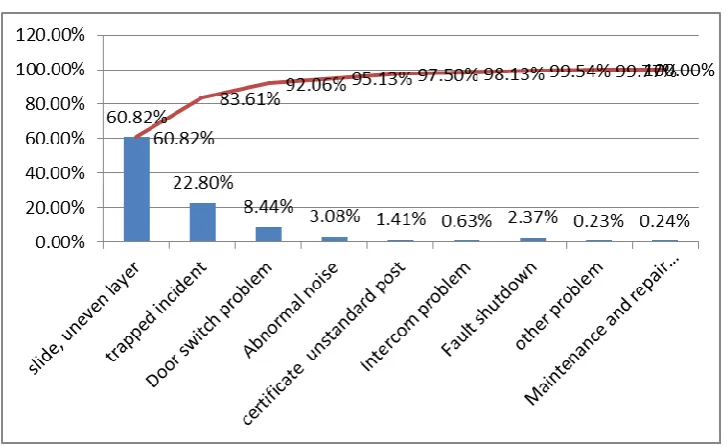
[image:4.595.83.517.590.776.2]Figure 5. Complaint ratio and Pareto distribution based on improved methods of ABC and AHP.
As can be seen from Figure 5, the slippery, uneven layer is the main influencing factor of residents' complaints; the trapped person is the secondary influencing factor of the residents' complaints; the door switch problem, the abnormal sound is out of service, the intercom problem, the maintenance is not timely, the annual inspection The card is not timely and more appropriate and other issues are the general influencing factors for residents' complaints.
Summary
As a special product, the elevator is manufactured and installed to daily use. The quality and safety of the elevator are subject to various conditions. In order to meet the people's requirements for the increasing safety and comfort of elevators, advanced technical means and management mode methods are needed to improve the efficiency of elevator safety management. This paper analyzes the elevator complaint data in the 12315 complaint hotline of a certain city in a certain year, and analyzes it by ABC method and improved ABC method respectively, and draws the most concerned and concentrated problem in elevator complaints. The conclusion of the method had been the decision-making basis of the elevator safety supervision department and the basis for the design of the elevator information construction in Beijing. The method helps to highlight the key points, improve the safety supervision effect of the elevator, and effectively exert the market supervision function of the elevator management department. The effect has been confirmed by practice.
Acknowledgements
This work is supported by the financial support of Beijing Natural Science Foundation (L160009) and Building of Innovative Team Plan (IG201701C2).
References
[1] Zhang Xupeng, Wang Qi, Zhao Fang. Discussion on Public Safety Maintenance Capability of Elevator under New Situation. Elevator Industry, 2015(4) 61-63(in Chinese).
[2] Zhang Xupeng. Study on subject responsibility of elevator safety management. China Elevator, 2016(10) 66-68. (in Chinese).
[4] Hai-Yan L, Li-Xin T. ABC classification of supplier relationship management in the Application. Logistics Engineering & Management, 2009.
[5] F. Çebi, Kahraman C, Bolat B . A multiattribute ABC classification model using fuzzy AHP. International Conference on Computers & Industrial Engineering. IEEE, 2010.
[6] Friedman J. The ABC classification of partial denture segments. Journal of Prosthetic Dentistry, 1953, 3(4):517-524.
[7] Teunter R H, Babai M Z, Syntetos A A. ABC Classification: Service Levels and Inventory Costs. Production & Operations Management, 2010, 19(3):343-352.
[8] Zhang Xupeng, Dou Guangchun. Analysis of Elevator Complaints and Reports Based on ABC Method.China Special Equipment Safety, 2017, 33(7)25-27. (in Chinese).
[9] Clifton A. Ericson. Hazard Analysis Technology [M]. National Defense Industry Press, Beijing. 2012 (in Chinese).