Concepts and issues in interfaces for multiple users
and multiple devices
C hristian Kray
Computing Department
Lancaster University
Lancaster, LA1 4YR, U.K.
+44 (0)1524 594801
kray@comp .lancs.ac.uk
Rainer W asinger
DFKI GmbH
Stuhlsatzenhausweg 3
66123 Saarbrücken, Germany
+49 (0)681 3023393
[email protected]
Gerd Kortuem
Computing Department
Lancaster University
Lancaster, LA1 4YR, U.K.
+44 (0)1524 593104
[email protected]
ABSTRACT
In this paper, we identify and discuss several groups of issues that arise in the design of interfaces for multiple users interacting with multiple devices. We analyze in what ways these interfaces differ from traditional user single-device interfaces, and identify different characteristics of interfaces. We categorize a possible set of device types that may exist in an environment, and then discuss the fundamental issues that have to be addressed when designing multi-user multi-device interfaces. The focus is on user and device management, technical concerns and social concerns, and some of the topics discussed include coordination, assignment, sharing, load-limits, coverage, privacy concerns, and user alienation.
1.
MOTIVATION
The design of interfaces that allow multiple users to interact with multiple devices, at the same time, and with a common set of services, is not an easy task. Users will pursue individual goals that may interfere with those of others. Additionally, many devices have been designed for individual use only. It i s thus the responsibility of the user interface to find a balance that facilitates access to complex services for an optimally large proportion of the users, rather than for just a single user. Consider for example a museum scenario, where visitors are equipped with PDAs to explore the exhibits [8]: not only are they potentially interacting with their own PDA but they may also interact with other users and public displays within the museum. Supporting all this in a consistent and transparent way is a major challenge. Further examples include airports, which nowadays feature a dense infrastructure of various in-and output devices, or the living room of the (not so distant) future, where a multitude of entertainment devices have to be controlled by a number of people. Generally speaking, as we are moving towards a world where computing and sensing devices are ubiquitous, the simultaneous interaction of many people with multiple devices becomes the standard setting.
However, interfaces for single-users have been at the centre of most research in human-computer-interaction, and a large portion of that research has focused on a stationary setting (a single person using a single desktop computer). Although research has covered multi-modal interaction in a stationary setting [12],[17],[3], there has until recently been little interest in interaction with multiple devices [2]. Similarly, interfaces for ubiquitous computing environments are a rather new field of research [4]. Furthermore, while computer-supported collaborative work (CSCW) is a well-established discipline within computer science [1], its main topic lies in the support of a distributed team of people working on a common project, rather than the coordination of possibly independent users that may be collocated but carrying out potentially unrelated tasks.
In the context of ubiquitous and mobile computing, this situation of independent and collocated users performing unrelated tasks is however very likely to occur. In order t o create user interfaces that support these types of scenarios, we first need to map the problem space and identify the issues arising in a multi-user multi-device multi-service setting. The goal of this paper is hence to define the entities, events, and relationships inherent in such a scenario, and to then systematically analyse what issues are relevant for each of them. Based on this analysis, we will also present some initial implications for the design of multi-user multi-device interfaces.
2.
TERMS AND DEFINITIONS
Figure 1 Different types of interfaces
[image:2.612.367.514.288.399.2]The last type of interface is a very challenging one as each transition from a less complex type of interfaces to a more complex one introduces further issues that need to be addressed. For example, moving from user single-device interfaces to multi-user single-single-device interfaces entails questions such as who controls the device and how can it be shared. Similarly, moving from a single-user single-device setting to a single-user multi-device setting may introduce the problem of having to fuse multi-modal input. However, prior to analyzing the key problems of multi-user multi-device interfaces, we have to precisely define what exactly constitutes such an interface and how this differs from traditional interfaces. An interface in our context comprises all means employed by one or more users to access a service provided b y a computer system. Interfaces are embedded in a physical space known as an environment, in which interactions take place. Interactions represent the actions through which users communicate their goals and intentions to the system, while the physical entities used to interact with a service are called devices (see Figure 2).
Figure 2 Situated Interfaces
One property that sets multi-user multi-device interfaces apart from other types of interfaces is the relationship they have with the environment. Unlike the traditional setup of a single user interacting with their personal computer, interactions involving multiple users and devices are inherently more closely linked to the state and affordances of the surrounding environment. illustrates this link via a schematic overview of the corresponding relationships, and shows that multiple users interact with a user interface that is comprised of several devices, in order to access one or more services or applications. In contrast to traditional graphical user interfaces, intelligent user interfaces may be largely transparent to the user [4], for example when a user interacts with the service through the use of a microphone. Depending on the nature of the service, additional people from remote locations may also access the services from within different environments.
2.1
Users
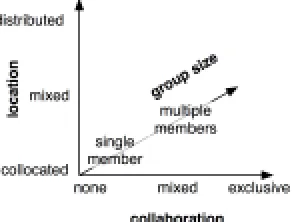
[image:2.612.68.291.411.508.2]A first obvious distinction between traditional and multi-user multi-device interfaces is that of single user and multiple user interaction with a system. In the latter case, we can differentiate among collaborative and independent interaction. An example of collaborative use would be a small group that interacts with an electronic whiteboard [10] in order to create a project schedule. However, if several people are located in the same room, they could use (and even share) one or more public displays to read their own emails. This interaction could be classified as independent. Mixing both collaborative and independent use results in a third type of interaction, where some people collaborate, while others interact independently with the system, for example in the case where the interactions described above occur in the same room. A further distinction in this context is that users of a system or service may be collocated, distributed (located at different sites), or again a combination of both. Figure 3 summarises the characteristics of users in a multi-dimensional graph that spans the design space.
Figure 3 Characteristics of users
2.2
Devices
In order to access a service or application, a user (or group of users) utilizes various devices such as a keyboard, mouse, or display. While we can distinguish between the use of a single device and the use of multiple devices, the use of multiple devices, (e.g. mouse and keyboard), is far more common. However, it should also be considered that multiple devices are harder to coordinate, and the use of a single device may well still be necessary, for example when a large number of people are all competing for a small number of devices that must ultimately be shared. A device may allow for input, output, or both, and provide for private or public use. For example, microphones only support input while speakers only support output and touch screens can be used for both. Headphones privately transmit their output to a single user, while a public loudspeaker does not. Furthermore, we can distinguish between devices that afford shared use and those that do not. A large public display is an example of a device offering shared use, whereas the display on a Pocket PC offers non-shared use.
non-dedicated devices can be further partitioned, based on whether or not they have been augmented or enhanced. For example, we can attach a sensor [5], such as a Radio Frequency ID (RFID) tag to an object like a book to enable a ubiquitous environment to better perceive it, and to facilitate its identification. If an object is non-augmented, it can be classified as non-enhanced, for example a non-tagged coffee mug. Enhanced devices may be passive in that they require the environment to detect their presence, such as the book example above. They can alternatively be active in that they pursue interaction with their environment such as a weight-sensitive table. Figure 4 depicts this classification of device types, which may interact with a system.
Figure 4 Device properties
2.3
Interactions
In comparison to single-user single-device scenarios, the actual interactions themselves may also have to be much richer, for example, to enable multiple users to interact simultaneously. This may require the use of different modalities such as the auditory, tactile or haptic channel, as well as the need to fuse multi-modal input in order to make sense of the users’ input [14]. Furthermore, there are novel types of interactions compared to a single-user setting – such as two users jointly performing a gesture or action.
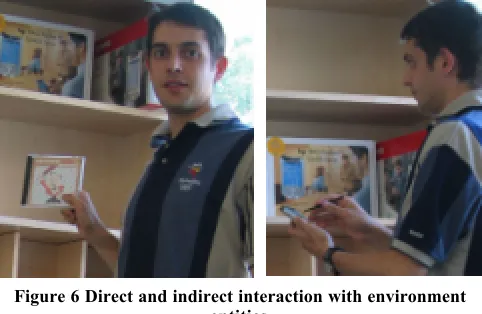
[image:3.612.54.295.524.681.2]The interactions may take place directly with environment entities (e.g. picking up an object in the room), indirectly (e.g. selecting the same object represented digitally on a display), or through a combination of both (e.g. selecting some objects represented on a display, while pointing to other objects in the real world). Direct and indirect interactions are displayed i n Figure 6.
Figure 6 Direct and indirect interaction with environment entities.
Tied to this notion is the idea that entities can accordingly be represented physically, or digitally. In [7], a continuum of
coherence is proposed to categorize the relationship between digital and physical representations of the objects. Coherence in this sense refers to the extent in which physical and digital objects are perceived as being the same thing. When coherence is weak, there is no link between a physical and digital representation of an object, whereas when the coherence i s strong, the user can no longer differentiate between digital or physical representations of the object.
As a result, interactions must be defined to uniformly and intuitively span interaction with objects represented in different ways. The interaction may (as described above) be with the same object represented at one time physically and at another time digitally, or even with different objects, some represented digitally, while others represented physically, for example “read me this book [physical pointing gesture] through these speakers [stylus gesture on a display]”.
Human interactions are fairly complex. Along with spanning differing object representations, interaction must also span the use of differing types of input mediums, such as speech and gesture. A person may in one instance interact solely through speech, while at another instance through gesture. Each input medium requires its own interaction library. For speech, this would be the language model, while for gesture it would be the gesture model (e.g. ‘point’, ‘pick up’, or ’put down’). Similar to above, different modalities may also be combined, and this can often lead to more natural and more robust levels of interaction [16].
3.
DESIGN ISSUES
There are a number of concerns that are specific to multi-user multi-device interfaces. While we can roughly group these into management, technical and social issues, they are often hard to classify due to overlapping categories. For example, while the assignment of a specific device to a user is a management problem, it also has a technical component (e.g. how t o represent the assignment internally) as well as a social one (e.g. who is authorized to claim a device for personal usage). Therefore, our grouping of issues under the categories of management, technical and social should not be perceived as being mutually exclusive.
3.1
Management issues
In a highly dynamic environment, a very fundamental problem is that of the initial registration and later identification of users and devices as they enter and leave the environment. This is vital for a system if it is to have an overview of its own composition and current capabilities. Registration and identification may be further complemented by verification (especially for sensitive services), which may provide information on the user’s accessibility to devices and services, their group membership, and their individual communication preferences.
contrast, a single-user scenario is usually fairly static with regards to the relationship between devices, services and the user. A second difference is that it is harder to assign the resulting observations made by various devices to a specific user and/or service, because there are a greater number of possible relationships and the number of devices and/or users may change dynamically, thus requiring continual reassignment.
Another key issue not found in single-user setups is that of device control [15]. Conflicts in control occur for example, when users compete for the same device that is either non-shareable or which one user does not want to share. A system handling multi-user multi-device interactions must not only provide a means for conflict-resolution but must do so without patronizing its users. This may require a model of social hierarchies and/or interactions as well as the continuous monitoring of intra-human interactions. Even if a device i s shareable, conflicts may still arise through the type of services being used, for example surfing the Internet and watching a movie, in which the foreground noise in watching a movie may result in an excessive level of background noise for surfing the Internet.
The number of available devices is a limiting factor on the number of users an environment can support. If the number of users rises faster than the number of available devices, the services will ultimately be bound by a load-limit. As an example, if no additional devices are added to an environment, services will become unavailable to new users when all of the devices become engaged. If users were to supply their own device(s) in addition to those already existing (e.g. a PDA), the number of users able to interact with services would increase. This procedure is of course limited by the computational capacity of the system. Another issue relating to user’s supplying their own devices, is that these devices must then support a communication protocol compatible with the underlying services of that environment, and that the user will then also be burdened with the need to carry their device around with them while interacting.
3.2
Technical issues
A further difference that arises through interacting with multiple devices is that of device handling, which allows for the control of specific device features, and also defines how a service should respond when a device is suddenly introduced or removed from an interaction. When an interaction spans several devices, as is in the case of media fusion (i.e. combining multiple input types) and media fission (i.e. combining multiple output types) [[12],[17]], the synchronization between these devices also becomes important. A further issue is that of device interference. This i s not only important on an interaction level, for example when many different public audio channels are actively presenting media to a small space, but also on a hardware level, in which interfering radio signals may affect the control of several wireless devices.
Coverage also constitutes a relevant factor, as users can only interact and communicate if they are in range of an adequate and available device. The level of coverage varies per device, for example speakers will provide better access to a crowd of people compared to a single display. Coverage also depends on the physical placement of devices (e.g. high up, low down), and on the expected density of users for a given physical
space, for example well-known paintings in a museum would attract many more users.
In situations that are more mobile than the traditional desktop, the localization of users and devices also becomes relevant. This is seen in the example “play me that [gesture] CD”, i n which localization information may aid in the identification of both the user and the CD. Identification (as introduced i n section 4.1) may be biometric-based (e.g. face recognition), or hardware-based (e.g. wearable devices), and the process may be either automatic (e.g. active tags [13]) or manual (e.g. Dallas Semiconductor’s iButton [6]). It may furthermore be intrusive to other users (e.g. speech), or non-intrusive (e.g. smart floor [8]), and the robustness of identification may be affected b y environment conditions such as low-light, or high levels of noise.
Depending on the type of device, energy consumption will also be relevant, and finally system performance will become an issue as the overall complexity of an environment grows through increased multiple user and multiple device interactions.
3.3
Social issues
4.
DESIGN IMPLICATIONS
The issues we discussed in the previous section provide some initial guidelines of what to look out for when designing a multi-user multi-device interface. However, we can derive some further implications from these observations that can inform the design process.
Firstly, the multitude of new issues compared to single-user (single-device) interfaces implies that the problem space i s larger by an order of magnitude. Consequently, the scalability of an interface plays an important role not only because more problems may be encountered but also because effort required to interpret interactions may increase very rapidly as the number of users and/or devices grows. Hence, designers should pay extra attention to the scalability of the interface. Secondly, multi-user multi-device interfaces introduce new ways of how things can go wrong. For example, in multi-modal interfaces employing speech recognition not only the content of an utterance has to be recognized but also the speaker. It may even be necessary to do so while several people are talking at the same time. Also, intra-human interaction has to be distinguished from human-computer interaction. Consequently, interface designers have t o emphasize robustness and consistency even more than i n traditional interface design.
Thirdly, a multi-user multi-device scenario is likely to be more dynamic than, for example, a traditional desktop setting. This implies that the design of a suitable interface should include specifications about how to react to changes such as the addition/removal of devices. In order to avoid disruptions i n the interface, a sophisticated representation format incorporating for example spatial and temporal constraints may be necessary.
The implications listed above are but a few examples for what to derive from the issues we identified in the previous section. However, they may serve as a starting point for further research.
5.
CONCLUSION
In this paper, we provided a first mapping of the problem space for designing interfaces for multiple users and multiple devices. We defined the fundamental terms and entities as well their relationship in this scenario: users, devices, and interactions. We then identified key problems in several core areas, namely management, technical, and social issues. Based on these issues, we provided a few examples for design guidelines that can be derived from the issues pointed out previously. The research presented in this paper can hence serve as a starting point to further explore the problem space of multi-user multi-device interfaces in a systematic way.
6.
REFERENCES
[ 1 ]
Bowers, J., Rodden, T., "Exploding the interface: Experiences of a CSCW network", Proc. of SIGCHI, 1993, pp. 255-262.[2]
Brumitt, B., Meyers, B., Krumm, J., Kern, A., and Shafer, S., " E a s y L i v i n g : T e c h n o l o g i e s f o r IntelligentEnvironments", Handheld and Ubiquitous Computing, 2000, pp 12-29.
[3]
Cohen, P., Johnston, M., McGee, M., Oviatt, S., Pittman, J., Smith, I., Chen, L., Clow, J., "Quickset: Multimodal interaction for distributed applications", Proc. of ACM International Multimedia Conference, 1997, pp 31-40.[4]
Dey, A., Ljundstrand, P., Schmidt, A., "Distributed andDisappearing User Interfaces in Ubiquitous Computing", CHI Workshop, 2001.