Mapping the organic vegetable value
chain along the EWEC
Lord, Montague J. and Tangtrongjita, Pawat
Asian Development Bank
1 March 2010
Online at
https://mpra.ub.uni-muenchen.de/42591/
and Industry along the East-West Economic Corridor to
Promote Trade, Investment and Value Chains
Project Number: 43117-01 March: 2010
Mapping the Organic Vegetable Value Chain along the EWEC
This consultant’s report does not necessarily reflect the views of ADB or the Government concerned, and ADB
and the Government cannot be held liable for its contents. (For project preparatory technical assistance: All the
Prepared by
ACFS –– Agricultural Commodity and Food Standards ACT – Organic Agriculture Certification in Thailand ADDA AQIS AusAID BDS CBTA CCI CDTA DFID EquiTool EU EWEC FAO GAP GMO GMP GMS GOMA HACCP HS IFAD IFOAM IMO IOAS IPM ITC ITECC JAS LCB MAF MSE NGO NOP NORAD NOS NSOA OARD PPP RCO SIPPO SNV SPS TOTA UNCTAD USDA VCCI – – – – – – – – – – – – – – – – – – – – – – – – – – – – – – – – – – – – – – – – – – – – –
Agricultural Development Denmark Asia Australian Quarantine and Inspection Service Australian Agency for International Development Business Development Service
Cross-Border Transport Agreement Chamber of Commerce and Industry
Capacity Development Technical Assistance Department for International Development
Guide for Assessing Equivalence of Standards and Technical Regulations
European Union
East-West Economic Corridor
Food and Agriculture Organization of the United Nations Good Agriculture Practices
Genetically Modified Organisms Good Manufacturing Practices Greater Mekong Subregion Global Organic Market Access
Hazard Analysis and Critical Control Point Harmonized System
International Fund for Agriculture Development
International Federation of Organic Agriculture Movements Institute of Marketecology
International Organic Accreditation Service Integrated Pest Management
International Trade Centre
International Trade Exhibition and Convention Centre Japanese Agricultural Standard of Organic Products Lao Certification Body
Ministry of Agriculture and Forest Micro and small scale enterprises Non-governmental organization National Organic Program
Norwegian Agency for Development Cooperation National Organic Standard
National Standards for Organic Agriculture Office of Agricultural Research and Development Public-private Partnership
Registered Certification Organization Swiss Import Promotion Programme Netherlands Development Organization Sanitary and Phytosanitary Standards Thai Organic Trade Association
United Nations Conference on Trade and Development United States Department of Agriculture
EXECUTIVE SUMMARY V
I. TRANSFORMING EWEC INTO AN ECONOMIC CORRIDOR 5
A Challenges in Transforming the EWEC into an Economic Corridor 5
B Why Organic Vegetables 6
C Study Scope, Coverage and Implementation 7
II. MAPPING THE CORE PROCESSES, AGENTS AND PRODUCTS 9
A Overview 9
B Elementary Organic Vegetable Supply Chains 11
C Value Chains of Producer Associations 11
D Agro-Tourism Value Chain 11
E Regional and Global Value Chains 13
F Vegetable Products in EWEC Provinces 16 III. MAPPING KNOWLEDGE AND SUPPORT SERVICES 18 A Overview 18 B Mapping Knowledge Channels 18 C Access to Knowledge along the Corridor 20 D Upgrading Knowledge along the Corridor 23 IV. MAPPING PRICE DIFFERENTIALS ALONG THE VALUE CHAIN 26
A Overview 26
B Organic Prices Local Markets 27
C Organic Prices National Markets 29
D Organic Prices Export Markets 29
V. MAPPING MARKETS AND PRODUCT FLOWS 31
A Overview 31
B Domestic Markets 33
C Regional and Global Markets 36
VI. MAPPING SUPPORT SERVICES 42
A Overview 42
B Government Support 42
C NGO Services 44
D Private Organization Support 46
VII. MAPPING THE ORGANIC CERTIFICATION PROCESS 47
A Overview 47
B Certification Procedure for Farmers 47
C Certification Agencies in Thailand 49
D Certification Agencies in the Lao PDR 51
E Certification Agencies in the Vietnam 51
F Export Market Certifications 52
G International and Regional Certification Bodies 54
H SPS Compliance in the EWEC Countries 54
VIII. MAPPING OPPORTUNITIES AND ACTION PLAN 56
A Seven Key Strengths 56
ANNEXES
1. Annex A: Consultations and Workshop Participants 63
EXECUTIVE SUMMARY
A. Transforming the EWEC into an Economic Corridor
The present study maps the organic vegetables value chain in the East West Economic Corridor (EWEC). It covers horizontal and vertical linkages, information and support services, price differentials, and packaging, branding and certification processes in an effort to identify strengths and challenges for an action plan in the value chain. In so doing, it supports the transformation of the EWEC from a transport and logistics corridor into a full-fledged economic corridor. After more than a decade in the making, the EWEC now offers time and cost-efficient transport linkages between major commercial centers and gateways to markets within and outside the corridor. By broadening the scope of the EWEC into value chains whose activities extend across districts, provinces, subregions and global markets, the economic corridor will enable households and enterprises of all sizes to better link their actions with value-adding downstream activities.
B. Challenges to Improving Livelihoods
The people living along the Corridor are among the poorest in the EWEC countries, and the majority of households are involved in activities related to the agricultural sector. A dependency on subsistence agriculture using traditional farming methods that rely on expensive pesticides and herbicides has caused many of the households to be economically impoverished. Farmers often lack knowledge about alternative farming techniques that rely on less expensive inputs and farming techniques requiring timely interventions and weed control. At the same time, most households are unaware of market opportunities beyond their immediate surroundings, and have little or no knowledge about broader national or international market opportunities. There is also a lack of pricing information, technologies, certification, branding, networking and linkages along the value chain for processing, packaging and marketing.
C. Adding Value to Organic Vegetable Production
One solution to the problems facing farmers along the Corridor is to create an integrated approach to the organic vegetable industry that takes advantage of existing agricultural resource-based activities. So far, efforts by local authorities and NGOs have been largely concentrated on promoting organic farming, without much attention being given to downstream linkages and value adding activities. While these efforts are laudable, they have not significantly impacted on farm incomes because organic vegetables are often sold alongside conventional vegetables at similar prices in community or provincial markets. Yet prices of organic produce in
the EWEC‟s large urban centers and in the North American and European markets are, on
average, 2.4 times higher than their nonorganic counterparts. By fully integrating their production, marketing and distributing activities, producer groups could obtain fair market prices for their products and thereby improve their livelihoods.
1. The Corridor’s Agricultural Producers are Well-Positioned to Tackle the Enormous Trade Potential in Organic Vegetables
along the Corridor are therefore enormous, as are the economy-wide effects that would be produced from additional employment and expenditures on downstream and supporting industries. These effects are particularly important for micro and small size enterprises, which tend to predominate in upstream activities and have the greatest difficulties in getting their products to markets outside their immediate communities.
2. Matching the Corridor’s Organic Farming Activities with the Enormous Market Potential for Organic Vegetables
Safe food concerns is driving the rapid growth in demand for organic vegetables, not only in international and national markets but in local markets as well.
The Thai domestic market for organic agricultural products is currently valued at US$80 million, which is three times greater than the market only five years earlier.
The Lao and Vietnamese markets for organic products are in the early stages of development, but are expanding rapidly because of concerns over food safety and recognition of the growing market deficits in neighboring countries like Thailand.
The North American and European markets together spend US$57 billion in organic foods and both have large shortages of domestic supplies.
Global market prices for conventional agricultural products have risen by 36 percent in the last year. At the same time, the price premiums on organic vegetables in the major international markets range from 33 percent for products such as aubergine, tomatoes and asparagus to as much as 300 percent for cabbage, onions and Chinese celery. Organic vegetable prices are also more stable than conventional vegetables and less subject to speculative price movements over the short to medium term.
Nearly all of the high-end organic vegetables are already being produced along the EWEC. They include Chinese celery, onions, cabbage, Chinese radish, broccoli, basil, yard-long beans, mushrooms, green lettuce, spinach and carrots. Farmers along the EWEC provinces are therefore in a exceptional good position to take advantage of the strong market for organic vegetables.
3. Time and Dedication will be Needed to Achieve Large Gains
It is important to recognize that development of a fully integrated EWEC organic vegetables value chain will require considerable time and dedication on the part of its participants, as well as supporting public agencies, private institutions and international development partners. It will also require considerable effort since, as a minimum, it will involve:
Building strong public-private partnership programs
Creating awareness with mass media campaigns
Intensifying collaboration among farmers to ensure adequate and reliable quantities for processing and packaging plants
Building inclusive farmer groups for the vast number of poor households that currently lack opportunities to add value to their products
Introducing market information about organic vegetable prices and access to markets
Helping producer groups to package and brand organically certified products to add value to their products
Supporting producer groups in the organic certification of their products
Enhancing sanitary and phytosanitary (SPS) and behind-the-border policies to encourage cross-border trade and investment along the Corridor
4. Seven Steps to a Successful Organic Vegetable Value Chain
A fully integrated approach to producing, marketing and distributing organic vegetables along the EWEC could be achieved in a relatively few, well planned steps:
Step 1 – Develop a business model for the industry that has as its actionable areas the use
of producer groups, accreditation of products for certification, branding and packaging to differentiate organic products from their conventional counterparts, and disseminating market information on prices and access requirements in national and export markets. Step 2 – Create high-profile pilot projects in key areas of the Corridor whose farmers,
packaging plants and distribution centers can serve as a showcase to others within a community.
Step 3 – Encourage producer groups and processing facilities within the Corridor so that
organic products can achieve scale economies needed to supply processors and packaging plants.
Step 4 – Use existing EWEC transport and logistics facilities along with improved border
formalities to promote cross-border trade and investment in organic vegetables. Step 5 –Market the EWEC as „the Organic Belt of the Greater Mekong Subregion’.
Step 6 – Disseminate market information through mass media channels covering market
prices for each type of organic vegetable being sold in large urban centers of the EWEC countries, as well as the North American and European markets. The same channels can be used to provide information about the different types of produce required in key markets and how farmers can better access those markets.
Step 7 – Improve knowledge and information flows through business development service
(BDS) centers that help upgrade farming practices, introduce appropriate farming methods, apply branding and marketing techniques, support organic certifications procedures, and facilitate networking among value chain participants.
5. Development of the Organic Vegetable Value Chain Will also Help Other Corridor Industries
The spillover effects of a full-fledged EWEC organic vegetable value chain are immense. They impact not only the majority of Corridor-based households whose livelihoods depend on farming, but also traders, processors, logistics providers, and the retail industry. Because of the size of its potential impact within provinces and along the entire length of the Corridor, the expansion of organic farming activities will also have large multiplier effects on local and national economies because of the feed-through effects that improvements in livelihoods can have on all aspects of consumer spending.
and exotic tropical fruits, livestock, rattan, furniture, cement and construction materials, bio-organic rice, sugar, handicraft, and herbal medicines.
All EWEC governments have demonstrated great enthusiasm for the development of organic agriculture in their countries. Value chains are considered one of the most effective ways to ensure the participation of micro and small enterprises in large-scale value adding activities. In many cases, local authorities, community leaders and international development agencies are already involved in the promotion of different organic projects. Consolidating that effort into a
unified and fully integrated program could make the Corridor into the „Organic Belt of the Greater Mekong Subregion‟ and greatly contribute to the EWEC‟s transformation into an
I. TRANSFORMING EWEC INTO AN ECONOMIC CORRIDOR
A. Challenges in Transforming the EWEC into an Economic Corridor
Corridors are the cornerstone of economic development in the Greater Mekong Subregion (GMS). Their infrastructure, system logistics and contact networks between supply areas and markets enable households and enterprises of all sizes to participate in the chain of activities by linking their actions with other primary and service providers in an industry. By integrating the activities of businesses from raw materials to eventual end-users, enterprises are able to deliver goods at improved values within each stage of the process at lower costs than if they operated in a piecemeal manner.
Development of transport and logistics corridors are therefore important predecessors to the
development of economic corridors, especially when an industry‟s value chain extends across
districts, provinces and countries, including the corridor gateways to global value chains. Transforming the East West Economic Corridor (EWEC) from a transport and logistics corridor to a full-fledged economic corridor has not, however, been seamless. While the EWEC provides important transport linkages between major commercial centers and gateways to markets within and outside the Corridor, it has yet to fulfill its intended development objective of reducing poverty, developing rural and border areas, and improving the earnings of low income and vulnerable groups along the areas surrounding the Corridor.1
Value chains can be an important vehicles for development by the private sector, especially micro and small sized enterprises (MSEs). But experiences in the GMS countries and global markets in general shows that value chains are not, in and of themselves, a panacea for the
EWEC‟s development. First, MSE-related value chain activities in countries like Thailand have flourished during periods of rapid national and international market growth, but linkages to medium and large sized companies have been broken during periods of sluggish growth and market contractions.
Secondly, during periods of uncertainty, many companies tighten supply relationships, and adopt strategies to mitigate supply chain risk by adopting performance-based contracts with suppliers or service providers. Moreover, the fact that MSE activities in countries like Vietnam have been unable to integrate into medium and large-scale business relationships because they lack international standards and quality controls.
Overcoming these obstacles requires that MSEs along the EWEC adopt good business practices in the form of (i) product and service improvements that are in line with national and international production and quality standards; (ii) public sector initiatives that promote an enabling environment for the private sector; (iii) greater access to finance and support services with specialized competencies in target activities; and (iv) development of networks that generate economies of scale and agglomeration in industries having existing or potential competitive advantages along the Corridor. All of these conditions require considerable time to implement and dedication on the part of the implementing agencies.
1 ADB, Strategy and Action Plan for the Greater Mekong Subregion East-West Economic Corridor. Available:
www.adb.org/GMS/Economic-Corridors/EWEC-SAP.pdf. For an evaluation of changes in living standards in the
EWEC area of Lao PDR, see Montague Lord, “Impact of the EWEC on Development in Border Provinces: Case
The present study focuses on one specific industry, namely, organic vegetables, along the EWEC. It discusses existing activities in the industry and identifies different value chain activities for the industry. In so doing, it seeks to map those activities in a representative value chain model. What immediately becomes apparent, however, it that there is no single parsimonious representation for organic vegetable activities along the EWEC. Some activities are localized, while others are well integrated into national and global value chains; others form part of an integrated eco-tourism system; and some others differentiate themselves by streamlining the value chain through contract farming and other arrangements to bypass middlemen.2 We therefore adopt a generalized value chain model for organic vegetables that
can be differentiated into a relatively few key sub-models, each of which requires specific supporting services, and networking configurations. That representation then allows us to identify and assess specific constraints to the successful implementation of the value chains, and how overcoming those issues could generate trade and investment flows along the Corridor, and ultimately lead to large improvements in the livelihoods of the populations in the EWEC provinces.
B. Why Organic Vegetables
The majority of MSEs along the EWEC are in the agricultural sector. The area surrounding the Corridor is largely semi-arid, and its population is among the poorest in the EWEC countries. Traditional agricultural communities follow an annual cycle, dictated by the farming seasons and tropical weather. A dependency on subsistence agriculture using traditional farming methods that rely on expensive pesticides and herbicides has caused many of the households to be economically impoverished. Farmers often lack knowledge about alternative farming techniques that rely on less expensive inputs and farming techniques requiring timely interventions and weed control. At the same time, most households are unaware of market opportunities beyond their immediate surroundings, and have little or no knowledge about broader national or international market opportunities. There is also a lack of pricing information, technologies, certification, branding, networking and linkages along the value chain for processing, packaging and marketing.
One solution to these problems is to create an integrated approach to the organic vegetable industry along the Corridor that takes advantage of existing agricultural resource-based activities within the subregion. There are eleven reasons motivating the selection of organic vegetables as a high profile, demonstrable value chain in the EWEC is as follows:
(1) A large number of households are involved in small scale agricultural activities and many of these households still live below the poverty line. (2) The global food market is robust, with prices for foods having risen 36
percent in the last year.3
(3) Global market prices for organic vegetables are, on average, 2.4 times higher than their conventional counterparts.4
2For details of contract farming in Thailand‟s Nakhon Pathom province (near Bangkok) for asparagus and other vegetables, see Chatcharee Naritoom, “Contract farming in Central Plain: a case study of asparagus grower
groups in Nakhon Pathom Province”. The International Conference on The Chao Phraya Delta: Historical Development, Dynamic and Challenges of Thailand„s Rice Bowl, 12-14 December 2000, Kasetsart University, Bangkok.
3 Based on March 2011 data compared from a year earlier. Source: World Bank, Food Price Watch. Available:
(4) Prices of organic vegetables tend to be more stable than those of conventional vegetables.5
(5) Since organic farming is labor intensive, the EWEC countries have a comparative advantage in the production of organic vegetables because of their low-cost labor relative to that of the more advanced countries.
(6) Safe food concerns is driving the rapid growth in demand for organic vegetables, not only in international and national markets but in local markets as well.
(7) Thailand‟s large deficit in existing production of organic products provides a ready market for any production taking place throughout the Corridor provinces.
(8) The Laotian province of Savannakhet, which is traversed by the EWEC, could be a major supplier of organic products for neighboring countries. (9) The public and private sectors in the central region of Vietnam have a strong
interest in developing organically certified products for the ASEAN region and markets in Europe and the United States.
(10) All EWEC governments support the development of organic agriculture, and in many cases, local authorities, community leaders and international development agencies are already involved in the promotion of different organic projects.
(11) Widespread implementation of organic vegetable value chains along the Corridor area could substantially improve living standards of large pockets of the EWEC population and thereby contribute importantly to the transformation of the EWEC transport and logistics corridor into an economic corridor.
C. Study Scope, Coverage and Implementation
The present study focuses on the mapping of the organic vegetables value chain in the EWEC. It identifies key value chain activities, linkages, supporting services, and related organizations and institutions involved in organic vegetables. Specific areas covered include key value chain functions, activities and participants in each function, input sources, end-market destinations, products and services along the chain, and interrelationships among participants within the chain. It also identifies and assesses constraints related to „hard‟ issues like cross-border
transport and logistics and „soft‟ ones like cross-border trade rules and regulations affecting the value chain that affect product trade flows originating from MSEs along the EWEC.
To properly cover these areas, the study is divided into the following major topics:
Mapping Core Processes, Agents and Products (Chapter 2)
Mapping Knowledge and Information Flows (Chapter 3)
Mapping Price Differentials along the Value Chain (Chapter 4)
Mapping Markets and Product Flows (Chapter 5)
4 Based on April 2011 prices in United States, compiled by Rodale Institute. See New Farm Organic Price Report,
available: http://www.rodaleinstitute.org/Organic-Price-Report.
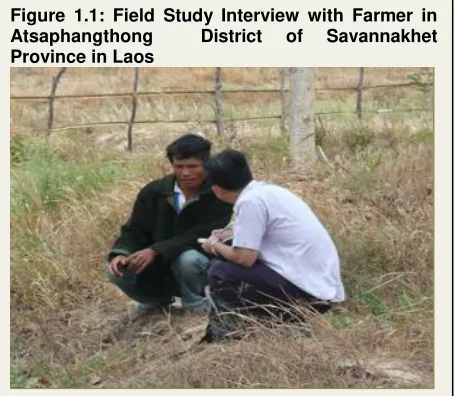
Figure 1.1: Field Study Interview with Farmer in Atsaphangthong District of Savannakhet Province in Laos
Mapping Support Services along the Value Chain (Chapter 6)
Mapping the Certification Process (Chapter 7)
Mapping Constraints and Action Plan (Chapter 8)
The results of the comprehensive analysis are being used to prepare quick reference guide in the form of a brochure that outlines the steps, inputs, risks and other requirements for participating in the organic vegetables value chain. It is to serve as a training tool by local chambers of commerce and industry to improve activities in the industry, especially those that support MSE activities into the high value product markets.
The study preparation and its delivery phases extends from the end of February 2011 to mid-June 2011. It includes a dissemination event (25-26 May) in the form of a workshop on value chain integration into existing production and distributions, which presents the mapping exercise to different representative participants
of the organic vegetables value chain along the EWEC, as well as local chambers of commerce and industry, and industry-related associations.
Four field trips were undertaken during the implementation of the assignment:
Field Trip No. 1: Khon Kaen and Kalasin (Thailand), 14-18 March 2011
Field Trip No. 2: Savannakhet (Laos), 21-25 March 2011
Field Trip No. 3: Hanoi and Da Nang (Vietnam), 28 March to 1 April 2011
Field Trip No. 4: Vientiane (Laos), 11-12 April 2011
[image:15.612.315.542.135.333.2]II. MAPPING THE CORE PROCESSES, AGENTS AND PRODUCTS
A. Overview
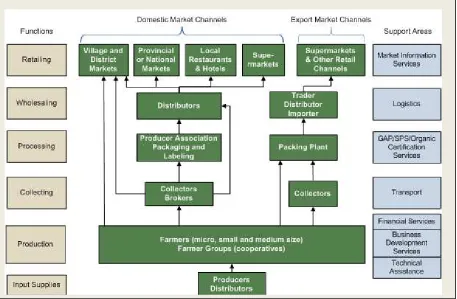
Figure 2.1 maps the traditional and modern production and distribution channels along the EWEC for organic vegetable. The channels range from a simple supply chain where the
products are simply transferred from the farm the consumer without any value being added to the products, to sophisticated value chains where the products are transformed through grading,
sorting, packaging, and cool storing along the various stages of production and distribution to add value to the product during the production and distribution to the consumer. The activities of each participant in the value chain are shown in Figure 2.2.
Input Supplies – At the initial stage of the process, the farm uses input supplies from either
external sources or from within the farming process itself. For organic farming, the key external inputs are likely to be seeds and, in some cases, organic fertilizers. In Savannakhet, for example, a Thai-owned company is manufacturing pellet-shape organic fertilizer; and in Khon Kaen, the bagasse residual of the large sugarcane process plants is sold to farmers. Often, however, the farm produces its own fertilizers through animal manure and the traditional methods of fermentation compost fertilization.
Production – Organic agricultural land in Thailand, Laos and Vietnam equals about 50,000
hectares, or 0.15 percent of all land area.6 Organic vegetables are mainly grown in small
landholdings by individual households or by farm groups. The farm groups either operate under a common organic project in a cooperative structure or as contract growers groups for processing and packaging companies or supermarkets.
In the Thai provinces traversed by the EWEC, there is a growing phenomenon of formal and informal associations of farmers. The more formal associations provide organic branding and certifications, while those that informal associations in a village exchange information and knowledge about organic farming techniques. They are often the predecessors to formal associations that develop branding and joint marketing strategies.
In the province of Savannakhet in Laos, farmers are being brought together in informal groups operating organic test sites run by local authorities and support from non-government organizations (NGOs).
In the central provinces of Vietnam that are traversed by the EWEC, there are several formal cooperatives known as communes, which are operated under the farmers association of each province. Each household has his own area of land, but a single agent manages the collection and distribution of all produce from the commune.
Collection – Traditional collectors and brokers predominate throughout the EWEC provinces.
They pick up the farm produce and carry them to local or provincial markets, normally without refrigeration. The emergence of specialized and dedicated refrigeration systems has yet to emerge in the subregion, notwithstanding advances in the infrastructure and logistics along the Corridor.
Figure 2.1: Mapping Core Processes in the EWEC’s Organic Vegetable Value Chain
Processing – The processor normally works with preferred suppliers, either in the form of
preferred groups or through contracting farming. These arrangements ensure high quality produce at low costs. These long-term arrangements support fair trade prices for farmers to ensure dedicated and stable supplies to the plant. The processing system is accompanied by certification services in the plant.
Wholesaling – The predominant Larger supermarkets like TOPS and Metro rely on dedicated
wholesalers, who only supply certain products and a single supermarket chain. Like processors, wholesalers also tend to form long-term arrangements with farm groups or associations. It ensures that traceability along the value chain.
Retailing – The traditional vegetable outlets are village and urban markets, while modern
retailing is divided into (i) supermarket and quality food stores, and (ii) restaurants and hotels. As distribution moves from domestic to foreign markets, controls over standards for quality and
safety, along with „just in time‟ deliveries rises. Exported produce is primarily directed at
supermarket chains. Reductions in trade barriers, improved transport and logistics systems, and increased capital mobility have all contributed to the growth in globalised value chains. Nevertheless, export markets tend to be concentrated in a relatively few supermarket chains.
Figure 2.2: Mapping Activities of Core Actors in Organic Vegetable Value Chain
Farmers Collectors Processors Wholesalers/Trader Retailers
Cultivation Collect Categorize Quality Control Storage
Growing Categorize Cleaning Storage Selling
Harvesting Store Drying Transport
Cuttig Transport Cutting
[image:17.612.80.538.635.740.2]B. Elementary Organic Vegetable Supply Chains
In the most basic household-level model, the farmer either transports his produce to the local market or sells it to a collector, who re-sells to a wholesaler or distributor or in the local market. These flows are depicted in Figure 2.1, first, through the direct channel between farmers to markets and, second, to local markets via collectors. There is no value added to the process because organic produce is normally sold alongside conventional produce, without any differentiation between the two.
Prices received by the farmer therefore tend to be low and in line with those of non-organic products. However, the profit margin for the farmer is higher than that of farmers who use the more costly chemical fertilizers, herbicides and pesticides. Organic farming is, however, more labor intensive, but in the EWEC countries labor is inexpensive and relatively abundant. The only drawback is the willingness of farmers to invest more time and energy in farming practices. Box 2.1 describes the case of one organic farmer in Savannakhet, who has successfully grown watermelons but faces low prices because of the lack of branding and certification for his product.
C. Value Chains of Producer Associations
When farmers develop relationships with one another or with processors and distributors, they are more likely to add value to their products. The most common relationship found along the EWEC is in the form of producer associations. In local markets like those in Khon Kaen and Kalasin, producer associations have been able to add value to their products through safe-food certification and branding their produce.
Farmers associations, operating as commercial organizations, are regular suppliers of supermarkets. The success of these associations is largely based on a combination of factors:7
(a) technical training on safe vegetable production; (b) efficient sourcing of input supplies; (c) collective marketing; (d) quality control; (e) labeling and branding; and, in a limited number of cases, (f) financing. In both Thailand and Vietnam, these associations have been more likely to receive government support in technical training and quality development than individual farms. Box 2.2 describes the case of one producer group in Khon Kaen that has substantially improved incomes of its member by producing certified organic vegetables.
D. Agro-Tourism Value Chains
There are three models used in the EWEC countries for tourism-linked organic vegetable value chains. All have integrated organic farming into their tourism and hospitality activities. The following are examples of facilities for each type:
Organic vegetable farms directly servicing restaurants: In Khon Kaen, the restaurant by
the name of Khun Pom Kitchen is owned and operated by Suwannabumi Organic Company, which cultivates organic vegetables in Phetchabun Province. Its farm produce is also sold at the restaurant, which therefore provides an important vehicle for the sale of its produce.
Organic vegetable tourist villages: In Da Nang, Tra Que Vegetable Village, near the
town of Hoi An, is famous for its wide variety of organic vegetables. Its farmers use neither manure nor chemical fertilizers but a kind of algae found only in a lagoon in Tra Que. The village produces 8 tons each day of produce, which is sold in the Quang Nam-Da Nang area at premium prices because of their freshness, good quality and safety. Residents of the village supplement their incomes through home-stays and restaurants that rely almost entirely on the village products and often provide cooking classes to Box 2.1: : Case Study of Ban Nong Pak Song Organic Watermelon Farming in Archsapungthong District of Savannakhet
Watermelons from Archsapungthong District in Savannakhet are famous for their excellent quality and taste. Ban Nong Pak Song in that district is located 3 kilometers from Route No. 9 the portion of EWEC in Lao PDR. Although
most of the community‟s farmers mainly
cultivate rice, four of them grow organic watermelon as their off season crop. They use 2 rai of their rice fields for organic watermelon and together they produce 4,800 watermelons each month.
The watermelon farmers have learned to use organic methods to grow watermelons without any external guidance. For example, they are using cow manure to produce biogas for their fuel consumption in the farms, a system similar to the advanced one used in the United States under the so-called Cow Power Program. Despite being free from pesticide and chemical fertilizer, there is no certification or safe food labeling for Ban Pak Song watermelon. As a result, Ban Nong Pak Son watermelon is sold without any recognition of its intrinsic value at prices similar to those of nonorganic products.
Mr. Suli Kaewvilaiporn is one of the four organic watermelon farmer. He produces 1,200 organic watermelons a month and sells them to the surrounding villages at 1,000 to 1,300 kip (4 to 5 baht) per watermelon. He could sell watermelons in Dong Hen market at a higher price of around 3,000 kip (11 to 12 baht), but would have to pay a daily rental for the market stand of 25,000 to 100,000 kip (100 to 400 baht). So Mr. Suli prefers to sell his watermelons in the nearby villages at a lower price to avoid rental fees for the market stand. His monthly income is 1,250,000 kip (4,800 baht), and he estimates that his net profit is somewhat over 300,000 kip (1,200 baht).
foreigners. Visitors can also participate in farming activities by preparing the land and fertilizing it with seaweed from the local lake.8
Home-stay organic farms: These home-stay farms are common in northern Thailand and
have yet to be developed along the Corridor provinces. In Laos there are some home-stay organic farms in Vang Vieng.9 They consist of organic farms where visitors can
work alongside local farmers for the natural cultivation of crops or assist with composting and all the other essential jobs associated with eco-living. The facilities range from fairly basic accommodations to relatively luxurious facilities with cooking lessons, herbal massage services and hiking and biking in the surrounding areas. An example is the
„Home-Stay Cottage‟ in Mae Taeng, Chiang Mai province. The facility is a member of
World-Wide Opportunities on Organic Farms (see Chapter 6 of this report of support services).10
E. Regional and Global Value Chains
There are a limited number of qualified organic vegetable producers along the EWEC provinces who are able or willing to export to regional or global markets. Yet participation in global organic vegetable value chains offers the largest earnings potential for producers. As mentioned earlier, the average price of organic vegetables in the United States is more than 140 percent that of conventional produce.11 The products commanding the highest organic price premiums are
cabbage, lettuce, onions, broccoli, and mushrooms. Global food retailers, largely in the form of multinational supermarkets, often develop their own standards for outsourcing the production of their vegetable products. They rely on efficient and standardized procurement procedures. For those farmers and processors able to acquire the necessary certifications for their products and meet the standards of those global food retailers, it means the realization of large price differentials between their products and conventional vegetables. It also opens opportunities for expanding their markets across other regional or global food retailers.
Two types of farmers in the EWEC provinces are currently integrated into global organic vegetable value chains. The first is the individual small farmer, an example of which is Suwannabhumi Organic Farm in Phetchabun province. Its products are certified by Good Agricultural Practices (GAP) for fruit and vegetables by the Ministry of Agricultural, the United States Department of Agriculture (USDA) organic certification, and the BCS Öko-Garantie organic certification, which indicates that the products me the European Union regulations for
8 The village operates with in collaboration with the Hoi An Government. For details, see
http://hoian-tourism.com/Tra%20Que%20Vegetable%20Village#.
9 See, for example, Vangvieng Organic Farm at www.laofarm.org. The farm is located in the village of Phoudindaeng,
near Vang Vieng in Vientiane Province. It was founded by Thanongsi Sorangkoun in 1996 to introduce organic farming methods to the province. There are a variety of projects that center around the organic production of mulberry trees, along with organic fruits, vegetables, poultry, and goat cheese for the on-site restaurant. Mulberry trees provide leaves to produce mulberry tea, mulberry wine, mulberry tempura and mulberry shakes. Wages support the villagers who work there, and profits provide assistance for the community.
10
The web site for „Home-Stay Cottage‟ is www.thailand-ecotourism.com. Other examples (a) Gerson Thailand Cancer Therapy Moms Organic Farm in Chiang Dao, Chiang Mai province. The web site is http://mylymeblog.com/?cat=3; (b) You Sabai Guesthouse and Organic Farm is located in Mae Taeng in Mae Tang province; see www.yousabai.com; (c) Tacompai is a traditional organic farm run by a local Yon family in Mae Hong Son province; see www.tacomepai.com; and (d) Santipap Gardens is located in Northeast Thailand on the shores of Ubonratana Dam Lake in Nong Bua Lampoo Province; see www.santipapgardens.com.
11 Based on April 2011 prices in United States, compiled by Rodale Institute. See New Farm Organic Price Report,
organic production. At present the farm‟s products are being exported to the Scandinavian
countries.
The second type consists of contract farmers that supply organic vegetables to a packaging plant whose products are exported. An example along the EWEC is Swift Company, which is
one of Thailand‟s leading exporters of organic fruits and vegetables, and which has a packaging
plant in Phetchabun province. It also operates a packaging plant in Pakse, Lao PDR, and is a supplier to leading supermarkets in Japan like as Jusco, Seiyu and Daiei, where strict premium quality and traceability systems are applied. The company has successfully streamlined the value chain through direct contracting with farmers and applied fair trade pricing practices in
which farmers are guaranteed prices under annually negotiated arrangements. The company‟s
model has won national and international recognition for its support to the welfare of communities and the improvements that it has brought to their household incomes.
[image:21.612.73.538.314.639.2]An example of the packaging process for asparagus from Taniyama Siam Co.,Ltd is shown in
Figure 2.3. The company‟s products have certifications for Good Manufacturing Practices (GMP)
and Hazard Analysis and Critical Control Point (HACCP). Their contracted farms are also been issued Good Agricultural Practices(GAP) certifications.
Figure 2.3: Production Process of Asparagus Product
1. Purchasing Site 2. Receiving Area
9. Cartoning
4. Cold Storage Room (raw materia)
8. Product Packed 5. Process Line
(root cutting, selection, cutting) 6. Process Line
(weighing)
3. Washing
6. Process Line (packing)
10. Carton 11.(Finished product ) Cold storage room (Loading in reefer container)12. Exporting
Box 2.2: Ban Mor Organic Farmers in Sam Sung District of Khon Kaen (Thailand)
Ban Mor is a community of small farmers in Sam Sung Ampur (district) of Khon Kaen province along the EWEC section of Thailand. Sam Sung‟s organic produce are well known and well-regarded by retailers. There are ten Ban Mor organic farmers, having a combined farming area of 85 rai (about 14 hectares). They currently produce ten types of vegetables, including cabbage, yard long beans and choy sum. Together they harvest 27 metric ton of vegetables each month.
Growth of Organic Farming
Ban Mor farm was first to produce organic vegetable in Khon Kaen. Its products are Good Agricultural Practices (GAP) certified by the Ministry of Agricultural. This certification allows them to sell their products in Thailand under the organic label (see photos in Annex C). To achieve this type of certification the farm must use organic fertilizers, uncontaminated water, and take special precautions to ensure that the products do not become contaminated.
Household Incomes Show Significant Improvements
Mr. Somjit Paohom is a president of Ban Mor organic farm group. He began cultivating vegetables in 1990 using non-organic methods. In 2000 he switched to organic farming because the local government promoted and supported organic farming in Sam Sung area. Since switching to organic farming, Mr. Somjit and other farmers have seen their household income increase steadily. Today their daily income is between 1,000 and 2,000 baht per household. Moreover, Ban Mor is now well-recognized as a learning and training center for interested farmers from Thailand and neighboring countries.
Organic Products Cannot Meet Market’s Demand
The Ban Mor farmers sell their products in the Banglampoo market of Khon Kaen city and Khon Kaen University. Supermarkets and hotels in Khon Kaen have asked Ban Mor farmers to become part of their supply chain. However, existing supplies to the local produce markets are bought out every day, so supplies are not available for other retail outlets. Land limitations prevent the farmers from further expanding their cultivation. Some supermarkets have taken to using the name of Sam Sung on their products to market their products, even though they do not originate from the Ban Mor farmers.
Better Prices Lead to Better Living Standards
F. Vegetable Products in EWEC Provinces
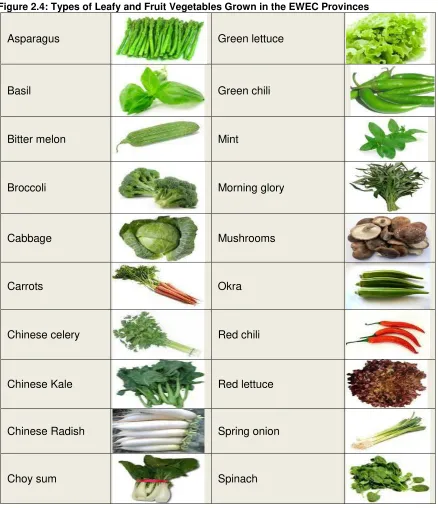
[image:23.612.88.526.171.679.2]The type of vegetables produced along the provinces traversed by the EWEC are classified as either leafy vegetables or fruit vegetables. Figure 2.4 lists the different types of vegetables produced in the provinces.
Figure 2.4: Types of Leafy and Fruit Vegetables Grown in the EWEC Provinces
Asparagus Green lettuce
Basil Green chili
Bitter melon Mint
Broccoli Morning glory
Cabbage Mushrooms
Carrots Okra
Chinese celery Red chili
Chinese Kale Red lettuce
Chinese Radish Spring onion
Coriander Tomatoes
Eggplants White Aubergine
III. MAPPING KNOWLEDGE AND SUPPORT SERVICES
A. Overview
Support services are intended to provide knowledge and information to farmers and other participants in the value chain. They include technical assistance to improve skills and technologies, business development services, product differentiation techniques through branding and marketing, accreditation for organic certification, and market information beyond local outlets.
There is considerable support for organic farming in the EWEC provinces, although more so in Thailand than in Laos and Vietnam. There is nonetheless a general tendency throughout the Corridor for local authorities, international organizations and NGOs to concentrate their technical assistance on the primary (farming) stages of the value chain. This limited focus approach ends up favoring the development of supply chains rather than value chains that add value to the process through processing or product upgrading in packaging, certification, branding and marketing activities. It makes little or no contribution to raising household incomes beyond those of farmers who grow conventional products.
Among individual farmers, especially those in poor rural areas who are largely self-sufficient, the most common complaint is lack of knowledge about how to grow particular types of vegetables. During field visits conducted for this study, farmers who did not operated as part of a producer group often complained about not receiving any advice or technical assistance about fertilization, planting and cultivation, weeding or other growing and harvesting activities.
Among brokers, the major problems center around lack of market information beyond local markets. For wholesalers, the problem is lack of differentiation between organic and conventional produce. Often the difficulty arises because of the absence of both branding and consumer awareness campaigns about food safety. For processors, the challenge is often to find a sufficiently large group of organic farmers in an areas that have the farming knowledge and expertise to provide adequate levels of the right kinds of products.
B. Mapping Knowledge Channels
In the EWEC, access to information and knowledge about organic farming methods and market information depends on the following features:
The existence of exemplary farmers in the community who can serve as a showcase to others within the community.
The mechanisms present within the community to share, maintain and collectively develop skills and knowledge.
Existence of needed knowledge and skills to understand the technology and to implement or operate it.
Box 3.1: Ban Pak Ka Organic Demonstration Farm, Kaisonephomvihan District of Savannakhet
Ban Pak Ka Organic Demonstration Farm in Kaisornephomvihan District of Savannakhet has been operating for the last year with the support of the Department of Agriculture and Forestry, the Asian Development Bank (ADB) and the International Fund for Agricultural Development (IFAD). It is made up of a group of farmers from the local communities, who have shown interest in adopting organic farming practices. The total land area dedicated to organic farming is 1.8 hectares, although not all of it is currently being cultivated.
Farmer Enthusiasm for the Project
The demonstration farm is showing farmers how to prepare soil, make organic fertilizer and pesticide, and harvest the produce. Despite initial misgivings about the benefits of growing organic produce, the farmers now see the benefits to themselves in terms of producing vegetables that require less input costs and are safer to eat. There are 11 households presently participating in the project, and each household is responsible for 40 square wah (80 square meters). A variety of vegetables are being cultivated, including cabbage, green salad, green onions, choy sum and morning glory.
Sharing Knowledge
Farmers receive training and share knowledge from other organic farms in the provinces of Vientiane and Pakse. Mr. Kaew Manu, President of Vientiane Organic Farm Networks, recently visited Ban Pak Ka Organic Demonstration Farm to teach members how to product organic fertilizer and pesticide. The training not only increased the farmers‟ knowledge about how to produce inexpensive fertilizers, but it gave them the opportunity to develop networking contacts in other provinces.
Marketing and Distribution
Mr. Thong Sri, President of Ban Pak Ka Organic Demonstration Farm, has helped to launch the groups products in the Lao International Trade Exhibition and Convention Centre (ITECC) in Savannakhet during April 2011. Afterwards, Department of Agriculture and Forestry of Savannakhet is planning to establish an organic vegetable market in Savannakhet in order to promote and sale organic fruit and vegetable to local market and neighboring areas.
Competitive Advantage of Farmers
Access to the necessary services to upgrade farming practices, introduce appropriate farming methods, and obtain needed certifications.
Farmers along the Corridor who receive information do so in one of the following ways:
Farms participate in testing and training area operated by local authorities and international organizations supporting farming activities. For example, at the Savannakhet Organic Experimental Site, the Department of Agriculture and Forestry and the International Fund for Agricultural Development (IFAD) are helping farmers to prepare the land for a variety of vegetables, make organic fertilizer and use natural methods to protect the crops from pests. (Photo 3.1).
Farmers are actively involved in community organizations that regularly meet to share information. For example, in Huay Meg District of Kalasin Province, community farmers from Tambon Kut Don meet regularly to discuss common issues. They recently agreed to dedicate a portion of each of their landholdings to the cultivation of organic vegetables. They also use a common shed to make organic fertilizer (Photo 3.2).
Farmer are organized into formal or informal cooperatives and sell their produce through a common collector or wholesaler. In Da Nang and Hue there are collective farms where each household operates their own plot of land but shares common tasks with other members of the group, including farming techniques and the use of a common broker to sell their vegetables in the market (Photo 3.3).
Farmers operated under some form of contractual arrangement with processor or wholesaler.
Photo 3.1: Testing and Training Farm in Savannakhet
Farmers learn to make liquid organic fertilizer.
Photo 3.2: Community Meeting Area for Farmers in Kalasin
Farmers recently agree to dedicate part of their land to organic vegetables.
Photo 3.3: Commune with Common Broker in Da Nang
While each household cultivates its own plot, they share knowledge and information.
C. Access to Knowledge along the Corridor
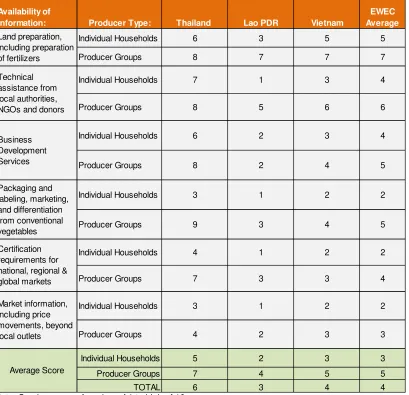
scale ranging from 1 (low) to 10 (high), and the results are presented in Table 3.1 and summarized in Figure 3.1.
There are two general observations about the pattern of knowledge and information flows for organic vegetable value chains along the Corridor:
First, the value chain participants along the Thai provinces of the Corridor have greater access to knowledge and information flows than the other EWEC countries. Participants in Savannakhet in Laos generally ranked the lowest in all categories, the reason being that the process of developing organic farming in the province has only recently started.
[image:28.612.84.493.287.682.2] Secondly, information and knowledge is higher in the primary stages of the value chain than in later stages. In fact, the later the stage along the value chain, the lower the rating. This pattern is common to all EWEC countries. Specific observations are as follows:
Figure 3.1: Summary of Perceptions on Level of Knowledge Transfer to Organic Vegetable Producers along EWEC by Value Chain Participants
Note: Scoring ranges from low of 1 to high of 10.
Table 3.1: Perceptions on Level of Knowledge Transfer to Organic Vegetable Producers along EWEC by Value Chain Participants
Note: Scoring ranges from low of 1 to high of 10.
Availability of
Information: Producer Type: Thailand Lao PDR Vietnam
EWEC Average
Individual Households 6 3 5 5
Producer Groups 8 7 7 7
Individual Households 7 1 3 4
Producer Groups 8 5 6 6
Individual Households 6 2 3 4
Producer Groups 8 2 4 5
Individual Households 3 1 2 2
Producer Groups 9 3 4 5
Individual Households 4 1 2 2
Producer Groups 7 3 3 4
Individual Households 3 1 2 2
Producer Groups 4 2 3 3
Individual Households 5 2 3 3
Producer Groups 7 4 5 5
TOTAL 6 3 4 4
Average Score Land preparation, including preparation of fertilizers
Technical assistance from local authorities, NGOs and donors
Market information, including price movements, beyond local outlets
At the farm level, individual farmers in Savannakhet were most likely to complain about the lack of information being provided to them on how to grow organic vegetables. However, there were similar occurrences in the other EWEC countries as well. Farmer groups generally have much higher access to information, either through external sources or from individual who read about and applied organic farming techniques to their plots and latter demonstrated the method to other farmers within the community. In central Vietnam that process is more formalized among farm cooperatives.
Technical assistance to farmers is fairly high in Thailand and often extends to individual farmers. There is a large and growing community of organic farmers and associations, whose members are highly dedicated to the promotion of organic activities. There is also a heightened public awareness of food safety in the country through mass media channels. In Vietnam, the Government and private sector have undertaken a number of actions to improve food safety, especially that aimed at securing increased entry into overseas markets. But problems remain because of the lack of a comprehensive model for managing antibiotics and chemical and biological products; low awareness of the food sanitation issues of different stakeholders; and lack of institutional, technical, and financial resources to ensure the sanitation standards. In Laos, organic farming with market linkage has only recently started to became important to Lao agriculture authorities and NGOs as many international development institutions and donor agencies realized the potential opportunities of organic agriculture as poverty eradication. However, the focus of technical assistance for organic farming has been concentrated in the northern provinces and in Champasak.
Business development services are more accessible along the Thai portion of the EWEC than in other EWEC countries because of the existence of major learning centers, for example, in Phitsanulok and Khon Kaen. A number of faculties are involved in the promotion of agriculture, food safety and organic methods in these centers. Similar learning centers exist in Hue and Da Nang, where a several faculties are also involved in agriculture and food-related
0 2 4 6 8
Land preparation, fertilizers, cultivation
Technical assistance
Business Development Services
Packaging, labeling, marketing
Certification requirements
Market information
Thailand
Laos
areas. Opportunities for developing BDS centers in Savannakhet are explicitly mentioned in the new EWEC Strategy and Action Plan.12
Packaging and labeling activities are fairly well developed in the Thai portion of the EWEC. Branding allows organic products to be differentiated from conventional products, and therefore significant price differentials to be applied when the consumer is made aware of the benefits of safe foods. However, branding in all EWEC countries requires strict conformity to labeling requirements. In Thailand, for example, labeling requirements differ according to the type of certification for the product. They nonetheless generally include essential elements indicating that the organic product has requirements from farm to market. The organic label is therefore a production process claim, rather than simply as product safety or quality claim. For products intended for overseas markets, the labeling requirements vary from country to country.13
Certification knowledge and information tends to be similar to that of packaging and labeling, since they are often carried out together.
Market information services about both pricing and regional or global markets are minimal or non-existent throughout the Corridor. Most of the support given to participants of the organic vegetable value chain along the Corridor is focusing on the primary stage of production. Pricing information is extremely limited, with the results that price differentials between organic and conventional vegetables tend to vary widely (see Chapter 4).
D. Upgrading Knowledge along the Corridor
Existing patterns for transferring knowledge and information to participants along the organic vegetable value chains in the EWEC provinces need to be improved upon. Best practices in value chain development for the industry point to the following opportunities for upgrading knowledge and information:
(1) Focus knowledge transfer and information flows to producer groups, since they have inherent scale economies and networking capabilities that help disseminate know-how and technologies;
(2) Help individual producers, who are often poor households, learn about organic farming techniques through mass media channels and demonstration sites strategically located in areas along the Corridor as a means of targeting poor households and helping them to improve their livelihoods;
(3) Provide integrated training to cooperatives and other producer groups on the full range of activities along the value chain, rather than limiting information to only production techniques, to ensure that farmers are able to benefit from the full range of market opportunities for organic vegetables;
12 ADB, Strategy and Action Plan for the Greater Mekong Subregion East-West Economic Corridor. Available:
www.adb.org/GMS/Economic-Corridors/EWEC-SAP.pdf.
13For details of labeling requirements on Japanese organic foods, see JETRO, “What Legal Requirements Apply to Food Labeling”. Available: www.jetro.go.jp. In the United States, National Organic Program (NOP) develops,
implements, and administers national production, handling, and labeling standards (see
(4) Promote the establishment of a centralized organic market information system that monitors organic vegetable prices and offers free or inexpensive access to price quotations in key provincial, national and overseas markets;
(5) Provide packaging and branding know-how to producer groups to help them differentiate their products and thereby increase the value of organic produce; (6) Disseminate information on upstream processing facilities that will support the
creation of a cold storage chain, warehouses, distribution facilities and cross-border logistics; and
Box 3.2: Case Study of Organic Experimental and Training Farms in Khon Kaen (Thailand)
Organic experimental and training farms are operating in Nai Muang and Khao Noi Tambons (sub-districts) in Vieng Kao Ampur (district) of Khon Kaen province. They are being managed under a three-year development plan of the Vieng Khao public administrative office. The area under cultivation covers 20 rai (3.2 hectares) of public land near a community pond, and the farmers are being taught how to cultivate organic vegetable by local experts.
There are currently about 200 households under the program and each is being offered 40 sq.wa by the local administrative office for the district. Among the vegetables being cultivated are cabbage, long bean, green onion, choi sum and morning glory.
Overcoming Water Limitations
While the area is presently limited to 20 rai, the project foresees an expansion to 200 rai (32 hectares). However, the underground water has a high salt contents and is limits the wider cultivation of agricultural products. At present, the amount of production is enough to cover household consumption by the local farmers and sale in the local market. If the water issue can be resolved, the expansion of organic farming in the district would expand greatly since many other farmers have expressed interest in joining the project.
Rising Consciousness about Safe Cultivation Practices
Mr. Thonginn Thangkumgee is a member of the Ban Nai Muang organic farmers group. Under the program and with the assistant of local public health office and Khon Kaen University he has learned how to prepare soil and make organic fertilizers and pesticide. He has also learned about the importance of safe foods, and how to make them through organic agricultural practices.
Plans for Certification
The vegetables cultivated by the farmers in the Ban Nai Muang and Kao Noi organic experimental and training project are consider to be organic. However, they have not yet received any type of certification. Once the project completes its first phase, there are plans to have the products certified under the Good Agricultural Practices (GAP) label of the Ministry of Agricultural.
Improving Living Standards
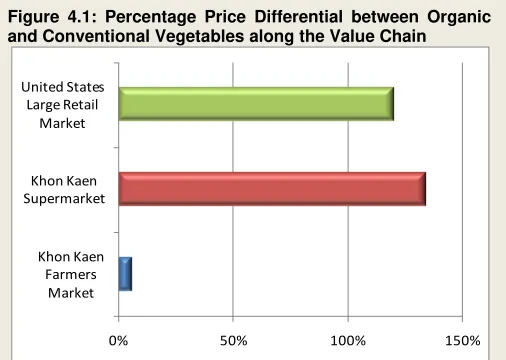
Figure 4.1: Percentage Price Differential between Organic and Conventional Vegetables along the Value Chain
Sources: Khon Kaen data collected during field visit week of 14 March 2011. US prices are for organic and conventional vegetables delivered to large distributors based in Los Angeles area. Data for week of 22 April 2011. Source: newfarm.rodaleinstitute.org
0% 50% 100% 150%
Khon Kaen Farmers
Market Khon Kaen Supermarket United States
Large Retail Market
IV. MAPPING PRICE DIFFERENTIALS ALONG THE VALUE CHAIN
A. Overview
Premium Prices –Organic vegetables are generally sold in retail outlets at higher prices than those of their conventional (non-organic) counterparts. For farmers, these higher prices translate into greater profits since the cost of organic farming is generally lower in the EWEC countries than non-organic farming. The reason is that natural fertilizers are less expensive than chemical fertilizers and pesticides used in conventional farming operations. Although the amount of labor used in organic farming is greater than in non-organic farming, labor costs in the EWEC countries are much lower than in the industrialized countries, which therefore provides these countries with a substantial competitive advantage in the production of organic produce relative to the more developed countries.
Importance of Product Differentiation – Premium prices of organic vegetables in retail domestic and overseas markets can
provide a means of expanding incomes and livelihoods for the people in the EWEC provinces (Figure 4.1). However, farmers can only achieve those higher incomes if they are able to differentiate their products from conventional produce. Generally, that differentiation requires certification by local or international authorities, branding and packaging of the products, and marketing and promotion, which in turn requires micro and small farmers to join together in producer groups to achieve the scale of production needed to make product differentiation a cost-effective operation.
When Premium Prices Erode Sales – While premium prices are beneficial to farmers, significant price differentials between organic and non-organic produce can erode market shares. The literature on organic produce often refers to the unfavorable effects of those price differentials on consumption of organic products in the major European and North American markets.14 However, there is little or no information about the point at which price differentials
have a significant negative impact on consumption of organic products. While this issue remains important to importers and retailers in the large overseas markets, it is of little consequence for the farmer groups and packaging plants within the EWEC countries since they are price takers in the market. The prices at which they sell their products are inevitably set by overseas markets
and local suppliers are simply „price-takers‟ in the market. What is important to local suppliers and packaging plants, however, is information about organic market prices in their target overseas markets. Otherwise, without that information, they can be subject to contractual arrangements that unfairly favor overseas buyers.
When Premium Price-Setting Becomes Important – Pricing decisions become important to farmer groups and packaging companies in the distribution process within the EWEC countries.
14Amarjit Sahota, “The Global Market for Organic Food & Drink”. In The Global Market for Organic Food & Drink:
[image:33.612.264.517.250.430.2]