http://dx.doi.org/10.4236/ojml.2016.63023
A Study of Relationship between Arabic and
Yoruba Languages
Kamil Adeleke Adeyemi
Department Religious Studies, Faculty of Arts, Ekiti State University, Ado-Ekiti, Nigeria
Received 1 May 2016; accepted 12 June 2016; published 15 June 2016
Copyright © 2016 by author and Scientific Research Publishing Inc.
This work is licensed under the Creative Commons Attribution International License (CC BY). http://creativecommons.org/licenses/by/4.0/
Abstract
This study examined the relationship between Arabic and Yoruba languages. An attempt is made to trace the history of the Yoruba as a race and the influence that Arabic language has on Yoruba language. This influence is observed in the pronunciation of some Yoruba words traceable to Ara-bic with the same meaning. These facts, if well proved will go a long way in lending credence to the historical belief that the Yoruba race originated from the Arab. To elucidate this, traces of Arabic words in Yoruba language are noted. Similarity in pronunciation of some letters in both languages, comparison in construction of words between them and similarity in the use of some words in both languages are analysed with the views of some Arabic scholars. Conclusion is then drawn to show the impact of Arabic on Yoruba Language.
Keywords
Arabic, Yoruba, Language, Semitic, Race
1. Introduction
No language in the world is without an origin. The origin may be from where it is being spoken or near to it. The language spoken may change from the origin but still, there must be traces or elements of this origin in it that will show emergence of this language from this source.
This is what happened in the Arabic diffusion of Arabic to Yoruba Language either by borrowing or historical connections. On historical connection, Burns (1972: p. 120)explains that before the first settlers of Yoruba stock at Ile-Ife led by Oduduwa, there was a black tribe called Negro, which was small in number but these emigrants (The Yoruba) later dominated this tribe with their language and culture.
Mecca. He states further on internal proofs of Yoruba’s early contact with Arabic and Islamic institutions in the literature of Ifa poetry, the theme of which is about Orunmila and al-Qaadī (Yoruba: Alukaadī or Alikaadī), a judge of the Sharia court.
To ascertain the level of relationship between Arabic and Yoruba languages, this paper will look into the fol-lowing issues:
1) Origin of Arab and their Language 2) Origin of Yoruba and their Language 3) Traces of Arabic words in Yoruba Language
4) Similarity in pronunciation of some Arabic and Yoruba Letters
5) Comparison in construction of words between Yoruba and Arabic languages 6) Lexical similarities in Yoruba and Arabic languages
7) Conclusion
2. Origin of Arab and Their Language
According to Khalifah (2000: p. 46), the Arab originated from Semitic race who lived in Euphrates, the land between two rivers (Tigris and Euphrates). Distress in this ancient city led to their separation throughout the World while the Arab settled at the Peninsula attributed to them. Their language is Semitic and it is nearest to the origin because the Arab did not mix so much with others (unlike other tribes whose languages have gone beyond the boundary of their origin). The said Semitic languages, as stated by Al-Fakhūri (N.D: p. 143) are:
- Babilliyyah wal Ashiriyyah (Babylonian and Assyrian) - al-Ibraniyyah (Hebrew)
- al-Himyariyyah (Himyaritic) - al-Aramiyyah (Phoenician) - al-Finiqiyyah (Phoenician) - al-Habbashiyyah (Ethiopian) - al-Arabiyyah (Arabic)
Rahim (2003: pp. 2-3) states that Arabic Language is the language of Prophet Ismail, though it was neither the language of his father (Prophet Ibrahim) as his language was Kildāniyyah (Chaldean) nor that of his mother who was an Egyptian and her language was Ibrāniyyah (Hebrew). Researchers on Ismail’s language, according to
Khalifah (2000: p. 46) have two opinions viz:
1) That he learnt this language from his neighbours who were Yemenites from Amalikid tribe who lived with him beside 'Zamzam (a spring in Makkah). It was among them that he got married.
2) That Arabic Language was the Language of Yacrub son of Qahtan who was recognized as the father of the Arab and got his name from the place called cAraba from the Arabal-Mutacarribah (the dwellers of the cities among the tribes of Arab) who mixed with others and also lived in Yemen.
With regard to these opinions, the Isma’ilite language came from Yemen. Apart from this, one may think that its pronunciation is Chaldeanite and Hebraic languages from his father and mother respectively and later spread all over Arabian Peninsula with different pronunciations.
Adedimeji (2012: p. 122) reveals that Arabic is the mother tongue of the Arab. This tribe are the people that speak Arabic as their native language. Their language along with the Hebrew and others forms the large chunk of the Semitic languages. Majority of Arab originated from the Arabian Peninsula. Some scholars asserts that the name Arab was derived from caraba which is another name for Tuhaamah a settlement in the peninsula that the early Arab were confined to and the social, cultural, religious and linguistic nerve of all the present-day Arab.
3. Origin of Yoruba and Their Language
Earlier on, Burns (1972: p. 120), in his contribution on the origin of the Yoruba and their place in Nigeria, he states that the African population in Nigeria is divided into numerous tribal and linguistic groups (with Yoruba inclusive) great and small, speaking different languages, professing different religions and different from one another in manner and customs. With particular reference to origin of Yoruba, he admits that little is known. Their ancestors have left for them practically no written records or monuments and their traditions interwoven with myth and legend, fragmentary and in many cases conflicting. He then explains further that the statement made by Sultan Bello of Sokoto, that the people of Yoruba, originated from the remnants of the children of Canaan, who were of the tribe of Namrud (Nimrod) (popularly called Lamurudu in Yoruba) and settled at Ile-Ife as a consequence of their being driven out of Arabia by Yaa-rooba, son of Qahtan to the Abyssinia. On the way, they left a tribe of their own people at every place they stopped. He also opines that all tribes of Sudan originated from them. He concludes that whatever their origin, it is probably that the Yoruba were originally of Negro blood.
Eventually, a further tradition that they (the Yoruba) came from Upper Egypt has better foundation in the sense that certain carved stones found at Ile-Ife, the manner in which the dead are bound for burial and the kind of cloth used for this purpose are supposed to indicate an Egyptian origin.
Al-Ilori (1987: p. 33) in his own part, did not support a myth that the fore-father of Yoruba and his wife de-scended from heaven down to Ile-Ife and from there his sons and descendants spread-black, white and yellow in complexion throughout the world. He referred this statement to Samuel Johnson and his further explanation on what Sultan Bello has said from Muhammad Masani in his book Az’haru’r Ruba.fi Akhbari Biladi Yoruba.
In his own submission, Al-Ilori affirms the statement that the present Yoruba tribes were formed from four origins: 1) Negroes, 2) Nubians, 3) Berbers and 4) Arab. He opines that the last three tribes have dwelled in Egypt, took from their cultures and carried them to Yoruba land. He then gives account that it has remained till now in Yoruba some of Arabic words which are more than one third in which Yoruba speak daily as it has re-mained in Nubian and Berber languages.
Based on the different opinions on the origin of Yoruba and their language, it is apparent that part of Yoruba language did not come from nowhere but seems to be connected with Arabic than any other languages.
4. Traces of Arabic Words in Yoruba Language
Apart from the borrowed words from Hausa to Yoruba language like Kai means “leave the place”, gāni means “to see properly”, magaji means “heir/leader of a family” and host of others, there are still many words in Yoruba language which emanate from Arabic. It cannot be said precisely here how and when these Arabic words diffused to Yoruba language beside the indications that showed the coming of Yoruba either from Upper Egypt or from the descendants of Nimrod. Besides, the word "Yoruba" seems to emanate from the said Yacrub son of Qahtan.
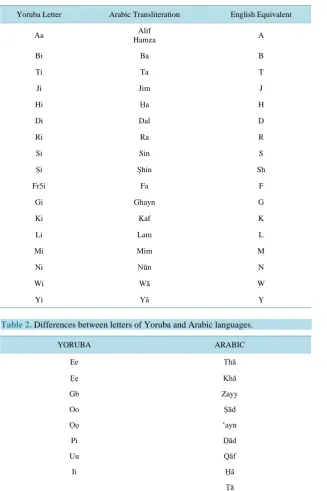
5. Similarity in the Pronunciation of Some Arabic and Yoruba Letters (Table 1)
There are some letters in Yoruba that are near in pronunciation to Arabic ones. These may be taken through the historical link between the Yoruba and Arab people (see Table 1).
There are some letters that are peculiar to either Yoruba or Arabic Languages alone that cannot be found ex-cept in either of the two (see Table 2).
6. Comparison in Construction of Word between Yoruba and Arabic
Among the characteristics of Yoruba language is the struggle to vowelize all Arabic words or to stop on them because it is not known in Yoruba to stop on consonant (as-sukūn) but ending the word on vowel always such as
mucallim in Arabic malīmu in Yoruba, qalam as Kalamu, Qurān as Kurāni etc. This also appears in pronouncing some Arabic nouns such as Kāmil in Arabic but Yoruba calls it Kāmilu, Ibrāhim as Buraimo, Maryam as
Mariamo, Ṣerifah as Ṣerīfatu, Mascud as Masūdi etc.
Table 1. Similarities between Arabic and Yoruba letters.
Yoruba Letter Arabic Transliteration English Equivalent
Aa Alif
Hamza A
Bi Ba B
Ti Ta T
Ji Jim J
Hi Ḥa H
Di Dal D
Ri Ra R
Si Sin S
Ṣi Ṣhin Sh
Fr5i Fa F
Gi Ghayn G
Ki Kaf K
Li Lam L
Mi Mim M
Ni Nūn N
Wi Wā W
[image:4.595.156.468.430.591.2]Yi Yā Y
Table 2. Differences between letters of Yoruba and Arabic languages.
YORUBA ARABIC
Ee Thā
Ẹẹ Khā
Gb Zayy
Oo Ṣād
Ọọ cayn
Pi Ḍād
Uu Qāf
Ii Ḥā
Ṭā
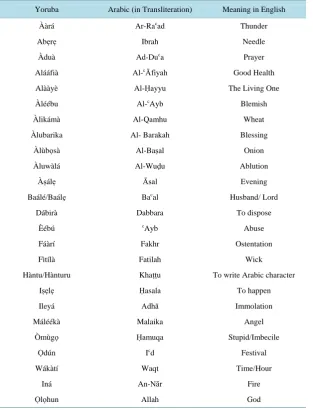
7. Lexical Similarities in Yoruba and Arabic Languages (Table 3)
There are some similarities in the use of words in Yoruba and Arabic languages especially the words that have something to do with religion and its creed or names of some items. Some of the words seem to have Arabic origin while others look like borrowed ones. The study will focus on those seem to have Arabic origin alone with the same meaning in the two languages.
In this regard, Abubakre (1983: p. 60) quotes from Joseph Greenberg the four possible sources of language similarities (see Table 3).
Table 3. Similarities between Yoruba and Arabic words.
Yoruba Arabic (in Transliteration) Meaning in English
Ààrá Ar-Racad Thunder
Abẹrẹ Ibrah Needle
Àduà Ad-Duca Prayer
Alááfià Al-cĀfiyah Good Health
Alààyè Al-Ḥayyu The Living One
Àléébu Al-cAyb Blemish
Àlikámà Al-Qamhu Wheat
Àlubarika Al- Barakah Blessing
Àlùbọsà Al-Baṣal Onion
Àluwàlá Al-Wuḍu Ablution
Àṣálẹ Āsal Evening
Baálé/Baálẹ Bacal Husband/ Lord
Dábirà Dabbara To dispose
Èébú cAyb Abuse
Fáàrí Fakhr Ostentation
Fìtílà Fatilah Wick
Hàntu/Hànturu Khaṭṭu To write Arabic character
Iṣẹlẹ Ḥasala To happen
Ileyá Adhā Immolation
Máléékà Malaika Angel
Òmùgọ Ḥamuqa Stupid/Imbecile
Ọdún Icd Festival
Wákàtí Waqt Time/Hour
Iná An-Nār Fire
Ọlọhun Allah God
3) borrowing, and 4) genetic relationship.
He gives details that using the above analysis as a yardstick to measure the relationship of Arabic with Yoruba, it will be found that both chance and symbolic similarities are of marginal use in a linguistic investiga-tion. He stresses further that if the similarity of a lexical item in a language with another one that involves both form and meaning, such similarity is due to receive an explanation more than of a chance. At the same time, if an item requires an historical explanation, there is need to modify its historicity. If the historical connection jus-tifies a genetic interference then that is a step ahead of the other whose historical relationship involves only bor-rowing.
8. Conclusion
There are some indications to suppose that parts of Yoruba language emanated from Arabic, which has root in Semitic language. In addition to this, mixture of different languages or dialects in use without proper records to guide these languages/dialects and the speakers always brings another language/dialect in between; neither the totality of the first language/dialect nor the second. Generation after generation, the first and second languages/ dialects will gradually diminish until they are forgotten totally while the emergence of that new one will super cede them in terms of speaking and daily uses. That is what might happen in Yoruba/Arabic case. In a nutshell, the comparison of Arabic and Yoruba languages shows that the diffusion of Arabic to Yoruba may be attributed to historical connections between the people of Yoruba and the Arab.
References
Abubakre R. D. (1983). Aspects of the Diffusion of Arabic to Yoruba. NATAIS Journal of the Nigerian Association of
Teachers of Arabic and Islamic Studies,II, 50-64
Abubakre, R. D. (2004). The Interplay of Arabic and Yoruba Cultures in South-Western Nigeria (pp. 21-22). Iwo: Dārul-cIlm
Publishers.
Adedimeji, A. A. A. (2012). The Prospects of Arabic language as a Unifying Force for Nigerian Muslims. In M. A. Abdul-
Raheem (Ed.), Challenges of Moon Sighting and Preservation of Arabic Manuscripts in Nigeria, Nigeria Association of
Teachers of Arabic and Islamic Studies (NATAIS) (pp. 121-140). Ijebu-Ode: Shebiotimo Publications.
Al-Fakhūri, H. (N.D). Tarikhul-Adabiyy (Literary History) (18th ed., p. 143). Lebanon: al-maktab-al Bolisiya.
Al-Ilori, A. A. (1987). Nasimus-Sibafi Akhbaril-Islam wa cUlamai Bilādi Yoruba (Gentle Wind on the Information of Islam
and the Scholars in Yoruba Land) (2nd ed., p. 33). Cairo: 'al-Matba'atun Namudhajiyyah.
Burns, A. (1972). History of Nigeria (Eighteenth Edition, p. 120). London: George Allen and Unwin.
Folorunso, M. A. (2009) Further Light on the Diffusion of Arabic Scholarship in Yorubaland. NATAIS: Journal of the
Nige-ria Association of Teachers of Arabic and Islamic Studies, 12, 13-26.
Ghaladanchi, A. (1982). Harakatu ‘l Lughatil Arabiyyah wa Adabiha fi Nigeria (Movement of Arabic Language and Its
Lit-erature in Nigeria) (pp. 124-127). Cairo: Darul-Ma'arif.
Khalifah, M. (2000). 'al-Adab wan-Nusūs fi Asrayn aljahiliyi wa Sadril Islam (Literature and Texts in the Pre-Islamic Period
and the Advent of Islam) (p. 46). Cairo: 'al-Hai'atul Amah lishu'unil matabi 'al-Amiriyyah.
Rahim, A. (2003) Islamic History (4th ed., pp. 2-3). India: Royal Publishers and Distributors.
Dictionaries
Arabic (Al-Qāmūs Dictionary English to Arabic; Arabic to English; Billingual 2008, Beirut, Dārul-Kotob Al-cIlmiyyah);