Journal
Journal
Journal of
Journal
of
of
of Chemical
Chemical
Chemical
Chemical and
and
and
and Pharmaceutical
Pharmaceutical Research,
Pharmaceutical
Pharmaceutical
Research,
Research,
Research, 2014,
2014,
2014,
2014, 6(1):434-438
6(1):434-438
6(1):434-438
6(1):434-438
Research
Research
Research
Research Article
Article
Article
Article
ISSN
ISSN
ISSN
ISSN :::: 0975-7384
0975-7384
0975-7384
0975-7384
CODEN(USA)
CODEN(USA)
CODEN(USA)
CODEN(USA) :::: JCPRC5
JCPRC5
JCPRC5
JCPRC5
Simulation
Simulation
Simulation
Simulation of
of
of
of coordination
coordination
coordination
coordination between
between human
between
between
human
human
human and
and
and
and exoskeleton
exoskeleton
exoskeleton
exoskeleton
Zhengdong
Zhengdong
Zhengdong
Zhengdong Yang
Yang
Yang
Yang
1111,,,, Rencheng
Rencheng
Rencheng
Rencheng Wang
Wang
Wang
Wang
1111,,,, Ming
Ming
Ming
Ming Wu
Wu
Wu
Wu
2222,,,, Xinyu
Xinyu
Xinyu
Xinyu Guan
Guan
Guan
Guan
1111and
and
and
and Run
Run
Run
Run Ji
Ji
Ji
Ji
33331
Department of Mechanical and Engineering Tsinghua University,China
2Northwestern University Feinberg School of Medicine, Chicago, USA
3
National Research Center for Rehabilitation Technical Aids, China
_____________________________________________________________________________________________
ABSTRACT ABSTRACT ABSTRACT ABSTRACT
The current available exoskeleton robots used fixed connection with human, which may result in discomfort or even cause injury to human during walking due to the strong constraints. To overcome these disadvantages, this paper introduces a novel human-machine interaction model by increasing connection joints between the exoskeleton and human at the location of thigh and shank. The process that the human walk on the ground with the assistance of exoskeleton robot and crutches was simulated using ADAMS. In addition, the impact of gait patterns and knee joint configuration on the human-machine coordination was analyzed. Results of this simulation analysis may be useful for the mechanical design and the clinical application of exoskeleton.
Key Key Key
Key words:words:words:words:Coordination, Human, Exoskeleton, Simulation.
_____________________________________________________________________________________________
INTRODUCTION INTRODUCTIONINTRODUCTIONINTRODUCTION
Exoskeleton is a robor worn by the human in the lower limb. The powered mechanical joints will drive the corresponding joints of patients with motor dysfunction in their lower limb to enhance endurance or to assist walking. Too strong constraints between human and exoskeleton may bring discomfort and even causes injury to the human. Current exoskeleton robots use single-axis knee joint in structure and use bundles to accomplish a fixed connection, such as HAL-5[1], Elegs[2] and Rewalk[3]. The exoskeletons with single-axis knee joint have advantages in simple structure and easy control, and the advantages of fixed connection are simple design and easy to wear. However, there are still many disadvantages in such exoskeletons, for example, they did not consider the effects of the difference between human joint and exoskeleton joint and the way of human-machine connection on the human-machine coordination.
Recent years, the coordination problem between human and exoskeleton has been investigated, but most of the studies focused on the upper limb exoskeletons. For example, Schiele A al. studied the effects of the movement of the upper limb joint on the coordination[4]. Gopura R studied the effects of the movements of the shoulder, elbow and wrist joint on the coordination, respectively[5].
Jianfeng Li transferred the upper limb exoskeleton coordination study to the weight support rehabilitation robot. However, his study did not explore the human-machine coordination when the human walked on the ground with the assists of the exoskeleton and crutches[6]. It is necessary to consider the case that human walk with assist of the exoskeleton and crutches because most of the existing exoskeletons(e.g. Elegs and Rewalk) are used in combination with crutches.
the exoskeleton and human in thigh and shank. Then by analyzing the movement deviation exremum, the impacts of gait patterns and configurations of knee joint on the human-machine coordination were explored.
EXPERIMENTAL
EXPERIMENTALEXPERIMENTALEXPERIMENTAL SECTIONSECTIONSECTIONSECTION
Connection model between human and exoskeleton
The human-machine connection model is divided into two parts, namely connection in thigh and connection in shank. The connection joints in thigh consist of Translational Joint 1 and Spherical Joint 1, and the connection joints in shank consist of Translational Joint 2, Translational Joint 3 and Spherical Joint 2. Fig.1(a) and Fig.1(b) are the connection models between human and exoskeleton that has single-axis knee joint and four-bar linkage multi-axis knee joint, respectively.
(((( aaaa ))))
(((( bbbb )))) Fig.
Fig.
Fig.Fig. 1:1:1:1: (a)(a)(a)(a) ConnectionConnectionConnectionConnection modelmodelmodelmodel betweenbetween humanbetweenbetweenhumanhumanhuman andandandand exoskeletonexoskeletonexoskeletonexoskeleton thatthatthatthat hashas single-axishashassingle-axissingle-axissingle-axis kneekneekneeknee joint.joint.joint.joint. (b)(b)(b)(b) ConnectionConnection modelConnectionConnectionmodelmodelmodel betweenbetweenbetweenbetween humanhumanhumanhuman andandandand exoskeleton
exoskeletonexoskeletonexoskeleton thatthatthatthat hashashashas four-four-four-four- barbarbarbar linkagelinkagelinkagelinkage multi-axismulti-axismulti-axismulti-axis kneekneekneeknee jointjointjointjoint
Crutch gait analysis experiments
[image:2.595.198.441.201.639.2]Fig. Fig. Fig.
Fig. 2:2:2:2: Four-pointFour-pointFour-pointFour-point gaitgaitgaitgait experimentexperimentexperimentexperiment
Fig. Fig. Fig.
Fig. 3:3:3:3: Three-pointThree-pointThree-pointThree-point gaitgaitgaitgait experimentexperimentexperimentexperiment
RESULTS
RESULTSRESULTSRESULTS ANDANDANDAND DISCUSSIONDISCUSSIONDISCUSSIONDISCUSSION
Simulation of coordination between human and exoskeleton
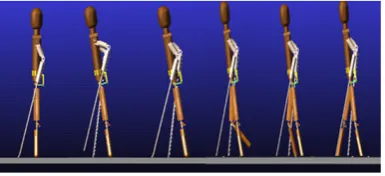
Firstly, the four-point gait was simulated in ADAMS to analyze the human-machine connection model. As the left leg and right leg theoretically have identical movement pattern excepta half-gait-cycle difference, this paper only had a simulation of a half-gait-cycle. The simulation process of a half-gait-cycle in ADAMS is shown in Fig.4.
[image:3.595.210.401.71.282.2]Fig. Fig. Fig.
Fig. 4:4:4:4: SimulationSimulationSimulationSimulation processprocessprocessprocess ofofof aofaaa halfhalfhalfhalf ----gaitgaitgaitgait----cyclecyclecyclecycle
Factors affecting the human-machine coordination
(a) Impact of Gait Pattern: The process of three-point gait was simulated as the same method used in the four-point gait. The movement deviation extremums in different gait patterns are shown in Tab.1.
Comparing the movement deviation extremums in two gait patterns, there are not significant difference, which demonstrated that both two gait patterns are feasible in the practical application.
(b)Impact of Configurations of Knee Joint
Most researchers simplified the knee joint to a single-axis joint, which was obviously different from the actual knee joint both in structure and movement. Thus, it was necessary to study the impact of configuration of knee joint on coordination between human and exoskeleton. This study was done by replacing the single-axis knee joint with four-bar linkage multi-axis knee joint without changing other settings. Subsequently, the new model was simulated in ADAMS. Movement deviation extremums in different configurations of knee joint are shown in Tab.2. In the table, ‘X’ means sarittal axis, ‘Y’ means vertical axis and ’Z’ means frontal axis.
[image:3.595.211.404.380.468.2]Table Table Table
Table 1:1:1:1: MovementMovementMovementMovement deviationdeviationdeviationdeviation inin twoinintwotwotwo GGGGaitaitaitait patternspatternspatternspatterns
Table Table Table
Table 2:2:2:2: MovementMovementMovementMovement deviationdeviationdeviationdeviation inininin twotwo configurationstwotwoconfigurationsconfigurationsconfigurations ofofofof kneekneekneeknee jointjointjointjoint
CONCLUSION CONCLUSIONCONCLUSIONCONCLUSION
According to the above simulation results, the main conclusions can be drawn as follows:
(1) Movement deviation extremums in connection joints in four-point gait are smaller than those in three-point gait, however, they are not significant. Thus, two gait patterns are feasible in the practical application;
(2) Compared to the single-axis knee joint exoskeleton, the multi-axis knee joint exoskeleton has better coordination with human;
This paper only includes some kinematic analysis about coordination between human and exoskeleton. Dynamic analysis should be explored in the future research.
Acknowledgements Acknowledgements Acknowledgements Acknowledgements
The author would like to thank the financial support by the Beijing Science and Technology Program (D121104002812001), National Natural Science Foundation of China (51175289), National Science and Technology Support Program (2012BAI34B02) and Tribology Science Fund of SKLT.
REFERENCES REFERENCES REFERENCES REFERENCES
[1]Tsukahara A, Kawanishi R, Hasegawa Y, et al.Advanced robotics,2010201020102010, 24(11): 1615-1638.
[4]Schiele A, van der Helm F C T.Neural Systems and Rehabilitation Engineering,2006200620062006, 14(4): 456-469. [5]Gopura R, Kiguchi K.ICORR International Conference,2009200920092009, pp: 178-187.