A Framework of Sustainable Development in Continuing Engineering Education
Programmes in Malaysia
Noraini Kaprawi
Director of Continuing Education Centre Universiti Tun Hussein Onn Malaysia
Wahid Razzaly
Dean of Academic Development Centre Universiti Tun Hussein Onn Malaysia
Anis Mardhiyah Azroai Universiti Tun Hussein Onn Malaysia
Abstract
Continuing education (CE) is increasing its importance as part of university education. Engineering Education is one of the disciplines under the scope of CE programmes offered by CE centers in Higher Education Institution (HEI) in Malaysia. The main objective of Continuing Engineering Education (CEE) is to help practicing engineers, technologists or technicians stay current with technological advances relevant to their current or future jobs and indirectly they are also involved in the country development. However, continuing engineering education faces some classic and some new challenges. One of the critical challenges common to all engineering disciplines is the need for sustainable
development of the programme. Although there are programmes that have successfully implemented skills into their curriculum, there are many factors that serve to hinder the philosophy of sustainability which may be contributed due to the non existence of guideline in CE centers. Hence the purpose of this research is to (i) determine the current status of sustainable development orientation in CEE centers and (ii) develop the framework of sustainable CEE programmes. This quantitative-designed research is carried out using modified Delphi method which involves participation from 33 experts in relevant fields that purposively chose regarding their positions. This methodology required two cycles of instrument distribution to get a consensus from the experts by using questionnaire form and supported by interview. The findings showed that the framework consists of eight components such as quality assurance
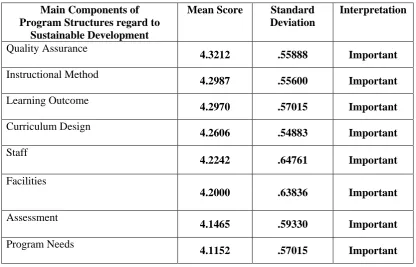
(mean=4.3212), instructional method (mean=4.2987), learning outcome (mean=4.2970), curriculum design (mean=4.2606), staff (mean=4.2242), facilities and support (mean=4.2000), assessment (mean=4.1465), and program needs (mean=4.1152). All components comprise 43 characteristics of sustainable development. Overall, the framework can be used as guideline to design and implement CEE programme to better equip the students to introduce and teach others with respect to sustainable
development value and practices.
Introduction
There are still many unsolved issues around us especially in industries that is related to economic vitality,
justice, social cohesion, environmental protection, inefficient use of energy, lack of water conservation,
increased pollution, abuses of human rights, war, poverty, overuse of personal transportation,
consumerism, and the sustainable management of natural resources, so as to meet the needs of the present
shift in addressing this issues for sustainable development. Many of this inequities experienced around us
need to be eradicated whilst survival of the human species warrants serious consideration and action,
with a particular need to deal with climate change. Development needs to be recognised as more than a
narrow measure of material prosperity and economic growth. It needs to incorporate health, education,
democracy and freedom and as a society we need to be aware of and engage in numerous forms of action
that will make a difference. Therefore, sustainable development is critical and should be considered to be
an essential direction for our world to move forward and for our quality of life.
Universities have a major role to play by introducing not only sustainable development teaching into the
curriculum across the spectrum of courses offered but also the program itself is sustainable. However, the
focus of this paper is on continuing engineering education, more than on the natural and physical sciences
or on social science, because most unsolved issues around us are most from the industrial activities and
that it affects our quality of life. These activities implement scientific advances and is generally rooted in
engineering.
Conceptualisation of Sustainable Development
Over the last 30 years, the concepts of ``sustainability'' and ``sustainable development'' have been
introduced in order to address the causes and effects of humanity's increasing impact on the world.
Sustainable development is a concept proposed by the Bruntland Commission, which leads to a
re-evaluation of the future, and the establishment of a new development pattern: "...sustainable development
attempts to satisfy current needs without compromising the ability of future generations to fulfil their
own needs". This concept links the importance to satisfy human aspirations to continuity for the benefit
of future generations. The use of resources, the course of investments, the direction of ecological
development and transformation, the strengthening of institutions, and all action aimed at development
should be in harmony, leading to an improvement in the abilities of people, which are needed to satisfy
the needs and aspirations of the human race. Thus, sustainability can also be defined as ``design of
human and industrial systems to ensure that humankind's use of natural resources and cycles does not
lead to diminished quality of life due either to losses in further economic opportunities or to adverse
impacts on social conditions, human health and the environment'' . This concept is in line with the
definition of ``sustainable development'' by the World Commission on Environment and Development
(WCED) which defines as: ``Development that meets the needs of the present without compromising the
ability of future generations to meet their own needs'' (WCED, 1987). The objective of sustainable
development is to resolve environmental problems as well as social and economic problems (Seliger,
Kernbaum and Zettl, 2006). Although objectives of sustainable development can be clearly stated, the
road towards sustainability is much less clear. It has been argued that competitiveness, environment, and
Paradigm Shift for Engineering Education
As the global population grows and standards of living improve, there will be increasing stress on the
world's limited resources. Thus among the professionals critically involved, which includes engineers of
the future, will be asked to use the earth's resources more efficiently and produce less waste, while at the
same time satisfying an ever-increasing demand for goods and services. To prepare for such challenges,
engineers will need to understand the impact of their decisions on built and natural systems, and must be
adept at working closely with planners, decision makers, and the general public. Sustainable Engineering
emphasizes these and related issues and aims for equity between different parts of the world and between
generations. However many still do not fully aware that there are still many industry that is
unsustainable by design. To achieve the goal of Sustainable Engineering, scientists and engineers must
use their best imagination, judgement and take initiative to apply science, technologies and practical
experience to shape competitive processes and products (Huntzinger, 2005). After all, it is assumed that
the core elements of the engineers' role in modern society are project management, problem solving and
solution development. Sustainable engineering challenges are the design of products and processes with
improved usefulness and less environmental harm. Technology enables processes to transform natural
resources into products to meet human needs. In order to achieve the ambitious goals of sustainability, a
paradigm change in applying engineering has to be performed and thus the paradigm of engineering
education too has to be changed.
Since engineers are frequently known as ‘problem solvers’ and if economies are becoming unsustainable
because of engineering, we should perhaps come up with a new continuing education strategy, in
achieving sustainable transformation where the scientific, social and legal change are taken into play.
Hence, CEE will be one of the most significant components for human resource development, through
the inculcation of innovative sustainable training, with a potential for adding value to products and
services towards improving the quality of life.
Continuing Engineering Education (CEE) For Sustainable Development
In relation to that, Sustainable CEE therefore may be defined as those activities related to the professional
development and enhancement of the engineers, technologist and technicians that meets the needs of the
present without compromising the ability of future generations to meet their own needs. This could lead
the goal of sustainable development so as to create ecologically and socially appropriate solutions of the
engineering world or industries within the capacity of nature without compromising future generations.
Recently The Ministry of Higher Education in Malaysia (MoHE) call all higher institutions in Malaysia
to have a centre or unit that could promote and implement CE activities or programmes with the prime
programmes through its CE centre (CEC UTHM) but it focuses more on offering engineering and
technical courses.
It is at the very core of the mission of continuing engineering education to be well attuned to industrial
needs and perspectives. Although objectives of sustainable engineering can be clearly stated, the road
towards sustainability is much less clear. In the context of continuing engineering education,
professional education and development for engineers, technologists and technicians occupies a
distinctive niche. It involves the activities of "The maintenance and enhancement of the knowledge,
expertise and competence of engineering professionals throughout their careers according to a plan
formulated with regard to the needs of the engineers (professional), the employer, the profession and
society" (Madden & Mitchell 1993, p 12).
Research found that there was a lack of knowledge and awareness concerning sustainable development
(VSNU, 2000) among students and also engineers. Not only that, they were not well equipped with the
knowledge and skills to participate in sustainable processes in the workplace (eg. in the design and
manufacturing). They were also not trained to be able to manage the change and uncertainty and make
judgments about the best course of action based on the available evidence. This requires our students or
future engineers to be equipped with creative problem-solving skills and to be able evaluate the
implications of their solutions beyond their immediate technical context. Therefore, re orienteering the
programs of CE for sustainable development is a key issue. There is an assumption that engineering as a
discipline will take a leading role in this in order that the engineers become well prepared for the
transition towards a sustainable industry. Thus there is a need for effective teaching methods, reform
existing programs, and practices so that they foster the concepts, skills, motivation, and commitment
needed for sustainable development. Successful integration of sustainability principles and methods into
engineering curricula requires a systemic change in our approach to education and societal values
(Ashford, 2004). Students not only need the knowledge base to make sound engineering decisions, they
need the intellectual development (e.g. higher-level cognitive and critical thinking skills) to supply
effective solutions to complex technical problems (Huntzinger, Hutchins, Gierke and Sutherland, 2005)
Sustainable CEE programmes should be designed so as to educate and train professionals who can
integrate the disciplines of green engineering and social sciences, producing professionals who can serve
as catalysts for future environmental, industrial and societal sustainability. The integration of
sustainability concepts into engineering curricula needs to occur with the concomitant facilitation of
intellectual growth and development and creative thinking. In order to promote those development
instructors should employ pedagogy that encourages a deep approach to learning facilitated by a variety
of learning tasks, clear communication of expectations, constructive feedback, mutual respect, and a
CEE not only brings about competency enhancement (and thus increased productivity), but is also a
means of converting 'job seekers' to 'job givers'. It is, therefore, imperative to emphasise on quality CEE
for overall improvement of the economy by enhancing the global competitiveness of technical manpower
and by ensuring excellent technical education to all sections of society. Therefore CEE must be adaptive
and multidisciplinary as it is education for other wide-ranging and fast-moving engineering fields.
Engineering educators have to address these challenges. Thus this paper addresses one of the challenges
of CEE, if this vision is to be realized, ie by having a framework for a sustainable CEE. This framework
is critical and timely as scholars and professionals committed to fostering sustainable development, have
urged a re-examination of the programmes and organization in CE-focused institutions of higher learning
(Anis 2008).
Nevertheless there has debates in Malaysia on how future engineers could participate in sustainable
design and manufacturing and it is often surrounded by uncertainty and ambiguity. It is anticipated that
they will be required to evaluate and apply information from multiple disciplines, such as economics,
public policy, the environmental and social sciences. However, critical thinking skills and the ability to
collect, evaluate, and utilize information are often not advanced in current engineering graduates. They
also have little or no experience of dealing with uncertainty and ambiguity in problem solving. Too often,
engineering curricula place more emphasis on the memorization of facts and well-established procedures
than on learning the skills necessary to deal with large, complex problems. As a result, there is an issue of
unsatisfied employers with ill-equipped and incompetent graduates (Wahid 2006).
Thus the Conference of Continuing Technical Education and Training (CCTET 2007) at UTHM has
highlighted the global need for a reorientation of continuing technical education for sustainable
development and emphasized the importance of effective training and teaching methods (Noraini, 2007).
In addition, it has also identified the need to reform existing continuing education policies, programs, and
practices so that they foster the concepts, skills, motivation, and commitment needed for sustainable
development. This new vision of continuing education includes ``linking social, economic, political, and
environmental concerns'' that will enhance critical analysis while nurturing creativity and innovation.
Successful integration of sustainability principles and methods into continuing engineering curricula
requires a systemic change in our approach to education and societal values. Students not only need the
knowledge base to make sound engineering decisions, they need the intellectual development (e.g.
higher-level cognitive and critical thinking skills) to supply effective solutions to complex technical
problems.
• recognize the problems of our global society;
• assess the contribution that technology might offer in solving these problems; • assess the limitations of technological solutions;
• acquire a basic knowledge of social science; and
• study interdisciplinary projects in cooperation with students of social sciences or humanities.
Industrial Skill Enhancement Programme (INSEP) at UTHM: An Example of a Sustainable Continuing Technical/Engineering Education
One of the most successful student-centered learning tools is problem-based learning (PBL).
PBL is the ``learning that results from the process of working toward the understanding or resolution of a
problem'' (Saren Lund, 2006). Engineering professionals are routinely confronted with complex problems
that require analytical, innovative, critical thinking and reasoning skills. In addition, engineering
professionals are constantly faced with new types of problems, as well as new information about existing
problems. As in medical, more than half of what the engineering students learn in university will be
outdated by the time they are in practice.. This means that students must not stop educating themselves
after getting their degrees and that they must become effective and efficient life-long learners. In the case
of UTHM, INSEP program implement the approach of Project Oriented Problem Base Learning
(POPBL) and adapting the dual training system. The projects that the students had to carry out is
recommended by industrial partners and finally could give solutions to ``real-workplace'' problems. This
acts as stimuli for learning or what we call ‘learn by doing’ and also giving them experiential learning. In
addition, the process in solving the problems in their project, it helps the students to integrate and
organize learned information in ways that will improve recollection and application of knowledge to
future problems. Considering the problem-solving nature of the engineering profession and the complex,
ill-defined nature of many issues surrounding sustainability, PBL is one of the necessary tool to enhance
the development and competencies of the future and current engineers.
In order to maximize POPBL's potential, the INSEP programme run by CEC UTHM has established few
criterias to be embedded in the training processs; responsibility for their self learning, exploration and
inquiry project oriented and multidisciplinary, Teamworking in both group- and self-directed work,
reflection on learning, Self and peer assessment, critical thinking and problem solving skills, value of
project in the real workplace, generic skill and industrial training. Therefore, INSEP programme is an
innovative training to skill formation of engineering and technical graduates where the activities is much
more than students working through problems to come up with an excellent and successful project. The
training goals of the INSEP was to prepare sustainable engineers with human, methodological, technical
and lifelong learning skills. The question is not how can we improve the current continuing educational
system, but how can we create a more effective and efficient continuing educational system.
The INSEP program has dedicated itself to ``reorienting continuing engineering education'' in order to
and “competent problem solvers”. They are accomplishing their goals by using PBL, concept maps, and
reflective narratives throughout their curriculum. These methods facilitate deep level understanding and
help students visualize the ``big picture.'' The program also empowers its students and encourages them
to take charge of their own learning, by allowing them to direct learning experiences (e.g. homework,
assessment) that best meet their needs. In addition, CEC UTHM is putting engineering in a social context
to produce a more diverse group of globally oriented engineers. CEC UTHM uses its strength in the multi
discipline experts from the FPT, FTMM, FPTek and all the engineering faculties to incorporate social
relevance, sustainability, open-mindedness, and creativity into its engineering program. This provides the
INSEP students with an awareness and competencies needed by industries and that current graduates
generally lack.
The ability of CEC UTHM INSEP Program to more fully integrate sustainability elements and social
issues into the curriculum most likely stems from two important factors: (1) it was able to start from a
‘fresh innovative idea’ when it was established in 2005, and (2) the timing of the programs conception
coincided with the implementation of National Dual System Training (NDTS) in Malaysia and a
proliferation of knowledge on POPBL, as well as an increasing global awareness of sustainability issues.
CEC did not have to overcome the barrier of reorienting a current system. CEC had the freedom to
redress the weaknesses entrenched within traditional continuing education curricula. INSEP has
successfully enhanced graduates with the skills most lacking in them, ie. critical thinking skills and the
ability to collect, evaluate, and utilize information, dealing with uncertainty and ambiguity in problem
solving.
Problem Statement
Current engineering graduates are entering the market place ill-equipped to deal with the problems of
society and industries are facing (Noraini 2007). Thus, the modern engineers need to be equipped with
the knowledge and skills to manage uncertainty and make judgments about the best course of action
based on the available evidence which requires them to have strong problem-solving skills and to be able
to evaluate the implications of their solutions beyond their immediate technical context ((Huntzinger,
Hutchins, Gierke and Sutherland, 2005). Change and innovations is required in universities to deliver
sustainable programmes. However, a framework to guide for sustainable programme development has
not been developed in most CE especially in Malaysia. As a primary concern, the vital importance of the
environment should be integrated across all disciplines and perhaps even be the core of all education. CE
centers also need to constantly monitor their performance as well as that of industry and make their
findings accessible to the public. Hence, the aim is to lay the framework of a sustainable development in
CE centers through links to the real world.
This paper offers a new paradigm for continuing engineering education and proposes a framework for
operational processes and structures, and its evolutionary processes which comprises of quality
assurance, instructional methods, Learning Outcome, Curriculum design, staff, facilities, assesment and
programme needs. Further, this paper proceeds on the assumption that the core elements of the engineers'
role in modern society are project management, problem solving and solution development.
Research Objectives
The objectives of this research were:
(i) to determine the current status of sustainable development oriented in CE centers
(ii) to develop the framework of CEE program for sustainable development
Conceptual Framework
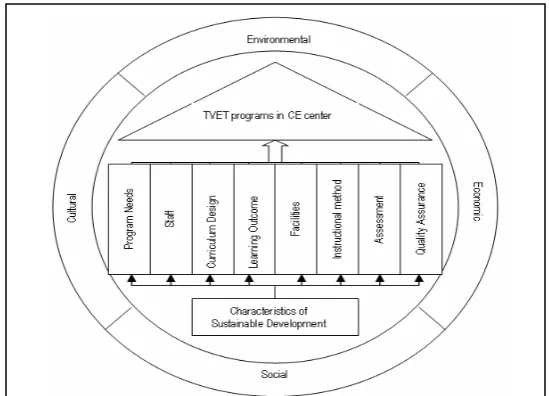
The conceptual framework, as shown in Figure 1, has been developed based on the major concern of CE
centers to retrain or upgrade the people who are at works.
The main idea of developing the appropriate framework came from the non existence of guideline in the
local CE centers about characteristics of the sustainable development oriented organization. After the
analysis of program structures regard to sustainable development, then eight main components of the
desirable framework were determined from: quality assurance, instructional method, learning outcome,
curriculum design, staff, facilities and support, assessment, and program needs (Malaysian Quality
Assurance Division, 2005; National Accreditation Council, MoHE, 2005; Engineering Accreditation
Commission-EAC, 2007; Hong Kong Council for Academic Accreditation-HKCAA, 2007; International
Association for Continuing Education and Training-IACET, 2005; and Continuing Education Centre,
UTHM, 2007). The main components consisted of dimensions of environmental, economic, social, and
cultural (Ahmed, Hadj, Joseph and Mohamed Elzain.; Posch and Steiner, 2006; and Sammalisto and
[image:8.595.168.443.520.718.2]Lindhqvist, 2008).
Research Design and Methodology
The quantitative descriptive research design used in the present study involved questionnaires, interviews
and document analysis. It was necessary to engage in both qualitative and quantitative data in this study
to obtain the desired findings. The preliminary ‘main components of program structure’ of sustainable
technical/engineering programme is discussed at several meetings and interview with stakeholders of CE
and validated by several experts of TVET. Further and extensive literature search provide with
preliminary criteria of each component which were then again validated by experts.
The Sample and Sampling of the Study
The selection of the institutions was made on the basis of their being representative of the technical
oriented institutions in Malaysia. The institutions were also being selected because of their involvement
and key stakeholders in continuing technical programmes.
The respondents in the study which were selected through purposive sampling, were staff and / lecturers/
directors or managers of CE at each of the selected higher education institutions in Malaysia. The
researcher believe that this purposive sampling technique is useful for selecting a sample in relation to
some criteria which are considered important for this study , i.e. the use of the best available knowledge
of the sample with regard to TVET teacher training and programme accreditation (research in curriculum
development, 1991). The sampling for the purpose of developing the subject recognition system concept
was appropriate considering that the respondents are deeply involved either as teachers/ lecturers or
managers. A total of thirty three (33) respondents were selected in this study.
Modified Delphi Study
A Modified Delphi Technique was used to answer the research questions. A key step in using the Delphi
Technique is the identification and selection of the panel, since it is the panel’s opinions and judgments
that determine the outcomes of the study. Individuals who are recognized as experts in the area being
studied should be selected for panel membership in Delphi research (Helmer, 1983; Dobbins, 1999).
Identifying individuals considered experts in the Sustainable Continuing Engineering/Technical
Education (CEE) comprised the first step in the selection process. In dealing with experts, there are
basically three rules that should be followed: select your experts wisely; create the proper conditions
under which they can perform most ably; and if you have several experts on a particular issue available,
use considerable caution in deriving from their various opinions a single combined position. In an effort
to increase the validity of this study, experts from a cross-section of the continuing education practitioner
who are actively involved in managing and defining the needs for effective continuing technical
education development in Malaysia, were utilized. A basic criterion for selecting experts was that they
Three instruments was used in this study (Refer Table 2, Appendix 2. In Phase 1 of the Modified Delphi
Study, the first instrument identified as Delphi Probe will be open-ended. The other two instruments is
identified as Delphi Round I (Phase 2) and Round II (Phase 3). In this study, the Delphi Probe will be
developed as an open-ended questionnaire to promote thoughtful and creative responses from the panel.
After this step, based on the responses by the experts, appropriate changes will be made in the statements
based on suggestions of the review panel.
In Phase 1, research instruments were developed from the analysis results of those related literatures and
also inputs from experts through the Delphi probe. The experts were then asked to check the validity and
reliability of the questionnaires which consist of eight components and 43 items. This resulted in the
initial instrument for Round I of the study. Further to that, Panel members’ responses to Round I will be
used to construct the Round II instrument. To assist in the development of sound conclusions and
recommendations for the study, a criterion for consensus will be pre-established for the data.
In the second round, the researcher delivered or e-mailed the panel of experts, materials that consisted of
a cover letter thanking them for their support and continued participation, and the Round II instrument.
The Round II instrument consisted of the statements for which there is not consensus among the panel
members in Round I. In order that comparisons could be made between the respondents personal ratings
and the mean ratings of the panel, the rating scale included the individual’s prior ratings. Panel members
will be asked to reconsider their previous answers and revised them if they desired. Respondents will also
be asked to state the reasons for any changes in their ratings. Panel members will be asked to return the
instrument within a certain time (eg one week). The researcher will make personal or phone contacts with
participants to clarify unclear or incomplete comments made on the questionnaires that might prove
useful in data analysis. Since most Delphi studies have analyzed data by using a combination of means,
median scores, and standard deviations (Dalkey, 1969; Uhl, 1983), for this study, the mean scores and
standard deviations will be used to analyze the findings.
This ‘Modified Delphi Study’ was divided into three phases as follows:
Phase I: Identification of main components of program structures through literature review, benchmarking and experts advice
Components of program structures in six institutions such as Quality Assurance Division, Public Higher
Institutions; National Accreditation Council, Ministry of Higher Learning, Malaysia; Engineering
Accreditation Commission-EAC; Hong Kong Council for Academic Accreditation-HKCAA;
International Association for Continuing Education and Training-IACET were purposively reviewed
regarding to their experiences in CE or TVET. Then, research instruments were developed from the
analysis results of those related literatures. The experts were asked to check the validity and reliability of
Phase 2: Development of the preliminary framework
The sample consists of 33 experts consisted of high ranking administrators of the CE centers and
academic experts in TVET and sustainable development fields were purposively selected to verify and
discuss the main components program structures regard to sustainable development including their
comments and suggestions. Besides, the experts were asked to rate the current status of sustainable
development practices in their centers. Data in this phase was collected by Delphi technique. Qualitative
data were analyzed using content analysis, and SPSS was used to analyze quantitative data. Descriptive
statistic, mean and standard deviation were used in finding consensus among the experts.
Phase 3: Evaluation of the appropriateness and the validity of the preliminary developed framework
The sample was 25 experts from those who involved in the second phase. The sample was asked to
evaluate the appropriateness, viability and validity of the preliminary developed framework, using the
same questionnaire in the second phase.
Findings and Discussion
The data gathered were analysed and shown as in Table 1 and 2 (Appendix 1). The analysis show that
the current status of sustainable development practices in almost HEIs are at moderate level. Although
there are programs that have successfully implemented skills into their curriculum, there are many
factors that serve to hinder the philosophy of sustainability whereby less exposure and awareness
towards sustainable development. This happens due to the non existence of guideline in the local CE
centers. Perhaps this framework could help in the awareness and motivates for sustainable programme
development. The Community colleges perceived that they are relatively sustainable as compared to
polytechnics and universities (refer Table 1)
The analysis of the questionnaires and interviews of experts involved in Malaysian CE, converges into
the following seven eight main components of program structures as follows:
(i) Quality assurance – the analysis indicate that the quality assurance contributes significantly towards reorienting undergraduate education towards sustainable development. The Panels, in
line with Wijeyaratne (2006), claimed that the quality in continuing education has been
identified as a multi-dimensional concept which embraces teaching, academic programs,
research, scholarships, staff, students, services provided to the community and the academic
environment as a whole.
(ii) Instructional method - the panel claimed that the desirable instructional method include a combination of classroom lecturing, problem-based learning, field-based learning or
sustainability and environmental issues. Consequently, according to Farrel and Ollervides
(2005), there is a need for people trained to work in an international setting, with a sound
understanding of sustainability issues and the mechanisms for tackling them; or in a local setting
with an international perspective. But, at CE level, sustainability education is often embedded
within single-discipline subjects, rather than being taught per se as a separate subject (Leal Filho,
2002 in Buchan, Spellerberg and Blum, 2007).
(iii) Learning outcome - panels claimed that at the end of the lesson, students will be able to bring all the learning in the program into application in their work practice. Therefore, it must be
noted that this research focuses on providing of a necessary framework to guide the
transformation from unsustainable development to sustainable development of CE program.
(iv) Curriculum design – the panels, claimed that employability skills is very important to be included in CE curriculum and this is in line with Buchan, G.D et al. (2007). While
emphasizing the need for the students to master the subject matter, there is also the need to
exposed or immerse the students in the reality of the work fields.
(v) Staff - the findings obtained show that education plays an important role in affecting how sustainable development can be achieved. Panels claimed that the effective way is promoting
life long learning to the staff.
(vi) Assessment – the panels, ( as agreed by Buchan, G.D et al. (2007), claimed that the students became too preoccupied with assessment, and they were not given the incentive to read widely
around the subject. Therefore, they preferred assessment is conducted in continuous rather then
examination-oriented.
(vi) Facilities - in addressing the challenges to productive use of energy, panels claimed that is important to CE programs to be conducted in appropriate rooms depend to the capacity of
students.
(viii) Program needs - as education can increase agricultural productivity,
empower women and change their status, decrease population growth rates,
promote environmental protection, and positively influence the standard of
living (McKeown, 2002), panels claimed that is important to ensure CE program
is to reorienting education for better lifestyle.
The analysis of the data showed that the criteria of the eight components are of important (Refer to Table
2, Appendix 1).
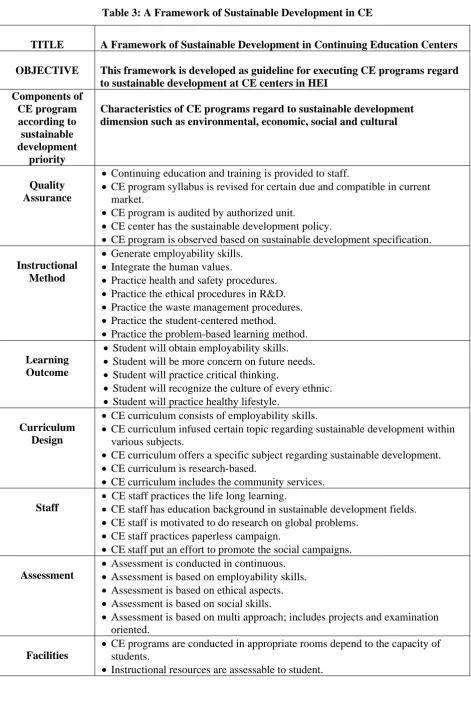
Table 3: A Framework of Sustainable Development in CE
TITLE A Framework of Sustainable Development in Continuing Education Centers
OBJECTIVE This framework is developed as guideline for executing CE programs regard to sustainable development at CE centers in HEI
Components of CE program according to sustainable development priority
Characteristics of CE programs regard to sustainable development dimension such as environmental, economic, social and cultural
Quality Assurance
• Continuing education and training is provided to staff.
• CE program syllabus is revised for certain due and compatible in current market.
• CE program is audited by authorized unit.
• CE center has the sustainable development policy.
• CE program is observed based on sustainable development specification.
Instructional Method
• Generate employability skills. • Integrate the human values.
• Practice health and safety procedures. • Practice the ethical procedures in R&D. • Practice the waste management procedures. • Practice the student-centered method. • Practice the problem-based learning method.
Learning Outcome
• Student will obtain employability skills. • Student will be more concern on future needs. • Student will practice critical thinking.
• Student will recognize the culture of every ethnic. • Student will practice healthy lifestyle.
Curriculum Design
• CE curriculum consists of employability skills.
• CE curriculum infused certain topic regarding sustainable development within various subjects.
• CE curriculum offers a specific subject regarding sustainable development. • CE curriculum is research-based.
• CE curriculum includes the community services.
Staff
• CE staff practices the life long learning.
• CE staff has education background in sustainable development fields. • CE staff is motivated to do research on global problems.
• CE staff practices paperless campaign.
• CE staff put an effort to promote the social campaigns.
Assessment
• Assessment is conducted in continuous. • Assessment is based on employability skills. • Assessment is based on ethical aspects. • Assessment is based on social skills.
• Assessment is based on multi approach; includes projects and examination oriented.
Facilities
• CE programs are conducted in appropriate rooms depend to the capacity of students.
• Consultancy services are provided without prejudice.
• Facilities used in CE center are established environmental friendly products. • Offer international level research opportunities.
Program Needs • Aim of CE program is to reorienting education for better lifestyle. • Aim of CE program is to provide life long learning.
• Objective of CE program is to enhance knowledge on sustainable development. • Objective of CE program is to enhance the public awareness regarding future
needs.
• CE program is offered to disability person.
Conclusion
Current status of CE programs regarding sustainable development have been recognized as a
global priority although several barriers have been noted, including the difficulty implementing
sustainability at the universities, polytechnics and community colleges level. However, these
programs may represent a good alternative or otherwise help to supplement sustainable
development education within higher education. More importantly, the flexibility of CE
programs might facilitate the integration of environmental, economic, social and cultural
issues; all of which are important dimensions of sustainable development. The research
affirmed that the time has come for the other CE centers to adapt and implement sustainable
development value and practices.
Successful integration of sustainability into engineering curricula requires a change in the
approach to education. Learner-centered environments are a prerequisite to the redesign of
continuing engineering education for sustainability. Because moving towards sustainability
requires open-mindedness and collaboration with a broad range of stakeholders, including
industry, government, students, and educators, a top-down approach to reform may not work.
Therefore, incorporating sustainability into higher education requires a new ``vision of
possibilities'' and an evolution in our way of thinking.
Recommendations to policy-makers and stakeholders of HEI, the voice from the academic
experts must be heard concerning this very crucial issue includes creating an institutional
framework or similar mechanism to develop a system or approach for community integration
References
Ahmed Al Naamany, Hadj Bourdoucen, Joseph Jervase and Mohamed Elzain (2006). “Raising Training Quality and Industrial Efficiency via Retraining of the Teachers.”Proceedings of ASAIHL Conference On Education For Sustainable Development. 401.
Allen-Gil, S., Walker, L., Thomas, G., Shevory, T. and Elan, S. (2005). “Forming Community Partnership to Enhance Education in Sustainability.” International
Journal of Sustainability in Higher Education. Vol. 6 (4). 392-402.
Asford, N.A., “ Major Challenges to Engineering Education For Sustainable Development (2004): What has to Change to Make it Creative, Effective, and Acceptable to the
Established Disciplines.” International Journal of Sustainability in Higher Education 5(3)
:
239-250
Bahagian Jaminan Kualiti (2005). “Kod Amalan Jaminan Kualiti IPTA Malaysia.” Putrajaya: rujukan bagi IPTA (2005).
Buchan, G.D., Spellberg, I. F. and Blum, W.E.H. (2007). “Education for Sustainability : Developing a Postgraduate-level Subject with an International Perspective.” International Journal of Sustainability in Higher Education. Vol. 8 (1). 4-15. Bulmahn, E. (2004). “Education for Sustainable Development: The Contribution of
Vocational Education and Training.” Final Report of UNESCO International Experts Meeting: Learning for Work, Citizenship and Sustainability. 25.
Engineering Accreditation Commission (2007). “Self Study Report” Maryland: rujukan bagi EAC (2007).
Farrell, T.A. and Ollervides, F. (2005). “A Case Study of Sustainable Development
Education in Me´xico.” International Journal of Sustainability in Higher Education. Vol. 6 (2). 122-133.
Hong Kong Council for Academic Accreditation (2007). “Guideline on Institutional Review and Programme Validation.” Hong Kong: rujukan bagi HKCAA (2007).
Huntzinger, D.N., Hutchins, M.J., Gierke, J.S., and Sutherland, J.W. (2005). “Enabling Sustainable Thinking in Undergraduate Engineering Education
International Association for Continuing Education and Training (2005). “Criteria for Learning Program Development.” McLean: rujukan bagi IACET (2005). Lembaga Akreditasi Negara (2005). “Laporan Penilaian Kurikulum Kursus IPTS.”
Putrajaya: rujukan bagi LAN (2005).
Lindelmalm, F. (2004). “Training Mid Carrier Professionals in Education for
Environment and Sustainability: The International Training Programme Education for Environment and Sustainability in Southern Africa, Asia, China and Sweden.”
UNESCO.
McKeown, R. (2002). “Education for Sustainable Development Toolkit.” Version 2. USA: Center for Geography and Environmental Education, University of Tennessee.
Mohan Das Gandhi, N., Selladurai, V. and Santhi, P. (2006). “Unsustainable Development to Sustainable Development : A Conceptual Model.” Management of Environmental Quality : An International Journal. Vol.17 (6). 654-672.
Moore, J. (2005). “Seven recommendations for Creating Sustainability Education at The University Level.” International Journal of Sustainability in Higher Education. Vol. 6 (4). 326 - 339.
Monzon, J.E. (2005). “The Challenges of Biomedical Engineering Education in Latin America. ” Proceedings of the 2005 IEEE Engineering in Medicine and Biology 27th Annual
Conference Shanghai, China, September 1-4.
Neelima Jerath (2003). “Environmental Education in Secondary Vocational Education: A Comparison of Five Asian Counties.” UNESCO.
Nicolaides, A. (2006). “The Implementation of Environmental Management towards
Education. Vol. 7 (4). 414-424.
Noraini Kaprawi, Wahid Razzaly, et al. (2007). “Panduan Penjaminan Kualiti dalam Latihan dan Pendidikan Teknikal Berterusan.” Johor: UTHM.
O’Leary, C., Lawless, D., Gordon, D., Li, H. and Bechkoum, K. (2006). “Developing a Software Engineering Curriculum for the Emerging Software Industry in China.” Proceedings of the 19th Conference on Software Engineering Education & Training – CSEET’06.
Ornstein, A.C. and Hunkins, F.P. (1993). “Curriculum: Foundation, Principles and Issues.” Second Edition. USA: Allyn and Bacon. 237.
Petridou, E. and Chatzipanagiotou, P. (2004). “The Planning Process in Managing Organisations of Continuing Education: The Case of Greek Vocational Training Institutions.” International Journal of Educational Management. Vol. 18 (4) 215-223. Posch, A. and Steiner, G. (2006). “Integrating research and teaching on innovation for sustainable development.” International Journal of Sustainability in Higher Education. Vol. 7 (3). 276-292.
Sammalisto, K. and Lindhqvist, T. (2008). “Integration of Sustainability in Higher Education: A Study with International Perspectives.” Innovation Higher Education. 32. 221-233. Saren Lund (2006). “Application of POPBL Methodologies at RUC, Denmark.” Asia Link
Project in a Virtual Learning Environment di University Malaya at 8th May 2006. Not Published.
Seehanath, V., Kanjanawasee, S. and Pitiyanuwat, P. (2006). “A Development Of An Appropriate Model Of National Institute Of Educational Testing Service For Thailand.” Proceedings of ASAIHL Conference On Education For
SustainableDevelopment. 423.
Seliger, G., Kernbaum, S., Zettl, M. (2006)” Remanufacturing Approaches Contibuting to Sustainable Engineering”. v. 13, n.3, p. 367-384, set.-dez.
UNESCO-UNEVOC International Center (2004). “Final Report of UNESCO International Experts Meeting: Learning for Work, Citizenship and Sustainability.” Bonn: rujukan bagi Bonn (2004).
Velazquez, L., Munguia, N. dan Sanchez, M. (2005). “Deterring sustainability in higher education institions.” International Journal of Sustainability in Higher Education. Vol. 6 (4) 383-391
Wehrmeyer, W. and Chenoweth, J. (2006). “The Role and Effectiveness of Continuing
Education Training Courses Offered by Higher Education Institutions in Furthering the Implementation of Sustainable Development.” International Journal of Sustainability in Higher Education. Vol. 7(2).129- 141.
Wijeyaratne, MJS. (2006). “Reorienting Undergraduate Education In Sri Lanka Towards Sustainable Development.” Proceedings of ASAIHL Conference On Education For SustainableDevelopment.
WCED (World Commission on Environment and Development) (1987), Our Common Future, Oxford University Press, Oxford.
Appendix 1
Table 1: The current status of sustainable development oriented in CE centers Current Status of Sustainable Development
Practice in CE Centers by Institution Components of
Program Structures University Politechnic Community College
Overall Status in HEI
Program Needs 3.3053
(Moderate) 3.6286 (Moderate) 3.8286 (Good) 3.4848 (Moderate) Learning Outcome 3.4842
(Moderate) 3.6000 (Moderate) 3.6571 (Moderate) 3.5455 (Moderate) Curriculum Design 3.4316
(Moderate) 3.2286 (Moderate) 3.4286 (Moderate) 3.3879 (Moderate) Instructional Method 3.6992
(Moderate) 3.7551 (Moderate) 3.6327 (Moderate) 3.6970 (Moderate)
Assessment 3.4211
(Moderate) 3.5714 (Moderate) 3.3571 (Moderate) 3.4394 (Moderate)
Staff 3.4211
(Moderate) 3.6571 (Moderate) 3.6857 (Moderate) 3.5273 (Moderate)
Facilities 3.2947
(Moderate) 3.1429 (Moderate) 3.4000 (Moderate) 3.2848 (Moderate) Quality Assurance 3.1053
(Moderate) 3.3143 (Moderate) 3.3714 (Moderate) 3.2061 (Moderate)
Total 3.3953
(Moderate) 3.4872 (Moderate) 3.5452 (Moderate) 3.4466 (Moderate)
Table 2: The main components of program structures regard to sustainable development
Main Components ofProgram Structures regard to Sustainable Development
Mean Score Standard Deviation
Interpretation
Quality Assurance
4.3212 .55888 Important Instructional Method
4.2987 .55600 Important Learning Outcome
4.2970 .57015 Important Curriculum Design
4.2606 .54883 Important Staff
4.2242 .64761 Important
Facilities
4.2000 .63836 Important
Assessment
4.1465 .59330 Important
Program Needs
[image:17.595.97.514.485.752.2]Appendix 2
Literature Review
Determine and analyse main
components of program
structures at several
institutions
(IPTA, LAN, EAC,
HKCAA, IACET dan PPB)
(i)
program
needs
(ii) learning
outcome
(iii) curriculum
design
(iv)
assessment
(v) instructional
method
(vi)
staff
(vii)
facilities
(viii)
quality assurance
Instrument II
Questionnaires consist of 43
items based on eight
components of program
structures
Experts Validation
(5 panels)
Pilot Test
(10 panels)
Sampling
Delphi panels
(Experts in CE, TVET and sustainable development fields) Phase I Instrumen I (Delphi Probe)