Static Task Partitioning Techniques for Parallel
Applications on Heterogeneous Processors
by
Aravind Vasudevan
Submitted to the School of Computer Science and Statistics
in fulfillment of the requirements for the degree of
Doctor of Philosophy
(Computer Science)
School of Computer Science and Statistics
UNIVERSITY OF DUBLIN, TRINITY COLLEGE
2
Declaration
I declare that this thesis has not been submitted as an exercise for a degree at this or any other university and it is entirely my own work.
I agree to deposit this thesis in the University’s open access institutional repository or allow the library to do so on my behalf, subject to Irish Copyright Legislation and Trinity College Library conditions of use and acknowledgement.
3
Everything in life has a form and function, follows a mathematical rule. Laws of
motion existed even before Sir Isaac Newton “discovered” them. It was just a
matter of realization of the existence of such equations. Maybe, there exists a
mother-of-all equation which governs the working of all forms and functions.
When looking at a specific system, some parameters zero out and the equation
contracts, giving rise to smaller simpler equations which dictate the principles
that govern entirety. Maybe, this is what they call God.
4
To my mother, and best well-wisher, Vijayalakshmi
To my father, and best advisor, Vasudevan
5
Acknowledgements
My heartfelt thanks are due to Dr. David Gregg, the IRC foundation and Trinity for giving me this prestigious opportunity of pursuing my passion to do research. I like to think of David as an “advisor” rather than a “supervisor” and it has been an absolute pleasure working with him. He has always had an open door policy and was always available to theory-craft crazy ideas that most often than not ended up scrubbed off the board. However, there were moments of brilliance, mainly because of David, which has resulted in this thesis. Thanks to his patience and understanding, my journey as a PhD student was smoother than it had any right to be! 1
Many thanks are due to two collaborators of mine who made me feel at home when I came to Dublin. Mark Purcell from IBM, who were kind enough to partly fund my research, helped me settle into the research setting here in Ireland. As soon as I started my PhD, he helped me hit the ground running by letting me co-author a paper he was working on at the time. Many thanks are in order to Dr. Avinash Malik who was in our lab for the first two years of my PhD. He was the one who pointed me in the direction of static scheduling algorithms and helped me focus on an interesting problem to work on.
I would also like to thank a few people who helped me get to Dublin: Prof. Venkateshwaran Nagarajan, who is a very dear mentor of mine from my younger research days at WAran Research FoundaTion (WARFT). He took me under his wing and taught me a lot more than research. To you sir, I will be eternally grate-ful; Dr. Ivo Ihrke for helping me get to Dublin and teaching a wonderful class on Computational Photography that is still bright as day in my head; Dr. Ananthan for instilling a sense of research in me and many many other people who were guiding beacons in my life.
1Acknowledgeception: I’d like to thank Andrew for coming up with this beaut of a line
6
I cannot forget to mention my lab mates2: Andrew, Martin, Mircea, Servesh
and Shixiong for making the long winding nights of burning the midnight oil seem a lot more palatable. I will miss the countless hours of debates and arguments about: optimum window positioning for optimum room temperature; placing smaller con-vex polygons on top of each other to cover a slightly bigger concon-vex polygon; count-less Olympiad questions from Bulgaria and last but definitely not least the never ending competitions to see who can eat the most burritos. I owe my deepest grat-itude to all my friends in Dublin for making life so much more enjoyable in this wet, damp country.
I remember during my formative years as a young researcher at the WARFT, I would come back home at 2 AM in the morning every day after a long and arduous day of research and arguments with fellow research trainees. My mother would wake up, even though I would sneakily enter the house, and serve me food and stay up with me until I go to bed. I cannot thank research enough for bringing me and my mom a lot closer. My father has been a real life role model who I get to meet and live with every day. He has taught me more things than I can remember, but most importantly he taught me how to be humane. He taught through practice and showed me it is more important than most other things in the world.
He drilled in me the idea of being level headed and centred. He taught me, come high or come low to stay with my feet firmly on the ground. My brother was the one who introduced me to computers. I remember sitting next to him, while he did his thing and just watching him and thinking to myself that I wanted to be like that one day. He taught me to persevere through hard times. I will never forget the quote that he once told me: “You are a wise amongst the fool. You need to be a fool amongst the wise, to learn the world better”. Without my family’s undying love and inspiration, I would not even be close to half the researcher I am today. Real life superheroes are hard to come by, but I am glad all of you did!
7
Last, but by no means the least, I would love to say thanks to my dear and loving wife, Rukmani Sridharan. Without her unwavering support, I definitely would not have been able to pull through my PhD. I cannot thank her enough for the many nights of unending debates on evolution and its fickle mind, the countless discussions on startup ideas, our undying passion for good food, her undying passion to eat healthy at the same time. Thank you for being more concerned about me than I am. More than anything, thank you for being there. I cannot wait for the days when she goes through her final PhD stages, when I can torture her equally and more!
Somebody once said “It’s the smaller things that count in life”, or was it “The devil is in the detail”? I can’t remember which. In any case, I would like to end my acknowledgements on a lighter note by acknowledging the smaller things in life that helped me truck through my PhD:Starcraft for providing countless hours of relief transporting me to another dimension, when things didn’t work so well in research; Liverpool for being an unending source of excitement and inspiration in my life. Following Liverpool through the years has been the best roller coaster I have ever been on. Bill Shankly once said “Football isn’t a matter of life and death of course, I am very disappointed with that attitude. I can assure you it is much, much more important than that” and I am inclined to agree with the shankman; Slash for keeping me company in the wee hours of the night with his private concerts just for my ears through this magical portal called YouTube; and finally Burritos for being so darned tasty!
8
Static Task Partitioning Techniques for Parallel
Applications on Heterogeneous Processors
by
Aravind Vasudevan
Submitted to the School of Computer Science and Statistics on July 12, 2016, in partial fulfillment of the
requirements for the degree of Doctor of Philosophy
(Computer Science)
Abstract
A critical factor contributing to the efficiency of execution of parallel applications on parallel computing resources is the method chosen to map and schedule the tasks of the parallel application. This problem, often referred to as the DAG schedul-ing problem, of statically mappschedul-ing and schedulschedul-ing a weighted directed acyclic graph (DAG) to a set of heterogeneous processors to minimize the completion time (makespan) has been extensively studied. It remains intractable even with severe assumptions applied to the task and machine models.
This thesis tackles two challenges faced by scheduling algorithms when map-ping and scheduling tasks onto heterogeneous processors: (1) the execution time of a task on heterogeneous processors is not well represented in the conventional application DAGs (2) critical-path is poorly defined in the presence of communi-cation and such heterogeneity.
We address the first challenge by adopting a better representation model for the application DAGs and the resource graphs that enable processors to be selectively faster for certain kinds of tasks. We propose, design and evaluate a simulated an-nealing based task mapping algorithm that exploits this representation and maps applications with task and data level parallelism onto a set of heterogeneous pro-cessors. The novelty of this algorithm lies in guiding the random search using one of the systemic parameters calledtemperature. We observe significant improvements, in quality of the solutions for real world benchmarks, when compared against other well established task mapping algorithms. As an additional contribution, we show that similar meta-heuristic techniques are effective for partitioning road networks for distributed simulation.
9
ineffective. We resolve this issue, by postulating that the critical path is inher-ently defined by its mapping and formulate a polynomial time algorithm (Critical Earliest Finish Time (CEFT)) to find the true critical path for a given application DAG and parallel computing resources. This algorithm runs in O(P2e), where P
is the number of different classes of processors and e is the total number of edges in the application graph. Based on our experiments, we show that the critical path lengths produced by our algorithm is always at least as long as the ones produced by CPOP for the conventional workloads. Our experiments also show that when we leverage the better representation model from our earlier work, the paths found by our algorithm are shorter than CPOP’s paths in 83.99% of the experiments.
We also extend our critical path finding algorithm into a DAG scheduling algorithm (CEFT-CPOP) by using the path found by our algorithm (with its cor-responding partial assignment) in conjunction with the critical path on a processor (CPOP) algorithm, with a running cost of O(p2e), where p is the number of
pro-cessors. We compare the efficacy of our algorithm mainly against CPOP through the use of makespan related comparison metrics like: schedule length ratio (SLR), speedup and slack. We find that our algorithm outperforms CPOP even as a scheduling algorithm, in nearly all aspects.
Thesis Supervisor: David Gregg Title: Associate Professor
Contents
1 Introduction 21
1.1 Dissertation outline . . . 25
2 Background 27 2.1 Parallel applications . . . 30
2.1.1 Representation of parallel applications . . . 31
2.1.2 Grand challenge applications . . . 33
2.1.3 Other real world applications . . . 34
2.2 Parallel execution infrastructure . . . 37
2.2.1 Heterogeneity at a cluster level . . . 42
2.2.2 Contrasting nature of homogeneity and heterogeneity . . . . 44
2.3 The mapping and scheduling problem . . . 45
3 Literature review 51 3.1 Taxonomy of scheduling strategies . . . 55
3.2 List scheduling heuristics for heterogeneous processors. . . 59
3.2.1 Ranking functions. . . 60
3.2.2 Levelized Min Tree . . . 62
3.2.3 Heterogeneous Critical Parent Trees (HCPT). . . 63
3.2.4 Heterogeneous Earliest Finish Time (HEFT) . . . 64
3.2.5 Critical path on a processor (CPOP) . . . 65
3.2.6 Lookahead algorithm . . . 66
3.2.7 Predict earliest finish time (PEFT) . . . 67
3.3 Task duplication heuristics . . . 69
Contents 12
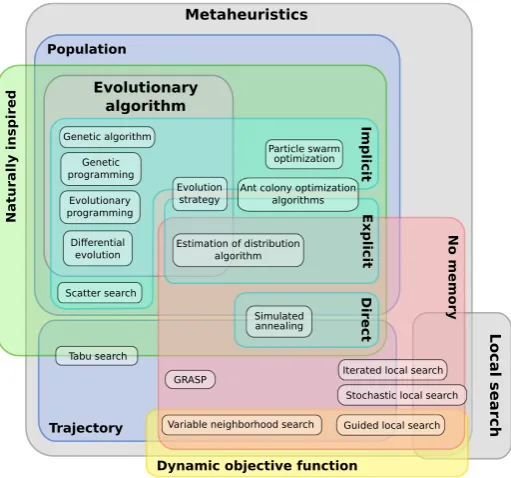
3.5 Meta-heuristics based random search . . . 71
3.5.1 Simulated annealing (SA) . . . 72
3.5.2 Genetic algorithm (GA) . . . 73
3.5.3 Particle swarm optimization . . . 75
3.5.4 Cross Entropy . . . 76
3.6 Other commonly used heuristics . . . 78
3.6.1 K-way graph partitioning . . . 78
3.6.2 Heterogeneous bin packing . . . 79
3.7 The bridge between theory and practice . . . 80
4 Static task partitioning and simulated annealing 83 4.1 Formulating the graphs and the objective function . . . 89
4.1.1 Task graph . . . 89
4.1.2 Resource graph . . . 90
4.1.3 Objective function . . . 91
4.2 Simulated annealing . . . 94
4.2.1 Simulated annealing : From the mapping problem standpoint 94 4.3 Our improved SA approach . . . 97
4.4 Experiments and results . . . 100
4.4.1 The task graph setup . . . 101
4.4.2 Adapting METIS for task partitioning . . . 101
4.4.3 Heterogeneous bin-packing heuristic . . . 105
4.4.4 Orsila et al.’s SA . . . 106
5 Applying meta-heuristics to road network partitioning 109 5.1 Partitioning road network graphs for distributed simulation. . . 111
5.2 A mathematical description of the problem and the objective function113 5.2.1 The road network graph . . . 113
5.2.2 Partitioning a graph . . . 113
5.2.3 Defining the objective function . . . 114
Contents 13
5.3.1 TwoTree partitioning . . . 116
5.3.2 Smart QuadTree partitioning . . . 116
5.3.3 Multi-level region growing road network partitioner: SParT-Sim. . . 117
5.4 Meta-heuristic Algorithms . . . 119
5.4.1 Simulated annealing (SA) . . . 119
5.4.2 Genetic Algorithm (GA) . . . 123
5.5 Experiments and Results . . . 125
6 Critical paths of applications on heterogeneous systems 133 6.1 Related work . . . 136
6.2 Defining a critical path for heterogeneous processors . . . 139
6.3 A dynamic programming solution . . . 144
6.3.1 Task duplication . . . 147
6.3.2 From critical path to makespan: CEFT-CPOP . . . 148
6.4 Complexity analysis. . . 150
6.5 Random graph generation . . . 152
6.6 Experiments and results . . . 156
6.6.1 Randomly generated workloads . . . 156
6.6.2 Comparison metrics. . . 159
6.6.3 Results and analysis . . . 162
7 The bigger picture 175 7.1 Academic contributions made during the PhD . . . 177
7.2 Applications of critical path . . . 178
7.3 Final thoughts. . . 180
List of Figures
2-1 Future scaling trends in parallel applications . . . 28
2-2 A sample application DAG and its execution cost table . . . 33
2-3 Application DAGs for Gaussian Elimination and Fast Fourier Trans-form . . . 35
2-4 Application DAG for Molecular dynamics code . . . 36
2-5 Three classes of multi-core die architectures . . . 37
2-6 Flynn’s taxonomy of computer architectures . . . 39
2-7 Generalised scheduling strategy . . . 46
2-8 Types of automatic partitioning and scheduling . . . 49
3-1 Sample parallel application DAG . . . 53
3-2 Types of scheduling algorithms . . . 55
3-3 Taxonomy of static task scheduling techniques . . . 57
3-4 Taxonomy of meta heuristic algorithms . . . 71
3-5 A chromosome representation of a set of 6 tasks mapped onto 3 processors . . . 74
3-6 PYRROS system architecture . . . 80
4-1 Compilation tool-chain and an example task graph . . . 91
4-2 Temperature variations in SA with varyingq . . . 99
4-3 Our SA approach Vs K-way graph partitioning . . . 102
4-4 Our SA approach Vs Heterogeneous Bin Packing. . . 104
4-5 Our SA approach Vs Standard SA approach . . . 106
5-1 A plot of a normal distribution where each band has a width of one standard deviation . . . 121
List of Figures 16
5-2 Comparison of the partitioning algorithms based on the Evenness factor . . . 126 5-3 Comparison of the partitioning algorithms based on the Inter-Partition
factor . . . 128 5-4 Comparison of the partitioning algorithms based on the Heaviest
Partition factor . . . 130 6-1 Section of a sample application graph . . . 147 6-2 A random graph generated with the following parameters : n =
64, i= 4, o = 4, c = 0.01, α = 0.1, β= 50, γ = 50 . . . 153 6-3 Sample graphs with 2 node-weights . . . 157 6-4 Percentage of instances CEFT’s CPL is longer, equal or shorter
compared to CPOP’s CPL . . . 162 6-5 Percentage of instances CEFT’s makespan is longer, equal or shorter
compared to CPOP’s makespan . . . 163 6-6 Comparing the lengths of the critical paths across different
work-loads in terms of α of the application graph . . . 164 6-7 Comparing speedup across different workloads in terms of the
num-ber of processors in the processor graph. Higher is better. . . 165 6-8 Comparing speedup for RGG-high in terms of number of tasks in
the input graphs. Higher is better. . . 166 6-9 Comparing SLR across different workloads in terms ofβof the input
graphs. Lower is better. . . 167 6-10 Comparing speedup across different workloads in terms of β of the
input graphs. Higher is better. . . 168 6-11 Comparing CPL for RGG-medium in terms of different values of β
in the input graphs . . . 169 6-12 Comparing Slack and SLR for RGG-classic in terms of α and CCR
of the input graphs. Lower is better. . . 170 6-13 Comparing SLR across different workloads in terms of number of
List of Algorithms
1 The Conventional Simulated Annealing Algorithm . . . 73
2 A genetic algorithm for task mapping . . . 74
3 Orsila et al.’s simulated annealing algorithm . . . 95
4 SParTSim algorithm . . . 117
5 The Simulated Annealing Algorithm . . . 120
6 Edge labelling . . . 122
7 A genetic algorithm for task mapping . . . 123
8 Identify & map the critical-path of a given DAG onto a set of pro-cessors . . . 145
9 The critical path on a processor (CPOP) algorithm . . . 148
10 Calculating ranks as a measure of distance from critical path . . . . 178
11 Pruning Transition Space. . . 179
List of Tables
4.1 The task graph setup . . . 100 4.2 Statistics comparing our SA approach and K-way graph partitioning 104 4.3 Statistics comparing our SA approach and heterogeneous bin packing105 4.4 Statistics comparing our SA approach and Orsila et al.’s SA . . . . 107 5.1 Acronyms for algorithms . . . 125 5.2 The task graph setup . . . 125 6.1 List of notations. . . 140 6.2 Execution time for the application and processor graph from
fig-ure 6-3 on page 157 . . . 157 6.3 Performance of CEFT compared against CPOP . . . 162
Chapter 1
Chapter 1. Introduction 22
O
verthe past few decades, there has been a growing demand forcompu-tational resources. With this ever increasing need, the community has addressed the issue in one of the following two ways. Firstly, efforts were made into increasing the compute capability of a single processor. With the introduction of the 4-bit Intel 4004 in 1971 to the 64-bit Sandy Bridge and Ivy Bridge processors in 2011, Intel and other companies like AMD have made signif-icant strides in the processor industry. In the early 2000s however, focus started shifting towards increasing the number of cores in a processor using a stamp-and-repeat paradigm. This meant that all the cores were exactly the same, but processors have multiple cores to provide support for parallel processing. However, this idea of stamp-and-repeat doesn’t scale well as many applications benefit from diversity rather than uniformity across cores as discussed in [Kumar et al., 2004].
Traditionally, software was written for serial architectures. This meant that at any given time only one piece of the code was being executed on a single piece of data1. But with the advent of parallel computing, newer algorithms were devised that were capable of being executed on the parallel computing infras-tructure concurrently. This was achieved by breaking the problem into smaller independent/dependent pieces, each of which can execute its part of the algorithm simultaneously with the other parts. With high performance computers deliver-ing petaFLOPS performance on LINPACK [Dongarra and Luszczek, 2011] and LAPACK [Anderson et al., 1999] these days, the gap between the projected per-formance and actual perper-formance delivered when an application is run is wide. A very important problem that arises in the context of parallel computing is one of mapping the application tasks onto the machines efficiently.
In many ways, computer architecture and high performance computing is at a crossroads. Old style clock scaling and the idea of stamp-and-repeat do not work as well as in the past. Energy dissipation is a huge problem from small machines in hand-held devices to large machines in high performance compute clusters.
Chapter 1. Introduction 23
Another concerning juncture at this crossroads is one of programmability. Computer architecture and hardware execution models have significantly been on the incline, while our ability to program them has not been able to stay on par2.
Interestingly however, there has been a significant shift in the design ideology of computing architectures in terms of the diversity of CPUs, GPUs, GP-GPUs, DSPs etc. As Kumar et al. suggest, heterogeneity will play a huge role in future high performance machines.
Kogge et al. conducted a study in 2008 examining the road ahead toExascale computing. In terms of hardware projections, the authors suggest that technology
will allow upwards of 1000 simple and perhaps heterogeneous cores on a die. A key impediment in the road ahead predicted by them was the near term evolution of operating environments. The authors suggest that operating systems have to evolve to address many of the challenges confronting high performance computing due to the explosive development of technology. They claim that the most difficult problem faced by the group dealt withpower and energy. In specific, the problem was one of finding technologies that allow building systems that consume low enough total energy per operation. When these low power devices are operated at desired computational rates, they exhibit an acceptable overall power dissipation (energy per operation times operations per second). In conclusion, the report suggests that the significant challenge will be in developing architectures, execution models and programming models that leverage emerging technologies.
Apart from power and the other significant challenges to high performance com-puting as mentioned above, a critical factor contributing to the efficiency of execu-tion of parallel applicaexecu-tions on parallel computing infrastructures is the method chosen to map & schedule the tasks of the parallel application. An article from NASA3 states that with the advent of hybrid super computers programming and
mapping tasks for optimal performance has become increasingly difficult and that “innovators” are working on a scheduling and dynamic execution framework for optimally scheduling tasks on different types of hardware.
2Case in point: IBM Cell processor
3Source: Scheduling Operations for Massive Heterogeneous Clusters. Link:
http://www. techbriefs.com/component/content/article/16854
Chapter 1. Introduction 24
These applications can be represented in many ways : Directed Acyclic Graphs (DAG) [Gerasoulis and Yang,1992,1993,Dick et al.,1998], Kahn networks [Caspi and Pouzet,1996] and Task Interaction Graphs (TIG) [Sanyal and Das,2005,Jain et al., 2004]. The most popular amongst these is the DAG representation and it includes various characteristics of the application such as execution time of tasks, data size of communication between tasks and the task precedence is preserved in terms of dependence edges between nodes in the DAG.
1.1. Dissertation outline 25
1.1
Dissertation outline
The rest of this dissertation is organized as follows. The problem of partitioning4 and scheduling parallel applications onto parallel heterogeneous resources is put into context in chapter 2 on page 28. For readers familiar with basic computer architecture, this chapter serves to simply set the context. Section2.1 on page 30 describes the representation of parallel applications and outlines some real world applications that are often used in the context of application partitioning and scheduling. In section 2.2 on page 37, we describe the multiprocessor model and outline how heterogeneity is pervasive throughout the field of parallel comput-ing. Finally in section 2.3 on page 45, we posit the problem of partitioning and scheduling algorithms addressed in this dissertation.
We present an in depth discussion into the previous work in related areas in chapter 3 on page 52. This chapter serves to provide terminology and describe notation used throughout this dissertation. In sections3.2 on page 59through 3.6 on page 78, we discuss in great lengths the different state of the art partitioning and scheduling algorithms under different categories. To conclude the literature review, we put in context the applicability of partitioning and scheduling algorithms to real world parallel computing resources in section 3.7 on page 80.
Chapter 4 on page 84 describes the simulated annealing approach based on static partitioning and scheduling. In section 4.1 on page 89, we define the struc-ture of the parallel input application graph and the parallel resource graph and the objective function that dictates the goodness of the solutions. We present the simulated annealing algorithm in the context of the mapping and partitioning problem in section4.2 on page 94 and present our modifications to the algorithm to get an improved annealing scheduling in section 4.3 on page 97. Section 4.4 on page 100 presents simulation results based on real world benchmarks on syn-thetically generated resources to demonstrate the effectiveness of the partitioning algorithm.
4Partitioning andmapping are used interchangeably throughout the rest of this thesis
1.1. Dissertation outline 26
In a similar vein to chapter 4 on page 84, the next chapter (chapter 5 on page 110describes the application of the simulated annealing algorithm and other meta-heuristic solutions to the problem of road network partitioning. In section5.1 on page 111, we posit the problem of partitioning road network graphs for dis-tributed simulation. In the next section, we outline the definition of the road network graph and the objective function which determines the goodness of a par-titioning scheme based on some load balancing metrics. Section 5.3 on page 116 presents three spatial partitioning algorithms for road networks and discusses its merits and demerits, while section 5.4 on page 119 describes in detailed the pro-posed meta-heuristic solutions. We discuss the results obtained the various differ-ent partitioning algorithms in section5.5 on page 125.
Chapter 6 on page 134 moves away from the meta-heuristic solutions to a deterministic polynomial time algorithm and describes our critical path finding algorithm for heterogeneous processors. In section6.1 on page 136, we outline the major drawbacks and pitfalls of the existing methods of calculating critical path and stress on the need for calculating the correct critical path. Sections 6.2 on page 139 and 6.3 on page 144 formally explain our method of calculating critical paths for applications on heterogeneous processors in polynomial time. Finally, in sections 6.5 on page 152 and 6.6 on page 156 we discuss the results obtained and compare them against the state of the art techniques.
Chapter 2
Chapter 2. Background 28
Figure 2-1: Future scaling trends in parallel applications 1
Figure 2-1 summarizes some of the trends observed in parallel and scientific ap-plications over time. This gives an insight into the internal structure of high performance applications and how they achieve high performance. In the figure, the vertical axis refers to locality – a metric of repeated accesses to memory that are close together physically. The horizontal axis refers to seriality – the amount of inherent parallelism present. When seriality is 1, the application is entirely serial. When it is close to zero, it is embarrassingly parallel. Over time, the ap-plications have become increasingly irregular [Kogge et al., 2008]. Earlier high end numeric applications used simple regular 3D grids where the data could be positioned carefully. They also employed techniques that provided a high degree of parallelism. Current generation applications however, use irregular grids with a number of auxiliary table look-ups which translates to poor locality.
[image:28.595.92.505.70.334.2]Chapter 2. Background 29
Hence, in this chapter we discuss this growing complexity of applications and the inter-relationship of computing systems today. In section2.1, we present a brief overview of the structure of parallel applications and some ways of representing them as workloads. This is followed by a discussion of the state of the computing systems today and its evolution in section2.2. This chapter concludes by bringing these two (the parallel applications and parallel computing resources) together in the context of the problem at hand: partitioning and scheduling in section 2.3.
2.1. Parallel applications 30
2.1
Parallel applications
Parallel applications have been ever increasing in complexity as shown in figure2-1 on page 28. According to the NASA Earth Science Vision 2030 report [Hildebrand et al.,2004], in the future, a single application itself could be composed of multiple smaller applications which by themselves would require a high-performance cluster to run. In its simplest form, parallel computing is the use of multiple computing resources for solving a computational problem :
• The problem is broken down into discrete parts that can be executed simul-taneously
• Each part is further broken down into sets of instructions
• Instructions from parts may execute simultaneously on different processors
Consequently, a parallel program or parallel application (1) is a problem that can be broken down into discrete pieces which may be solved serially or concur-rently; (2) has a control flow/dependence tree which dictates the order of execution of these discrete pieces. There are several advantages of using parallel applications and parallel computing: (1) Exploiting the abilities of the underlying parallel hard-ware (2) Shorter execution times for applications (3) Solving larger more complex problems, like the ones mentioned in Section 2.1.2 in a feasible time frame. 2
2There are several other forms of parallelism like SIMD, ILP, bitwise parallelism etc. that
2.1. Parallel applications 31
2.1.1
Representation of parallel applications
In the context of this thesis, some of the more commonly used application repre-sentations to represent task-parallelism are briefed as follows.
2.1.1.1 Task Interaction Graphs
A Task Interaction Graph, commonly referred to as TIG, was presented by Dou-glas L Long and Lori A Clarke in 1989 [Long and Clarke, 1989]. This model for representation of concurrent programs, represents a task as a set of regions and a set of interactions between regions. Long and Clarke’s work was an improvement upon the seminal work of Taylor [Taylor,1983a,b] in 1983. To model the behaviour of a system, Taylor used a reduced flow graph representation of every task in a graph and defined a concurrency graph. Unfortunately, the number of states in this graph can be very large. Long and Clarke’s work helps mitigate this issue of state space explosion by moving into a representation called aTask Interaction Concurrency Graph TICG. In their paper, they claim to reduce the state space by over fifty percent for the then common concurrency examples in the literature. TIGs have been used to represent applications in the context of scheduling algo-rithms in some specific cases [Jain et al., 2004, Sanyal and Das, 2005]. However, they are not the preferred form of representation of applications in the scheduling community.
2.1.1.2 Kahn Process Networks
In 1974, Gilles Kahn became one of the first to provide a theoretical basis for dataflow computation in his short paper [Gilles, 1974]. In this paper he describes a simple language for parallel programming and analyses its mathematical proper-ties. This paper was an attempt to provide a concrete solution to the long-standing debate of what the best primitive for writing system programs was. A system in this model presented by Kahn is a set of sequential processes running concurrently that communicate by passing data tokens through a set of unbounded single-sender single-receiver FIFO queues.
2.1. Parallel applications 32
A process or actor in this system fires according to a set of predefined firing rules. Each of these firings is assumed to be atomic, i.e. when a firing starts it is assumed to finish depending on the speed of the processor. During each atomic firing, an actor consumes a predefined number of input tokens and produces a predefined number of output tokens. Kahn restricts that the actor is blocked until it consumes the required number of input tokens. Writing to the single-sender single-receiver FIFO queues however, is non-blocking. Kahn imposed a set of restrictions on his model and proved that these restrictions make the system deterministic. Due to this deterministic nature of the model, for a given set of input tokens, there is only one possible sequence of output tokens. This implied that the sequence of messages that pass through each queue does not depend on the speed of the processes or the order in which the processes execute.
Another interesting feature that these set of rules provided was the choice of the order of firing actors in the system. This required that signal processing applications have as a goal the scheduling of the actor firings at compile time. In the case of a multiprocessor system, a per processor list of scheduled actors has to be obtained during compile time. However, KPNs cannot be scheduled statically [Zurawski,2005]. This is because the firing rules do not allow us to build, before runtime, a sequence of firing such that the system does not block under any circumstance hence necessitating the use of dynamic scheduling. However, with dynamic scheduling comes associated implementation overhead. This becomes one of the primary reasons Kahn Process Networks are not used to represent applications in this thesis. Another disadvantage stems from the fact that KPNs allow for unbounded communication queues and the potential growth of memory needs of these unbounded buffers.
2.1.1.3 Directed Acyclic Graphs
Directed acyclic graphs are a common representation of parallel applications often found in the literature. A weighted DAG is represented by the tuple G = V,E
where V represents the set of vertices vi|∀i ∈ 1..|V| and E represents the set of
2.1. Parallel applications 33
T2 T3 T4 T5
T7 T8 T9
T10 T1
T6
(a) Sample application DAG
Task P1 P2 P3
T1 22 21 36
T2 22 18 18
T3 32 27 43
T4 7 10 4
T5 29 27 35
T6 26 17 24
T7 14 25 30
T8 29 23 36
T9 15 21 8
T10 13 16 33
(b) Execution Cost Table
Figure 2-2: A sample application DAG and its execution cost table
G =V,E,C,T whereC represents the set of communication costs andT represents the set of computation costs. Figure2-2 shows a sample application DAG with 10 nodes and an associated cost table for three processors. This is the model that is used throughout this thesis and in each chapter, a brief overview is given on the formulation and generation of these graphs.
Call to mind our discussion about the growing needs of scientific applications at the beginning of this chapter. In the following two subsections, we illustrate some of these applications that are currently used in the high performance computing community using one of the aforementioned representations.
2.1.2
Grand challenge applications
In 1992, the Department of Energy (DOE) of the United States government setup policy terms for high-performance computing funding called “Grand Challenge Ap-plications”. Agrand challengeis a fundamental problem in science or engineering, with far-reaching applications that can be solved by the use of high performance computing resources. This was an initiative to increase and facilitate the use of these high performance machines in scientific computing. The grand challenge ap-plications are considered to be some of the hardest scientific computing problems. Some examples of this type of application include :
2.1. Parallel applications 34
• Computational Chemistry (CC)
• Computational Structural Biology
• Mathematical Combustion Modelling (MCM)
• Quantum Chromodynamics Calculations
• The Numerical Tokamak Project
• Global Climate Modelling (GCM)
• Groundwater Transport and Remediation (GTR)
• Computational Fluid Dynamics
• Symbolic computation Speech processing
Natural Language Processing (NLP)
Computer Vision
• N-body simulation
The list of grand challenge applications continues to grow. Recently, Nuclear Stockpile Research3 has been added to the same class of applications as these
massively compute-intensive applications.
2.1.3
Other real world applications
TheBlue Brain projectfrom EPFL Lausanne, has used a Blue Gene/P computer to simulate a portion of the human cerebral cortex [Markram, 2006,Djurfeldt et al., 2008], containing 1.6 billion neurons with approximately 9 trillion connections. This was a mere one percent of the cerebral cortex. The Blue Gene/Q, third generation of the Blue Gene series, has been used for even bigger and record-breaking applications.
3Source: Why the Nuclear Stockpile Needs Supercomputers. Link:
2.1. Parallel applications 35
T1,1
T1,2 T1,3 T1,4 T1,5
T2,2
T2,3 T2,4 T2,5
T3,3
T3,4 T3,5
T4,4
T4,5
(a) Gaussian Elimination
T4 T5 T6 T7
T8 T9 T10 T11
T12 T13 T14 T15
T2 T3
T1
(b) Fast Fourier Transform
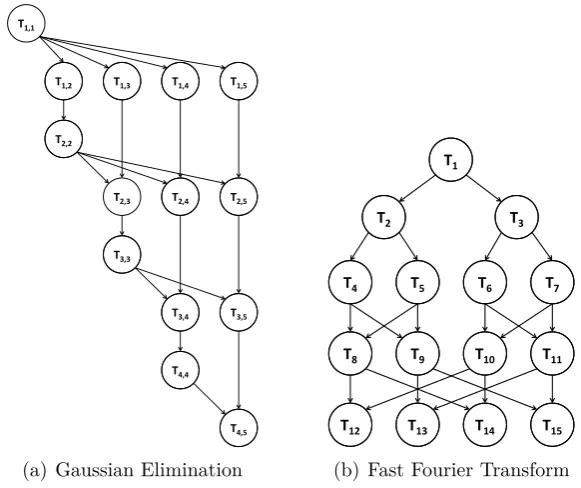
Figure 2-3: Application DAGs for Gaussian Elimination and Fast Fourier Trans-form.5
A near real-time simulation of the electro physiology of the human heart, called the Cardioid code, achieved nearly 12 petaFLOPS 14 petaFLOPS was achieved by HACC, a cosmology simulation framework running a 3.6 trillion particle bench-mark. Gaussian Elimination [Wu and Gajski, 1990, Cosnard et al., 1988], is an algorithm which solves a linear system of equations by performing a sequence of operations on the associated matrix of coefficients. Figure 2-3(a) shows the task graph for the Gaussian Elimination algorithm operating on a matrix of size 5. The total number of tasks in a Gaussian Elimination graph is given by m
2+m−2
2 and in the case of the figure, the number of tasks whenm = 5 is 14.
Figure 2-3(b) shows the task graph of another real world application, Fast Fourier Transform. The FFT algorithm can be split into two parts: recursive calls
and the butterfly operation [Topcuoglu et al., 2002]. For a given input vector of size m which is a power of two, there are 2×m−1 recursive calls and m×log2m
butterfly operations. This application is especially unique in that all the paths in this application are the critical-path and they all have the same weight [Cosnard et al., 1988] rendering them unusable for the work presented in Chapter 6.
6Redrawn from [Wu and Gajski,1990,Cosnard et al.,1988,Topcuoglu et al.,2002]
[image:35.595.152.443.69.313.2]2.1. Parallel applications 36
T1
T2 T3 T4
T5 T6 T7 T8 T9 T10 T11
T12 T13 T14 T15
T16 T17 T18 T19 T20 T21 T22
T23 T24 T25 T26 T27 T28 T29
T30 T31 T32 T33 T34 T35
T36 T37 T38
T39 T40
T41
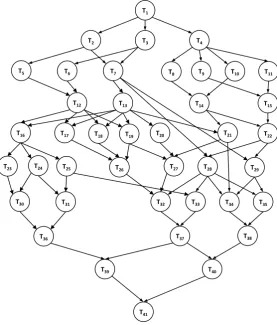
Figure 2-4: Application DAG for Molecular dynamics code. 6
Another commonly found application in the literature is the modified molec-ular dynamic code from [Kim and Browne, 1988]. The task graph of this code is presented in Figure 2-4. This application serves as a benchmark for scheduling algorithms due the shape of its irregular task graph. The task graph was modified by Kim and Browne [Kim and Browne,1988] from its original structure in order to increase the number of tasks and edges. They also modified the computation and communication times of the tasks and edges as well while synthetically generating the architecture on which this task graph was run. This was done in an attempt to increase the variability in the graph and test the robustness of the schedul-ing algorithms. In a similar vein, all the schedulschedul-ing algorithms presented in this thesis were tested on synthetically generated application and processor graphs, unless explicitly stated otherwise. The generator for these synthetic graphs is well documented in Section6.5.
[image:36.595.159.437.71.397.2]2.2. Parallel execution infrastructure 37
(a) Hierarchical designs (b) Pipelined designs
(c) Array designs
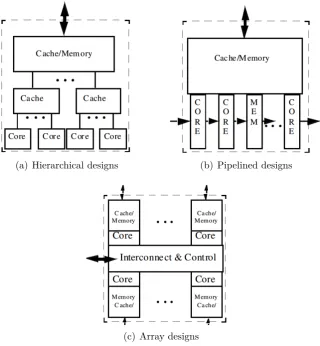
Figure 2-5: Three classes of multi-core die architectures7
2.2
Parallel execution infrastructure
Advanced computing applications such as the ones described in Section 2.1.2 and many more such applications, modelled using techniques described in Section2.1.1, are driving an evolution in the development of computing infrastructure. Kogge et al. claim that contemporary microprocessor architectures are undergoing a transition towards parallelism. They add that this is on account of mining out the instruction-level parallelism and deep pipelining (increased clock rates) which accounted for much of the spurt in growth of single-processor technology. Con-ventional multi-core microprocessors are currently classified into three different classes [Kogge et al., 2008] as shown in figure 2-5.
7Source: [Kogge et al.,2008], figure 4.1
[image:37.595.136.457.74.421.2]2.2. Parallel execution infrastructure 38
Hierarchical designs are multiprocessor designs where cores share cache in a tree like structure (similar to the L1, L2 cache in modern day processors as shown in fig-ure 2-5(a) on the preceding page) with an interface to external memory (DRAM). Inpipelined designs, data enters cores through an external input into the first core. The first core performs some computation and passes it onto its neighbour and so on. The last core finally sends the data back out to be transferred to another multiprocessor system or to some storage. They also share a common bank of cache. Graphics processors like the Xelerator X10q [Carlstr¨om et al.,2004], which contains 200 separate cores, arranged in a pipeline fall into this category. Finally, inarray processors each core has some local memory and may or may not share a common memory. They may have an on-chip interconnection network like a global crossbar for inter core communication. Intel’s teraFLOP Chip [Alm´asi et al.,2003] and the MIT RAW processor [Vangal et al., 2008] fall under this category.
2.2. Parallel execution infrastructure 39
Instruction Pool
Da
ta P
ool
PU
SISD
(a) SISDInstruction Pool
Da
ta P
ool
PU
PU
MISD
(b) MISDInstruction Pool
Da
ta P
ool
PU
PU
PU
PU
SIMD
(c) SIMDInstruction Pool
Da
ta P
ool
PU
PU
PU
PU
PU
PU
PU
PU
MIMD
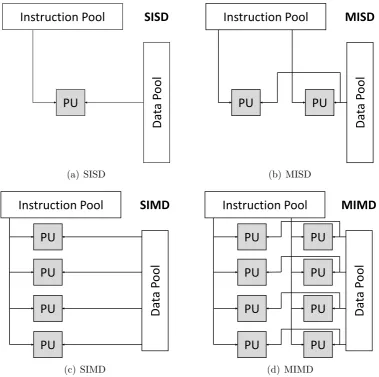
(d) MIMDFigure 2-6: Flynn’s taxonomy of computer architectures
As mentioned earlier, one of the ways to exploit parallelism in an application is through the use of a parallel execution infrastructure. In the same way that there is heterogeneity at a processor level, the idea permeates to a cluster level too. Traditionally homogeneous systems have been defined using the following two properties:
• Processors in the system are identical in design and functionality and in-terconnected via a homogeneous communication backbone. A homogeneous communication backbone is a communication infrastructure wherein each communication link has the same bandwidth capability.
• The same software backend should be used to generate and execute the application programs.
[image:39.595.109.489.73.450.2]2.2. Parallel execution infrastructure 40
Recall the discussion from Section 1about the evolution of processor architec-tures and the ideology of stamp and repeat, that constitutes homogeneous proces-sors. This kind of parallel computing ability provided by homogeneous systems is very well suited for running a small number of similar parallel applications. Jack Dongarra and Alexey Lastovetsky in their book on high performance het-erogeneous computing [Dongarra and Lastovetsky,2009] pose another stipulation which has to be satisfied by a system to be deemed a homogeneous system : The system has to be dedicated; i.e. only one application can execute on the machine at any given time. A violation on this restriction makes the system heterogeneous in their context. This however is not in the purview of this thesis as executing multiple applications on a given parallel execution infrastructure either through “Space sharing” or “Time sharing” is not considered. Readers are encouraged to explore [Pascual et al., 2009, Cohen et al., 2010, 2011] if they are interested in multi-organization scheduling.
Heterogeneous computing on the other hand has been gaining renewed atten-tion in the recent past. AMD in an attempt to combine a CPU and a GPU in a single die started a project codenamed “Fusion” in 2006. This was a direct result of AMD acquiring the chipset company ATI in 20068. The result of the project
is the fabled APUs or accelerated processing units. The first of this generation of processing units, Llano and Brazos, were announced in January 2011 and has been continuing ever since. The latest in this line of processors released in 2015 is the Godavari which uses the Steamroller architecture9 with Bristol Ridge set to
release in 2016 using the Excavator architecture10.
Intel’s response to this rising need of heterogeneity in processing units came twofold : FPGA hybrids and GPU hybrids. The evolution of CPU-FPGA hybrids has been primarily motivated by rising costs of designing and man-ufacturing ASICs11. FPGAs, although stand-bys in the recent past, have been
8Source: AMD completes takeover of ATI. Link:
http://www.cbc.ca/news/business/ amd-completes-takeover-of-ati-1.571612
9Source: Wikipedia. Link:
https://en.wikipedia.org/wiki/Steamroller_ (microarchitecture)
10Source: Wikipedia. Link:
https://en.wikipedia.org/wiki/Excavator_ (microarchitecture)
11Source: Intel’s Hybrid CPU-FPGA. Link:
2.2. Parallel execution infrastructure 41
gaining popularity as the cost of reprogrammable logic continues to decline owing, in part, to Moore’s law. In spite of this recent gain in popularity, FPGAs still remain as an expensive solution while being power hungry. Efforts are being made consistently in the field to decrease the power consumption of FPGAs by clock gating, voltage thresholding and many more techniques [Li et al.,2004,Jamieson et al., 2009, Oliver et al., 2012, Gaillardon et al., 2015].
Nevertheless, the need for an alternative to application specific integrated cir-cuits (ASICs) is pressing, because ASICs are extremely expensive unless the vol-ume of chips needed is huge. Attempting to address this need, companies like Intel, STMicroelectronics and Xilinx are working towards FPGA hybrid solutions. Intel announced the E600C series codenamedStellarton as its first product in this niche. Stellarton combines a 1.3GHz single-core dual-threaded Intel Atom Proces-sor (codenameTunnel Creek) with an Altera Arria-II FPGA in a two die system. The two die are linked over a PCI Express interface. Stellarton is also the only hybrid processor of this type that supports the Intel architecture (x86).
On the other hand, one of the latest in Intel’s CPU/GPU hybrids, is Intel’s much touted Larabee which was cancelled in 2010. Larabee was considered as a hybrid between a multi-core CPU and a GPU as it had similarities to both. It provided multi-threading support with wide SIMD units. Each core contained an AVX-512 bit vector processing unit capable of processing 16 single precision floating point numbers at a time. This was, at the time, much higher SSE units than most x86 processors. There are quite a few advantages for this shift towards on-die hybridization12. Firstly, the cores of Larabee have features similar to both CPU and GPU cores. Since the high performance vector unit is on the same die as the CPU, the cost of communication between the two is drastically reduced thereby greatly increasing the performance. Secondly, the on-die hybrids are eas-ier to manufacture compared to to separate chips for the CPU and GPUs with all the circuitry in-between.
12Source: Sandy Bridge and AMD Fusion: hybrid chips explained. Link:
http://www.techradar.com/news/computing-components/graphics-cards/ sandy-bridge-and-amd-fusion-hybrid-chips-explained-940992/2
2.2. Parallel execution infrastructure 42
Owing to the aforementioned reasons, the power consumption is also signifi-cantly lesser owing to fewer interconnects and reduced communication. This sort of hybridization greatly affects the execution times of a given task on the processor depending on the type of the task.
2.2.1
Heterogeneity at a cluster level
Homogeneity in computing infrastructures have been the norm in the industry for a long time. As mentioned in section 2.2 on page 37, homogeneity mandates that all computing units in the computing platform are identical and hence a task from a parallel application takes the same amount of time to execute on one processor as it does on any other. On the other hand, heterogeneous platforms use different types of processors such as CPUs, GPUs, FPGAs, co-processors etc. A given task from a parallel application will have varying execution times on different processing elements in the computing infrastructure. This is attributed to the recent development of GPUs being able to outperform CPUs on many embarrassingly-parallel tasks.
Intel in the recent past, has envisioned a heterogeneous future for supercomput-ing13. Commercial off the shelf clusters and servers typically rely on homogeneous
CPUs to process data. Instead of purely depending upon CPUs to do the work, heterogeneous clusters add many more types of silicon in their configuration. This enables these monolithic machines to shunt embarrassingly-parallel problems onto GPUs, FPGAs and other accelerator units.
There are several High-Performance clusters which fall under the class of het-erogeneous systems. Many of the top supercomputers from the Top500 list14 are
heterogeneous. In 2008, IBM’s Roadrunner [Barker et al., 2008] was the first ever supercomputer to reach sustained performance of over 1 petaFLOPS on the LINPACK benchmark. It consisted of 12,240 modified IBM Cell processors (Pow-erXCell 8i) and 12,240 AMD Opteron cores arranged in a uniquetri-blade config-uration. One blade, containing two dual-core Opteron processors was responsible
13Source: Intel bets on heterogeneous future for supercomputing. Link:
http://www.zdnet. com/article/intel-bets-on-heterogeneous-future-for-supercomputing/
14Source: Top500 Supercomputing List. Link:
2.2. Parallel execution infrastructure 43
for the coordination and I/O operations. The other two blades consisted of two Cell processors each. Compute intensive work was shunted to the Cell processors which used its eight internal SPEs to crunch numbers at 102.4 gigaFLOPS
The current fastest supercomputer in the world, as of June 2015, is China’s Tianhe-215. This behemoth has 32,000 Intel Ivy Bridge Xeon sockets and 48,000
Xeon Phi boards for a total of 3,120,000 cores. Each compute node is composed of 2 Intel Ivy Bridge sockets and 3 Intel Xeon Phi boards. The system is composed as : 2 nodes per board, 16 boards per frame, 4 frames per rack and 125 racks in total. Some applications currently being ported onto TH-2 include High-order CFD Simulation and Gyrokinetic Toroidal Code (GTC) (from Jack Dongarra’s report). From these two stellar examples and many others from the Top500 list, it is evident that heterogeneity is ubiquitous in the modern supercomputing world.
There are other forms of parallel computing that enable users to run parallel applications. In the recent past, scientists have already begun to leverage cloud computing resources to execute scientific workflows [Keahey,2009,Deelman et al., 2008]. Cluster/Distributed computing projects like SETI@Home [Anderson et al., 2002], Einstein@Home [Abbott et al.,2009] and more recently LHC@Home16have become very popular as an effective crowd sourced computing resources.
Apart from these examples of heterogeneity in high performance computing, it is becoming increasingly common in all other forms of parallel computing. In the case of cloud computing, efforts have already been made enable users to ac-cess heterogeneous clouds consisting of accelerators and GPUs [Crago et al.,2011]. The @Home initiatives being crowd-sourced are massively heterogeneous as dif-ferent architectures are brought into the network as more people volunteer. Note however, for these types of applications, a dynamic scheduling algorithm might be better suited than a static scheduling algorithm, as it is easy to account for the variability and temporal nature of the devices that are in the network. The overhead associated with a dynamic algorithm is admissible given the non-existent time-criticality of the application.
15Source: Visit to the National University for Defense Technology Changsha, China. Link:
http://www.netlib.org/utk/people/JackDongarra/PAPERS/tianhe-2-dongarra-report. pdf
16Source:LHC@Home. Link:
http://lhcathome.web.cern.ch/
2.2. Parallel execution infrastructure 44
2.2.2
Contrasting nature of homogeneity and
heterogene-ity
From the standpoint of the DAG-scheduling problem, which will be discussed at great length in Section 2.3 on the facing page, heterogeneity offers a greater challenge in finding good solutions. In the case of a homogeneous execution infras-tructure, the tasks in the application DAG have only one execution time associated with them as all the processors execute any given task in the same amount of time. Heterogeneity complicates this further as each task has a set of P execution times, whereP is the total of number of types of processors. Hence, for a given v
set of tasks, the execution times are given by a matrix Ccomp(v ×p). One of the
main advantages of moving to a heterogeneous execution model is finer granularity of representation of the execution times which lead to better scheduling decisions. However, finding the critical-path in the task graph becomes very difficult as we discuss in detail in chapter 6 on page 134. Existing algorithms find an approx-imation of the critical-path by averaging the execution times of tasks across all processors, in which case the advantage provided by the finer granularity is lost.
However, one major drawback of heterogeneity stems from the fact that, a heterogeneous execution framework either requires a major rewrite of the compiler with a common programming language; or requires the added complexity of writing programs that can run on different ISAs.
Heterogeneity is not limited to disparities in execution times alone. It some-times manifests itself when tasks from an application DAG need certain types of execution units [Shi and Dongarra, 2006]. For example, a GPU task can be exe-cuted in either a GPU or a CPU. But the GPU may offer marked improvements in speed compared to a CPU. In our research from chapter4 on page 84, we deal with exposing these kinds of requirements by introducing a better representation for calculating theCcomp(v×p). In the next section, we posit the application DAG
2.3. The mapping and scheduling problem 45
2.3
The mapping and scheduling problem
Recall the discussion about the growing needs of scientific applications (beginning of chapter 2 on page 28) and the increasing capabilities of the execution infras-tructure (Section 2.2 on page 37). One of the important factors that contributes to the speedup obtained by running a parallel program on a parallel machine, is the inherent parallelism present in the application. Gene Amdahl in 1967 pro-posed a law which predicts the theoretical maximum speedup when using multiple processors :
S(N) = 1 (1−α) + α
N
(2.1)
where S denotes the speedup for program P when N processors are used. α is the fraction of the program that can be parallelized (inherent parallelism). Apart from the inherent parallelism there are other factors which heavily influence the overall execution time of an application. We identify some of the key fundamental problems in parallel application execution as follows:
• Identifying all types of parallelism in the application
• Partitioning the application into sequential/SIMD tasks
• Mapping said tasks onto processors
• Scheduling mapped tasks while maintaining global order
• Generating code for scheduled tasks corresponding to the processor they are assigned to
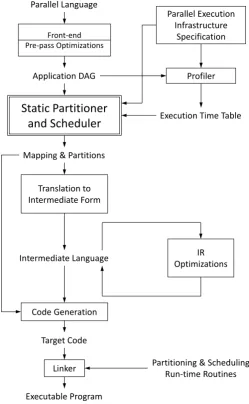
This thesis aims to address the two problems in the middle, namely : mapping and schedulingand develop necessary key solutions. Note that, these two steps are not necessarily independent of each other as some algorithms map and schedule a task at the same time. Figure2-7 on the next pageshows a general strategy for the automatic partitioning and scheduling of a parallel language on a multiprocessor
2.3. The mapping and scheduling problem 46
Front-end Pre-pass Optimizations
Parallel Language
Application DAG
Static Partitioner
and Scheduler
Mapping & Partitions
Translation to Intermediate Form
Intermediate Language
Code Generation
Target Code
Linker
Executable Program
Profiler
Execution Time Table Parallel Execution
Infrastructure Specification
IR Optimizations
Partitioning & Scheduling Run-time Routines
Figure 2-7: Generalised scheduling strategy17
system. Section 3.7 describes a few systems which follow this general idea and implement scheduling strategies for certain language-multiprocessor pairs. Firstly, an application in the parallel language is converted into an equivalent DAG. In order to evaluate the execution times of the tasks in this DAG, the profiler takes the DAG and the hardware specification as inputs. It returns an execution time table which is reminiscent of the table presented in Figure 2-2(b) on page 33.
The static partitioner and scheduler (compile-time analysis) takes as input the following: the application DAG, the parallel execution infrastructure specification and the execution time table. It proceeds to partition and schedule tasks from the application DAG ontoprocessors from the parallel execution infrastructure.
[image:46.595.172.422.70.475.2]2.3. The mapping and scheduling problem 47
Once the tasks have been scheduled, they are translated to their intermediate representations and optimizations at that level are applied. Finally, the code generation phase generates code for a given task according to its target processor (the processor to which this task is mapped to during the compile-time analysis). The linker links the generated code with any run-time support routines necessary for partitioning and scheduling.
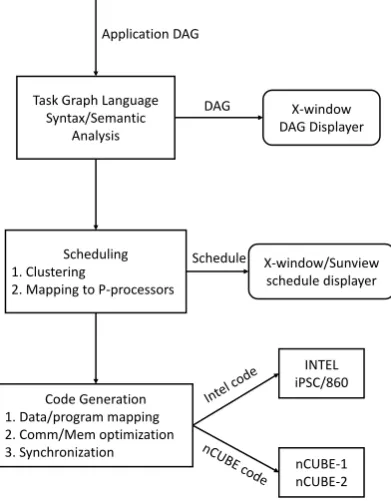
In this thesis, we focus solely on the static partitioner and scheduler and the techniques used in this phase of the automatic partitioning and scheduling process; and we do not focus on the other parts, namely: application DAG generation, profiling of said DAGs on multiple real-world hardware, code generation etc. as it is outside the scope of this research. There are however, several key pieces of research that deal with these aspects of the process [Ramaswamy and Banerjee, 1996, Buck et al., 1994]. Section 3.7 on page 80 describes a few systems which incorporate these techniques and implement the automatic scheduling process from start to finish.
The scheduling problem can be succinctly defined as: assign tasks from the parallel program onto processors, so as to minimize the total parallel execution
time [Sarkar, 1989]. This is also commonly referred to as the multiprocessor scheduling problem (this problem is also referred to as DAG scheduling and task scheduling)18. This problem without communication delays has been studied at great length in the past [Graham et al., 1979, Yang and Gerasoulis, 1993, Krish-namoorthy and Efe, 1996].
It has been shown to be N P-complete in the general case [Lenstra and Rin-nooy Kan, 1978, Johnson and Garey, 1979] and even in some special restricted cases [Ullman, 1975] like two-processor scheduling and unit execution times for tasks. However, [Graham, 1969] showed that the upper bound on the execution time produced by linear time list scheduling heuristics is two. The schedule pro-duced by the list scheduling heuristic will hence be at worst twice as long as the optimal solution.
18These names are used interchangeably throughout the rest of this thesis
2.3. The mapping and scheduling problem 48
When communication delays are introduced, the scheduling problem becomes significantly more difficult. The tight bound on execution times produced by list scheduling algorithms found by Graham do not hold in the context of multiproces-sor systems with communication delays. Lee and Shinshow that the assignment problem in an N-processor homogeneous network may be tractable for certain in-terconnection topologies and may not be tractable for others. Farhad et al. show experimentally that state-of-the art integer linear programming approaches for or-chestrating stream graphs are intractable or at least impractical for larger stream graphs and larger number of processors.
A naive notion of parallelism dictates that tasks should be assigned to differ-ent processors as much as possible [Sarkar, 1989]. While this balances the load better, it does not account for communication delays. Communication delays are nullified when two communicating tasks are allocated to the same processor; al-locating them on different processors requires the communication cost to be paid. Hence, the scheduling problem to minimize the total parallel execution time of the application becomes a multi-objective optimization problem in:
• Increasing processor utilization
• Decreasing inter-processor communication thereby reducing communication delays
This multi-objective optimization problem in conjunction with the complexities introduced by heterogeneity, as mentioned in Section 2.2.2 on page 44 further complicates the problem. Hence, the only feasible solution comes in the form of heuristics and meta-heuristics as explained in Section 3.1 on page 55. When it comes to automatic partitioning and scheduling, these solutions can be factored into three main groups as shown in Figure 2-8 on the facing page.
2.3. The mapping and scheduling problem 49
Possibilities for automatic partitioning and scheduling
Compile-time partitioning and compile-time mapping & scheduling
Compile-time partitioning and run-time mapping & scheduling
Run-time partitioning and run-time mapping & scheduling
Figure 2-8: Types of automatic partitioning and scheduling
However, the major drawback for run-time partitioning and scheduling which is the use of a dynamic scheduling system necessitates that the partitioning strategies be very simple. The seemingly obvious way to develop partitioning and scheduling problems is to choose a particular parallel language and a particular multipro-cessor system and then formulate a strategy that works best for this language-multiprocessor system pair.
This has been done in the past for a few language-multiprocessor system pairs [Gilbert, 1980,Hornig,1984]. However, our objective is to develop strategies for mapping and scheduling that extend well beyond a language-multiprocessor system pair and are language independent and multiprocessor-system indepen-dent. We formulate the problem of task mapping and scheduling in greater detail at the beginning of the next chapter.
Chapter 3
Chapter 3. Literature review 52
T
he aim of this chapter is not just to “pigeon-hole” different schedulingalgorithms into categories; instead, it is also an attempt to understand how the scheduling algorithms have evolved with time and how they differ on issues related to parallel processing. In order to formally define the DAG scheduling problem and understand its evolution, let us first consider the inputs to the problem: the parallel application and the parallel infrastructure specification. Recall from our discussion in Section2.1.1.3 on page 32, a Directed Acyclic Graph (DAG) is commonly used to represent the application in the literature. Resource characterization has been conventionally done in one of two ways: (1) using an undirected graph to represent the processors in the systems; or the more popu-lar method (2) using a heterogeneity factor to modify the execution times and communication time of tasks. We explain the first method in great detail in the research in section 4.1.2 on page 90 while we use the second method to generate random graphs in section 6.6.1 on page 156.
As mentioned earlier, a parallel application is represented using a directed acyclic graph (DAG), G = (V,E) as shown in figure 3-1 on the facing page. V
represents the set ofv nodes and each node vi ∈ V represents a task in the parallel
application. The total number of tasks is given by v = |V|. In the context of representing a parallel application as a DAG, we refer to each node vi by a task
from the parallel application ti. The set of edges or the precedence constraints
in the parallel application is represented by E; each edge ei,j ∈ E represents the
task precedence constraint such that taskti has to complete before tj starts while
datati,tj denotes the amount of data to be transferred from ti totj.
The DAG is complemented by aCcomp matrix that is av×pcost matrix which
gives the execution time of every task on every processor in the system, wherepis the total number of processors. An element of this matrixwi,j gives the execution
time of task ti on processor pj. In the literature, however; the average execution
time of a task wi (defined in equation 3.1 on the next page) is used to compute