Status of
t
he Usage of Active Learning and Teaching
Method and Techniques by Social Studies Teachers
Özkan Akman
Nizip of Educational Faculty, Gaziantep University, Turkey
Copyright©2016 by authors, all rights reserved. Authors agree that this article remains permanently open access under the terms of the Creative Commons Attribution License 4.0 International License
Abstract
The purpose of this study was to determine the active learning and teaching methods and techniques which are employed by the social studies teachers working in state schools of Turkey. This usage status was assessed using different variables. This was a case study, wherein the research was limited to 241 social studies teachers. These teachers were randomly selected from various regions of Turkey during the 2014-2015 fall and spring period. ‘Active learning method and techniques scale’ was used by the researchers as the data collection tool. The reliability and validity of the scale were tested before applying to the participants of study. Cronbach’s Alpha reliability coefficient was calculated as 0.88. Seventy-four articles of the scale consisted of 82 articles. These articles included eight questions related to the occupational and demographic specifications of the participants and five Likert type questions for the active learning method and technical knowledge. The data were analyzed by one-way analysis of variance (ANOVA), independent t-test and post hoc Tukey’s test, using the SPSS 18.00 packaged program. Findings shows that project, concept map, finding reason – result, teaching through invention are the most frequently used techniques. Findings in this study point towards differences in the usage status of active learning-teaching methods among the social studies teachers. These differences are not based on the educational background of the teachers or their graduation institute, but on the gender, international experiences, in-service participation for occupation development, occupational seniority, and status and geographic location of the school where the teachers were employed.Keywords
Social Information, Active Learning and Teaching, Method and Techniques1. Introduction
Students participate in the process and students participate when they are doing something besides passively listening in active learning (1). Being active in/out classroom is considered to have a huge impact on the development and learning psychology of the secondary school students. However, the activity conditions of the students can be transformed and made stable by enhancing the permanency and efficiency of the learning-teaching process through active learning methods and techniques [18]. In this context, an effective guidance system is critical for producing an appropriate learning behavior among students. Therefore, the learning-teaching process, which is closely related to process management method [29], must be effectively employed to achieve this behavioral outcome.
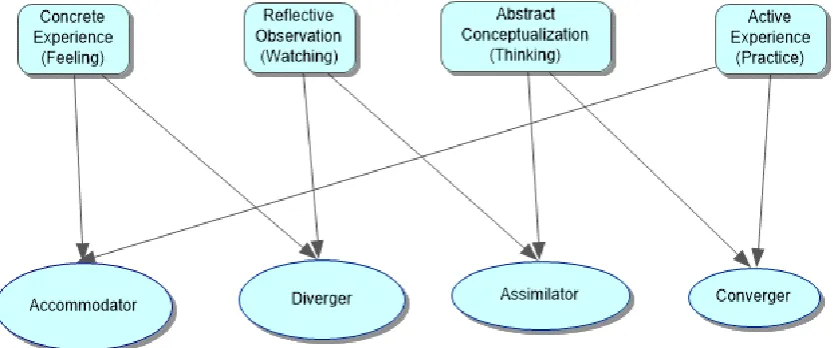
Figure 1. Learning model of Kolb
As seen on the figure 1. concrete experience, reflective observation, abstract conceptualization and active experience are the cornerstones of the Kolb’s model. Kolb’s model [23] plays a major influencing role in the process of determining methods and techniques for the teacher and learner in the learning process. This determination helps individuals for determining their occupation, approach towards problems, and learning or teaching objectives. In addition to this, it enables individuals to understand their weak and strong aspects [2].
The learning and teaching process includes subject, object, method, and environmental relations. In this process, these components are intricately interrelated to each other and the whole system [7]. In this context, it is important to balance the integrity of each component to make the entire process effective. For example, while possessing sufficient field knowledge, insufficient pedagogic knowledge of a teacher might lead to an inefficient transfer of learning. Therefore, the teaching will be deemed as unproductive [1].
A 21st century’s teacher cannot meet requirements of
students by delivering knowledge and evaluating students within the boundaries of curriculum. Today’s teacher must be a good guide, observer, manager and a qualified person, with a capacity to organize the teaching-learning processes in a way that allows for active engagement of the learner. It implies that qualifications and efficiency demanded in the teaching occupation has increased exponentially in the current scenario [17]. Therefore, it is important to regulate the courses for steering the students toward knowledge, instead of directly transferring the knowledge, and employ different method-technique and approaches for achieving this learning outcome. However, several studies point that many teachers do not have sufficient knowledge about the different methods and techniques that can increase participation of the students in the courses [19].
As indicated earlier, it is important to develop certain competencies in students. These competencies include application of acquired knowledge and skills, assuming responsibilities, communication and team work [12]. These competencies can be achieved by selecting and applying
appropriate methods aiming active learning, which are currently lacking in most of the 21st century teachers [27].
The research conducted by Özabacı & Acat [29] emphasizes that teachers must place informative specification (transferring information through the used methods) as the uppermost specification, while placing intellect and wisdom as the sixth specification in their list of qualifications. However, teachers revealed their lack of informing specification, in a recent study [23].
The results gained from the research show that mere wisdom is insufficient for transferring knowledge to learners. The practitioners of any program are teachers, and hence the contents and objects of the program should be prepared with care. With regards to the interaction between the components of a program and learning-teaching process, in particular, the impact of a teacher over the entire process is considered to be more powerful than other components [11]. In other words, even if a curriculum is well-prepared, the desired result cannot be achieved with under qualified teachers [32,11]. It implies that the quality of education is directly related with the qualification of the teacher [22]. Therefore, teachers must learn and adopt new programs and act in accordance with their roles for improving efficiency of programs.
by preventing rote learning [10,4,16,6]. Active learning includes students in the entire teaching-learning process and influences their learning behavior, thereby encouraging learning based on both skill and attitude [8]. Several studies report that the application of active learning strategies, which occur as a result of the reflections of constructivist approaches on the education, facilitate conceptual learning. Conceptual learning, in turn, enables children to develop mindset of lifelong learning, and gain skills that can be used in every field of the life [25].
With regards to the learning strategy designed for the social studies course taught in Turkey, the program provides multiple choices of subjects, skills and activities. This design aims to determine the productivity of a student’s learning level. The ability to remember information differs in every learner, and this difference must be considered to determine productive learning levels in each learner [26]. Besides, field knowledge, skills of the teacher, and teacher-student relationship are among the factors that effectively determine the learning level of students. The qualification of the teacher and applied teaching methods must be considered for determining actualization of the learning in social studies course.
In teaching social studies course, question-reply, problem solving, presentation, travel-observation, work and experiment methods are frequently used to achieve learning outcomes [13]. Nearly, all the methods applied in learning and teaching concepts may be considered as valid for social studies course. It is observed that dominant learning styles impact learning processes and occupational life. Therefore, the study aims to determine different teaching styles of social studies teachers. Under the light of these explanations, the study aims to determine these different teaching styles aiming active learning of social studies teachers in terms of various variables.
Social studies teachers are expected to be enthusiastic people, who not only transfer knowledge to students but also establish good communication with the students (34). They teach the students to think, examine, and solve problems. These teachers also provide feedback on research results of students; show confidence on the learning levels of each student; value individual differences, and build confidence and fondness for the course in students; encourage innovations; and above all try to be role models for the students.
1.1. Object of the Research
The study aimed to determine the active learning and teaching methods employed by social studies teachers in Turkey. The study attempted to achieve the stated objective by answering the following question:
1-Which methods are used frequently?
2-Is there a significant difference in usage status of active learning-teaching methods and techniques by social studies teachers in accordance to their genders, educational level, occupational development, experience?
2. Method
2.1. Pattern of the Research
The research was based on the comparative type descriptive survey model from the quantitative research techniques. The data required for descriptive survey model was obtained from individuals in study population, mentioned as the target group of the research. Active learning techniques and methods were used as measuring tools for analyzing the data (5).
2.2. Participants of the Research
A total of 283 social studies teachers participated during the initial stage of the study. These teachers were randomly selected from seven regions of Turkey, during the 2014-2015 academic year, fall and spring semesters. However, 42 teachers were excluded from the analysis for giving wrong and random replies to the questionnaire in scope of the research. As a result, the answers of 241 social studies teachers were included in the analyses. There were 166 (68.9% of total participants) male and 75 female (31.1% of total participants) participants. With regards to the educational status of the participants, 228 (94.6%) of them completed Bachelor’s degree and 13 (5.4%) had a Master’s degree. Teachers with a doctorate degree or higher education were not part of the study.
Additionally, there were 221 participants (91.7%) from social studies teaching department, seven participants (2.9%) from history department, and 13 participants (5.4%) from history teaching department but all were teaching social studies. During the time of research, 50 participants (20.7%) had 0-1 year of experience, 137 participants (56.8%) had served for 1-5 years, 27 participants (11.2%) possessed 6-10 years of experience, and 27 participants (11.2%) had between 11-15 years of experience. With regards to the type of employment, there were 25 paid teachers (10.4%), 50 intern teachers (20.7%), 139 regular teachers (57.7%), and 27 managers (11.2%). A total of 27 participants (11.2%) worked in villages, 61 participants (25.3%) worked in districts, 146 (60.6%) worked in cities, and seven (2.9%) worked in metropolitans. While 127 (52.6%) participants had earlier taken part in the in-service educational activities, 114 (47.4%) participants had never participated in these activities.
2.3. Data Collection Tools
specifications of the participants and five-point Likert type questions for the active learning method and technical knowledge. The five-point Likert scale included: “I do not know at all, I know a little and I never applied, I know and I sometimes apply, I know, and I frequently apply.” The participants choose a number, ranging from 1-5, on this scale.
2.4. Analysis of the Data
Unilateral variance analysis (one-way ANOVA), independent t-test and post hoc Tukey’s test were employed to analyze the data, using the SPSS 18.00 packaged software. Besides, the descriptive statistical values of the active learning methods and techniques (see, annex 1) were also calculated.
[image:4.595.58.296.336.381.2]3. Findings
Table 1. Independent t-test analysis results according to the gender variable of social studies teachers
Gender N Mean Ss F t df p Male 166 209.1446 32.53833 .887 –1.988 132
0.042 Female 75 218.6800 35.46188 –2.048 239
The findings focus on t-test analyses of the usage status of alternative methods and techniques of the teachers, which were conducted according to gender variable, international experiences, and seminar participation based on the occupational experience. The ANOVA test analyses were made according to education level, graduated department,
length of service, status in school, and geographical location of the school. Independent t-test analysis results according to gender variable are given in Table 1.
Table 1 shows a significant difference in favor of the females, according to the gender variable (p<0.05). In other words, females use the active learning techniques and methods more than the males. Independent t-test analysis results according to abroad experiences are given in Table 2.
The examination of Table 2 shows a significant outcome in favor of the teachers with international experiences, according to the international experience variable (p<0.05). In other words, the teachers with international experiences use the active learning techniques and methods more than teachers without international experience. Independent t-test analysis results according to the teachers’ seminar participation related with their occupational experience are given in Table 3.
The examination of Table 1 shows a significant difference in favor of the females, according to the gender variable (p<0.05). In other words, females use the active learning techniques and methods more than the males. Independent t-test analysis results according to abroad experiences are given in Table 2.
[image:4.595.89.521.491.546.2]The examination of Table 2 shows a significant outcome in favor of the teachers with international experiences, according to the international experience variable (p<0.05). In other words, the teachers with international experiences use the active learning techniques and methods more than teachers without international experience. Independent t-test analysis results according to the teachers’ seminar participation related with their occupational experience are given in Table 3.
Table 2. Independent t-test analysis results according to abroad experience of social studies teachers Abroad experience status N Mean ss F t df p
Yes 21 239.0000 2.83324 6.175 1.860 121
0.000 No 220 210.1429 17.26645 10.185 118.000
Table 3. Independent t-test analysis results of the social studies teachers according to participation to the seminar related with the occupational experience According to participation
to the seminar N Mean Ss F t df p Yes 127 216.7087 33.17584 2.206
[image:4.595.92.517.648.750.2]235 0.029 No 114 207.0273 34.28040 .717 2.201
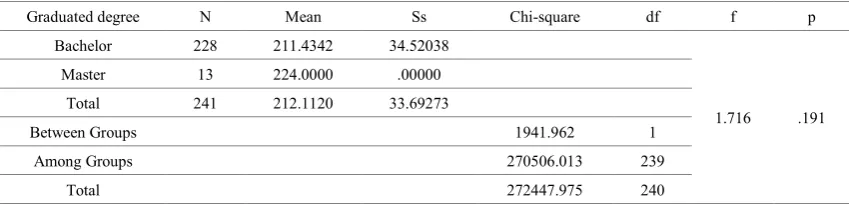
Table 4. ANOVA results showing the active learning and method usage according to the education level of social studies teachers Graduated degree N Mean Ss Chi-square df f p
Bachelor 228 211.4342 34.52038
1.716 .191 Master 13 224.0000 .00000
Total 241 212.1120 33.69273
Between Groups 1941.962 1
Among Groups 270506.013 239
Table 5. ANOVA results of the social studies teachers according to graduated school
Graduated School N Mean Ss Chi-square df f p Social studies 121 210.8190 34.84125
2.074 0.128 History 67 230.8571 10.96097
History Teaching 53 224.0000 25.12355 Total 241 217.1120 33.69273
Among Groups 4666.358 2
Within Groups 267781.617 238
[image:5.595.91.522.86.432.2]Total 272447.975 240
Table 6. ANOVA results of the social studies teachers for the length of service
Length of service N Mean SS Chi-square df f p Between 0-1 Year 50 232.8200 21.45207
14.419 0.000 Between 1- 5 Years 137 208.4088 32.35978
Between 6-10 Years 27 218.1852 29.17327 Between 11-15
Years 27 186.4815 40.81136 Total 241 212.1120 33.69273
Among groups 42052.671 3
Within groups 230395.304 237
Total 272447.975 240
The examination of Table 3 shows a significant outcome in favor of the teachers who participated in the in-service seminars, according to the participation status of social studies teachers (p<0.05). In other words, the teachers who participate in seminars related with their occupations use the active learning techniques and methods more than the teachers who do not. In this case, the importance of active learning methods and techniques, and in-service education course is understood. ANOVA results showing the active learning and method usage according to the education level of teachers are given in Table 4.
The examination of Table 4 does not show significant differences in the comparisons of the ANOVA results according to the education level of social studies teachers (p<0.05). Accordingly, it is observed that there is no relation between education level of the social studies teachers and active learning techniques and method usage status. Under normal conditions, active learning techniques should be employed by highly qualified teachers, but no such relation is seen here. ANOVA results of the social studies teachers according to their graduate school are given in Table 5.
The examination of Table 5 does not show significant
differences in the social studies teachers according to the graduated department (p>0.05). Social studies are carried out by teachers who graduate from science, literature, history department, and history teaching and geography teaching departments. In Table 6, it is examined whether there is a significant difference in the length of service of the social studies teachers.
Table 7. ANOVA results of the social studies teachers according to their position in the school they work
.
Status in school N Mean Ss Chi-square df f pIntern teacher 35 201.1600 29.04978
2.097 0.011 Regular Teacher 67 220.8200 38.52732
Manager 139 210.7986 28.50888 Total 241 212.8889 48.14029
Among groups 7046.209 3
Within groups 265401.766 237
Total 272447.975 240
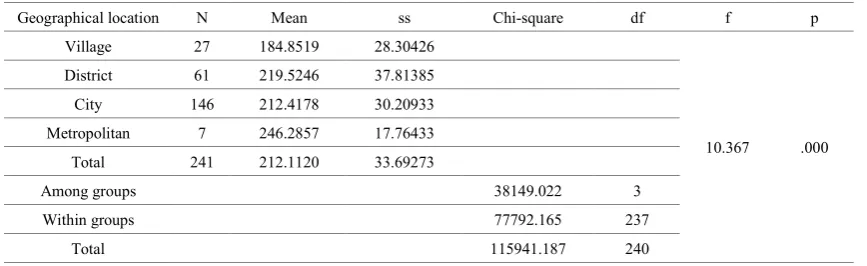
Table 8. ANOVA results of the social studies teachers according to the geographic location of the school Geographical location N Mean ss Chi-square df f p
Village 27 184.8519 28.30426
10.367 .000 District 61 219.5246 37.81385
City 146 212.4178 30.20933 Metropolitan 7 246.2857 17.76433 Total 241 212.1120 33.69273
Among groups 38149.022 3
Within groups 77792.165 237
Total 115941.187 240
The examination of Table 7 shows significant differences between the status of social studies teachers in the schools they work and usage status of active learning methods and techniques (p<0.05). Accordingly, it is obvious that regular teachers use the active learning methods and techniques more than the managers and intern teachers. It is observed that the active learning methods and techniques are used sparingly by the managers. This finding brings to the forefront the importance of engaging in educational activities at the managerial level. Table 8 observes whether the social studies teachers use the active learning techniques and methods according to the geographic location of the school.
The examination of Table 8 shows that the ANOVA test results are significantly in favor of the social studies teachers working in municipalities, according to the geographical location of the school (p<0.05). Accordingly, it is observed that the teachers working in municipalities use the active learning methods and techniques more than the teacher working in villages, districts, and cities. It is thought that the physical conditions of the schools, student profiles, family profiles, variety of the financial potential, and existence of the social environments might contribute toward this difference.
4. Discussion
In this study, the usage status of active learning-teaching methods and techniques of the social studies teachers are examined in terms of variables like gender, international experiences, in- service participation based on occupation, education level, graduated school, length of service, status in
the school where the teacher works, and the location of the school where the teacher works. The examination of the gender variables shows that the females use the active learning and teaching methods more than the males. A study conducted by Aydede & Matyar [3] could not identify significant differences between both genders in the gender variable. They expressed that the males and females display the same tendency while adopting the teaching methods and techniques. Çaycı & Ünal [9] expressed that the learning styles are important variables in terms of gender variable.
[image:6.595.90.524.227.360.2]working in high school and secondary school, it was observed that the teachers did not have sufficient knowledge of the methods and techniques before in-service course. However, their knowledge on teaching methods and techniques positively developed after completion of the in-service course.
In this study, no relation is found between the active teaching techniques and methods of the social studies teachers and their education level. Under normal conditions, the usage of active learning and teaching methods and techniques is expected to increase with an increase in the education level. However, uneven distribution of the participants and non-existence of any Master's degree in the education field might have contributed towards this condition. Similarly, the graduation school of the social studies teacher does not produce significant difference. In Turkey, differences might be identified among the graduate departments of social studies teachers. Social studies teaching could be undertaken by teachers who graduated from different study streams.
An inverse relationship is observed between the length of the service of the social studies teachers and the methods and techniques employed by these teachers. The findings show that traditional methods are used by teachers with longer length of service. Particularly, the occupational exhaustion situation is mostly seen in the teachers who have been in the service for more than 20 years. It is observed that the teachers who are new in occupation and have shorter service duration use the education methods and techniques. In the study of Erdem, Uzal & Ersoy [14], it is concluded that the level of teachers in using active learning methods and techniques shows differences according to the occupational length of service, graduated educational institution, and levels of competence-efficiency and self-evaluation. However, differences are not seen according to the school type which the teacher works, gender and teaching field. The non-existence of any difference in the length of service might be due to the differentiation in the sampling groups which participate in the research. The differences occurring in this research might be due to participation of high-school teachers who have actively participated in many in-service studies; participation of teachers working in Anatolian Teacher High School through a different exam; and the longer duration of this research.
With regards to the status of schools that employ social studies teachers and its relation with the employment of active teaching methods and techniques, it is observed that
regular teachers use the active learning method and techniques more than the managers and intern teachers. A relationship is observed between the geographical location of the school where the teacher works and the active teaching techniques status. Accordingly, it is observed that the social studies teachers working in the municipalities use the active learning and teaching techniques more than the teachers working in districts and villages. The data of Ministry of Education and Turkish Statistical Institute mentions that the academic successes of the students studying in big cities are much more than the success achieved in small cities and villages, and the data mentions about the social and innovative specifications of the teachers working in big cities.
5. Conclusions
The usage status of the active learning-teaching methods and techniques of the social studies teachers differs in terms of the variables like gender, international experiences, in-service experience for occupational development, length of service, status in the school where the teacher works, and the location of the school. However, differences are not observed with regards to the education level and graduation school of teachers.
6. Suggestions
1- Teaching and learning approaches of the teachers should be determined according to other in-service education activities and the precautions required for these activities.
2-The teachers must be encouraged to participate in the domestic and international activities for their professional developments.
3- Precautions must be taken while classifying the difference between the teachers working in rural areas or districts
4- Teachers who changed occupation from teaching to managing and then again joined back as teachers must participate in in-service educational activities.
Appendix
Annex 1. Descriptive values of the articles of active teaching method and techniques scale
Method and Techniques N Minimum Maximum Mean Std. Deviation Variance
Brainstorming 241 2,00 5,00 3,5851 ,70860 ,502 Mental Mapping 241 1,00 4,00 3,0456 ,89092 ,794 Concept Network 241 2,00 5,00 3,3942 ,88401 ,781 Concept Map 241 2,00 5,00 3,7012 ,98845 ,977 Project 241 2,00 5,00 3,7718 ,91389 ,835 Conference 241 1,00 4,00 2,8506 ,49423 ,244 Panel 241 2,00 4,00 2,9502 ,33790 ,114 Open Session 241 2,00 3,00 2,7178 ,45099 ,203 Kollegyum 241 1,00 4,00 2,8589 ,69283 ,480 Forum 241 1,00 4,00 2,6515 ,67922 ,461 Problem Solving 241 2,00 5,00 3,5270 ,74743 ,559 Sample case examination 241 2,00 5,00 3,5270 ,67105 ,450 Travel-Observation studies 241 2,00 5,00 3,0041 ,71003 ,504 Simulation 241 1,00 5,00 2,9627 ,83831 ,703 Demonstration 241 1,00 5,00 3,3444 1,04963 1,102
Discussion 241 1,00 5,00 3,2075 ,96959 ,940 Data Scheme Preparation 241 1,00 4,00 1,7427 ,83179 ,692 Jigsaw Method 241 1,00 4,00 1,9461 1,04143 1,085 Computer aided teaching 241 2,00 5,00 3,3776 ,80788 ,653
Philipss 66 241 1,00 4,00 1,9751 ,97436 ,949 Formulization 241 1,00 5,00 2,5311 1,14021 1,300 Fish Bone techniques 241 1,00 4,00 3,2490 ,69840 ,488
Creative Drama 241 2,00 5,00 3,3071 ,91122 ,830 Role 241 1,00 5,00 3,3237 1,00986 1,020 Pantomime (silent game) 241 1,00 4,00 2,6432 ,89748 ,805
Making poem 241 1,00 5,00 2,7220 1,04955 1,102 Making song 241 1,00 5,00 2,5934 1,08041 1,167 Completing story 241 1,00 5,00 2,8838 ,94151 ,886
Finding title 241 1,00 5,00 3,0871 ,96430 ,930 Finding slogan 241 1,00 5,00 3,2863 1,15334 1,330 Advertisement preparation 241 1,00 5,00 3,0871 ,98143 ,963
Picturing 241 1,00 5,00 2,9710 ,97638 ,953 Court 241 1,00 4,00 2,3444 ,90925 ,827 Think-Discuss-Share 241 1,00 5,00 3,1867 1,08128 1,169 Newspaper publishing 241 1,00 4,00 2,4315 ,96850 ,938
Press Meeting 241 1,00 3,00 2,0373 ,86762 ,753 Analogy (Metaphor) 237 1,00 4,00 2,4726 ,80008 ,640 Empathy 241 2,00 5,00 3,6556 ,81244 ,660 Mutual teaching 241 1,00 5,00 3,1203 1,05970 1,123 Teaching through invention 241 2,00 5,00 3,6473 ,75006 ,563
Finding reason-result 241 2,00 5,00 3,8631 ,80747 ,652 Making regression 241 1,00 5,00 3,3693 ,98770 ,976 Reverse Thinking 241 1,00 5,00 2,6017 1,02827 1,057
Talking in order (flash) 241 1,00 5,00 2,6680 1,39559 1,948 Teaching someone 241 1,00 5,00 2,8714 1,05872 1,121 Information paper bag 241 1,00 4,00 1,7925 ,96959 ,940
Interview 241 1,00 4,00 2,7427 1,07248 1,150 Socrates (question- reply
method) 241 1,00 5,00 3,4398 1,13170 1,281 Question network 241 1,00 5,00 2,9336 1,10856 1,229 What does it have 241 1,00 5,00 2,6680 1,01949 1,039 Learning by discovering 241 1,00 4,00 3,3610 ,76265 ,582
Workshop 241 1,00 4,00 2,2448 ,88637 ,786 Fİnd who are you? 241 1,00 4,00 2,4232 ,99756 ,995 Sand hour 241 1,00 3,00 1,6349 ,81104 ,658 Station 241 1,00 5,00 2,7635 ,82543 ,681 Find treasure 241 1,00 4,00 2,1494 ,87231 ,761 Learning Gallery 241 1,00 3,00 2,2573 ,83179 ,692 Snowball 241 1,00 4,00 2,8216 ,58924 ,347 Murmur 241 1,00 4,00 2,8091 ,70480 ,497 Puzzle 241 1,00 5,00 2,8631 ,98844 ,977 Bingo 241 1,00 4,00 2,5560 ,92081 ,848 Aquarium (Internal cycle) 241 1,00 4,00 2,6141 ,81933 ,671 Year book preparation 241 1,00 4,00 2,4108 ,96249 ,926 Writing letters 241 1,00 5,00 2,8506 ,91884 ,844 Summarizing 241 1,00 5,00 3,4025 1,22127 1,491 Evaluation papers 241 1,00 5,00 3,0705 1,07587 1,158 Shared teaching (Synergogy) 241 1,00 5,00 2,8174 1,43173 2,050 Teaching through research 241 2,00 5,00 3,6929 ,73393 ,539 Hypothesis creation/testing 241 1,00 5,00 3,1203 ,85516 ,731 Six thinking hats method 241 1,00 5,00 3,1120 ,77453 ,600 Comparing beginners with
masters 241 1,00 4,00 1,9170 ,96683 ,935 Showing cards/matching 241 1,00 4,00 2,3237 ,89618 ,803 Keeping course diary/ Keeping
Diary 241 1,00 5,00 2,6598 1,06868 1,142
REFERENCES
[1] Bonwell, Charles; Eison, James (1991). Active Learning: Creating Excitement in the Classroom. Information Analyses - ERIC Clearinghouse Products (071). p. 3.ISBN 978-1-878380-06-7. ISSN 0884-0040.
[2] Akman, Ö., & Güven, C. (2015). TPACK Survey Development Study for Social Sciences Teachers and Teacher Candidates. Online Submission, 1(1), 1-10.
[3] Aşkar, P., & Akkoyunlu, B. (1993). Kolb öğrenme stili envanteri. Eğitim ve Bilim, 17(87).
[4] Aydede, M. N., & Matyar, F. (2009). Fen bilgisi öğretiminde aktif öğrenme yaklaşımının bilişsel düzeyde öğrenci başarısına etkisi. Türk Fen Eğitimi Dergisi, 6(1), 115-127. [5] Bagci Kilic, G. (2001). Olusturmaci fen ögretimi. Kuram ve
Uygulamada Egitim Bilimleri, Sayi, 1.
[6] Balcı, A. (2007). Sosyal Bilimlerde Araştırma: Yöntem, Teknik ve İlkeler. Ankara: PegemA Yayıncılık.
[7] Bonwell, C.C. &. Eison, J.A. (1991). Active learning: Creating excitement in the classroom. ASHE-ERIC Higher Education Report No. 1. Washington, DC: George Washington University.
[8] Büyükkaragöz, S., & Çivi, C. (1999). Genel Öğretim Metotları. İstanbul: Beta Basım Yayın Dağıtım AŞ.
[9] Capel, S., Leask, M. & Turner,T. (1995). Learning to teach in the secondary school-a comparison to school experience. London& New York, Routledge.
[10] Çaycı, B., & Ünal, E. (2007). Sınıf öğretmeni adaylarının sahip oldukları öğrenme stillerinin çeşitli değişkenlere göre incelenmesi. Bilim, Eğitim ve Düşünce Dergisi, 7(3), 1-16. [11] Çelik, S., Şenocak, E., Bayrakçeken, S., Taşkesenligil, Y., &
Doymuş, K. (2005). Aktif Öğrenme Stratejileri Üzerine Bir Derleme Çalışması. Atatürk Üniversitesi Kazım Karabekir
[12] Demirel, Ö., Kaya, Z. (2006, Ed.). Eğitim Bilimine Giriş. İstanbul: Pegema Yayıncılık.
[13] Doğan, H. (1997). Eğitimde program ve öğretim tasarımı. Ankara: Önder Matbaası.
[14] Doğanay, H., (2002), Coğrafya Öğretim Yöntemleri
(OrtaöğretimCoğrafyaEğiti-minin Esasları), Erzurum: Aktif
Yayınevi, s. 147-173.
[15] Erdem,A., Uzal, G., Ersoy, Y., (2006), Fen Bilgisi/Fizik Öğretmenlerinin Eğitim Sorunları, Arastırma Raporu, TFV Yayını,
[16] Felder, R.M. (1996). Matters of style. ASEE Prism, 6 (4): 18-23.
[17] Fleming, D. S. (2000). A teacher's guide to project-based learning, scarecrow education, Attn: Sales department, 15200 NBN Way, P.O. Box 191, Blue Ridge Summit, PA 17214.
[18] Gökçe, E. (2000). Yirmibirinci yüzyılın öğretmeni. Çağdaş
Eğitim Dergisi, 270.
[19] Gökçe, E. (2004). İlköğretimde aktif öğrenme sürecine ilişkin öğrenci ve öğretmen görüşleri. Akdeniz Üniversitesi Eğitim Fakültesi Dergisi, 1, 53-64.
[20] Gönen, S., Kocakaya, S., & Cemil, I. N. A. N. (2006). The effect of the computer assisted teaching and 7E model of the constructivist learning methods on the achievements and attitudes of high school students. TOJET: The Turkish Online Journal of Educational Technology, 5(4).
[21] Guild, P.B. ve Garger, S. (1991). Marching to Different Drummers. USA: ASCD.
[22] Moore, K., (2000), Öğretim Becerileri (Çev.: Nizamettin Kaya), Ankara: Nobel Yayınevi, s. 79-80.
[23] Oğuzkan, F. (1989). Orta dereceli okullarda öğretim: Amaç, ilke, yöntem ve teknikler. Ankara: Emel Matbaacılık. [24] Önen, F., Saka, M., Erdem, A., Uzal, G., & Gürdal, A. (2008).
Hizmet İçi Eğitime Katılan Fen Bilgisi Öğretmenlerinin
Öğretim Tekniklerine İlişkin Bilgilerindeki Değişimin Tesbiti: Tekirdağ Örneği. Ahi Evran Üniversitesi Kırşehir Eğitim
Fakültesi Dergisi, 9(1).
[25] Özabacı, N & Acat, M.B. (2005). Öğretmen Adaylarının Kendi Özellikleriyle İdeal Öğretmen Özelliklerine Dönük Algılarının Karşılaştırılması. Kuramdan Uygulamaya Eğitim Yönetimi, 11(42) 195-209.
[26] Senemoğlu, N. (1987). Sınıf içi öğretmen davranışları üzerine bir araştırma.Eğitim ve Bilim, 11(64), 50-57.
[27] Tekin, S., & Ayas, A. (2005). Kimya öğretmenlerine yönelik bir hizmet içi eğitim kursunun yansımaları: Akçaabat örneği. Milli Eğitim Dergisi, 165, 107-122.
[28] Yaşar, Ş., Gültekin, M., Türkan , B., Yıldız, N., Girmen, P. (2005). Yeni İlköğretim Programlarının Uygulamasına İlişkin Sınıf Öğretmenlerinin Hazır bulunuşluk Düzeylerinin ve Eğitim Gereksinimlerinin Belirlenmesi (Eskişehir İli Örneği).
Yeni İlköğretimProgramlarınıDeğerlendirme Sempozyumu, Kayseri
[29] Jonassen, D. H., & Grabowski, B. (1993). Individual differences and instruction. New York: Allen & Bacon. [30] Karaçalı, A. (2004). Kerem Altun ile “Öğretmen Yeterlikleri”
Üzerine. Bilim ve AklınAydınlığındaEğitim Dergisi, Yıl:5, Sayı:58.
[31] Kılıç, A. ve Acat, M.B. (2007). Öğretmen adaylarının algılarına göre öğretmen yetiştirme programlarındaki derslerin gereklilik ve işe vurukluk düzeyi. Sosyal Bilgiler Dergisi, 17, 21–37.
[32] Kolb, D. (1984). Experiential Learning: Experience as the Source of Learning and Development. Englewood Cliffs, NJ. Prentice Hall, 1984.
[33] Marx, R. W., Blumenfeld, P. C., Krajcik, J. & Soloway, E. (1997). Enacting project-based science: challenges for practice and policy. Elementary School Journal, 94(5),341 – 358.