The combination of
offshore flow and the nearshore jet, in conjunction with
Human activities, climate changes
California’s irregular coastline, influences
affect marine populations
temperature andLouis
W. Botsfordphytoplankton growth. Pictured is Crescent City.
Upwelling of nutrient-rich waters makes California’s coastal ocean one of the most productive in the world. Better understanding of the year-to-year changes in popula- tions due to El Nifios, and recent awareness of decade-to-decade widespread changes in the ocean and atmosphere, have improved our ability to project the effects of fishing and climate change on ma- rine populations. On smaller scales, we are also finding that weekly changes in upwelling winds cause coastal currents to deliver planktonic larvae to the coast in spatial patterns. Addi- tional research is vitally needed to reduce the uncertainty in popula- tion prediction that allows politi- cal pressure to lead to overfishing and confounds recovery planning for endangered species such as salmon.
ew Californians are aware that our
F
coastal ocean is one of the most biologically productive in the world. It is one of the world’s four major up- welling areas, located on the eastern boundaries of the Pacific and Atlantic basins, in both hemispheres. The broad (600-mile-wide) southward flow of waters off our coast, the California Current, is thus similar to the Humboldt Current along Chile and Peru, the Benguela Current off southern Africa and the Canary Current off northern Af- rica, all of which are characterized by strong upwelling and high fisheries pro- ductivity. Although these eastern boundary currents comprise only a small percentage of the total area of the global oceans, they are responsible for 40% of the world’s fish harvest.Even though we understand the fundamental reason that these areas are so productive, we need a much better understanding of why the bio- logical populations within each eco-
system fluctuate so dramatically from year to year and over decades. Until we understand the forces that drive these natural fluctuations, it will con- tinue to be difficult to separate them from the changes that are being caused by human activities, such as pollution, overfishing, deterioration of the fresh- water habitat of salmonids and climate change through the greenhouse effect.
Over the past several decades we have made significant advances in our understanding of how varying physi- cal conditions drive changes in bio- logical populations along the coast. With increasing interest in marine re- search due to concern for declining populations and possible changes in climate, even greater advances may soon be possible, enabling us to man- age these resources better.
The physical setting
blow from the north. Because of the earth's rotation and the resulting Co- riolis effect, these winds cause surface waters to flow away from shore and are the indirect cause of a rapid, nearshore current called a coastal jet.
Next to the coast, this movement of surface water offshore leads to its re- placement by water from the bottom, which is both cooler and richer in nu- trients. The combination of offshore flow and the nearshore jet, in conjunc- tion with the irregular shape of the coastline, leads to the exotic patterns of temperature and phytoplankton growth that oceanographers first be- gan to see in satellite images in the
1970s (fig. 1).
The primary biological effects of upwelling are: (1) greater biological
productivity; (2) transport of biologi- cal organisms; and (3) a decrease in water temperature, which generally slows biological processes. Of these, the increase in productivity by micro- scopic plants called phytoplankton is usually considered most important by oceanographers. Movement of organ- isms may be just as important, how- ever, although the effects of transport may not be positive. To be successful, the planktonic larvae of fish and benthic invertebrates must avoid be- ing swept to the south or offshore dur- ing the upwelling season (Parrish et al.
1981).
Upwelling varies weekly, season- ally and annually, and along the coast. In California, the upwelling season is the spring and early summer, during
27-2. N O A M . AVHRR. 8 July 1981.
FabColor S a Surlacc 1empn:lm I-.
Fig. 1. (a) Data from the satellite Instrument called the Coastal Zone Color Scanner, indi- cating the pattern of primary productivity (phytoplankton abundance) on July 7, 1981. (b) Data from the Advanced Very High Resolution Radiometer, Indicating ocean temperature
on July 8,1981. During the upwelling season, primary productivity Is generally higher and temperatures are cooler near shore, but this pattern is Interrupted by strong off- shore flow near points such as Point Arena. (Figure by M. Abbot and P.T. Strub of Or- egon State University.)
which time the phenomenon typically occurs in bouts of a week to 10 days, with slightly briefer periods of relax- ation from upwelling between epi- sodes. Along the coast, upwelling is weak in Southern California and strongest just north of San Francisco, but still strong near the California/Or- egon border.
The amount of upwelling varies from year to year with the strength and duration of winds during the spring. Until 15 to 20 years ago, varia- tion in upwelling was considered the primary physical mechanism deter- mining the productivity of Califor- nia's fisheries from year to year (Reid 1962).
other major influence on the physics and biology of California's coastal ocean is the occasional occurrence of events called El Nifios. On California's coast, El Niiios are manifested as 1- or 2-year periods with warmer tempera- tures, higher sea levels, a weaker Cali- fornia Current and lower biological productivity than usual. El Niiios oc- cur in both hemispheres; in fact they received their name (Spanish for "the C h i l d ) in South America because they typically occur near Christmas. El Niiios are initiated by a weakening of the tradewinds near the equator, which allows the water "piled up" ' (that is, slightly higher sea level) on the western side of the Pacific to "slosh back to the eastern side, in- creasing sea level and seawater tem- peratures at the coast. The higher sea level spreads northward and south- ward along the coast, and tempera- tures increase. Another name for this phenomenon is ENSO, El Niiio- Southern Oscillation; the term southern oscillation refers to the atmospheric pressure change that leads to the re- laxation in the trade winds.
events has increased over the past 20 years. The dramatic effects of the
1982-1983 ENSO were the first to
draw attention in time for research ef- forts to be mobilized to study the phe- nomenon (Wooster and Fluharty
1985). As sea levels and ocean tem-
peratures began to increase to un- usually high levels in 1982, marine
We have come to realize that an-
[image:2.594.36.382.287.653.2]scientists in Southern California began to study the large 1982-1983 El Niiio, in part with Sea Grant funding. Scien- tists found that this El Niiio was ac- companied by changes in the depths of water layers, a decline in nutrients, lower zooplankton biomass and (in contrast to the 1957-1958 El Niiio) low salinities, with dramatic declines in kelp forests and their associated spe- cies (Tegner and Dayton 1991).
In the early 1980s, scientists from Scripps Institution of Oceanography proposed that the relationship be- tween the total weight (or biomass) of zooplankton and cooler temperatures was due not to upwelling, as had pre- viously been thought, but to stronger southward flow of the California Cur- rent during non-ENS0 years. The vari- ability in the southward transport of subarctic water appeared to be related to changes in the relative amount of the North Pacific Current (the current that flows eastward across the Pacific from Japan), which splits to flow northward in the Alaska Current and southward in the California Current.
25
1
201
Another important recent finding is that ocean conditions also change on broad spatial scales, over longer time scales than the 5-to 10-year variability in ENSO. In some locations, atmo- spheric and ocean conditions, plus the associated marine ecosystems, appear to change in a fundamental way every 30 to 60 years. Such changes from one oceanographic regime to another are called regime shifts. A recent example is the dramatic shift in a number of at- mospheric and oceanographic vari- ables in the North Pacific coincident with intensification of the Aleutian low-pressure system in the mid-1970s.
The biological response
We are now beginning to under- stand how changes in physical condi- tions affect the fish and shellfish popu- lations residing in California’s coastal ocean. Oceanographic conditions have the most profound effect on the num- bers of individuals of a species that make it through the free-floating planktonic larval phase each year to join the juvenile and adult population
Pacific sardine
n
200 300 400 500 600 700 800 900 1000 11 00 1200 1300 1400 1500 1600 1700 1800 1900 2000
!?
Northern anchovy
&
25 B$ 20
15
10 5
0
200 300 400 500 600 700 800 900 1000110012001300140015001600 1700180019002000 Year
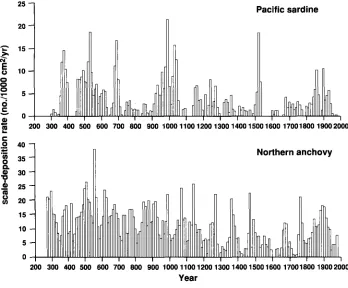
Fig. 2. Deposition rates of fish scales from the Pacific sardine and the northern anchovy from anaerobic sediments in the Santa Barbara Basin over the past 1,700 years. These rates of fish scale deposition were proportional to population abundance of these spe- cies. (From Baumgartner et al. 1994.)
(a process referred to as recruitment). For most marine fish there is a critical period near the time at which the lar- val yolk sac is completely absorbed and the fish must begin to fend for themselves. At this time the fish must have adequate available food, and they must be at, or on their way to, a favorable location (in terms of preda- tors, habitat and so on). Poor recruit- ment is usually the result of one of these conditions not being satisfied. A well-known example in the California Current is the fact that anchovy larvae require periods of relatively calm weather so that high enough food den- sities for them to feed adequately can develop, an effect named for its dis- coverer, Reuben Lasker, a prominent NMFS scientist (Mullin 1995).
Biological oceanography in the California Current really got started during the decline of the sardine fish- ery (which collapsed from landings of 700 million metric tons per year to es- sentially zero in the late 1940s and early 1950s) with the founding of the California Cooperative Fisheries In- vestigation (CalCOFI). CalCOFI was founded to coordinate the studies of a number of institutions seeking the causes of this decline, although the program has expanded to include many other species and to address many other topics in the California Current. The CalCOFI sampling pro- gram, carried on over the past 50 years, is one of the best in the world. One example of the value of a long- term monitoring program such as this is the recent identification by Scripps scientists of the dramatic decline in zooplankton biomass over the past 30 years (Roemmich and McGowan 1995). The annual scientific meeting of CalCOFI is a focal point of biological and physical research in the California Current, and much of the Sea Grant- funded research on fisheries oceanog- raphy and marine policy is reported and discussed there.
[image:3.594.34.382.400.688.2]formation on this fishery is the depos- its of fish scales in the sediments in the Santa Barbara Basin. The relative abundance of scales of sardines, an- chovies and hake at each depth are a record of population fluctuations in each of these species over the past 2,000 years (Soutar and Isaacs 1974) (fig. 2). Sea Grant-funded scientists are trying to determine whether these changes could be related to past cli- mate change (Baumgartner et al. 1994).
Marine scientists have recently be- gun to realize that similar fluctuations in fish populations occur at the same time even though the populations are on different sides of the ocean or in different hemispheres. For example, the Kuroshio-Oyashio sardine off Ja- pan was at high levels over the same time as the Pacific sardine off Califor- nia, and it has recently increased again to high levels at the same time as the sardine in the California Current. These changes are thought to be due to changes in physical conditions (re- gime shifts), possibly linked by atmo- spheric interactions over large distances.
In another dramatic decline, catches of the commercially harvested Dunge- ness crab near San Francisco collapsed from 12 million pounds to less than a million pounds in the late 1950s, just after the major El Nifio of 1957-1958. Several explanations have been pro- posed, among them a permanent shift in ocean conditions. The cause of the de- cline is still not known with certainty.
Further north, in Northern Califor- nia, Oregon and Washington, Dunge- ness crab catches go through regular cycles of about 10 years. Since the late 1970s, research has focused on the causes of the cycles, so that they might be managed to avoid these boom-and- bust cycles. Groups at UC Davis and Humboldt State University used math- ematical models combined with field data to show how the negative influ- ences of adult crabs on recruitment of juveniles (including cannibalism of adults on newly settled juveniles and density-dependent fecundity) could contribute to these cycles.
Research since the mid-1980s has indicated that annual variability in the way currents transport the planktonic larvae of crabs and other species also
g
8
A commercial fisher hoists aboard a crab trap with a meager catch. Although catches are highly variable, most fisheries manaclers believe the Dungeness crab population is
healthy.
has a critical effect on their population booms and busts. Data from Russian plankton cruises off the California coast indicate that Dungeness crab lar- vae disperse several hundred kilome- ters offshore, but may be transported back toward suitable nearshore habitat by migrating vertically between layers of water flowing in different direc- tions. Modeling studies have shown that the timing of egg hatching and larval release into the plankton rela- tive to the timing of the “spring transi- tion” to the upwelling season also has a critical effect on the number of Dungeness crab larvae that success- fully return to near shore. Other mod- eling studies of the Dungeness crab subpopulations from Northern Cali- fornia to Washington have shown that the patterns of larval dispersal be- tween subpopulations can have a criti- cal effect on whether populations cycle and how synchronous these cycles are along the coast (Botsford et al. 1994).
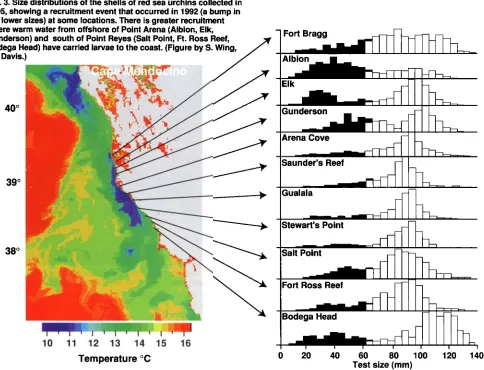
Researchers at UC Davis have re- cently shown how upwelling and re- laxation also affect the alongshore dis- persal of planktonic larvae along the coast. They have found that the larvae of fish and shellfish are not washed
away to Southern California in the up- welling jet, but are retained in the lee side of promontories such as Point Reyes during strong upwelling (Wing et al. 1995). Then, during periods of upwelling relaxation, when winds cease or reverse for a few days, these larvae are transported northward, where they settle to the bottom along the coast. Such upwelling shadows occur at several points along the coast, and they may be important in maintaining persistent populations in spite of strong upwelling in Northern Califor- nia. Researchers at the Moss Landing Marine Laboratory of the California State University system are investigat- ing the impact of similar transport processes on rockfish recruitment (see page 41).
Fig. 3. Size distributions of the shells of red sea urchins collected in 1995, showing a recruitment event that occurred in 1992 (a bump in the lower sizes) at some locations. There is greater recruitment where warm water from offshore of Point Arena (Albion. Elk. Bodega Head) have carried larvae to the coast. (Figure by S. Wing, Gunderson) and south of Point Reyes (Salt Point, Ft. Ross Reef, UC Davis.)
40"
39"
380
Temperature "C
settlement elsewhere. This information is to being used to develop new, more efficient harvesting strategies for this fishery.
Populations of the two species of Pacific salmon that once supplied a prodigious harvest off California's shores appeared to fluctuate in cycles related to those in the Dungeness crab population during the 1950s through the 1970s, but more recently have been dominated by decline (see California
Agriculture Nov.-Dec. 1995). One of
the runs of chinook salmon on the Sac- ramento River is listed under the fed- eral Endangered Species Act, and oth- ers are proposed. Catch of coho salmon has declined over the past sev- eral decades, and some of these stocks are listed under both the state and the federal Endangered Species Acts, while others are proposed at both lev- els of government. At the same time, there has been a dramatic increase in Alaska salmon stocks and a glut in the Alaska market. We need to know how
I
A l b i o n d-
Salt Point
-
-Fort Ross Reef - -
-
BodegaHead
-
I I0 20 40 60 80 100 120 140
Test size (mm)
much the regime shift in the 1970s con- tributed to both the increase in Alaskan salmon stocks and the concomitant de- cline in salmon stocks off the West Coast of the contiguous United States by alter- ing the relative split of the North Pacific Current (Pearcy 1992).
The next decade
These examples illustrate how our understanding of the coastal ocean has progressed steadily over the past 40 years, but it is still not adequate to re- solve the problems that confront us. Al- though we understand some of the bio- logical responses to physical changes, we do not completely understand the processes controlling the abundance of even one single population.
The general reason for wanting to understand the natural fluctuations of populations is to reduce uncertainty. One of the oldest marine problems, overfishing, is a good example of the general effect of uncertainty on re- source management. Overfishing re-
sults from the fact that managers are under considerable political and social pressure to increase allowable catches, but fisheries scientists are not able to tell them with certainty how much fishing is too much, nor whether an ongoing decline in a fishery is due to overharvesting or to natural causes. The consequence of this interaction is increased harvest pressure.
This combination of political pres- sure on the one hand and scientific un- certainty on the other is present in all of the threats facing the marine envi- ronment. Research on natural change in marine populations can reduce this uncertainty. To be politically viable, solutions to resource problems (like application of the Endangered Species Act) must be supported by an ability to differentiate the effects of human activities from those of natural change.
A number of harvested species worldwide have shown dramatic de- clines. Species now in danger of
continued from p. 40
extinction are the most extreme ex- amples. Recovering endangered spe- cies requires identification of the causes of decline, and there is almost inevitably some confounding of natu- ral and human causes. We simply don’t know enough to untangle the threads. For example, the dams on the Snake River, where endangered stocks of Columbia River chinook salmon spawn, were completed in the mid- 1970s, about the same time as the re- gime shift in the northeast Pacific. An- other example, closer to home, is the decline in coho salmon over the past decade, during the period following the regime shift in the 1970s, but ac- companied by increasing diversions in California’s coastal streams and, until recently, by high harvest rates.
One possible cause of major alter- ations in the biological productivity in California’s coastal ocean is climate change, which could cause dramatic changes in coastal populations by in- creasing the frequency or intensity of ENS0 events, or by increasing up- welling (Bakun 1990). The decline in zooplankton biomass off Southern California is an example of long-term change that may be due to change in climate.
The advances of the past several de- cades have brought us closer to the an- swers we need by sharpening our fo- cus on the time and space scales at which important processes operate. Ecologists, oceanographers and meteo- rologists realize that an important re- quirement for solving a problem is choosing the proper temporal and spa- tial scale at which to approach it. One example is the recent appreciation of the fact that large changes in marine environments are taking place on a global scale. The apparent synchrony of various dramatic shifts in popula- tion abundance in different parts of the world, and a realization of the pos- sible atmospheric linkages across ocean basin scales, are allowing us to link events that previously seemed isolated.
population questions may encompass some of the keys to understanding these shifts in abundance. One advan-
This increase in the scope of marine
tage of a global perspective is the gain in analytical power possible through a comparative approach. Conclusions are often hampered by the limited time spans of available population data. By increasing the number of “ex- perimental replicates” through a com- parative approach, we have essentially increased the amount of available data. In addition to the shift in focus of spatial scale, oceanographers have re- cently realized that biological pro- cesses change on longer time scales (50 years or more), most likely in response to large-scale fundamental changes in the physical state of the atmosphere and ocean.
Another shift in the scale of re- search focus is our increased aware- ness of the importance of circulation near promontories and changes in up- welling on weekly time scales in main- taining coastal populations and bio- logical communities. Even though we are interested in changes in recruit- ment from year to year, we need to look within years to describe the mechanisms responsible for longer term changes. With regard to spatial scales, we are interested in population levels and ecosystem health along the entire coast, but we may be able to manage better by taking advantage of the variability in productivity and cir- culation on much smaller scales, such as those shown in figure 3. One grow- ing trend in the management of coastal ecosystems is the use of pro- tected areas or reserves. The design of management strategies involving pro- tected areas requires understanding variability in productivity and larval dispersal on these scales.
There is a growing trend to manage coastal ecosystems using protected areas or re- serves. Big Creek Ecological Reserve, shown above, is on the coast of Monterey County,
20 miles south of Big Sur.
f o r m e d t o coordinate research on simi- l a r m a r i n e species in similar ecosys- tems (for example, eastern b o u n d a r y u p w e l l i n g areas) throughout the
world, a n d to enhance research capa- bilities in countries with less technol- o g y a n d resources t h a n the U n i t e d States. UC will continue t o contribute
to this research area through the Scripps I n s t i t u t i o n o f Oceanography at
UCSD, the M a r i n e Science Center a t UCSB a n d Long M a r i n e Laboratory a t UCSC. Also, Uc's Bodega M a r i n e Laboratory i s considering i n i t i a t i o n of
a p r o g r a m to s t u d y the local m a r i n e environment. O t h e r participants will
include the Moss L a n d i n g M a r i n e Laboratory a n d Humboldt State Uni-
versity, both of w h i c h m a i n t a i n active research a n d teaching programs a n d research vessels. N a t i o n a l M a r i n e Fisheries Service scientists will con- t i n u e to p l a y a leading role.
W e expect the n e x t decade of re- search in California's coastal ocean to
b e exciting a n d productive, a n d w e hope t o g a i n t h e k n o w l e d g e necessary
to m a i n t a i n the biodiversity a n d po-
tential for food p r o d u c t i o n in this valuable n a t u r a l resource, our coastal ocean.
L. W. Botsford is Professor, Department of Wildlife, Fish, and Conservation Biology, UC Davis.
I would like to acknowledge the many dedicated marine scientists who have con- tributed to the results described here, whose work I did not have the space to ref- erence in detail. I also thank John
McGowan of Scripps Institution of Oceanography and Ted Strub of Oregon State University for their comments on this article.
References
Bakun A. 1990. Global climate change and intensification of coastal ocean upwelling. Science 247:198-201.
Bakun A. 1996. Patterns in the Ocean: Ocean Processes and Marine Population Dy- namics. La Jolla, CA. California Sea Grant College System. 339 p.
Baumgartner TR, Soutar A, Riedel W.
1994. Reconstruction of the history of Pacific
sardine and northern anchovy populations over the past two mil- lennia from sediments of the Santa Barbara Basin. CalCOFl Report. 33:24-40.
Botsford LW, Moloney CL, Hastings A, et al. 1994. The influ- ence of spatially and temporally varying oceanographic conditions on meroplanktonic metapop- ulations. Deep-sea Res II
McGowan JA. 1982. Large-scale interannual physical and biologi- cal interactions in the California Current. J Marine Res 40:1095- 1125.
Mann KH, Lazier JRN. 1996.
Dynamics of marine ecosystems: Biological-physical interactions in
411107-145.
Chelton DP, Bernal PA,
the oceans. Blackwell Scientific.
Mullin M. 1995. Webs and scales. Univ Washington Pr.
Parrish RH, Nelson CS, Bakun A. 1981.
Transport mechanisms and reproductive suc- cess of fishes in the California Current. Biolo Oceanog 1 :175-203.
Pearcy W. 1992. Ocean Ecology of North Pacific Salmonids. Seattle: Univ Washing- ton Pr.
Reid JL. 1962. On the circulation, phos- phate-phosphorous content and zooplankton volume in the upper part of the Pacific Ocean. Limnol Oceanog 7:287-306.
Roemmich D, McGowan J. 1995. Climatic warming and the decline of zooplankton of the California Current. Science 267:1324-6.
Soutar A, lsaacs JD. 1974. Abundance of pelagic fish during the 19th and 20th centu- ries as recorded in anaerobic sediment of the Californias. Fish Bull 72:257-73.
Tegner MJ, Dayton PK. 1991. Sea ur- chins, El Niiios, and the long term stability of Southern California kelp forest communities. Marine Ecol Prog Ser 77:49-63.
Wing SR, Largier JL, Botsford LW, Quinn JF. 1995. Settlement and transport of benthic invertebrates in an intermittent upwelling region. Limnol Oceanog 40:316-29.