ENTERPRISE ADOPTION ORIENTED CLOUD COMPUTING
PERFORMANCE OPTIMIZATION
Moustafa Noureddine
A thesis submitted in partial fulfilment of the requirements of the University of East London for the degree of Doctor of Philosophy
2
Abstract
Cloud computing in the Enterprise has emerged as a new paradigm that brings both business
opportunities and software engineering challenges. In Cloud computing, business
participants such as service providers, enterprise solutions, and marketplace applications
are required to adopt a Cloud architecture engineered for security and performance. One
of the major hurdles of formal adoption of Cloud solutions in the enterprise is performance.
Enterprise applications (e.g., SAP, SharePoint, Yammer, Lync Server, and Exchange Server)
require a mechanism to predict and manage performance expectations in a secure way. This
research addresses two areas of performance challenges: Capacity planning to ensure
resources are provisioned in a way that meets requirements while minimizing total cost of
ownership; and optimization to authentication protocols that enable enterprise applications
to authenticate among each other and meet the performance requirements for enterprise
servers, including third party marketplace applications. For the first set of optimizations, the
theory was formulated using a stochastic process where multiple experiments were
monitored and data collected over time. The results were then validated using a real-life
enterprise product called Lync Server. The second set of optimizations was achieved by
introducing provisioning steps to pre-establish trust among enterprise applications servers,
the associated authorisation server, and the clients interested in access to protected
3 to authentication among all communicating entities in the authentication protocol and
referral tokens are used to establish trust federation for marketplace applications across
organizations. Various case studies and validation on commercially available products were
used throughout the research to illustrate the concepts. Such performance optimizations
have proved to help enterprise organizations meet their scalability requirements. Some of
the work produced has been adopted by Microsoft and made available as a downloadable
4
Table of Contents
ABSTRACT ... 2
LIST OF TABLES ... 6
LIST OF FIGURES ... 7
CHAPTER 1: INTRODUCTION ... 8
1.1MOTIVATION ... 8
1.2RESEARCH METHODOLOGY ... 10
1.3SUMMARY OF CONTRIBUTIONS ... 11
1.4PLAN OF THE RESEARCH ... 13
CHAPTER 2: LITERATURE REVIEW ...15
2.1CAPACITY PLANNING ... 15
2.1.1 Introduction ... 15
2.1.2 Literature Review of Capacity planning in the Cloud ... 16
2.1.3 Dynamic Capacity Allocation ... 19
2.1.4 Static Capacity Allocation ... 21
2.2CLOUD AUTHENTICATION ... 24
2.2.1 Introduction ... 24
2.2.2 Analysis of Single-Sign-On (SSO) and Federated Identity Management (FIM) ... 26
2.2.3 OpendID ... 31
2.2.4 SAML ... 35
2.2.5 OAuth 2.0 ... 39
2.3CONCLUSION OF LITERATURE REVIEW ... 45
CHAPTER 3: CAPACITY PLANNING USING MODALITY COST ANALYSIS ...47
3.1INTRODUCTION AND MOTIVATION ... 47
3.2MEDIA APPLICATIONS PERFORMANCE ... 48
3.3MODALITY COST ANALYSIS (MCA)METHODOLOGY ... 49
3.4EXPERIMENTS AND RESULTS ... 54
3.5VALIDATION METHODOLOGY ... 59
3.6HARDWARE BENCHMARKS ... 67
3.7CONCLUSION ... 70
CHAPTER 4: LYNC SERVER CAPACITY PLANNING CALCULATOR ...72
4.1OVERVIEW ... 72
4.2USING THE CAPACITY CALCULATOR ... 74
4.2.1 Instant Messaging and Presence ... 76
4.2.2 Enterprise Voice ... 76
4.2.3 Conferencing ... 77
5
4.3ADJUSTING FOR PROCESSORS’VARIATIONS ... 80
4.4EXAMPLE CALCULATING NEEDED RESOURCES ... 81
CHAPTER 5: PERFORMANCE OF CLOUD AUTHENTICATION ...87
5.1INTRODUCTION TO CLOUD AUTHENTICATION ... 87
5.2OAUTH OPTIMIZATION FOR ENTERPRISE ADOPTION ... 89
5.3CASE STUDY ... 92
5.4CONCLUSION ... 97
CHAPTER 6: FEDERATION IN THE ENTERPRISE ...98
6.1INTRODUCTION TO CLOUD FEDERATION ... 98
6.2MARKETPLACE AS A SERVICE MAAS ... 100
6.3ENTERPRISE FEDERATION ... 102
6.4FEDERATION CASE STUDY ... 106
6.5CONCLUSION ... 115
CHAPTER 7: CONCLUSION ... 116
7.1SUMMARY ... 116
7.2LIMITATIONS &FUTURE WORK ... 117
REFERENCES ... 118
6
List of Tables
Table 1: Main Authentication Protocols ... 26
Table 2: Authentication Protocols ... 44
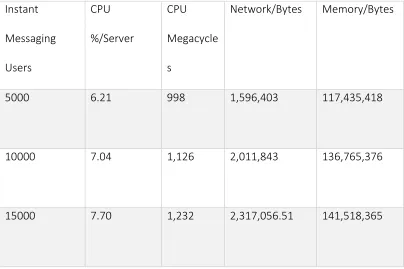
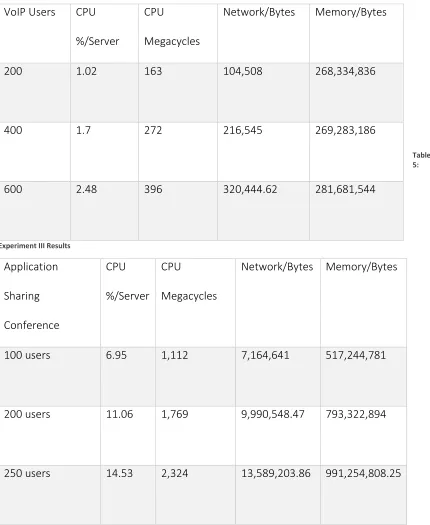
Table 3: Experiment I Results ... 56
Table 4: Experiment II Results ... 57
Table 5: Experiment III Results ... 57
Table 6: Experiment IV Results ... 58
Table 7: MCA-S Experiment Results ... 63
Table 8: MCA-M Experiment Results ... 64
Table 9: MCA-L Experiment Results ... 65
Table 10: Benchmarking example modalities ... 69
Table 11: Server CPU Capacity Calculations ... 82
Table 12: Audio/Video CPU Capacity Calculations ... 85
Table 13: Resource Server (SharePoint) Table ... 93
Table 14: Authorisation Server (AS1) Table ... 93
Table 15: Client Table (SAP) ... 94
Table 16: The Modified Protocol Access Token Parameters ... 96
Table 17: Authorisation Server (AS1) ... 107
Table 18: Access token parameters for the modified protocol ... 109
Table 19: Authorisation Server (AS1) Table Supporting Identity Federation ... 110
7
List of Figures
Figure 1: OpenID Protocol Flow... 33
Figure 2: SAML Protocol Flow ... 38
Figure 3: OAuth 2.0 Protocol Flow ... 42
Figure 4: CPU utilization ... 50
Figure 5: Memory utilization ... 51
Figure 6: Bandwidth utilization ... 52
Figure 7: Lync Server Stress Tool GUI ... 60
Figure 8: CPU average for each server ... 62
Figure 9: Lync Server Capacity Planning Calculator ... 75
Figure 10: OAuth 2.0 Protocol Flow ... 90
Figure 11: OAuth 2.0 Modified Flow ... 91
Figure 12: UML Sequence Diagram of a marketplace application ... 104
8
Chapter 1: Introduction
1.1 Motivation
Adoption of Cloud computing model can only become a viable alternative for large
enterprises if these infrastructures can provide proper levels of performance that assure
quality and guarantee service level agreements are met. An enterprise that focuses on
moving to the Cloud needs to know and apply the proper configuration to provide the right
levels for individual services if they are deployed in the Cloud (Noureddine & Bashroush,
2011). Security, availability, performance, and privacy are examples of many metrics that
are important for an enterprise to ensure a successful migration to the Cloud. This research
covers an important metric necessary for Cloud adoption—performance optimization to
guarantee service license agreements (SLAs). In order to guarantee performance SLAs,
service providers in the Cloud tend to over-provision expensive resources. This is done
mainly due to the lack of tools that guide such optimization of performance and cost, and
SLA violations are costly for Cloud-hosted applications. This research addresses these issues
by providing a methodology to help enterprises to make informed decisions with respect to
the right level of resource provisioning and optimizing server-to-server authentication
mechanisms for Cloud authentication and federation.
The first research area demonstrates a tested methodology to guide resource provisioning
9 to approximate the performance predicted from each modality (e.g., instant messaging and
voice calls). The methodology is based on the representation of resource cost per modality.
Subsequently, the research presents how the estimate of the expected application
performance could guide resource provisioning decisions. The methodology is illustrated
through various case studies using a commercially available media application, the Microsoft
Lync Server.
Secondly, in addition to capacity planning, in order to further encourage enterprise adoption
of Cloud services, providers need to ensure adequate and secure architecture is
implemented with minimal performance overhead. Today, most large Cloud providers use
OAuth (Open Authentication) to enable authentication in the Cloud. OAuth protocol was
published in December 2007 and quickly became the industry standard for web-based
access delegation (Yang & Manoharan, 2013), (Pai, et al., 2011). However, OAuth faced
many challenges to enter the enterprise domain, mainly due to the lack of performance
capabilities currently offered by the protocol. In this research, optimization to OAuth is
introduced where the Authorisation Server is provisioned with an explicit authorisation table
so that servers can act on behalf of users and reduce per-client round trip to OAuth
authorisation server. This reduces the amount of processing for some popular protected
resources and alleviates the risk of potential threats such as Denial-of-Service (DoS) attacks
10 With the combination of optimal hardware resource provisioning and reduced
authentication overhead, Cloud providers can minimize the cost, guarantee SLAs, and secure
access to data resources, all of which are key aspects for enabling better Cloud adoption in
the Enterprise.
1.2 Research Methodology
In the early stages of this research, a hypothesis is developed to solve the issues related to
performance for enterprise adoption of Cloud computing. The hypothesis calls for a
methodology to estimate hardware resources cost for cloud applications to ensure service
level agreements are met.
Two sets of experiments are performed. In the first set of experiments, the resource
overhead for four modalities are measured in isolation, namely instant messaging, Voice
over IP (VoIP), application sharing conference, and address book download. In the second
set, the resource overhead for three scenarios that combine all of the four modalities
together are measured simulating a real end user experiment. The second set of
experiments is used to validate the hypothesis. Each set of experiments are run for several
hours where data is collected every hour. The hardware for both set of experiments were
fixed: A server with dual processors quad-core 2.0 GHz (2,000 megacycles per second), 16
gigabytes of memory, 30GB disk space, and 2-port 1 gigabit per second network adapter.
The results of the experiments showed that there is possible to calculate capacity using the
11 deployed on the fixed experiment hardware server, and a simulation tool representing users
accessing the server is developed for these experiments. The results show that the
methodology is valid for production software.
1.3 Summary of Contributions
The key contributions of this research are in presenting methodologies that will allow the
Enterprise to adopt Cloud Computing, the contributions are summarized in four different
areas:
1. Develop a methodology for capacity planning to estimate the resources needed of
the Cloud service providers, this will reduce total cost of ownership and guarantees
service level agreements are met.
2. Develop the Lync Server Capacity Calculator as a tool to guide the resources needed
to host Lync Server in the Cloud.
3. Optimization to OAuth authentication mechanisms to make it more suitable for
Enterprise adoption, with focus on server-to-server authentication. Such
optimization will enable large enterprise organizations to meet the performance and
scalability expectations when hosting hundreds of millions of users.
4. Optimization to authentication mechanisms to enable cloud federation with focus
12 enterprise applications to meet performance expectations when serving large
numbers of third party applications across multiple federated organizations.
The following is a list of publications made on the findings of this research:
1. M. Noureddine, R. B. (2013). An Authentication Model towards Cloud Federation
in the Enterprise. Journal of Systems and Software.
2. M. Noureddine, R. B. (2011). A Performance Optimization Model towards OAuth
2.0 Adoption in the Enterprise. Proceedings of the 7th International Conference
on Global Security, Safety & Sustainability (ICGS3). Greece.
3. M. Noureddine, R. B. (2011). A provisioning model towards OAuth 2.0
performance optimization. IEEE 10th International on Cybernetic Intelligent
Systems (CIS), (pp. 76-80).
4. M. Noureddine, R. B. (2011). Cost Effective Datacentre Capacity Planning Analysis
Using Modality Cost Methodology. Ubiquitous Computing and Communication
Journal (UBICC).
5. M. Noureddine, R. B. (2011). Modality cost analysis based methodology for cost
effective datacentre capacity planning in the cloud. Special Issue on the
International Conference on Information and Communication System, ICIC.
6. M. Noureddine, R. B. (2011). Modality Cost Analysis: A Methodology for Cost
Effective Datacentre Capacity Planning in the Cloud. International Conference on
13 7. R. Bashroush, M. N. (2012). A Cost Effective Cloud Datacentre Capacity Planning
Method Based on Modality Cost Analysis. International Journal of
Communication Networks and Distributed Systems.
8. R. Bashroush, M. N. (in review). Predictive Cloud Service Management for
Optimizing Energy Efficiency: A Modality Based Approach, IEEE Transactions on
Network and Service Management (in review)
9. M. Noureddine, R. B. (in review). Capacity Planning Analysis and Workload
Prediction for Lync Server, IEEE Transactions on Dependable and Secure
Computing (progressed to second round of reviewing)
1.4 Plan of the Research
The thesis is structured in the following way:
Part I: Introduction
Chapter 1: Problem statement and contribution
Chapter 2: Literature Review
Part II: Capacity Planning
Chapter 3: Capacity planning using modality cost analysis methodology
Chapter 4: The Lync Server capacity planning calculator
Part III: Cloud Authentication Optimization
Chapter 5: Performance of Cloud authentication
14 Part IV: Conclusion
Chapter 7: Conclusion and Future Work
Chapter 1 introduces the challenges with enterprise adoption of Cloud computing,
summarizes the contributions and lists out the recent publications. Chapter 2 covers the
literature review and organizes them into two main subsections, literature review for the
capacity planning research area and literature review for Cloud authentication protocols and
includes a survey of most popular authentication protocols including their strengths and
weaknesses. Chapter 3 covers the methodology developed in this research to help Cloud
providers ensures the optimal level of resources are used to serve the needs of their hosted
customers while Chapter 4 illustrates the Capacity Planning Calculator tool developed out
of this research to help guide the resource allocation for Lync Server. Chapter 5 discusses
the performance of Cloud authentication and the optimization developed in this research to
address the enterprise challenges with adopting authentication protocols. Chapter 6 builds
on chapter 5 and extends the optimization to cover cloud federation for marketplace
applications. At last, chapter 7 provides conclusion remarks with a summary and future
15
Chapter 2: Literature Review
2.1 Capacity Planning
A series of data centre capacity planning methods have been proposed to minimize resource
utilization while guaranteeing service level agreements (SLAs). The goal of this research area
is to help Cloud service providers to provision hardware resources while maintaining
performance expectations. This literature review considers current approaches to Cloud
capacity planning schemes. This consideration is beneficial to Cloud providers interested in
reducing total cost while guaranteeing performance expectations.
2.1.1 Introduction
Cloud computing provides an advantage for companies and institutions that rely on a grand
scale IT operations in a cost effective way. The early Cloud-based models have enabled the
enterprises to access more computing resources and more services at an attractive price
model to reduce total cost of ownership (TCO) (Sukumar, 2011). The Cloud architectures are
designed in a way that multiple services as IaaS (Infrastructure as a Service), PaaS (Platform
as a Service), and SaaS (Software as a Service) are provided to a large set of consumers in a
16 allocated with a set of physical or virtual servers that run in the datacentres. These servers
are available in different types with varying capabilities such as number of processors,
different network bandwidth, different ranges of memory, and different storage capacity.
The capacity planning process is one of the modern fields of interest for Cloud computing,
and it is used for estimating the efficiency of the Cloud operations. Ad-hoc or intuitive
resource allocation processes can drive the Cloud network towards an operational failure
due to missed SLAs or wasted resources due to over-provisioning. Therefore, it is the
responsibility of Cloud service providers to ensure appropriate resources are allocated to
each customer to guarantee acceptable performance of their products. Many Cloud
providers misunderstand the relationship between capacity planning and performance
tuning (Allspaw, 2008). While they affect each other significantly, they have different goals.
Performance tuning optimizes an existing system for better performance, while capacity
planning determines what the system needs while maintaining the performance baseline. In
this chapter, a summarized number of the well-known capacity planning models are
presented, and an evaluation of the known strength and weaknesses in the context of
capacity planning for Cloud providers are discussed.
2.1.2 Literature Review of Capacity planning in the Cloud
Cloud computing offers the facility to utilize shared hardware and software resources and
17 operations that meet changing and evolving business requirements. The location of physical
resources and devices being accessed are typically not known to the end user. Cloud
providers such as Amazon EC2 (IaaS), Azure (PaaS), and Google (SaaS) are transforming
labour intensive, hard-coded systems into shared, automated, and fully managed adaptive
services which promise great opportunities for reducing energy and hardware costs (Lenk,
et al., 2009). These providers need to provision hardware resources to meet required
capacity. Required capacity is the minimum amount of capacity needed to satisfy resource
demands for workloads on a server resource (Rolia, et al., 2005). An important issue is how
various server resources may be allocated to an application such that the service level
agreements (SLAs) are met while minimizing the cost. Using heuristic and intuitive
methodology usually leads to more resources than are actually necessary. While such
over-provisioning may guarantee performance, this guarantee may come at a very high cost. A
capacity planning model may guide the Cloud service provider in making informed decisions
about the right level of resources, so that acceptable service performance may be provided
in a cost-effective manner. There are various research areas that provide guidance for Cloud
providers to allocate the right capacity and minimize hardware resource utilization. They
can be broken into two main areas, 1) dynamic capacity allocation (Simmons, et al., 2007),
(Ye Hu, 2009), and 2) static capacity allocation (Zhu, et al., 2008), (Daniel Gmach, 2007),
18 In dynamic capacity allocation, the resources are allocated dynamically as needed and
demand peaks, while, in statistic allocation, the needs are pre-estimated and expected
resource requirements are preconfigured until the requirements or demand of the
application is planned to change. For example, if an application is expected to have a
response time of less than t seconds and if the workload is expected to increase then the
required computing resources will increase accordingly to ensure response time remains <
t. One approach for ensuring the satisfaction of the computing needs of a particular
application is to provide enough resources for the anticipated peak demand (static
allocation). Alternatively, in dynamic allocation, the resources are dynamically allocated as
needed and de-allocated from a hardware resource when the demand for the applications
is decreased.
Both dynamic and static allocation models research areas cover virtualization and
virtualization overhead such as in (Chris Matthews, 2009), (Yexi Jiang, 2013), and shared
resource pools vs. dedicated resource pools (Zhiliang Zhu, 2011) (Menasce & Bernnani,
2006). The next sections analyse various dynamic and static capacity planning research
19
2.1.3 Dynamic Capacity Allocation
Every Cloud provider facility, composing of data centres, servers, tooling and fixtures, etc.,
has a limited amount of capacity. Effective consumption and management of production
resources have significant implication to the profitability of the organization. Capacity
planning helps in laying the base for all resource optimization activities. However, due to the
fluctuation of’ demand pattern, a Cloud provider may experience unexpected utilization
caused by fluctuating demands. The ability to response to the dynamic demand and product
mix changes has become a key competitive advantage, even at the short term and long term
capacity planning arena. Much of the research in this field is at its early phases with respect
to the understanding of effective allocation of the dynamic resources for optimal utilization
in Cloud data centres. Yagiz Onat Yazir et.al (Yagiz Onat Yazir, 2010), have proposed a new
approach for dynamic independent resource management in Cloud computing. It is a
two-phase work. In the first two-phase, the resource management is allocated into independent
tasks, which is done by independent node agents which are lightly coupled with the physical
machines in the data centre. In the second phase, the autonomous node agents run the
configuration in parallel through multiple threads that process decision analysis. Their
approach claims to have a positive reflection on feasibility, scalability, and flexibility. T.R.
Gopalakrishnan et.al (Gopalakrishnan & Vaidehi, 2011) developed a Rule Based Resource
allocation model (RBRAM). It is a time-marching model that processes Supply-Demand
20 achieved through allocating the right resources to the Cloud at the right time. Daniel
Warneke and Odej Kao (Warneke & Odej, 2011) have designed a data processing framework
and have compared it with other data processing framework. The research they proposed
clearly takes advantage of the dynamic resource allocation offered by Infrastructure as a
Service (IaaS) Cloud for task scheduling and execution. Jiayin et.al (Jiyin Li, 2010), have
proposed a Cloud capacity planning system that uses adaptive resource allocation with
preconfigured tasks. The algorithms in this research adjust the resource allocation
dynamically based on the progress of the actual task completion. Therefore, they are able
to improve utilization by predicting next in line task requirements. Graham Kirby et.al
(Graham Kirby, 2010) designed an ad hoc Cloud model. Their research shows that the
proposed model is performance resilient and self-managing where it can balance potentially
conflicting objectives. The authors claim that their ad-hoc Cloud model allows complex
Cloud style applications to utilize unused resources on hardware allocated in the datacentre.
Another area of research on dynamic capacity allocation looks at specific application type.
Peter Bodík et.al (Peter Bodík, 2009) research discusses methodologies for training and
tuning data centre performance. It focuses on online training without violating the SLA in
place. Mainly, it identifies the challenges in offline training, for example, not necessarily
reflecting the capacity of application in production, and that the performance profile
changes regularly because of changes of how applications are used. In this research, the
authors propose to train the performance model using an exploration method that quickly
21 claimed in the research provides an exploration process to strike a balance between not
violating the performance SLAs and the need to collect sufficient data to train an accurate
performance model, which requires pushing the system close to its capacity. By using this
exploration policy, they can train a performance model of a Web 2.0 application in less than
an hour and then immediately use the model in a resource allocation controller. In this
research, analysis is provided of how the resources in a Cloud computing infrastructure may
be managed in a cost efficient manner to reduce the total cost of ownership, similar research
focuses on e-Commerce applications exclusively (Gokhale, 2008), (Lu & Gokhale, 2006).
2.1.4 Static Capacity Allocation
Static allocation of hardware resources is a method for forecasting resources demands
upfront. This method calls for a solution that ensure SLAs for applications in changing
datacentre conditions while hiding the complexity from the owners or administrators of the
datacentre and the application owners. Service providers, today, achieve this through virtual
resources or physical resources. Virtualization technologies promise great opportunities for
reducing energy and hardware costs through server consolidation (Song, et al., 2008) (J.
Zhang, 2007). In addition, virtualization can optimize resource sharing among applications
hosted in different virtual machines to better meet their resource needs. However, to safely
transition and correctly estimate and predict the required capacity, service providers need
to estimate the additional resource requirements incurred by virtualization overheads. In
22 design a methodology for estimating the additional requirements when transferring an
application to virtual servers. The methodology has two key components: A set of
micro-benchmark to assess the various types of overhead caused by virtualization on a given
configuration, and another model to assess regression when virtualization is used. Their
experiments show impressive results predicting requirements within 5% median error. The
focus of their research is on CPU requirements due to the virtualization overhead. These
findings provide a methodology for Cloud providers interested in virtualizing datacentres to
assess additional capacity needed to make a move to the Cloud without excessively
over-provisioning resources.
In (Zhu, et al., 2008), the authors look at analysing various workload requirements per
application. In this research, the authors consider the issues of workload analysis, capacity
planning, and performance modelling with a goal to automate the use of resource machines
that are serving a large numbers of enterprise services. They provide a three tier approach
that relies on the following:
1. The classification of workload demand configurations
2. The simulation of synthetic workloads that help predict future demands based on
the configurations
3. A capacity placement recommendation service.
The accuracy of capacity planning predictions depends on the ability to depict capacity
demand patterns, to recognize trends so that future demands are predicted, and to align
23 determines the peak and repetitive nature of enterprise expectations. Resources are
automatically classified according to their expected behaviour based on the periodic model.
The repeated occurrences are evaluated for similarities. Synthetic transactions and
workloads are produced in a manner that mimics peak, periodic nature, and trending
behaviour of the various resources. In addition, the authors illustrate these analysis in a case
study that involves running 6 months of data for 139 enterprise applications used to apply
and evaluate the enterprise capacity analysis and related capacity planning approaches. The
results show that such approach is great for predicting the required capacity with little risk.
In (Bashroush & Noureddine, 2012), the research area provides a quantitative measurement
of the resource cost (CPU, memory, storage, and network bandwidth) imposed by each of
the modalities of the application, in isolation, allowing organizations to make informed
decisions with respect to the right level of resource provisioning. The objective of the
research is to illustrate a tested methodology to guide resource provisioning decisions. It
presented a systematic methodology to estimate the performance expected from each
modality based on the representation of resource cost per modality. Subsequently, the
research discussed how the estimate of the expected application performance could guide
resource provisioning decisions. The research illustrated the methodology using a case study
of commercially available media application, the Microsoft Lync Server 2010 (Noureddine &
Bashroush, 2011), (Noureddine & Bashroush, 2011), (Noureddine & Bashroush, 2011). Then
it validated the performance estimation and resource provisioning methodology using a
24 with all the modalities working together. The results can guide providers into provisioning
datacentres for optimizing performance and cost. By profiling the application into a set of
modalities and measuring hardware resources cost in isolation, Cloud providers should be
able to pinpoint their capacity to exact needs without wasting expensive resources. The
experiments provided in this research represented various application profiles. The results
showed that measuring modalities in isolation and using the results to provision datacentres
is an effective methodology. The research also discussed the process for applying hardware
benchmarks for scenarios where experimental hardware servers differ from deployment
hardware or for upgrading hardware servers without invalidating experimental results. The
challenge with shared CPU resources has been reviewed in (Sean Kenneth Barker, 2010) and
(Jones, et al., 1997) extensively with profiling the CPU utilization in a shared resource pool.
This research emphasized the opportunity to profile CPU utilization in a shared manner.
2.2 Cloud Authentication
A number of authentication protocols have been used over the years to enable Cloud
authentication. These protocols have strengths and weaknesses that make them desirable
for some organizations while an impediment for other organizations. This section analyses
the most popular ones and discusses their strength and weaknesses.
2.2.1 Introduction
Single Sign On (SSO) or federated identity means linking the electronic identities across
25 management (FIM) systems are the systems in place to enable such linking (Ernest & Foo,
2009). Simply, applications and servers do not necessarily need to own and store users’
credentials in order to authenticate them. Instead, they can use an identity management
system that is already storing a user’s electronic identity to authenticate the user, given, of
course, that the user has the right to access the resources. For providers of protected
resources, this is great as it relieves it from having to manage the identity of every user. It
is also very convenient for users, since they don’t have to keep a set of usernames and
passwords for every single application that they use. There are many protocols for federated
identity such as OpenID, SAML, and OAuth. These protocols are developed by three main
body standards, namely OASIS, W3C, and the IETF. They all provide standards that cover
current identity management protocols that combine multiple configurations. OASIS
supplies SAML and the Web services (WS-* (IEFT, 2010), (IETF, 2010)) suite of standards.
W3C provides HTTP architecture, URIs, and the service-related SOAP that are leveraged by
federated and distributed identity solutions. The IETF body of standards provides several
relevant standards, including the Transport Layer Security (TLS), Simple Authentication and
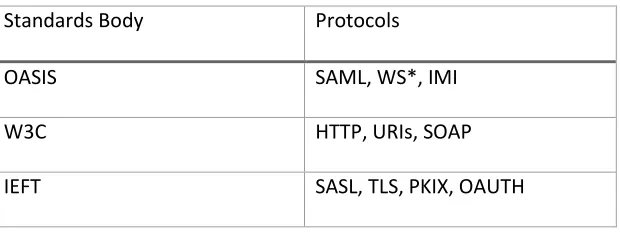
Security Layer (SASL), and Public-Key Infra- structure (PKIX) along with OAuth. Below in Table
26 Table 1: Main Authentication Protocols
Standards Body Protocols
OASIS SAML, WS*, IMI
W3C HTTP, URIs, SOAP
IEFT SASL, TLS, PKIX, OAUTH
In this section, a survey of the three main ones, OpenId, SAML, and OAuth along with analysis
of SSO (Single Sign On) and Federated Identity Management (FIM) services are discussed.
2.2.2 Analysis of Single-Sign-On (SSO) and Federated Identity
Management (FIM)
SSO (Single Sign On) is a service in which the user authenticates once at home identity
provider (IDP) and log in to access consecutive services within the federated service
providers. This area is covered in much research over the years. In (Madsen, et al., 2005),
Madsen et al. addressed multiple problems of federated identity. The research illustrated
that Federated Identity Management (FIM), which is architected on numerous industry
standards, streamlines the processes used by federated organizations in term of simplifying
the authentication configuration experience, sharing user identity objects, and accessing
various permissions using credentials requirements. However, Madsen illustrated the
ongoing problems and challenges in a federated identity environment such as exploitation
27 trustworthiness of the user. Problems and concerns of identity management are too many,
among others, most worthy of mention is users having to provide their credentials to many
service providers, leading to opportunities for the users’ credentials to be compromised
while executing the federated identity. In (Layouni & Pollet, 2009), Rodriguez et al.
demonstrated Federated Identity Architecture as a technique for resolving exposures. The
research identified the three methods for implementing security issue in Federated Identity
Architecture including Shibboleth, Liberty Alliance, and WS- Federation (Layouni & Pollet,
2009). In (Archer, et al., 2011), Archer et al. argued that the most common attacks are the
theft of users’ identity. Identity theft happens on the least secure channels while it is very
difficult to identify until the harm is done. Besides identity attacks, legal compliance is
another security problem in federated identity; the research does not address the enterprise
28 security problems related to federated identity concerning relationships between vendors
and consumers, these five security issues are:
1. Communication with a Human Resources system (HR) is tough where HR is the only
master source for employees’ identities.
2. Identities in partner organizations cannot be verified in an authoritative way.
3. Most organizations do not support federated identity.
4. The identity service provides the self-asserted identity for consumers yet it does not
cover the rest of identity types.
5. Organizations do not have a way to communicate directly, but rather federate or
proxy their identity services
These issues emphasize the need for good planning and to handling how identity attributes,
accounts, and lifecycle management of all identity-types will operate in the Cloud (Archer,
et al., 2011). Suriadi et al. in (Suriadi, et al., 2009) identified that one of the main problems
with these identity models is privacy in an SSO environment, relying parties (RP) or service
providers (SP). All of these three services hold important and secure user identities. These
services can also be collecting information about users from various identity providers.
Suriadi et al. also analysed sharing of user’s information by malicious identity providers and
service providers which can disclose a complete user’s identity and activities. Related to
29 caused web users to be careful of SSO implementations, the research claims that this is one
of the main reasons for the lack of widespread adoption. In (Wang, et al., 2012), Wang
discussed another problem of federated identity that is in the process of switching
authentication mechanisms to a single sing on solution. Such switch requires education of
the users and possible dissatisfaction if the transition to SSO is not smooth. What makes the
situation worse is the lack of demand from users as studies have shown that users are
already satisfied with their own password management.
Additional research on single sign on (SSO) studies the security implications of various
authentication protocols. Somorovsky et al. in (J. Somorovsky, 2012) investigated fourteen
implementations of SAML protocol and they founded many security issues that related to
Extensible Mark-up Language (XML) signature wrapping. These implementations used SAML
assertions for making security statements between subjects. Therefore, they developed an
automated tool to penetrate XML testing of signature wrapping, their research did not
address performance implications, rather focused exclusively on security penetration.
Wang (Wang, et al., 2012) considered alternative solutions to SSO when he analysed Privacy
Aware Identity Management and Authentication for the Web (SAW) as viable alternatives.
He highlighted vulnerabilities and security issues in the three common identity systems,
namely, Microsoft Passport, OpenID and SAML (Wang, 2011). Rodriguez et al. (Layouni &
Pollet, 2009) focused on Federated Identity Architecture (FIA) and analysed some of the
problem related to it. Furthermore, they explored commercial Federal Identity Architecture
30 suggested a cryptography based federated identity with some important features to make
it Cloud friendly and adaptable to the Cloud environment. They synchronized hierarchical
identity-based cryptography with federated identity management in the Cloud. However,
such research does not address specific values to increase adoption of SSO in the Cloud.
In (Li-chun, et al., 2008), the authors suggested a dynamic federated-domain authentication
scheme based on credit worthiness. The trust relationship is dynamically formed based on
the value of the credit. Based on this relationship, federated-domain authentication could
be established. However, the calculations need to be processed by a trusted third party
which can become bottlenecked during the authentication execution. In (Zhen-Guo, et al.,
2009), the authors put forward an enhanced dynamic authentication process based on
digital signature. The process can reduce how often the two parties communicate in order
to authenticate, and thus improving the availability of the network resources. But the
federated domains were not considered in this paper, so it was more applicable to
single-domain, thus such protocol is not considered adequate for large-scale distributed computing
environment.
Performance is yet another open challenge for organizations planning to adopt a security
protocol to achieve SSO. These areas have been analysed in different research areas. The
majority of the research have compared the performance of different tools that tune the
performance. In (Ferraz, 2005) server SOAP based tools were profiled to assess SOAP
31 study (Gray, 2004) looked into the performance of other middleware such as Java RMI and
CORBA. This research has illustrated that the performance of web services is a major
performance bottleneck, especially when applying reliability and security assertions. In
security related studies, Moralis et al. (Moralis, et al., 2007) have compared the performance
of SSO requirements through X.509 Token Profile against Kerberos Token Profile. Liu et al.
(Liu, et al., 2005) have performed several tests for different operations such as Encryption
vs. Decryption and Signing vs. Verifying using multiple various algorithms to assess their
performance capabilities for these operations. The study of Tang et al. (K. Tang, 2006) has
compared the performance of WSS Encryption and WSS Signing. Shirasuna et al. (Shirasuna,
et al., 2004) have assessed security methods for grid services. Their assessment has shown
that message level security is slower than transport level security, and should be used if
there is no additional requirement to use message level security. In (Sun Microsystems,
2010), WSIT (Web Service Interoperability Technology) is evaluated for the opportunity to
improve performance for WS* protocols, and its tight integration with WCF, however, it is
relatively new, and there is no published research that conducted performance assessment
of applying WSIT Security Mechanisms at this time.
2.2.3 OpendID
OpenID is an open standard adopted by Microsoft, Facebook, Google, Symantec, PayPal,
Yahoo, and Ping Identity, among many others. OpenID allows clients to be authenticated
32 OpenID providers to log in to protected services that accept the OpenID authentication
model.
The OpenID specification defines three roles:
1. The client or the user that is looking to verify its credentials
2. The entity looking to verify the identity of the client, known as the relying party (RP)
3. The entity that registers the OpenID URL and can verify the end client’s identity,
known as the OpenID provider (OP)
For OpenID to be configured correctly, every single client or user in a client needs to have
its OpenID configured or pre-registered. SAML and OAuth are able to sign in users based on
their email address or username, which makes it much easier to administer. Consider, for
example, an application that serves 10k users. To enable SSO via OpenID, it would be
required to preconfigure the correct OpenID settings for each of the users of the application.
To enable SSO via SAML or OAuth, all that's required is to configure a couple of URLs that
are applicable to all users.
One of the important advantages of OpenID is the ability to auto-discover the identity
provider. For example, the OpenID https://identityprovider1.com/user1/ contains the
discovery information, in other words, that identity provider can be found at
33 configuring an app for SSO very simple, but it becomes a drawback in a large enterprise
context. There are also many Cloud-based OpenID identity providers to choose from which
can create a wild-wild-west environment with no scrutiny of who can become an identity
provider.
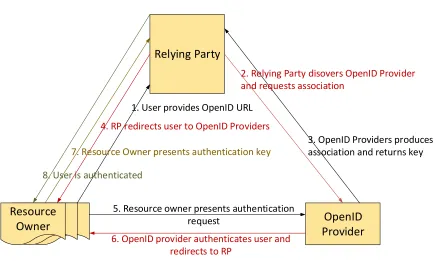
The following diagram Figure 1: OpenID Protocol Flow explains a use case for an OpenID
[image:33.612.115.551.385.646.2]scenario:
Figure 1: OpenID Protocol Flow
OpenID Provider Resource
Owner
Relying Party
1. User provides OpenID URL
2. Relying Party disovers OpenID Provider and requests association
3. OpenID Providers produces association and returns key
4. RP redirects user to OpenID Providers
5. Resource owner presents authentication request
6. OpenID provider authenticates user and redirects to RP
7. Resource Owner presents authentication key
34 Though OpenID started as a very promising protocol, it failed to make a large impact. Many
enterprises rushed into adopting OpenID by becoming an OpenID provider but declined to
become a relying party. For example, Microsoft soon became an OpenID provider allowing
its users (for example, a Hotmail user can use Hotmail credentials to login to other websites)
to obtain an access token for logging into a relying party. However, most enterprises did not
become relying parties to other OpenID providers (in the example of Hotmail, users were
not allowed to login to Hotmail using third party OpenID tokens). Mostly due to security and
performance concerns with OpenID.
OpenID can be described as being a user-centric rather than a site centric approach to
identity management (Jacob Bellamy-McIntyre, 2011). Unlike OAuth, as also illustrated in
Figure 1: OpenID Protocol Flow above, each user needs to obtain an access token. While in
OAuth with some optimization, one token can be presented on behalf of other users (server
level trust). What is more favourable, however, about OpenID compared to other identity
protocols such as OAuth, is that the identity provider does not require any pre-established
relationship with the web service or website for which it is providing authentication. Users
choose their own OpenID identity providers who provide them with a unique URL that
represents their identity. They then supply this URL to the relying party site that supports
35 can leverage the authentication methodology of other identity providers and therefore
reduce the time required for users to access their services.
You and Jun in (Jun & You, 2010) proposed I-PIN (Internet Personal Identification Number)
method to strengthen the authentication of users with the Cloud OpenID environment to
restrict phishing attacks. They compared and evaluated their method with the existing
OpenID method, and came up with recommendations to secure OpenID ecosystem (Jun &
You, 2010). Their method proposes that a user has to choose only 1 identity provider out of
3 identity providers, which delivers OpenID authentication in order to receive the OpenID
service. A user receives I-PIN information from main Confirmation Authority via OpenID
Identity Provider. In addition, they compared and evaluated their proposed method with an
existing OpenID method, and confirmed that authentication was safe and secure against
private information exposition and hence against phishing attacks.
2.2.4 SAML
Security Assertion Markup Language (SAML) is a product of the OASIS Security Services
Technical Committee. Dating from 2001, SAML is a XML-based open standard for exchanging
authentication and authorisation data between secure domains, that is, between a service
provider and identity provider (Fang, et al., 2005) (Lynch, 2011) (Zhenxiang Tu, 2012) (Wang
36 SAML assumes the principal, mostly a user but could be an application, has enrolled with at
least one identity provider. The identity provider is anticipated to provide local
authentication services to the principal. On the other hand, SAML is agnostic to how local
authentication services are implemented, though individual service providers most likely are
interested in how authentication is implemented. SAML is an extensible protocol by design
since it is XML-based, which makes it a standard that is very flexible. For example, federation
partners can decide to share whatever identity objects they want in a SAML assertion
message payload as long as those objects can be represented in XML. Interoperability gives
SAML a major advantage over other systems. Using SAML, organizations do not need to
build relying party for every incoming authentication type. SAML can support single sing on
with many different federated partners. Organizations who have gone through the pain of
supporting single sign on for multiple providers value the benefits of SAML the most. They
are now requiring the use of SAML for single sign on with Cloud services, applications and
other external service providers. SAML defines XML-based assertions and protocols, profiles
and bindings. The term SAML Core refers to the general syntax and semantics of SAML
assertions as well as the protocol used to request and transmit those assertions from one
system entity to another. SAML includes three types of assertions:
A. Authentication assertion
B. Authorisation assertion
37 Each assertion contains all the important information such as assertion id, version, issuer,
and assertion creation time. The elements of assertion are used to provide the recipients of
the assertion and the start time of the assertion. The element contains the important data
that describes the certification object. Records such as IP address, authentication time, and
authentication method, permissions, and authorisation basis are all part of an SAML
element. It is important to note that SAML does not refer to how an object is transmitted
but rather to what is transmitted. The ‘how’ part is obtained by the SAML binding. A SAML
binding determines how SAML requests and responses map onto standard messaging or
communications protocols. An important and synchronous binding is the SAML SOAP
binding. A SAML profile is a combination of assertions, bindings and protocols. SAML is not
concerned with confidentiality, integrity, or non-reputability of assertions in transit.
The SAML specifications define three roles:
1. The principal, which is usually the user looking to access a protected resource
2. The identity provider (IDP), which is the entity that is capable of authenticating and
verifying the identity of the principal
3. The service provider (SP), which is the entity hosting the protected resource and
interested in verifying the identity of the end user
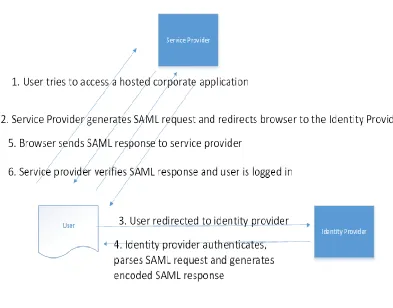
38 Figure 2: SAML Protocol Flow
SAML is viewed in the industry as a complex protocol and has been out favoured mainly due
to the complexity in parsing the XML and the performance implications of such
requirements (Menasce, 2002). The new generation of innovators viewed the Internet from
inside the Web and brought a new set of languages and tools to bear on the development.
This has shifted focus from XML and SOAP into lighter weight JavaScript Object Notation
(JSON) and REST using HTTP architecture. Although XML can also be used in the REST model,
the trend has been for a more stripped-down approach. OAuth has been implemented from
39 As the interaction between service providers and requesters occurs via XML-based SOAP
messages, securing web services tends to make these messages longer than they would be
otherwise. Such interaction will require interpretation by XML parsers on both sides that
reduces the performance of web services (Menasce, 2002).
In order to minimize the drawback of performance, there are some research that were
reviewed. One of them is discussed in (Ragouzis, et al., 2008), an approach named as ‘the
Enhanced Client or Proxy (ECP)’. However, this profile refers to WAP-Gateways (Wireless
Application Protocol), and it brings additional complexity and limitation to mobile
application, yet there exists no performance evaluation for such approach. Another
alternative approach is the virtual authentication proxy which enables communication with
multiple IDPs during the authentication process (Takeda, et al., 2006), but has not resulted
in a complete implementation yet that can validate the performance gain.
In addition, in (K. Daniel, 2008) the performance analysis of SAML showed that the
authorisation procedures need a lot of time in comparison to other processes due to the
SAML specific communication sequences and resulting overhead. This makes SAML a
challenging protocol for enterprises concerned with performance.
2.2.5 OAuth 2.0
OAuth (OAuth, 2012) (Open Authorisation) is an authentication standard for allowing users
to share their private resources (e.g. photos, videos, contact lists) stored on a protected
40 a third-party site access to their information stored with another service provider, without
sharing their access permissions or the full extent of their data. OAuth has become a popular
choice for Cloud providers due to its simplicity. As large providers started using OAuth 1.0
(the first version of the protocol), the community of organizations interested in adopting
OAuth came quickly to realize that the protocol does not scale well when it comes to
performance. It required state management across different steps; temporary credentials
management; and provided no isolation of the Authorisation server from the protected
resource server itself. In addition, OAuth 1.0 required that the protected resource servers’
endpoints have access to the client credentials in order to validate the request. This broke
the typical architecture of largest providers in which a centralized authorisation server is
used for issuing credentials, and a separate server is used for API calls. OAuth 1.0 required
the use of both sets of credentials: the client credentials and the token credentials, which
made the separation very hard (OAuth, 2012).
As the deployment of Cloud based enterprise software evolves (such as Exchange Online,
SharePoint Online, and SAP to name a few), there is a growing trend for these applications
to integrate with each other. In addition, many marketplace applications would highly
benefit from integrating with these enterprise resources through an API over HTTP or other
protocols. Often these resources require authorisation for access to such Protected
Resources. The systems that are trusted to make authorisation decisions may be
41 OAuth Web Resource Authorisation Profiles (OAuth WRAP (IEFT, 2011)) enables a Protected
Resource to delegate the authorisation task to one or more trusted authorities. Clients,
which wish to access a Protected Resource, would have to first obtain authorisation from a
trusted authority (Authorisation Server). Different credentials and profiles can be used to
obtain this authorisation, but once authorised, the Client is provided with an Access Token
and possibly a Refresh Token for obtaining more Access Tokens. The Authorisation Server
typically includes authorisation information in the Access Token and digitally signs the
Access Token. The Protected Resource server can verify that an Access Token received from
a Client was issued by a trusted Authorisation Server and is valid using the digital signature.
The Protected Resource Server can then examine the contents of the Access Token to
determine the authorisation level that has been granted to the Client.
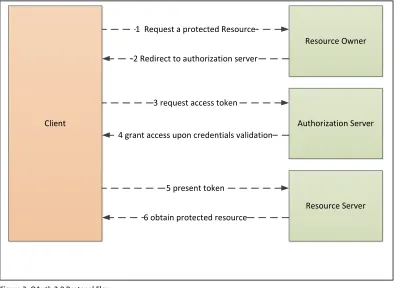
Figure 3: OAuth 2.0 Protocol Flow below shows the architecture for OAuth 2.0 with an
independent Authorisation Server.
The abstract flow illustrated in Figure 3 describes the interaction between the four roles and
includes the following steps:
1. The client requests authorisation from the resource owner
2. The resource owner redirects the request to authorisation server
42 the client credentials
4. The authorisation server validates the client credentials and the authorisation grant,
and if valid issues an access token
5. The client requests the protected resource from the resource server and
authenticates by presenting the access token
6. The resource server validates the access token, and if valid, serves the request.
Client
Resource Owner
Authorization Server
Resource Server 2 Redirect to authorization server
1 Request a protected Resource
3 request access token
5 present token
4 grant access upon credentials validation
[image:42.612.128.522.353.641.2]6 obtain protected resource
43 OAuth specification aimed to complement OpenID and let users delegate access to a
protected resource through an Authorisation Server that issues tokens that do not include
users’ credentials. OAuth implementation and deployment continues to grow with a lot of
research currently emerging to address various limitations of the protocol. In (Marouf,
2012), the authors discuss an optimization to OAuth to enhance overall privacy. The
research proposes a user-based, and category-based collaborative filtering mechanisms
which are not provided by the protocol itself; however, the research does not address the
performance challenges discussed in this research. In (Pai, et al., 2011), the authors
formalize the OAuth protocol using a method called Knowledge Flow Analysis to discover
known security vulnerability in OAuth, yet again, the research does not outline any
performance issues such as the ones identified in this research paper.
Another related area of research adopts a similar optimization approach albeit using
browser-based plug-ins and extensions to aid information privacy without necessarily
specifying the protocol. In (Dymond, 1998), Jenkin and Dymond originally identified this
approach to address the problem of “an information provider wanting to serve secrets
embedded within regular webpages to authorised users.”
So far, there has been no work focusing on Enterprise adoption of the OAuth protocol. This
44 an area where more research is needed. Some of this research are covered in upcoming
chapters where the current state of existing protocol is extended to benefit adoption in the
enterprise. (Noureddine & Bashroush, 2011), (Noureddine & Bashroush, 2011), (Noureddine
& Bashroush, 2013)
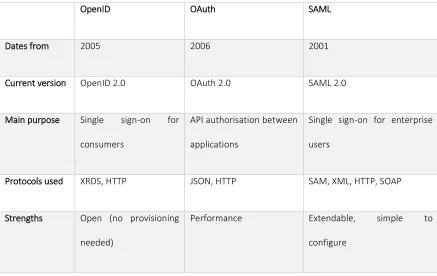
This Table 2: Authentication Protocols explains the major differences between the three
[image:44.612.116.553.346.622.2]protocols:
Table 2: Authentication Protocols
OpenID OAuth SAML
Dates from 2005 2006 2001
Current version OpenID 2.0 OAuth 2.0 SAML 2.0
Main purpose Single sign-on for
consumers
API authorisation between
applications
Single sign-on for enterprise
users
Protocols used XRDS, HTTP JSON, HTTP SAM, XML, HTTP, SOAP
Strengths Open (no provisioning
needed)
Performance Extendable, simple to
45
Weaknesses Performance, Security
and Privacy, hard to
configure
Pre-configuration
requirements
Complex, time consuming to
parse XML
2.3 Conclusion of Literature Review
Performance modelling in cloud computing is critical for any cloud provider to ensure
appropriate provisioning of hardware resources and deployment of enterprise applications.
This chapter reviewed various research areas around capacity planning and performance
optimization for authentication protocols. The capacity planning research is broken into
two areas, the dynamic capacity planning and the static capacity planning, both areas are
reviewed with focus on current research. In addition to capacity planning, organizations
need to ensure proper deployment of enterprise cloud solution in a secure and performant
way. Selecting the right authentication protocol is critical to such success. This chapter
reviewed the major authentication protocol with focus on current research while comparing
pros and cons for each of the top three protocols, namely, OpenId, SAML, and OAuth. The
chapter alluded to the lack of research on enterprise level performance evaluation. This
research and the rest of the chapters cover the area of performance optimization for
47
Chapter 3: Capacity Planning Using Modality Cost Analysis
3.1 Introduction and Motivation
It is one of the responsibilities of service providers to ensure appropriate resources are
allocated to each tenant to guarantee acceptable performance of their products. The
relationship between capacity planning and performance tuning is often misunderstood
(Allspaw, 2008). While they affect each other significantly, they have different goals.
Performance tuning optimizes an existing system for better performance, while capacity
planning determines what the system needs while maintaining the performance baseline.
In order to guarantee performance SLAs (Service License Agreements), service providers in
the Cloud tend to over provision mainly due to the lack of capacity planning tools that guide
such optimization of performance and cost, and SLA violations are costly for Cloud hosted
applications. A quantitative measurement of the resource cost (CPU, memory, storage, and
network bandwidth) imposed by each of the modalities of the product, in isolation, may
allow organizations to make informed decisions with respect to the right level of resource
provisioning. In this research, tested methodology to guide resource provisioning decisions,
is presented. The research presents a systematic methodology to estimate the performance
expected from each modality based on the representation of resource cost per modality.
Subsequently, the research discusses how the estimate of the expected application
48 using a commercially available media application is presented using the Microsoft Lync
Server 2010. Subsequently, the performance is estimated using a validation software tool
to simulate a realistic workload against a production datacentre with all the modalities
working together. The layout of this chapter is as follows: Section 3.2 provides an overview
of media applications performance. Section 3.3 provides an overview of the Modality Cost
Analysis, the research capacity planning methodology. Sections 3.4 and 3.5 present the
results of performance analysis and validation tool. Section 3.6 discusses hardware
benchmarks and Sections 3.7 offers concluding remarks and directions for future research.
3.2 Media Applications Performance
The performance of real-time media applications may be divided into two main categories,
each categorized by the requirements of their intended applications. Conversational
applications (also known as synchronous communication applications) are characterized by
their stringent delay constraints, or latency, which makes it bound by the network
bandwidth and processor speed. On the other hand, non-conversational applications (also
known as asynchronous communication applications) are delay-insensitive as they operates
in a similar way to email and bound by storage capacity. Performance analysis for media
applications can be addressed from two perspectives: end-user’s and service provider’s
perspective. A customer interacts with media applications through a series of consecutive
but unrelated requests. This request sequence is termed as a session. Each session can
49 sharing. Metrics such as response time, session length, session availability, and quality of
service are important from a user’s perspective. On the other hand, metrics such as
throughput, latency, and resource usage are important from a provider’s perspective since
they can guide the capacity planning and affect total cost and SLA guarantees. This research
considers the performance from a provider’s perspective since the focus is on capacity
planning for Cloud providers (vs. consumer or end user perspective). The research
addresses both synchronous and asynchronous method of communication for media
application by assessing CPU, storage, memory and network bandwidth.
3.3 Modality Cost Analysis (MCA) Methodology
Modality Cost Analysis is a methodology for assessing resource cost for each of the
modalities of an application (modality is a scenario in which an application is used, for
example, instant messaging and voice calls are two different modalities of a media
application). In this methodology, the application is broken into a set of modalities, and each
is measured for resource cost (CPU, Network bandwidth, Storage, and Memory) in isolation.
The first rationale behind using isolated cost analysis rather than the aggregated cost of the
application in its entirety is that the workload for different modalities varies dramatically and
aggregation may not capture these variations. The second rational is that Cloud providers
may need to allocate resources based on their customers’ user-profile. For example, when
50 messaging user, another may be a heavy video chat user, and a third one may be a very
heavy voice customer such as a call centre. Instant messaging is CPU intensive while video
and voice calls are network bandwidth intensive. Using this methodology, the service
provider will be able to allocate resources appropriately and accurately for these different
user profiles according to what they are going to be using.
When using modality cost analysis, resource cost is calculated separately, namely, the CPU
cost, the Network cost, and the memory cost, and any other cost that might be relevant to
the provider such as storage in scenarios where the application storage requirements are
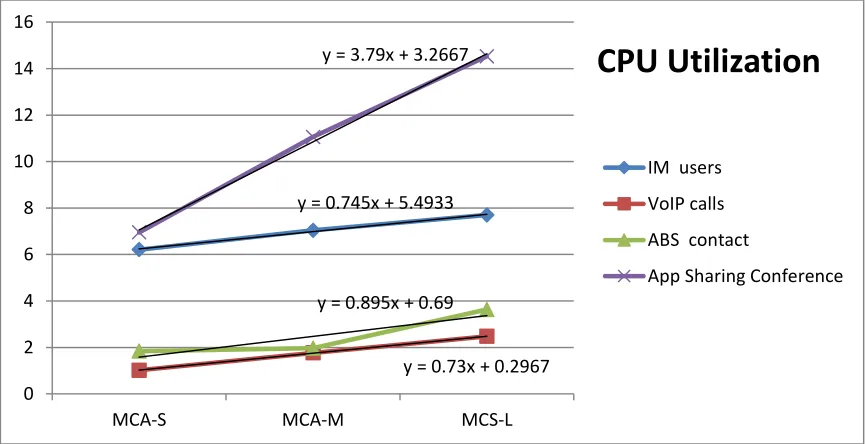
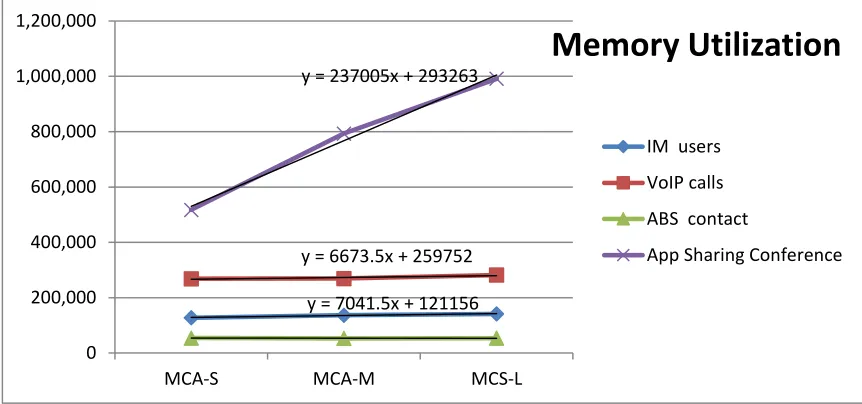
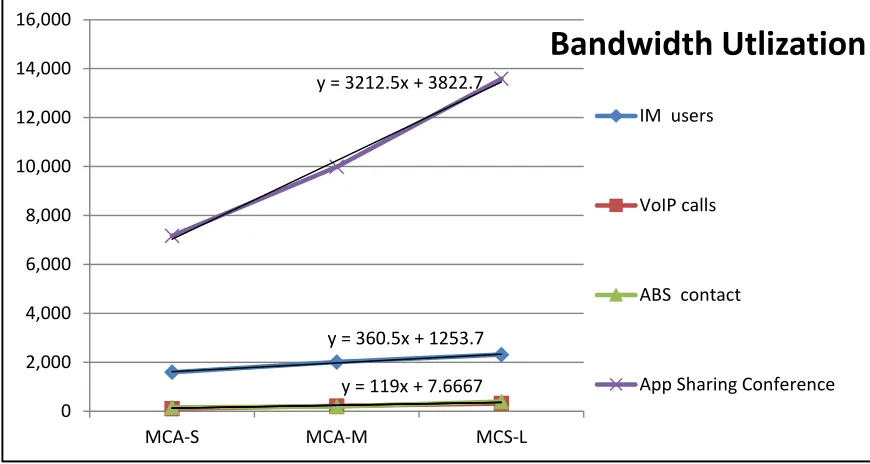
significant. The following graphs show the results of the experimentations after plotting the
[image:50.612.115.548.381.603.2]results. The next section, Experiments and Results, discusses the details of the experiments.
Figure 4: CPU utilization
y = 0.745x + 5.4933
y = 0.73x + 0.2967 y = 0.895x + 0.69
y = 3.79x + 3.2667
0 2 4 6 8 10 12 14 16
MCA-S MCA-M MCS-L
CPU Utilization
IM users VoIP calls ABS contact
51 Figure 5: Memory utilization
y = 7041.5x + 121156 y = 6673.5x + 259752 y = 237005x + 293263
0 200,000 400,000 600,000 800,000 1,000,000 1,200,000
MCA-S MCA-M MCS-L
Memory Utilization
IM users VoIP calls ABS contact
52 Figure 6: Bandwidth utilization
The figures, Figure 4: CPU utilization, Figure 5: Memory utilization, and Figure 6: Bandwidth
utilization, summarize the results of the three experiments. By adding trend lines to the
chart lines, it can be seen that the modalities grow linearly. The next section discusses the
details of obtaining the results.
In order to simplify the methodology, consider T tenants (customers) with their distribution
denoted by T1, T2. … Tn. Consider m modalities, and r resources. The