Empirical Software Engineering (EMSE) manuscript No. (will be inserted by the editor)
A Large Study on the Effect of Code Obfuscation on the
Quality of Java Code
Mariano Ceccato, Andrea Capiluppi, Paolo Falcarin, Cornelia Boldyreff
the date of receipt and acceptance should be inserted later
Abstract
Context:Obfuscation is a common technique used to protect software against mali-cious reverse engineering. Obfuscators manipulate the source code to make it harder to analyze and more difficult to understand for the attacker. Although different ob-fuscation algorithms and implementations are available, they have never been directly compared in a large scale study.
Aim: This paper aims at evaluating and quantifying the effect of several different obfuscation implementations (both open source and commercial), to help developers and project manager to decide which one could be adopted.
Method:In this study we applied 44 obfuscations to 18 subject applications covering a total of 4 millions lines of code. The effectiveness of these source code obfuscations has been measured using 10 code metrics, considering modularity, size and complexity of code.
Results:Results show that some of the considered obfuscations are effective in mak-ing code metrics change substantially from original to obfuscated code, although this change (called potency of the obfuscation) is different on different metrics. In the pa-per we recommend which obfuscations to select, given the security requirements of the software to be protected.
Mariano Ceccato
Fondazione Bruno Kessler–IRST, Trento, Italy E-mail: [email protected]
Andrea Capiluppi
Brunel University, Kingston Lane, Uxbridge, London UB8 3PH E-mail: [email protected]
Paolo Falcarin
University of East London, London E16 2RD, UK E-mail: [email protected]
Cornelia Boldyreff
1 Introduction
Software protection is increasingly becoming an important requirement for industrial software development. Historically, software protection first appeared as attempts at adding license-checking code to computer games, followed by algorithms for white-box cryptography [30] used for digital media piracy protection. Every software vendor should be aware of the potential for man-at-the-end (MATE) attacks against their products and the techniques available to mitigate these attacks. MATE attacks take many forms: in atampering attack, the user breaks the integrity of a piece of software, by modifying it in ways not intended by the software vendor. In a malicious reverse engineering attack, the attacker violates the confidentiality rights of the vendor by extracting intellectual property contained in the software, such as algorithms. Finally, in a cloning attack, copyright laws are violated by cracking and distributing illegal copies of the software. Methods for protecting against MATE attacks are variously known as software protection [12].
The software protection problem is fundamentally harder than other security prob-lems. The reason is the wide attack model that software protection researchers and practitioners must compete with; one has to assume an almighty adversary who has full access to the chosen software and hardware and can examine, probe, and modify it at will. For this reason, no piece of software, however well protected, is expected to survive intact “in the wild” for a long period of time. An example of a very common form of protection against reverse engineering attacks is obfuscation which modifies a program to make it harder for the adversary to analyze or comprehend [11].
Code obfuscation was first discussed by Cohen [8] as a technique for automati-cally creating multiple versions of the same program, thereby making each version a more difficult target for malware to analyze and modify. Typical code obfuscation tech-niques [11] include splitting code into smaller pieces, merging pieces of unrelated code, randomizing code placement and instruction selection, breaking abstraction bound-aries, mapping initially clean data structures to mangled ones, and flattening or intro-ducing bogus control flow.
Essentially, obfuscation aims to work in the opposite direction to refactoring; code obfuscators should work against the understandability of the code. Given that metrics have been proposed to interpret and guide the refactoring effort, for instance in the presence of bad smells [24], the obfuscation tools should attempt to increase the same metrics that the refactoring tools are designed to decrease. For instance, the broad aim of refactoring is to “decrease the complexity of the code”, hence the code obfuscators should provide algorithms to increase code complexity. This aspect and the fact that there are currently no practical security metrics to measure the quality of the protection poses the two following questions:
1. What is the effectiveness of different obfuscation algorithms? 2. What is impact of obfuscation on the code?
3. What protections should be chosen when securing a software system?
This paper is structured as follows. Section 2 discusses the related work in software protection metrics. Section 3 illustrates the obfuscation algorithms applied in this study and Section 4 presents the experimental design adopted in the study. Then Sections 5, 6 and 7 show the comparison results of the obfuscation algorithms. Section 8 discusses the implications and outlines the threats to validity, while Section 9 concludes the paper.
2 Related Work
With sufficient effort, most obfuscation techniques can be defeated. All of the informa-tion needed to break a software system is present in the executable or bytecode, and these can be controlled by the attacker. Assessing software protections means to esti-mate the extra delay the most sophisticated attacker would incur due to a particular protection technique used on a given application.
The evaluation of the increased strength introduced by obfuscation techniques has been mainly addressed by using code metrics [1, 13, 14, 16, 18, 20]. Even if metrics are based on reasonable assumptions about the expected problems that an attacker would face to defeat code protection, they just estimate and approximate a specific level of security that the underlying application should receive. Experimental evidence suggested that metrics correlate to the actual difficulty of performing attacks [4–6, 25]. Despite the benefits of experimental investigation, in the security literature only a few works are based on attacks performed by human subjects on binary code [25] and even fewer works [4,6] on applied empirical approaches, because they are expensive and time consuming. As an example, the comparison of just two obfuscation techniques and maintainability by users took a long time [5]. In this paper we adopt a different perspective; instead of comparing obfuscations in terms of how long attackers take to break them, we have measured the effects of the obfuscation by quantifying the changes occurred to source code in terms of modularity, complexity and size. In order to provide a replicable study, we have provided a statistically sound evaluation of several obfuscations with a wide set of metrics on a set of subject applications for a total of 4 millions lines of code analyzed.
Many authors have chosen just a few particular metrics with the assumption that these were good indicators of software complexity and ensure a harder task for the attacker when (s)he tries to break the code. For example, Anckaert et al. [1] evaluate the obfuscation efficacy by using a specific set of metrics for control-flow and data-flow complexity. Linn et al. [20] define theconfusion factor as the percentage of assembly instructions in the binary code that cannot be correctly disassembled by the disassem-bler, assuming that the difficulty of static code analysis will increase with this metrics, even if it strongly depends on the disassembly tools and algorithms used.
A more high-level approach has been proposed by Collberg et al. [11] when they defined the concept ofpotency of an obfuscation as the ratio between the complexity (measured with any metric) of the obfuscated code and the complexity of the orig-inal source code, and the concept of resilience, i.e. how difficult is to automatically de-obfuscate the protected code. In our research we use a similar approach when per-forming the correlation analysis of the variance of the chosen metrics.
Heffner and Collberg [14] used metrics for obfuscation potency and performance degra-dation as they aimed at finding the optimal sequence of obfuscations to be applied to different parts of the code in order to maximize complexity and reduce performance overhead. With a similar goal, Jakubowski et al. [16] presented a framework for itera-tively combining and applying protection primitives to code; they also used code size, cyclomatic number and knot count metrics to evaluate the code complexity. Our work is in the same line of research, and brings the added value of replicating the experiment on a very large scale, and comparing 44 obfuscating algorithms.
Alternatively, tools have been used to assess the resilience of code obfuscations. For instance, Sutherland at al. [25] relied on a program binary instrumentation tool to measure the fraction of the obfuscating transformations that the attackers can undo automatically. Goto et al [13] proposed thedepth of parse treesas a measure of source code complexity. Udupa et al [26] measured the resilience of an obfuscation by using the amount of time required to perform the automatic de-obfuscation to evaluate the effectiveness of control flow flattening obfuscation, relying on a combination of static and dynamic analysis. Our approach measures one obfuscation at a time. As a devel-opment of our research, it would be very relevant to study the application of a series of obfuscation algorithms on the same code, and analyze whether the resilience increases as compared to when a single obfuscation algorithm is applied.
Finally, Visaggio et al. [28] used the code entropy and size to detect obfuscated malware code in Javascript; their goal and metrics are different from ours but they also analyze the difference between metrics values obtained from obfuscated code and non-obfuscated code. Zeng et al.. [31] analyzed different obfuscations to discover which ones can break different types of watermarks hidden in the code.
3 Obfuscation Algorithms
In this study we compare the effects of several obfuscation transformations on Java code. We have selected three of the most prominent and used tools: the Sandmark obfuscating toolset [11]1, the Allatori Java obfuscating toolset2 (version 4.1) and the Zelix KlassmasterTMJava obfuscator3(version 5.5.0), for a total of 44 different atomic obfuscation algorithms.
The first (Sandmark) has been selected because it provides levels of flexibility, customization and openness that other obfuscation tools lack4; the second (Allatori) has been selected because it provides an all-in-one suite for obfuscating Java classes, and it provides a free toolkit; and the third (KlassmasterTM) because it represents the state-of-the-art obfuscation toolkit, albeit at a licensing price. Below we detail how each tool has been used, together with the options that have been activated to produce the obfuscated outputs.
1
http://sandmark.cs.arizona.edu/downloads.html 2
http://www.allatori.com/ 3
http://www.zelix.com/Klassmaster/ 4
3.1 Sandmark
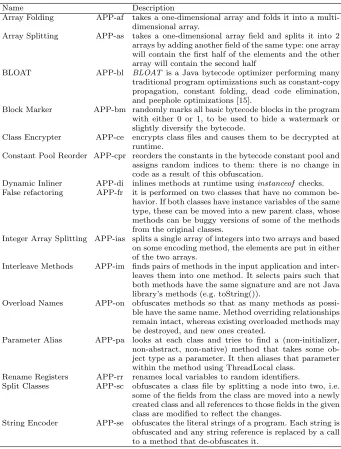
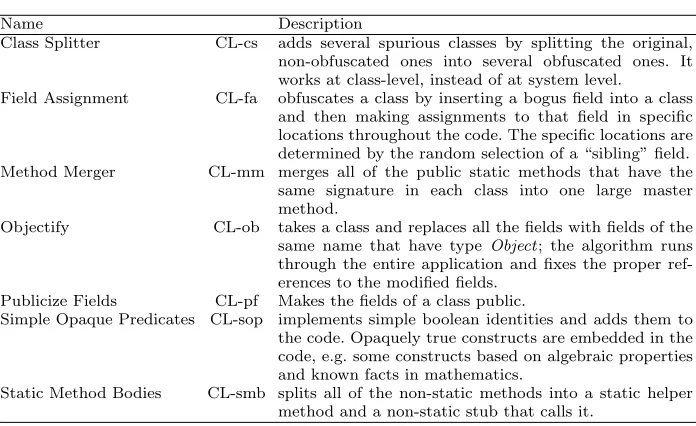
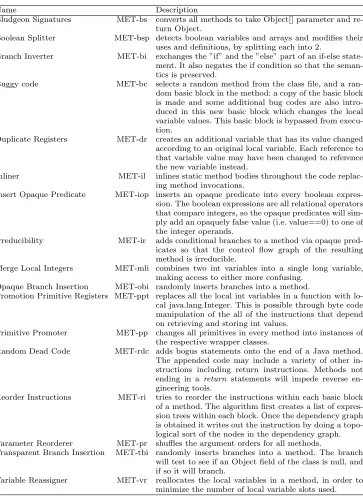
The Sandmark software tool can perform obfuscations, as well as statically and dy-namically watermarking the source code and the binaries of Java systems. Being open-source, it also provides a full list of obfuscators, grouped in three categories: application-, class- and method-level. Method- and class-level obfuscations are more configurable as they allow developers to select which methods (or classes) to obfus-cate; all other algorithms are considered application-level obfuscations. Such selections of partial obfuscation might be useful to prevent some methods from being obfus-cated for the sake of performance and reliability; for example, obfuscation of reflective code can break the application (i.e. not preserving program semantics) while some obfuscations can penalize performance. Table 1, Table 2 and Table 3 summarize the characteristics of all the 40 algorithms used in this study, dividing them respectively in APP (application-), CL (class-) and MET (method-) level obfuscation algorithms. These descriptions are taken from the manual provided with the toolkit.
3.2 Allatori
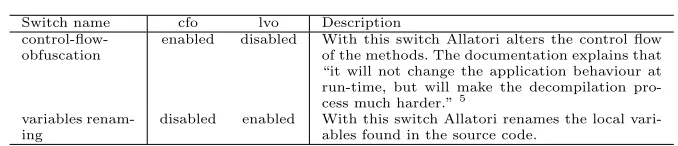
The second obfuscation tool used, Allatori, can also be streamlined and activated via a command line interface. It provides methods to obfuscate and watermark the Java classes. The command line invocation requires an xml configuration file to activate the options for the obfuscation and watermarking. Since we were only interested in obfuscation, the options for the watermarking have been disabled. Browsing the doc-umentation provided with the toolkit, we concluded that only 2 configurations are appropriate. Therefore two configurations have been created and analyzed, one with the control flow obfuscation activated (termedcfo) and another “light” configuration, without control-flow obfuscations, but with the renaming of the local variables (termed lvo), as summarised in Table 4.
3.3 Zelix KlassmasterTM
The third obfuscation tool used, Zelix KlassmasterTM, is also a commercial tool that provides several activation points for the obfuscation of the Java classes under study. It also provides a way to preserve methods, classes and packages from obfuscation, in order to focus very carefully the effects of the obfuscation algorithms. The tool can be streamlined by the use of scripts, which make it very powerful and automatisable.
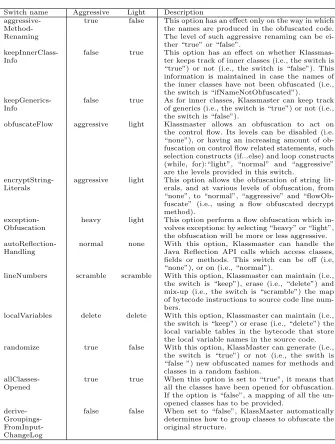
Analyzing the documentation of the toolkit, it is evident that more control on the output obfuscation is given by Zelix than Allatori, albeit less than with Sandmark. Therefore, we have created two configuration files (“aggressive” and “light” obfuscation scenarios) which by activating switches can be used to affect the control flow attributes in more or less depth6as described in Table 5.
To try and understand more practically the meaning and effect of these switches, we tried different values of the same switch on a small Java class and we compared the results. Our observations are reported on the last column of Table 5.
6
Name Description
Array Folding APP-af takes a one-dimensional array and folds it into a multi-dimensional array.
Array Splitting APP-as takes a one-dimensional array field and splits it into 2 arrays by adding another field of the same type: one array will contain the first half of the elements and the other array will contain the second half
BLOAT APP-bl BLOAT is a Java bytecode optimizer performing many traditional program optimizations such as constant-copy propagation, constant folding, dead code elimination, and peephole optimizations [15].
Block Marker APP-bm randomly marks all basic bytecode blocks in the program with either 0 or 1, to be used to hide a watermark or slightly diversify the bytecode.
Class Encrypter APP-ce encrypts class files and causes them to be decrypted at runtime.
Constant Pool Reorder APP-cpr reorders the constants in the bytecode constant pool and assigns random indices to them: there is no change in code as a result of this obfuscation.
Dynamic Inliner APP-di inlines methods at runtime usinginstanceof checks. False refactoring APP-fr it is performed on two classes that have no common
be-havior. If both classes have instance variables of the same type, these can be moved into a new parent class, whose methods can be buggy versions of some of the methods from the original classes.
Integer Array Splitting APP-ias splits a single array of integers into two arrays and based on some encoding method, the elements are put in either of the two arrays.
Interleave Methods APP-im finds pairs of methods in the input application and inter-leaves them into one method. It selects pairs such that both methods have the same signature and are not Java library’s methods (e.g. toString()).
Overload Names APP-on obfuscates methods so that as many methods as possi-ble have the same name. Method overriding relationships remain intact, whereas existing overloaded methods may be destroyed, and new ones created.
Parameter Alias APP-pa looks at each class and tries to find a (non-initializer, non-abstract, non-native) method that takes some ob-ject type as a parameter. It then aliases that parameter within the method using ThreadLocal class.
Rename Registers APP-rr renames local variables to random identifiers.
Split Classes APP-sc obfuscates a class file by splitting a node into two, i.e. some of the fields from the class are moved into a newly created class and all references to those fields in the given class are modified to reflect the changes.
[image:6.612.74.415.86.535.2]String Encoder APP-se obfuscates the literal strings of a program. Each string is obfuscated and any string reference is replaced by a call to a method that de-obfuscates it.
Table 1 Sandmark – Descriptionapplicationlevel obfuscation algorithms (APP).
4 Experimental Setup
Name Description
Class Splitter CL-cs adds several spurious classes by splitting the original, non-obfuscated ones into several obfuscated ones. It works at class-level, instead of at system level.
Field Assignment CL-fa obfuscates a class by inserting a bogus field into a class and then making assignments to that field in specific locations throughout the code. The specific locations are determined by the random selection of a “sibling” field. Method Merger CL-mm merges all of the public static methods that have the
same signature in each class into one large master method.
Objectify CL-ob takes a class and replaces all the fields with fields of the same name that have type Object; the algorithm runs through the entire application and fixes the proper ref-erences to the modified fields.
Publicize Fields CL-pf Makes the fields of a class public.
Simple Opaque Predicates CL-sop implements simple boolean identities and adds them to the code. Opaquely true constructs are embedded in the code, e.g. some constructs based on algebraic properties and known facts in mathematics.
[image:7.612.75.423.83.296.2]Static Method Bodies CL-smb splits all of the non-static methods into a static helper method and a non-static stub that calls it.
Table 2 Sandmark – Description ofclasslevel obfuscation algorithms (CL).
4.1 Research Questions
The research questions that we intend to investigate in this study are the following:
RQ1 What is thepotencyof code obfuscation?
RQ2 Do different obfuscations have a differentimpacton source code? RQ3 Doesinitial qualityof clear code influence the obfuscation potency?
4.2 Experimental Definition
Thegoal of this study is to analyze the effect of a source code obfuscation with the purpose of evaluating its effectiveness in defactoring source code. The quality focus regards how obfuscation impact the code with respect to complexity, modularity and size.
Results of this study can be interpreted from multipleperspectivesas follows:
– a researcher interested to empirically assess obfuscation; and
– a software developer or project manager, who wants to ensure high resilience to attacks to subsystems of a sensitive applications running in an untrusted environ-ment, before delivering it to the clients.
Name Description
Bludgeon Signatures MET-bs converts all methods to take Object[] parameter and re-turn Object.
Boolean Splitter MET-bsp detects boolean variables and arrays and modifies their uses and definitions, by splitting each into 2.
Branch Inverter MET-bi exchanges the ”if” and the ”else” part of an if-else state-ment. It also negates the if condition so that the seman-tics is preserved.
Buggy code MET-bc selects a random method from the class file, and a ran-dom basic block in the method: a copy of the basic block is made and some additional bug codes are also intro-duced in this new basic block which changes the local variable values. This basic block is bypassed from execu-tion.
Duplicate Registers MET-dr creates an additional variable that has its value changed according to an original local variable. Each reference to that variable value may have been changed to reference the new variable instead.
Inliner MET-il inlines static method bodies throughout the code replac-ing method invocations.
Insert Opaque Predicate MET-iop inserts an opaque predicate into every boolean expres-sion. The boolean expressions are all relational operators that compare integers, so the opaque predicates will sim-ply add an opaquely false value (i.e. value==0) to one of the integer operands.
Irreducibility MET-ir adds conditional branches to a method via opaque pred-icates so that the control flow graph of the resulting method is irreducible.
Merge Local Integers MET-mli combines two int variables into a single long variable, making access to either more confusing.
Opaque Branch Insertion MET-obi randomly inserts branches into a method.
Promotion Primitive Registers MET-ppt replaces all the local int variables in a function with lo-cal java.lang.Integer. This is possible through byte code manipulation of the all of the instructions that depend on retrieving and storing int values.
Primitive Promoter MET-pp changes all primitives in every method into instances of the respective wrapper classes.
Random Dead Code MET-rdc adds bogus statements onto the end of a Java method. The appended code may include a variety of other in-structions including return inin-structions. Methods not ending in areturn statements will impede reverse en-gineering tools.
Reorder Instructions MET-ri tries to reorder the instructions within each basic block of a method. The algorithm first creates a list of expres-sion trees within each block. Once the dependency graph is obtained it writes out the instruction by doing a topo-logical sort of the nodes in the dependency graph. Parameter Reorderer MET-pr shuffles the argument orders for all methods.
Transparent Branch Insertion MET-tbi randomly inserts branches into a method. The branch will test to see if an Object field of the class is null, and if so it will branch.
[image:8.612.80.443.85.583.2]Variable Reassigner MET-vr reallocates the local variables in a method, in order to minimize the number of local variable slots used.
Table 3 Sandmark – Description ofmethodlevel obfuscation algorithms (MET).
4.3 Context: Subject Applications
In order to perform the experiment in realistic settings, we have considered the most active Java projects hosted in one of the largest Open Source portal (SourceForge7).
7
Switch name cfo lvo Description
control-flow-obfuscation
enabled disabled With this switch Allatori alters the control flow
of the methods. The documentation explains that “it will not change the application behaviour at run-time, but will make the decompilation
pro-cess much harder.”5
variables renam-ing
disabled enabled With this switch Allatori renames the local
[image:9.612.74.413.82.155.2]vari-ables found in the source code.
Table 4 Configuration of the two alternative versions of Allatori
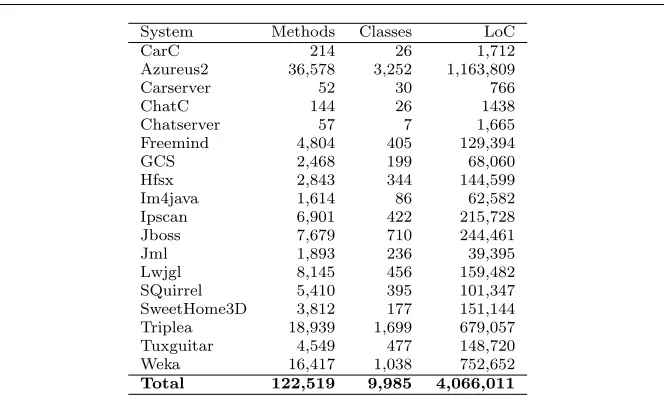
A summary of the characteristics and the domains of the selected systems is avail-able in Tavail-able 6. The applications vary both in terms of topic and size. At the time of writing (July 2012) 10 of them are among the 25 most downloaded and active projects on SourceForge8. The complete application set consists of 18 applications, including approximately 100k methods and almost 10k classes, giving a total of more than 4 millions lines of code.
4.4 Metrics
As stated in the research questions, different obfuscation techniques may have differ-ent impacts on the source code. For instance an obfuscation approach could focus on changing a specific aspect of the code (e.g., complexity) at the cost of overlooking others (e.g., modularity and size). As suggested by Collberg and Thomborson in their seminal work [10], we consider several software engineering code metrics to quantify the measurable effect of code obfuscation, in terms of the complexity, the modularity and the size of obfuscated code.
Complexity Metrics Code complexity is measured using the McCabe cyclomatic com-plexity index [22]. Even though this metric was initially proposed for procedural code (e.g., C, ADA, etc.), its adoption in object oriented languages has been often discussed and partially validated by other authors [21, 27].
As this metric is computed on the source code, we need to decompile obfuscated code. To achieve this aim, we use thejad decompiler [19], and the resultant source code has been analyzed withscitool9in to compute the McCabe cyclomatic complexity.
Modularity Metrics The Chidamber and Kemerer (C&K) object-oriented metrics frame-work [7] is a suite of metrics for OO design, and is composed of the following modularity metrics:
– Weighted Methods Per Class (WMC), – Depth of Inheritance Tree (DIT), – Number of Children (NOC),
– Coupling Between Object Classes (CBO), – Response For a Class (RFC), and – Lack of Cohesion in Methods (LCOM).
8
As provided in the “Recently updated” section of the Java applications, http:// sourceforge.net/directory/language:java/os:linux/freshness:recently-updated/.
9
Switch name Aggressive Light Description
aggressive- Method-Renaming
true false This option has an effect only on the way in which
the names are produced in the obfuscated code. The level of such aggressive renaming can be ei-ther “true” or “false”.
keepInnerClass-Info
false true This option has an effect on whether
Klassmas-ter keeps track of inner classes (i.e., the switch is “true”) or not (i.e., the switch is “false”). This information is maintained in case the names of the inner classes have not been obfuscated (i.e., the switch is “ifNameNotObfuscated”).
keepGenerics-Info
false true As for inner classes, Klassmaster can keep track
of generics (i.e., the switch is “true”) or not (i.e., the switch is “false”).
obfuscateFlow aggressive light Klassmaster allows an obfuscation to act on
the control flow. Its levels can be disabled (i.e. “none”), or having an increasing amount of ob-fuscation on control flow related statements, such selection constructs (if...else) and loop constructs (while, for):“light”, “normal” and “aggressive” are the levels provided in this switch.
encryptString-Literals
aggressive light This option allows the obfuscation of string
lit-erals, and at various levels of obfuscation, from “none”, to “normal”, “aggressive” and “flowOb-fuscate” (i.e., using a flow obfuscated decrypt method).
exception-Obfuscation
heavy light This option perform a flow obfuscation which
in-volves exceptions: by selecting “heavy” or “light”, the obfuscation will be more or less aggressive.
autoReflection-Handling
normal none With this option, Klassmaster can handle the
Java Reflection API calls which access classes, fields or methods. This switch can be off (i.e, “none”), or on (i.e., “normal”).
lineNumbers scramble scramble With this option, Klassmaster can maintain (i.e.,
the switch is “keep”), erase (i.e., “delete”) and mix-up (i.e., the switch is “scramble”) the map of bytecode instructions to source code line num-bers.
localVariables delete delete With this option, Klassmaster can maintain (i.e.,
the switch is “keep”) or erase (i.e., “delete”) the local variable tables in the bytecode that store the local variable names in the source code.
randomize true false With this option, KlassMaster can generate (i.e.,
the switch is “true”) or not (i.e., the swith is “false ”) new obfuscated names for methods and classes in a random fashion.
allClasses-Opened
true true When this option is set to “true”, it means that
all the classes have been opened for obfuscation. If the option is “false”, a mapping of all the un-opened classes has to be provided.
derive- Groupings- FromInput-ChangeLog
false false When set to “false”, KlassMaster automatically
[image:10.612.76.411.81.525.2]determines how to group classes to obfuscate the original structure.
Table 5 Configuration of the two alternative versions of KlassmasterTM .
These metrics have been used extensively by researchers in the past few years, and they have been validated for OO languages [2].
The C&K metrics are computed by theckjm tool10[17].Ckjmcalculates the C&K metrics by processing directly the bytecode of compiled Java files. This tool also
calcu-10
System Methods Classes LoC
CarC 214 26 1,712
Azureus2 36,578 3,252 1,163,809
Carserver 52 30 766
ChatC 144 26 1438
Chatserver 57 7 1,665
Freemind 4,804 405 129,394
GCS 2,468 199 68,060
Hfsx 2,843 344 144,599
Im4java 1,614 86 62,582
Ipscan 6,901 422 215,728
Jboss 7,679 710 244,461
Jml 1,893 236 39,395
Lwjgl 8,145 456 159,482
SQuirrel 5,410 395 101,347
SweetHome3D 3,812 177 151,144
Triplea 18,939 1,699 679,057
Tuxguitar 4,549 477 148,720
Weka 16,417 1,038 752,652
[image:11.612.81.413.78.277.2]Total 122,519 9,985 4,066,011
Table 6 Summary of subject applications.
lates (for each class) theNumber of Afferent Couplings (Ca), and theNumber of Public Methods (NPM).
Size Metrics The size of the code is determined by counting theLines of Code. Lines are counted using the linuxwcutility on the java code obtained after decompiling the bytecode.
Potency Eventually, we quantify the effect of obfuscation by comparing complexity, modularity and size before and after obfuscation. To achieve this aim we adopt the notion of obfuscationPotency, originally proposed by Collberg and Thomborson [10]. For each metricM LetM(P) be the complexity of the clear programP, andM(P′)
the complexity of the programP′obfuscated with the transformationT. Potency ofT
with respect to the programP and metricM is defined as:
Tpot(P, M)
def
= M(P′)
M(P) −1 (1)
However, metrics are computed per class and not per program, so metrics do not provide a single value for a program but a set of values. In order to turn potency into an operative metric, we have to rely on the average valuesMof the metricMcomputed on all the classes of the programP andP′. The operative definition of potency used
in our study is:
Tpot(P, M)
def
= M(P′)
4.5 Experimental Procedure
An overview of the toolchain adopted to prepare the code for the experiment is shown in Figure 1. First of all, the three obfuscation tools are applied to the original code, in order to obtain the obfuscated version. As mentioned above, the three obfuscation tools produce bytecode as an output. While modularization metrics can be computed directly on the bytecode, in order to measure complexity and size, it is necessary to decompile the classes to obtain Java source code. Invocations to thejad decompiler are piped after the production of the obfuscated bytecode, and the resultant source code is analyzed.
Clear code
Sandmark
Allatori
Zelix Klassmater
Obfuscated code
Modularity metrics
Decompilation (jad) Decompiled code
Comlexity metrics
Size metrics
Fig. 1 Overview of the toolchain used.
4.6 Sanity Check
In the real world software systems may vary considerably in terms of code quality metrics. Before using the subject applications in our study, we have to perform a sanity check on the subject applications to exclude the possibility that they are too similar each other and bias the study. For the the purpose of the sanity check, we formulate the subsequent null hypothesis:
H0s : There is no difference among applications in terms of the quality of source code;
To understand if the considered subject applications convey an adequate diversifi-cation, first of all we have measured their code qualities (i.e., complexity, modularity and size) and then we have studied their variance.
To achieve this objective, i.e., the test of hypotheses H0s, we use the Analysis of Variance (ANOVA). Although ANOVA is a parametric test, it is considered quite robust also for non-normal and non-interval scale variables.
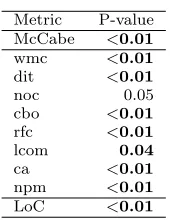
For each metric, we compute the ANOVA table of metric by Subject Application, and we report the results in Table 7 (p-values only). With the only exception ofNumber of Children (noc), for all other metrics we observe statistical significance. In these cases, we can reject the null hypothesisH0sand formulate the subsequent alternative hypotheses:
– Subject applications are different in terms of (McCabe cyclomatic)complexity; – Subject applications are different in terms ofmodularity(with respect towmc,dit,
cbo,rfc,lcom,caandnpm);
[image:12.612.77.418.229.278.2]Metric P-value McCabe <0.01 wmc <0.01 dit <0.01
noc 0.05
cbo <0.01 rfc <0.01
lcom 0.04
[image:13.612.203.288.84.194.2]ca <0.01 npm <0.01 LoC <0.01
Table 7 Analysis of variance of subject applications by metric.
Thus, applications are quite diversified11in terms of complexity, modularity and size, so they represent an adequate set of subject applications to study the effect of code obfuscation.
5 RQ1: Obfuscation Potency
This section reports on the analysis on obfuscation potency, i.e. the difference between clear and obfuscated code with respect to code metrics. For the first research question we formulate the subsequent null hypotheses:
H01c : There is no difference in thecomplexityof clear and obfuscated code. H01m : There is no difference in themodularityof clear and obfuscated code. H01s : There is no difference in thesizeof classes on clear and obfuscated code.
The three null hypotheses aretwo-tailed, because we are interested in analyzing the effect of obfuscation in both directions, i.e. its increase and reduction. In fact, different obfuscation techniques may have different impacts on the source code. For instance, an approach could focus on changing a specific aspect of the code (e.g., complexity) at the cost of overlooking others (e.g., modularity and size). In case the analysis allows us to reject a null hypothesis, an alternative hypothesis will be formulated.
5.1 Overall Analysis
First of all, we measure the complexity, modularity and size of the classes from clear code. Then, we apply each obfuscation to each case study application, thus obtaining 44 versions of the 4 Mloc (one version per obfuscation). Finally, we measure the same metrics on obfuscated classes.
Before approaching a detailed analysis, we mean to perform an overall analysis, to see if the considered metrics capture any difference among all the treatments (i.e., obfuscations). Thus, we use the ANOVA test. This test can be used to decide whether to reject the null hypothesis that the distribution of a given the metric (e.g., Lines of Code) is the same across treatments (i.e., all the obfuscated code and clear code).
11
A distinct one-way ANOVA test is run for each metric, thus AOVA is run 10 times. Table 8 reports the Analysis of Variance of Metric by Treatment, a different metric per line. Statistical significance is assumed when the p-value is <0.05 (we assume significance at a 95% confidence level, α=0.05), significant cases are highlighted in boldface. As can be seen in the table, for almost all the metrics we can reject the null hypothesis of no difference, with the only exception of noc. So we can formulate the alternative hypothesis that there is some difference between obfuscated and clear code with respect to all the remaining metrics.
Relation tested p.value McCabe <0.01 wmc <0.01 dit <0.01
noc 0.84
cbo <0.01 rfc <0.01 lcom <0.01 ca <0.01 npm <0.01 LoC <0.01
Table 8 Analysis of variance of Metric by Treatment.
Based on the experimental data, we can reject the null hypothesesH01c,H01mand H01s. Thus, we can formulate the subsequent alternative hypotheses:
– Thecomplexityof obfuscated code is different than complexity of clear code, and the magnitude of this difference is expressed by thepotency12 shown in Table 9. – Themodularityof obfuscated code is different than modularity of clear code, with
respect to wmc, dit, cbo, rfc, lcom, ca and npm. The magnitude of this difference is expressed by thepotencyshown in Table 10.
– Thesizeof obfuscated classes is different than size of classes from clear code, and the magnitude of this difference is expressed by thepotencyshown in Table 11. In the rest of this section, post-hoc tests will be used to determine which obfuscation algorithms do in fact improve or degrade obfuscated code compared to clear code.
5.2 Analysis of Complexity
We start by considering the McCabe cyclomatic complexity of clear code and obfus-cated code. Figure 2 shows the boxplots of the McCabe cyclomatic complexity. Ob-fuscations are sorted by ascending order of the average McCabe complexity (smaller averages on the left-hand side, higher averages on the right-hand side). The reference value of clear code is highlighted in red. By visual inspection, we can note that most obfuscations report a complexity similar to the clear code, i.e. with a mean of 1. Only few cases show higher values of complexity, on the right hand side of the plot.
12
allator
i−cf
o
allator
i−lvn
APP−bm APP−ce APP−cpr APP−fr APP−ias APP−on APP−rr CL−cs Clear CL−f
a
CL−mm CL−smb CL−sop klass−grr
klass−light MET−bi MET−bs MET−bsp MET−dr
MET−il
MET−iop MET−ir MET−mli MET−obi MET−ppt MET−rdc MET−r
i
MET−r
p
MET−tbi MET−vr APP−af APP−as APP−BL APP−di APP−im APP−pa APP−sc APP−se CL−ob MET−bc CL−pf MET−ppr 1
2 5 10
Fig. 2 Boxplot of McCabe cyclomatic complexity.
To see if the observations formulated in the graph are statistically significant, we compare the complexity of the clear code and the obfuscated code with the unpaired (two-tailed) Mann-Whitney test [23]. This test is non-parametric, so it does not make any assumptions on the normal distribution of the experimental data. Given the ex-perimental settings, it is not possible to use a paired test. In fact some obfuscations rename or split classes and methods in a way that makes it hard to map obfuscated methods back to the original ones.
When multiple pairwise comparisons are performed with overlapping data, however, the number of hypotheses in a test increases and so does the likelihood of witnessing a rare event. Hence, the chance to reject true null hypotheses may also increase (type I error). To control this problem, we adopt theHolmcorrection which is more complex but also more powerful than theBonferronicorrection. TheHolmcorrection consists of using different significance levels on different tests.P-values from thendependent hypotheses are sorted in ascending order. Then, on each orderedp-valuei, a decreasing correction factorn−i+ 1 is used, i.e., an increasing significance levelα/(n−i+ 1). We reject the null hypotheses until the minimum indexkfor which the null hypothesis cannot be rejected is encountered (p-valuek> α/(n−k+1)). All subsequent hypotheses cannot be rejected (p-valuei:i > k).
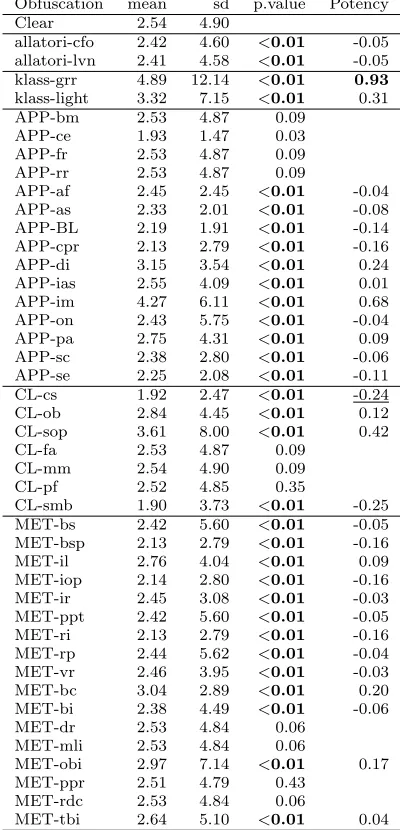
While the statistical test allows for checking the presence of significant differences, it does not provide any information about the magnitude of such a difference. This is particularly relevant in our study, since we are interested to investigate to what extent the use of obfuscation changes the complexity of source code. To this aim we adopt the notion of obfuscationPotency, as defined in Equation (2).
[image:15.612.87.563.115.269.2]Obfuscation mean sd p.value Potency
Clear 2.54 4.90
allatori-cfo 2.42 4.60 <0.01 -0.05 allatori-lvn 2.41 4.58 <0.01 -0.05 klass-grr 4.89 12.14 <0.01 0.93 klass-light 3.32 7.15 <0.01 0.31
APP-bm 2.53 4.87 0.09
APP-ce 1.93 1.47 0.03
APP-fr 2.53 4.87 0.09
APP-rr 2.53 4.87 0.09
APP-af 2.45 2.45 <0.01 -0.04 APP-as 2.33 2.01 <0.01 -0.08 APP-BL 2.19 1.91 <0.01 -0.14 APP-cpr 2.13 2.79 <0.01 -0.16 APP-di 3.15 3.54 <0.01 0.24 APP-ias 2.55 4.09 <0.01 0.01 APP-im 4.27 6.11 <0.01 0.68 APP-on 2.43 5.75 <0.01 -0.04 APP-pa 2.75 4.31 <0.01 0.09 APP-sc 2.38 2.80 <0.01 -0.06 APP-se 2.25 2.08 <0.01 -0.11 CL-cs 1.92 2.47 <0.01 -0.24 CL-ob 2.84 4.45 <0.01 0.12 CL-sop 3.61 8.00 <0.01 0.42
CL-fa 2.53 4.87 0.09
CL-mm 2.54 4.90 0.09
CL-pf 2.52 4.85 0.35
CL-smb 1.90 3.73 <0.01 -0.25 MET-bs 2.42 5.60 <0.01 -0.05 MET-bsp 2.13 2.79 <0.01 -0.16 MET-il 2.76 4.04 <0.01 0.09 MET-iop 2.14 2.80 <0.01 -0.16 MET-ir 2.45 3.08 <0.01 -0.03 MET-ppt 2.42 5.60 <0.01 -0.05 MET-ri 2.13 2.79 <0.01 -0.16 MET-rp 2.44 5.62 <0.01 -0.04 MET-vr 2.46 3.95 <0.01 -0.03 MET-bc 3.04 2.89 <0.01 0.20 MET-bi 2.38 4.49 <0.01 -0.06
MET-dr 2.53 4.84 0.06
MET-mli 2.53 4.84 0.06
MET-obi 2.97 7.14 <0.01 0.17
MET-ppr 2.51 4.79 0.43
MET-rdc 2.53 4.84 0.06
[image:16.612.144.344.92.507.2]MET-tbi 2.64 5.10 <0.01 0.04
Table 9 Mann-Whitney test of McCabe cyclomatic complexity (with Holm correction) and Potency.
statistically significant, p-values are highlighted in boldface (Holm correction is used). To avoiding misleading interpretations, potency is reported only on those cases where statistical significance is observed. Moreover, the highest potencies are highlighted in boldface and the lowest potencies are underlined, to evidence those obfuscations that reported the most relevant change in the code.
Among the application level obfuscations, the code obfuscated withArray Folding (APP-af),Array Splitting(APP-as),Bloat (APP-BL),Constant Pool Reorder (APP-cpr), Overload Names (APP-on), Split Classes (APP-sc), String Encoder (APP-se) achieves a significant reduction of the complexity (potency<0), whileDynamic Inliner (APP-di),Integer Array Splitting(APP-ias),Interleave Methods(APP-im),Parameter Alias(APP-pa) make complexity increase. The other application level obfuscations do not achieve statistical significance for McCabe complexity. Among class level obfus-cations there are two cases that make complexity decrease (Class Splitterand Static Method Bodies), while just two increase complexity (Objectify, Simple Opaque Predi-cates). Eventually, when considering method level obfuscations, many significant cases are reported that make complexity either increase or decrease.
5.3 Analysis of Modularity
APP−sc
allator
i−cf
o
allator
i−lvn
CL−cs APP−di
APP−im APP−on APP−pa CL−ob klass−grr MET−bs MET−ppt MET−r
p
APP−af APP−as APP−BL APP−bm APP−ce APP−cpr APP−fr APP−rr APP−se Clear CL−f
a
CL−mm CL−pf MET−bc MET−bi
MET−bsp MET−dr MET−il MET−iop MET−ir MET−mli MET−obi MET−ppr MET−rdc MET−r
i
MET−tbi CL−sop MET−vr APP−ias klass−light CL−smb 1
2 5 10 20 50
Fig. 3 Boxplot of Wighted Method per Class.
In a similar way we have analyzed the metrics related to modularity. Figure 3 shows the boxplot of thewmcmetric (Weighted Method per Class) for the considered obfuscations. As in the previous case, the values for the original, non-obfuscated clear code are in red. From a visual inspection, we see that the clear code is in the middle of the spectrum and nearly half of the obfuscations make wmc decrease, while in other half of the case wmc increases with respect to clear code. Unlike from the previous case, the modularity values are not always similar to the case of clear code. For reason of space, we omit the boxplots of the other modularity metrics, but we present the results of the statistical analysis for all the metrics. All the boxplots are available in a technical report [3].
[image:17.612.87.565.307.460.2]Obfuscation Potency
wmc dit noc cbo rfc lcom ca npm
allatori-cfo -0.40 -0.03 -0.15 -0.35 -0.52 -0.42 allatori-lvn -0.40 -0.03 -0.15 -0.35 -0.52 -0.42
klass-grr -0.19 -0.11 -0.15 -0.76 -0.23
klass-light 0.09 0.15 0.09 -0.62 0.14 0.01
APP-bm
APP-ce 1.02 -1.00 -1.00
APP-fr APP-rr
APP-af 0.59 -0.73 -0.96
APP-as 0.58 -0.73 -0.97
APP-BL 0.60 -0.73 -0.97
APP-cpr -0.09 0.24 0.03
APP-di 0.21 -0.57 -0.97
APP-ias 0.14 0.10 0.28 -0.06 0.18 -0.57 -0.03 0.28
APP-im -0.34 -0.44 -0.37 -0.93
APP-on 0.37 -0.41 -0.12 9.43 -0.28 0.24
APP-pa 0.05 -0.28 0.09 2.98 0.07
APP-sc -0.50 -0.49 -0.59 0.18 -0.39 -0.34
APP-se 0.56 -0.69 -0.97
CL-cs -0.42 -0.30 1.09 -0.37 -0.41 -0.84 -0.33 -0.22 CL-ob 0.23 -0.27 -0.38 -0.16 3.99 -0.25 0.14
CL-sop 0.03 0.11 -0.52 0.01 0.05
CL-fa CL-mm CL-pf
CL-smb 0.78 0.27 2.78
MET-bs 0.23 -0.27 -0.40 -0.16 3.99 -0.28 0.14
MET-bsp -0.09 0.24 0.03
MET-il -0.14 0.25 0.14 0.22
MET-iop -0.09 0.24 0.03
MET-ir -0.09 0.24 0.03
MET-ppt 0.23 -0.27 -0.38 -0.09 3.99 -0.25 0.14
MET-ri -0.09 0.24 0.03
MET-rp 0.23 -0.27 -0.38 -0.16 3.99 -0.25 0.14
MET-vr 0.10 0.07 0.09 0.19 -0.53 0.16
MET-bc -0.11 0.27 0.04
MET-bi MET-dr MET-mli MET-obi
MET-ppr 0.05
[image:18.612.94.393.90.507.2]MET-rdc MET-tbi
Table 10 Mann-Whitney test of Chidamber and Kemerer object-oriented metrics (with Holm correction) and Potency.
potency of the obfuscation in the line, with respect to the metric in the column. For each metric, we highlighted in boldface the highest and the lowest values of potency.
the metrics. In fact, for each metric, there are obfuscations that report a positive po-tency, and obfuscations that report a negative potency.
With some obfuscations, the obfuscated code is not significantly different from the clear code with respect to any modularity metrics. These obfuscations areBlock Marker (APP-bm),False refactoring(APP-fr),Rename Registers(APP-rr),Field Assignment (CL-fa),Method Merger(CL-mm), Publicize Fields(CL-pf),Branch Inverter (MET-bi),Duplicate Registers (MET-dr), Merge Local Integers(MET-mli), Opaque Branch Insertion(MET-obi),Random Dead Code (MET-rdc), Transparent Branch Insertion (MET-tbi).
5.4 Analysis of Class Size
CL−smb APP−ce APP−af APP−as APP−BL APP−se CL−cs APP−bm APP−fr APP−rr Clear CL−f
a
CL−mm CL−pf MET−bi MET−dr MET−mli MET−vr
allator
i−cf
o
allator
i−lvn
APP−ias klass−grr MET−tbi APP−cpr APP−sc klass−light MET−bsp MET−il MET−iop MET−ir MET−obi MET−r
i
APP−on CL−sop MET−ppr CL−ob APP−pa MET−r
p
MET−rdc MET−bs APP−im MET−ppt APP−di MET−bc 1
2 5 10 20 50 100 200
Fig. 4 Boxplot of Lines of Code.
Eventually, we analyze how obfuscation affects the size of the code. Figure 4 shows the boxplots ofLines of Codecase studies applications. While only few cases make this metric decrease, a relevant number of obfuscations makes theLines of Codeincrease on the right-hand side of the graph.
[image:19.612.83.564.281.436.2]Obfuscation mean sd p.value Potency Clear 33.19 122.29
allatori-cfo 33.60 118.47 <0.01 0.01 allatori-lvn 32.68 114.79 <0.01 -0.02 klass-grr 48.42 289.44 <0.01 0.46 klass-light 39.32 139.58 <0.01 0.18 APP-bm 33.34 121.78 <0.01 0.00 APP-ce 12.03 17.57 <0.01 -0.64 APP-fr 33.33 121.76 <0.01 0.00 APP-rr 33.33 121.76 <0.01 0.00 APP-af 13.72 14.10 <0.01 -0.59 APP-as 13.40 13.47 0.01
APP-BL 13.39 14.08 <0.01 -0.60 APP-cpr 26.99 78.57 <0.01 -0.19 APP-di 29.59 39.38 <0.01 -0.11 APP-ias 35.38 88.29 <0.01 0.07 APP-im 59.05 122.22 <0.01 0.78 APP-on 24.29 71.29 <0.01 -0.27 APP-pa 30.74 82.52 <0.01 -0.07 APP-sc 20.31 30.80 0.13
APP-se 13.17 13.74 <0.01 -0.60 CL-cs 18.85 42.61 <0.01 -0.43 CL-ob 28.43 73.10 <0.01 -0.14 CL-sop 48.20 129.58 <0.01 0.45 CL-fa 33.33 121.76 <0.01 0.00 CL-mm 33.39 121.97 <0.01 0.01 CL-pf 32.84 120.98 <0.01 -0.01 CL-smb 18.94 84.76 <0.01 -0.43 MET-bs 28.79 80.77 <0.01 -0.13 MET-bsp 27.68 79.22 <0.01 -0.17 MET-il 36.50 153.48 <0.01 0.10 MET-iop 32.82 92.36 <0.01 -0.01 MET-ir 31.36 82.02 <0.01 -0.05 MET-ppt 44.60 119.93 <0.01 0.34 MET-ri 26.99 78.57 <0.01 -0.19 MET-rp 26.90 74.00 0.03
MET-vr 33.59 92.06 0.68
[image:20.612.144.348.93.507.2]MET-bc 53.52 82.72 <0.01 0.61 MET-bi 30.64 116.75 <0.01 -0.08 MET-dr 32.91 121.22 <0.01 -0.01 MET-mli 35.99 130.19 <0.01 0.08 MET-obi 45.37 162.61 <0.01 0.37 MET-ppr 39.48 149.55 <0.01 0.19 MET-rdc 37.28 121.54 <0.01 0.12 MET-tbi 33.43 103.35 <0.01 0.01
Table 11 Mann-Whitney test of Lines of Code (with Holm correction) and Potency.
Secondarily, in this study Zelix Klassmaster and Allatory have been involved that applied a combination of obfuscations, while Sandmark has been used only with in-dividual obfuscations separately. So we are interested in studying if, when combining many obfuscations obfuscations together, the effect of the single obfuscations reinforce each other in the combination. So, we formulate these additional null hypotheses:
H01r : When applying different obfuscations in combination, different obfuscations do notreinforceeach other.
5.5 Analysis of Non-deterministic Behaviour
In this subsection we study the impact of non-determinism on obfuscation potency. Among the case studies we have selected CarRace because no obfuscator fails in (i.e., crashes when) obfuscating it. We have generated 500 instances of CarRace obfuscated with the same obfuscation, and we repeated the process for all the obfuscation, for a total of 500*44=22,000 distinct versions of CarRace.
To analyse the interaction of two or more factors we use two-way Analysis of Vari-ance (ANOVA). We chose to use ANOVA because, differently from its non-parametric alternatives (such as the Kruskal-Wallis test) ANOVA allows to test for the presence of interactions between factors, i.e. it allows to perform a two-way analysis. Although ANOVA is a parametric test, it is considered quite robust also for non-normal and non-interval scale variables.
To study if the variation in the source code is due to non-determinism, we have applied the two-way Analysis of Variance (ANOVA) 10 times, once per metric.
For this analysis, only obfuscated code is considered, so clear code is not considered here.
Metric Obfuscation Iteration Obfuscation:Iteration
McCane <0.01 1.00 1.00
wmc <0.01 0.98 1.00
dit <0.01 0.99 1.00
noc <0.01 0.98 1.00
cbo <0.01 0.99 1.00
rfc <0.01 1.00 1.00
lcom <0.01 0.99 1.00
ca <0.01 0.99 1.00
npm <0.01 0.98 1.00
[image:21.612.118.372.343.446.2]Lines of Code <0.01 1.00 1.00
Table 12 Analysis of variance of Metric by Obfuscation and Iteration.
The results are summarized in Table 12, a distinct metric per row. The first row, for instance, reports the p-values of the Analysis of variance of McCabe complexity by Obfuscation and Iteration. For each metric (first column), the results of the test (p-values) should be interpreted as the source of the variation in the metrics (e.g., complexity) due to the fact that a different obfuscation is used (second column), due to the different iterations for each obfuscation (third column) or if variation in the metric is due an interaction (dependency) between the obfuscation and the iteration (last column).
All in all, while obfuscation influences complexity, modularity and size of code (see above in this section), we can not reject the null hypothesis H01nd that non-determinism potentially involved by some obfuscating transformations does not influ-ence the final result.
5.6 Analysis of Reinforcement
In the previous experiments, we considered combined obfuscation algorithms, applied with Allatori and Zelix Klassmaster tools. Allatory supports only two configurations of combined obfuscations (see Table 4) and individual obfuscations can not be applied separately. However, Zelix Klassmaster allows a more fine grained configuration, and single obfuscations can be applied separately.
Thus, in the following, we study the effect of individual obfuscations of Zelix Klass-master, and we compare them with the two combined obfuscation configurations consid-ered previously (i.e.,klass-grrandklass-light). In detail, each combined configurations is compared with the single obfuscations that participate in the combination.
The effect of each obfuscation is assessed by comparing complexity, modularity and size of clear code and obfuscated code, using unpaired (two-tailed) Mann-Whitney test, with Holm correction (correction required because of multiple pairwise comparisons with overlapping data). While the statistical test allows for checking the presence of significant differences, it does not provide any information about the magnitude of such a difference. To this aim we adopt the notion of obfuscation Potency, as done previously in this section.
Table 13 reports the comparison for the more aggressive configuration (i.e., klass-grr), while Table 14 for the light configuration (i.e.,klass-light). Obfuscations are re-ported in rows and metrics in columns. These tables report the effect of obfuscations as their Potency. However, to avoid misleading interpretations, Potency is reported only when the difference between clear and obfuscated code is statistically significant (according to the Mann-Whitney test with Holm correction). For example, the dif-ference between code obfuscated with klass-grrand clear code measured ascais not statistically significant, so no ca-potency is reported on the table forklass-grr. To help readability, for each metric, the highest value of potency is highlighted in boldface, while the lowest value is underlined.
Table 13 reports the comparison of the combined configurationklass-grr(first row) with the individual obfuscations composing it. Considering the code complexity (col-umnMcCabe) we see that potency of the compound obfuscation (0.93) is higher than most of the individual obfuscations, however the highest potency is scored by an indi-vidual obfuscation (1.15 for obfuscateFlow-aggressive).
This can be interpreted as an average reinforcement effect among individual ob-fuscations. Different strategies to make code more complex can be combined to make code even more complex. However, very elaborated strategies to achieve this objective can be combined at the cost of losing effectiveness, for example because specific classes could be targeted instead of all.
the value of individual obfuscations, while forditandcastatistical significance is not observed.
The contrasting effect on coupling and cohesion could be interpreted as a deliberate strategy of the developers of Zelix Klassmaster to privilege the effect on coupling rather than on cohesion to make the code more hard to understand (apparently, this strategy can not be disabled by the configuration file).
Eventually, for the size we observe reinforcement, as the LoCpotency of the com-bination (klass-grr) is much higher than the potency of single obfuscations.
Obfuscation McCabe wmc dit noc cbo rfc lcom ca npm LoC
klass-grr 0.93 -0.19 -0.11 -0.06 -0.15 -0.76 -0.23 0.46
aggressiveMethod-Renaming-true
0.64 -0.39 -0.02 -0.15 -0.22 -0.34 -0.61 -0.09 -0.44 0.15
keepInnerClassInfo-false
0.64 -0.39 -0.02 -0.15 -0.22 -0.33 -0.61 -0.09 -0.44 0.15
keepGenericsInfo-false 0.64 -0.39 -0.02 -0.15 -0.22 -0.33 -0.61 -0.09 -0.44 0.15
obfuscateFlow-aggressive
1.15 -0.39 -0.02 -0.15 -0.33 -0.62 -0.07 -0.44 0.30
encryptStringLiterals-aggressive
0.60 -0.39 -0.02 -0.15 -0.22 -0.33 -0.61 -0.09 -0.44 0.13
exceptionObfuscation-heavy
0.78 -0.39 -0.02 -0.15 -0.33 -0.61 -0.04 -0.44 0.20
autoReflection-Handling-normal
0.55 -0.36 -0.10 -0.29 -0.32 -0.18 -0.18 -0.40 0.21
lineNumbers-scramble 0.64 -0.39 -0.02 -0.15 -0.22 -0.33 -0.61 -0.09 -0.44 0.25 localVariables-delete 0.64 -0.39 -0.02 -0.15 -0.22 -0.33 -0.61 -0.09 -0.44 0.15 randomize-true 0.64 -0.39 -0.02 -0.15 -0.22 -0.33 -0.61 -0.09 -0.44 0.15 allClassesOpened-true 0.64 -0.39 -0.02 -0.15 -0.22 -0.33 -0.61 -0.09 -0.44 0.15
deriveGroupingsFrom-InputChangeLog-false
[image:23.612.73.496.202.398.2]0.64 -0.39 -0.02 -0.15 -0.22 -0.33 -0.61 -0.09 -0.44 0.15
Table 13 Mann-Whitney test of complexity, modularity and size (with Holm correction) and potency for Zelix Klassmaster obfuscator (aggressive variant). For each metric, the highest value of potency is highlighted in boldface, while the lowest value is underlined.
Similarly to theaggressivecase, Table 14 analyses the reinforcement effect of obfus-cations for the light configuration of Zelix Klassmaster. Differently from the previous case, no relevant reinforcement is observed on complexity (McCabepotency) and size (Loc potency). In fact, the potency of the combination is quite low with respect to the potency of individual obfuscations. However, the trend on modularity is confirmed, as the reinforcement is positive on coupling (wmc,cbo,rfc,ca,npm) and negative on cohesion (lcom).
All in all, we can reject the null hypothesis H01r and formulate these alternative hypotheses:
– When applying a combined obfuscation in Zelix Klassmaster, individual obfusca-tions reinforce each other to increase coupling potency (with respect towmc,cbo, rfcandnpm) and to decrease cohesion (with respect tolcom).
Obfuscation McCabe wmc dit noc cbo rfc lcom ca npm LoC
klass-light 0.31 0.09 0.15 0.09 -0.62 0.14 0.01 0.18
aggressiveMethod-Renaming-false
0.64 -0.39 -0.02 -0.15 -0.22 -0.33 -0.61 -0.09 -0.44 0.15
keepInnerClassInfo-true
0.77 0.02 0.09 0.08 -0.16 0.09 0.25
keepGenericsInfo-true 0.64 -0.39 -0.02 -0.15 -0.22 -0.33 -0.61 -0.09 -0.44 0.15 obfuscateFlow-light 0.64 -0.39 -0.02 -0.15 -0.22 -0.33 -0.61 -0.09 -0.44 0.15
encryptStringLiterals-normal
0.28 -0.33 -0.02 -0.15 -0.22 -0.31 -0.58 -0.09 -0.44 0.03
exceptionObfuscation-light
0.64 -0.39 -0.02 -0.15 -0.22 -0.33 -0.61 -0.09 -0.44 0.15
autoReflection-Handling-none
0.64 -0.39 -0.02 -0.15 -0.22 -0.33 -0.61 -0.09 -0.44 0.15
lineNumbers-scramble 0.64 -0.39 -0.02 -0.15 -0.22 -0.33 -0.61 -0.09 -0.44 0.25 localVariables-delete 0.64 -0.39 -0.02 -0.15 -0.22 -0.33 -0.61 -0.09 -0.44 0.15 randomize-false 0.64 -0.39 -0.02 -0.15 -0.22 -0.33 -0.61 -0.09 -0.44 0.15 allClassesOpened-true 0.64 -0.39 -0.02 -0.15 -0.22 -0.33 -0.61 -0.09 -0.44 0.15
deriveGroupingsFrom-InputChangeLog-false
[image:24.612.73.482.84.277.2]0.64 -0.39 -0.02 -0.15 -0.22 -0.33 -0.61 -0.09 -0.44 0.15
Table 14 Mann-Whitney test of complexity, modularity and size (with Holm correction) and potency for Zelix Klassmaster obfuscator (light variant). For each metric, the highest value of potency is highlighted in boldface, while the lowest value is underlined.
6 RQ2: Obfuscation Impact
In the previous section we were interested in a detailed analysis of the consequences of obfuscation on code quality. In this section we mean to analyze the impact of obfus-cation on broader sense, but to achieve this objective we have to keep the level of the analysis less detailed.
For the second research question we formulate the subsequent null hypothesis:
H02i : There is no difference in theimpactof different obfuscations on the quality of source code.
Due to the large amount of data and p-values, it is not possible to show all detailed results dividing by obfuscation, by metric and by application, as has been done in Section 5 (however, detailed analyses are available in the technical report [3]).
The last column of the table summarizes the impact of the obfuscation as the number of metrics for which the obfuscation has shown a significant difference with respect to clear code.Allatori cforeports animpactof 10 because obfuscated code was found to be significantly different than clear code in all the 10 considered metrics.
The obfuscations with higher impact areAllatori-cfo,Allatory-lvn, as they reported a significant difference with respect to clear code in all the 10 metrics. Another notable case isSplit Classes(APP-sc) as it was significant with respect to 7 metrics.
ObfuscationsKlass-light,String Encoder(APP-se) andStatic Method Bodies (CL-smb) have been shown to be effective in causing significant differences in 5 metrics and Klass-grr,Class Encrypter(APP-ce) andArray Folding(APP-af) has an impact on 3 metrics.
All the remaining obfuscations have reported significant differences on 2 or less metrics, some of them did not significantly affect any metric.
All in all we can reject the null hypothesis H02i and formulate the subsequent alternative hypothesis:
– Different obfuscations have different impact on the quality of source code. In par-ticular, almost all the obfuscation transformations have an impact on (LoC) size and (McCabe) complexity and few obfuscations also have an impact on modularity as shown in Table 15.
7 RQ3: Influence of Initial Quality
For the final research question concerning whether the initial quality of clear code influence the quality of obfuscated code, we formulate the subsequent null hypothesis: H03q : the potency of the obfuscation is not correlated with the quality of clear code.
7.1 Analysis of Correlation
To study the relation between the initial quality of the clear code the obfuscation po-tency, we use thePearson correlationtest. This test computes the correlation coefficient r, a symmetric, scale-invariant measure of association between two random variables. It ranges from −1 to +1, where the extremes indicate perfect (positive or negative) correlation and 0 means no correlation.
For each pair of metricsAandB, we compute the value of first metric in the clear code (i.e.A(P)) and the potency with respect to second metric (i.e.,Tpot(B, P)). We repeated the same process for all the obfuscationsT and all the programsP. Finally, for each obfuscation we apply the Pearson correlation test to study if there is a correlation betweenA(P) andTpot(B, P) across all the case study programs, to study the influence on the initial value of metricAto theB potency due to obfuscationT.
For each obfuscation, we have tested the correlation between all the possible pairs metric-potency. Considering that the study involves 10 metrics, the complete pairwise correlation involve 100 pairs, so an appropriate correction factor is required. To this achieve this, we used the Holm correction factor.
Obfuscation McCabe LoC wmc dit noc cbo rfc lcom ca npm success impact
allatori-cfo 7 13 11 4 5 8 10 11 5 11 18 10
allatori-lvn 7 13 11 4 5 8 10 11 5 11 18 10
klass-grr 1 1 0 0 0 0 0 0 2 0 13 3
klass-light 1 1 0 1 0 0 1 1 0 0 13 5
APP-bm 1 8 0 0 0 0 0 0 0 0 18 2
APP-ce 2 1 0 0 0 0 0 0 1 0 18 3
APP-fr 1 8 0 0 0 0 0 0 0 0 18 2
APP-rr 1 8 0 0 0 0 0 0 0 0 18 2
APP-af 3 2 0 0 1 0 0 0 0 0 4 3
APP-as 1 1 0 0 0 0 0 0 0 0 4 2
APP-BL 2 2 0 0 0 0 0 0 0 0 4 2
APP-cpr 1 0 0 0 0 0 0 0 0 0 6 1
APP-di 3 0 0 0 0 0 0 0 0 0 5 1
APP-ias 1 2 0 0 0 0 0 0 0 0 9 2
APP-im 0 1 0 0 0 0 1 0 0 0 6 2
APP-on 0 2 0 0 0 0 0 0 0 0 7 1
APP-pa 1 0 0 0 0 0 0 0 0 0 8 1
APP-sc 0 0 0 0 0 0 0 0 0 0 6 0
APP-se 1 1 1 1 1 0 0 0 0 0 4 5
CL-cs 2 1 1 0 3 0 1 0 1 1 6 7
CL-ob 0 4 0 0 0 0 0 0 0 0 8 1
CL-sop 6 7 0 0 0 0 0 0 0 0 13 2
CL-fa 1 8 0 0 0 0 0 0 0 0 18 2
CL-mm 1 8 0 0 0 0 0 0 0 0 18 2
CL-pf 1 8 0 0 0 0 0 0 0 0 18 2
CL-smb 18 17 13 0 0 0 5 17 0 0 18 5
MET-bs 1 0 0 0 0 0 0 0 0 0 8 1
MET-bsp 1 0 0 0 0 0 0 0 0 0 6 1
MET-il 0 0 0 0 0 0 0 0 0 0 7 0
MET-iop 1 0 0 0 0 0 0 0 0 0 6 1
MET-ir 0 0 0 0 0 0 0 0 0 0 6 0
MET-ppt 1 0 0 0 0 0 0 0 0 0 8 1
MET-ri 1 0 0 0 0 0 0 0 0 0 6 1
MET-rp 1 4 0 0 0 0 0 0 0 0 8 2
MET-vr 1 0 0 0 0 0 0 0 0 0 12 1
MET-bc 1 1 0 0 0 0 0 0 0 0 4 2
MET-bi 5 11 0 0 0 0 0 0 0 0 18 2
MET-dr 1 8 0 0 0 0 0 0 0 0 17 2
MET-mli 1 8 0 0 0 0 0 0 0 0 17 2
MET-obi 3 15 0 0 0 0 0 0 0 0 17 2
MET-ppr 1 12 0 0 0 0 0 0 0 0 17 2
MET-rdc 1 14 0 0 0 0 0 0 0 0 17 2
[image:26.612.71.474.85.501.2]MET-tbi 7 8 0 0 0 0 0 0 0 0 17 2
Table 15 Mann-Whitney test (with Holm correction) between clear and obfuscated code, and impact of obfuscation.
obfuscation noc, McCabe complexity and number of Lines of Code are highly correlated with the potency computed as the increase of McCabe complexity of the obfuscated code. This means thatKlass-grris a potent obfuscation because it makes the complex-ity of code increase, but the increment in complexcomplex-ity depends on the initial qualcomplex-ity of clear code. Added complexity is higher when the classes in the clear code have high coupling (noc), high (McCabe) complexity and large size (LoC).
Obfuscation Metric Potency Correlation
klass-grr noc Pot McCabe 0.67
klass-grr McCabe Pot McCabe 0.82
klass-grr LoC Pot McCabe 0.86
APP-di wmc Pot cbo -1.00
APP-di dit Pot cbo 0.99
APP-di npm Pot cbo -1.00
APP-im noc Pot cbo 0.95
APP-im noc Pot ca 0.95
APP-on npm Pot cbo 0.97
APP-on npm Pot ca 0.98
APP-sc noc Pot dit 0.98
APP-sc lcom Pot lcom 1.00
APP-se LoC Pot wmc -0.97
CL-smb npm Pot rfc 0.73
[image:27.612.94.417.80.239.2]MET-bs noc Pot ca -0.99
Table 16 Pearson correlation test between initial metric and potency (with Holm correction).
between dit and cbo potency is positive, the correlation between wmc/npm and cbo po-tency is negative. This means that this obfuscation scores higher cbo popo-tency on those applications whose classes present high values of dit, but low values of wmc/npm.
Other obfuscations whose potency is correlated with modularity and size of classes in clear code areInterleave Methods(APP-im),Overload Names(APP-on),Split Classes (APP-sc),String Encoder(APP-se),Static Method Bodies(CL-smb) andBludgeon Sig-natures(MET-bs).
Overall, many cases of significant correlation between the initial quality of clear code and the potency of obfuscating transformations can be observed. Thus, we can reject the null hypothesisH03q and formulate the following alternative hypothesis:
– The potency of obfuscating transformations is correlated with the quality of clear code for the cases shown in Table 16.
8 Discussion
Here we report our main findings and we elaborate on some implications for developers who want to use code obfuscation and who need to decide which particular algorithm to adopt.
8.1 Findings
The main findings of this research are as follows:
in other ways (see RQ1, analysis of complexity). For example, Klass-grr increase the cyclomatic complexity of obfuscated code, whileClass Splittermake the cyclomatic complexity decrease.
– Cohesion Vs coupling: the results here are similar to what has been observed for code complexity, also when considering modularity an opposite effect is expected on cohesion and coupling. In fact, to make the code harder to understand, intu-itively cohesion should be low and coupling should be high. However, we observed that many obfuscations were able to decrease cohesion (lcom increased), but just few transformations had a high coupling potency (see RQ1, analysis of modular-ity). Moreover, some cases worked well on different directions on different coupling metrics. For example, Class Splitterhas high number of children (noc) coupling potency, but low coupling potency on all the other coupling metrics.
– Contrasting effect of code size: Code size metrics measure the amount of code that an attacker should consider to perpetrate an attack. We observed that obfuscation might either increase or decrease the size of obfuscated classes to make code harder to understand (see RQ1, analysis of size). Probably, the effect of size reduction is just a side effect of a transformation that aims at working on other aspects relevant to code understanding. This is the case of Class Encrypter, whose objective is to encrypt classes and remove useful information, thus achieving also size reduction. However, size reduction in this case is not expected to bring major benefits to understanding.
– Obfuscation could reinforce each other: when combining different obfuscations to protect the code, the effect is not a straightforward reinforcement of each other transformation. In fact, in Zelix Klassmater we observed that combined obfus-cations helps in increasing coupling, at the cost of higher cohesion (lower lcom). Instead, the effect on complexity and size really depends on the composition con-figuration. As a matter of fact, we observed contrasting reinforcement effects on complexity and size on different composition configurations (See RQ1, analysis of reinforcement).
– Impact of commercial tools depends on the configuration: tools can be complex to use and developers should be quite familiar with them to obtain satisfying results. In fact, even if commercial tools guarantee high impacts, their performance highly depends on configuration parameters. As a matter of fact, the impact of Zelix Klassmaster almost doubles, increasing from 3 to 6 when moving from a light to a more aggressive configuration (see RQ2, analysis of impact).
– Initial quality of clear code affects obfuscation potency: Different developers adopt different programming styles, so distinct programs vary considerably in terms of code metrics (see QR2, analysis of diversification among subject applications). Ad-ditionally, the capability of obfuscation in altering code is not an absolute measure, but it may depend on the properties of the code to obfuscate. For instance, the presence of a particular feature in the clear code may influence the potency of an obfuscation that relies on such a feature. In particular, if the clear code contains few string variables, then the effect of theString Encoderobfuscation is expected to be relatively marginal, when compared to the effect of the same obfuscation on another program that process many strings. Seemingly, if the code does not con-tain generics or arrays, the obfuscations relying on these features will not be very effective.
more the complexity, then the final complexity can be huge, even if the measured potency (difference between clear and obfuscated) might not be so high. Conversely, if the original code is not so complex and the obfuscation is able to add complexity, the measured potency could be higher than the previous case, even if the absolute complexity of the result is lower than the previous case.
In particular, the measurable effect of code obfuscation depends on the initial size and complexity of the clear code (see QR3, analysis of correlation). Thus, to max-imize obscurity, project managers should carefully evaluate which obfuscation to adopt, by considering what are the programming features currently adopted by the developer team.
8.2 Recommendations
Based on these results, we can formulate some implications for developers who have to decide which obfuscation transformation to adopt. First of all, a developer should carefully elicit the security requirements of the application to be protected. This in-volves thinking of the assets to protect (e.g., secret keys or critical functionalities) and modelling the attack’s behavior.
In the case where the attack requires substantial code understanding, code obfus-cation could be an effective way to delay such a human-intensive process. But the obfuscation to deploy should be selected carefully, depending on the qualities of the code that are important to change. In this study we observed the effect of obfuscation on complexity, modularity and size, so our results support the choice of obfuscation with respect to these dimensions.
8.2.1 Complexity Potency
When a developer is interested in delivering obfuscated code that is very complex (with respect to cyclomatic complexity), obfuscations with high complexity potency should be selected. Luckily, many of the considered obfuscating transformations have positive potency, they increase the McCabe cyclomatic complexity of the obfuscated code. In particular, three obfuscations report a potency>0.33, they areKlass-grrwith a potency of 0.93, Interleave Methods (APP-im) with 0.68 andSimple Opaque Predicates (CL-sop) with 0.42. So these three obfuscations should be selected to make obfuscated code more complex.
However, a developer should keep in mind that the complexity potency of Klass-grr is very sensitive to the initial quality of clear code. To produce very complex obfuscated code when using this transformation, the clear code should have high (noc) coupling, a large (Loc) size and already be quite complex, i.e. with a high value of McCabe cyclomatic complexity. Moreover, Klass-grr has also relevant effects on size (size potency=0.46) but not on modularity, because it makes coupling decrease and modularity increase.
It is interesting to note that the reduced effectiveness of Klass-light, i.e. the less aggressive variant ofKalss-grr, can be quantified with a reduction of 66% in complexity potency, from 0.93 to 0.31.