I
ntegration operators for generating
RDF/OWL-based user defined mediator views in a grid
environment
Abdel-Rahman H. Tawil · Adel Taweel · Usman Naeem · Matthew Montebello · Rabih Bashroush · Ameer
Al-Nemrat
Abstract Research and development activities relating to the grid have generally focused on applications where data is stored in files. However, many scientific and commercial applications are highly dependent on Information Servers (ISs) for storage and organization of their data. A data-information system that supports operations on multiple informa-tion servers in a grid environment is referred to as an interoperable grid system. Different perceptions by end-users of interoperable systems in a grid environment may lead to dif-ferent reasons for integrating data. Even the same user might want to integrate the same distributed data in various ways to suit different needs, roles or tasks. Therefore multiple mediator views are needed to support this diversity. This paper describes our approach to supporting semantic interoperability in a heterogeneous multi-information server grid envi-ronment. It is based on using Integration Operators for generating multiple semantically rich RDF/OWL-based user defined mediator views above the grid participating ISs. These views support different perceptions of the distributed and heterogeneous data available. A set of grid services are developed for the implementation of the mediator views.
Keywords:
1 Introduction
Onewaytosupportinteroperabilityinamulti-ISsgridenvironmentistodefinea single centralizedglobalviewconformingallparticipatingschemasoftheindividualISstoa com-mondatamodel,querylanguageandmanagementsystem.Inthisapproachtheintegrated schemaviewisaconsistent,non-redundantandasemanticallycompleterepresentationof all the distributed and heterogeneous information available (Sheth and Larson 1990). How-ever, a single view has a number of serious disadvantages. For example, the global schema may grow very large and becomes rigidly complex, especially if the participating ISs are numerous,withindividuallylargeschemasofstructuralandsemanticheterogeneity.Also, thesystemintegrator,nottheusers,normallyidentifyandresolveallconflictsamongall participatingISseventhoughsomemightneverarise.Assuch,thecreationofsuchaschema iscomplex,andisnotsuitableforuserswithdiverserequirementsnorforapplicationsthat requires frequent modifications to their local schemas and, consequently, to the composite global integrated schema. In a grid environment, conforming databases to a single seman-tic interpretation of the underlying information, as is usually the case in the global schema approach,israrelyacceptabletogridendusers.Differentendusersmayhavedifferent rea-sonsforintegratingdata,andeachusermightwishtodefinehisownmediatorviewsofthe underlyingservers,withouthavingtoconformtosomeotheruser’sviews.
InTawiletal.(2002,2008)wearguethat abetter,moreflexible approachtosupport heterogeneousISsinteroperabilitywouldresultfromcreatinguserdefinedmediatorviews abovethedistributeddatabasesoftheISs-witheachmediatorviewtailoredtowardsa cer-taingroupof specificusers’requirementsorapplicationprogramsfunctionalities.These user-defined mediators are created by applying a set of semantically-rich integration oper-ators, capable of reconciling the semantic and structural differences that are likely to arise whenintegratingdistributed,heterogeneousandautonomousservers.Theideaof mediat-ingdifferentheterogeneousISsusinglocalsemanticrelationshipswasexploredinfederated andinteroperablemulti-databaseapproaches(e.g.,Riveroetal.2011a;Riccietal.2010; KoehlerandBenkner2009;Brezanyetal.2004; Chen et al .2004; Halevy et al. 2003; Nejdl andWolf2002;Ludascheretal.2001;Manolescuetal.2001;Papakonstantinouetal.1996; Arens et al. 1993). There, it is assumed that each mediator view in a multi-database environ-ment provides integrated access to data stored in multiple autonomous and heterogeneous ISs and the focus is on mapping between the stored relations across the multi-databases. In asense,amediatorisaviewofdatafoundinoneormoreISs.Datadoesnotexistatthe mediatorbutonemayquerythemediatorasifitiswherethedataisstored.
SQPeer system (Kokkinidis and Christophides 2004) uses the Semantic Overlay Networks (SONs) technology, according to which peers sharing the same schema information about
a communitydomainareclustered togethertothesame SON.Theactive schemaofthe
peerisasubset(view)ofauniqueglobalSONschemaforwhichallclassesandproperties are populated in the peer base. The system identifies peers that can answer a query by maintainingindexesonschemainformationonpeers.Thus,queryprocessingisnotbased onqueryreformulation.RDFSculpt(Kaoudietal.2005),introducesintegrationoperators to manipulate RDF schemas. A key feature of their work is that such integration is based on set-like semantics. They define three binary operators (union, intersection, difference) thatcanbeappliedonexistingRDFschemagraphsasawhole,andproducenewones.A unaryoperatorisalsodefinedthatcanbeappliedononeRDFschemagraphandreturna part (subset) of it. Defined operators can be included in any RDF query language to support manipulationofRDFschemasasfull-fledgedobjects.Recently,gridsareemergingasthe infrastructureandsetofprotocolsthatenablesintegrated,collaborativemanagementanduse of inter-connected hardware and software resources (Mukherjee and Watson 2012; Young-Jin and Thottan 2011; Manuali and Grif 2011). This raises the question as to how ISs can be deployedandinteroperateinsuchanewparadigmwherealargeamountofdecentralized independentlyadministratedsourcescanbeinvolvedinthegrid-scalesharingcycle.Within a grid environment interoperable server systems are usually heterogeneous, this means that thereareheterogeneityproblemsthatneedstoberesolved,whereheterogeneitymayariseat thehardware,operatingsystem,datamodel,databasemanagementsystem,querylanguage andalsoatthesemanticinterpretationofthestoredinformation.
2 The MetaMed service-based architecture
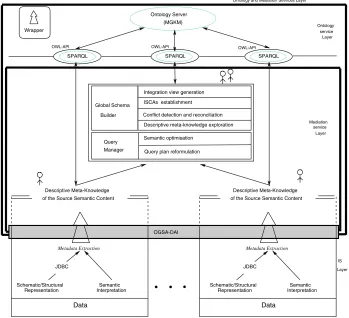
The MetaMed mediation system provides integrated access via a general service-based architecture approach (Fig.1) that is common to many grid projects. A high level view of the MetaMed system architecture shows that our system consists of the following three distinct layers: the ISs layer, the grid services layer, the Ontology and mediation services layer:
• The information servers layer consists of (i) the local ISs which will eventually be available to the end (global) users (ii) a set of low level application programming inter-faces (i.e. JDBC/ODBC drivers (Orfali and Harkey 1996)) to provide direct access to the underlying ISs, and (iii) wrappers designed to be used in an information grid infrastructure that may initially rely upon the OGSA-DAI (Jackson et al. 2011) grid middleware. Wrappers (also called translators) (Papakonstantinou et al. 1995) pro-vide a common query language and common data model for extracting the information needed to bring data uniformly back into the grid.
• The grid services layer consists of specific functionalities particularly related to grid facilities, is provided by using the standard Globus Toolkit Services. The Open Grid Services Architecture Data Access and Integration (OGSA-DAI) as well as grid func-tionality and database services (Muppavarapu et al.2010) offered by other flavours of
Ontology and Mediation Services Layer
Ontology Server
Integration view generation
service Layer Mediation .. .. ..
. .
BuilderISCAs establishment
Conflict detection and reconciliation Descriptive meta-knowledge exploration Global Schema
Query Manager
Semantic optimisation
Query plan reformulation (MGKM)
JDBC
Metadata Extraction Metadata Extraction
JDBC
.
Descriptive Meta-Knowledgeof the Source Semantic Content
Descriptive Meta-Knowledge of the Source Semantic Content
Schematic/Structural Representation Schematic/Structural Representation Interpretation Semantic Semantic Interpretation OGSA-DAI Layer IS .. Data Data Wrapper Ontology service Layer
OWL-API OWL-API OWL-API
SPARQL SPARQL
[image:4.440.45.394.282.600.2]SPARQL
grid middleware is shown on this level. OGSA-DAI is a middleware product that allows ISs, such as relational or XML databases, to be accessed in a data grid. Furthermore, it provides some of the base capabilities that would be required to run higher-level data integration services. Using OGSA-DAI interfaces disparate, heterogeneous data resources may be accessed in a uniform manner. It is important to note though that the underlying data model of each source is not hidden - a relational data resource remains a relational resource and the semantic and structural heterogeneity across grid databases will not masquerade. OGSA-DAI does not support database query languages hetero-geneity and does not provide a query language that is not already supported by the data resource or through some other third party application.
• The mediation services layer consists of the core system modules which collectively provide the mediation services and it is composed of two main modules:
1. Global Schema Generator (GSG): this includes the set of modules which are
responsible for generating the global schema to be provided for the user, starting from the source descriptive meta-knowledge formulated in terms of the generic
RDF/OWL-based domain model ontology (called the MGKM).1 The GSG
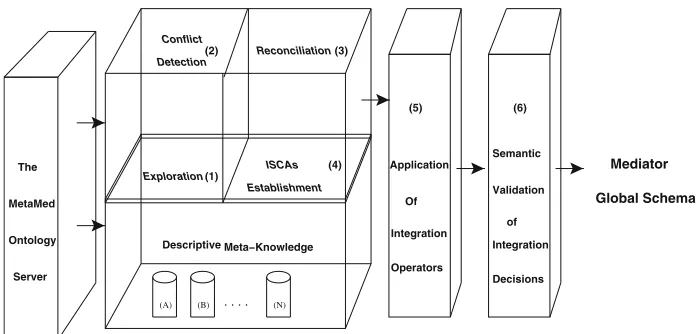
pro-vide the following services:(1)descriptive meta-knowledge exploration,(2)conflict detection and(3)reconciliation,(4) interschema correspondence assertions estab-lishment, (5) integration views generation. Moreover, the module performs (6) semantic validation of integration decisions taken by the user during the building of the integrated views. The result of the overall process is the so-called Mediator Global Schema view (see Fig.2).
2. Query Manager (QM): this is the query management module. It generates
OQLI3 (Hillairet et al.2009) language queries to be sent to wrappers starting from each query posed by the user on the global schema. The QM provides the service of automatically optimising and reformulating global queries into a corresponding set of sub-queries for the individual ISs.
• The ontology Services Layer: A major source of knowledge for mediation comes from the ontology layer (Rivero et al.2011b; Vidal et al.2011). The MetaMed Ontology services targets two basically different application requirements. First the grid itself needs an ontology service. This service provides meta information about grid entities. Secondly, the MetaMed network Terminology Server (MTS) provides common terms (vocabulary) which are used to construct metadata descriptions that characterize the underlying ISs semantic content or to specify an information request, refer to Tawil et al. (1998) for a more detailed discussion about this layer. All interactions with this
layer are achieved via OWL API (Horridge and Bechhofer 2011) abstraction layer
which sits above an SPARQL/Jena query interface (Kollia et al.2011).
Registered services at the grid layer are published in a registry. The grid middleware can query the registry to discover information on behalf of applications. These services about services are rather well known and deal with established web services concepts. A meta-registry knows the technical aspects about other services and responds to questions about their properties. Software modules at the mediation services layer communicates with both the ontology and the ISs layers using OWL API calls and JDBC API calls respectively. Wrappers convert data from each source into a common model. A wrapper for a particu-lar source converts queries submitted in the common grid format and query language into
(6) (5)
Operators
Validation Semantic
of
Integration
Decisions (2)
(4) Mediator
Global Schema (1)
The
MetaMed
Ontology
Server
Descriptive Meta−Knowledge Exploration
(A) (B) . . . . (N) Reconciliation (3)
Establishment
Of Application
Integration ISCAs
[image:6.440.44.394.55.222.2]Detection Conflict
Fig. 2 Mediator global schema generation
queries understandable by that source. The wrapper also receives the results from a source, and converts them into a model understood by the application. Applications can access data directly through wrappers, but they may also go through integrated views. In MetaMed wrappers are used to make local ISs comply with the internal MGKM representation of our system. Wrapping services act as transducers between the local ISs and the MetaMed high level integration services and connect to the ISs through JDBC/ODBC drivers, and to Ontology knowledge base services through OWL API-SPARQL drivers.
In the next section we describe the set of RDF/OWL-based representation format for our integration operators used in generating user-defined mediator views. The generated global views consist of virtual classes, that derives their instances from their corresponding local integration units.
3 RDF/OWL-based integration operators for generating global views
customizability has several advantages as it reduces the complexity of the mediator genera-tion process because only the relevant parts of the participating ISs schemas are integrated. The size of a generated mediator view is smaller compared with the case when a single global integrated schema is defined. This saves the user the burden of considering large global schema to locate information from multiple distributed and heterogeneous servers. Providing a schema integration language that aids in defining views with multiple seman-tics saves users the effort of manually integrating the selected information to create his/her views as is the case with the multidatabase language approach. Selectivity allows for infor-mation to be mediated from a large number of participating grid ISs. While customizability, on the other hand, means that the integrator can accurately indicate how to view selected information, and provision multiple semantic perspectives of the participating ISs at the mediator level.
Four major groups of integration operators are defined:Importation,Generalisation,
Spe-cialisationandMergeroperators. In what followsAttis a function that returns the attributes
of its argument,Extis function that returns the extension of its argument, Dare a set of derived (user defined) properties, that do not exist in the local classes but can be derived based on existing attributes,Gcare global classes,Lcare their corresponding local classes.2 A detailed description of the generated interschema correspondence establishment rules following the execution of the integration operators is given in Tawil et al. (2008).
3.1 Importation operator
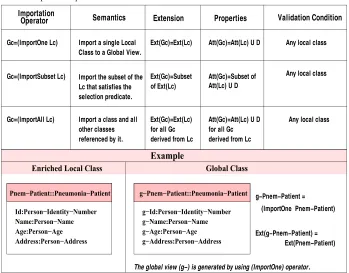
This group consists of operators: ImportOne, ImportSubset, and ImportAll. It is responsible for importing local classes into a global view without actually integrating them. Table1 shows the services provided by each of the importation operators.
When a local class is imported, the set of attributes (Att) and all the descriptions asso-ciated with that class are also imported. For example, in terms of the relational model, it is possible to import a single table (ImportOne), a subset of a table (ImportSubset) or a table and all other tables referenced by it (ImportAll). Also, the extension (Ext) of the globally imported classes equals the extension of their local counterparts. The semantics of the importation operators are described explicitly in an RDF/OWL-based operators (opt) ontology. Below is the representation of the ImportOne operator:
<owl:ObjectProperty rdf:ID="ImportOne">
<rdfs:subPropertyOf rdf:resource="#ImportationOperator" /> <rdfs:domain>
<owl:Class>
<owl:unionOf rdf:parseType="Collection"> <modl:LocalClass rdf:about="#Lc" />
<modl:UserDefinedAttribute rdf:about="#D" /> </owl:unionOf>
</owl:Class> </rdfs:domain>
<rdfs:range rdf:resource="#GlobalClass" /> <owl:Restriction>
2The structural representation of our local and global schema views are specified internally in terms of the
<owl:allValuesFrom rdf:resource="#Lc"/> <owl:allValuesFrom rdf:resource="#D"/> </owl:Restriction>
<rdfs:label xml:lang="en">ImportOne</rdfs:label>
<rdfs:comment xml:lang="en">Imports a single local class to a global view.</rdfs:comment>
</owl:ObjectProperty>
Table1shows how this operator, ImportOne, could be used to import the enriched
Pnem-Patientclass to the global user-defined level, (::) denotes the subclass relationship (e.g.
Pnemonia-Patient) and the (:) denotes the semantic types of the attributes (e.g. Patient-Identity-Number, Person-Full-Name, Date-Of-Birth, ..). Both the subclass relationship and the semantic types of the attributes are extracted from the MGKM semantic model.
Each imported class is represented internally using the functionsImport-Classand
Import-Attributerelations of the Importation operator. TheImport-Classfunction takes a local class
Pnem-Patient as input and generates a global one g-Pnem-Patient as its output, e.g.
<owl:class rdf:ID="g-Pnem-Patient">
<rdf:type rdf:resource="&opt;GlobalClass" /> <opt:Import-Class rdf:resource="#Pnem-Patient" />
<rdfs:subClassOf rdf:resource="&mgkm;Pneumonia-Patient" /> <opt:Imported-Attribute rdf:resource="#g-Pnem-Patientg.g-Id"/> <modl:isIdentifiedBy>
<modl:PrimaryKey>
<modl:Attribute rdf:resource="#g-Pnem-Patientg.g-Id"/> </modl:PrimaryKey>
</modl:isIdentifiedBy> ....
</owl:class>
The Import-Attribute function takes a local attribute Pnem-Patient.Id as input and
generates a global imported g-Pnem-Patient.g-Id attribute as output, e.g.
<owl:DatatypeProperty rdf:ID="g-Pnem-Patient.g-Id"> <rdf:type rdf:resource="&opt;GlobalAttribute" />
<rdfs:subPropertyOf rdf:resource="&mgkm;Person-Identity -Number"/>
<opt:Import-Attribute rdf:resource="#Pnem-Patientg.Id" /> </owl:DatatypeProperty>
3.2 Generalisation operator
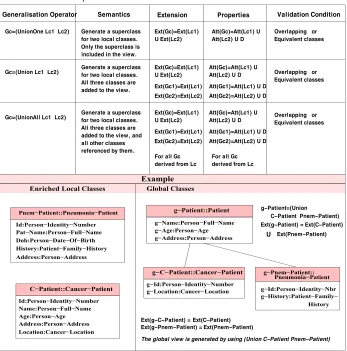
This group consist of operators: UnionOne, Union, and UnionAll. These integrate local classes by linking them to a common superclass. The local classes have to be semantically overlapping. Table2shows the services of each generalisation operator.
When a set ofintentionally related3local classes are Unioned three virtual classes are
created to the global view, namely: the generated superclass and its two subclasses. It is possible to add only the generalised superclass (UnionOne) , the generated superclass and its
Table 1 Importation operator semantics
two subclasses (Union) or the generated superclass its two subclasses and all other classes referenced by them (UnionAll). The set of attributes and the associated descriptions that belong to the union of both local classes are upward-inherited by the generated superclass. Below is the RDF/OWL representation of the UnionOne operator:
<owl:ObjectProperty rdf:ID="UnionOne">
<rdfs:subPropertyOf rdf:resource="#UnionOperator" /> <rdfs:domain>
<owl:Class>
<owl:unionOf rdf:parseType="Collection"> <modl:LocalClass rdf:about="#Lc1" /> <modl:LocalClass rdf:about="#Lc2" />
<modl:UserDefinedAttribute rdf:about="#D" /> </owl:unionOf>
</owl:Class> </rdfs:domain>
<rdfs:range rdf:resource="&opt;GlobalClass" /> <owl:Restriction>
<owl:allValuesFrom rdf:resource="#Lc1"/> <owl:allValuesFrom rdf:resource="#Lc2"/> <owl:allValuesFrom rdf:resource="#D"/> </owl:Restriction>
<rdfs:comment xml:lang="en">A Table has a set of Columns. </rdfs:comment>
</owl:ObjectProperty>
In the example of Table2the attributesg-Name,g-Age,g-Addressare upward inherited, and the description associated with the class g-Patientis that of patients suffering from either Cancer or Pnemonia.
<owl:class rdf:ID="g-Patient">
<rdf:type rdf:resource="&opt;GlobalClass" /> <rdfs:subClassOf rdf:resource="&mgkm;Patient" /> <owl:oneOf rdf:parseType="Collection">
<mgkm:pathology rdf:about="&mgkm;Cancer" /> <mgkm:pathology rdf:about="&mgkm;Pnemonia" /> </owl:oneOf>
[image:10.440.47.394.263.614.2]</owl:class>
The rest of the inherited global classes and attributes are imported to their respective classes using the importation operator. Also, the extension of the generated superclass is the union of the extension of both local classes. While the extension of the other global classes (e.g.g-C-Patient and g-Pnem-Patient) is that of their local counterparts.
In the above example, the two property sets, namely: Id, Pat-Name, Dob, History, Address and Id, Name, age, Address, Location which belong to the classesPnem-Patient
andC-Patientrespectively, may have semantic conflict. For instance, whileg-Patient.g-Age
can be safely retrieved from theC-Patient.Ageattribute, a function is required to calculate the age of the patient from his date of birth when it is retrieved fromPnem-Patient.Dob. Also, equivalent properties may disagree on their syntax as well. For instance, the Name property maybe speltNamein one class andPat-Namein another. These conflicts are iden-tified and delt with during the conflict detection and resolution phase (see Tawil et al.2008) of the global schema generation process. Establishing interschema correspondence relation-ships and defining proper transformation to reconcile any heterogeneity is only possible when the semantic description of each property is explicitly defined to our system and the correspondence establishment rules to resolve conflicts are specified.
Another important issue that is demonstrated by the current example is establishing the set of correspondences between instances from the extensions of classesC-Patientand
Pnem-Patientto determine the correct instances for the generated global classg-Patient.
This achieved by using global integrity constraints that are defined on both classes, since primary keys (OIDs) are usually insufficient to determine this relationship. While primary keys are sufficient to uniquely identify objects at the local schema they are insufficient to determine relationships between retrieved instances from different distributed grid ISs at the mediator level. In this example, a patient object of one database represents the same real object of another if they have the same name, age and address:
(=> (=Ext C−PatientPnem−Patient)
(and(=V alueC−Patient.namePnem−Patient.name)
(=V alueC−Patient.age(Date−Of−Birth−To−AgePnem−Patient.Dob?age)) (=V alueC−Patient.addressPnem−Patient.address)))
In the above asserted OKBC knowledge => stands for implication,=Ext stands for extension equivalence, =V aluestands for attribute values equivalence, and Date-Of-Birth-To-Ageis a function that calculates the age of a person from its date of birth. The generalised (unioned) superclass is represented internally using the Union-Classand Union-Attribute
functions of the generalisation operator. TheUnion-Classfunction takes two local classes as input Pnem-Patient, C-Patient and generates a global one g-Patient as its output, e.g.
<owl:class rdf:ID="g-Patient">
<rdf:type rdf:resource="&opt;GlobalClass" /> <opt:Union-Class>
<modl:LocalClass rdf:resource="#Pnem-Patient"/> <modl:LocalClass rdf:resource="#C-Patient"/> </opt:Union-Class>
While theUnion-Attributefunction takes two local attributes Pnem-Patient.Pat-Name, C-Patient.Name as input and generates one global imported attribute g-Patient.g-Name as output, e.g.
<owl:DatatypeProperty rdf:ID="g-Patient.g-Name"> <rdf:type rdf:resource="&modl;Attribute"/> <rdfs:domain>
<opt:Union-Attribute> <owl:Class>
<owl:unionOf rdf:parseType="Collection">
<modl:LocalAttribute rdf:about="#Pnem-Patient. Pat-Name" />
<modl:LocalAttribute rdf:about="#C-Patient.Name" /> </owl:unionOf>
</owl:Class>
</opt:Union-Attribute> </rdfs:domain>
<rdfs:subClassOf rdf:resource="&mgkm;Person-Identity-Number"/> <rdfs:range rdf:resource="#g-Name"/>
</owl:DatatypeProperty>
The associated global subclasses of the unioned superclass are mapped internally using the importation operator relations as described above. In our semantic representations we are trying to model real world concepts. In the real-world a concept can have multiple par-ents and can inherit properties along multiple paths. While, polyhierarchies are difficult to maintain, however when providing the correct set of axioms, an automated reasoner such as (pellet) can be used to maintain such relationships. The effort is considerable requir-ing richer axioms but worthwhile as the automated reasoner is able to maintain the whole structure, avoiding errors. The more expressive axiomatization also enables richer queries.
3.3 Specialisation operator
This group consists of two operators: Intersect, and IntersectAll. These integrate a set
of overlapping classes by generating a common subclass. Table 3 shows the services
contributed by each operator of this group.
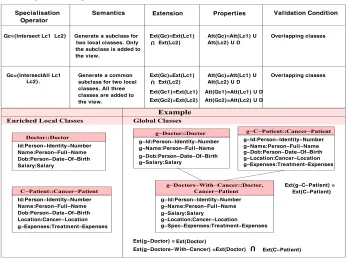
The Specialisation operator group integrates a set ofintentionally relatedlocal classes by specialising them into a common subclass. This adds three virtual classes to the grid global view, these are the generated subclass and its two superclasses. The set of attributes belonging to the two superclasses are imported from their respective local classes using the Include operator. The attributes that belong to the generated subclass are downward-inherited by the generated subclass. The extension of the generated global subclass is the intersection of the extension of both local classes. While the extension of the other global classes is that of their local counterparts.
Table 3 shows how the classes Doctor and C-Patient are integrated, using speciali-sation operators to generate the class Doctors-With-Cancerof hospital doctors who are suffering from cancer. To calculate the treatment expenses of doctors who are patients, we need to override theg-Expensesproperty of theg-C-Patientclass with a user-defined
Table 3 Specialisation operator semantics
g−C−P atient.g−Expenses-g−C−P atient.g−Expenses∗40
100
stating that these patients gets a 40 % discount. The OKBC representation of this rule is:
(and=(User−Defined−Attributeg−Spec−Expenses)
(Attribute−Ofg−Spec−Expensesg−Doctor−With−Cancer) (=valueg−Spec−Expenses(−g−Expenses(∗0.4g−Expenses)))
The specialised subclass is represented internally using theIntersect-Class, and
Intersect-Attribute functions of the specialisation operator. TheIntersect-Classfunction takes two
classes as input and generate an intersected subclass as output. The associated global super-classes of the specialised subclass are mapped internally using the importation operator relations.
3.4 Merger operator
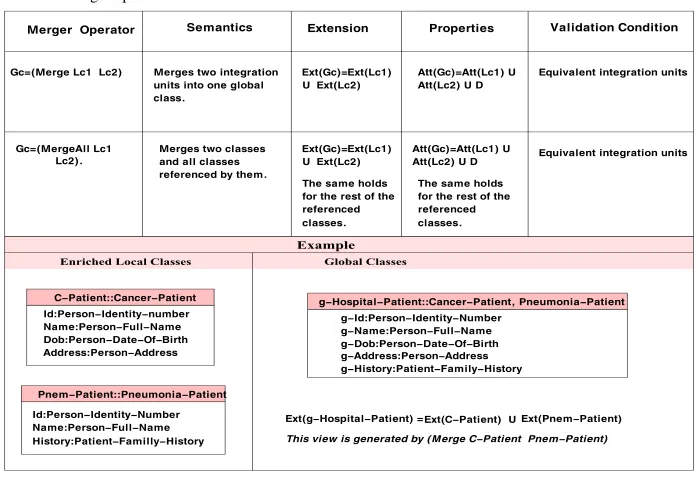
This group consists of two operators: Merge, and MergeAll. The service offered by these operators is to integrate equivalent local integration units by merging them into one global class. Table4shows the effects of each of this group of operators.
Table 4 Merger operator semantics
of the global class is the union of the descriptions associated with its local merged from classes. Accordingly, the description of theg-Hospital-Patientclass is that of patients who are either suffering from Pnemonia or Cancer, or from both.
Finally, the combined global class is represented internally using theMerge-Classand
Merge-Attributefunctions of the merger operator. TheMerge-Classfunction takes two local
classes Pnem-Patient, C-Patient as input and generate one global class g-Hospital-Patient as its output.
<owl:class rdf:ID="g-Hospital-Patient">
<rdf:type rdf:resource="&opt;GlobalClass" /> <opt:Merge-Class>
<modl:LocalClass rdf:resource="#Pnem-Patient"/> <modl:LocalClass rdf:resource="#C-Patient"/> </opt:Merge-Class>
<rdfs:subClassOf rdf:resource="&mgkm;Pneummonia-Patient"/> <rdfs:subClassOf rdf:resource="&mgkm;Cancer-Patient"/> </owl:class>
While the Merge-Attributefunction takes two local attributes Pnem-Patient.Name, C-Patient.Name as input and generates a global one g-Hospital-Patient.g-Name as its output.
<owl:DatatypeProperty rdf:ID="g-hospitaPatient.g-Name"> <rdf:type rdf:resource="&modl;Attribute"/>
<rdfs:domain>
<opt:Merge-Attribute> <owl:Class>
<modl:LocalAttribute rdf:about="#Pnem-Patient .Name" />
<modl:LocalAttribute rdf:about="#C-Patient.Name" /> </owl:unionOf>
</owl:Class>
</opt:Merge-Attribute> </rdfs:domain>
<rdfs:subClassOf rdf:resource="&galen;Person-Full-Name"/> <rdfs:range rdf:resource="#g-Name"/>
</owl:DatatypeProperty>
It is worth mentioning, here, that it is possible for the integration expert to override any of the global attributes for a virtual class by overriding (customizing) global attributes or processing the results of the retrieved values. This can be implemented in a variety of ways: these range from simple arithmetic manipulations (e.g. defining a function to convert degrees Centigrade to Fahrenheit) to complex operations which can only be realized using external programs. The reason behind allowing for user-specified options is to give users more control over the global view definition process and to support customizability.
3.5 Cost of integration operators
Open and dynamic grid environments pose additional challenges to the provision of cost-related metadata, since cost models require cost-cost-related information to be consistently obtainable, i.e. over all data sources. In a grid environment quantitative cost estimates are difficult to derive, when the data to be retrieved is computed by complex queries, that retrieves and integrates data from different heterogeneous and grid distributed ISs. The cost of both Union and Intersection operators in the grid depends on network cost of query exe-cution time and the scale of data retrieved to be processed. Accordingly, we can find the overall execution time by adding to the query execution cost the flat overheads. To over-come the difficulties of cost-based query planning, we advocate a qualitative approach. We assume that the cost to reformulation, query translation, and the system overheads are stable, which entails that if the size of data to be processed is determined we are able to estimate (with the help of a cost model, or based on previous experience) the execution time of each integration operation.
We estimate the cost of a distributed plan purely in terms of its execution time. We also assume that the execution time is dominated by the tuple transfer costs, and integration operators used. Thus ignoring the local processing costs. Accordingly, the execution costs are computed in terms of the response times offered by the various sources that makes up the (distributed) plan. The response time of a server is proportional to the number of times that server is called, and the expected number of tuples transferred over each call.
3.5.1 Case study
The experiment described in this subsection calculates the cost of using the integration operators of the MetaMed system when evaluated against example queries on the mediator global schema discussed in Fig.4. Queries are run in various different configurations, and with varied parameters to test the different operators including theImportation,
response time was taken into consideration when calculating the cost of execution for each operator.
The case study has been conducted on a homogeneous collection of dedicated MySQL server machines with no direct user access at King’s College and University of Malta, while the global mediator schema is run from the University of East London. All machines run-ning Windows 7 operating system and had the same specifications (CPU 2.60 GHz, 4 GB RAM). All three universities are connected via the (https://www.ja.net/products-services/ janet-connect/janet-connections!). Janet is high-speed network for the UK research and education community. A connection to Janet gives a reliable and high bandwidth network.
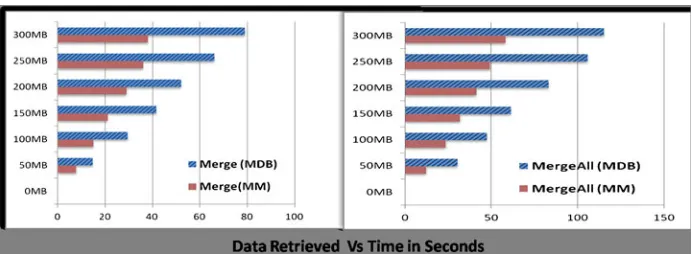
The data (1 Gigabyte in total) is distributed over two volumes located on both sites. In itself, then, these data can be accommodated in memory on any of the machines, so that the execution time of a mediator calls should be dominated by CPU processing. The queries submitted to the mediator global schema view are executed at the local server where the data is located and retrieves tuples, from which part of the data are joined tuples across both sites, some satisfies the aggregation criterion while other tuples required functional conversions. Attributes are either generalized or specialized and the rest of the data is imported. As the cost of calls to MetaMed is several orders higher than a normal query execution between the two local sources, the query cost is expected to be dominated by the processing of returned data when a standard MultiDatabase (MDB) approach is used as opposed to a intelligent query planning and formulation when data are requested against the MetaMed (MM) mediator schema.
In our case study, all machines have wrappers implemented with APIs that can sup-port the MetaMed global mediator queries and are capable for translating from and to the mediator global schema. The CPU cost of a MetaMed call for a given stored dataset varies significantly depending on the operator’s required for specific query requests. Since the CPU speeds and usage cost may vary, there is a range of options within a grid environ-ment for increasing the parallelism in the operation calls. Two strategies for parallelizing operators calls maybe considered in our integration context based on prior knowledge of individual IS specification and network speed. One strategy could be to targethigh-speed
processors, the parallelization of the operation by the mediator through requesting larger
[image:16.440.46.393.472.601.2]data sets from the fastest processor depending on the distance and network speed. A sec-ond strategy may opt to target,slowest processor-firstwhich could be adopted if the user is charged for using Grid resources, and the cost of a resource depends on its power. However, neither of these strategies are considered in our experiment.
Fig. 4 Intersect operator cost
Much of the cost of the integration process occurring is spent while enriching the local schema and in the building of the integrated schema. The cost of using the importation operator including all of it’s versions (ImportOne,ImportSubsetandImportAll) is equivalent to executing a direct query request to the participating ISs as the data is not integrated when using this operator.
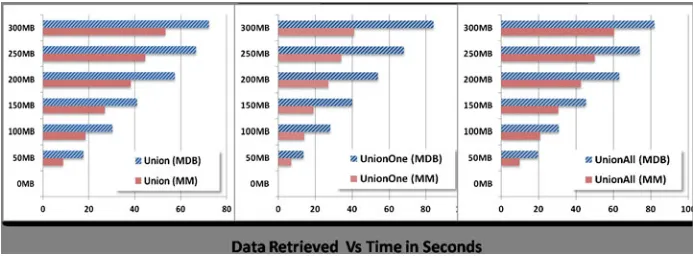
The cost of the Generalisation operator depends on which version of the operator is used
(UnionOne,UnionorUnionAll). The cost of the operator depends on the data retrieved by
the query when executed against the generalized classes of the MetaMed mediator global schema and is evaluated by executing several Multi-database (MDB) queries (Smith et al. 2002; Lu et al.1992) requesting data from the generalized class. In our mediator schema example the Union operators were used and a superclass with the associated subclasses are generated representing the integration of equivalent attributes. Any remaining attributes are imported to their respective global mediator classes. The cost is determined based on query execution time when the same results are requested using queries against the mediator schema and then the same data is retrieved and integrated using MDB queries against the individual ISs schemas, see Fig.3.
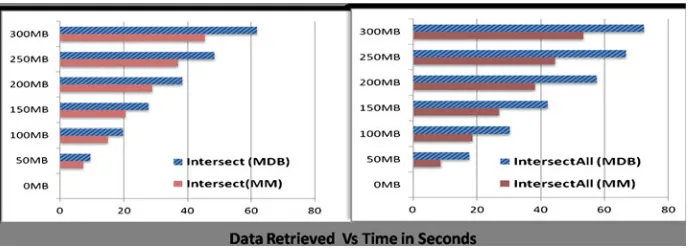
The cost of the specialisation operator is evaluated based on the size of the intersected data when integrated using either one of the operators (IntersectorIntersectAll). The query execution time is significantly reduced when the data is actually imported from either one of the local databases rather than filtering the data at the global schema. The same data is retrieved and integrated using queries against the mediator global schema and also on MDB queries against the individual ISs schemas, see Fig.4.
Both Merger operators (Merge andMergeAll) significantly reduce the execution time. Prior to query execution MetaMed identifies the server from which the data are to be retrieves and complete the Merging of the data at the mediator global schema. The cost is evaluated based on the size of the data retrieved that is part of the merged classes from the global schema, see Fig.5.
3.6 Verification of integration decisions
Fig. 5 Merge operator cost
depends on the interschema semantic relationships among these units (e.g. equivalence, overlap, .. etc), and user preferences, see (Li et al.2010; Tawil et al.2008; Li and Ling2004). Semantic preservation rules for validating user decisions have been defined. Based on the description of the individual ISs, the interschema semantic relationships and the description of the conditions under which the integration operators can be applied, the verification of integration decisions can be validated using semantic preservation rules. The descriptions of the data elements involved in the execution of an integration operator can either match the integration rules associated with this operator or not. These are enforced implicitly by controlling user choices, i.e. a user cannot make an erroneous selection because s/he is presented with the valid set of properties to choose from. Whenever a choice is made by a user at the grid level, all the properties that may create a conflict if they were to be chosen during subsequent interactions are masked automatically by the system.
The domain (the concept(s) with which an operator is associated) and the range (the type of values it can have) of the internal relations associated with each operator are explic-itly defined (constrained) in the system. For example, theImport-classandImport-Attribute
relations of the importation operator can be described as follows:
(=> (Import−Class ?Lc?Gc)
(and=(Interface ?Lc) (Interface ?Gc) (=Ext ?Gc ?Lc)
(or =(= Att(?Gc)Att(?Lc))
(Subset−Of Att(?Gc)Att(?Lc))).
The local class?Lccan be imported to a global class?Gconly if both?Lcand?Gcare of type interface, and the associated attributes of?Gcare equal to or are a subset of those of
?Lc, and the extension of the global imported classes?Gcare equal to those of their local counterparts?Lc.
(=> (Import−Attribute ?Att Lc?Att Gc)
A local attribute?Att Lccan only be imported to a global one?Att Gcif both?Att Lcand
?Att Gcare of type attribute, and the extension of the global attributes equals those of their
local counterparts. For the merger operator this translates to the following rules:
(=> (Merge−Class ?Lc1 ?Lc2 ?Gc)
(and = (Interface ?Lcl) (Interface ?Lc2) (Interface ?Gc)
(Intentionally−Equivalent−With ?Lc1 ?Lc2) (= Att(?Gc) (Union = Att(?Lc1)
Att(?Lc2))))).
The local classes?Lc1and?Lc2can be merged to a global class?Gconly if?Lc1,?Lc2,
?Gcare of typeInterface, both?Lc1and?Lc2are intentionally equivalent, and the associated attributes of?Gcare the union of the intentionally equivalent attributes of?Lc1and?Lc2.
(=> (Merge−Attribute(and(?Att Lc1) (?Att Lc2))?Att Gc)
(and = (Attribute ?Att Lc1) (Attribute ?Att Lc2) (Attribute ?Att Gc)
(Intentionally−Equivalent−With ?Att Lc1 ?Att Lc2) (=Ext ?Att Gc(UnionExt = ?Att Lc1
?Att Lc2)))).
The local attributes?Att Lc1and?Att Lc2can be combined to a global attribute?Att Gc
only if?Att Lc1,?Att Lc2,?Att Gcare of type attribute, and both?Att Lc1and?Att Lc2are intentionally equivalent. Also, the extension of global attributes?Att Gcequals the union of the extension of their local counterparts?Att Lc1and?Att Lc2.
The use of MGKM in the integration process in grid-settings allows us to use the descrip-tions associated with local classes to validate the user decisions (asserdescrip-tions) about concepts to be integrated. In general, the descriptions of the data elements involved in the execution of an integration operator can either match the integration rules associated with this operator or not. Accordingly, three different situations are possible: an error message is signalled, a warning is given, or the integration is granted.
[image:19.440.47.393.539.615.2]Depending on both the situation and the kind of correspondence (see Table5), the system notifies the integration expert with one of the following messages:
Table 5 Cases in which the system can detect anomalies
A≡B A⊆B A∩B= ∅ A∩B= ∅
– Error Message, the interschema correspondence between the concepts description and the predefined semantics of the integration operator are disjoint. For example, if the database schemasPnem-Patient(Stores information about patients suffering from a pnemonia infection), andLung-Tumor-Patient(Stores information about patients suf-fering from lung tumor) are said to be merged, then an error is detected because their interschema corresponding definition indicates that both schema concepts are
intention-ally related(both schemas are storing information about patients, but these patients
are suffering from different types of diseases). The merge operator group can only be applied if both database concepts to be integrated are at leastintentionally equivalent.
– Warning Message, the interschema correspondence between the concepts descriptions
and the predefined semantics of the integration operator can be matched, but the system believes that a more accurate integration operator can be applied. For example, if the schema conceptsCancer-Patient4andLung-Tumor-Patient5are said to be merged by the
person responsible for integration using the merger operator, then a warning is detected because the description ofCancer-Patientschema subsumes that of the
Lung-Tumor-Patientand therefore it seems that applying the generalisation operator would be a better
choice.
– Granted, the definition of the correspondence and the chosen integration operator match
perfectly, and the system cannot find a better operator to be used.
– Ignored, the definition of the correspondence does not make any new contribution.
For example, if the Importation operator is chosen then the definition of interschema correspondences are ignored.
The integration process is semi-automatic and the integrator input is required to solve conflicts. In case of an Error or a Warning message the enriched schema models are exploited to assist the user (integration expert) during the integration process by automat-ically identifying integratable schema concepts and validating user assertions about the concepts to be integrated. The integration operators provide the integration expert with the necessary tools to assist in designing the global schema and to resolve conflicts when defining the mappings from the local ISs schemas to the global integrated schema.
4 Generation of the mediator global schema
In this section, we present an integration scenario to show how our integration language is used to define a mediator global schema, that is a mediator view of data stored in local ISs. In the scenario we examine the case when the integrator wishes to integrate two databases:
Lung-Infection-DBandCancer-DB, see Fig.6.
The process of generating global classes is interactive with the integrator (Papakonstantinou et al.1996; Sheth and Larson Levy et al.1990;1996). We assume that both schemas are enriched with semantic knowledge extracted from the MGKM. Lets sup-pose as a first step the integrator wishes to generalise the Pnem-Patientand thePatient
classes of theLung–Infection-DBandCancer-DBrespectively, and to create a new
Hospital-Patientclass as a superclass of the two classes. All three classes are added to the view. The
attributes belonging to theHospital-Patientclass corresponds to the union of the attributes of the classes belonging toPnem-PatientandPatient, where semantically equivalent attributes
history:Patient−Family−History pat−job:Job job:Job position:Doctor−Rank date−of−birth:Date−Of−Birth specialisation:Doctor−Specialisation salary:Salary address:Address Physician::Doctor doc−Id:Doctor−Identity−Number address:Address sex:Sex rank:Doctor−Rank name:Person−Full−Name number:Patient−Identity−Number name:Person−Full−Name pat−Id:Patient−Identity−Number Patient::Cancer−Patient Doctor::Doctor staff#:Doctor−Identity−Number blood−group:Blood−Type dob:Date−Of−Birth first−name:Person−First−Name wage:Salary Lung−Infection−DB Cancer−DB doctor:set<Doctor> dob:Date−Of−Birth address:Address sex:Sex physician:set<Physician> blood:Blood−Type smoking−history:Patient−Smoking−History
1:M Attribute−Domain Relationship
[image:21.440.49.396.62.313.2]Legend last−name:Person−Last−Name age:Age name:Person−Full−Name Pnem−Patient::Pneumonia−Patient sex:Sex speciality:Doctor−Specialisation address:Address address::Address street:Street−Address city:City−Address zip−code:Postal−Address
Fig. 6 Enriched ISs schemas of Lung-Infection-DB and Cancer-DB
are automatically unified into unique global attributes in theHospital-Patientclass. Before the integration process is initiated and based on the associated semantic domains with each of the classes to be generalised the system infers (suggests) the following RDF/OWL-based relationships:6
<owl:Class rdf:ID="#Pnem-Patient.number">
<mgkm:Is-Equivalent-With rdf:resource="#Patient.pat-Id" /> </owl:Class>
<owl:Class rdf:ID="#Pnem-Patient.name"> <mgkm:Is-Aggregation-Of>
<owl:unionOf rdf:parseType="Collection">
<modl:LocalAttribute rdf:about="#Patient.first-name" /> <modl:LocalAttribute rdf:about="#patient.last-name /> </owl:unionOf>
<mgkm:Is-Aggregation-Of> </owl:Class>
<owl:Class rdf:ID="#Pnem-Patient.dob">
<mgkm:Has-Data-Representation-Conflict rdf:resource="#Patient
6The integrator is asked to accept/modify or reject the generated types of correspondences for the interschema
.age"/>
<owl:FunctionalProperty rdf:resourse="Date-Of-Birth-To-Age" /> </owl:Class>
<owl:Class rdf:ID="#Pnem-Patient.physician">
<mgkm:Is-Equivalent-With rdf:resource="#Patient.doctor" /> </owl:Class>
<owl:Class rdf:ID="#Pnem-Patient.smoking-history"> <mgkm:Is-Kind-Of rdf:resource="#Patient.history" /> </owl:Class>
...
In the above interschema correspondence assertions, an Is-Equivalent-With assertion is assigned when both schema elements are representing the same real-world concepts, Is-Kind-Of assertion is assigned when two schema elements exists at different levels of abstraction in two different databases, Is-Aggregation-of is assigned when the domain of one schema element maps to a group, or collection of domains in another. The output of this unification process for the Hospital-Patientclass of Fig. 6, is the following set of global attributes (g-name,g-dob,g-address,g-sex,g-blood,g-job,g-doctor), the associated internal assertions include:
<opt:UnionClass rdf:ID="#g-hospital"> <owl:unionOf rdf:parseType="Collection">
<modl:LocalClass rdf:about="#Pnem-Patient" /> <modl:LocalClass rdf:about="#patient" /> </owl:unionOf>
</opt:UnionClass>
<opt:UnionAttribute rdf:ID="#g-hospital.name"> <owl:unionOf rdf:parseType="Collection">
<modl:LocalAttribute rdf:about="#Pnem-Patient.name" /> <modl:LocalAttribute>
<owl:unionOf rdf:parseType="Collection">
<modl:LocalAttribute rdf:about="#Patient.first-name" /> <modl:LocalAttribute rdf:about="#Patient.last-name" /> </modl:LocalAttribute>
</owl:unionOf> </opt:UnionAttribute>
....
Of course additional information has to be provided for completing the grid level global schema definition. In particular, MetaMed asks the designer to interactively supply information regarding:
completely different term. In our example, the designer decides to assign the name
g-Hospital-Patientto the global class generated from integratingg-Pnem-Patientand
g-Patient.
2. Mappings between the global attributes of the global class, and the corresponding attributes of the local one. In particular, if a global attribute is obtained from integrat-ing more than one local attribute, mappintegrat-ing information will be generated automatically depending on the integration operator used, the resulting generated classes and their internal representation:
• andmappings: this specifies that the value of a global attribute corresponds to the union of the attributes of a given class. For example the global attribute name of
g-Hospital-Patientcorrespond to bothfirst-nameandlast-nameattributes of
Pnem-Patient. By specifying this mapping relationship forg-name, the integrator states
that the values offirst-name, andlast-namehave to be considered when
g-Hospital-Patient.nameis retrieved from the Pnem-Patient database.
• or mappings: this specifies that the value of a global attribute corresponds to the value of at most one local attribute of a given class.g-Hospital-Patient.name
corresponds to thenameattribute of thepatientclass.
[image:23.440.48.395.316.600.2]3. default values to be assigned to global attributes in correspondence of a given class. A default value is always verified for the global attribute when evaluated on the class. For example, the integrator knows that the global attributeg-rankofg-Hospital-employees
has values ‘Doctor’ or ‘Consultant’ when evaluated on theg-Doctorclass, even if the globalg-rankattribute is not declared in any of the local ISs.
4. new attribute for the global class. The integration operator suggests a name assignment that is constructed from the local integrated schema (which usually not very readable) and provides the integrator with the option to manually change it.
TheDoctorandPhysicianclasses are integrated using the Merger operator to create the
g-Hospital-Doctorclass, see Fig.7. Furthermore, previously integrated views can participate
in further integration procedures. Accordingly,g-Hospital-Patientandg-Hospital-Doctorcan be furthur integrated using the same Merger operator to generate theg-Hospital-Personclass which groups information about all persons working in and/or treated at the hospital, again refer to Fig.7.
Global classes are specified in terms of the MetaMed ODLI3 knowledge representation language7and the information on attribute mappings and default values is represented in the form of RDF/OWL-assertions. An example of MODLI3 specification for the global class
Hospital-Personis shown bellow:
<owl:Class rdf:ID="g-Hospital-Person" > <rdf:type rdf:resource="&modl;Interface" /> <rdfs:subClassOf rdf:resource="&mgkm;Person" /> <modl:Has-Class-Extent>
<owl:oneOf rdf:parseType="Collection">
<modl:Interface rdf:about="#Pnem-Patient"/> <modl:Interface rdf:about="#Patient"/> <modl:Interface rdf:about="#Physician"/> <modl:Interface rdf:about="#Doctor"/> </owl:oneOf>
</modl:Has-Class-Extent> <modl:isIdentifiedBy>
<modl:PrimaryKey>
<modl:hasAttribute rdf:resource="#g-Hospital-Person.g-name"/>
</modl:PrimaryKey> </modl:isIdentifiedBy> ...
</owl:Class>
<owl:DatatypeProperty rdf:ID="g-Hospital-Person.g-name"> <rdf:type rdf:resource="&modl;Attribute" />
<rdfs:domain rdf:resource="#g-Hospital-Person" /> <rdfs:range rdf:resource="&mgkm;Person-Full-Name" /> <rdfs:subPropertyOf rdf:resource="&mgkm;Has-Person-Name"/> </owl:DatatypeProperty>
<opt:Maps-Class rdf:ID="g-Hospital-Person">
<modl:Interface rdf:resource="#g-Hospital-Patient" />
7MODL
I3 (Tawil et al.2008) is a declarative specification of the ODMG-93 Object Definition Language
<modl:Interface rdf:resource="#g-Hospital-Doctor" /> </opt:Maps-Class>
<opt:Maps-Attribute rdf:ID="g-Hospital-Person.name"> <owl:oneOf rdf:parseType="Collection">
<owl:unionOf rdf:parseType="Collection">
<modl:Attribute rdf:resource="#Cancer-DB.Patient.first-name" />
<modl:Attribute rdf:resource="#Cancer-DB.Patient.last-name" />
</owl:unionOf>
<modl:Attribute rdf:resource="#Lung-Infection-DB.Pnem-Patient.name" />
<modl:Attribute rdf:resource="#Cancer-DB.Doctor.full-name" />
<modl:Attribute rdf:resource="#Lung-Infection-DB.Physician. Name />
</owl:oneOf>
</opt:Maps-Attribute> ...
As we can see from the specification, for each attribute, in addition to its declaration, mapping rules are defined, specifying both information on how to map the attribute on the corresponding attributes of the local classes and on possible default values defined for it on local classes. For example, for the global attributename, the mapping rule specifies the attributes that have to be considered in each of the classes to which it corresponds. Mapping rules are automatically generated by scanning the mapping relationships associated with the operator history.
The global grid-level schema of the mediator is composed of the global classes generated/defined by the user using the provided integration operators.
4.1 External schema specification module
Part of the customizability philosophy adopted in our design is to enable end users of our system to view the global integrated schema in their preferred DDL. Once the internal mediator schema view is defined, the user can decide on how s/he is interested in viewing that schema. The External Schema Specification Module enable end users to specify tem-plates that facilitate the interpretation of the integrated view internal representation into a target DDL. Each template contains parameters which refer to the necessary information for expressing the syntax of the output DDL. Typical templates for an OO DDL language include Java methods that direct the generation of class names, keys, superclasses and prop-erties. These templates are stored in a file called External Schema Specification File (ESSF) for the output language. The following extract of a java program depicts a template that will transform a virtual class from its RDF/OWL internal representation into standard ODL representation:8
public createStandardODLTemplate(Interface InterfaceName, Key KeysName,
Extent ExtentsName,
SuperclassOf Superclasses, Attribute PropertyNames, ValueType PropertyType) {
File standardOQL = new File(standardOQL);
FileWriter fwOQL = new FileWriter(fwStandardOQL); write(fwOQL, ‘Interface’);
write(fwOQL, InterfaceName); fwOQL.write(‘:’);
write_inheritance(fwOQL, Superclasses); fwOQL.write(‘\n’);
fwOQL.write(‘(’);
writeStringToFile(fwOQL, ‘extent’); write-extent(fwOQL, ExtentsName); fwOQL.write(‘\n’);
writeStringToFile(fwOQL, ‘key’); fwOQL.write(‘)’); fwOQL.write(‘\n’); fwOQL.write(‘{’); fwOQL.write(‘\n’);
writeProperties(fwOQL, PropertyNames, PropertyTypes); fwOQL.write(‘\n’);
writeStringToFile(fwOQL, (‘};’); }
void writeStringToFile(FileWriter fw, String s) throws IOException
{
for(int i=0; i<s.length(); i++) fw.write(s.charAt(i));
fw.write(‘\n’); }
void write-inheritance(FileWriter fw, SuperclassOf SuperclassesName) throws IOException
{
// Enumerates over the inheritance list
Enumerator eSuperclasses = SuperclassesName.enumerate_list (); while(eSuperclasses.has_more_p()){
writeStringToFile(fw, eSuperclasses.next().toString()); fw.write(‘:’)
This specification phase is performed once per target DDL. The result of applying the above user defined template to the MODLI3schema of Fig.7we get the following ODMG-93 ODL schema definition:
Interface g-Hospital-Person : Person (Key g-name)
{
attribute Person-Name g-name; attribute Date-Of-Birth: g-dob; attribute Address g-Address; attribute Sex g-Sex;
}
Interface g-Hospital-Patient : g-Hospital-Person, patient ( )
{
attribute Patient-Blood-Type g-blood; attribute Job g-job;
attribute set<Doctor> g-doctor; }
... ..
Queries posed by the user using his/her preferred DDL are first translated to the MODLI3 internal representation before being processed by the QM. Clearly it is much easier to create DDL templates when the target DDL is at least as expressive as MODLI3. When the target DDL is less expressive than the internal representation model, issues of limited expressiveness of the target DDL need to be considered.
5 Query reformulation
In this section we will give a few examples of how a query processor can make use of the integration knowledge in extracting data from several ISs. We describe how it is possi-ble to exploit the information on the grid schema for global processing. When a grid user submits a query on the global schema, MetaMed takes the query and produces a set of subqueries that will be sent to the single information sources. According to other semantic approaches (Comito et al.2005; Levy et al.1996; Arens et al.1993), this process consists of two main phases:
• semantic optimisation;
• query plan formulation;
5.1 Semantic optimisation
based on logical inference from content knowledge (in particular on the integrity constraint rules) of the mediator schema, shared among the local classes from which the global class is generated.
Let us the consider the the request: “Retrieve the doctors whose annual salary is greater than £55000”:
select name from g-Doctor
where g-salary is > 55000;
Let us suppose that in both integrated databases exists a relationship between the salary of the doctor and his rank, stating that all doctors with a salary greater than £55000 are ranked as consultants. This constraint rule can be defined in the following way:
(Defining-Axiom R1
(=> (and (Interface g-Doctor) (> g-Doctor.g-salary 55000)
(Monetary-Units g-Doctor.g-salary pounds)) (= g-Doctor.rank Consultant))).
The mediator executes the semantic expansion of the input query by applying ruleR1. The resulting query is the following:
select name from g-Doctor
where g-Doctor.g-salary > 55000 and g-Doctor.rank = ‘Consultant’;
Semantic expansion is performed in order to add predicates in the where clause: this process makes query plan formulation more expensive (because a heavier query has to be translated for each interesting source) but single source’s query processing overhead can be lighter if secondary indexes into predicates added exist in the servers involved.
5.2 Query plan reformulation
Once the mediator has produced the optimized query at the grid level, a set of subqueries for the local ISs will be formulated. For each IS, by using the mapping rules associated with each global class, the mediator has to express the optimized query in terms of local schemas. In order to produce the translated query, the mediator checks and translates every predicate (boolean factor) in the where clause of the global query to determine the local query to be generated. Starting from the local classes associated with the global class(es) queried by the user.
Referring to our query example, thestep 1of the reformulation algorithm will consider the querying of two local ISs’ classes (tables)Pnem-PatientandPatient, so that we derive the following queries for serversLung-Infection-DBandCancer-DBrespectively:
select name select fname, lname
from Lung-Infection-DB.Physician from Cancer-DB.Doctor
where Physician.wage > 55000 where Doctor.salary > 55000
and Physician.rank = ‘Consultant’; and Doctor.position =
If integrity constraints are provided also for a local server, it is possible to perform semantic query optimization with ODB-Tools on the corresponding local queries too, before sending the query to the source. For example, if the following rule is provided for theDoctor
class of theCancer-DB:
(Defining-Axiom R2
(=> (and (Interface Cancer-DB.Doctor) (= Doctor.Position Consultant)) (> Doctor.staff# 100))).
R2can be used to optimize the local queryS2, giving raise to the following query:
select fname, lname from Cancer-DB.Doctor where Doctor.salary > 55000
and Doctor.position = ‘Consultant’
and Doctor.staff# > 100;
This transformation could be useful if, for example, an index is available for the staff#
attribute.
5.3 Query optimisation using extentional knowledge
Another type of knowledge which could be useful for query optimisation is interschema knowledge of extensional type. It is defined in terms of interschema properties, specifying mutual relationships between class instances and corresponding databases.
Example of interschema properties that can be specified for two classescandcat the extensional level are (equivalence, containment, overlapping, disjointness).
Referring to our example, let us suppose that the designer is able to state this exten-sional property: Ext(Pnem-Patient) ⊂Ext(Patient), stating that the patients stored in the
Pnemoniaclass of theLung-Infection-DBare subset of those stored in thePatientclass of the
Cancer-DB. The mediator may exploit this knowledge during the query processing phase to
minimize the data processing required. In particular, if the user is looking for the name of the patients whose blood type is AB, the following query will be submitted:
select name
from g-Hospital-Patient where g-blood = ‘AB’;
By exploiting the introduced extensional property, the mediator knows that all patient instances of thePnem-Patientclass are also stored (and thus retrieved) in thePatientclass. Consequently only the following query is considered and will be sent to thePatientclass of the cancer database:
select name from g-patient
where g-blood = ‘AB’;
6 Conclusions
In this paper we have described the design and implementation of a multiple views inte-gration language that facilitates the efficient production of multiple inteinte-gration views from multiple heterogeneous ISs in a Grid Environment. The language is based on a small set of integration operators that are capable of providing a consistent and non-redundant represen-tation of distributed participating ISs. The operators are customizable to satisfy the needs of different user groups or participating programs. Users decisions on concepts to be integrated are validated by the system.
The MetaMed system offers an integration language of operator services for grid end-users to work with in terms of integrated and customized mediator views. Global queries are executed by means of mapping requests against the mediator schema to requests against the underlying ISs schemas. The mapping of queries is facilitated by a set of reformulation rules that accompany each view. Finally, we believe that the availability of a rich set of integration operators and the declarative nature of our language substantially increases the degree to which service-oriented mediator functionalities can be integrated in a grid setting.
References
Al-Mourad, M.B., Gray, W.A., Fiddian, N.J. (2003). Multiple views with multiple behaviours for interop-erable object-oriented database systems. In Proceeding of 14th international conference on database
and expert systems applications, Czech Republic, lecture notes in computer science (LNCS2736).
Springer-Verlag.
Arens, Y., Chee, C.Y., Hsu, C., Knoblock, C.A. (1993). Retrieving and integrating data from multiple infor-mation sources. International Journal of Intelligent and Cooperative Inforinfor-mation Systems, 2(2), 127– 158.
Brezany, P., Woehrer, A., Tjoa, A.M. (2004). Novel mediator architectures for grid information systems.
Journal for Future Generation Computer Systems - Grid Computing: Theory, Methods and Applications, 21(1).
Cattel, R.G. (1996). ODMG-93 The object database standard release 1.2. San Francisco: Morgan Kaufmann. DBLP,http://dblp.uni-trier.de.
Chen, H., Wu, Z., Zheng, G., Mao, Y. (2004). RDF-based schema mediation for database grid. In Fifth
IEEE/ACM international workshop on grid computing (GRID04) (pp. 456-460).
Comito, C., Talia, D., Gounaris, A., Sakellariou, R. (2005). Data integration and query reformalution in service-based grids: Architecture and roadmap. Technical report, CoreGRID technical report number TR-0013. Institute on knowledge and data management.
Duwairi, R.M. (1997). Views for interoperability in a heterogeneous object-oriented multidatabase system. PhD thesis. University of Wales College of Cardiff: Department of Computer Science.
Halevy, A.Y., Ives, Z.G., Mork, P., Tatarinov, I. (2003). Piazza: Data management infrastructure for seman-tic web applications. In Proceedings of the 12th international world wide web conference (pp. 556–567). Halevy, A.Y., Ives, Z.G., Madhavan, J., Mork, P., Suciu, D., Tatarinov, I. (2004). The piazza peer data
management system. IEEE Transactions on Knowledge and Data Engineering, 16(7), 787–798. Hillairet, G., Bertrand, F., Lafaye, J. (2009). Rewriting queries by means of model transformations from
sparql to oql and vice-versa. In R. Paige (Ed.), Theory and practice of model transformations, lecture
notes in computer science (Vol. 5563, pp. 116–131). Berlin/Heidelberg: Springer.
Horridge, M., & Bechhofer, S. (2011). The owl api: a java api for owl ontologies. Semantic Web, 2, 11–21. Jackson, M.J., Antonioletti, M., Dobrzelecki, B., Hong, N.C. (2011). Distributed data management with
ogsadai. In S. Fiore & G. Aloisio (Eds.), Grid and cloud database management, (pp. 63–86). Berlin/Heidelberg: Springer.
Kaoudi, Z., Dalamagas, T., Sellis, T. (2005). RDFSculpt: managing RDF schemas under set-Like semantics, 123–137.
Koehler, M., & Benkner, S. (2009). A service oriented approach for distributed data mediation on the grid. In