An Analysis of Causes and Welfare Effects of Real Exchange Rate
Movements
by
Clemens Grafe
Thesis submitted at the Department of Economics at the London School of Economics and Political Science in fulfillment of the requirements for the degree of
Doctor of Philosophy at the University of London
UMI Number: U 198995
All rights reserved
INFORMATION TO ALL U SE R S
The quality of this reproduction is d ep en d en t upon the quality of the copy subm itted.
In the unlikely even t that the author did not sen d a com plete m anuscript
and there are m issing p a g e s, th e se will be noted. Also, if material had to be rem oved, a note will indicate the deletion.
Dissertation Publishing
UMI U 198995
Published by ProQ uest LLC 2014. Copyright in the Dissertation held by the Author. Microform Edition © ProQ uest LLC.
All rights reserved. This work is protected against unauthorized copying under Title 17, United S ta tes C ode.
ProQ uest LLC
789 East E isenhow er Parkway P.O. Box 1346
f H e S C S
f
An Analyis of Causes and Welfare Effects of Real Exchange Rate Movements
byClemens Grafe
Abstract
This thesis contributes to the research on determinants and welfare effects of real exchange rate movements. Chapters two to four focus on a discussion of money supply shocks as one of the sources of changes in the real exchange rate. More specifically chapter two contains a critical overview of empirical and theoretical research that contributes to our understanding of the monetary transmission mechanism in open economies. The chapter analyses two specific classes of models, liquidity models and sticky price models and investigates to which degree these models are able to rationalise the result of related empirical studies.
The third chapter focuses on the determinants of the welfare effects of money supply shocks across countries if prices are sticky. It analyses specifically the implications of different forms of price stickiness. Furthermore it combines these nominal rigidities with different real imperfections in the labour market. The chapter concludes that the impact of a money supply shock on real exchange rates and the welfare effect at home and abroad depend strongly on the type of nominal rigidity assumed.
The fourth chapter analyses the effect of a money supply shock on tradable and nontradable producers inside a country and shows that the widespread belief that tradable sectors benefit the most from a depreciation of the exchange rate could be misplaced. It stresses the importance of sectoral labour mobility and risk sharing in an evaluation of relative welfare effects.
C ontents
1 In tr o d u c tio n
2 S tick y P ric e M o d els and L iq u id ity M o d e ls o f O p en E con om ies
D o th e y fit th e ev id en ce?
2.1 In tro d u c tio n ... 2.2 Empirical R e s e a rc h ... 2.2.1 M onetary policy, nominal and real exchange rates and domestic
o u t p u t ... 2.2.2 Spillovers of m onetary p o l i c y ... 2.2.3 The pass through of exchange rate movements to p r i c e s ... 2.3 T h e o r y ... 2.3.1 Sticky P r i c e s ... 2.3.2 Liquidity Models and Segmented M a r k e t s ... 2.4 Conclusion ...
3 C o n tr a stin g D ifferen t Form s o f P ric e S tick in ess: E x ch a n g e R a te O ver
sh o o tin g and B eg g a r T h y N eig h b o u r P o lic y
3.1 In tro d u c tio n ... 3.2 The Model ... 3.2.1 Consumers’ P r o b le m ... 3.2.2 F irm s’ P r o b le m ... 3.3 Steady State A n a l y s i s ... 3.4 The Economy under Nominal R ig i d i t i e s ...
8
11
11
14
14
20
22
25 26 37 45
47
3.4.1 Exchange R ate Overshooting and Uncovered Interest R ate P arity . 63
3.4.2 W inners and Losers of an U nanticipated Money S h o c k ...67
3.5 Conclusion ... 77
4 W in n ers and L oser o f M o n ey S u p p ly S hocks in O p en E co n o m ie s 88 4.1 In tro d u c tio n ... 88
4.2 The m o d e l... 93
4.3 Asym metric expansions of the money supply ... 98
4.3.1 The intra country eq u ilib riu m ...103
4.3.2 The two tradable s e c to rs ...106
4.3.3 Aggregate D y n a m ic s ... 109
4.4 The relative welfare of the tradable and nontradable p r o d u c e r s ...113
4.5 R o b u s t n e s s ... 117
4.5.1 Sticky Prices in the consumers’ c u rre n c y ... 118
4.5.2 The role of labour m o b i l i t y ...121
4.6 Conclusion ... 123
5 T h e R e a l E x ch a n g e R a te in T ra n sitio n E co n o m ies 135 5.1 In tro d u c tio n ...135
5.2 The Model ... 139
5.2.1 The state sector ... 139
5.2.2 The New S e c t o r s ... 140
5.2.3 Labor M a r k e t... 141
5.2.4 Financial M arkets ... 142
5.2.5 Goods M arket ...142
5.2.6 Emergence and Growth of the M odern Sectors ...143
5.3 Big Bang ... 145
5.4 T ransition d y n a m i c s ... 149
5.5 The Steady S t a t e ...152
5.6 A Model w ith Imperfect S u b s t i t u t e s ... 153
5.6.2 Big-bang ...154 5.6.3 Transition d y n a m ic s ...155 5.7 Conclusion ...158
6 C o n clu sio n 165
List o f Figures
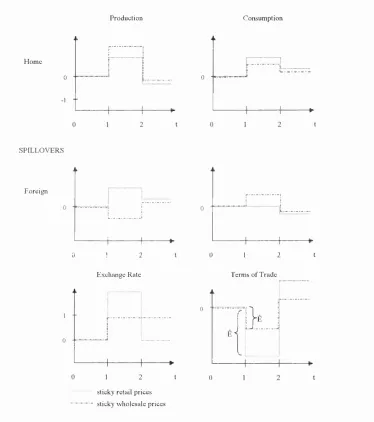
3.1 Sticky Prices in the Consumers’ and in the P roducers’ Currency: Impulse
Response Functions...70
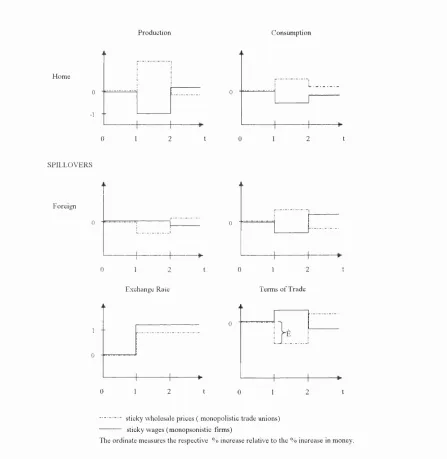
3.2 Monopolistic and Monopsonistic Labour Markets: Impulse Response Func tions... 74
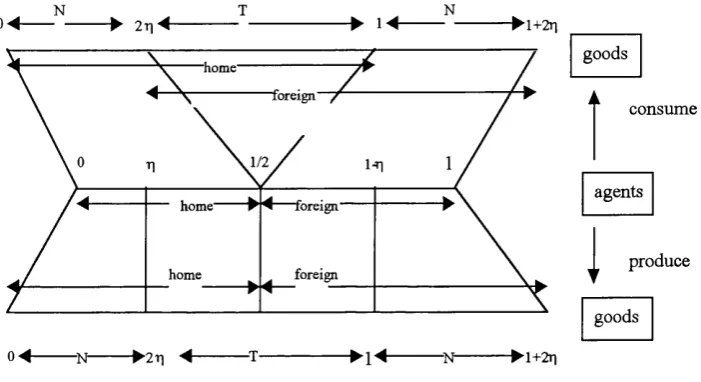
4.1 The Model ... 95
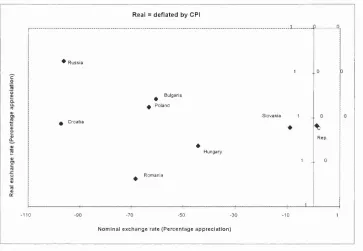
5.1 Correlation of Nominal and Real Exchange R ates...137
5.2 P roductivity in the S tate S e c to r... 144
5.3 The situation after Big B a n g ...147
5.4 Transition... 150
5.5 The Hiring in the New S e c t o r ...151
5.6 q(0) at the Tim e of Big B a n g ... 156
5.7 Transition D y n a m ic s ... 157
Acknowledgements
In w riting this thesis I have benefited from the advice from m any people. In particular Charles R. Bean was very helpful in guiding my work over th e years and encouraging me to raise my ambitions. I learned a great deal from our frequent discussions and I am very greatful to him for seeing me through the completion of this thesis even after he had resigned from the London School of Economics. I want to thank Alan M anning for his generosity in seeing me trough the final stages after Charles R. Bean had resigned.
The research presented in chapter three has been conducted jointly w ith Markus K. Brunnermeier, when he was a fellow PhD student at the LSE. Over the years I have greatly benefited from our discussion about economics. Even though or perhaps because he had specialised in quite different branches of economic research I benefited greatly from his constant questioning of the m ethods used in international macroeconomics.
A special thanks is due to Charles Wyplosz who greatly encouraged me to enter this Ph.D. and who helped me especially in the difficult early stages of the Ph.D. Chapter five of this thesis is in fact based on joint research we did in those years.
Conducting this research would have been impossible w ithout the financial assistance granted to me both by the Deutscher Akademischer A ustauschdient and the Training and Mobility Research Network of the European Union.
C hap ter 1
In trod u ction
This thesis provides an analysis of causes for real exchange rate movements and discusses the welfare implications of the implied changes in relative prices. More specifically, the second, third and fourth chapters discuss the impact of m onetary policy on the real exchange rates, the current account and the welfare effects of its movements. In contrast the last chapter, discusses nonm onetary causes of real exchange rate changes through an analysis of the real exchange rates in transition economies.
The th ird chapter discusses the implications of different forms of price stickiness for the movement of exchange rates and welfare abroad and at home after an asymmetric money supply shock. The chapter extends the two country Obstfeld and Rogoff (1995) setting and shows th a t the im pact of a money supply shock on the national economy and the spillover effects to other countries depend crucially on (i) the form of price or wage stickiness as well as on (ii) the structure of the labour m arket. W ith prices sticky in the consumers’ currency, the exchange rate overshoots even though uncovered interest rate parity is violated and an unexpected m onetary expansion leads to a “beggar thy neighbour” effect. Exactly the opposite occurs if prices are sticky in the producer’s currency . In this case a positive money supply shock causes positive spillover effects. The chapter also discusses the implications of different imperfections in the labour market for the im pact of money supply shocks on the exchange rate and the current account. The im pact of wage stickiness depends crucially on the structu re of the labour market. If the labour m arket is dom inated by labour unions, a positive money supply shock leads qualitatively to the same spillover dynamics and exchange rate dynamics as under sticky prices in the producers’ currency. II' on the other hand, firms have all bargaining power in the labour market the opposite output dynamics and exchange rate dynamics follows a money expansion.
m onetary policy on exchange rate volatility and deviations from PPP. It argues th a t the im pact of m onetary shocks on the exchange rate depends crucially on the opportunities to share risks across sectors.
The fifth chapter analyses the behaviour of real exchange rates in transition economies. The investigation abstracts from any m onetary effects. Real exchange rates appear to present a specific behaviour in the early phase of transition: they are largely unaffected by nominal exchange rate movements and exhibit tren d appreciation. The model pre sented here describes the transition process as the emergence of two new (traded and non-traded goods) sectors and the decline of an inefficient and subsidised state sector. The absence of financial markets means th a t firms accum ulate capital through retained earnings. Labour m arkets are imperfect giving rise to a wage gap. The model shows th a t the real excahnge rate plays the crucial role of determ ining real wages. Through real wages it sets the pace for the development of the new sectors as workers are attracted out of the state sector. The link beween growth and real appreciation differs from the usual Balassa Samuelson effect. The chapter explores the role of labour m arket distortions and foreign financing.
C hapter 2
Sticky P rice M od els and L iquidity
M od els o f O pen E conom ies
D o th e y fit th e evid en ce?
2 .1
I n tr o d u c tio n
This chapter gives an overview of the recent research into the effect of m onetary shocks on nominal and real exchange rate dynamics and the implied im pact on real variables. As such it also reviews a p art of the litterature th a t is most relevant for the research presented in chapters 3 and 4.
dynamics being almost disconnected from fundam entals in the short to medium run, also referred to as the exchange rate disconnect puzzle. The fact th a t a structural change in the dynamics of the real exchange rate which is a relative price does not result in any change in the behaviour of volumes appears to be difficult to reconcile w ith economic theory.
These empirical findings sparked a lively debate am ongst economists at the time. M ussa (1986) argues th a t the increase in the variance of real exchange rates can not be explained w ithout resorting to some form of sluggish price adjustm ent. Stockm ann (1987), in contrast, points out th a t the root should be found in real shocks because of the persistence of the movement in the real exchange rates, a view th a t was supported by research by Huizinga (1987). Huizinga claimed th a t real exchange rates possess a unit root and th a t most of the variance of real exchange rates should be a ttrib u ted to perm anent shocks and not m onetary shocks which should only have a transitory impact.
more recently Chinn and Meese (1995) show th a t the models are able to outperform the random walk at horizons of more than 2-3 year. Nevertheless this is of little consolation w ith respect to nominal shocks. Since there is little controversy nowadays amongst economists th a t money is neutral in the long run, real effects of m onetary disturbances, if they exist, should be most prominent in the short rim.
Even though the findings by Meese and Rogoff are damning, they are not restricted to the field of exchange rate dynamics. In fact, this failure is tru e for almost every field in economics th a t tries to explain asset prices. Currently many economists believe th a t this failure m ight be due to the micro structure of financial m arkets, an area th a t has seen a lot of interest over the last decade. U nfortunately this is well beyond the scope of this chapter.
Instead we restrict ourselves in this survey to the macro-economic research, th a t tried to improve on the Meese/Rogoff finding either by developing new models or by applying more recent econometric techniques. The next section provides an overview about the empirical research, which is mainly using vector auto regressions. The subsequent section provides a survey of recent theoretical research in the area where we restrict ourselves to models th a t allow for nonneutralities of m onetary policies. F irst if money is neutral, exchange rate dynamics stem ming from m onetary policy are not very interesting because they trivially translate into equiproportinate changes of the nominal exchange rate w ith the real exchange rate remaining unaffected. Second it is difficult to explain the close correlation of nominal and real exchange rates in low inflation countries if money is neutral, unless we attrib u te most of the changes to real shocks as Stockm ann proposed.1 Third, much empirical evidence suggests th a t m onetary policy has real effects.
Models of theories with nonneutralities can be broadly divided into two classes. One class makes use of the Keynesian assum ption th a t prices are sticky, mostly rationalised by the assum ption th a t it is costly to change prices. The other class assumes th a t financial m arkets are segmented, meaning access to financial m arkets is not freely available to everybody.
1If real shocks w ere at th e root o f th e puzzles sta te d in th e introd u ction , it w ould be difficult to see
2 .2
E m p ir ic a l R e se a r c h
Before we discuss the theory of the im pact of m onetary policy on nominal and real exchange rates we provide an overview of recent empirical research on the topic. We also present information on the transm ission of m onetary shocks on consumption and production in open economies. Of particular interest in the transm ission mechanism of m onetary shocks in open economies is the pass-through of exchnange rate movements into prices. T h at is why section 2.2.3 is specifically devoted to this topic.
W ith few exceptions recent empirical research on the topic has used vector auto regressive m ethods to investigate the im pact of m onetary shocks. While some use a structural approach, using identifying restrictions th a t are justified by a specific model, the restrictions imposed in the papers reviewed could actually be derived from many of the models th a t are discussed in section 2.3. Thus w ith respect to the identifying restrictions the models discussed in the subsequent section are observationally equivalent. T h at is why we do not go into how the authors are justifying the restrictions they imposed. Only empirical research th a t makes use of calibration techniques is model specific. T hat is why this class of papers is discussed in the section on theory rather th an in here.
2 .2 .1 M o n e t a r y p o lic y , n o m in a l a n d r e a l e x c h a n g e r a t e s a n d d o m e s t ic
o u t p u t
economists have w ith rationalising the movement of real exchange rates. Clarida and Gali’s estim ation strategy is based on the fact th a t it should be possible to estim ate the transitory deviation of the real exchange rate from its long rim equilibrium by using ex post interest rate differentials. Since m onetary shocks should only have an influence on the transitory component as money is neutral in th e long ru n this should provide an upper bound for the im pact of m onetary shocks on th e real exchange rate.
More specifically let rJt = i3t — Et7rj.+1 denote the ex ante real interest rate in country
j (i.e. i denotes the nominal interest rate and 7r the inflation rate). If uncovered interest rate parity holds (i^ — = Et(et+i — e*), where et denotes the exchange rate), then the ex ante real interest differential A r t between the home and foreign country can be w ritten as A r t = Et(qt+ 1 — qt) where qt denotes the real exchange rate qt = s t + p { —
P t. Solving this equation, the deviation of the real exchange rate can be w ritten as
qt — qt = Et(EtJLQArt+ j) where qt = lim ^ o o Etqj denotes the expected long run level
of the exchange rate. As said before th a t means th a t as long as uncovered interest rate parity holds the tem porary deviation of the real exchange rate should be given by the expected sum of future ex ante interest rate differentials. Although ex ante interest rates are unobservable they are by definition given by the expectation of observable ex post real interest rates. Thus, using the law of itterated expectations the deviation of the real exchange rate from its long run expected level can be w ritten as q t~ q t — E t { T ^ QA8t-\-j))
the interest parity restriction th a t is relevant for estim ating th e transitory component in the real exchange rate from real interest rate differentials is violated in the data, raising doubts about the uncovered interest rate parity condition.
After having followed this more traditional approach and having failed to shed light on real exchange rate movements the authors continue w ith an investigation or real ex change rates using a structural VAR in the tradition of Blanchard and Quah (1989). They specify a Dornbusch type model and allow for three types of shocks; money sup ply shocks, supply shocks and dem and shocks and estim ate a structu ral VAR on output, the real exchange rate and expected inflation. They identify the shocks by assuming th a t only real shocks have a long term im pact on output. Dem and shocks can have a long term influence on the real exchange rate and the price level and m onetary shocks only cause a change in the relative price level and nominal exchange rates in the long run. Even though these identifying restrictions are derived using a sticky price model, they are not inconsistent w ith other classes of models like the liquidity models discussed in section 2.3. Using this methodology they find th a t nom inal shocks explain a substan tial am ount of the variance of the real exchange rates of Germany and Japan vis a vis the US at short horizons. For example 50% of the real exchange ra te movements at a horizon of one year are explained by m onetary shocks. Strangely enough this is not true for B ritain and Canada. Only 1% of the variance is explained for the UK at the same horizon. Almost all the rest of the real exchange rate variance is explained by dem and factors rather than supply factors, a finding th a t is in line w ith work by de Gregorio et al (1994).
movements die out after 16 to 20 quarters. There is also a significant overshooting of the exchange rate. They also find th a t the depreciation reaches its maximum only 4 m onths after the shock. In a similar VAR Schlangesief and Wrase (1995) additionally report th a t a rise in the federal funds rate simulaneously raises short term interest rates in other OECD countries, although by a smaller amount. The differences found in the im pact across countries is a recurring p attern in this sort of investigation and raises doubts about the robustness of the results against changes in the identifying restrictions and the set of variable included.
O ther authors have subsequently tried to increase the num bers of variables included. Evans and Eichenbaum (1995) and Grilli and Roubini (1995) use 7 variable VAR systems th a t in both papers include foreign and domestic output, dom estic and foreign short term rates and the exchange rate. They differ in as far as Evans and Eichenbaum include the ratio of nonborrowed reserves to to tal reserves while Grilli and Roubini include the foreign price level. They also differ in the way they identify m onetary innovations. While Grilli and Roubini identify m onetary innovations as changes in short term interest rates, Eichenbaum and Evans identify them by changes in the m onetary aggregate. Both use a recursive structure to identify m onetary shocks. Despite these differences the results are pretty similar and confirm the results obtained by Clarida and Gali. They find w hat is widely called the forward discount puzzle, namely th a t after the im pact of a m onetary contraction the exchange rate takes up to two years to reach the peak of its appreciation. This implies th a t the interest differential can easily have the opposite sign of the ex post exchange rate movement in the short term. Similar to Clarida and Gali (1994) Evans and Eichenbaum find th a t between 13 and 42 percent of the 12 quarter ahead forecast error for the US dollar/D M exchange rate is a ttrib u te d to US m onetary policy. Furtherm ore both papers find the liquidity puzzle, nam ely th a t interest rates fall after a m onetary expansion. Additionally they report an exchange rate puzzle -while the dollar appreciates after an increase in interest rates other OECD currencies depreciate.
interest rate innovations partly reflect inflationary pressures and Sims and Zha (1995) proposed a structural VAR approach th a t include proxies for expected inflation to resolve the price puzzle. In their paper the methodology involves contemporaneous restrictions rath er th an the recursive structure used in Evans and Eichenbaum (1995) and Grilli and Roubini (1995). Extending this work to the open economy Kim and Roubini (2000) showed th a t using the same technique of contemporaneous restrictions in a structural VAR and involving variables th a t can proxy for expected inflation the exchange rate puzzle is resolved. Furtherm ore they find much less evidence of a delayed overshooting. A lthough the im pact of a money shock on the exchange rate is not instantaneous, the period in which it appreciates is much shorter th an the two years found earlier.
The critical element in all of these emprical studies is th e exact identification proce dure used by the authors and the set of variables included. Typically the results are not very robust to the choice of variables included and assumptions made. Specifically the large differences across countries raise some doubt about the identification procedures used. This issue is rather akward as there are a few identification assumptions which are noncontroversial on theoretical grounds. This also restrict to some extent the num ber of variables th a t can be included as with more variables more and probably even more controversial identifying restrictions are needed. Faust and Rogers and Uhlig have suggested procedures of how to improve on these weaknesses.
of any non-controversial identifying assumptions one should try a whole set of plausible identifying assumptions (including the once used in the previously discussed papers), to study th e robustness of the results. Therefore their procedure returns a whole range of values, of which they report the minima and maxima. In doing so they find th a t the delayed overshooting, reported in the earlier papers is due to th e assum ption about the recursive structure in money m arkets assumed by Evans and Eichenbaum. They show th a t if money innovations by the Fed could influence foreign interest rates in the same m onth, the effect on the exchange rate peaks on im pact, i.e. there is no delayed overshooting. W ith respect to other regularities reported above, th eir identification leads to similar results w ith the difference th a t they report wide ranges depending on the set of identification restritions included. For instance they report th a t US m onetary policy accounts for between 8% and 56% of the forecasting error in the U S/D M exchange rate at the 48 m onth horizon. A distinct advantage of their procedure is th a t they can expand the Eichenbaum /Evans 7 variable VAR to a 14 variable set because they do not have to choose specific identifying assumptions. They include besides others, commodity prices and long term interest rates. They find th a t in th e larger VAR the share of the forecasting error th a t is attributable to nominal shocks falls to between 2%-30%. While they find evidence of substantial overshooting, these periods are times of large and volatile deviations from uncovered interest parity. These deviations are larger than the change in short term interest rates or interest rate differentials. This suggests th a t the Dornbusch overshooting model is ill equipped to explain the overshooting found in the d ata and also explains why authors such as Clarida and Gali have repeatedly failed to find a connection between real interest rate differentials and real exchange rate changes.
different model (built on Rogoff 1992), th a t makes him estim ate a VAR th a t includes the difference in the share of government in GDP, the money multiplier, the real exchange rate and the difference in ou tp ut additionally to the difference in base money. In the spirit of Faust and Rogers he considers different identifications and states the minima and m axim a of w hat can be attrib u ted to different shocks.
Summarising, the evidence found in VARs of th e im pact of m onetary shocks on real exchange rates is rath e r sketchy and most results are not very robust to changes in the variables included, countries investigated and identification restritions employed. Nevertheless, w ith very few exceptions, authors find th a t a substantial am ount of real exchange rate volatility can be attrib u ted to m onetary shocks and the movement of the rate goes in the ’’correct” direction. The exchange rate depreciates if the money supply is expanded and appreciates if it is contracted. Furtherm ore th e exchange rate seems to overshoot its long term equilibrium, although it is n ot clear if it reaches its peak on im pact of the shock or if there is delayed overshooting.
2 .2 .2 S p illo v e r s o f m o n e t a r y p o lic y
After having discussed the relationship between m onetary policy shocks and exchange rates we continue by discussing their im pact on volumes of consumption and produc tion abroad. U nfortunately none of the papers above specifically analyses the spillovers from foreign m onetary policy on foreign o u tp ut and consumption. The scarce evidence is surprising because competitive devaluations and beggar thy neighbour effects have always been a topic in political and economic discussions. According to the impulse re sponse functions in Faust and Rogers the im pact of a positive m onetary shock on foreign ou tpu t is positive, of smaller m agnitude th an the domestic ou tp ut expansion b u t of a similar duration. Clarida and Gali report only the ratio of the change in ou tput which is sharply positive, thus in line w ith Faust and Rogers. Schlangensief and Wrase confirm the observation of a positive although much smaller spillover on foreign output in their VAR analysis. Furtherm ore they find quite substantial persistence. U nfortunately none of the papers includes any measures of consumption
rath er than the im pact of m onetary policy on them. Backus, Kehoe and K ydland (1992) report th a t somewhat puzzlingly the international correlation between output is higher th an th a t of consumption, an observation which is at odds w ith international risk sharing. Backus et al notice th a t this is difficult to reconcile w ith stan d ard real business cycle models. In the Penn World Table, correlations for o u tp ut for the period (1973-1992) is 0.53 while th a t for consumption is only 0.4. Similarly Lane (1998) reports th a t GNP is more volatile th an GDP at the business cycle frequency for OECD countries. In a way this observation is not th a t surprising given the large evidence of a very strong home bias in asset holdings, specifically equity holdings. For example the US population holds 90 per cent of its equity portfolio in US firms while in Jap an this ratio is as high as 98 per cent. In Europe, however, the homebias is not as extreme. For an exhaustive overview of the literature see Lewis (1999). Nevertheless, while the home bias can only provide a reason why there is no perfect risk sharing and thus a low correlation for foreign and home consumption, it cannot explain why the volatility of consum ption or GNP is higher th an th a t of GDP.
The author has come across little evidence th a t analyses the effect of money shocks on the current account. Backus et al. (1992) find the so called J-curve effect, i.e. the current account initially turns negative when the exchange ra te depreciates and only turns positive w ith a significant delay. This is at odds w ith recent evidence found by others. Lane (1999) and B etts and Devereux (1997) report th a t positive m onetary shocks lead to a depreciation and have a positive im pact on the current account which is in line w ith standard theory.
Similarly Lane and Milesi-Ferreti (1999) report th a t there can be a significant rela tionship between changes in net foreign assets and changes in the real exchange rate, suggesting th a t even tem porary changes in the real exchange ra te can have long term effects through the distribution of assets.
seems to suggest th a t the im pact on consumption is smaller (this is obviously very speculative). Furtherm ore there is some evidence th a t the current account surplus for the home country rises and th a t the net asset position is positively affected after a positive domestic money shock .
2 .2 .3 T h e p a s s t h r o u g h o f e x c h a n g e r a t e m o v e m e n t s t o p r ic e s
As m entioned in the introduction, the passthrough of exchange rates to prices has drawn a lot of atten tio n recently and later chapters in this thesis will argue, th a t the degree of exchange rate pass through has im portant implications on th e transm ission of m onetary shocks in the international economy.
The research on exchange rate passthrough is partly driven by the aim to understand the large short to medium run deviations from purchasing power parity, which are ob served in the data. The m ain reason why economists look for m onetary shocks as one of the driving forces for this phenomenon is the following. T here is little controversy about the fact th a t money supply shocks are one of the driving forces behind the movement of nom inal exchange rates and, as explained above, it appears th a t nominal exchange rate movements spill directly into real exchange rate movements in OECD countries. In fact, the correlation between nominal and real exchange rates is close to one for these countries. Since most of the OECD economies are quite open economies this appears to suggests th a t the passthrough from exchange rates to prices is far from complete. The same is not tru e in countries th a t have higher inflation rates. In those countries the corrletation between real and nominal rates is much lower. These regularities have often been used as evidence th a t sticky prices in the consum ers’ currency m ust be at work, but we discuss in the last section of this chapter th a t these regularities can also be rationalised w ithout this assumption.
the nontradable sector. Wages will rise in the foreign tradable sector com pared to the home tradable sector, if expressed in the same unit because of the gain in productivity. If there is labour mobility across sectors, wages will also rise in the foreign nontradable sector com pared to the home nontradable sector. Since productivities in the nontradable sector haven’t changed the price of nontradable o u tp u t in the foreign country will rise com pared to th a t of tradables, which should be tantam on t to a real appreciation (Balassa (1964) Samuelson(1964)). Nevertheless, Canzoneri et al. (1999) show th a t while it is true th a t in the long run the relative productivities of the tradable and nontradable sectors determ ine their relative prices, it is much harder to establish th a t this also determines the real exchange rate. The reason is th a t contrary to much theory, it is not only different prices for nontradable goods th a t drive the real exchange rate b u t also differences in the prices for tradable goods. While the difference in these prices should, according to many theories be negligable because of international arbitrage, the d a ta seem to suggest th a t the international disparities in the pricing of easily tradable goods seem to be both large and very persistent. Thus, Conzoneri et al find very little evidence th a t tradable goods prices are governed by the law of one price even if they consider the relatively long period from 1970-1990. This evidence is confirmed by Feenstra and Kendall (1997) who also show th a t much of the change in real exchange rates is due to only partial pass through of nominal exchange rate movements by exporting firms. For an explanation they actually don’t refer to price stickiness in the consumers’ currency b ut instead argue th a t monopolistic power induces firms to lower their m argin ra th e r th a n fully adjust the prices.
Contrary to the evidence by Canzoneri et al.(1999) other authors have shown th a t it is possible to confirm the P P P hypothesis for OECD countries if one uses d a ta sets th a t span almost 100 years. Thus, the long run, in which P P P holds is understood to be quite extensive. The time period needed for half the deviation from P P P to disappear is estim ated to be around four years (see Rogoff for a survey).
as to nontradable goods economists have started to look a t disaggregated price series for similar trad ed goods in different countries to study the law of one price for these goods. Engel and Rogers (1996) investigate the variation in prices for similar goods between cities in Canada and the US close to the border and compare this w ith the variation across different cities inside the US. They find th a t being on the other side of the border adds about 2000 miles to the distance between cities, m easured as the increase in variance. While this border effect could obviously also be due to many other effects such as tariffs etc, the authors believe th a t much of the effect should be attribu ted to firms pricing to market together w ith sticky prices in the consum ers’ currency. In a follow-on model about Europe, Engel and Rogers (1999) find further evidence for this hypothesis by separating the two effects in a panel study. They use b o th a border dummy and a measure of nominal exchange rate volatility.
K nettner (1993) also attributes much of the variability in real exchange rates to swings in the nominal exchange rate and sticky prices in the consumers currency. For interm ediate good prices, a class of goods whose prices are believed to be less sticky and for which international arbitrage is probably easier, Goldberg and K nettner (1997) report th a t while deviations from the law of one price still show a lot of persistence, 50% of the deviation disappears after one year, a rate th a t is much higher than for other classes of goods.
2 .3
T h e o r y
This section provides an overview of recent progress in th e theory of the m onetary transm ission mechansim in the open economy. In doing so, we concentrate on models th a t allow for money supply shocks to have real effects. As outlined in the introduction, the theory of two country models w ith non-neutralities of money can be roughly classified into two groups. Models th a t assume sticky prices or wages and models w ith segmented financial markets. Grilli and Roubini (1996) p ut the difference as follows. ”In a sense, sticky price models assume th a t adjustm ent in asset m arkets is instantaneous while the one in goods m arkets is slow; while liquidity models assume th a t adjustm ent in asset m arkets is slow while the one in goods markets in instantaneous.”
While sticky prices or wages are commonly believed to exist, economists have more or less failed so far to come up with an explanation for th e persistence of nominal prices. Few attem ps of a rationalisation exist like firms selling insurance to workers by long term wage contracts or simply the adjustm ent of a price involving a menu cost (for a survey see Stiglitz). Similarly m arket segmentation is usually implem ented in the models by assuming transactions costs in financial markets. While again these are plausible it would still be desirable to model where these costs come from and which economic variables they vary with.
While much of the literature is usually an extension of work in one country models, we restrict ourselves here as much as possible to the models th a t are concerned explicitly w ith two countries. The next section is devoted to models th a t assume some form of price or wage stickiness, while the section thereafter deals w ith liquidity models.
2 .3 .1 S t ic k y P r ic e s
Recent years have seen extensive research in an attem p t to improve on the still widely used Mundell Flemming model while keeping the assum ptions of sticky prices or wages. The m ain building block used in this field of research is a static model developed by Blanchard and Kiyotaki (1987) for a closed economy. In contrast to the ealier sticky price models, this model starts from micro foundations, i.e. it has utility maximising consumers and profit maximising firms.
Not only does it allow for sticky prices in contrast to a neoclassical world bu t it also assumes monopolistic com petition in the goods m arket, an assum ption th a t is now widely believed to be realistic for many markets. Monopolistic com petition is useful in these models because it allows firms to earn positive profits even if their price is not optimally set from a profit maximising point of view. Furtherm ore it allows money supply shocks to have real effects if there are nominal rigidities. The reason is th a t under the assum ption th a t firms don’t change their nominal prices in the short term, real prices can change after a money shock. O utput is suboptim al in equilibrium due to the monopolistic distortion, which imposes higher prices th an m arginal costs. Under the assum ption of price stickiness agents effectively loose their price setting power. Since in equilibrium they earn positive profits they will expand their production when dem and rises knowing th a t the expansion has no im pact on the price they charge. Thus a money expansion raises output, i.e. money is not neutral in the short run.
T h e b asic tw o co u n try m o d el
Obstfeld and Rogoff (1995) extend the Svensson and W ijnbergen framework by introduc ing a home bias in asset holdings. Agents only own firms in their own country and are not able to use ownership in foreign firms to diversify the risk. They use their model to analyse the Dornbusch experiment of an unanticipated m onetary shock on the economy. Prices are assumed not to be changed in the producers’ currency, which is similar to the assum ption th a t wages are sticky in this setting. Because the money shock has an im pact on the exchange rate and exchange rate pass through is com plete in this setting (prices are only sticky in the producers’ currency) the relative prices between home and foreign goods change instantaneously after the money supply shock. Despite the assumption of sticky prices in the producers’ currency, price levels are not sticky because the price of im ported goods changes. Naturally, this also alters the term s of trade. After a posi tive money supply shock o utput in the home country expands b o th because the money shocks stim ulates dem and ju st like in the B lanchard/K yotaki model (the monopolistic deadweight loss is reduced) b u t also because home goods become cheaper compared to foreign goods. Under the assum ption of a unit elasticity of substitution between real balances and consumption, the exchange rate im mediately jum ps into the new steady state, altering the relative price between home and foreign goods. As a result of the associated term s of trade shock, foreign producers earn more per unit in real term s while home producers earn less. This effect allows the foreign agents to participate in the tem porary gains and raises their consumption. Due to the change in relative prices foreign production decreases after a home money supply shock, i.e. the spillover effects on foreign o utpu t are negative, ju st like in th e Mundell Flem ming Dornbusch model. This feature of the model is clearly at odds w ith the econom etric evidence provided in the last section.
depreciation (Backus et al.(l992). The reason could be th a t volumes adjust immedi ately in the model, while the traditional explanation of th e J-curve effect relies on an assum ption th a t volumes do not adjust instantaneously to changes in relative prices. It nevertheless should be possible to alter the current account dynamics w ithout relying on a sluggish adjustm ent of volumes by introducing investment. If th e elasticity of dem and for investment w ith respect to the interest rate is high enough it should be possible to raise dem and for investment at home after a money shock enough to cause the current account to go into deficit.
In the absence of any overshooting and because of the positive initial im pact on the current account, the exchange rate jum ps by less th a n it would do under flexible prices. The reason is th a t the long run terms of trade need to change in favour of the foreign country, such th a t th a t country will be able to export enough to pay back for its short term borrowing. This result makes it more difficult to a ttrib u te much of the observed exchange rate volatility to money shocks. In principle the model can produce overshooting if the utility is changed such th a t consum ption does not enter the money dem and equation linearly. However, to produce substantial overshooting the exponent of consumption in the money dem and must be much larger th a n one - an assumption th a t is quite questionable. Therefore the model is ill suited to explain exchange rate volatility. Furtherm ore the kind of overshooting does depend on the fact th a t nominal interest rate parity holds, which is at odds w ith m any empirical studies such as Faust and Rogers (2000).
light of the evidence provided in the introduction, the assum ption of full exchange rate pass through in the Obstfeld/Rogoff model is far from noncontroversial.
A m o d el th a t allow s for a closed so lu tio n
policy, (the money supply shock still occurs w ith zero probability), it is at the cost of assuming th a t money supply shocks do not have current account effects. In contrast the evidence provided in section two suggests th a t money supply shocks do have current account effects and alter the international distribution of assets.
N o n tr a d a b les and tra d in g co sts
Hau (1998) introduced nontradable goods into the Obstfeld Rogoff model, which alters the counterfactual result in the basic model th a t there is no home bias in consumption. As a result the im pact of a money shock on the exchange ra te depends upon the openness of the economy i.e.the im pact on the exchange rate is larger the less open an economy is and on the size of the two countries. This is in contrast to the Obstfeld Rogoff model where the im pact on the exchange rate is independent of the size of the two countries. Ju st like in the Obstfeld and Rogoff model only prices of im ports change in the short rim as the exchange rate movement is passed through. All other prices stay fixed intially if prices are sticky in the producers’ currency. W ith fewer tradable goods available more of a relative price change between individual foreign and home tradable goods is needed to create the same relative change in the price level and in the current account. Consequently the exchange rate needs to change more in the short run for less open economies. H au argues th a t this allows for a reverse causality between openess and exchange rate volatility. Usually it is assumed th a t high volatility causes firms to refrain from trade, instead he argues th a t because countries are closed their exchange rate volatility is higher. The disadvantage of this explanation for volatility is th at it relies on a high price volatility of im ported goods which hasn’t been found in the data. He finds some econometric evidence for his result by showing th a t volatility rises if he controls openess by the size of the country in a two stage least square estimation. Nevertheless it could be th a t central banks ju st pay less atten tio n to the exchange rate in less open economies.
foreign bonds is in line w ith recent research by H au (2000), who empirically shows empirically th a t at least in the stock market, average returns for foreigners are lower th a n those for domestic investors. As a result of the friction in financial markets, interest rates can differ tem porarily across countries. Since it becomes more difficult to lend to foreigners, the domestic interest rate falls by less after a domestic money shock th an it would w ithout the friction. Clearly current consum ption at home rises more th a n it would if agents could costlessly smooth their consumption stream . The current account surplus is smaller and the exchange rate depreciates by less. In fact the exchange rate undershoots its long run equilibrium. Less financial integration (higher costs) therefore leads to more consumption but less exchange rate volatility and more ouput and interest volatility. Consumption and ou tput obviously track each other more closely which is in line w ith the findings by Feldstein and Horioka(1980). Thus, while financial integration raises the volatility of exchange rates according to Sutherland, trade integration lowers it according to H au (1998). The implications for interest and exchange rate volatility seen together is difficult to reconcile with the data. Interest rates tend to behave rath er smoothly while exchange rates are volatile.
Obstfeld and Rogoff (2000) discuss how the introduction of trading costs for the im ports and export of goods can resolve m any of the puzzles in international macro economics. Trading costs are obviously able to mimic the home bias in consumption as the cost incurred for exporting raises the price of goods produced abroad compared to those domestically produced. The paper argues further th a t trading costs can explain the relatively small size of current accounts (the Feldstein Horioka Puzzle). The reason is th a t trading costs can drive a wedge between real interest rates at home and abroad. Borrowing from abroad is expensive because in order to pay the due interest more goods have to be exported and more resources are lost in form of trading costs. The authors show how the real interest rate rises quickly w ith the size of th e current account and claim th a t this is the reason why current accounts never rise too much.
ultim ately paid in goods and th a t the flow is therefore taxed by transpo rt costs. Thus, even though it might be optim al for risk sharing purposes to have a global portfolio, the tran spo rt tax introduces a home bias.
Adding price stickiness to their model Obstfeld and Rogoff claim they can explain the Purchasing Power P arity Puzzle, i.e. the slow dissipation of deviation of the real ex change rate from its P P P level in OECD countries. They argue th a t the P P P puzzle can be explained by the sticky consumer price models surveyed above b ut there must be sub stantial costs to international trad e to rationalise the international price discrimination th a t these models allow for.
A sto c h a stic m o d el w ith ra tio n a l e x p e c ta tio n s
All the models discussed so far assume th a t agents don’t anticipate th e money supply shock, a notion th a t is clearly open to the Lucas’ critic. Obstfeld and Rogoff (1999) introduce rational expectations and uncertainty into the model. They use the specifica tion of Corsetti and Pesenti since the implied consumption risk sharing allows the model to be almost completely solved w ithout a log linearisation. Not using log linearisation allows them to calculate the risk premia they are mainly interested in. Again this comes at the expense th a t money shocks do not have any im pact on the current account for the reasons explained above. U nfortunately many of the results are driven by exactly this lim itation of the model.
post differences in relative output levels. In welfare term s the authors show th a t higher volatility of prices leads to less welfare b o th at home and abroad. A further interesting result they obtain is concerned w ith the risk prem ium of the exchange rate. The authors argue th a t this risk prem ium th a t is associated w ith m onetary policy shocks can be quite large and its volatility helps to explain the observed high volatility of exchange rates. Furtherm ore the risk premium can be negative. The reason is th a t if home m onetary policy is an im portant source of uncertainty, home currency denom inated assets m ight actually hedge against th a t risk. Thus, th e risk prem ium gives rise to a possible explanation for the forward discount puzzle. If higher inflation countries also have a more volatile inflation rate, it is at least theoretically possible th a t the forward prem ium is opposite in sign to the expected rate of currency depreciation.
Devereux and Engel (1999) extend the model to the case of stickiness in the con sum ers’ currency w ith the m ain aim to study the welfare implications of fixed versus floating exchange rate regimes. The type of stickiness m atters not only for the volatility of consumption and exchange rates b ut also for the level once risk prem ia are taken into account. Since consumption is hedged from exchange ra te risk under stickiness in con sumer prices, a floating exchange rate is always preferable as long as consumers are at least as risk averse as the risk aversion implied by log preferences. Instead, if prices are sticky in the producers’ currency fixed exchange rates are prefered as long as consumers are risk averse enough.
th a n th a t economies are fully closed. Thus, at least one of the relationships should be non monotonic.
P e r siste n c e
C ontrary to th e d a ta all the models imply th a t nominal prices are very volatile. They stay constant for one period and adjust to their new steady state values in the next. Therefore, the models are not able to account for the observed persistence of the im pact of m onetary policy. Chari, Kehoe and M cG rattan (1999) have improved the models by allowing for staggered price setting, developed by Calvo (1983) for closed economy models. In their model the opportunity to adjust prices arrives stochastically. Thus, in each period only a fraction of the producers adjust their prices and price adjustm ent is sm oothed out. They show th a t for certain param eter values the model can create persistence defined as prices not being fully adjusted after all producers had the opportunity to do so. The reason why a producer does not adjust his price to the new steady state price immediately is th a t he has to take the prices of others into account. If others haven’t yet had the chance to adjust their prices, full price adjustm ent m ight be suboptim al as the loss in dem and could outweigh the higher margin. Chari et al.show th a t only if producers charge constant m ark ups over marginal cost and the m arginal cost of production is rising in to tal production, prices are adjusted fully and there is no persistence, i.e. each firm adjusts its price only once. This has the consequence th a t models in which prices are fixed in the consumer’s currency rath er th an in th e producers’ currency, staggering is only able to produce persistence if m ark ups change. The reason is th a t if wages are flexible the cost of production is rising in the level of o utput.
to change w ith the price level and again this channel increases persistence because the m ark up becomes variable. Thus, while it m ight be analytically difficult to produce persistence because translog utilities and the introduction of interm ediate goods slightly complicate the algebra and staggered price setting is needed, there is no reason why price adjustm ent under sticky prices could not take much longer th an the period in which all firms should have adjusted at least once. It appears easier to produce persistence in models th a t assume sticky prices in the producers’ currency.
C a lib ra tin g stick y p rice m o d els
output. W ith sticky wages this effect is overturned as labour is dem and determ ined in the short run and the increased dem and for foreign interm ediate goods is strong enough to overturn th e first effect. Assuming th a t prices are sticky in the consumers’ rather than the producers currency does not affect the correlation of o u tp u t very much. Nevertheless it does lower the correlation of consumption even further and raises the variability of nominal and real exchange rates and exchange rate overshooting is stronger. All these are features reported by many empirical studies.
Bordo et al. (2000) calibrate a sticky wage model over the period of the great depression and find th a t it fits the actual dynamics of outpu t and consumption very well. They therefore question the approach by others th a t claimed th a t financing constraints were the m ain driving force behind the severity of the recession. Nevertheless they find th a t the model is much less effective good in explaining th e recovery afterwards. Therefore they disagree th a t it was a m onetary expansion th a t was mainly responsible for the upturn.
In te rn a tio n a l m o n eta ry co o rd in a tio n
intertem poral elasticity of substitution and the elasticity of substitution between home and foreign goods. If the intertem poral elasticity is larger th a n the elasticity between home and foreign goods, m onetary policies are strategic substitutes. If the home money supply is expands, the foreign central bank ideally reacts by contracting the money sup ply. This is because in this case the home nominal shock would raises foreign output, imposing an excessive cost of foregone foreign leisure. The optim al response by the Cen tral Bank is therefore to reduce foreign output by contracting the foreign money supply. If the elasticity between home and foreign o utput is higher th a n the intertem poral elas ticity, a home money expansion lowers foreign ou tp u t and the optim al response of the foreign central bank is to raise the money supply. In th a t model the optim al outcome can only be obtained by coordination. Individually th e central banks would not take the terms of trade effect into account when setting m onetary policy and thus choose too little an expansion. Therefore in the Corsetti, Pesenti model, policy coordination could raise the inflation rate, a result th a t is contrary to widespread belief th a t policy coordination lowers the inflation rate. It is likely th a t this result again is reversed if prices are sticky in the consumers currency as the negative term of trad e effect disappears. Thus, policy coordination in such a scenario is likely to lower the inflation rate.
An ad hoc way forward to analyse optim al policy rules may be to extend Kim et al (1999) to a two country model. They impose taxes onto the model such th a t the steady state is moved towards the outcome th a t a social planner would impose, i.e. the monopolistic distortions have no effect. Thus m onetary policy shocks per se lower welfare and the optim al inflation rate is zero. Nevertheless m onetary policy m ight be able to smoothen ou tp u t if other dem and or supply shocks hit the system and it is unable to adjust because prices are fixed. In such a model it should be possible to find optimal m onetary rules for open economies.
2 .3 .2 L iq u id ity M o d e ls a n d S e g m e n t e d M a r k e ts
1956). A simple rationalisation is th a t people generally act through intermediaries in financial m arkets which involves substantial transaction costs.
M o d els w ith ex o g en o u s o u tp u t and ex o g en o u s se g m e n ta tio n
The general idea in all these models is th a t either agents are not able to adjust their savings/consum ption decision instantaneously (exogenous segmentation) or th a t not all agents are active at all times in financial m arkets (endogenous segmentation). The idea of a segmentation at the root of many puzzles found in the d ata was initially picked up by Grossman and Weiss (1983) and then by Rotem berg (1984) and finally by Lucas (1990) for closed economy models. Initially researchers in this area were looking for a rationalisation of the liquidity puzzle, i.e. the regulartiy found in the d ata th a t interest rates tend to fall initially after a m onetary expansion. Grossmann and Weiss and Rotem berg study the dynam ic response of interest rates in determ inistic models w ith exogeneous segmentation and exogenous output. In addition they limit asset trade to noncontingent securities. On account of the last restriction on financial markets, money injections have complicated wealth affects in addition to liquidity effects which make the models relatively complicated and restrict the analysis to zero probability shocks.
model is able to replicate the liquidity effect, i.e. th a t following a m onetary loosening, nominal interest rates tend to fall initially. M onetary models or th e general equilibrium model of Lucas (1982) w ithout liquidity effects are unable to simulate this effect as a m onetary expansion raises expectations of future inflation and thus interest rates and this is the only channel through which money effects interest rates. In the model w ith limited participation, the effect of higher inflationary expectations can be reversed due to the liquidity effect. An obvious shortcomming of th e Lucas model is th a t liquidity effects last for only one period as agents are able to adjust their portfolio fully in the next period and therefore there is no persistence. A strong lim itation of the model is th a t ou tp u t is exogenous and m onetary shocks therefore only affect the distribution of consumption b ut not production.
Grilli and Roubini (1992) extend the Lucas model to a two country world and show th a t the ’’excess” volatility results also apply to real and nom inal exchange rates. In a follow-on paper Grilli and Roubini (1993) study th e im pact of capital controls and the structure of public debt. Since the dem and for money in these models depends on the size of transactions in hnanciai markets, they show th a t a shortening of the term structure of debt, results in an appreciation of the exchange rate. The same is true for capital controls (taxes on foreign asset acquisitions) since it reduces the dem and for foreign money for the purpose of asset transactions.
T h e m o d el w ith en d o g en o u s o u tp u t b ut ex o g e n o u s seg m e n ta tio n
dem and for credit from the firms, which generates th e liquidity effect. Subsequently, the firms borrow more and produce more temporarily. M onetary policy has an effect on o u tp u t ju st like in sticky price/wage models but the effect comes from the supply side rath e r th a n the dem and side. Note also th a t this makes the model observationally equivalent to sticky price models w ith respect to the im pact of money shocks on domestic output. This is tru e even though money injections lower welfare in liquidity models while they raise welfare in the sticky price models, discussed above. The reason is th a t ou tput is suboptim ally low in the sticky price models due to th e monopolistic distortions while it is at the optim um in liquidity models.
Again Grilli and Roubini (1991) have extended this work to the open economy. They show th a t m onetary policy affects bo th nominal and real interest rates and exchange rates as well as o utput in the home and in the foreign country. The spill over from home money supply shocks on the foreign country are positive, differently from the Mundell Flem ming model or the Obstfeld Rogoff model. Schlangesief and Wrase add stochastics to this model. In their model agents enter each period w ith a share in the domestic capital stock and some domestic currency. They allocate a p a rt of the inherited currency for consumption purposes (which is added to income from labour) and deposit the rest w ith an intermediary, who only lends to domestic firms. The shopper trades money in a cash m arket to buy both home and foreign goods. In equilibrium the shopper never comes home w ith any cash. Only the interm ediary who borrows or lends to produce comes home w ith some cash profit plus any cash leftover from the initial allocation. The worker provides labour inelastically.
p u ttin g upward pressure on the interest rate through th e Fisherian channel. Thus these two channels work against each other. Furtherm ore higher investm ent dem and (money shocks are effectively subsidies for investment) leads to an increase in the price level, working against the liquidity effect.
This is the reason why the authors additionally explore a variant of the model in which firms have to make investment decisions prior to the shock, thus picking up an idea of Christiano and Eichenbaum (1992) for closed economies. In their specification, the liquidity effect is reversed w ithout the introduction of sluggish capital. They need sluggish capital investment to generate an im pact fall in the interest ra te after a mone ta ry expansion. The im pact of a positive m onetary shock in the model w ithout sluggish capital adjustm ent is such th a t nominal interest rates abroad and at home rise initially due to anticipated inflation. As a result of the higher investment costs labour dem and falls and o utpu t contracts. Lower domestic output leads to a real appreciation as less domestic goods are available which is counterfactual. Only w ith sluggish capital adjust m ent does the interest rate move in the right direction, i.e. the liquidity effect is large enough to overturn the effect of anticipated inflation. Lower interest rates lower m ar ginal cost and raise labour demand, since capital is fixed in the short run w ithout putting additional pressure on prices. O utput expands and the real exchange rate depreciates. A positive m onetary shock always puts upward pressure on th e nominal exchange rate as the money injections pass via labour income into the goods market.
related to the marginal rate of substitution between home and foreign goods and thus to sm ooth consumption decisions. They conjecture th a t the results m ight be improved if they allowed for other motives for currency trades th a n consumption.
Chari, Christiano and Eichenbaum add quadratic costs between periods to the infinite trading costs inside a period and show th a t they are able to increase the persistence of the liquidity effect.
E n d o g en o u s seg m en ta tio n o f m ark ets and ex o g e n o u s o u tp u t
Alvarez, Atkeson and Kehoe (1998, 2000) have recently extended this literature. The model is a standard cash in advance model ju st like the models discussed before. Instead of assuming th a t portfolio adjustm ents are impossible inside a period, they assume th a t agents have to pay a fixed cost if they want to trade in the bond m arkets (1998,2000). This fixed cost causes agents to adjust their portfolios only infrequently. Households begin each period w ith some cash in the goods m arkets and th a n split into a worker and a shopper. O uput is stochastic but exogenous and the worker only sells the endowment for cash. Agents’ endowments are determined by idiosyncratic shocks, which lead to agents having different amounts of cash balances when they sell th e endowment. This has the im plication th a t in each period only a fraction of the population is willing to spend the fixed cost in the bond market. The shopper decides to buy goods w ith ju st the current real balance or to pay the fixed cost to transfer cash to or from th e bond market and then buy goods. Only shoppers w ith very high or low real balances are willing to pay the fixed cost to transfer funds. The agents w ith interm ediate balances are inactive.
th a t th e intertem poral rate of substitution is the same for all active agents. T h at is also why all active household consume the same independently of their individual stochastic shock to the endowment. The consumption level of th e active agents therefore only depends on money growth and not on individual wealth. A positive money shock rai