445
EXPLORING THE ROLE OF SOCIAL CAPITAL IN
IMPLEMENTING A COLLABORATIVE SCM SYSTEM
1DONG HYUK JO, 2JONG WOO PARK
12Department of Business Administration, Soongsil University, Seoul, South Korea
E-mail: 1[email protected], 2[email protected]
ABSTRACT
In recently years, since uncertainty increases in business environment and market competition intensifies, the importance of collaborative supply chain management (SCM) is increasing. Companies need to collaborate with partner Firms within the supply chain from the perspective of strategy and system to respond quickly to dynamic market changes. Therefore, this study was conducted with the aim to seek ways to implement the collaborative supply management system of manufacturing Firms from the perspective of social capital. To achieve the purpose of this study, the author examined the concept and dimensions of social capital and supply chain collaboration through literature review and empirically verified the influencing relationship between the social capital, collaborative supply chain management system, and supply chain performance of manufacturing Firms. This study is meaningful in that the author confirmed the importance of social capital formation and collaborative SCM system establishment for enhancing the competitiveness of manufacturing Firms, and suggested the strategic directions of the supply chain management that can contribute to improving supply chain performance.
Keywords: Supply Chain Management (SCM), SCM Systems, Social Capital, Supply Chain Collaboration, Supply Chain Performance, Small And Medium-Sized Enterprises (SMes)
1. INTRODUCTION
In today's hypercompetitive market, since the company individual capabilities alone are not sufficient enough to achieve better quality and cost savings and remain flexible, and thus the need for supply chain collaboration with partner Firms with complementary assets within the supply chain with is increasing [39].
A supply chain is a network between organizations involved in delivering products or services from suppliers to producers and to customers. Organizations in the network exchange information to coordinate the production and distribution of goods and services. However, as information exchanged between supply chains is incomplete, inaccurate, distorted, or delayed, which leads various problems such as poor and uncoordinated decisions, stockpiling and shortages of inventory, long product life cycles, and system inefficiencies. Therefore, effective supply chain management (SCM) is required to solve these problems and to improve the performance of the entire network [5].
The SCM system is a key driver of effective SCM. The SCM system allows it to share and
exchange information between organizations within the supply chain network, supporting the organization's strategy, operations and decision making. Through this SCM system, organizations can minimize a bullwhip effect, maximize efficiency of activities, reduce inventory, shorten cycle time and achieve acceptable quality levels [13] [33].
446 [39]. In addition, the sustainable SCM (sustainable SCM), which has become a conversational topic, suggests that Firms can create new values by and achieving social, economic and environmental sustainability with external stakeholders rather than attempting to acquire corporate value only within the supply chain [38] [2] [21].
These new perspectives, ranging from SCM to supply chain collaboration and sustainable SCM, are being introduced in various concepts, but it can be said that these perspectives ultimately focus on with who Firms can acquire and utilize resources in response to a rapidly changing business environment. In response to this trend, in recent studies on the supply chain, academic interest has been increasingly focused on strategies to efficiently manage relationships between organizations participating in the supply chain [23] [25]. The shift of the social capital to the inter-organization domain, which was explained only at the individual level of organization members in the organizational theory in the past, is also based on these changes. However, since social capital, a set of resources depending on social relations, has different attributes and manifests itself in various phenomena [23], it is not difficult to precisely define the substance in the inter-organizational relationship, and furthermore, there are not many exploratory and empirical studies conducted on the formation and role of social capital.
Therefore, this study is intended to examine the role of social capital in implementing the collaborative supply chain management system in the supply chain environment. The main objectives of this study are as follows. First, the author will examine the role of social capital in the supply chain through literature review and confirm the types and structural relationship of social capital. Second, the author will examine whether social capital acts as a driver of the collaborative SCM by measuring the effect of social capital accumulated on the collaborative SCM between the organizations within the supply chain. Third, the author will confirm the effect of collaborative SCM on the supply chain performance and provide the theoretical and practical implications for manufacturing Firms to contribute to the improvement of the supply chain performance.
To achieve the research objective, this study is designed and structured as a literature review and theoretical framework. This study is divided into five chapters. Chapter 1 introduces the thesis and its objectives, scope, and organization. Chapter 2 presents a research hypothesis based on a review of literature on major concepts and theories. Chapter 3
presents the sample, measure and analysis method of the study. Chapter 4 presents the data analyses and findings. Chapter 5 presents the summary and future research directions, based on the results of the test of the theoretical model.
2. THEORETICAL BACKGROUND AND
HYPOTHESES 2.1. Social Capital
Individuals and organizations form dynamic relationships within society and are germinated in social relationships [15]. Individuals and organizations involved in the germinated relationship acquire the social capital as a resource derived from the network [31]. In other words, the social capital is a set of social resources that are derived from the network as a core resource directly connected to the survival of the organization, thereby creating the competitive advantage of the organization [22]. As a result, the social capital, which was studied at the individual level, has expanded to the organizational dimension and drew attention as the concept of social capital or relational capital [12] [1] [23].
In the context of the buyer-supplier relationship in the supply chain, relational capital is based on the concept of social capital, meaning that the relationship between Firms is formed by interactions, leading to development from transactional relationship to collaborative relationship [12] [32] [23]. Nahapiet & Ghoshal (1998) defined the relational capital is a social unit between group members and the aggregate of the substantial and potential resources appearing through network activities. Kale et al. (2000) defined the relational capital as a level of trust and respect created through intimate interactions between Firms. And Griffith & Harvey (2004) defined the relational capital as the aggregate of substantial and potential resources that can be combined and induced in a network of individuals or societies. Looking at these definitions, the relational capital is a concept that was applied to the inter-company relationship in the supply chain based on the concept of social capital.
447 increasing corporate performance [40]. In other words, the buyer-supplier partnership removes the anxiety and risk factors from the uncertainty of buyers and suppliers, and provides an attractive motive for both parties to participate in the supply chain [30]. The partnership also reduces transactional costs [20], reduces the extent to which formal agreements are concluded [29], and resolves organizational conflicts [34]. In particular, the positive effects obtained by collaborative behaviors in forecasting inventory and demand have already been discussed in several studies [3].
2.2. Structural relationship of social capital Since the social capital can manifest itself in various forms through the social network, it is difficult to find a congruence on the composition of social capital. According to the classification of Nahapiet & Ghoshal (1998), which is most commonly accepted in the previous studies on social capital, the author, in this study, categorized the types of social capital into structural capital, cognitive capital, relational capital, and then examined the structural relationship.
As a sub-dimension of social capital, structural capital is the capital value that appears in the connection pattern between the members forming the network [31], and is measured as the degree of interaction that signifies the closeness of the relationships or the strength of the network formed between members [41] [9] [6]. In other words, the structural capital is a relationship that can strengthen accessibility and combination between members. In this relationship, the necessary information and resources are shared through the network formed by members, and this interaction creates new knowledge, thereby strengthening the competitiveness of the organization [45].
The cognitive capital refers to the cognitive system shared by members within a social network, providing the resource that allows it to understand common meanings between network members and promote behavioral patterns through shared vision, goals and language, or semantic system [31]. In other words, the cognitive system in the organization is the basic mechanism that maintains the consistency of the behavior in the organization and preserves and develops the norms, values, and culture of the organization [19]. Sharing vision and value in an organization creates perceptions of the commonality that spread throughout the organization, provides consistency in various activities, which makes organizational members understand and collaborate with each other through shared visions and goals [36].
The relational capital refers to the inter-personal relationship formed by the interaction of the individuals constituting the network [31], and the relational capital refers to the trust, norms, obligations, or expectations that guarantees the social interaction in terms of the quality of inter-personal relationship between members [31] [10]. The trust between members of a social network contributes to organizational performance by promoting organizational activity, enabling collaborative behaviors between members, and reducing conflicts and transactional costs [35].
As shown above, the structural capital of the social capital is interconnected through the social relationship between social members [31], and the social interaction between members is strengthened as the social network is strengthened [23]. Network members can form shared values and group identity more quickly when the similarities in social exchange relationship are higher [17], and they can learn the organization's language, norms, and customs through social interactions [41]. The relational capital of social capital evolves and evolves by social interaction and socialization [11]. In other words, if the social relation between the members is strong, the members interact more often, thereby increasing the level of trust [23]. In this way, the formation of a social network encourages members to establish a trust relationship by sharing their vision and goals. Therefore, this study established hypotheses as follows:
H1-1: Structural capital will have a positive effect on cognitive capital.
H1-2: Structural capital will have a positive effect on relational capital.
2.3. Social Capital and Supply Chain
Collaboration
In recent years, the collaboration in the studies of SCM has emerged as the most important factor
to determine the source of corporate
448 improvement [14] [4]. Therefore, the formation of a long-term and friendly partnership based on the trust formed between the supply chain members can serves as a strategic plan for greater performance and sustainable competitive advantage [42].
For successful SCM operation, it is important for the partners within the supply chain to establish collaborative relationship and a trust relationship should be established to the extent that the partners can efficiently perform each role as one organization [12]. By establishing trust, organizations can share valuable information, invest time and resources on partner Firms, thereby achieving better results than outcomes obtained individually [23]. In other words, inter-company trust promotes collaborative activities between partners such as information sharing, system integration and provision of manpower and resources. In addition, sharing vision and goals plays a key role in the efficient operation of the supply chain by promoting the relational proximity and collaborative commitment between Firms. Therefore, this study established hypotheses as follows:
H2-1: Structural capital will have a positive effect on system collaboration.
H2-2: Cognitive capital will have a positive effect on system collaboration.
H2-3: Relational capital will have a positive effect on system collaboration.
H3-1: Structural capital will have a positive effect on strategic collaboration
H3-2: Cognitive capital will have a positive effect on strategic collaboration.
H3-3: Relational capital will have a positive effect on strategic collaboration.
2.4. Supply Chain Collaboration and Supply Chain Performance
In recent years, the collaboration in the studies of SCM The system collaboration in the supply chain refers to an effort to create mutually compatible communication system so that demand forecasts and plans can be shared as well as daily electronic transaction and information exchanges between Firms, and Firms in the supply chain can continue to collaborate effectively with their partners through the SCM system [26]. The strategic collaboration is a combination of demand forecasting and business planning between Firms, serving as a key factor to the supply chain performance of Firms [37]. In other words, first, the strategic collaboration can strengthen leaning and develop knowledge by promoting trust and
commitment of supply chain members. Second, developing a strategic plan with supply chain partners enables them to understand their role and work efficiently. Third, the strategic collaboration motivates supply chain members to achieve common goals rather than seeking short-term opportunities individually. Fourth, the strategic collaboration helps reduce operational costs [26].
In this way, the strategic collaboration as supply chain collaboration is based on system collaboration. In other words, a mutually compatible system is required to share demand forecasts and plans between supply chain partners. Therefore, Firms need collaborative information systems to establish and institutionalize collaborative relationships with other partner Firms, and performing supply chain collaboration activities such as strategic planning and demand forecasting without system collaboration can be risky [26]. Therefore, this study established hypotheses as follows:
H4 : System collaboration will have a positive effect on strategic collaboration.
In addition, inter-company collaboration in the supply chain can increase the productivity and efficiency of Firms by adapting to rapid changes in the market and shortening the development period of new products [43] [4] [44] [39]. It also enables organizations to achieve various goals such as organizational competency, operational efficiency, customer satisfaction, and acquire competitive advantage [42]. Therefore, it is expected that supply chain collaboration will have a direct positive impact on financial performance and customer satisfaction and organizational capacity of the Firms participating in the supply chain participating by increasing the productivity and efficiency of the Firms. Therefore, this study established hypotheses as follows:
H5-1: System collaboration will have a positive effect on financial performance.
H5-2: Strategic collaboration will have a positive effect on financial performance.
H6-1: System collaboration will have a positive effect on operation performance.
H6-2: Strategic collaboration will have a positive effect on operation performance.
3. RESEARCH METHOD
3.1. Sample
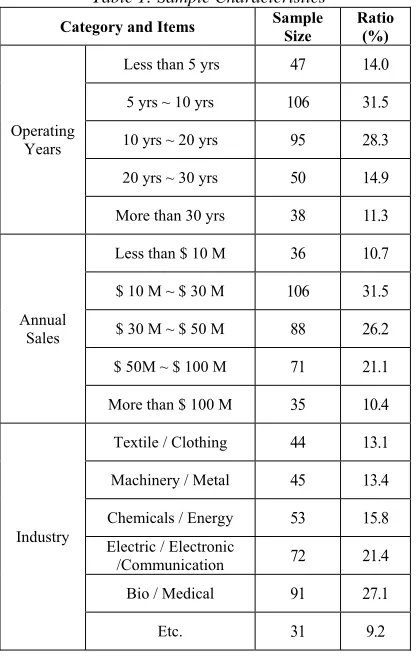
449 Firms, the author collected the data from the small and medium sized manufacturing Firms in the metropolitan area of Korea and analyzed the data statistically. A questionnaire survey was conducted with a total of 350 firms. After eliminating the questionnaires with missing or inadequate answers, 329 cases were finally selected as valid samples. The samples of this study are summarized in Table 1.
Table 1: Sample Characteristics
Category and Items Sample Size Ratio (%)
Operating Years
Less than 5 yrs 47 14.0
5 yrs ~ 10 yrs 106 31.5
10 yrs ~ 20 yrs 95 28.3
20 yrs ~ 30 yrs 50 14.9
More than 30 yrs 38 11.3
Annual Sales
Less than $ 10 M 36 10.7
$ 10 M ~ $ 30 M 106 31.5
$ 30 M ~ $ 50 M 88 26.2
$ 50M ~ $ 100 M 71 21.1
More than $ 100 M 35 10.4
Industry
Textile / Clothing 44 13.1
Machinery / Metal 45 13.4
Chemicals / Energy 53 15.8
Electric / Electronic
/Communication 72 21.4
Bio / Medical 91 27.1
Etc. 31 9.2
3.2. Measure
To ensure the content validity of the measurement tool, this study used the measurement items verified in the existing literature by revising and supplementing them according to the purpose of this study. First, Social Capital (Structural Capital, Cognitive Capital, Relational Capital) was constructed into 4 items each in reference to the studies by Nahapiet & Ghoshal (1998), Chiu et al. (2006), Chen et al. (2008), Villena et al. (2011) and Yu et al. (2013), and were measured using 7-point Likert scale (Strongly disagree ~ Strongly agree). Also, Supply Chain Collaboration (System Collaboration, Strategic Collaboration) was
constructed into 4 items each in reference to the studies by Kim & Lee (2010), Kim et al. (2010) and Singhry et al. (2015), and were measured using 7-point Likert scale. Supply Chain Performance (Financial Performance, Operation Performance) was constructed into 4 items each in reference to the studies by Flynn et al. (2010), Cao & Zhang (2011), Zhang & Huo (2013) and Chang et al. (2016), and were measured using 7-point Likert scale.
3.3. Analysis method
For the analysis method and measurement tool of structural equation models, this study analyzed the results and verified the hypothesis using Amos 24.0. For the analysis of the structural equation model, the measurement model was estimated first, and then it was analyzed using the two-step approach that estimates the structural model.
4. ANALYSIS AND RESULTS
4.1. Measurement Model
450
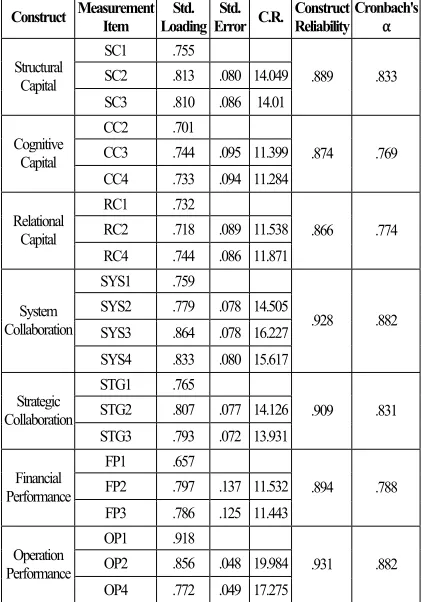
Table 2: Confirmatory factor analysis base on reliability
Construct MeasurementItem LoadingStd. ErrorStd. C.R. ReliabilityConstruct Cronbach's ⍺
Structural Capital
SC1 .755
.889 .833
SC2 .813 .080 14.049
SC3 .810 .086 14.01
Cognitive Capital
CC2 .701
.874 .769
CC3 .744 .095 11.399
CC4 .733 .094 11.284
Relational Capital
RC1 .732
.866 .774
RC2 .718 .089 11.538
RC4 .744 .086 11.871
System Collaboration
SYS1 .759
.928 .882
SYS2 .779 .078 14.505
SYS3 .864 .078 16.227
SYS4 .833 .080 15.617
Strategic Collaboration
STG1 .765
.909 .831
STG2 .807 .077 14.126
STG3 .793 .072 13.931
Financial Performance
FP1 .657
.894 .788
FP2 .797 .137 11.532
FP3 .786 .125 11.443
Operation Performance
OP1 .918
.931 .882
OP2 .856 .048 19.984
OP4 .772 .049 17.275
Table 3: Correlations between Constructs and Validity
Cons
truct 1 2 3 4 5 6 7
1 .727*
2 .403 .698*
3 .401 .475 .684*
4 .383 .391 .453 .765*
5 .300 .449 .370 .421 .770*
6 .394 .317 .340 .423 .417 .740*
7 .154 .200 .208 .222 .200 .272 .819*
*AVE (Average Variance Extract)
1 = Structural Capital, 2 = Cognitive Capital, 3 = Relational Capital, 4 = System Collaboration, 5 = Strategic
Collaboration, 6 = Financial Performance, 7 = Operation Performance
4.2. Structural model
As measurement model’s fitness, and reliability and validity of measurement items were verified, structural model analysis were conducted. As a result of structural model’s fitness test, χ = 382.367 (P = .000), χ /df = 1.951 was above threshold 3, and RMSEA = .053 was below standard of 0.08. Moreover, GFI = .910, TLI = .944, CFI = .952, IFI = .953 all of indices appeared above recommended value of 0.9 and therefore, the structural model’ goodness of fit of the research model was verified.
4.3. Hypotheses Test
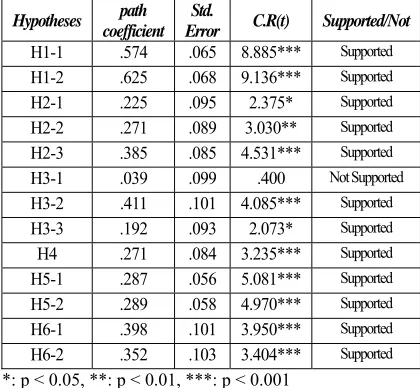
After structural model’s fitness was confirmed, research hypotheses were tested. As a result, first, for structural relationship of social capital, structural capital (C.R. = 8.885, = .000) have an effect on cognitive capital, thus, supporting H1-1. Also, structural capital (C.R. = 9.136, p = .000) have an effect on relational capital, thus, supporting H1-2. Second, for relationship between social capital and supply chain collaboration, structural capital (C.R. = 2.375, p = .018), cognitive capital (C.R. = 3.030, p = .000), and relational capital (C.R. = 4.531, p = .000) all had significant effects on system collaboration, thus, supporting 1, H2-2, and H2-3. Also, cognitive capital (C.R. = 4.085, p = .000) and relational capital (C.R. = 2.073, p = .000) had significant effects on strategic collaboration, while structural capital (C.R. = .400, p = .689) did not have a significant effect on strategic collaboration, thus H3-2 and 3-2 was supported while H3-1 was not supported.
Third, for relationship between system
collaboration and strategic collaboration, system collaboration (C.R. = 3.235, = .000) have an effect on strategic collaboration, thus, supporting H4.
Lastly, for relationship between supply chain
[image:6.612.90.301.435.639.2]451
Table 4: Validity of research hypothesis
*: p < 0.05, **: p < 0.01, ***: p < 0.001
5. CONCLUSION
This study conducted confirmatory factor analysis to ensure the content validity of the measurement tool.
This study was intended to determine the role of social capital in implementing the supply chain management system. To achieve the purpose of this study, the author examined the role of social capital in implementing a collaborative supply chain management system of manufacturing Firms through literature review, empirically verified the influencing relationship with the supply chain performance and derived the significant results as follows: First, the structural capital as a social capital has a positive effect on the cognitive and relational capital. The stronger the inter-company social relationship, more often they interact and the trust level increases [23]. Therefore, it was confirmed that the formation of the social network of the manufacturing company positively affected the formation of common values, goals, and trust between partner Firms. Second, it was found that that structural the structural capital, cognitive capital, and relationship capital as social capital had a positive effect on system collaboration, and the cognitive capital and relational capital had a positive effect on strategic collaboration. For successful SCM operation, it is important to establish a collaborative relationship between partners within the supply chain, and a trust relationship should be established so that they can efficiently perform each role as one organization [28] [35]. Therefore, it was confirmed that the formation of a social network of manufacturing Firms, the sharing of vision and values with partner Firms through this, and the formation of trust
relationship promoted collaborative activities such as information sharing, system integration, and manpower and resources support, thereby contributing to the organizational performance. Third, the system collaboration as a supply chain integration was found to have a positive effect on strategic collaboration, indicating that the Firms in the supply chain can collaborate with partners through various levels of SCM system continuously and effectively [26]. Fourth, in the relationship between supply chain collaboration and performance, system collaboration positively affected financial performance and operational performance, and strategic collaboration positively affected financial performance and operational performance. The supply chain collaboration improves the productivity and efficiency of Firms by adapting to rapid changes in the market and shortening the technology development period of new products [43] [4] [44]. In addition, it helps to achieve various objectives such as organizational competence, operational efficiency, and customer satisfaction and to gain competitive advantage [26] [42] [39]. Therefore, it was confirmed that supply chain collaboration not only directly affected the financial performance by increasing the productivity and efficiency of the company, but also positively affected the partnership, customer satisfaction and organizational competency.
The implications derived from this study can be summarized as follows. In this study, the author examined the role of social capital and supply chain collaboration and verified it empirically, proving its theoretical expansion. Through literature review, the author suggested the social capital as a predisposing factor of the supply chain collaboration between manufacturing Firms, and confirmed the structural relationship between social capital dimension and the influencing relationship between social capital and supply chain collaboration. In addition, the author suggested the supply chain collaboration as a predisposing factor of the supply chain performance of the manufacturing Firms, the structural relationship between supply chain collaboration dimension and dimension, and the influencing relationship between supply chain collaboration and performance.
This study also allows room for future research. Social capital and supply chain collaboration could be organized in differently, leading to differences in the success and benefits provides. The social capital and its relationship to a firm's supply chain collaboration and supply chain performance would be a useful object of future research.
Hypotheses path coefficient
Std.
Error C.R(t) Supported/Not
H1-1 .574 .065 8.885*** Supported
H1-2 .625 .068 9.136*** Supported
H2-1 .225 .095 2.375* Supported
H2-2 .271 .089 3.030** Supported
H2-3 .385 .085 4.531*** Supported
H3-1 .039 .099 .400 Not Supported
H3-2 .411 .101 4.085*** Supported
H3-3 .192 .093 2.073* Supported
H4 .271 .084 3.235*** Supported
H5-1 .287 .056 5.081*** Supported
H5-2 .289 .058 4.970*** Supported
H6-1 .398 .101 3.950*** Supported
452 REFRENCES:
[1] Autry, C. W., & Griffis, S. E., “Supply chain capital: the impact of structural and relational linkages on firm execution and innovation”,
Journal of Business Logistics, 29(1), 2008,
pp.157-173.
[2] Beske, P., Land, A., & Seuring, S., “Sustainable supply chain management practices and dynamic capabilities in the food industry: A critical analysis of the literature”,
International Journal of Production Economics,
152, 2014, pp.131-143.
[3] Cachon, G. P., “The allocation of inventory risk in a supply chain: Push, pull, and advance-purchase discount contracts”, Management Science, 50(2), 2004, pp.222-238.
[4] Cao, M., & Zhang, Q., “Supply chain collaboration: Impact on collaborative advantage and firm performance”, Journal of Operations Management, 29(3), 2011,
pp.163-180.
[5] Cao, Q., Gan, Q., & Thompson, M. A., “Organizational adoption of supply chain management system: A multi-theoretic investigation”, Decision Support Systems,
55(3), 2013, pp.720-727.
[6] Carey, S., Lawson, B., & Krause, D. R., “Social capital configuration, legal bonds and performance in buyer–supplier relationships”,
Journal of Operations Management, 29(4),
2011, pp.277-288.
[7] Chang, W., Ellinger, A. E., Kim, K. K., & Franke, G. R., “Supply chain integration and firm financial performance: A meta-analysis of positional advantage mediation and moderating factors”, European Management Journal,
34(3), 2016, pp.282-295.
[8] Chen, M. H., Chang, Y. C., & Hung, S. C., “Social capital and creativity in R&D project teams”, R&d Management, 38(1), 2008,
pp.21-34.
[9] Chiu, C. M., Hsu, M. H., & Wang, E. T., “Understanding knowledge sharing in virtual communities: An integration of social capital and social cognitive theories”, Decision support systems, 42(3), 2006, pp.1872-1888.
[10] Chow, W. S., & Chan, L. S., “Social network, social trust and shared goals in organizational
knowledge sharing”, Information &
Management, 45(7), 2008, pp.458-465.
[11] Coleman, J. S., “Social capital in the creation of human capital”, American journal of sociology, 94, 1988, pp.95-120.
[12] Cousins, P. D., Handfield, R. B., Lawson, B., & Petersen, K. J., “Creating supply chain relational capital: the impact of formal and informal socialization processes”, Journal of operations management, 24(6), 2006,
pp.851-863.
[13] Dehning, B., Richardson, V. J., & Zmud, R. W., “The financial performance effects of IT-based supply chain management systems in manufacturing firms”, Journal of Operations Management, 25(4), 2007, pp.806-824.
[14] Flynn, B. B., Huo, B., & Zhao, X., “The impact of supply chain integration on performance: A contingency and configuration approach”,
Journal of operations management, 28(1),
2010, pp.58-71.
[15] Granovetter, M., “Economic action and social structure: The problem of embeddedness”,
American journal of sociology, 91(3), 1985,
pp.481-510.
[16] Griffith, D. A., & Harvey, M. G., “The influence of individual and firm level social capital of marketing managers in a firm’s global network”, Journal of World Business,
39(3), 2004, pp.244-254.
[17] Gulati, R., & Sytch, M., “Does familiarity breed trust? Revisiting the antecedents of trust”,
Managerial and Decision Economics, 29(2‐3),
2008, pp.165-190.
[18] Hair, J. F., Black, B., Anderson, R., & Tatham, R., “Multivariate Data Analysis: Text and Readings”, New Jersy: Prentice Hall. 1995. [19] Hedberg, B., “How organizations learn and
unlearn”, In P. Nystrom & W. Starbuck (Eds.), Handbook of organizational design. New York: Oxford University Press, 1981, 1-27.
[20] Heide, J. B., & John, G., “Alliances in industrial purchasing: The determinants of joint action in buyer-supplier relationships”, Journal of marketing Research, 27(1), 1990, pp.24-36.
[21] Ince, H., & Ince, A. S., “The role of supply chain collaboration on sustainable supply chain
management performance”, Journal of
Management Marketing and Logistics, 2015,
2(3), pp.223-231.
[22] Inkpen, A. C., & Tsang, E. W., “Social capital, networks, and knowledge transfer”, Academy of management review, 30(1), 2005,
pp.146-165.
[23] Johnson, N., Elliott, D., & Drake, P., “Exploring the role of social capital in facilitating supply chain resilience”, Supply Chain Management: An International Journal,
453 [24] Kale, P., Singh, H., & Perlmutter, H.,
“Learning and protection of proprietary assets in strategic alliances: Building relational capital”, Strategic management journal, 21(3),
2000, pp.217-237.
[25] Khan, S. A., Liang, Y., & Sumaira, S., “The effect of buyer-supplier partnership and information integration on supply chain performance: an experience from chinese manufacturing industry”, International Journal of Supply Chain Management, 4(2), 2015,
pp.20-34.
[26] Kim, D., & Lee, R. P., “Systems collaboration and strategic collaboration: Their impacts on supply chain responsiveness and market performance”, Decision Sciences, 41(4), 2010,
pp.955-981.
[27] Kim, K. K., Park, S. H., Ryoo, S. Y., & Park, S. K., “Inter-organizational cooperation in buyer– supplier relationships: Both perspectives”,
Journal of Business Research, 63(8), 2010,
pp.863-869.
[28] Kumar, N., Scheer, L. K., & Steenkamp, J. B. E. “The effects of perceived interdependence on dealer attitudes”, Journal of marketing research, 32(3), 1995, pp.348-356.
[29] Larson, A., “Network dyads in entrepreneurial settings: A study of the governance of exchange relationships”, Administrative science quarterly, 37(1), 1992, pp.76-104.
[30] Maloni, M. J., & Benton, W. C., “Supply chain partnerships: opportunities for operations research”, European Journal of Operational Research, 101(3), 1997, pp.419-429.
[31] Nahapiet, J., & Ghoshal, S., “Social capital, intellectual capital, and the organizational advantage”, Academy of management review,
23(2), 1998, pp.242-266.
[32] Petersen, K. J., Handfield, R. B., Lawson, B., & Cousins, P. D., “Buyer dependency and relational capital formation: the mediating effects of socialization processes and supplier
integration”, Journal of Supply Chain
Management, 44(4), 2008, pp.53-65.
[33] Qrunfleh, S., & Tarafdar, M., “Supply chain information systems strategy: Impacts on
supply chain performance and firm
performance”, International Journal of
Production Economics, 147, 2014, pp.340-350.
[34] Ring, P. S., & Van de Ven, A. H., “Developmental processes of cooperative interorganizational relationships”, Academy of management review, 19(1), 1994, pp.90-118.
[35] Rousseau, D. M., Sitkin, S. B., Burt, R. S., & Camerer, C., “Not so different after all: A
cross-discipline view of trust”, Academy of management review, 23(3), 1998, pp.393-404.
[36] Rudd, M. A. “Live long and prosper: collective action, social capital and social vision”,
Ecological economics, 34(1), 2000, pp.131-144.
[37] Sanders, N. R., & Premus, R., “Modeling the relationship between firm IT capability, collaboration, and performance”, Journal of Business Logistics, 26(1), 2005, pp.1-23.
[38] Seuring, S., “A review of modeling approaches for sustainable supply chain management”,
Decision support systems, 54(4), 2013,
pp.1513-1520.
[39] Singhry, H. B., Abd Rahman, A., & Ng, S. I., “Measurement for supply chain collaboration
and supply chain performance of
manufacturing companies”, International Journal of Economics and Management,
9(spec. Dec.), 2015, pp.1-22.
[40] Srivastava, R. K., Shervani, T. A., & Fahey, L., “Market-based assets and shareholder value: A framework for analysis”, The Journal of Marketing, 62(1), 1998, pp. 2-18.
[41] Tsai, W., & Ghoshal, S., “Social capital and value creation: The role of intrafirm networks”,
Academy of management Journal, 41(4), 1998,
pp.464-476.
[42] Villena, V. H., Revilla, E., & Choi, T. Y., “The dark side of buyer–supplier relationships: A social capital perspective”, Journal of Operations management, 29(6), 2011,
pp.561-576.
[43] Wiengarten, F., Humphreys, P., Cao, G., Fynes, B., & McKittrick, A., “Collaborative supply chain practices and performance: exploring the key role of information quality”, Supply Chain Management: An International Journal, 15(6),
2010, pp.463-473.
[44] Wu, L., Chuang, C. H., & Hsu, C. H., “Information sharing and collaborative behaviors in enabling supply chain performance: A social exchange perspective”,
International Journal of Production Economics,
148, 2014, pp.122-132.
[45] Yu, Y., Hao, J. X., Dong, X. Y., & Khalifa, M., “A multilevel model for effects of social capital and knowledge sharing in knowledge-intensive work teams”, International Journal of Information Management, 33(5), 2013,
pp.780-790.
[46] Zhang, M., & Huo, B., “The impact of dependence and trust on supply chain integration”, International Journal of Physical Distribution & Logistics Management, 43(7),
454 Appendix. Measurement Items
Dimensions Items LoadingFactor
Social Capital
Structural Capital
The frequency of contacts with partners (official) .735 The frequency of contacts with partners (informal) .786
Communication with partners .743
Interaction with partners .684
Cognitive Capital
Goals shared with partners .531
Shared vision with partners .704
The similarity of the organizational culture and values .762
Efforts to achieve common goals .665
Relational Capital
Trust with partners .714
Respect for the partners .679
Reciprocity with partners .713
friendship with partners .745
Supply Chain collaboration
System Collaboration
Accomplishing by electronic communication .646 Sharing an information system throughout the collaboration .790 Working together the information control system .780 Using the data provided IT tools when making managerial decisions .708
Strategic Collaboration
Establishment and prediction of a joint plan is an important/reflected .693 Working together strategic issues and policies .736 Working together planning and executing budget and investment .759 The performance evaluation and monitoring together. .777
Supply Chain Performance
Financial Performance
Increased in sales .737
Increased in profit .716
Reduced production costs .634
Reduced inventory maintenance costs .767
Operation Performance
Product quality improvement .844
Meet customer requirements .849
Increased customer satisfaction .799