IJPSR (2014), Vol. 5, Issue 11 (Research Article)
Received on 07 March, 2014; received in revised form, 18 April, 2014; accepted, 01 July, 2014; published 01 November, 2014
SYNTHESIS, SPECTRAL STUDIES AND ANTIMICROBIAL SCREENING OF SOME
TRANSITION METAL COMPLEXES WITH SUBSTITUTED ACETOPHENONE
THIOSEMICARBAZONE
Shyam Kumar Meena* and Meenakshai Jain
Department of Chemistry, Govt. P.G. College Dholpur, Rajasthan, India. Department of Chemistry, University of Rajasthan, Jaipur, Rajasthan, India.
ABSTRACT: Complexs of Fe, Cu and Zn have been prepared by reacting metal chloride\sulphate with p-hydroxyacetophenone thiosemicarbazone, fluoroacetophenone thiosemicarbazone, p-bromoacetophenone thiosemicarbazone as ligands and their complexes were screened for their IR, NMR, and antifungal and antibacterial studies. . Acetophenone thiosemicarbazone ligands were prepared by the reaction of substituted acetophenone with thiosemicarbazone in the presence of hot ethanol. All the transition-ligands 1:2 complexes have been isolated in the solid state, are stable in air, and characterized on the basis of their elemental and spectral data. They were found to be active against influenza, protozoa, small pox, and certain kinds of tumor. Their metal complexes were used, in various biological systems, polymers, dyes, anti-inflammatory, analgesic and anti-oxidative action. The Schiff bases and their metal complexes were used in various biological activities such as antimicrobial, antifungal, antiviral, insecticides, and antitumor activity.
INTRODUCTION: The Schiff’s base and their metal chelates is effective anticancer, antitumor, anti tuberculosis, antipyretic agent as well as anti fertility. Schiff’s base possess industrial application as catalysts, dyes, fiber, perfumes an aesthetic, plant growth inhibitors cosmetics corrosion inhibitors, oxygen absorbents, polymers, lubricating agents, for removing metal impurities of oil and drying accelerators.1-7.
QUICK RESPONSE CODE
DOI:
10.13040/IJPSR.0975-8232.5(11).4880-86
Article can be accessed online on: www.ijpsr.com
The metal complexes with Schiff’s base derived from chalcone and thiosemicarbazone have been extensively studied and have exhibited medicinal properties 8. Copper (II) complexes have found possible medicinal uses in the treatment of many diseases including cancer.9 Semicarbazone of various transition metals have been investigated owing to their coordination capability and pharmaceutical activity10-12. Schiff’s bases make them more effective in attaining high coordination structure13. Since Domagk’s original report14 on the anti-tubercular activity of thiosemicarbazones, the number of papers on the pharmacology of these compounds has expanded dramatically. They have also been found to be active against influenza 15, small pox 16, and certain kinds of tumor17 and have
Keywords:
Synthesis, Spectral studies, Transition metal complexes, acetophenone thiosemicarbazone, Antibacterial
activity.
Correspondence to Author: Shyam Kumar Meena Lecturer in Chemistry Govt. P. G. College Dholpur Rajasthan, 328001, India
E-mail:
been suggested as possible pesticides and fungicides 18. Their activity has frequently been thought to be their ability to chelate with tracer metal.
MATERIALS AND METHODS:
The transition metal complexes of substituted acetophenone thiosemicarbazone were derived from the reaction an aqoues solution of metal salt. Acetophenone thiosemicarbazone ligands were prepared by the reaction of substituted acetophenone with thiosemicarbazone in the presence of hot ethanol. All the transition-ligands 1:2 complexes have been isolated in the solid state, are stable in air, and characterized on the basis of their elemental and spectral data.
Thiosemicarbazone ligands behave as bidentate ligands by coordinating through the Sulfur of the isocyanides group and nitrogen of the cyanide residue. The acetophenone thiosemicarbazone ligands and their transition complexes have been screened for their IR, NMR, and antifungal and antibacterial studies.
Synthesis of substituted acetophenone thiosemicarbazones (2a-d) Table-1
P-Fluoroacetophenonethiosemicarbazone
P-Fluoroacetophenonethiosemicarbazone was prepared after the method of compainge and Archer.19 F- Fluoroacetophenone (2.52 ml, 20 mmol) was dissolved in ethanol (50ml) in a round bottomed flask and heated on a water bath for 5-10 minutes. This hot solution was treated with a hot ethanolic solution (50 ml) of thiosemicarbazone (1.80g, 20mmol) and refluxed for 4-5 hrs on water bath using reflux water condenser. The change in color of solution indicates the formation of P-Fluoroacetophenone thiosemicarbazone (2a-d). on cooling the reaction mixture the cream coloured product crystallized out which was filtered off under water suction and further recrystallized from absolute ethanol and finally dried over anhydrous cacl2 in a vacuum desiccators.
FIG: 1
FIG: 2
Synthesis of 4-subsitituted aceto phenone thio semicarbazones metal complexes (3a-d):
Bis (F-Fluoroacetophenonethiosemicarbazone) iron (II)
P-Fluoroacetophenonethiosemicarbazone (1.816g, 8mmol) was dissolved in ethanol (20ml) and heated on a water bath. This solution was slowly treated with an aqueous solution of metal salt Feso4.6H20 (0.6076g, 4mmol) in 2:1 molar ratio with string. Reaction mixture was refluxed on water bath for 1-2 hrs and left overnight to yield the crystalline dark green coloured crystals, which was filtered off under suction washed with water till filtrate become colourless. The product was finally washed with dilute ethanol and dried over fused cacl2 in vacuum desiccators.
FIG: 3
BIS(PCHLOROACETOPHENONETHIOSEMICARBAZ ONE) CUPPER (II) (3A-D) TABLE-2
FIG: 4
BIS(PFLUOROACETOPHENONETHIOSEMICARBAZ ONE) IRON (II) (4A-D) TABLE-3
RESULTS AND DISCUSSION: Substituted acetophenones
observed due to acetophenone >C=O and at 1620 cm-1 due to >C=C< stretching vibration.
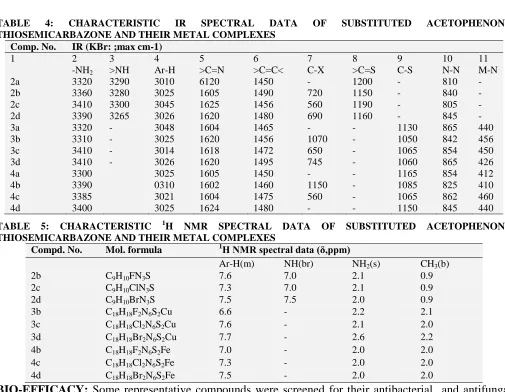
Substituted acetophenonethiosemicarbazones Formation of substituted acetophenones thiosemicarbazone was confirmed by the disappearance of absorption band from 1720-1650 cm-1 due to carbonyl group (>C=O) and appearance of new absorption bands from 3400-3350,3320-2800,and 1200-1045 cm_1 assinged to –NH2, -NH and >C=S stretching vibrations, respectively in their IR spectra. Similarly, in 1H NMR spectra an additional broad singal at δ 2.85 ppm appears due to –NH2 and a sharp singlet at δ 10.82 ppm due to –NH- protons are observed which further support the formation of compounds.(2a-d).
Metal complexes of substituted acetophenone thiosemicarbazone
In the IR spectra of the ligands and complexes only selected absorption peaks are discussed, which are important for ascertaining the doner sites of ligands. In the in spectra of metal complexes of substituted acetophenone-thiosemicarbazones the presence of absorption band at 3380cm-1 due to – NH2 (symmetric) and at 3380cm-1due to-NH2 (asymmetric) modes remain almost unaltered. This clearly indicates the noninvolvement of this group in complexation reaction 20-21 but slight displacement of these frequencies is due to increased positive charge on nitrogen atom arising
from the donation of electron pair from sulfur of thioamide moiety which is involved in chelation 22-23
. Sharp absorption band from 3280-2850cm-1 which was due to NH- in ligands disappear in complexes indicating possible deprotonation on the β-nitrogen after complextion with metal ion 24-27
.A new absorption band in the complexes at 445-432 due to (M-N) confirm the metal nitrogen bond in the complexes 28-29.
All compounds have been characterized on the basis of spectral (IR, NMR) studies and elemental analysis. IR spectra (400-4000cm-1) were recorded using a KBr. Central drug research institute (CDRI), Lucknow and Department Of Chemistry, University of Rajasthan, Jaipur. 1H NMR spectra were recorded on Brucker spectrometer (300 MHz) at CDRI, Lucknow using CDCl3/DMSO as solvent. TMS was taken as internal standard. C, H, N and s analysis of these compounds have been done using Coleman C and H analyzer. Melting points were determined in open glass capillaries and are uncorrected. The purity of compounds was checked by TLC using silica gel-G as adsorbent and visualization was accomplished by UV light or iodine adsorption.
All compounds are crystalline dark coloured solides, have fairly high melting points and are sparingly soluble in common organic solvents and are insoluble in water.
TABLE 1: ANALYTICAL AND PHYSICAL DATA OF SUBSTITUTED
ACETOPHENONETHIOSEMICARBAZONES [Y-AR-C (CH3) =N-NH-CS-NH2]
Comp. Y Mol.
formula
colour Mol.
Wt.
m.p. yield Elemental anylysis % (calcd.) C H N S 2a H C9H11N3S Green 193 170 90 55.93,5.74,21.74,16.59
2b 4-F C9H10FN3S Cream 211 150 85 51.17,4.77,19.89,15.18
2c 4-Cl C9H10ClN3S Brown 227 125 82 47.47,4.43,18.45,14.08
2d 4-Br C9H10BrN3S Cream 272 185 86 39.72,3.70,15.44,11.78
TABLE 2: ANALYTICAL AND PHYSICAL DATA OF CU (II) COMPLEXES OF SUBSTITUTED ACETOPHENONETHIOSEMICARBAZONE [Y-AR-C (CH3) =N-NH-CS-NH2]2 CU (II)
Comp. Y Mol.
formula
colour Mol.
Wt.
m.p. yield Elemental anylysis % (calcd.) C H N S 3a H C18H20N6S2Cu Green 440 146 90 47.39,4.41,18.21,14.32
3b 4-F C18H18F2N6S2Cu Cream 482 153 75 44.65,3.69,17.34,13.17
3c 4-Cl C18H18Cl2N6S2Cu Brown 227 141 81 40.95,3.45,15.99,12.32
3d 4-Br C18H18Br2N6S2Cu Cream 272 142 85 31.95,2.95,13.85,10.51
TABLE 3: ANALYTICAL AND PHYSICAL DATA OF FE (II) COMPLEXES OF SUBSTITUTED
ACETOPHENONETHIOSEMICARBAZONE [Y-AR-C (CH3) =N-NH-CS-NH2]2FE (II)
Comp .
Y Mol.
formula
colour Mol.
Wt.
[image:3.612.45.567.317.751.2]4b 4-F C18H18F2N6S2Fe Grey 478 153 75 44.95,3.65,17.45,12.99
4c 4-Cl C18H18Cl2N6S2Fe Brown 511 170 81 35.50,2.90,13.90,9.95
4d 4-Br C18H18Br2N6S2Fe Cream 600 165 85 41.96,3.45,15.99,12.32
TABLE 4: CHARACTERISTIC IR SPECTRAL DATA OF SUBSTITUTED ACETOPHENONE
THIOSEMICARBAZONE AND THEIR METAL COMPLEXES Comp. No. IR (KBr: ;max cm-1)
1 2 3 4 5 6 7 8 9 10 11
-NH2 >NH Ar-H >C=N >C=C< C-X >C=S C-S N-N M-N
2a 3320 3290 3010 6120 1450 - 1200 - 810 -
2b 3360 3280 3025 1605 1490 720 1150 - 840 -
2c 3410 3300 3045 1625 1456 560 1190 - 805 -
2d 3390 3265 3026 1620 1480 690 1160 - 845 -
3a 3320 - 3048 1604 1465 - - 1130 865 440
3b 3310 - 3025 1620 1456 1070 - 1050 842 456
3c 3410 - 3014 1618 1472 650 - 1065 854 450
3d 3410 - 3026 1620 1495 745 - 1060 865 426
4a 3300 3025 1605 1450 - - 1165 854 412
4b 3390 0310 1602 1460 1150 - 1085 825 410
4c 3385 3021 1604 1475 560 - 1065 862 460
4d 3400 3025 1624 1480 - - 1150 845 440
TABLE 5: CHARACTERISTIC 1H NMR SPECTRAL DATA OF SUBSTITUTED ACETOPHENONE
THIOSEMICARBAZONE AND THEIR METAL COMPLEXES
Compd. No. Mol. formula 1H NMR spectral data (δ,ppm)
Ar-H(m) NH(br) NH2(s) CH3(b)
2b C9H10FN3S 7.6 7.0 2.1 0.9
2c C9H10ClN3S 7.3 7.0 2.1 0.9
2d C9H10BrN3S 7.5 7.5 2.0 0.9
3b C18H18F2N6S2Cu 6.6 - 2.2 2.1
3c C18H18Cl2N6S2Cu 7.6 - 2.1 2.0
3d C18H18Br2N6S2Cu 7.7 - 2.6 2.2
4b C18H18F2N6S2Fe 7.0 - 2.0 2.0
4c C18H18Cl2N6S2Fe 7.3 - 2.0 2.0
4d C18H18Br2N6S2Fe 7.5 - 2.0 2.0
BIO-EFFICACY: Some representative compounds were screened for their antibacterial and antifungal efficacy. Bis (F-Fluoroacetophenonethiosemicarbazone) iron (II)
FIG: 5 ANTIBACTERIAL SPECIEES-E.COLI FIG: 6 ANTIBACTERIAL SPECIEES-STREPTOMYCES
[image:4.612.52.557.94.486.2] [image:4.612.53.559.509.718.2]
FIG:7ANTIBACTERIAL SPECIEES-BACILLES CEREUS FIG:8 ANTIBACTERIAL SPECIEES-STREPTOCOCCUS
AUREUS
FIG: 9 ANTIFUNGAL SPECIES-FUSARIUM FIG: 10 ANTIFUNGAL SPECIES-PENECILLUM
FIG: 12 ACKNOWLEDGEMENT: Authors are thankful to Head Department of Chemistry, University of Rajasthan, Jaipur for providing research facilities. Central Drug Research Institute (CDRI), Lucknow, Seminal Applied Science Pvt. Ltd Jaipur for providing research facilities.
REFERENCES:
1. Kumar Deveshk, “Application of metal complexes of Schiff base with special reference to thiosemicarbazone: a review” 2014,2,13.
2. Singh P. Vinod, Singh Shweta, Singh P. Divya , Tiwari K. , Mishra Monika .“Synthesis, spectroscopic (electronic, IR, NMR and ESR) and theoretical studies of transition metal complexes with some unsymmetrical Schiff bases” Journal of Molecular Structure, 2014, 71-78, 1058
3. Khoo Teng-Jin, Khaled bin break Mohammed, Crouse K.A., Ali A.M., Cowley A.R. , Watkin D.J. , Tarafder M.T.H. “Synthesis, characterization and biological activity of two Schiff base ligands and their nickel(II), copper(II), zinc(II) and cadmium(II) complexes derived from S -4-picolyldithiocarbazate and X-ray crystal structure of cadmium(II) complex derived from pyridine-2-carboxaldehyde” Inorganica Chimica Acta , 2014,413,68-76.
4. Fekri Roghayeh, Shaabani Behrooz, Synthesis and Characterization of Ni (II) Complex with Tridentate Ligand of Schiff’s Bases of Salicylaldehyde with Thiocyanate Ligand , J. Appl. Environ. Biol. Sci.2013, 3(8), 75-78
5. Chohan Z. H. “Ni (II), Cu (II) and Zn (II) metal chelates with thiazole Schiff bases synthesis, characterization and
bactericidal properties”, Met.-Based Drugs, 1999; 6: 75-80.
6. Prakash Anant, Adhikari Devjani “Application of Schiff bases and their metalComplexes-A Review, International Journal of ChemTech Research, 2011, 3, 1891-1896. 7. Cohan Z. H. and Kausar S, “Synthesis, characterization
and biological effect of anions on Co (II) and Ni (II) chelates of tridentate Schiff base”, J. Chem. Soc. Pak., 2001; 23: 163-167.
8. Marisa, B.F, Franco B., Claudio C , Stéphanie D , Irène M.-B , Giorgio P , Elisabetta P , Silvana P. and Pieralberto T., “Copper (II) and Cobalt (III) Pyridoxal Thiosemicarbazone Complexes with Nitroprusside as Counterion”, J. Med. Chem., 2005; 48:1671–1675 . 9. Orvig C. and Abrahams M. J., “Biochemical and inorganic
copper chemistry”, Chem. Rev., 1999; 99: 2201.
10. Nadkarny V. V., Rao R. S., and Fernandes P. S., “Synthesis of a few acid hydrazides: sulfonyl hydrazides and their derivatives from 2-phenyl-1, 2, 3-triazole-4-carboxylic acid and [(4-nitrophenyl) thio] acetic acid as antibacterial”, J. Indian Chem. Soc., 1976; 53: 833-36. 11. Garg A., Tendon J. P., “Magnetic and spectroscopic
studies of chromium (III) complexes of semicarbazones and thiosemicarbazones”, Synth. React. Inorg. Met.-Org. Chem., 1990; 20: 707-15.
12. Oza C. k., Jain M., Jain N., Verma D., “Synthesis characterization, Antimicrobial, Activities, and structural studies of lanthanide (III) complexes with 1-(4-chloroo phenyl)-3-(4-fluoro/hydroxyl phenyal) prop-2-en-1-thiosemicarbazone”, Phosphorus, Sulfur Silicon Relat. Elem., 2010; 185: 377-386.
(II) and zinc (II) with nitrogen donor ligands”, J. Indian Chem. Soc., 1980; 57: 552-3.
14. Domagk, G.; Behnisch, R.; Mietzsch, F.; Schmidt, H. “New compound active neagainst tuberculosis bacilli in vitro” Naturwissenschaften, 1946; 33: 315.
15. Orlova N.,Aksenova V.A.,Selidovkin D.A.,Bogdanova N.S.,and Perkin G.N.,Syntheses and spectroscopic studies of potential antitumor copper (II) complexes with 5-phenylazo-3-methoxy salicylidene thiosemicarbazone and N4 substituted thiosemicarbazones,’’Russ.Pharm. Toxical, 1968,348.
16. Bauter D J, Stvincent L., Kempe C.H., Downle A.W., “Prophylactic treatment of small pox contact with N-methylisatin betathiosemicarbazone (compound33T57, marboran)” Lancet, 1963; 2: 494-6.
17. Petering, H. G., Bus Kirk, H. H., Underwood, G. E , “Antitumor action of 2-oxo-3-ethoxybutyraldehyde bis(thiosemicarbazone) and similar compounds”, Cancer Research, 1964; 24: 367-72.
18. By Johnson, Charles W., Joyner, Joseph W., Perry, R. P, “The inhibitory effect of four thiosemicarbazones on Cryptococcus neoformans “, Antibiotics and Chemotherapy (Washington, D. C.), 1952; 2: 636-8. 19. Compaigne E.E., Archer W.L., J.Am.Chem.Soc.
1952,74,5801.
20. Parihari, R. K., Patel, R. K., Patel, R. N. “Synthetic and structural studies of the transition metal complexes of manganese-, cobalt- and zinc(II) with m-nitrobenzaldehyde thiosemicarbazone and some neutral ligands “,Journal of the Indian Chemical Society, 2000; 77(6): 289-290.
21. Varshney A., Tandon J. P., Crowe, A. J, “Synthesis and structural studies of tin (II) complexes of semicarbazones and thiosemicarbazones”, Polyhedron 1986; 5(3): 739-42. 22. Amita Singh, Lalita; Dhakarey, Rajesh; Saxena, G. C.,
“Magnetic and spectral behavior of semicarbazone derivatives of manganese (II), copper (II), iron (III) and chromium (III) and their antimicrobial screening “, Journal of the Indian Chemical Society, 1996; 73(7): 339-342.
23. Mohanty, L. M., Mishra, R. C., Mohapatra, B. K., ‘Studies on hydrazones, semicarbazones, thiosemicarbazones and oximes as ligands. Part-I. Some divalent metal complexes of benzoin phenylhydrazone and thiosemicarbazone”, Journal of the Indian Chemical Society, 1995; 72(5): 311-13.
24. Sengupta, S. K., Pandey, O. P., Srivastava, A. K., Srivastava, S. K.,”Synthesis and structural studies of mono(cyclopentadienyl)titanium(IV) derivatives of acetylferrocenyl thiosemicarbazones “, Indian Journal of Chemistry, Section A: Inorganic, Bio-inorganic, Physical, Theoretical & Analytical Chemistry, 1999; 38A(10): 1066-1069.
25. Bhardwaj, N. C., Singh, R. V. “Penta- and hexacoordinated aluminum (III) complexes of thiosemicarbazones”,Journal of the Indian Chemical Society 1994; 71(1):35-8.
26. Mishra, R. C., Mohapatra, B. K., Panda, D., “Studies on hydrazones, semicarbazones, thiosemicarbazones and oximes as ligands. Part VII: Some divalent metal complexes of benzalacetone thiosemicarbazone”, Journal of the Indian Chemical Society, 1983; 60(8): 782-3. 27. Patil, M. S., Deore, H. O., Kulkarni, M. M., Shah, J. R,
“Structural studies on nickel(II), cobalt(II), iron(II), copper(II), manganese(II), iron(III), chromium(III) and vanadyl(2+) chelates of 2-hydroxy-1-naphthaldehyde semicarbazone” Journal of the Indian Chemical Society, 1983; 60(9): 817-20.
28. Speca A. N., Karayannis, N. M., Pytlewski, L. L., “Chromium (III) and iron (III) perchlorate chelates with the mono-N-oxides of 2, 2’-bipyridine and 1, 10-phenanthroline”, Inorganica Chimica Acta, 1974; 9(1): 87-93.
29. Kaul B.B. and Pandeya K.B., “Synthesis and spectral studies of platinum metal complexes of benzoin thiosemicarbazone”, Journal inorg. Nuclear chemistry, 1977; 40:1035.
All © 2014 are reserved by International Journal of Pharmaceutical Sciences and Research. This Journal licensed under a Creative Commons Attribution-NonCommercial-ShareAlike 3.0 Unported License.
This article can be downloaded to ANDROID OS based mobile. Scan QR Code using Code/Bar Scanner from your mobile. (Scanners are available on Google Playstore)
How to cite this article
![TABLE 1: ANALYTICAL AND PHYSICAL DATA ACETOPHENONETHIOSEMICARBAZONES [Y-AR-C (CH3) =N-NH-CS-NH2] Comp](https://thumb-us.123doks.com/thumbv2/123dok_us/8888145.949429/3.612.45.567.317.751/table-analytical-physical-data-acetophenonethiosemicarbazones-ar-ch-comp.webp)