Full Length Review Article
SILVER RATIOS, CARDANO’S FORMULA, AND VISUAL MODEL OF THE SECOND ATOMIC SHELL
*Alexander V. Yurkin
City of Puschino, Russia
ARTICLE INFO ABSTRACT
This work is devoted to geometrical research of the ray trajectories system. We consider trajectories of electrons moving in the second shell of an atom. The proposed model of movement of electrons is based on the geometrical interpretation of the Pauli Exclusion Principle and the geometric interpretation of distribution of electrons in energy levels, shells, and subshells of atoms in Mendeleev’s periodic table. It turned out that the second shell can be described by a cubic equation, Cardano’s formula, and a new system of triangles as well. We present some new geometric ratios - silver ratios - between the elements of our model and the triangle system (the ratios between the sides, angles and areas of triangles). In the paper, we show that it is possible to describe atomic shells geometrically using complex numbers, and generalize our approach to geometric interpretation of the rest atomic shells. In the Appendix we apply the silver ratios to show the images of a silver parallelepiped and examples of silver houses and we compare our trajectories system with trajectories of car driving.
Copyright©2016, Alexander V. Yurkin.This is an open access article distributed under the Creative Commons Attribution License, which permits unrestricted use, distribution, and reproduction in any medium, provided the original work is properly cited.
INTRODUCTION
Visual geometric models are used to describe various phenomena (Peters James F., et al., 2015). Cardano’s formula is used to find roots of a cubic equation to which various calculations, including the problems of trisection of an angle and doubling the cube well-known since ancient times, are reduced to. Unfortunately, the Academy of Sciences in Paris no longer considers projects related to these problems since the 18th century (Mathematical encyclopedic dictionary, 1988). In this paper, we use Cardano’s formula to research recurrence relations in the geometrical model of the second electron shell of an atom (Yurkin A. V., 2016). For the convenience of readers, the Appendix hereto contains figures related to the nuclear topic taken from the previous publication of the author (Fig. 4) and from the well-known monograph in physics (Fig. 5 and 6). The possibility of using the silver ratios in other (non-nuclear) areas is shown in Fig. 4 captures and in Fig. 7 in the Appendix.
System of Trajectories
In papers (Yurkin A. V., 2015 and Yurkin A. V., 2016), we described a flat system of periodic trajectories. This system consists of ray groups, where the rays themselves are inclined at angles narrow to the axis, which are multiples to the angle :
= ( + 1/2) , = 0, ±1, ±2 …. ………..(1)
Rays branching points are spaced apart horizontally at the distance Land vertically at small distances multiple to the length / 2:
= /2, = 0, ±1, ±2 ………(2)
We called this ray system as [ = + and = /2] system or semi-integer ray system.
*Corresponding author: Alexander V. Yurkin City of Puschino, Russia
ISSN: 2230-9926
International Journal of Development Research
Vol. 06, Issue, 06, pp. 8077-8084, June,2016
International Journal of
DEVELOPMENT RESEARCH
Article History: Received 16th March, 2016
Received in revised form 02nd April, 2016
Accepted 24th May, 2016
Published online 30th June, 2016
Available online at http://www.journalijdr.com
Key Words:
Ray trajectories,
In Fig. 4 in the Appendix we provide an image of the second electron shell as [ = ( + 1/2) , = /2] system of periodic trajectories from paper(Yurkin A. V., 2016). In paper (Yurkin A. V., 2016), it was shown that ray wavy trajectories correspond to atomic shells:
Wavy trajectories containing segments inclined at angles /2to the horizontal correspond to the first electron shell of an atom;
Wavy trajectories containing segments inclined at angles /2 and 3 /2 to the horizontal correspond to the second electron shell of an atom;
Wavy trajectories containing segments inclined at angles /2, 3 /2 , and 5 /2 to the horizontal correspond to the third electron shell of an atom;
Wavy trajectories containing segments inclined at angles /2, 3 /2 , 5 /2, 7 /2 and to the horizontal correspond to the third electron shell of an atom; and so on.
To illustrate coherence of our visual geometric model with the known approaches to description of an atom, Fig. 5 in the Appendix shows atomic shells and subshells, and Fig. 6 in the Appendix shows a part of the periodic table from monograph (Savelyev I. V., 1982). Fig. 1 shows the completely filled second electron shell as a system of periodic trajectories (equations 1 and 2).The inclination angles of the trajectory segments are /2 and 3 /2. Ɛ is the energy propagating along the trajectory segment (Ɛ is the weight / weight factor).
Fig.1. System of periodic (wavy) trajectories
The second electron shell is filled completely. Quantum transitions are shown in the form of angles between dash-dotted lines. is the number of passes (iterations). Ɛ ; ,Ɛ ; , and Ɛ ; is the energy propagating along the segments of trajectories 1, 2, and 3
within the same pass . The segments are numbered upwards.
In this case, as the rays propagate along the branching segments, energy is added as follows:
Ɛ ; =Ɛ ;
Ɛ ; =Ɛ ; ………..(3)
Ɛ ; =Ɛ ; +Ɛ ;
Paper (Yurkin A. V., 1994) showed that propagation of rays at angles /2 and 3 /2 in such a system (Fig. 1) was described by sequences:
2, 3, 4, 5, 7, 9, 12, 16, 21, 28, … - for /2 and
………..(4)
1, 1, 1, 2, 2, 3, 4, 5, 7, 9, … - for 3 /2.
Members of these sequences are expressed by the following recurrent formula:
= + . ……….(5)
Where:
=Ɛ ; +Ɛ ; , аnd =Ɛ ; . ……….. (6)
Relative distribution of energy at the angle (along the angles /2 and 3 /2) is as follows:
= =Ɛ ; Ɛ;
Ɛ ; . ………(7)
The value of is numerically equal to the relative size of the quantum transition between the first and the second energy levels of the shell :
The ratio of the number of rays (the ratio of energies propagating along the trajectory segments) within the same pass in Fig. 1 can be calculated accurately. If the number of passes is infinite, it is expressed in radicals. It can be found by consideration of the geometric progression:
1, , , , ……….(9)
It similar to consideration of Fibonacci sequence (Vorob’ev N. N., 1992). For progression (9) to be the solution of equation (5), the following ratio shall be met for any :
= + .
Hence, upon dividing by , we get:
= + 1. ………..(10)
The real root of cubic equation (10) is calculated by Cardano’s formula:
= + = 1,3246. ………..(11)
Where (in our case): = + ≈ 0,9869 and = ≈ 0,3377.
Therefore, for a steady-state distribution we have expression (7) as follows:
= = ≈ 3,0796 ………(12)
Silver Ratios
By analogy with the ratios for Fibonacci numbers and the golden ratio (Vorob’ev N. N., 1992) (golden ratio equation = + 1), let us write down separately some ratios between real numbers for our cubic case (5, 6, and 10):
= = . ………..(13)
Given that Ɛ ; = a; Ɛ ; = b; and Ɛ ; = c , we have:
= , ………..(14)
= , ……….. (15)
= , ……… (16)
= = , ……… (17)
= , ……….(18)
= + , ……….(19)
= , and so on. ………. (20)
Equations (14 to 20) can be proved numerically or by successive substitutions until we arrive at equation (10).
Normalised form:
+ + = 1, ………...(21)
= 1. ………..(22)
Where ≈ 0,4302; ≈ 0,2451; and ≈ 0,3247.
Formula (11) may be written down as follows:
= + = + 1 = + + 2 ……….. (23)
We shall take as the principal number of silver ratios, and , , and as additional numbers of silver ratios.
Some Generalisations
Except for one real root, let us write two complex roots also received from Cardano’s formula:
, = ± √3, where = √ 1. ……… (24)
And + √3 = = = = = + = √ , ……….(25)
where ≈ 0,4387 ≠ , and √3 ≈ 0,3162 ≠ c.
And , = ± , and so on. ...(26)
We shall consider expressions (24) as complex ratios between the values of the electron energy levels of our atomic model expressed by complex numbers. Note that all the three roots , , of equation (10) can also be shown in a three-dimensional
geometric ray model, e.g., as we did it in paper (Popyrin et al., 1999).
It can be assumed that if the trajectory systems (1 and 2) contain segments inclined at the angles , , , , …, then these systems can be described by equations of the first, third, fifth, seventh, etc. degrees, respectively, similar to equation (10).
Silver Triangles
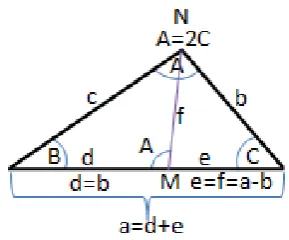
[image:4.595.40.457.190.304.2]To represent the above ratios visually, we shall present numbers of the silver ratios , ,с, and as parts of a triangle (let us call it a silver triangle for our cubic case, by analogy with the golden triangle for the flat case (Vorob’ev N. N., 1992)) and systems of similar triangles.
Fig. 2. Shows such a triangle
Fig. 2. Silver Triangle with sides , , , angles , , , and bisector of the angle .
Ratios of the sides in this triangle are expressed by equations (16 to 23). The bisector of the angle divides the opposite side of the triangle into parts as follows:
= + , where = and = .
Perimeter of the triangle is expressed by equation (21):
= + + = 1.
Therefore, formula (23) may also be written down as follows:
[image:4.595.215.360.493.613.2]Ratios between the angles in this triangle are as follows:
= 2 = ( ) ≈ 1,6937 ≈ 97,0399°
= 3 = ( ) ≈ 0,6011 ≈ 34,4401° ……….. (27)
= ( ) = ( ) ≈ 0,8468 ≈ 48,5200°.
Ratios of the areas of triangles , , and are as follows:
= ; = + 1; and = . ………..(28)
We can obtain from (28) a quantic equation similar to (coincided with) cubic equation (10):
= + 1. ………(29)
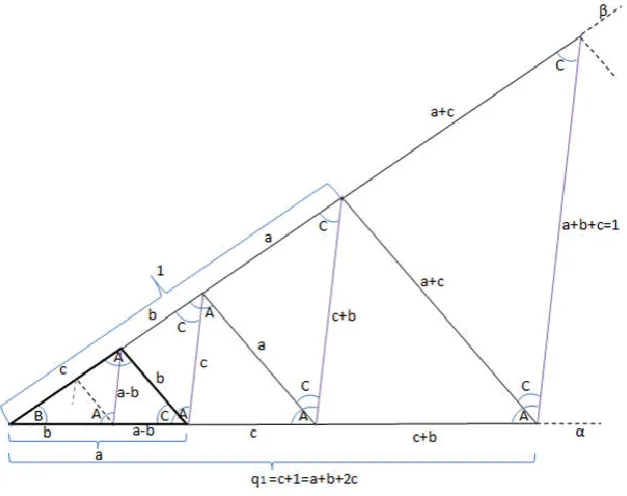
[image:5.595.141.455.284.532.2]The image of the system of similar triangles in Fig. 3 gives us additional visual presentation of silver ratios:
Fig. 3. System of triangles similar to the silver triangle
The system of similar triangles is located between two lines and , where is the angle between them. The parallel lines are crossing the lines and at the angles and . The points of intersection of the parallel lines and the line at the angles and converge. The point of intersection of the parallel lines and the line at the angles and converge too. Thus, the parallel lines form a zigzag between the lines and . The ratios between pieces of the figure shown in Fig. 3 are obvious.
Conclusion
The atomic structure is usually described using the periodic table approach based on Mendeleev’s system of chemical elements (Savelyev I. V., 1982 and Landau L. D. and Livshits E. M., 1989), or non-visual mathematical formalistic approach based on the Bohr-Sommerfeld theory and quantum mechanics (Savelyev I. V., 1982, Sommerfeld Arnold, 1973, and Landau L. D. and Livshits E. M., 1989). The mathematical formalistic approach is used in other fields of physics for example for laser beams investigations (Mensky М. B. and Yurkin A. V., 2008). In our paper, we used a geometric approach based on research of visual geometric models in the form of trajectories and triangles. We hope that our visual geometric approach can complement the above two approaches to contribute in research of the atomic structure in its entire complexity.
Acknowledgements
The author expresses gratitude to Prof. S. E. Shnoll, Prof. V. V. Dikusar, Prof. V. V. Smolyaninov, Prof. E. I. Mayevsky, Prof. V. G. Mikhalevich, Dr. D. E. Shnoll, Dr. A. Shemetov, Dr. O. Nersesyan and Dr. S. Sakhaeva for useful discussions. The author
also thanks participants of a seminar of theoretical and experimenta under the leadership of Dr. O. Mornev for new ideas.
REFERENCES
Landau L. D. and Livshits E. M. 1989. Theoretical physics. (Russian)
Mathematical encyclopedic dictionary, 1988.
Mensky М. B. and Yurkin A. V. 2008. “The `diffusion' of light and angular distribution in the laser equipped with a multilobe mirror”, Procedings of Institute of Systems Analysis of RAS
Peters James F., Tozzi Arturo and Ramanna Sheela
Gate. Technical Report, April, DOI:10.13140/RG.2.1.2399.0167. Popyrin S. L., Sokolov I. V. and Yurkin A. V.
generation in a multilobe mirror cavity”, Optics Communications Savelyev I. V. 1982. Course of the general physics.
Sommerfeld Arnold, 1973. Cognition Ways in Physics. Visibility in Physics and others. (Russian)
Vorob’ev N. N. 1992. Chisla Fibonachchi (Fibonacci Numbers). Moscow: Nauka. Yurkin A. V. 1994. “Quasi-resonator a new interpretation of scattering in lasers”, Yurkin A. V. 2015. “Symmetric triangle of Pascal and arithmetic
interpretation of processes in long pipes”. Lambert Academic Publishing, 2015, ISBN: 978 8443-2275-0).
Yurkin A. V. 2016. “Оn descriptive geometrical interpretation of the the Newtonian laminar current of liquid”,
Appendix
Fig.4. One of the eight ray groups of { =
process of filling the shell . is the principal quantum number (or ) is the spin quantum number.The dash
from (Yurkin A. V., 2016)). We will give briefly in addition an example not from nuclear area where it is possible to observe the also thanks participants of a seminar of theoretical and experimental biophysics of the city of Pus
under the leadership of Dr. O. Mornev for new ideas.
Theoretical physics. Vol. 3. Quantum mechanics. Nonrelativistic theory. Moscow: Nauka.
. Moscow: Soviet encyclopedia. (Russian)
“The `diffusion' of light and angular distribution in the laser equipped with a multilobe Procedings of Institute of Systems Analysis of RAS, Vol. 32, no. 2, pp. 113 – 121; arXiv:physics/0108037
Peters James F., Tozzi Arturo and Ramanna Sheela, 2015. “Gibson’s ecological theory of perception: topology matters”, pril, DOI:10.13140/RG.2.1.2399.0167.
Yurkin A. V. 1999. “Three-dimensional geometrical analysis and the characteristics of laser Optics Communications, Vol. 164, pp. 297 - 305.
Course of the general physics. Moscow: Nauka, Vol. 3. (Russian) Cognition Ways in Physics. Visibility in Physics. Collection of papers,
sla Fibonachchi (Fibonacci Numbers). Moscow: Nauka. (Russian) resonator a new interpretation of scattering in lasers”, Quantum Electron
“Symmetric triangle of Pascal and arithmetic parallelepiped. On possibility of new evident geometrical interpretation of processes in long pipes”. Lambert Academic Publishing, 2015, ISBN: 978-3-659
Оn descriptive geometrical interpretation of the principle of Pauli, elements of the table of Mendeleyev and the Newtonian laminar current of liquid”, Progress in physics, Vol. 12 pp. 149-169, issue 3 (April
= ( + 1/2) and = /2} subsystem of periodic trajectories
is the principal quantum number, is the orbital quantum number,
The dash-doted lines show the reference axes for measuring the angles and distances.
We will give briefly in addition an example not from nuclear area where it is possible to observe the l biophysics of the city of Puschino which has taken place
Vol. 3. Quantum mechanics. Nonrelativistic theory. Moscow: Nauka.
“The `diffusion' of light and angular distribution in the laser equipped with a multilobe arXiv:physics/0108037.
“Gibson’s ecological theory of perception: topology matters”, Research
dimensional geometrical analysis and the characteristics of laser
, Moscow: Nauka, pp. 122, 123
Quantum Electron., Vol. 24, p. 359. parallelepiped. On possibility of new evident geometrical
659-38411-0 (ISBN:
978-3-principle of Pauli, elements of the table of Mendeleyev and 169, issue 3 (April-July).
shown trajectories. Such trajectories can arise at the movement of the single car on a direct road. The driver turns a wheel once on small angles ± from time to time; so that the inclination angles of the trajectory segments are ± /2 to the axis of road (a, b). The driver turns a wheel once or twice on small angles ± from time to time; so that the inclination angles of the trajectory segments are ± /2 or ±3 /2 to the axis of road (c – h).
Fig.5. Division of possible states of an electron in an atom into shells and subshells (Table 36.1 from (Savelyev I. V., 1982))
Fig.6. The process of filling the electron shells of the first 36 elements of the periodic system (Table 37.1 from (Savelyev I. V., 1982))
Fig.7. Silver parallelepiped
Fig.7. Silver parallelepiped (a) and silver houses (b) and (c)