4636
MOBILE COMMERCE CONSUMER VALUE DISPARITY BY
GENERATION GAP : GIFT-GIVING CASE
1HYUN JIN, YEO, 2SEOK-HUN KIM
1First Author: Assistant Professor, Department of Business Administration, International College,
Dongseo University, Republic of Korea
2Corresponding Author: Assistant Professor, Department of Electronic commerce, Paichai University,
Republic of Korea
E-mail: 1[email protected], 2[email protected]
ABSTRACT
According the Pew research, a smartphone penetration rate of the world is fifty percent while major twenty-seven counties’ median is twenty-seventy-six percent. The higher level of income country has higher penetration. With penetration rate of smartphone growth, mobile coupon market including gift coupon is dramatically growing either. In that, there have been diverse analysis and studies about mobile coupon. Meanwhile, as the digital technology has been dramatically improved, the generation gap conflict issued at marketing and human resource management in business criteria. In this research, I clarify generation gap of mobile coupon gift consumers by multi-group structural equation model to define characteristic of e-commerce consumer on mobile coupon gift. As a result, there are generation gap on gift-giving intention causing factors among generations: generation X, Y, and Z.
Keywords: Generation Gap, Gift-Giving, Mobile-Coupon, e-Commerce, Mobile-Commerce
1. INTRODUCTION
The global digital gift card market is expected to continuously extended by 2025 [1]. In the South Korea, a mobile coupon market size is 1billion USD in 2017 and expected to extend 2billion USD by 2020 [2]. Although the market size of the Korean mobile coupon is not much significant than world market size, the Korean mobile market is sensitive to technology adaption enough to be called ‘new technology test country’ in medias.
According to the Korean Internet and Security Agency(KISA), 71.6% of smartphone user use their smartphone over seven hours a week, and smartphone penetration rate of age group twenties and thirties are 99.9%, fourties and fifties are 99.7% and 98.7%, and even sixties are 82.5% [3]. Even the smartphone penetration rate becomes almost 100%, usage application is simple, ‘Instant Messenger (95.1%)’ and ‘Shopping (59.6%)’ [4,5]. The most popular instant messenger in the Korea is ‘KaKao Talk’ which has 99.4% usage frequency for user [3]. In that one can conclude that the almost all Korean twenties to fifties using ‘Kakao Talk’ and more than half of them are shopping with their phone. Additionally, today, the Fintech technology make
mobile coupon usage easier that expedite gift-giving behavior of consumer [6].
With above explosive usage rate of smartphone, instant messenger, and mobile shopping, mobile coupon becomes popular which deliver coupon or coupon by instant messenger [6]. A mobile coupon is electronic ticket which is used for buying product or service, or discount of product or service [7]. The Korean mobile coupon market which is started with telecommunication company voucher is facing new era with representative instant messenger’s functions ‘Kakao Talk Present’, and ‘Plus Friend’ that support mobile coupon deliver [6].
4637 exists which is valuable for service providers and customers [8].
Nowadays, through 99.9% the smartphone penetration rate of the Korea, measuring and clarifying generation gap of mobile coupon gift givers with the perspective of different value of presentation divided by age. Before analyzing the generation gap, one should clarify the existing model suits to each generation. For that, I utilize mobile coupon gift giving model which is proved before and add technology acceptancy to find disparity among generations [8].
In this research I divide mobile coupon users by generation with generation segment explaining related research in this paper, and clarify which factors affect to gift-giving motivation of each generation with consumer value perspective in theory of consumption values. Furthermore, with the TAM (Technology Acceptance Model), I will clarify disparity among generations by the Multi group Structural Equation Model.
2. RELATED RESEARCH 2.1 Generation Gap
Each generation have unique expectations, experiences, generational history, and values that influences their buying behaviors [9]. Multi-generational marketing is the practice of appealing to unique generation being a group of individuals born and living about the same time [10]. There are diverse researches for the Human Resource Management criteria in business administration fields not only marketing criteria. However, the results of this research may valuable to marketing criteria not the H.R. Even without researches, in common sense, people recognized there are generation gap, and previous researches divide generations specifically below.
2.1.1 Generation X
Generation X (a.k.a Baby Bust, Slackers) was born during 1965-1977 and are in the 43-54 age range of 2019 [9]. They have taken huge responsibility for self-raising and tend to be less traditional than any other generations [9]. They marry cautiously [10,11]. In this generation, multiculturalism and thinking globally is the norm and the generation have experienced the penetration of personal computers and made 1990’s ‘dot.com’ stars [9]. Even the generation is highly educated, they are pessimistic, skeptical, disillusioned and questioning of conventionality [12].
The generation consumer tastes are not Baby Boomers (their previous generation), often blaming the materialism of the Baby Boomers for their difficult times [9]. They are incredibly disloyal to brands and companies and needs to buy products and services to set up households and for their children [13]. This generation is hard to reach. Generation X wants to hear the features of the products and services, and also want explain why the features are necessary [14]. There are diverse and plenty of researches about generation X characteristics that explains the generation’s history, behavior and other business factors.
In the famous Korean drama issued in 2013 which describe university students in 1994, an actor said ‘Our generation is stuck generation between analog and digital’. In Korea, generation X represents ‘diversity’. The Korean X generation has little different character to other countries’. Because they experienced and suffered by IMF depression that impact the Korea late 1997. Many Korean researchers studied characters affected by the monetary risk event. However, in this research I concern general factors of the generation for generalization of theory.
2.1.2 Generation Y
Generation Y (a.k.a Gen Y, Millennials, Net Generation) was born during 1977-1994 [9]. They are in 26-42 age range of 2019. They are children of the Baby Boomers (born during 1946-1964), and grew up in a time of immense and fast change including full-employment opportunities of women, dual-income households [9]. They were born in technology, electronic device environments such as personal computer meaning they are technology friendly generation. They are accustomed to a diverse universe where anything seems possible [11,12].
4638 collaborated, connected with their peers by the Social Network Services [17].
In Korea, this generation is significantly distinguished to Baby Boomers, because not they are their children but they are technology friendly and the Korea is one of the Internet Technology advanced country in the world, and the results diverse social conflicts such as communicating to parents. However, this generation is the most important and concerning target generation of new technology based business such as digital coupon which this research clarify.
2.1.3 Generation Z
After Williams Strauss and Neil Howe issued “no one knows who will name the next generation after the Millennials”, in 2012, USA Today sponsored an online contest to choose the name of the next generation, and in the contest, the name ‘Generation Z’ firstly suggested [18]. Generation Z (a.k.a Tweens and Generation XD) was born after 1994. They are in 1~25 age range of 2019. Generation Z is the newest generation and they are in their early formative years. They faced terrorism, school violence, economic recession, and the United States mortgage crisis [9].
In terms of an individual Generation Z’s characteristics, lifestyles, and attitudes, they are the new conservative embracing traditional beliefs, family unit valued, self-controlled, and more responsible than previous generations [9]. Similar to the Millennials (Generation Y), they are born in technology environment meaning they are accustomed to high-tech and multiple information sources. They are global and diverse generation comes from a diverse mix of backgrounds with different experiences and ideas, and put values on security more than ever [19].
In Korea, there are not many researches or emerging issues concerning difference between millennials and generation Z. However, there are diverse world-wide previous researches that the Korean has same generation change to generation Z. In this research, I define generation Z to individuals who have experience to buy mobile coupon gift under age 24.
2.2 Gift-Giving Motivation
A Gift-giving and taking behavior has been analyzed and researched since 1970s in consumer behavior criteria on gift satisfaction, identification of giver and taker,
giving behavior and avoid behavior, gift-giver’s selection time delay, and give-giving motivation [20,21]. Among those diverse gift-giving previous researches, this research focuses on gift-giving motivation in order to clarify generation gap about gift-giving motivation. In terms of ‘Gift-Giving Motivation’, the Motivation is ‘Inner causal factor that has direct effect on the Human behavior’ [22], which distinguished to the Utilitarian motivation and the Hedonic motivation [23].
Sherry(1983) claimed in research that gift-giving motivation is in spectrum between altruism (taker’s satisfaction maximization) and compulsion(giver’s satisfaction maximization) , and divided a gift-giving process to three stages: Gestation Stage, Presentation Stage, and Reformulation Stage [21] . There have been practical studies about gift-giving such as money gift, and the Japanese marriage congratulatory money tradition.
[image:3.612.344.513.472.726.2]In 1993, with all the respect of previous gift-giving researches, Mary claimed the three factors as gift-giving motivation: Experiential/Positive Attitude, Obligated Attitude, Practical Attitude [24]. With respect of Mary’s research, this research utilizes two factors from that: Experiential and Obligated, since the practical attitude factor is much similar to functional value concept in theory of consumption value that I explain below. Figure 1 shows Mary’s three gift-giving motivation factors.
4639 2.3 Theory of Consumption Values
[image:4.612.95.297.274.392.2]The Theory of Consumption Values(TCV) is developed to explain consumer’s purchase choice, and specific product/brand choice based on the Customer Value [25]. The Customer Value(CV) is a strategy tool for new customer acquisition and customer maintenance which is widely researched not only manufacturing but also service criteria [26, 27]. Until late 1990s, the CV researches mentioned about its definition, however, today, majority of researchers use the CV concept with ‘benefit’ and ‘give, sacrifice’ factors that Woodruff claimed [28]. The previous researches about the CV definition was quality and price aspect, while today researches are about operating those concepts [29].
Figure 2: Customer Choice Value, Sheth et al (1991)
In 2001, Sweeney claimed the PERVAL (PERceived VALue) Model which remove two values : Epistemic and Conditional Value from the five value factors model of Sheth et al(1991) [31], which has Social, Emotional, Functional, Epistemic and Conditional values [30]. Sweeney insisted that a company should understand and evaluate the factors of the CV: customer’s benefit and sacrifice and reallocate a company resources [30]. Sweeney’s research model has been utilized and proved by diverse criteria researches. In this research, with the respect to the PERVAL Model and the Theory of Sheth et al (1991) research, I utilized the Functional value, Social Value, and
Emotional Value and definition derived from those researches.
The Functional Value(FV) in this research illustrates functional quality and price usefulness from mobile coupon gift, and the Social Value(SV) is usefulness that acquired the mobile coupon gift-giving behavior is related to specific social group, while the Emotional Value(EV) explains emotional or static usefulness by selecting the mobile coupon. Figure 2 below shows the Sheth et al (1991) original CV theory.
2.4 Technology Acceptance Model
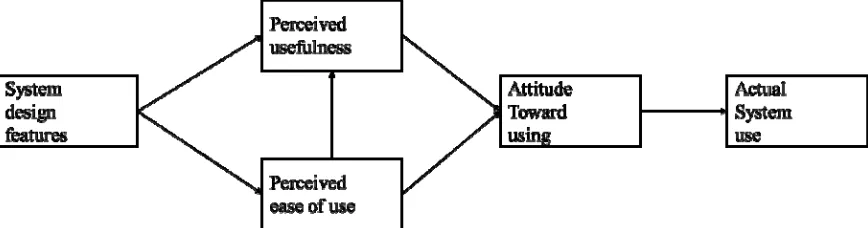
The Technology Acceptance Model (TAM) is released by Davis (1989) derived from the Theory of Reasoned Action (TRA) [32]. Since the model is released in 1989, massive researches about the model application, prove and upgrade are performed. In 2003, Venkatesh released UTAUT (Unified Theory of Acceptance Use of Technology) model which unify valid models derived from TAM model [33]. The initial TAM model had been proved and validated as a mediation role of system property and usage rate for several years, however, even TAM2 model is released, the model is criticized because it illustrated only 40% of real system usage rate which lead the Unified model [33]. Despite of some argues, the TAM model has been utilized and applied to innumerous criteria to not only business system but also personal technology acceptance description with considering social influences. Figure 3 shows the TAM model.
[image:4.612.94.528.589.703.2]In this research, I utilize two factors: Perceived Usefulness and Perceived Ease of Use, from the TAM model to clarify why certain generation want to give a gift with mobile coupon technology, because purpose of this study is not focus on technology itself but generation disparity about the technology. The Unified Model factors are not considered complex to apply on this research model.
4640 3. RESEARCH MODEL
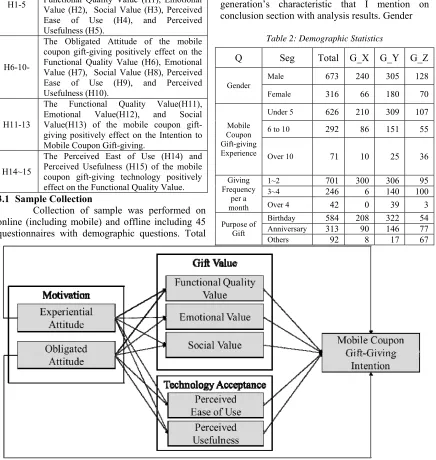
With respect to previous researches and purpose of this research, I set fifteen hypothesis below for Multi-group Structural Equation Model(MSEM) to clarify the model works and generation gap among X,Y, and Z generation of model. Figure 4 illustrates the research model for the MSEM.
Table 1: Hypothesis of this research
Seq Description
H1-5
The Experiential Attitude of the mobile coupon gift-giving positively effect on the Functional Quality Value (H1), Emotional Value (H2), Social Value (H3), Perceived Ease of Use (H4), and Perceived Usefulness (H5).
H6-10-
The Obligated Attitude of the mobile coupon gift-giving positively effect on the Functional Quality Value (H6), Emotional Value (H7), Social Value (H8), Perceived Ease of Use (H9), and Perceived Usefulness (H10).
H11-13
The Functional Quality Value(H11), Emotional Value(H12), and Social Value(H13) of the mobile coupon gift-giving positively effect on the Intention to Mobile Coupon Gift-giving.
H14~15
The Perceived East of Use (H14) and Perceived Usefulness (H15) of the mobile coupon gift-giving technology positively effect on the Functional Quality Value. 3.1 Sample Collection
Collection of sample was performed on online (including mobile) and offline including 45 questionnaires with demographic questions. Total
1,011 answers are collected, and 989 answer sheets are applied after removing invalid answer sheets such as missing questionnaires and biased answers. Balancing generation was our major concern because all three generations should have enough samples for analysis.
[image:5.612.93.529.251.711.2]Table 2 shows the demographic statistics of the sample divided by generation. The demographic statistics shows as the generation is younger, experience frequency raises and purpose changes either. However, the generation X’s total price of gift consumer spend per month is more than other generations. It seems reflecting the generation’s characteristic that I mention on conclusion section with analysis results. Gender
Table 2: Demographic Statistics
Q Seg Total G_X G_Y G_Z
Gender
Male 673 240 305 128
Female 316 66 180 70
Mobile Coupon Gift-giving Experience
Under 5 626 210 309 107
6 to 10 292 86 151 55
Over 10 71 10 25 36
Giving Frequency
per a month
1~2 701 300 306 95
3~4 246 6 140 100
Over 4 42 0 39 3
Purpose of Gift
Birthday 584 208 322 54 Anniversary 313 90 146 77
Others 92 8 17 67
4641 status shows for generation Y and Z that Male has more experience of the mobile coupon gift-giving that seems to celebrate the anniversaries.
3.2 Research Model
Figure 4 shows the research model of this research. For MSEM, this research divide generation by Williams (2001) segment age range [9]. According to the generation separation standard, in this research sample, a number of Generation X is 306, Generation Y is 485, and Generation Z is 198. All three generation samples are enough to perform SEM. Generation Z sample is smaller than other generations because it includes teenage group that have not enough monetary condition to use mobile gift-giving coupon which usually paid with the Fintech payment system today. The MSEM analysis is performed for each generation with same research model in Figure 4. For analysis I utilize AMOS 18.0 and SPSS 20.0.
4. RESULTS
4.1 Convergent Validity
[image:6.612.314.527.76.191.2]Before validation of hypothesis with MSEM, Exploratory Factor Analysis (EFA) is performed for the research model, and Confirmatory Factor Analysis (CFA) is performed for each MSEM factors. First, I validate the Factor Loadings (FL) between questionnaires and each factor. Second, calculate the Construct Reliability (CR) and Average Variance Extracted (AVE) for validation. Table 3 shows the result of Convergent Validation (CV) for SEM Model and Table 4,5,6 shows the result of CV for each MSEM model meaning SEM for each generation group. All the CV results shows variances are suitable for factors.
Table 3: Convergent Validity for SEM
Seg Factor FL CR AVE
Motivation
Experiential Attitude
0.722
0.718 0.537 0.681
0.790 Obligated
Attitude
0.811
0.723 0.525 0.710 0.838 Gift Value Functional Quality Value 0.733
0.738 0.562 0.699
0.761
Emotional Value
0.811
0.729 0.538 0.711
0.794
Social Value
0.801
0.687 0.499 0.710
0.690
Technology Acceptance
Perceived Ease of Use
0.750
0.774 0.588 0.876
0.771
Perceived Usefulness
0.877
0.748 0.556 0.781
0.712
Mobile Coupon Gift-giving Intention
0.819
0.719 0.523 0.741
0.774
Table 4: Convergent Validity for MSEM (Generation X)
Criteria Factor FL CR AVE
Motivation
Experiential Attitude
0.742
0.731 0.545 0.775
0.747
Obligated Attitude
0.734
0.717 0.522 0.759 0.832 Gift Value Functional Quality Value 0.771
0.750 0.570 0.776
0.720
Emotional Value
0.819
0.737 0.543 0.716
0.830
Social Value
0.716
0.698 0.506 0.751
0.793
Technology Acceptance
Perceived Ease Of Use
0.733
0.759 0.578 0.803
0.760
Perceived Usefulness
0.707
0.710 0.532 0.735 0.708 Mobile Coupon Gift-giving Intention 0.780
0.712 0.519 0.685
[image:6.612.283.522.220.633.2]0.831
Table 5: Convergent Validity for MSEM (Generation Y)
Criteria Factor FL CR AVE
Motivation
Experiential Attitude
0.802
0.752 0.559 0.822
0.770 Obligated
Attitude
0.834
0.733 0.531 0.815 0.769 Gift Value Functional Quality Value 0.704
0.719 0.550 0.686
[image:6.612.105.522.221.735.2]4642 Emotional
Value
0.724
0.733 0.540 0.801
0.812
Social Value 0.726
0.705 0.510 0.769
0.803
Technology Acceptance
Perceived Ease Of Use
0.804
0.756 0.576 0.795
0.683
Perceived Usefulness
0.827
0.749 0.557 0.738
0.810 Mobile Coupon
Gift-giving Intention
0.827
0.722 0.525 0.712
0.817
Table 6: Convergent Validity for MSEM (Generation Z)
Criteria Factor FL CR AVE
Motivation
Experiential Attitude
0.840
0.763 0.566 0.810
0.815
Obligated Attitude
0.838
0.734 0.532 0.797
0.793
Gift Value
Functional Quality
Value
0.739
0.748 0.568 0.719
0.795
Emotional Value
0.692
0.686 0.512 0.710
0.686
Social Value
0.837
0.716 0.517 0.747
0.779
Technology Acceptance
Perceived Ease Of
Use
0.734
0.771 0.586 0.820
0.819
Perceived Usefulness
0.694
0.710 0.532 0.770
0.684
Mobile Coupon Gift-giving
Intention
0.787
0.701 0.512 0.762
0.688
4.2 Structural Equation Model
After CV, SEM is performed with AMOS 18.0. SEM model fit satisfies at SEM and MSEM model meaning each generation model. Table 7 and Figure 5 shows the result of MSEM.
Table 7: Result of MSEM (*≥0.01, **≥0.05, N.S.=Not Significant)
PATH ALL G_X G_Y G_Z
EA →
FQV N.S N.S N.S N.S
EA →
EV 0.142* 0.011* 0.301* 0.188* EA →
SV 0.411* 0.319* 0.013* N.S EA →
PEU N.S N.S 0.009** N.S
EA →
PU 0.331* 0.301* 0.411* 0.141**
EA →
MCGGI 0.102* 0.013* 0.118* 0.199*
OA →
FQV N.S N.S N.S N.S
OA →
EV 0.019* 0.101* 0.303* 0.033** OA →
SV 0.114** 0.111* 0.010* N.S OA →
PEU N.S N.S N.S N.S
OA →
PU 0.198* 0.041** 0.003* N.S
OA →
MCGGI 0.131* 0.218* 0.019** 0.099*
FQV →
MCGGI N.S N.S N.S N.S
EV →
MCGGI 0.188* 0.091* 0.211* 0.366*
SV →
MCGGI 0.310* 0.408* 0.010* 0.171**
PEU →
MCGGI N.S N.S N.S N.S
PU →
MCGGI 0.104* 0.003* 0.318* 0.011**
4643 The Result of MSEM shows significant differences among generations. First, in the Motivation Phase. The Experiential Attitudes has not significant effects on the Functional Quality Value and Perceived Ease of Use. The Experiential Attitude has significant effect to the Emotional Value on entire model and each generation model while the Social Value has not significant from the Experiential Attitude. Between the Perceived Ease of Use is only significant for Generation Y group. The Obligated Attitude also has not significant path to the Functional Quality Value and Perceived Ease of Use. Different to the result of the Experiential Attitude, Obligated Attitude has not group disparity. Second, in the Consumption Values phase, the Functional Quality Value has not significant path to any factors. The emotional value and the Social Value has significant path to the Mobile Coupon Gift-Giving Intention. Third, in the Technology Acceptance phase, the Perceived Ease of Use has none while the Perceived Usefulness has all significant path to the Intention.
Although discussion of the results will be issued on the conclusion chapter, the results intuitively shows many information about generation gap. For example, the path from the Experiential Attitude to the Social Value is not significant for the Generation Z. Because their social position is not grown up enough to consider sociality with present. The Experiential Attitude to the Perceived Ease of Use is significant for the
Generation Y that could reflect their characteristic caring only result not process.
[image:8.612.90.533.396.708.2]Following table 8 shows the direct and indirect effect of motivation to the mobile coupon gift-giving intention. The results explain consumer use the mobile coupon gift directly from their Experiential and Obligated motivation or indirectly via feeling value. The result shows the Experiential Attitude has more direct effect on the mobile coupon gift-giving intention, meaning people decide to present when they learn from their experience and knowledge of gift-giving behavior rather than considering values from that behavior. The Obligated Attitude has less direct effect to the mobile coupon gift-giving intention meaning even they feel obligation to gift-giving behavior, they think about the values that the behavior could give to them. The results do not mean to marketers that mobile coupon products or services having good consumer experiences do not need values. It’s about their strategy to put more marketing resources on some point of view.
Table 8: Motivational Direct and Indirect Effect
PATH DIRECT EFFECT INDIRECT EFFECT TOTAL
EA →
MCGGI 0.211 0.144 0.355
OA →
MCGGI 0.011 0.133 0.144
4644 4.3 Group Compare Analysis
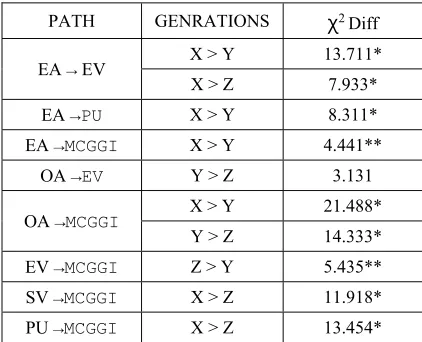
With the paths significant to all generations in Table 7, this research performed path MSEM to clarify path difference among groups. Through the constraint and non-constraint model for each path, χ2 difference validation is performed (Goodness of fit test; p<0.05=3.84, p<0.01=6.63 when df=1). Table 9 below shows the result of the test.
[image:9.612.89.300.372.543.2]The results show that there are significant differences among generations meaning there are generation gap on mobile coupon gift-giving consumers. In Generation X, the Experiential Attitude has more strength path than Generation Y and Z and more strength than Generation Y about effect to the Perceived Usefulness. The Obligated Attitude has not enough differences to the Emotional Value among generations. It’s not significant, however, it directly effects on the intention for the sequence Generation X, Y, and Z.
Table 9: Multi group analysis result
PATH GENRATIONS χ2 Diff
EA → EV X > Y 13.711*
X > Z 7.933*
EA →PU X > Y 8.311*
EA →MCGGI X > Y 4.441**
OA →EV Y > Z 3.131
OA →MCGGI X > Y 21.488*
Y > Z 14.333*
EV →MCGGI Z > Y 5.435**
SV →MCGGI X > Z 11.918*
PU →MCGGI X > Z 13.454*
5. DIFFERENCE FROM PRIOR WORK The multi generation marketing have been a practice of appealing to unique generation being a group of individuals born and living about same time [10]. Since prior researches have been clarified the specifications itself, or differences among generation, this research results gives significant different phase. Firstly, it not only clarifies differences among generation but also prove common factors those all generation have. Secondly, in the perspective of gift-giving motivations, this research lists common factors that marketers could utilize for mobile commerce promotion. Lastly, according to the TAM results of this research, mobile coupon companies make
strategies to facilitate usage of entire generations in their users.
6. CONCLUSION
According to the results, the mobile coupon gift-giving consumers has significant generation gap. However, there are common factors clarified to affect gift-giving intention. The Experiential Attitude and the Obligated Attitude of gift-giving motivation proved that gift-giving offline motivation theory works on online mobile coupon gift-giving, meaning a psychological process of gift-giving behavior is same on online even the process is much easier and there are none face-to-face communications. The result illustrates that marketers can use traditional marketing strategy for promotion to present product or service sales.
This research also clarified direct and indirect effects of motivation factors. As a result, the Experiential Attitude has more direct effect to gift-giving intention while the Obligated Attitude has indirect. The result means consumers having good experience for mobile coupon gift-giving product or service, they have more direct intention to repurchase the product or service.
A gift product or service value results with the theory of consumption values find out that mobile coupon gift-giving consumers do not care the Functional Quality Value of the product or service, but care the Emotional and Social Value. It could be interpreted as the characteristic of gift [8]. People purchase and give a gift with emotional causes such as obligation rather than its functional quality because the product will be utilized by consumer themselves but gift-taker. The Emotional and Social Value has significant effect to the mobile coupon gift-giving intention which supports above theory.
On the aspect of technology acceptance, the Perceived Ease of Use has none significant effects to gift-giving intention while the Perceived Usefulness has for all generations. The result illustrates that people use the mobile coupon technology not because the technology is easy but useful as gift-giving method. In Generation Y results, there are significant relation between the Experiential Attitude to the Perceived Ease of Use but it seems to come from the generation’s characteristic.
4645 effect from the Experiential Attitude to the Social Value because generation Z has not enough social position that better to consider social relation such as business relations. Second, different to other two generations, in the result of generation Z SEM, the Obligated Attitude does not have significant effect to the Social Value, and the Perceived Usefulness. The result shows the generation cares the obligation of gift but they purchase mobile coupon gift not for social relationship, and not because the technology is useful. For that generation, mobile technology is part of their life [19].
Through the result of Multi-group difference test for the paths significant for all generations, we can find interesting fact that the path effect strength is different to generations. There are many paths that generation X has stronger effects than other generations: EA to EV, EA to PU, EA to MCGGI, OA, SV, and PU to MCGGI. The result is the reflection of the generation’s characteristics: cautious, pessimistic, skeptical, disillusioned and questioning of conventionality [10,11,12].
Although this research clarified the mobile coupon gift-giving model and generation gap with MSEM, there are limitations for further studies. First, the sample comes from only the Korean consumers. It has limitations to generalize to use for global market. Second, the mobile coupon used in this research is one company’s system: The Kakao Talk. Consumers are affected by diverse marketing factors when they purchase such as brand. However, this research could not consider it. Last, this research tried to clarify the new model and generation gaps simultaneously, meaning the model is not proved for many application area and generalized yet.
ACKNOWLEDGEMENT:
This work was supported by the research grant of Pai Chai University in 2019.
REFRENCES:
[1] QY Research, “Gift Cards Market: Global Industry Analysis, Breakdown Data by Manufacturers, Key Regions, Types and Application and Forecast 2018-2025”, 2017. [2]http://www.fnnews.com/news/201804231722268
327, 23/04/2018
[3] Korea Internet & Security Agency, “Survey on the Internet Usage Report”, 2018.
[4] Korea Internet & Security Agency, “Survey on the Internet Usage Statistics”, 2018.
[5] Korea Internet & Security Agency, “2018 Korea Internet Whitepaper”, 2018.
[6] Korea Telecom Economics and Management Laboratory, “Evolution of Mobile Coupon”, 2015.
[7] Mobile Marketing Association, “Introduction to Mobile Coupons”, 2007.
[8] H.J., Yeo, “Mobile Coupon Gift-giving Intention Model in Mobile Instant Messenger Environment”, Journal of Society for Quality
Management, Vol. 42, No. 4, 2014 , pp.717-728,
[9] Kaylene C. Williams and Robert A. Page, “Marketing to generations”, Journal of
Behavioral Studies in Business, 2011.
[10] Morris, W. “The American Heritage Dictionary”, 1982, pp.549.
[11] Hawkins, D.I., Mothersbaugh, D.L., and Best, R.J., “Consumer Behavior”, 11th edition,
Irwin/McGraw-Hill, 2010.
[12] Dietz, J., “Defining Markets, Defining Moments: America’s 7 Generational Cohorts, Their Shared Experiences, and Why Businesses Should Care”, The Journal of Consumer
Marketing, Vol.20, No.2/3 ,2003, pp.172-174.
[13] Moore, M., and Carpenter, J.M., “Intergenerational Perceptions of Market Cues among US Apparel Consumers”, Journal of
Fashion Marketing and Management, Vol.12,
No.3, 2008, pp.323-337.
[14] Himmel, B., “Different Strokes for Different Generations”, Rental Product News, Vol.30,
No.7, 2008, pp.42-46.
[15] Anonymous, “The Ne(x)t Generation”,
Customer Relationship Management, Vol.13,
No.1, 2009, pp.21.
[16] Sisk, M., “Web Banking: Dexia Gives Kids Their Own Bank; Brussels-Based Axion Features a ‘Youth Index’ and Streams Concerts in Banner Ads to Appeal to Teens and 20 Somethings without Turning Off Older Consumers”, Bank Technology News, Vol.23,
No.4, pp.21.
[17] Williams, G., “Using Multi-Generational Marketing to Target Donors”, Nonprofit World,
Vol.23, No.5, 2005, pp.8-13.
[18] Horovitz, Bruce, “After Gen X, Millennials, what should next generation be?”, USA Today,
Retrieved 24 Nov. 2012.
[19] Wellner, A.S., “Generation Z”, American
4646 [20] B. Russel, “It’s the Thought That Counts: A
Signed Digraph Analysis of Gift-Giving”,
Journal of Consumer Research, 3,DEC,1976,
pp.155-162
[21] S. John and M.A. McGrath, “Gift Giving in Anthropological Perspective”, Journal of Consumer Research, 10. SEP, 1983, pp.157-167. [22] E.J. Murray, “Motivation and Emotion”,
Englewood Cliffs, N.J:Prentice-Hall, Inc., 1964.
[23] Solomon, Michael R., “Consumer Behavior: Having, Being and Buying”, Bosten, M.A: Allyn
and Bacon, 1992.
[24] Mary F.W. “Three Motivations for Interpersonal Gift Giving: Experiential, Obligated and Practical Motivations”, Advances
in Consumer Research, Vol.20, 1993,
pp.520-526.
[25] Jagdish N. Sheth, Bruce I. Newman, Barbara L. Gross, “Consumption Values and Market Choice”, South Western Publishing, Cincinaati, OH, 1991.
[26] V.A. Zeithaml, “Consumer Perceptions of Price, Quality and Value: a means-end model and synthesis of evidence”, Journal of Marketing,
Vol.52, 1988, pp.2-22.
[27] B.T. Gale, “Managing Customer Value”, Free
Press, New York, 1994.
[28] Woodruff, R.B., “Customer Value: the next source for competitive advantage”, Journal of
the Academy of Marketing Science, Vol.25,
No.2, 1997, pp.139-153.
[29] Yonggui Wang, Hing Po Lo, Renyong Chi and Yonheng Yang, “An integrated framework for customer value and customer-relationship-management performance: a customer-based perspective from China”, Managing Service Quality, Vol.14, No.2, 2004, pp.169-182. [30] Sweeney, J.C. and Soutar, G.N.,
“Consumer-perceived value: the development of a multiple-item scale”, Journal of Retailing, Vol.77, No.2, 2001, pp.203-220.
[31] J.N. Sheth, B.I. Newman, and B.L. Gross, “Why We Buy What We Buy: A Theory of Consumption Values”, Journal of Business
Research, Vol.22, 1991, pp.159-170.
[32] Fred D. Davis, “Perceived Usefulness, Perceived Easy of Use, and User Acceptance of Information Technology”, MIS Quarterly,
Vol.13, No.3, 1989, pp.319-340.