ORIGINAL RESEARCH ARTICLE
APPLICATION OF THE INTERNATIONAL CLASSIFICATION OF FUNCTIONING, DISABILITY
AND HEALTH (ICF) IN A THERAPEUTIC-EDUCATIONAL APPROACH FOR CHRONIC LOW
BACK PAIN
1
Karoleen Oswald Scharan,
2Bárbara Cordeiro Santos,
1,*Rafaella Stradiotto Bernardelli
and
3Auristela Duarte de Lima Moser
1
PhD student in the Post-Graduation Program of Health Technology of Pontifical Catholic University of Paraná,
Curitiba, Paraná Brazil
2
Msc. in the Post-Graduation Program of Health Technology of Pontifical Catholic University of Paraná, Curitiba,
Paraná Brazil
3
Professor in the Post-Graduation Program of Health Technology of Pontifical Catholic University of Paraná,
Curitiba, Paraná Brazil
ARTICLE INFO ABSTRACT
Purpose: To validate empirically the Brief core set for low back pain of the International Classification of Functioning, Disability and Health in the context of a Back School program.
Method: Quantitative, descriptive and cross sectional study with 69 subjects, from April to November 2015. The core set was applied by asking questions of Body Functions, Activities and Participation and Environmental Factors. Clinical records and complementary examinations of physical therapy assessment were used to classify Body Structures. Categories were considered representative and validated for the sample when 20% or more of subjects presented some difficulty. Data were processed by IBM SPSS Statistics 20.
Results: Predominance of females (65.2 %) and age between 18 and 78 years (mean ± SD = 41.78 ± 17.09). In Body functions 8 in 10 categories were above 20%; Activities and participation, 9 in 12 were considered representative; Environmental Factors, all 10 categories presented more than 20% of the sample considering items as facilitators. Any category of Body structures was considered validated.
Conclusion: Categories of the ICF core set were considered validated to the context of health education to low back pain. This generates a classification tool that complements the understanding of functionality through body functions, social and environmental aspects to better guide rehabilitation interventions.
Copyright ©2018,Karoleen Oswald Scharan et al. This is an open access article distributed under the Creative Commons Attribution License, which permits unrestricted use, distribution, and reproduction in any medium, provided the original work is properly cited.
INTRODUCTION
Low back pain has been reported as a global public health issue due to its high prevalence. It is estimate that up to 80% of the people have, had or are going to have some episode of low back pain at some point of their lives (WHO, 2003).
Corresponding author: Rafaella Stradiotto Bernardelli,
1
PhD student in the Post-Graduation Program of Health Technology of Pontifical Catholic University of Paraná, Curitiba, Paraná Brazil.
In Brazil, according to the National Research by Households Samples of 2008, the most reported chronic diseases were: hypertension (14.1%) followed by problems of the column (13.5%) (Brasil, 2011). The low back pain is the main contributor of years lived with disability (Vos et al., 2013) and it is associated with the reduction of the quality of life and the functional capacity (Anderson, 1999). People who have chronic pain need monitoring and intervention, which may require a multidisciplinary treatment to reduce painful conditions and functional, degenerative and psychological changes (Volinn, 1997).
ISSN: 2230-9926
International Journal of Development Research
Vol. 08, Issue, 01, pp.18631-18638, January,2018
Article History:
Received 05th October, 2017
Received in revised form 26th November, 2017
Accepted 20th December, 2017
Published online 31st January, 2018
Key Words:
International Classification of Functioning, Disability and Health,
Low Back Pain, Health Education
Physiotherapy, Health Profile.
Citation: Karoleen Oswald Scharan, Bárbara Cordeiro Santos, Rafaella Stradiotto Bernardelli and Auristela Duarte de Lima Moser, 2018. “Application of the international classification of functioning, disability and health (ICF) in a therapeutic-educational approach for chronic low back pain”,
International Journal of Development Research, 8, (01), 18631-18638.
A strategy that has been shown to be effective to people with low back pain is the Back School Program (Andrade et al., 2005). This strategy usually combines therapeutic exercises, postural re-education and information about self-care with the column. They are structured from physical assessments and questionnaires to assess different aspects of the health of individuals (Noll et al., 2013). Although the programs are successful and well structured, they require the application of a functional classification that is a differential as a common language to collect data in this population that suffers from low back pain. In order to understand the states of health of an individual, the World Health Organization (WHO) has created the International Classification of Functioning, Disability and Health (ICF) (OMS, 2015). The relevance of the ICF is due to the way they consider the functionality and the repercussions on the state of health of the individual from the body related components and the environment in its surroundings (Battistella and Brito, 2002).
The ICF represents a consensus model and its use in research and in clinical practice have often been emphasized (OMS, 2015). Because it is a long document (more than 1400 categories), its full implementation is not always possible or necessary in specific contexts (Selb et al., 2014). Therefore, it were created core sets, presented in the form of a list of important categories for particular health situation or context and that are usually defined by experts in the area concerned (Stucki et al., 2007). They can be used on the comprehensive version, which includes the largest number of categories and are indicated for multidisciplinary use, or the brief version, which is ideal for research and for clinical practice (Cieza et al., 2004a). One of these core sets is going to be an object of this study. The ICF application could happen in different contexts and health states can be classified, documented and used for clinical practice, in addition to provide additional information to the development of the classification (Cieza et al., 2004a). As part of the deployment and enhancement of core sets of ICF, they must go through a process of validation or pilot studies (Cieza et al., 2004b).
In Brazil, had already been done an application of the comprehensive core set for low back pain in an ambulatory care context (Riberto et al., 2011). It was not found in the literature, until the present moment, evidences of the application of the brief core set for low back pain (Cieza et al., 2004b) in a therapeutic-educational context, such as a Back School approach. The use of this classification with the other instruments used in the Back School, would verify the validity of a set of categories of ICF in a different context. Consequently, would culminate in the knowledge of the biopsychosocial aspects, which is of great importance for the proper design of therapeutic practices, as well as to the guidelines given in these programs. In addition, the ICF can also be incorporated into health systems and the data can be used by managers, researchers and users. Thus, its use in public health allows the comparison of data between people in various departments, regions and countries for a period of time. It becomes a tool that promotes the data collection and the formation of consistent national and global databases (PNSF, 2010). Because of the impact of low back pain on functionality and the quality of life of the population, the relevance of its social and economic aspects and the need to apply the classification in different contexts, this study aims to empirically validate the brief core set of ICF to low back pain in the context of a Bach School program.
METHODS
The quantitative and cross-sectional study was approved by the local committee (Comitê de Ética em Pesquisa da Pontifícia Universidade Católica do Paraná (CEP/PUCPR) under the number 908.554. It was realized in a Back school program, based in a private institution of higher education in the city of Curitiba (Paraná, Brazil) during the period of April to November of 2015. All subjects gave written consent to the use of answered questionnaires and their information was anonymized. The convenience sample consisted of 69 community adult volunteers, participants of the cited program. The inclusion criteria were: be male or female, to have minimal age of 18 years; to have low back pain during more than three months; to have mechanical-degenerative low back pain; to present stable condition. The exclusion criteria were: to be in pregnancy; to have column fracture history; to have undergone a surgery less than six months; to present severe osteoporosis and / or tumors; to be away from work because low back pain; to have diagnosis of fibromyalgia; to present cognitive changes; to be in physical therapy treatment.
To fulfill the brief core set for low back pain it was followed the model in the English version proposed by ICF - RESEARCH BRANCH (2012). The tool was developed into the Portuguese version according to the categories description (OMS, 2015) and was entitled as: Questionnaire of the brief core set for low back pain of the International Classification of Functioning, Disability and Health (ICF). The questionnaire was applied through questions by two health professionals specifically trained. Participants signed the Free and Informed Consent Term and answered the core set questionnaire. The questions were based on the categories’ description. Participants were asked to answer the questions based on the last 30 days with the support of the ICF scales to choose the qualifier that best represented what was being asked. In relation to the classification, the categories of the Body Functions and Body Structures component were classified from their codes plus a generic qualifier with negative scale, which represents the magnitude of difficulty or deficiency that the subject presents in the category. The categories of Activities and Participation were classified only with the first generic qualifier, which indicates the performance or magnitude of the difficulty that the person has in performing the action described by the category.
The categories of the Environmental Factors component were classified with each code plus a qualifier on a positive or negative scale for each category. This scale represents in what intensity the subject experiences an environmental factor as a barrier or facilitator (OMS, 2015).
Most of the categories were classified by the response given by the participant. The category body functions tonus was performed by clinical examination and the three categories of Body Structures were classified from the data contained in the item of clinical or complementary examination of the physiotherapeutic evaluation. For this last component, it was necessary to use an inspection examination or additional examination reports to classify the categories. The data were tabulated in Microsoft Excel 2010 worksheets and treated in the IBM SPSS Statistics 20. The socio demographic data, the functional characteristics and the quality of life of the participants were obtained from the physiotherapeutic evaluation.
As a criterion for the validation of the core set categories, 20% or more of the sample were found with qualifiers that represent some difficulty (Jondostir et al., 2010). Categories with a percentage of difficulty above 20% were considered representative and validated for the context. The qualifier 9 corresponds to the category being not applicable and was considered neutral in the study. The categories that presented the qualifier 8 indicate that the subject could not determine the magnitude of the difficulty in the last 30 days or that it was not possible to quantify the magnitude of the deficiency from the data contained in the evaluation.
RESULTS
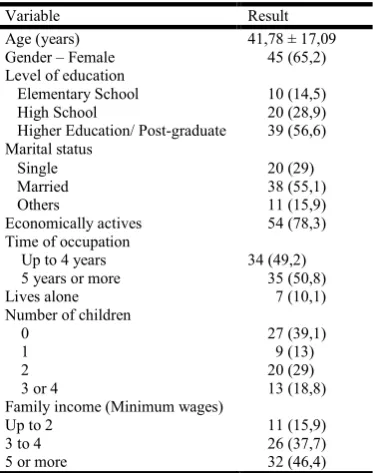
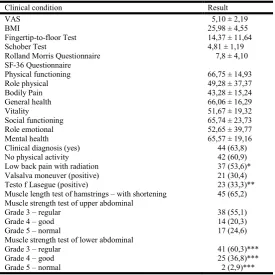
[image:3.595.70.257.297.534.2]The demographic profile and the clinical conditions of the participants are set out in table 1 and 2, respectively.
Table 1. Average ± standard deviation, absolute and relative frequencies (%) of the social demographic characteristics of the
sample
Variable Result
Age (years) 41,78 ± 17,09 Gender – Female 45 (65,2) Level of education
Elementary School High School
Higher Education/ Post-graduate
10 (14,5) 20 (28,9) 39 (56,6) Marital status
Single Married Others
20 (29) 38 (55,1) 11 (15,9) Economically actives 54 (78,3) Time of occupation
Up to 4 years 34 (49,2) 5 years or more
Lives alone
35 (50,8) 7 (10,1) Number of children
0 27 (39,1)
1 9 (13)
2 20 (29)
3 or 4 13 (18,8)
Family income (Minimum wages)
Up to 2 11 (15,9)
3 to 4 26 (37,7)
5 or more 32 (46,4)
Source: author, 2016.
Note: results described by average ± standard deviation or by absolute frequency (relative frequency)
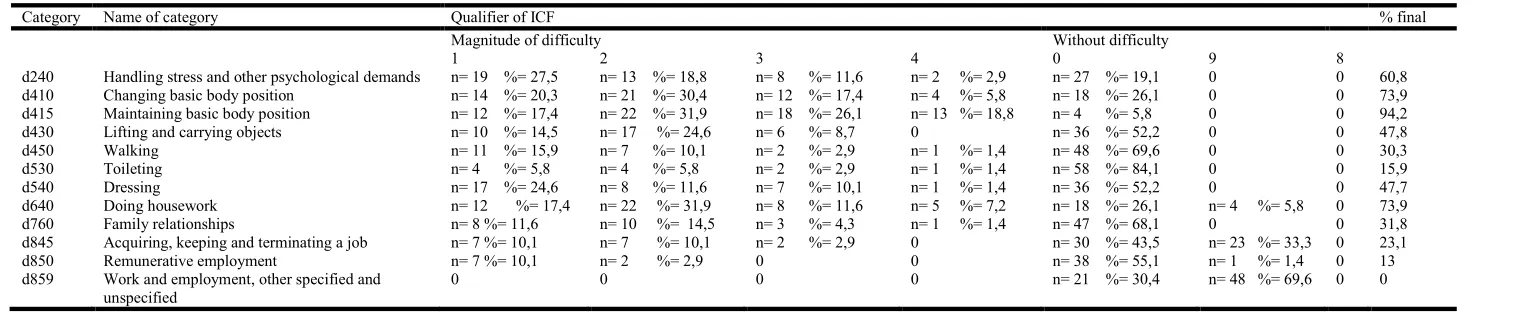
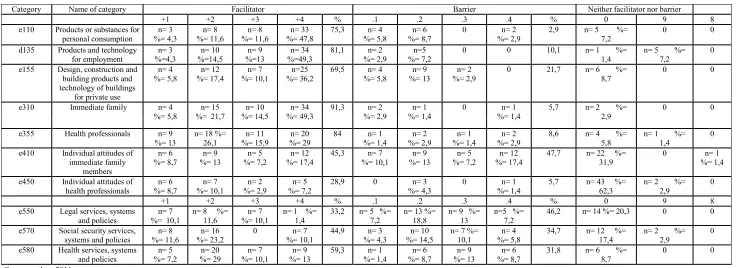
The tables 3, 4 and 5 represent absolute and relative frequencies of answers of the participants to the categories of the component Body Functions, Body Structures and Activities and Participation. The final percentage of each frame is referring to the sum of the relative frequencies of the participants in the qualifiers of the column "magnitude of difficulty". The table 6 represents the results of Environmental Factors component. Final percentage referred to the sum of relative frequencies of qualifiers in the column “Facilitator” and “Barrier”.
DISCUSSION
To date, it has been the first time that the brief core set of ICF for low back pain has been applied to participants in a therapeutic-educational approach to chronic low back pain in order to enable and use the ICF to support evaluations. As the use of this classification in specific situations (core sets) and in different contexts still requires validation (Cieza et al., 2004b),
the application of this core set allowed the version of a light technology to classify the functionality for people with chronic low back pain. The context was differentiated from a clinical setting and the core set covered more comprehensive content regarding routinely used instruments such as the evaluation itself, the analogue visual scale, the Roland Morris questionnaire, and the SF-36 quality of life questionnaire. In general, the instruments access information related to some Body Functions and to Activities and Participation. However, they do not access mental functions, for example, or constructs of environmental factors, already based on the literature on their relationship with chronic low back pain (Sigl et al., 2006; Jonsdottir et al., 2010). Of the total of 35 categories of the brief core set, 27 (77.1%) were considered representative in the present study. Among the most affected categories, 8 corresponded to the Body Functions component, 9 to Activities and Participation, and 10 to Environmental Factors.
The prevalence of women and middle-aged subjects in the fourth decade of life corroborates studies performed in patients with low back pain and that applied ICF (Riberto et al., 2011;
Jondostir et al., 2010). Regarding pain, the highest
incidence occurred in the economically productive phase. These findings are corroborated by the literature (Anderson et al., 1999; Moser et al., 2012). Pain, the main symptom reported by the subjects and the reason they sought the program, was classified as moderated by the ICF. Other studies with patients with low back pain participating in a Back School who accessed pain through another scale, such as the Visual Analogue Scale (VAS) reported the intensity as moderate (Durmus et al., 2014; Tsukimoto et al., 2006). Pain can impact both the functions of individuals and their day-to-day activities. However, environmental factors can offer sufficient support to manage these limitations, since most people with low back pain reported the environment in which they live, the technologies for their work, the support or opinion of relatives, friends and health professionals, and health services, social security as important facilitators in daily routine.
With regard to the body structures, usually affected in people with chronic low back pain, more than half of the sample (63.8%) presented a clinical diagnosis performed by a physician and supported by clinical exams. Low back pain is also characterized by changes in specific tests and in tests of muscle strength and length of the trunk and lower limbs (Imamura, 2001; Gouveia and Gouveia, 2008). In the present study, these findings were also identified in those patients who did not present a clinical diagnosis, establishing functional
impairment. Compromises related to muscle strength and
b130 described as "General mental functions of the physiological and psychological mechanisms that stimulate the individual to act persistently to satisfy their specific needs and objectives", "includes: function of energy level, motivation, appetite, desire, and control of impulses " (OMS, 2003). This difficulty can be corroborated by the report of the reasons listed for the low practice of physical activity reported as: physical limitations, pain and lack of mood.
[image:4.595.160.436.85.360.2]This result reminds the interdependence between the components Body Functions and Activities and Participation of the ICF, which can be accentuated in patients with low back pain impacting the quality of life (Mendonça and dos Anjos, 2004). The Body Functions component was the one that most presented categories with important levels of difficulty for the subjects. The categories of this component related to energy, emotional functions, pain, exercise tolerance and muscular endurance are quite typical in this population (WHO, 2013).
Table 2. Average ± standard deviation, absolute and relative frequencies (%) of the clinical conditions of the sample
Clinical condition Result
VAS 5,10 ± 2,19
BMI 25,98 ± 4,55
Fingertip-to-floor Test 14,37 ± 11,64
Schober Test 4,81 ± 1,19
Rolland Morris Questionnaire 7,8 ± 4,10 SF-36 Questionnaire
Physical functioning 66,75 ± 14,93
Role physical 49,28 ± 37,37
Bodily Pain 43,28 ± 15,24
General health 66,06 ± 16,29
Vitality 51,67 ± 19,32
Social functioning 65,74 ± 23,73
Role emotional 52,65 ± 39,77
Mental health 65,57 ± 19,16
Clinical diagnosis (yes) 44 (63,8)
No physical activity 42 (60,9)
Low back pain with radiation 37 (53,6)*
Valsalva moneuver (positive) 21 (30,4)
Testo f Lasegue (positive) 23 (33,3)**
Muscle length test of hamstrings – with shortening 45 (65,2) Muscle strength test of upper abdominal
Grade 3 – regular 38 (55,1)
Grade 4 – good 14 (20,3)
Grade 5 – normal 17 (24,6)
Muscle strength test of lower abdominal
Grade 3 – regular 41 (60,3)***
Grade 4 – good 25 (36,8)***
Grade 5 – normal 2 (2,9)***
Source:author, 2016.
Note: results described by average ± standard deviation or by absolute frequency (relative frequency) *Subjects who reported irradiation to one or both lower limbs
** Subjects who reported pain to the elevation of one or both lower limbs *** Absolute and relative frequency referred to 68 subjects
Table 3 – Absolute and relative frequencies of responses to the categories of Body Function. Final percentage referred to the sum of relative frequencies of participants in the column “magnitude of difficulty”
Categor y
Name of category Qualifier of ICF % final
Magnitude of difficulty Without difficulty
1 2 3 4 0 9 8
b130 Energy and drive functions
n= 15 %= 21,7
n= 27 %= 39,1
n= 8 %= 11,6
n= 2 %= 2,9
n= 17 %= 24,6
0 0 75,4
b134 Sleep functions n= 6 %= 8,7
n= 22 %= 31,9
n= 11 %= 15,9
n= 4 %= 5,8
n= 26 %= 37,7
0 0 62,3
b152 Emotional functions n= 15 %= 21,7
n= 18 %= 26,1
n= 16 %= 23,2
n= 3 %= 4,3
n= 17 %= 24,6
0 0 75,4
b280 Pain n= 6
%= 8,7
n= 28 %= 40,6
n= 19 %= 27,5
n= 14 %= 20,3
n= 2 %= 2,9
0 0 97,1
b455 Exercise tolerance functions
n= 18 %= 26,1
n= 20 %= 29
n= 9 %= 13
n= 2 %= 2,9
n= 20 %= 29
0 0 68,2
b710 Mobility and joint functions
n= 6 %= 8,7
n= 8 %= 11,6
n= 6 %= 8,7
n= 1 %= 1,4
n= 48 %= 69,6
0 0 30,4
b715 Stability of joint functions
n= 5 %= 7,2
n= 3 %= 4,3
n= 2 %= 2,9
0 n= 59
%= 85,5
0 0 14,5
b730 Muscle power functions n= 6 %= 8,7
n= 13 %= 18,8
n= 8 %= 11,6
0 n= 42
%= 60,9
0 0 39,1
b735 Muscle tone functions 0 0 0 0 n= 69
%=100
0 0 0
b740 Muscle endurance functions
n= 15 %= 21,7
n= 26 %= 37,7
n= 8 %= 11,6
n= 1 %= 1,4
n= 19 %= 27,5
0 0 72,5
Source: author, 2016.
[image:4.595.63.538.448.694.2]Despite the presence of involvement of the structures of the body discussed in the paragraphs above, there was no report of difficulty on the stability functions of the joints, nor was the category of functions related to muscle tone, passively tested by the physiotherapist. The Activities and Participation component was the second that presented the most representative categories for the sample. In this component, the subjects' activities are interpreted as actions performed in daily life and participation, such as involvement in different life situations (Kozlowska, 2013) This is a rather vast component regarding the typical characteristics of subjects with low back pain, since it portrays states of functionality that impact on everyday aspects, on the professional, on psychological relationships and demands (Cieza et al., 2004b). This component is particularly rich in information that can complement the attendance, since it comes back to the day to day of the people who look for a Back School program.
[image:5.842.75.770.106.175.2]Among the categories with the highest difficulty in this component are those of maintaining posture, changing posture, performing daily activities and dealing with stress and other psychological demands. Riberto et al. (2011), when evaluating subjects with low back pain in outpatient clinics, also found greater impairments in the categories cited. Regarding the psychological demands, according to the description of the category itself, it involves dealing with responsibilities, stress and crisis (OMS, 2015). The factors most commonly cited by the subjects were related to the pressure of work and day-to-day and the work day. Other studies also cite psychological changes as a factor that may be associated with chronic low back pain (Van Tulder, 2001; Brockow et al., 2004). A broader health perspective allows to adapt interventions with themes and experiences focused on the mentioned factors, minimizing the impacts of these functions on the activities and participation of these people.
Table 4 - Absolute and relative frequencies of responses to the categories of Body Structures. Final percentage referred to the sum of relative frequencies of participants in the column “magnitude of impairment”
Category Name of category Qualifier of ICF % final
Some impairment Without impairment
1 2 3 4 0 9 8
s120 Spinal Cord and related structures 0 0 0 0 n= 22 %= 31,9 0 n= 47 %= 68,1 0
s760 Structure of the trunk 0 0 0 0 0 n= 25 %= 36,2 n= 44 %= 63,8 0
s770 Additional musculoskeletal structures related to movement 0 0 0 0 0 0 n= 69 %= 100 0
Source: author, 2016.
Table 5 - Absolute and relative frequencies of responses to the categories of Activities and Participation. Final percentage referred to the sum of relative frequencies of participants in the column “magnitude of difficulty”
Category Name of category Qualifier of ICF % final
Magnitude of difficulty Without difficulty
1 2 3 4 0 9 8
d240 Handling stress and other psychological demands n= 19 %= 27,5 n= 13 %= 18,8 n= 8 %= 11,6 n= 2 %= 2,9 n= 27 %= 19,1 0 0 60,8 d410 Changing basic body position n= 14 %= 20,3 n= 21 %= 30,4 n= 12 %= 17,4 n= 4 %= 5,8 n= 18 %= 26,1 0 0 73,9 d415 Maintaining basic body position n= 12 %= 17,4 n= 22 %= 31,9 n= 18 %= 26,1 n= 13 %= 18,8 n= 4 %= 5,8 0 0 94,2 d430 Lifting and carrying objects n= 10 %= 14,5 n= 17 %= 24,6 n= 6 %= 8,7 0 n= 36 %= 52,2 0 0 47,8 d450 Walking n= 11 %= 15,9 n= 7 %= 10,1 n= 2 %= 2,9 n= 1 %= 1,4 n= 48 %= 69,6 0 0 30,3 d530 Toileting n= 4 %= 5,8 n= 4 %= 5,8 n= 2 %= 2,9 n= 1 %= 1,4 n= 58 %= 84,1 0 0 15,9 d540 Dressing n= 17 %= 24,6 n= 8 %= 11,6 n= 7 %= 10,1 n= 1 %= 1,4 n= 36 %= 52,2 0 0 47,7 d640 Doing housework n= 12 %= 17,4 n= 22 %= 31,9 n= 8 %= 11,6 n= 5 %= 7,2 n= 18 %= 26,1 n= 4 %= 5,8 0 73,9 d760 Family relationships n= 8 %= 11,6 n= 10 %= 14,5 n= 3 %= 4,3 n= 1 %= 1,4 n= 47 %= 68,1 0 0 31,8 d845 Acquiring, keeping and terminating a job n= 7 %= 10,1 n= 7 %= 10,1 n= 2 %= 2,9 0 n= 30 %= 43,5 n= 23 %= 33,3 0 23,1
d850 Remunerative employment n= 7 %= 10,1 n= 2 %= 2,9 0 0 n= 38 %= 55,1 n= 1 %= 1,4 0 13
d859 Work and employment, other specified and unspecified
0 0 0 0 n= 21 %= 30,4 n= 48 %= 69,6 0 0
[image:5.842.61.826.231.388.2]Regarding the environmental factors component, all categories in the present study had a percentage above 20% for the interpretation of the environment as facilitator. This interpretation was also identified by Jondosttir et al. (2010) who analyzed people with low back pain who were being treated or who had already been treated. The authors identified only the climate as a barrier. Although the climate category was not contained in the brief core set for low back pain, this was an item reported for the worsening of pain in the present study. Although all categories were interpreted as facilitators, some of the subjects considered items as barriers. This consideration was greater than in the study by Jondosttir et al. (2010), specifically the categories related to services, systems and policies and that interpretations as barriers or facilitators may differ from country to country (Cieza et al., 2004b). According to Brockow et al. (2004), the ICF categories that are most relevant to subjects with low back pain are concentrated in the Activities and Participation components and in
[image:6.842.54.797.115.383.2]Environmental Factors. Araújo (2013) reinforces that the intervention based on the components of the ICF should start with changes in the environment in which the individual is. This information is very relevant when thinking about therapeutic educational programs because there is a theoretical approach to reduce doubts and inform the subjects about the aspects to be modified in their day to day and practical so that they experience the modifications associated with therapeutic exercises (Volinn, 1997; Moser et al., 2012). Regarding the Body Structures component, there was not enough allowance from the data obtained through the evaluation to quantify the magnitude of the changes in this component. However, it was possible to record that there were changes in the structures, corroborating the fact that many of the lumbar related symptoms come from alterations in various structures of the spine, including muscles, ligaments, fascia, vessels, bones (Cieza et al.,2004b; Durmus et al., 2014).
Table 6. Absolute and relative frequencies of responses to the categories of Environmental Factors. Final percentage referred to the sum of relative frequencies of qualifiers in the column “Facilitator” and “Barrier” (Curitiba, 2015)
Category Name of category Facilitator Barrier Neither facilitator nor barrier
+1 +2 +3 +4 % .1 .2 .3 .4 % 0 9 8
e110 Products or substances for personal consumption n= 3 %= 4,3 n= 8 %= 11,6 n= 8 %= 11,6 n= 33 %= 47,8
75,3 n= 4 %= 5,8
n= 6 %= 8,7
0 n= 2 %= 2,9
2,9 n= 5 %= 7,2
0 0
d135 Products and technology for employment n= 3 %=4,3 n= 10 %=14,5 n= 9 %=13 n= 34 %=49,3
81,1 n= 2 %= 2,9
n=5 %= 7,2
0 0 10,1 n= 1 %=
1,4
n= 5 %= 7,2
0
e155 Design, construction and building products and technology of buildings
for private use
n= 4 %= 5,8 n= 12 %= 17,4 n= 7 %= 10,1 n=25 %= 36,2
69,5 n= 4 %= 5,8
n= 9 %= 13
n= 2 %= 2,9
0 21,7 n= 6 %= 8,7
0 0
e310 Immediate family n= 4 %= 5,8
n= 15 %= 21,7
n= 10 %= 14,5
n= 34 %= 49,3
91,3 n= 2 %= 2,9
n= 1 %= 1,4
0 n= 1 %= 1,4
5,7 n= 2 %= 2,9
0 0
e355 Health professionals n= 9 %= 13
n= 18 %= 26,1
n= 11 %= 15,9
n= 20 %= 29
84 n= 1 %= 1,4 n= 2 %= 2,9 n= 1 %= 1,4 n= 2 %= 2,9
8,6 n= 4 %= 5,8
n= 1 %= 1,4
0
e410 Individual attitudes of immediate family members n= 6 %= 8,7 n= 9 %= 13 n= 5 %= 7,2 n= 12 %= 17,4
45,3 n= 7 %= 10,1 n= 9 %= 13 n= 5 %= 7,2 n= 12 %= 17,4
47,7 n= 22 %= 31,9
0 n= 1 %= 1,4
e450 Individual attitudes of health professionals n= 6 %= 8,7 n= 7 %= 10,1 n= 2 %= 2,9 n= 5 %= 7,2
28,9 0 n= 3 %= 4,3
0 n= 1 %= 1,4
5,7 n= 43 %= 62,3
n= 2 %= 2,9
0
+1 +2 +3 +4 % .1 .2 .3 .4 % 0 9 8
e550 Legal services, systems and policies
n= 7 %= 10,1
n= 8 %= 11,6
n= 7 %= 10,1
n= 1 %= 1,4
33,2 n= 5 %= 7,2
n= 13 %= 18,8
n= 9 %= 13
n=5 %= 7,2
46,2 n= 14 %= 20,3 0 0
e570 Social security services, systems and policies
n= 8 %= 11,6
n= 16 %= 23,2
0 n= 7 %= 10,1
44,9 n= 3 %= 4,3
n= 10 %= 14,5
n= 7 %= 10,1
n= 4 %= 5,8
34,7 n= 12 %= 17,4
n= 2 %= 2,9
0
e580 Health services, systems and policies n= 5 %= 7,2 n= 20 %= 29 n= 7 %= 10,1 n= 9 %= 13
59,3 n= 1 %= 1,4 n= 6 %= 8,7 n= 9 %= 13 n= 6 %= 8,7
31,8 n= 6 %= 8,7
0 0
Source: author, 2016.
The importance of using the ICF is to generate a systematized language to record information and to be able to record a broader view of the domains that may be associated with a health condition or disease and to prevent or reduce recurrences (OMS, 2015). Therefore, the importance of the use of classification in the most different contexts is reinforced, especially with multidimensional approaches focusing beyond the physical symptoms and their treatments
Limitations and future studies
The present study presented some limitations such as: the subjects' profile may not represent the population with low back pain in Brazil; there was insufficient data extracted from the evaluation to quantify the categories of the Body Structures component; and there were range of categories and little specificity of them mainly in the components Activities and
participation and Environmental factors. These last
components cited contain a range of examples in each category. Some subjects reported that in some situations there is some difficulty in choosing a qualifier that is represented for the entire category. Therefore, it is necessary to note which is the example that the subject has difficulty for the intervention to be as directed as possible. It is suggested that other studies apply classification as a way of monitoring the outcomes of this treatment modality and that accompany the medium and long term the functionality of these people with low back pain. It is hoped that this study will help other researchers better understand the multifactorial aspects of low back pain using ICF as well as the replication of the study in other Back Schools in different regions or contexts.
Conclusion
It was possible to apply the CIF in the context of a School of the Column and to use the data obtained to access the health states of the participants as a form of validation of the categories of the core set. It is believed that this validation could be a contribution to future comparisons with the current instruments used by the program by reinforcing its power of evidence. It is believed that the findings of the present study will allow the use of this subsidy with the evaluations, allowing adjustments and adaptations of the approaches used by the professionals.
REFERENCES
Andersson GB 1999. Epidemiological features of chronic low-back pain. The lancet. 354:9178, pp 581-585. doi: http://dx.doi.org/10.1016/S0140-6736(99)01312-4. Andrade SCD, Araújo AGRD, Vilar MJP 2005. Back School:
historical revision and its application in chronic low back pain. Revista Brasileira de Reumatologia. 45:4, pp
224-228. doi:
http://dx.doi.org/10.1590/S0482-50042005000400006.
Araújo ES 2013. CIF: uma discussão sobre linearidade no modelo biopsicossocial. Fisioterapia & Saúde Funcional. 2:1, pp 6-13.
Battistella LR, de Brito CMM 2002. Reflexões Classificação Internacional de Funcionalidade (CIF) International Classification of Functioning Disability and Health (ICF).
Acta Fisiátrica. 8:1, pp 18-23. Available in:
<http://www.actafisiatrica.org.br/edicoes.asp?vol=9&ano= 2002> Access: 15 jan 2016.
Brasil, Plano Nacional de Saúde (PNS) 2012- 2015. Brasília,
2011. Available in:
<http://pns.dgs.pt/pns-versao-completa/> Access: 15 jan 2016.
Brockow T, Cieza A, Kuhlow H. Sigl T, Franke T, Harder M, Stucki G 2004. Identifying the concepts contained in outcome measures of clinical trials on musculoskeletal disorders and chronic widespread pain using the International Classification of Functioning, Disability and
Health as a reference. Journal of Rehabilitation Medicine.
36, pp 30-36.
Cieza A, Ewert T Ustun TB, Chatterji S, Kostanjsek N, Stucki G. 2004a. Development of ICF Core sets for patients with
chronic conditions. J Rehabil Med., suppl. 44 pp 9-11.
Cieza A, Stucki G, Weigl M, Disler P, Jackel W, van der Linden S, Kostanjsek N, De Bie R 2004b. ICF Core sets for low back pain. J Rehabil Med. 36, pp 69-74.
Durmus D, Unal M, Kuru O. 2014. How effective is a modified exercise program on its own or with back school in chronic low back pain? A randomized-controlled clinical
trial. J Back Musculoskelet Rehabil.27:4, pp 553-561.
Gouveia KMC, Gouveia EC 2008. O músculo transverso abdominal e sua função de estabilização da coluna lombar. Fisioterapia e Movimento. 21:3, pp 45-50.
ICF research-branch 2012. ICF Documentation form.
Germany. Available in: <
http://www.icf-core-sets.org/en/page4.php>. Access: 16 dez 2015.
Imamura ST, Kaziyama HHS, Imamura M 2006. Lombalgia. Revista de Medicina. 80:2, pp 375-390.
Jonsdottir J, Rainero G, Racca V, Glässel A, Cieza A 2010. Functioning and disability in persons with low back pain. Disability and Rehabilitation. 32:1, pp 78-84.
Kozlowska K 2013. Stress, Distress, and Bodytalk: Co-constructing Formulations with Patients Who Present with Somatic Symptoms. Harvard Review of Psychiatry. 21:6, pp 314-333.
Mendonça CP, Dos Anjos LA 2004. Aspectos das práticas alimentares e da atividade física como determinantes do crescimento do sobrepeso/obesidade no Brasil Dietary and physical activity factors as determinants of the increase. Cad saúde pública. 20:3, pp 698-709.
Moser AD, Scharan KO, Pereira PA, Passini C 2012. Escola da coluna associada a estabilizacão segmentar na lombalgia
mecânico-degenerativa. Revista Terapia Manual. 1:1 pp
364-373.
Noll M, Vieira A, Darski C, Candotti CT 2013. Escolas posturais desenvolvidas no Brasil: revisão sobre os instrumentos de avaliação, as metodologias de intervenção
e seus resultados. Revista Brasileira De Reumatologia.
54:1, pp 51-58.
Organização Mundial da Saúde 2015. Classificação
Internacional de Funcionalidade, Incapacidade e Saúde, CIF. 2 ed. Brasil: Edusp - Editora da Universidade de São Paulo.
Política nacional de saúde funcional PNSF; 2011. Ministério da Saúde (Brasil), Política Nacional de Saúde Funcional: Construindo MAIS saúde para a população brasileira. Brasília. Avaiable in: <https://xa.yimg.com/kq/ groups/ 18516898/.../PNSF+-+18.11.2010.doc> Access: 15 jan 2016.
Riberto M, Chiappetta LM, Lopes KAT, Battistella LR. A
experiência brasileira com o core set da classificação
Selb M, Escorpizo R, Kostanjsek N, Stucki G, Ustün B, Cieza A 2014. A guide on how to develop an international classification of functioning, disability and health core set.
Eur J Phys Rehab Med. 51:1, pp 105-17.
Sigl T, Cieza A, Brockow T, Chatterji S, Konstanjsek N, Stucki G 2006. Content comparison of low back pain-specific measures based on the insternational classification of functioning, disability and health (ICF). Clin J Pain. 22:2, pp 147-153.
Smuck M, Kao M-CJ, Brar N, Martinez-Ith A, Choi J, Tomkins-Lane CC 2014. Does physical activity influence the relationship between low back pain and obesity? The
Spine Journal. 14:2, pp 209-16.
Stucki G, Cieza A, Melvin J 2007. The international classification of functioning, disability and health: A unifying model for the conceptual description of the
rehabilitation strategy. J Rehab Med. 39:4, pp 279-285.
Thomaz PMD, da THM, Costa EFdS, Pedro Curi Hallal 2010. Fatores associados à atividade física em adultos, Brasília, DF. Rev Saude Publica. 44:5, pp 894-900.
Tsukimoto GR, Riberto M, Brito CA, Battistella LR 2006. Avaliação longitudinal da Escola de Postura para dor lombar crônica através da aplicação dos questionários Roland Morris e Short Form Health Survey (SF-36). Acta Fisiátrica. 13:2, pp 63-69.
Van Tulder M 2001. Treatment of low back pain: myths and facts. Schmerz. Germany. 15:6, pp 499-503.
Volinn E 1997. The Epidemiology of Low Back Pain in the
Rest of the World: A Review of Surveys in Low‐and
Middle‐Income Countries. Spine. 22:15 pp 1747-1754.
Vos T, Flaxman AD, Naghavi M, Lozano R, Michaud C, Ezzati M, Shibuya K, Salomon JA, Abdalla S, Aboyans V 2013. Years lived with disability (YLDs) for 1160 sequelae of 289 diseases and injuries 1990–2010: a systematic
analysis for the Global Burden of Disease Study 2010. The
lancet. 380:9859, pp 2163-2196.
Weigl M, Cieza A, Andersen C, Kollerits B, Amann E, Stucki G. 2004. Identification of relevant ICF categories in
patients with chronic health conditions: a Delphi exercise. J
Rehabil Med. suppl 44, pp 12-21.
World health organization 2003. Technological report series.The burden of musculoskeletal conditions at the start of a new millennium. Geneva. Available in: < http://apps.who.int/iris/handle/10665/42721> Access: 15 jan 2016.
World health organization 2013. How to use the ICF: A practical manual for using the International Classification
of Functioning, Disability and Health (ICF). Geneva, Out.
Available in: <www.who.int/cla ssifications/draf
ticfpractica lmanual.pdf> Access: 15 jan 2016.
18638 Karoleen Oswald Scharan et al.Application of the international classification of functioning, disability and health (icf) in a therapeutic-educational approach for chronic low back pain