BIROn - Birkbeck Institutional Research Online
Fan, Hao and Poulovassilis, Alexandra (2005) Using schema transformation
pathways for data lineage tracing. In: Jackson, M. and Nelson, D. and Stirk,
S. (eds.) Database: Enterprise, Skills and Innovation. Lecture Notes in
Computer Science 3567. Berlin, Germany: Springer-Verlag, pp. 133-144.
ISBN 9783540269731.
Downloaded from:
Usage Guidelines:
Please refer to usage guidelines at
or alternatively
Birkbeck ePrints: an open access repository of the
research output of Birkbeck College
http://eprints.bbk.ac.uk
Fan, Hao and Poulovassilis, Alexandra (2005). Using
schema transformation pathways for data lineage tracing.
Lecture Notes in Computer Science 3567: 133-144
This is an author-produced version of a paper published in
Lecture Notes in
Computer Science
(ISSN 0302-9743). This version has been peer-reviewed
but does not include the final publisher proof corrections, published layout or
pagination.
All articles available through Birkbeck ePrints are protected by intellectual
property law, including copyright law. Any use made of the contents should
comply with the relevant law.
Citation for this version:
Fan, Hao and Poulovassilis, Alexandra (2005). Using schema transformation
pathways for data lineage tracing.
London: Birkbeck ePrints.
Available at:
http://eprints.bbk.ac.uk/archive/00000305
Citation for the publisher’s version:
Fan, Hao and Poulovassilis, Alexandra (2005). Using schema transformation
pathways for data lineage tracing.
Lecture Notes in Computer Science 3567
:
133-144
http://eprints.bbk.ac.uk
Using Schema Transformation Pathways for Data
Lineage Tracing
Hao Fan, Alexandra Poulovassilis
School of Computer Science and Information Systems, Birkbeck College, University of London, Malet Street, London WC1E 7HX
{hao,ap}@dcs.bbk.ac.uk
Abstract. With the increasing amount and diversity of information available on
the Internet, there has been a huge growth in information systems that need to integrate data from distributed, heterogeneous data sources. Tracing the lineage of the integrated data is one of the problems being addressed in data warehousing research. This paper presents a data lineage tracing approach based on schema transformation pathways. Our approach is not limited to one specific data model or query language, and would be useful in any data transformation/integration framework based on sequences of primitive schema transformations.
1
Introduction
A data warehousing system collects data from distributed, autonomous and heteroge-neous data sources into a central repository to enable analysis and mining of the inte-grated information. However, sometimes what we need is not only to analyse the data in the integrated database, but also to investigate how certain integrated information was derived from the data sources, which is the problem of data lineage tracing (DLT). Sup-porting DLT in data warehousing environments has a number of applications: in-depth data analysis, on-line analysis mining (OLAM), scientific databases, authorization man-agement, and materialized view schema evolution [2, 18, 8, 13, 9].
AutoMed1is a heterogeneous data transformation and integration system which of-fers the capability to handle data integration across multiple data models. In the Au-toMed approach, the integration of schemas is specified as a sequence of primitive schema transformation steps, which incrementally add, delete or rename schema con-structs, thereby transforming each source schema into the target schema. We term the sequence of primitive transformations steps defined for transforming a schemaS1into
a schemaS2a transformation pathway fromS1toS2.
In [11] we discussed how AutoMed metadata can be used to express the schemas and the cleansing, transformation and integration processes in heterogeneous data ware-housing environments. In this paper, we focus on how AutoMed metadata can be used for tracing the lineage of data in an integrated database.
The outline of this paper is as follows. Section 2 gives a review of related work. Section 3 gives an overview of AutoMed, as well as a data integration example. Section 4 presents our DLT techniques, including the DLT formulae developed to handle virtual
intermediate lineage data and the DLT algorithm operating along a general schema transformation pathway. Section 5 gives our concluding remarks.
2
Related Work
The problem of data lineage tracing in data warehousing environments has been for-mally studied by Cuiet al.in [8, 6, 7]. In particular, the fundamental definitions regard-ing data lineage, includregard-ing tuple derivation for an operator and tuple derivation for a
view, were developed in [8], as were methods for derivation tracing with both set and
bag semantics. Their work has addressed the derivation tracing problem using bag se-mantics and has provided the concept of derivation set and derivation pool for tracing data lineage with duplicate elements. Reference [6] also introduces a way to trace data lineage for complex views in data warehouses. However, the approach is limited to the relational data model.
Another fundamental concept of data lineage is discussed by Bunemanet al.in [4], namely the difference between “why” provenance and “where” provenance. Why-provenance refers to the source data that had some influence on the existence of the integrated data. Where-provenance refers to the actual data in the sources from which the integrated data was extracted.
In our approach, both why- and where-provenance are considered, using bag seman-tics. Our previous work [10] defines the notions of affect-pool and origin-pool for data lineage tracing in AutoMed — the former derives all of the source data that had some influence on the tracing data, while the latter derives the specific data in the sources from which the tracing data is extracted. In that work we develop formulae for deriv-ing the affect-pool and origin-pool of a data item in the extent of a materialised schema construct created by a single schema transformation step. Our DLT approach is to apply these formulae on each transformation step in a transformation pathway in turn, so as to obtain the lineage data in stepwise fashion.
Cui and Widom in [7] also discuss the problem of tracing data lineage for gen-eral data warehousing transformations, that is, the considered operators and algebraic properties are no longer limited to relational views. However, without a framework for expressing general transformations in heterogeneous database environments, most of algorithms in [7] are recalling the view definition and examining each item in the data source to decide if the item is in the data lineage of the data being traced. This can be expensive if the view definition is a complex one and enumerating all items in the data source is impractical for large data sets.
Reference [18] proposes a general framework for computing fine-grained data lin-eage,i.e.a specific derivation in the data source, using a limited amount of information,
weak and verified inversion, about the processing steps. Based on weak and verified
data warehouse evolves. Our approach considers the problem of data lineage tracing at the tuple level and computes the exact lineage data. Moreover, AutoMed’s ready sup-port for schema evolution (see [12]) means that our DLT algorithms can be reapplied if schema transformation pathways evolve.
One limit of our earlier work described in [10] is that we assumed the transforma-tion pathway used by our DLT algorithm is fully materialised,i.e.new schema con-structs created along the pathway are materialised. In practice, we need to handle the situation of virtual or partially materialised transformation pathways, in which interme-diate schema constructs may or may not be materialised. In this paper, we describe an approach for tracing data lineage along a general schema transformation pathway.
3
Overview of AutoMed
AutoMed supports a low-level hypergraph-based data model (HDM). Higher-level mod-elling languages are defined in terms of this HDM. For example, previous work has shown how relational, ER, OO [15], XML [19], flat-file [3] and multidimensional [11] data models can be so defined. An HDM schema consists of a set of nodes, edges and constraints, and each modelling construct of a higher-level modelling language is specified as some combination of HDM nodes, edges and constraints. For any mod-elling languageMspecified in this way, via the API of AutoMed’s Model Definitions Repository [3], AutoMed provides a set of primitive schema transformations that can be applied to schema constructs expressed inM. In particular, for every construct of Mthere is anaddand adeleteprimitive transformation which add to/delete from a schema an instance of that construct. For those constructs ofM which have textual names, there is also arenameprimitive transformation.
In AutoMed, schemas are incrementally transformed by applying to them a se-quence of primitive transformations t1, . . . , tr. Each primitive transformation adds,
deletes or renames just one schema construct, expressed in some modelling language. Thus, the intermediate (and indeed the target) schemas may contain constructs of more than one modelling language.
Eachaddordeletetransformation is accompanied by a query specifying the extent of the new or deleted construct in terms of the rest of the constructs in the schema. This query is expressed in a functional query language IQL2. The queries withinaddand
deletetransformations are used by AutoMed’s Global Query Processor to evaluate an IQL query over a global schema in the case of a virtual data integration scenario. In the case that the global schema is materialised, AutoMed’s Query Evaluator can be used directly on the materialised data.
3.1 Simple IQL
In order to illustrate our DLT algorithm, we use a subset of IQL, Simple IQL (SIQL), as the query language in this paper. More complex IQL queries can be encoded as a series
2IQL is a comprehensions-based functional query language. Such languages subsume query
of transformations with SIQL queries on intermediate schema constructs. We stress that although illustrated within a particular query language syntax, our DLT algorithms could also be applied to schema transformation pathways involving queries expressed in other query languages supporting operations on set, bag and list collections.
SupposingD, D1 . . . , Dn denote bags of the appropriate type (base collections),
SIQL supports the following queries:group Dgroups a bag of pairsDon their first component.distinct Dremoves duplicates from a bag.f Dapplies an aggregation functionf(which may bemax,min,count,sumoravg) to a bag.gc f Dgroups a bagDof pairs on their first component and applies an aggregation functionfto the second component.++ is the bag union operator and−− is the bag monus operator [1]. SIQL comprehensions are of three forms:[x|x1 ←D1;. . .;xn ←Dn;C1;...;Ck],
[x|x ← D1; member D2 y], and[x|x ← D1; not(member D2 y)]. Here, eachx1,
...,xn is either a single variable or a tuple of variables.xis either a single variable or
value, or a tuple of variables or values, and must include all of variables appearing in
x1, ...,xn. EachC1, ...,Ckis a condition not referring to any base collection. Also, each
variable appearing inxandC1, ...,Ckmust also appear in somexi, and the variables in
ymust appear inx. Finally, a query of the formmap(λx.e)Dapplies to each element of a collection Dan anonymous function defined by a lambda abstraction λx.eand returns the resulting collection.
Comprehension syntax can express the common algebraic operations on collection types such as sets, bags and lists [5] and such operations can be readily expressed in SIQL. In particular, let us consider selection (σ), projection(π), join (⊲⊳), and
ag-gregation (α) (union (S) and difference (−) are directly supported in SIQL via the
++and−−operators). The general form of a Select-Project-Join (SPJ) expression is
πA(σC(D1 ⊲⊳ ... ⊲⊳ Dn))and this can be expressed as follows in comprehension
syn-tax:[A|x1←D1;. . .;xn ←Dn;C]. However, since in general the tuple of variablesA
may not contain all the variables appearing inx1, ...,xn (as is required in SIQL), we
can use the following two transformation steps to express a general SPJ expression in SIQL, wherexincludes all of the variables appearing inx1, . . . .xn:
v1= [x|x1←D1;. . .;xn←Dn;C]
v =map(λx.A)v1
The algebraic operatorαapplies an aggregation function to a collection and this func-tionality is captured by thegcoperator in SIQL. E.g., supposing the scheme of a col-lectionDisD(A1,A2,A3), an expressionαA2,f(A3)(D)is expressed in SIQL as:
v1=map (λ{x1,x2,x3}.{x2,x3}) D v =gc f v1
3.2 An Example Data Integration
In this paper, we will use schemas expressed in a simple relational data model to illus-trate our techniques. However, we stress that these techniques are applicable to schemas defined in any data modelling language having been specified within AutoMed’s Model Definitions Repository, including modelling languages for semi-structured data [3, 19]. In our simple relational model, there are two kinds of schema construct:Reland
attribute ofRis the projection ofRontok1, ..., kn, a. We refer the reader to [15] for an
encoding of a richer relational data model, including the modelling of constraints. Suppose thatMAtab(CID,SID,Mark)andIStab(CID,SID,Mark)are two source relations for a data warehouse respectively storing students’ marks for two departments
MAandIS, in whichCIDandSIDare the course and student IDs. Suppose also that a relationCourseSum(Dept,CID,Total,Avg)is in the data warehouse which gives the total and average mark for each course of each department.
The following transformation pathway expresses the schema transformation and integration processes in this example. Due to space limitations, we have not given the steps for removing the source relation constructs (note that this ‘growing’ and ‘shrinking’ of schemas is characteristic of AutoMed schema transformation pathways). Schema constructshhDetailsiiandhhDetails,Markiiare temporary ones which are cre-ated for integrating the source data and then deleted after the global relation is crecre-ated.
addRelhhDetailsii [{’MA’,k1,k2}|{k1,k2}← hhMAtabii]
++[{’IS’,k1,k2}|{k1,k2}← hhIStabii];
addAtthhDetails,Markii [{’MA’,k1,k2,x}|{k1,k2,x}← hhMAtab,Markii]
++[{’IS’,k1,k2,x}|{k1,k2,x}← hhIStab,Markii];
addRelhhCourseSumii distinct[{k,k1}|{k,k1,k2}← hhDetailsii]
addAtthhCourseSum,Totalii[{x,y,z}|{{x,y},z}←(gc sum
[{{k,k1},x}|{k,k1,k2,x}← hhDetails,Markii])];
addAtthhCourseSum,Avgii [{x,y,z}|{{x,y},z}←(gc avg
[{{k,k1},x}|{k,k1,k2,x}← hhDetails,Markii])];
delAtt hhDetails,Markii [{’MA’,k1,k2,x}|{k1,k2,x}← hhMAtab,Markii]
++[{’IS’,k1,k2,x}|{k1,k2,x}← hhIStab,Markii];
delRel hhDetailsii [{’MA’,k1,k2}|{k1,k2}← hhMAtabii]
++[{’IS’,k1,k2}|{k1,k2}← hhIStabii];
...
Note that some of the queries appearing in the above transformation steps are not SIQL but general IQL queries. In such cases, for the purposes of lineage tracing, we decompose a general IQL query into a sequence of SIQL queries by means of a depth-first traversal of the IQL query tree. For example, the IQL query
[{x,y,z}|{{x,y},z}←(gc avg[{{k,k1},x}|{k,k1,k2,x}← hhDetails,Markii])]
is decomposed into following sequence of SIQL queries:
v1=map(λ{k,k1,k2,x}.{{k1,k2},x})hhDetails,Markii
v2=gc avg v1
v =map(λ{{x,y},z}.{x,y,z})v2
In the rest of the paper, our discussion assumes that all queries in transformation steps are SIQL queries.
4
Data Lineage Tracing with AutoMed Schema Transformations
v DL(t)
group D [{x, y}|{x, y} ←D;x=a]
sort D D|t
distinct D D|t
aggFun D D
gc aggFun D [{x, y}|{x, y} ←D;x=a]
D1++D2++. . .++Dn ∀i.Di|t
D1−−D2 D1|t,D2
[x|x1←D1;. . .;xn←Dn;C] ∀i.[xi|xi←Di;xi= ((λx.xi)t)]
[x|x←D1; member D2y] D1|t,[y|y←D2;y= ((λx.y)t)]
[x|x←D1;not(member D2y)] D1|t,D2
[image:8.612.179.440.63.206.2]map(λx.e)D [x|x←D, e=t]
Table 1. DLT Formulae forMtMs
a global databaseGDwith schemaGS, and the transformation pathwayLS → GSis
ts1, ..., tsn. Given tracing datatdbelonging to the extent of some schema construct in
GD, we firstly find the transformation steptsi which creates that construct and obtain
td’s lineage, dli, fromtsi. We then continue by tracing the lineage ofdli from the
remaining transformation pathwayts1, . . . , tsi−1. We continue in this fashion, until we
obtain the final lineage data from the data sourceLD.
Sincedeletetransformations do not create schema constructs, they can be ignored in the DLT process. Tracing data lineage with respect to a transformationrename(O, O′)
is simple — the lineage data inOis the same as the tracing data inO′. It only remains
to consideraddtransformations. A singleaddtransformation step can be expressed as
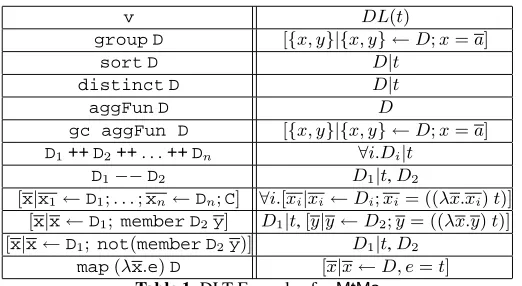
v=q, in whichvis the new schema construct created by the transformation andqis an SIQL query over the current schema constructs. We have developed a DLT formula for each type of SIQL query which, given tracing data inv, evaluates the lineage of this data from the extents of the schema constructs referenced inv=q. If these extents and the tracing data are both materialised, Table 1 gives the DLT formulae for tracing the affect-pool of a tuplet,DL(t). The DLT formulae for tracing the origin-pool are similar and we refer the reader to [10] for a discussion of the difference between the affect-pool and the origin-pool.
In Table 1,D|tdenotes all instances of the tuplet in the bagD (i.e. the result of the query[x|x ←D;x=t]). Since the results of queries of the formgroup Dand
gc f Dare a collection of pairs, in the DLT formulae for these two queries we assume that the tracing tupletis of the form{a, b}.
The DLT formulae in Table 1 either provide a derivation tracing query [8] specify-ing the lineage data oftor, in some cases, give the lineage data directly. If a formula returns a derivation tracing query, we need to evaluate the query to obtain the lineage data. If a formula returns the lineage data directly, no such evaluation is needed.
trans-formation pathways not all schema constructs created byaddtransformations will be materialised, and the above simple DLT approach is no longer applicable because it does not obtain lineage data from a virtual schema construct. In this paper, we propose a DLT approach that handles such general transformation pathways.
4.1 The Approach
One approach to solving the problem of virtual schema constructs would be to use Au-toMed’s Global Query Processor to evaluate the query creating the virtual construct and compute its extent, so that the above simple DLT approach could be applied. However, this approach is impractical due to the space and time overheads it incurs.
Instead, our approach is to use a data structure,Lineage, to denote lineage data from the extent of a schema construct. If the construct is materialised,Lineagecontains the actual lineage data. If the construct is virtual,Lineagecontains relevant information for deriving the lineage data. This information will be used by subsequent DLT steps to evaluate the final lineage data. EachLineageobject contains five attributes:(i)data, which is a collection of materialised lineage data or, if the lineage data is virtual, the value null;(ii)construct, which is the name of the schema construct whose extent contains the lineage data;(iii)isVirtual, stating if the lineage data is virtual or not;(iv)
elemStruct, describing the structure of the data in the extent of a virtual schema con-struct,e.g.a 2-item tuple{x1,x2}, or a 3-item tuple{x1,x2,x3};(v)constraint, expressing the constraint specifying the lineage data from a virtual schema construct.
For example, suppose lineage data in a schema construct D is derived from the query [{x, y}|{x, y} ← D;x = 5], and lpis a Lineageobject expressing the lineage data. IfD=[{1,2},{5,1},{5,2},{3,1}]is materialised, thenlpwill be:lp.data=
[{5,1},{5,2}];lp.construct= ”D”;lp.isVirtual=false;lp.elemStruct=null; and lp.constraint=null. On the other hand, ifDis a virtual schema construct, then
lpwill be:lp.data=null;lp.construct= ”D”;lp.isVirtual=true;lp.elemStruct= ”{x,y}”; andlp.constraint= ”x=5”.
We denote byO|dlaLineageobject in whichOis the name of the schema con-struct anddl is the data lineage. If the lineage data is materialised,dlwill be the data itself, otherwisedlwill be the form of(S, C), whereS denotes theelemStruct
andC theconstraint. For example, the above two Lineageobjects are denoted by
D|[{5,1},{5,2}]andD|({x,y},x=5), respectively.
4.2 The DLT Formulae
It is necessary that our DLT formulae can handle the following four cases: MtMs— both the tracing data and the source data are materialised;MtVs— the tracing data is materialised and the source data is virtual;VtMs— the tracing data is virtual and the source data is materialised; andVtVs— both the tracing data and the source data are virtual. The DLT formulae for the case ofMtMswere given in Table 1, and from these we have derived the DLT formulae for the other three cases:
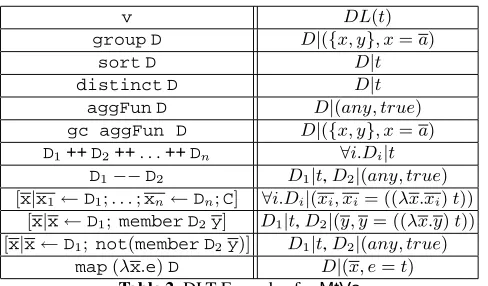
CaseMtVs. There were two kinds of DLT formulae in Table 1: tracing queries and
v DL(t)
group D D|({x, y}, x=a)
sort D D|t
distinct D D|t
aggFun D D|(any, true)
gc aggFun D D|({x, y}, x=a)
D1++D2++. . .++Dn ∀i.Di|t
D1−−D2 D1|t,D2|(any, true)
[x|x1←D1;. . .;xn←Dn;C] ∀i.Di|(xi, xi= ((λx.xi)t))
[x|x←D1;member D2y] D1|t,D2|(y, y= ((λx.y)t))
[x|x←D1; not(member D2y)] D1|t,D2|(any, true)
[image:10.612.188.432.63.206.2]map(λx.e)D D|(x, e=t)
Table 2. DLT Formulae forMtVs
queries. For example, the tracing query [{x, y}|{x, y} ← D;x = a] is expressed as
D|({x, y}, x=a). In the case of real lineage data, the lineage data might be the tracing data,t, itself or all the items in a source collectionD. If the lineage data ist, it is avail-able no matter whetherDis materialised or not. If the the lineage data is all items in a virtual collectionD, it is expressed byD|(any,true). Table 2 illustrates the DLT formulae for the case ofMtVs.
Case VtMs. Virtual tracing data can be created by virtual source data. In
particu-lar, there are three kinds of virtual lineage data created in Table 2: (any,true),
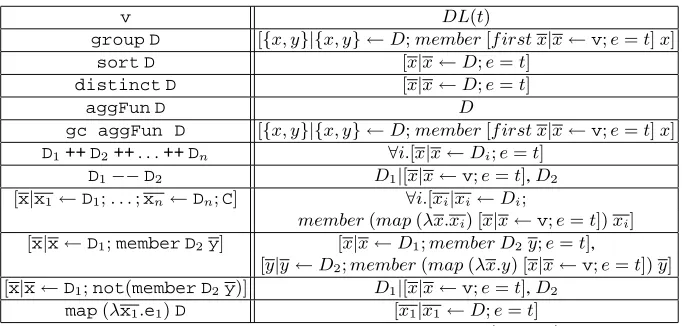
({x,y},x=a), and(x,e=t)3. The DLT formulae forVtMscan be derived by apply-ing these three kinds of virtual tracapply-ing data to the formulae given in Table 1. In this case, all source data is materialised, there is no virtual intermediate lineage data created.
For example, suppose the query isv=group D. If the virtual tracing tuple t is
(any,true), the lineage dataDL(t)is all data inD,i.e. DL(t) =D. Iftis({x,y},
x=a),DL(t)is all tuples inDwith first component equal toa, which is the result of the query[{x, y}|{x, y} ← D;x=a]. Iftis(x,e=t),DL(t)is all tuples inDwith first component equal to the first component of the tracing datat, which is the result of the query[{x, y}|{x, y} ←D;member[f irst x|x←v;e=t]]. We can see that the virtual view,v, is used in this query. Since the source data is materialised, we can easily recovervand evaluate the tracing query.
Table 3 gives the whole list of formulae for the case ofVtMswith virtual tracing data of the form(x,e=t). The formulae for the other two kinds of virtual tracing data can easily be derived.
CaseVtVs. The DLT formulae forVtVsare similar to the formulae forVtMsbut in this case the source data are unavailable. Thus, we useLineageobjects to store the virtual intermediate lineage data.
3
Note that in Table 2 the lineage data (xi, xi= ((λx.xi)t)) and (y, y= ((λx.y)t)) in
the 8th and 9th lines are not virtual. Since t is real data and variable tuple x contains all variables appearing in xi, the expression (λx.xi) t returns real data too. For
exam-ple, supposing x = {x1, x2, x3}, xi = {x1, x3}, and t = {1,2,3}, then(λx.xi)t =
v DL(t)
group D [{x, y}|{x, y} ←D;member[f irst x|x←v;e=t]x]
sort D [x|x←D;e=t]
distinct D [x|x←D;e=t]
aggFun D D
gc aggFun D [{x, y}|{x, y} ←D;member[f irst x|x←v;e=t]x]
D1++D2++. . .++Dn ∀i.[x|x←Di;e=t]
D1−−D2 D1|[x|x←v;e=t],D2
[x|x1←D1;. . .;xn←Dn;C] ∀i.[xi|xi←Di;
member(map(λx.xi) [x|x←v;e=t])xi]
[x|x←D1;member D2y] [x|x←D1;member D2y;e=t],
[y|y←D2;member(map(λx.y) [x|x←v;e=t])y]
[x|x←D1;not(member D2y)] D1|[x|x←v;e=t],D2
[image:11.612.138.479.63.226.2]map(λx1.e1)D [x1|x1←D;e=t]
Table 3. DLT Formulae forVtMswith tracing data(x, e=t)
For example, suppose the query isv=group D. If the virtual tracing tuple t is
(any,true), the virtual lineage dataDL(t)isD|(any,true). Iftis({x,y},x=a), the virtualDL(t)isD|({x,y},x=a). Iftis(x,e=t), the virtualDL(t)isD|({x,y},
member[first x|x← v;e=t]x). Note that, the virtual viewvis used in this vir-tual lineage data expression. However, since the source data Dis virtual, we cannot recovervby just evaluating the queryv=group D. In this case, AutoMed’s Global Query Processor can be used to materialisev. Oncevis materialised, the virtual trac-ing datatcan also be recovered and this situation reverts to the case ofMtVswhich we discussed earlier. Alternatively, the view definition ofvcan be propagated through the remaining DLT steps until the end of the process. So far we have only implemented the first approach and it remains to implement the second approach and investigate their trade-offs.
4.3 DLT for General Transformation Pathways
Having obtained the DLT formulae for above four cases, lineage data based on a sin-gle transformation step is obtained by applying the appropriate formula to the step’s query. Our DLT procedure for a single transformation step isDLT4AStep(td, ts)and its output is the lineage oftdints’s data sources i.e. a list ofLineageobjects which might contain either materialised or virtual lineage data. In our DLT algorithms for a general transformation pathway, there are two further procedures: tracing the lineage of a single tuple along a transformation pathway and tracing the lineage of a set of tuples along a transformation pathway. This is because the lineage of one Lineage
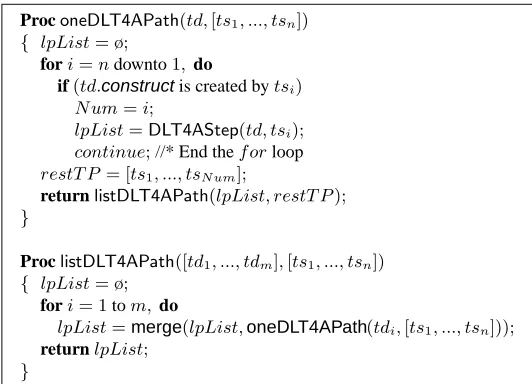
object based on a single transformation step might be a list ofLineage objects, if the transformation step has multiple data sources. Figure 1 gives the two procedures:
oneDLT4APath(td,[ts1, ..., tn]) traces the lineage of a single tracing tupletd along
a transformation pathway[ts1, ..., tn], andlistDLT4APath([td1, ..., tdm],[ts1, ..., tsn])
ProconeDLT4APath(td,[ts1, ..., tsn]) { lpList= ø;
fori=ndownto1,do
if(td.constructis created bytsi)
N um=i;
lpList=DLT4AStep(td, tsi);
continue;//* End thef orloop restT P= [ts1, ..., tsN um];
returnlistDLT4APath(lpList, restT P);
}
ProclistDLT4APath([td1, ..., tdm],[ts1, ..., tsn]) { lpList= ø;
fori= 1tom,do
lpList=merge(lpList,oneDLT4APath(tdi,[ts1, ..., tsn]));
returnlpList;
[image:12.612.174.440.64.256.2]}
Fig. 1. DLT Algorithms for a general transformation pathway
oneDLT4APathfirstly finds the transformation step,tsi, which creates the schema
construct containingtdand then calls the procedureDLT4AStepto obtain the lineage oftdbased on this transformation step.DLT4AStepreturns a list ofLineageobjects. After that, the procedureoneDLT4APathcalls the procedurelistDLT4APathto further trace the lineage of this list ofLineage objects along the rest of the transformation pathway (i.e. the steps prior to tsi). oneDLT4APathalso returns a list of Lineage
objects. listDLT4APath itself callsoneDLT4APathfor each item tdi in the tracing
data list to find the entire lineage of the whole list based on the transformation pathway. Themergefunction is used to avoid duplication of lineage data: A tuple,dl, might be in the lineage of two different tracing tuples,tdiandtdj(i6=j). Ifdland all its copies
in a source collection have already been added tolpListas the lineage oftdi, we do
not add them again intolpListas the lineage oftdj.
The complexity of the overall DLT process isO(n×m)wherenis the number of
addtransformations in the transformation pathway andmis the number of different schema constructs referenced in the pathway.
4.4 Example
v1 = [{’IS’,k1,k2,x}|{k1,k2,x}← hhIStab,Markii]
v2 = [{’MA’,k1,k2,x}|{k1,k2,x}← hhMAtab,Markii]
hhDetails,Markii =v1++v2
v3 =map(λ{k,k1,k2,x}.{{k,k1},x})hhDetails,Markii
v4 =gc avg v3
hhCourseSum,Avgii=map(λ{{x,y},z}.{x,y,z})v4
Traversing this transformation pathway in reverse, we obtaintd’s lineage data,dl, with respect to each view as follows:
td =hhCourseSum,Avgii|{’MA’,’MAC01’,81}
MtVs
=⇒v4|dl =v4|{{’MA’,’MAC01’},81}
MtVs
=⇒v3|dl =v3|({x,y},x={’MA’,’MAC01’})
VtVs
=⇒ hhDetails,Markii|dl=hhDetails,Markii|({k,k1,k2,x},{k=’MA’;k1=’MAC01’})
VtVs
=⇒v2|dl =v2|({k,k1,k2,x},{k=’MA’;k1=’MAC01’}),
v1|dl =v1|({k,k1,k2,x},{k=’MA’;k1=’MAC01’})
VtMs
=⇒ hhMAtab,Markii|dl=hhMAtab,Markii|({k1,k2,x},{’MA’=’MA’;k1=’MAC01’})
hhIStab,Markii|dl =hhIStab,Markii|({k1,k2,x},{’IS’=’MA’;k1=’MAC01’})
In conclusion, we can see that the lineage fromhhIStab,Markiiis empty and the lin-eage formhhMAtab,Markiiis obtained by evaluating the final tracing query[{k1,k2,x}| {k1,k2,x}← hhMAtab,Markii;’MA’=’MA’;k1=’MAC01’].
5
Concluding Remarks
AutoMed schema transformation pathways can be used to express data transformation and integration processes in heterogeneous data warehousing environments. This pa-per has discussed techniques for tracing data lineage along such pathways and thus addresses the general DLT problem for heterogeneous data warehouses.
We have developed a set of DLT formulae using virtual arguments to handle virtual intermediate schema constructs and virtual lineage data. Based on these formulae, our algorithms perform data lineage tracing along a general schema transformation path-way, in which eachaddtransformation step may create either a virtual or a materialised schema construct. The algorithms described in this paper have been implemented and tested over simple relational data source and integrated schemas. We are currently de-ploying them as part of a broader bioinformatics data warehousing project (BIOMAP). One of the advantages of AutoMed is that its schema transformation pathways can be readily evolved as the data warehouse evolves [12]. In this paper we have shown how to perform data lineage tracing along such evolvable pathways.
Although this paper has used IQL as the query language in which transformations are specified, our algorithms are not limited to one specific data model or query lan-guage, and could be applied to other query languages involving common algebraic operations on collections such as selection, projection, join, aggregation, union and difference.
integration framework based on sequences of primitive schema transformations. For example, [19, 20] present an approach for integrating heterogeneous XML documents using the AutoMed toolkit. A schema is automatically extracted for each XML docu-ment and transformation pathways are applied to these schemas. Reference [16] also discusses how AutoMed can be applied in peer-to-peer data integration settings. Thus, the DLT approach we have discussed in this paper is readily applicable in peer-to-peer and semi-structured data integration environments.
References
1. J. Albert. Algebraic properties of bag data types. In Proc. VLDB’91, pages 211–219. Morgan Kaufmann, 1991.
2. P. A. Bernstein and T. Bergstraesser. Meta-data support for data transformations using mi-crosoft repository. IEEE Data Engineering Bulletin, 22(1):9–14, 1999.
3. M. Boyd, S. Kittivoravitkul, and C. Lazanitis. AutoMed: A BAV data integration system for heterogeneous data sources. In Proc. CAiSE’04, LNCS. Springer-Verlag, 2004.
4. P. Buneman, S. Khanna, and W.C. Tan. Why and Where: A characterization of data prove-nance. In Proc. ICDT’01, volume 1973 of LNCS, pages 316–330. Springer, 2001.
5. P. Buneman et al. Comprehension syntax. SIGMOD Record, 23(1):87–96, 1994.
6. Y. Cui and J. Widom. Practical lineage tracing in data warehouses. In Proc. ICDE’00, pages 367–378. IEEE Computer Society, 2000.
7. Y. Cui and J. Widom. Lineage tracing for general data warehouse transformations. In Proc. VLDB’01, pages 471–480. Morgan Kaufmann, 2001.
8. Y. Cui, J. Widom, and J.L. Wiener. Tracing the lineage of view data in a warehousing environment. ACM Transactions on Database Systems (TODS), 25(2):179–227, 2000. 9. C. Faloutsos, H.V. Jagadish, and N.D. Sidiropoulos. Recovering information from summary
data. In Proc. VLDB’97, pages 36–45. Morgan Kaufmann, 1997.
10. H. Fan and A. Poulovassilis. Tracing data lineage using schema transformation pathways. In Knowledge Transformation for the Semantic Web, volume 95 of Frontiers in Artificial Intelligence and Applications, pages 64–79. IOS Press, 2003.
11. H. Fan and A. Poulovassilis. Using AutoMed metadata in data warehousing environments. In Proc. DOLAP’03, pages 86–93. ACM Press, 2003.
12. H. Fan and A. Poulovassilis. Schema evolution in data warehousing environments — a schema transformation-based approach. In Proc. ER’04, LNCS, pages 639–653, 2004. 13. H. Galhardas, D. Florescu, D. Shasha, E. Simon, and C.A. Saita. Improving data cleaning
quality using a data lineage facility. In Proc. DMDW’01, page 3, 2001.
14. E. Jasper, A. Poulovassilis, and L. Zamboulis. Processing IQL queries and migrating data in the AutoMed toolkit. Technical Report 20, Automed Project, 2003.
15. P. McBrien and A. Poulovassilis. A uniform approach to inter-model transformations. In Proc. CAiSE’99, volume 1626 of LNCS, pages 333–348. Springer, 1999.
16. P. McBrien and A. Poulovassilis. Defining peer-to-peer data integration using both as view rules. In Proc. DBISP2P, Berlin, Germany, September 7-8, LNCS. Springer, 2003.
17. A. Poulovassilis. A Tutorial on the IQL Query Language. Technical Report 28, Automed Project, 2004.
18. A. Woodruff and M. Stonebraker. Supporting fine-grained data lineage in a database visual-ization environment. In Proc. ACDE’97, pages 91–102. IEEE Computer Society, 1997. 19. L. Zamboulis. XML data integration by graph restrucring. In Proc. BNCOD’04, volume
3112 of LNCS, pages 57–71. Springer-Verlag, 2004.