Frosh, Stephen and Phoenix, A. and Pattman, R. (2003) Taking a stand:
using psychoanalysis to explore the positioning of subjects in discourse.
British Journal of Social Psychology 42 , pp. 39-53. ISSN 0144-6665.
Downloaded from:
Usage Guidelines:
Please refer to usage guidelines at
or alternatively
British Journal of Social Psychology (2003), 42, 39–53 ©2003 The British Psychological Society
www.bps.org.uk
Taking a stand: Using psychoanalysis to explore
the positioning of subjects in discourse
Stephen Frosh
1*, Ann Phoenix
2and Rob Pattman
31
School of Psychology, Birkbeck College, University of London, UK
2Faculty of Social Sciences, The Open University, Milton Keynes, UK
3Faculty of Education, The Open University, Milton Keynes, UK
This paper is concerned with thinking through the cultural construction of personal identities whilst avoiding the classical social–individual division. Our starting point is the notion that there is no such thing as ‘the individual’, standing outside the social; however, there is an arena of personal subjectivity, even though this does not exist other than as already inscribed in the sociocultural domain. Our argument is that there are psychoanalytic concepts which can be helpful in exploring this ‘inscription’ and thus in explaining the trajectory of individual subjects; that is, their speci c positioning in discourse. The argument is illustrated by data from a qualitative study of young masculinities, exploring the ways in which some individual boys take up positions in various degrees of opposition to the dominant ideology of ‘hegemonic’ masculinity.
This paper is concerned with thinking through the cultural construction of personal identities whilst avoiding the classical social–individual division. Our starting point is the notion that there is no such thing as ‘the individual’, standing outside the social; however, thereis an arena of personal subjectivity, even though this does not exist other than as already inscribed in the sociocultural domain. Our argument is that there are psychoanalytic concepts which can be helpful in exploring this ‘inscription’ and thus in explaining the trajectory of individual subjects; that is, their specific positioning in discourse. This addresses a gap in the explanatory power of much discursive social psychology (e.g. Edley & Wetherell, 1997), between giving an account of the dis-courses within which subjects are positioned, and being able to offer plausible reasons why specific individuals end up where they do. This paper should thus be seen as a contribution to a continuing and constructive debate about the relationship between discursive psychology and what Wetherell (2001) refers to as ‘cultural psychoanalysis’ (see also Billig, 1999; Frosh, 2001).
One significant contribution of discourse analysis to psychology is its portrait of the way social constructs ‘fix’ the range of identity positions available to people, usually as a set of historically constituted discourses amongst which each person has to locate
her- or himself. However, less light has been thrown on the question of what it is that produces the specific ‘choice’ of location a particular individual makes amongst the available identity positions. Given that, for example, it is possible to be ‘macho’ or ‘new man’ (as in Edley & Wetherell, 1997), why does a particular male individual become located as the latter and not the former? Many discourse analysts do not attempt to address this question, but rather are content to describe the accounting procedures whereby the task of positioning is achieved by participants, a ‘how’ rather than a ‘why’ approach. On the whole, it is difficult to find examples within the discourse analytic literature of systematic efforts to account for the adoption of particu-lar identity positions by specific actors, a gap which in recent years has started to encourage an (often critical) encounter with psychoanalysis (e.g. Billig, 1999).
When discourse theorists have turned to psychoanalysis, it is commonly to Lacanian theory (e.g. Parker, 2001), with good reason. This is because Lacanianism has launched a relentless onslaught on the integrity of the ego, and with it claims for the essential autonomy of the ‘self’. In Lacan’s (1949) famous account of the mirror stage, for instance, the mother does not mirror the child’s actuality back to her or him, thus aiding the development of the true self, as Winnicott suggests, nor does she act primarily as a receptacle for the child’s projected drives, as Klein proposes. Rather, Lacan’s use of the ‘mirror’ term describes a specious representation of integrity, in which the mother presentsher ownvision to her infant. The child’s perception of her or his ‘specular image’ produces the fiction that she or he is whole and has a clearly ascertainable identity, when what is happening is really that the child is identifying with a vision that comes from elsewhere, from outside. Thus, rather than being the source from which communications flow, the ego is created only in relation to some-thing outside itself, coming into being as an ‘imaginary capture’, a moment of mistaken self-identification that is the beginning of a permanent tendency whereby the subject seeks imaginary wholeness to paper over conflict, lack and absence.
One of the many intriguing features of the Lacanian system, which it shares with discourse theory, is the ambiguity of its account of the social or cultural, which is seen as both regulatory and productive or constitutive of subjectivity. This can be seen in the mirroring moment in which the external form—the mother’s desire, for example—is given as a kind of ‘exoskeleton’, imprisoning the infantile psyche but also holding it together, producing joyous relief in the subject as she or he struggles with infantile anguish. The ambiguity of the social can also be seen in what Lacanians refer to as the accession to the Symbolic, the domain of language and culture, in that the subject is inserted into an order which lies beyond (pre-dating and post-dating) her or him, and that constrains what can be said and done. Thus, Laplanche and Pontalis (1973, p. 286), drawing on the Lacanian vision, portray the Oedipus complex as a meeting between ‘the child, the child’s natural object and the bearer of the law’, in which language has alimitingfunction. But it is also productive (indeed, this is a major marker of difference between the Symbolic order and the Imaginary in Lacanian theory), in that the Symbolic allows human subjectivity to form, creating the con-ditions for communication and hence for some kind of deeper recognition of subject-hood. Without this movement, there is not only narcissism but the risk of full-blown psychosis creeping upon the individual who renounces the Symbolic, who ‘forecloses’ the word of the father (Lacan, 1955/6, p. 215). Taking on the yoke of culture is thus a necessary condition of subjecthood.
the way these forces operate in the individual’s experience. In this theory, the subject is structured in and by discursive relations which are institutionalized in culture and manifested in linguistic practice, and through this are productive of human conscious-ness. However, the Lacanian version of things is not by any means the only, or necessarily the clearest, psychoanalytic approach offering leverage on the encultur-ation of what seems most personal—the inner life of each apparently separate individ-ual. Object relations theory offers a more grounded approach stressing the other-orientation of the infant from the start; in its Kleinian variant, this is manifested as an interest in the ‘containing’ function of the other (mother, analyst) in the face of the destructive urges arising out of the infant/patient (see Frosh, 1999). In contemporary intersubjectivist theory (e.g. Benjamin, 1998), which intersects both with object relations thinking and with the American psychoanalytic tradition, the stress is on recognition and identification; that is, subjecthood is formed through aligning oneself with the loved other and receiving back from that other an acknowledgement of one’s own separate existence as a subject. The space created here for human agency is quite different from what emerges from Lacanian theory, emphasizing the active nature of a self which is constructed on the basis of unconscious identifications (‘intersubjective’ refers to the intermixing of subjectivities, not just observation of ‘interpersonal’ inter-actions), and hence is not pre-given and essentialist, but which nevertheless can become a more integrated entity, defending itself against threats to its continuing existence. Restoring agency or, in Benjamin’s intersubjectivist terms, ‘authorship’ to the subject enables us to ask questions about why and how specific formations of subjecthood come about; that is, what purposes they serve, what anxieties are actively being defended against, what aspirations fulfilled.
Perhaps the most focused attempt to carry out social psychological discourse analy-sis whilst employing a psychoanalytic framework has come from within this general tradition in the influential work of Wendy Hollway (1989; Hollway and Jefferson, 2000). Hollway makes use of a Kleinian perspective to provide biographical indices marking the development of individuals’ subject positions, theorizing this with the notion of a ‘defended subject’—an idea consistent with intersubjectivist as well as object relational perspectives. This helps to provide a plausible narrative of why specific participants become embroiled in particular sorts of patterns of anxiety, pro-ducing their individualized cocktail of beliefs, behaviours and accounting practices abstracted from those available in the cultural pool. One thing which is revealed by this work is the potential richness of the results when the close attention to detail and the sophisticated social theory that characterizes discursive psychology are combined with the attention to individual biography and emotional subtexts, which is psycho-analysis’ own terrain (see Frosh, Phoenix, & Pattman, 2000, for an elaboration of this argument). It is a combination of this kind, between a rigorous awareness of the constructing activity of social processes and an equally potent analysis of the agentic struggles of individual subjects, that is needed in order to be able to explore how specific subject positions come to be held.
psychoanalysis at all in this context is to risk losing the great contribution that dis-cursive psychology has made in emphasizing the ‘performative’ nature of language in constructing identities, because much psychoanalysis lays stress on the irreducibility of the unconscious, as referred to by the Kleinians as an ‘inner world’ (e.g. Rustin, 1991). In this respect, Lacanianism looks like a more promising route forward, through its emphasis on representation and, most importantly, its argument that the unconscious is itself aneffect of language, and that ‘It is the world of words that creates the world of things’ (Lacan, 1953, p. 65). However, it is precisely the place of the subject as agent which is so much in need of theorizing in discursive psychology, and which is addressed very compellingly by intersubjectivist and object relational theory. Our route through this mire is to argue that in the accounts which individuals give of their lived experiences, one can see at work both the powerful effects of social discourses and the agentic struggles of particular subjects as they locate themselves in relation to these discourses—and that the unconscious is both generated by this struggle and generative of its consequences. There is a considerable amount of intersubjectivist, even Kleinian, influence on our work here, but we are also in the tradition of certain strands of post-Lacanian thought, notably that personified by Judith Butler, who among other things provides us with a way into the shadowy domain of the non-discursive when she comments (1997a, p. 97), ‘Identity can never be fully totalized by the symbolic, for what it fails to order will emerge within the imaginary as a disorder, a site where identity is contested’.
In summary, our argument is that the psychological applicability of discourse analy-sis will be advanced if we can gain clues to what structures discourse at the level of the ‘personal’. While culture makes available the subject positions we can inhabit, the ‘investment’ that people have in these subject positions is not necessarily captured by the articulation of the discourses themselves; rather, it may hinge on unspoken and at times unspeakable events, experiences and processes, all of them ‘cultural’, but also deeply embedded in subjectivity. It is here, very specifically, that psychoanalysis might have something significant to say.
Method
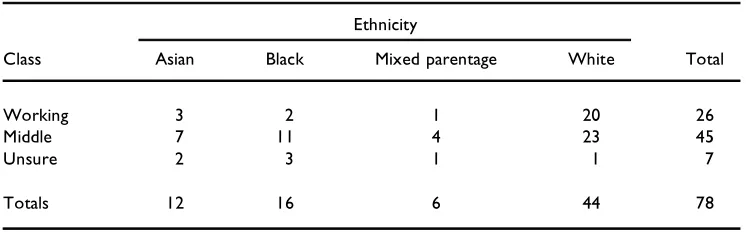
The boys described below participated in an interview-based study of 11–14-year-old boys in London schools in the late 1990s. The 12 schools in the study comprised four in the private (‘independent’) and eight in the state education sector, four of which were boys’ schools and eight coeducational. We conducted 45 group interviews on the topic of ‘growing up as a man’ with groups usually of 4–6 young people (range 4–8). Thirty of these group interviews were with boys in single-sex groups, and nine inter-views were with mixed groups of boys and girls. Seventy-eight volunteers from the boys who had taken part in the groups were selected for individual interviews; their broad background ethnic and social class characteristics are given in Table 1. The design of the study was for a follow-up to the individual interview approximately 2 weeks after the first interview, and 71 boys were given a second interview. (In seven cases, boys were either away from school when we returned or had been suspended.) The individual interviews were ‘interviewee centred’, with the interviewer taking a facilitative role, picking up on issues the interviewees raised and encouraging them to develop and reflect upon these and to provide illustrative narrative accounts. These interviews were conducted in a ‘clinical style’ (see Hollway & Jefferson, 2000) to address issues of self-definition as male/masculine, identificatory models, relationships with boys and with girls, intimacy and friendship, attitude towards social and media representations of masculinity, and so on. The second interview explored repetitions, contradictions and gaps in the material from the first interview, allowed more focused investigation of specific points relating to the research questions and offered the respondent the opportunity to reflect and comment on the process of the interview itself. The interviewer in all cases was the third author (Rob Pattman), a white man in his early 40s. All the interviews took place in school rooms allocated for the purpose by the teaching staff and lasted about an hour.
[image:6.423.27.400.78.194.2]Interviews were all transcribed and are subject to a continuing process of thematic and narrative analysis, described fully elsewhere (Froshet al., 2002). In relation to the material presented in this paper, we have drawn on two main analytic strategies. These are, first, narrative analysis of the material from some individual boys, selected to identify what Bruner (1990) calls ‘canonical narratives’ (which are general stories about how lives may be lived in the culture, serving to justify certain behaviours) as well as personal narratives; and second, the summary notes written up by the inter-viewer after each interview, recording impressions of the process of the interview (for example, whether it was ‘easy’ or ‘difficult’, whether there were surprising aspects to it, and so on).
Table 1.Characteristics of boys interviewed individually by ethnicity and social class
Class
Ethnicity
Total
Asian Black Mixed parentage White
Working 3 2 1 20 26
Middle 7 11 4 23 45
Unsure 2 3 1 1 7
Positioning and policing: Three case examples of young masculinities
Being with girls and transgressing gender boundaries
One very powerful focus for the exploration of masculine identities in our London sample was football, which is a particularly good example of how behavioural noncon-formity amongst boys could become constructed not just as gender nonconnoncon-formity, but as something pathological in gender terms—something girlish. Only one boy in our sample, Oliver (a white 12-year-old), reported choosing to go around with girls rather than play football; according to his own account, this made his gender identity position quite problematic. His narrative was that this choice was based on his own superior
knowledge of what was, and what was not, worth doing—with football being very much in the latter category. Oliver constructed an account of boys, in general, as lacking in sense because of their obsession with football; his choice to go with the girls was therefore, in his version of things, not because of any inadequacy on his part, but because he was one of the few boys who could do what was necessary to be successful at school and, by implication, in life. Thus, when asked how other boys saw him as different, he focused specifically on football, forging a positive identity for himself as a boy who was not obsessed by it and, as a result, was liked by teachers as well as by girls. (Names of all participants have been changed. See Appendix for transcription conventions.)
Extract 1
Oliver: I don’t play football . . . I hate football. What’s the point (.) of eleven men running up and down a bit a grass, kickin’ a ball? (.) There’s no point a that. An’ (.) everyone teases, everyone goes ‘Oh, you can’t play football’ an’ that, when I’m talkin’ about interesting stuV
with the girls. An’ goin’ I.T. Club wiv my friends (.) an’ that. (1) And, (5) boys just, (1) ah, what can I say? (2) Boys (2) are just, (.) ah, what is it? (2) Idle. Boys are just too idle.
For Oliver, football was an obsession with trivia, which made boys unable to concen-trate in class or to develop friendships with girls. He was also convinced that his girl friends would be shocked if he started showing an interest in football; this conviction enabled him to construct himself as better than other boys in the eyes of girls.
Extract 2
Oliver: If (1) I go up to a girl now and go, (.) ‘Did you watch the Man United game last night, or the Arsenal?’ They go, ‘Oliver!’ [shocked tone] (.) and walk oV. And they won’t speak to me for the rest of the year.
The price Oliver reported paying for this set of attitudes and behaviours was high. He told us that he was bullied in the school and outside it (for example, on the bus) and was generally taunted by other boys, who called him ‘girl’, suggesting that he was seen as transgressing normal gender boundaries.
Extract 3
Oliver: All the girls around the girls’ area (.) treat me like if I am a girl. But the boys, nah, they don’t treat me like if I’m a boy, they treat me exactly as how I’m a girl. Goin’ around pushin’ (.) makin’ sexist comments an’ that.
Int: They make sexist comments to you?
Int: How d’you feel about that?
Oliver: It (3) it really (1) irritates me, ’cos (.) I’m a boy like any other boy . . . It feels really rotten to be called a girl.
Oliver enjoyed being treated as one of their own by the girls, but he assuredly did not like being teased and devalued through being called ‘girl’ by the boys. Moreover, he implied that these two identities as ‘girl’ were mutually reinforcing: Being teased and called ‘girl’ by other boys reinforced his estrangement from them and his investment in being singled out as a friend by girls. He spoke, for example, about how the girls supported him when he mentioned being teased, by making him special and one of them: Mimicking them, he said,‘Don’t worry, Oliver . . . as far as we’re concerned (.) you’re one of us. And the boys can go an’ mmn themself.’
Part of the constraint placed on Oliver by his self-claimed voluntary exile from hegemonic masculinity was around sexuality. Identifying with girls also meant for Oliver not relating to them sexually, and indeed differentiating himself from boys who did so. He was critical of other boys for whistling when girls who wore mini-skirts bent over and showed their knickers, for not appreciating what he idealized as the ‘inner beauty’ of girls and ‘taking the mickey’ out of him for liking ‘ugly’ girls. He mentioned acting as a mediator, asking girls out for other boys, yet when questioned about whether he would ask girls out for himself, he seemed surprised, and said, ‘They’d think that I was joking’, and ‘just doesn’t feel right’. Unlike other boys whom he described as ‘flash’, he declared that he wore clothes for functional reasons and defined himself with great relish as the most popular with girls, precisely for not focusing on his looks.
Extract 4
Oliver: Last time I went round the girls’ area one of my friends was talking [high voice] ‘Look how the boys wear perfect trousers, perfect shoes. Why can’t they all dress like Oliver for he’s the smartest? Baggy trousers for more room and to get some air in there.’
It may be that there was an element of teasing here which Oliver did not recognize; it also seems clear that Oliver was allowed to be ‘one of the girls’ only under the strict condition that he did not introduce boys’ culture, whether through football or sexual display. In other parts of his interview, Oliver rebukes the provocativeness of the ‘mini-skirted’ (i.e. sexually flirtatious) girls and their male admirers, and tells an elaborate and possibly fanciful story of a romantic relationship with one particular girlfriend. Interestingly, this story centres around the purchase of condoms: For weeks, he has asked her if he should get some and she says ‘not yet’; when she finally allows him to do so (‘Go on, then, Oliver, I know it’s burning a hole in your pocket, but you can go and buy a pack’), she then won’t allow him to use them.
Extract 5
Oliver: So I buy a pack and (.) don’t get up to anything. She goes, ‘Now keep them for when you’re ready.’
Int: Oh, I see, yeah. Yeah. Oliver: So I’m well prepared.
Oliver’s account of himself as a young man expresses a variety of ‘counter-hegemonic’ tendencies including disapproval of boys’ obsession with football, idealiz-ation of some girls, and distancing himself from sexual flirtatiousness. In the process, he makes it clear that he is often unhappy amongst his peers, especially when he is teased and bullied. Our interpretation of this is that Oliver’s assumption of the position of ‘non-macho boy’ is a fraught one, in which the discursive work he undertakes throughout the interview is oriented towards creating a story of his superiority over the boys (and some girls) who bully and tease him, while under-pinning it is a very strong sense of loss and exclusion. What seems to happen here is that there is a strong and mutually reinforcing association between his opposition to the classical ‘hegemonic’ forms of masculinity that hold sway in our sample and a flight from any expression of sexual interest and desire, whether hetero- or homo-sexual in orientation. Despite his attestations about his special status with the girls and the enjoyment he derived from this, Oliver’s story suggests that he was tolerated rather than welcomed, and that his superior airs were the product of considerable uncertainty about where he might belong. Relating to these girls as potential girl-friends was experienced by him as incompatible with remaining friendly with them. The implication, for Oliver at least, is that gender relations are eroticized by emphasizing gender difference; ‘crossing over’ can only be achieved at the expense of sexuality.
Our suggestion here is that Oliver’s attempts to construct himself as outside the policed boundaries of normative masculinity carry with them an emotional charge which implies anxiety over sexual contact, which is nevertheless very much on his mind. Psychodynamically, it appears that the intensity of Oliver’s struggle to present himself as a different kind of boy from the ‘macho’ ideal is fuelled not so much by a repudiation of this ideal (indeed, in thegroupinterview in which he took part, he was deeply engaged in stereotypically boyish discussions, so much so that another boy complained about his ‘silliness’), as by anxiety over whether he can manage the demands he imagines it places on him, particularly in the sexual domain. One possi-bility is that this anxiety drives his resistance to hegemonic masculinity, carrying certain costs (of bullying and exclusion) but also relieving him of the burden of negotiating his sexuality. We do not know exactly why Oliver should take up this position, and we are certainly not endorsing the idea that all attempts to resist the coercions of normative social structures have neurotic origins. However, what we are suggesting is that Oliver’s specific and personal location in this cultural assemblage, as represented by his conversation with our interviewer, can perhaps be understood as produced not as a kind of counter-hegemonic conscious ‘choice’, but as an attempt to use the available discursive possibilities to deal with a set of powerful unconscious conflicts.
The viewpoints of a boy mocked as gay
Extract 6
Alan: To your mates, you can’t exactly say, erm, ‘I’m gettin’ my hair cut—do you reckon a French crop would look good?’ Your mates would probably say it was gay, yeah and you call me gay for the rest of your life. But a girl, they say, ‘Yeah, it would look good, but Curtains would look better’. Girls are more open to you, but keep it to theirselves in their group, without blurting it out.
Because girls were not homophobic, not only were they more ‘open’ in the way he illustrated, but also, he said, ‘You can talk to them about being called gay’. He mentioned that this was ‘a big issue in this school’, and said that he was called gay ‘all the time’ because he and another boy, with whom he was close, were constructed as soft, ‘sad’ and quiet. This was explicitly constructed by Alan as a form of bullying.
Extract 7
Int: Why do you get called gay?
Alan: ’Cos me and my friend, we joke a lot. Me and my best friend, he’s Asian. We talk to each over and most of the time we laugh at each other as well, ’cos he says a joke and you can drag it on and on and keep laughin’ and you’re sittin’ there tryin’ not to laugh ’cos the teacher’s talkin’ to you and you might start ‘ha, ha, ha!’ deliberately to try and get him into trouble and you’re like tryin’ to shut up and then they goes, ‘Look at ’em two gays, laughin’ at each other’s sad jokes.’
Int: But don’t boys—don’t boys quite often laugh at each other, without being called gay? Alan: Erm, it depends who you are, ’cos I’m usually, well, I’m a quiet boy, yeah, compared to
the bullies, where a bully who laughs at another bully can’t go up to them and say, ‘You’re gay’.
Int: Oh I see, yeah.
Alan: ’Cos they’d punch your head in.
In the second interview, Alan elaborated on the sorts of things which boys did which caused other boys to call them gay—things which he presented as ordinary and fun and as having ‘nothing wrong’ with them, like having a shower after sport.
Extract 8
Alan: If I was to have a shower, like in P.E., now, me and my friends, and say another—the other half of the changin’ room come in and say, ‘Ooh, look at ’em lot, gays in the shower, havin’ a shower together’ an all of that . . . It hurts, ’cos you jus’ havin’ a good time an you’re not. It’s not gay and there’s nothin’ wrong with it—you’re jus’ showerin’ .
Perhaps prompted by the fact that he was talking openly to an adult male about naked boys in changing rooms, Alan reflected on how some boys might imagine ‘something was happening between us’.
Extract 9
Alan: I mean, some of my friends—well, not my friends, some people are outside and they was in ’ere, they’d say somethin’ was happenin’ between us.
Int: Oh, would they?
Alan: Yeah. They think it’s strange two men in a room or even two men and a child in a room alone together on their own, so it’s stupid, ridiculous.
assured the interviewer they were not serious, they were ‘just messing’. For Alan, however, the suspicions of other boys which could be provoked simply by seeing a man interviewing a boy in a room were not to be dismissed as just messing around but highlighted how ‘stupid’, ‘ridiculous’ and obsessive was boys’ labelling of other boys and men as gay. Part of what is going on here might be that Alan is unsure of how to manage or perhaps consciously acknowledge homosexual impulses, leading him both to be particularly alert to the sexual charge in situations of male intimacy (showers, being alone in the interview room) and to reject very assertively the intimations of homosexuality as ‘stupid’. However, the sexualization of these situations was by no means uncommon amongst the boys, as the example of banging on the windows shows, so Alan’s uncertainties seem likely to be shared by many other boys as well.
What might be more specific in Alan’s account is an attempt to construct himself into a position opposed to that of the hegemonic ideal, which he sees enacted all around him in the behaviour of his peers, as well as in the labelling of him as gay because of his closeness to some other boys. One possible source for this attempt to differentiate himself from this mode of masculinity was that Alan had the worst relationship with his father of any of the boys in our sample, countered slightly by an idealized link with his mother but nevertheless full of bitterness, antagonism and deep depression.
Extract 10
Alan: It hurts . . . to know that (.) really, I don’t think I’ve got a dad. Int: Mmm
Alan: I know it sounds cruel, but to me, all a dad is, to make me (.) and put food on our plate. I mean (.) that’s all a dad seems to me.
Int: Mmm
Alan: I mean I know you’re meant to love your dad, but (.) [quietly] I haven’t found a reason to love my dad.
Alan’s story is full of despair at the general nastiness of his father in his attitude towards himself and the other members of the family, as well as a painful disappointment in him. Importantly, however, Alan somehow manages to hold on to a sense that it is possible to be different; that is, that masculinity does not have to be defined by the abusiveness with which he himself is faced.
Extract 11
Alan: He moans at us an’ I roll my eyes and turn my head, cos I don’ wanna hear it, and then he goes, ‘Yeah, you roll your eyes,’ an’ all of this, ‘act hard an’ be a man for once’. I am growin’ up an I’m gonna be a man an’ I’m gonna be a good man.
in the interviews ‘’Cos you seem so nice and you’re kind of what I would like to be, you’re a nice man’. What might be understood here is that Alan’s bitter experiences with his own father and the intensity of his protective bond with his mother have led him to a state of inner turmoil about what it means to be ‘a man’ at all. Trying to find an alternative to the damaging hardness he has encountered, he identifies with, and seeks recognition from, anyone who responds to him with sensitivity. In the cultural context of hegemonic masculinity, this places him in the terrain of homosexuality and makes him vulnerable to homophobic abuse; his self-location as ‘different’ then feeds back into a critical stance with respect to the hegemonic ideal. At the end of this, Alan is not happy, but he is at least starting to articulate a way of ‘doing boy’ which is at odds with the harshness of the masculinities that he finds around him. This is strategically de-ployed both in his encounters with peers and in his discussions with our interviewer; its ‘energy’ comes from a deeply felt wish to take his troubled personal experience and make of it something which Kleinians might call ‘reparative’ and which of necessity involves becoming positioned in a counter-hegemonic discourse.
Hardness and homophobia
The final example we want to bring here is of John, a tall, white 13-year-old who presented himself as a tough and violent person caught up in a rough and dangerous male culture, with numerous examples of fights, including some involving weapons, and involvement in racial abuse. He enjoys violence on television and sees his violence as something inherent to him, not within his control (‘It’s like smoking or drinking coffee—you want to stop but you can’t’). His description of his relationship with other boys is in terms of hardness and aggression; ‘reputation’ is important, and tenderness with boys is automatically connected with homosexuality. Yet, construct-ing rigid boundaries between boys and girls, he also idealized girls as friendly and emotionally supportive. He said,
Extract 12
John: I prefer speaking to girls about my problems than I do to boys, especially to older women.
This view was echoed by a number of boys we interviewed individually who said that they would not tell adult males about problems to do with girlfriends, bullying and work because of being seen as ‘wimpish’ or because their fathers would joke about it. John mentioned being able to speak to his mother, and not his father, about ‘problems at school’ and ‘puberty’, and he also contrasted the sympathy girls showed when he spoke about his anxieties with what he imagined would be the jokey and insensitive responses of boys, should he divulge these feelings to them. Though John expressed dissatisfaction with boys and men for being teasing, unsympathetic and unsupportive, he seemed to preclude the possibility of having ‘soft’, ‘serious’ and ‘tender’ relations with them by constructing these types of relations as gay unless they were directed towards girls.
Extract 13
John: Sometimes when I’m feeling down an’ that I don’t really wanna see (1) boys. Could just see the girl’s face or something like that.
Int: Right. D’you want to elaborate on that, why, why’s that?
Some of the tensions and possible contradictions in John’s ‘hardness’ came to the fore when the interviewer asked him what would happen if a boy, rather than a girl, was ‘quite tender and comforting towards you’.
Extract 14
John: He’d be pushed aside.
Int: By you? Would you push him aside?
John: Well, depends if (2) depends if the boys would push him away rst or if I don’t get to hear him he might just be bugging me or something so I just push him to the side and then I feel sorry for them because they’re trying to help me and then I don’t, then I get angry and I’ll lose my temper.
John makes it clear that he would not be able to bear a tender and comforting approach from another boy; not only would it run generally counter to masculine culture (‘depends if the boys would push him away first’), but he would interpret it as ‘bugging’ him. He also says he will ‘get angry’ and lose his temper, but what is unclear is whether the anger is the reason for pushing the hypothetical tender boy away, or whether (as the text seems to imply) it is anger with himself: ‘then I feel sorry for them because they’re trying to help me’. That is, one reading of John’s account is that he is implying a causal link between pushing away other boys when they show signs of concern and getting angry himself, as if he knows he has missed an opportunity.
This reading of the loss involved for John in maintaining his tough self-presentation is supported by the way he offered much thoughtful material about the difficulties of making emotional contact with boys, and described how he had a male best friend in whom he could cautiously confide, reasonably safe in the knowledge that he would not be made fun of. His difficulty is that his wish for closer and more intimate male contacts of this kind is at odds with a very strong fear of being labelled ‘gay’. Given the strength of his own explicit homophobia (‘I mean that’s just grown on me and I just can’t stand gay people’) this is a particular worry for him, fuelling his dislike of overly close contact with other boys. Thus he arrives at a position in which he is continuously demonstrating hardness, but has some awareness of the price that he is paying for this.
Extract 15
John: So people try to help me and then I just push them aside and then they don’t come back. So I feel sorry for them and I feel sorry for myself.
Despite the emphasis on hardness, there are indications of a ‘softer’ side to John both in some of the things he said and in his relationship with the interviewer. For instance, there is a partial contrast between John’s aggressiveness and the way he muses on the absence of his father (who has left the family home), expressing anger but also evoking a strong sense of loss.
Extract 16
John: But then now, he’s, he’s like stopped ringing an’ he’s, he’s got his other family now I think he’s just.(1) I don’t think he just wants to see me any more.
This passage comes from early in the interview, before John can have a realistic sense of what the interviewer is like. Perhaps revealing a strong wish to be able to confide in an adult man, John seems quickly to trust him and to be willing not just to talk openly to him but to use him as a kind of sounding board for some of his own thinking. He is also able to elicit genuine warmth in the interviewer, who despite being appalled by John’s violence ends up liking him and finding it hard to say goodbye. Indeed, the interviewer’s account of John positions him as a serious boy who used the interview thoughtfully to describe and perhaps explore his position on a wide range of topics. That John tells him that he ‘would be available at any time’ if required for more interviews suggests that an exchange is occurring in which the interviewer is emotion-ally touched by John; the boy picks this up and responds to it but turns it around so that he is able to appear in control rather than dependent.
This is once again speculative, not available to the kind of careful testing out of interpretations which is the hallmark of a psychoanalytic exchange. Nevertheless, it is not implausible to say that John’s vulnerability and sense of rejection by his father are translated into a very keenly felt need to maintain a ‘hard’, virile masculinity premised on the rejection of anything that holds the slightest taint of effeminacy and the homosexuality associated with it. John’s discursive work is absolutely hegemonic; what is available to him—hardness, homophobia, racism—is welcomed as a prop to a psychic structure always in danger of collapsing. But, alongside this, both the discur-sive record from John himself and the response of the interviewer to him indicate that there is a price that he has to pay, in a way the reverse price to that attached to Oliver’s position. In every move he makes, there is some regret, because hegemonic masculin-ity of this kind is premised on the occlusion of the alternative possibilities: softness, supportive contact with boys, a dependent acknowledgement of the pain of his father’s rejection. The interviewer feels drawn to this tough, ungiving boy because underneath the toughness there is an appeal for something else: a homosocial contact marked by emotional concern. Perhaps more than either of the other examples, this one seems to attest to the power of Judith Butler’s (1997b) assertion that ‘crafting a sexual position . . . always involves becoming haunted by what’s excluded. And the more rigid the position the greater the ghost, and the more threatening it is in some way’ (p. 237). The homophobic performances of boys like John may thus be understood as ways of shoring up their masculinities by constructing the feminine other as an ever-present threat.
Conclusion
The material we have quoted, selected from a more detailed account of the policing of boys’ sexualities (Froshet al., 2002), shows quite clearly the operations of some very coercive discourses of masculinity in the generation of these London boys’ identities. The three boys we have described give indications in different ways of the construc-tion of ‘compulsory heterosexuality’ (Butler, 1990) and its links with gender identity; what can also be observed, albeit less clearly, is the sense of loss associated, even in some of the toughest boys, with this harsh set of subject positions.
performances through which boys give substance to masculinity as well as construct-ing themselves as masculine. That is, boys’ homophobia is seen as a set of activities through which they publicly and repetitively assert their ‘normal’ masculinity through heterosexuality. Concomitantly, because of its status as ‘not masculine’, homosexuality is associated with femininity, and the construction of masculinity is partially under-pinned by projecting this ‘femininity’ onto particular boys who are singled out as gay or not sufficiently masculine. Nayak and Kehily suggest that the compulsive and repetitive way in which boys assert their masculinities through homophobia implies just how fragile and precarious these identities are, something seen clearly in the material from John in particular. We have been arguing something more general, however, through this paper. This is that the analysis of discourse can give us consider-able insight into the kinds of resources availconsider-able in a culture for constructing identity positions, and indeed can reveal which of these are dominant, and which subordinate. This is consistent with those strands of psychoanalytic thinking, such as the Lacanian, which emphasize the external construction of the ego: What makes an ‘identity’ is what is mirrored to it. But there is an additional move required if one wants to understand the specificity of each subject’s personal investment in these discursive positions, a move which goes ‘beyond’ or ‘beneath’ discourse to explore the needs which are being met, the ‘enjoyment’ created, by the position which is taken up. This move ‘beyond’ has to be made respectfully and cautiously, to be sure: There is no certainty of interpretation, not even of the somewhat shaky kind made possible in psychoanalysis by examining the response of the analysis and to the analyst’s interven-tions. There is also the danger of a kind of voluntarism in which it is implied that people can actively and easily choose which of the available positions to align them-selves with. It is not like that: Subject positions are coercive and complex, as each of our research participants shows. Nevertheless, what is revealed by psychoanalytic explorations of the ‘unsaid’ but partly known inside each subject is that there may be important reasons why each one of us ends up where we are, and these reasons are the legitimate target of psychological enquiry.
Acknowledgements
The authors would like to thank Professor Ian Parker, Dr Peter Redman and Dr Karen Henwood for helpful comments on an earlier version of this paper. The study described in the second part of the paper was funded by the British Economic and Social Research Council, grant number L129251015.
References
Benjamin, J. (1998). Shadow of the other: Intersubjectivity and gender in psychoanalysis. New York: Routledge.
Billig, M. (1999).Freudian repression: Conversation creating the unconscious. London: Sage. Bruner, J. (1990).Acts of meaning.Cambridge, MA: Harvard University Press.
Butler, J. (1990).Gender trouble. London: Routledge. Butler, J. (1993).Bodies that matter. New York: Routledge.
Butler, J. (1997a).The psychic life of power. Stanford: Stanford University Press.
Butler, J (1997b). Gender as performance: An interview with Judith Butler for Radical Philosophy, by Osborne, P. and Segal, L. In K. Woodward (Ed.),Identity and difference (pp. 235–238). Milton Keynes, UK: Open University Press.
Edley, N., & Wetherell, M. (1997). Jockeying for position: The construction of masculine identities.Discourse and Society,8, 203–217.
Frosh, S. (1999).The politics of psychoanalysis. London: Macmillan.
Frosh, S. (2001). Things that can’t be said: Psychoanalysis and the limits of language. International Journal of Critical Psychology,1, 39–57.
Frosh, S., Phoenix, A., & Pattman, R. (2000). ‘But it’s racism I really hate’: Young masculinities, racism and psychoanalysis.Psychoanalytic Psychology,17, 225–242.
Frosh, S., Phoenix, A, & Pattman, R. (2002). Young masculinities: Understanding boys in contemporary society. London: Palgrave.
Hollway, W. (1989).Subjectivity and method in psychology. London: Sage.
Hollway, W., & Jefferson, T. (2000).Doing qualitative research differently. London: Sage. Lacan, J. (1949). The mirror stage as formative of the function of the I as revealed in
psychoanalytic experience. InEcrits: A Selection. London: Tavistock, 1977.
Lacan, J. (1953). The function and field of speech and language in psychoanalysis. In J. Lacan, Ecrits: A Selection. London: Tavistock, 1977.
Lacan, J. (1955/6). On a question preliminary to any possible treatment of psychosis. InEcrits: A selection. London: Tavistock.
Laplanche, J., & Pontalis, J. B. (1973).The language of psychoanalysis. London: Hogarth Press. Nayak, A., & Kehily, M. (1996). Playing it straight: Masculinities, homophobias and schooling.
Journal of Gender Studies,5, 211–230.
Parker, I. (2001). Lacan, psychology and the discourse of the university.Psychoanalytic Studies, 3, 67–77.
Phoenix, A., & Frosh, S. (2001). Positioned by ‘hegemonic’ masculinities: A study of London boys’ narratives of identity.Australian Psychologist,36, 27–35.
Rustin, M. (1991).The good society and the inner world. London: Verso.
Rustin, M. (1995). Lacan, Klein and politics: The positive and negative in psychoanalytic thought. In A. Elliott & S. Frosh (Eds.),Psychoanalysis in contexts(pp. 223–245). London: Routledge.
Wetherell, M. (1998). Positioning and interpretive repertoires: Conversation analysis and post-structuralism in dialogue.Discourse and Society,9, 387–412.
Wetherell, M. (2001). Gendered subjectivity: Identity, the unconscious and imaginary positions. Paper presented at the BPS Annual Conference, Glasgow, 2001.
Received 25 May 2001; revised version received 26 November 2001
Appendix: Transcription conventions
(.) indicates brief pause; longer pauses are timed, for example (2) means ‘two-second pause’.
. . . indicates omitted text.