Active Learning based on the use of Augmented Reality
Outline of Possible Applications:
Serious Games, Scientific Experiments, Confronting
Studies with Creation, Training for Carrying out
Technical Skills
Jean-Marc Cieutat
ESTIA Research Technopole Izarbel 64210 Bidart, France
Olivier Hugues
ESTIA Research Technopole Izarbel 64210 Bidart, France
Nehla Ghouaiel
ESTIA Research Technopole Izarbel 64210 Bidart, France
ABSTRACT
This paper looks at augmented reality as a support for active learning. Fourth areas of application are studied: serious games, scientific experiments, confronting study results with creation and training for carrying out technical skills. After introducing a new proposed augmented reality definition, we illustrate each area with original examples like an augmented reality serious game to understand electromagnetic phenomena and their applications in electrical engineering or still an augmented reality training application to learn welding. At the end, we finish to observe that systems using augmented reality can provide a semi-determinist aspect where technology is easier to implement, less rigid and more interactive than other traditional systems.
Keywords
Active learning – Augmented reality – Mixed reality – Serious games – Scientific experiments – Training simulators.
1.INTRODUCTION
The main aim of active learning, including all the methods associated with this approach, is to make the learner an active player in the learning process with a view to constructing knowledge through work in context, confronting problems to be solved, the exact opposite of the passing on theoretical knowledge. In this regard, Freinet wrote in 1964 in his educational invariants that, on the one hand, “The normal way of acquiring knowledge is not through observation, explanations or demonstrations, the basic processes of schooling, but tentative experiments, a natural and universal approach” and that, on the other hand, “Knowledge is not acquired as we may sometimes think, by studying rules, but through experience. Studying these rules in French, art, mathematics and science is like putting the cart before the horse.”
We begin by defining augmented reality. In the first chapter we highlight the principle of active learning based on a new concept which is beginning to emerge: “serious games”. In order not to limit ourselves to the purely digital universe of video games, we also explore the educational contributions of a new type of “serious games”, closer to reality through the use of augmented reality, thus creating hybrid systems, located at a halfway point between reality and virtuality, and which are difficult to label as being either augmented reality
or augmented virtuality applications. The initial framework for educational application which we chose was understanding electromagnetic phenomena and their applications in electrical engineering. A demonstrator is presented.
Similarly, the scientific literacy “Main à la Pâte” programme set up by the physicist and Nobel prize winner for physics Georges Charpak, the astrophysicist Pierre Léna and the physicist Yves Quéré, with the support of the Academy of Sciences, advocates an educational approach for teaching science at school based on concrete experimentation with regard to scientific phenomena. The programme specifically emphasises the research and experimental approach as opposed to passing on theoretical knowledge.
In the paper’s second chapter, after having explored the universe of “serious games”, we show how Augmented Reality can be a precious tool to support the research and experimental approach: better visualising and better understanding physical phenomena present thanks to augmented reality, eg. better understanding that the aforementioned electromagnetic phenomena are variations in the intensity of magnetic fields which create an induced current. To do so, we begin be revisiting the famous experiments by the French physicist Jean Bernard Léon Foucault, and namely the famous Foucault pendulum whose first public demonstration, which showed the earth’s rotation, date back to 1851, based on the new possibilities made available by technological developments. The following step consists of simultaneously confronting the model with reality by juxtaposing the results of the simulation with experimentation in a single video flow.
The originality of the educational approach even allows us to envisage making science popular in schools: the aim of experimental science and technologies is to understand and describe the real world, that of nature and that built by mankind, and to act on it. However, behind these initial results there are true societal stakes, such as qualifications. We constantly learn, and some require not only knowledge, but also a great deal of skill. In the third chapter, we focus on training using augmented reality, in this case learning a technical skill (welding, cutting, etc).
1.
WHAT IS AUGMENTED REALITY?
1.1 Commonly admitted definitions
[image:2.595.58.264.220.288.2]The term augmented reality was first used in 1992 by Tom Caudell and David Mizell to name the overlaying of computerised information on the real world. Subsequently, the expression was used by Paul Milgram & Fumio Kishino in their seminal paper “Taxonomy of Mixed Reality Visual Displays” in which they describe a continuum between the real world and the virtual world (nicknamed mixed reality) where augmented reality evolves close to the real world whereas augmented virtuality evolves close to the virtual world (figure 1).
Fig 1: Continuum between reality and virtual reality
In 1997 Ronald Azuma developed a complementary definition which he completed in 2001 [23] and which, along with Milgram & Kishino’s approach, gave two commonly admitted definitions of augmented reality. According to Azuma, an augmented reality system is one which complements the real world with (computer generated) virtual objects so they seem to coexist in the same space as the real world, which in both cases leads him to define the features of an augmented reality system according to the following three properties:
1. “Combining real and virtual”. In the 3D real world 3D entities must also be integrated.
2. “Real time interactivity”. This namely excludes films even if the previous condition is respected.
3. “3D repositioning”. This enables virtual entities to be made to visually coincide with reality.
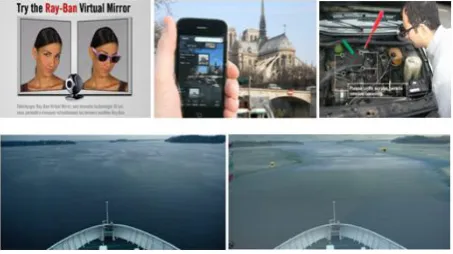
Displaying augmentations can be done with direct or indirect vision (thus inducing an additional mental load). In the case of direct vision, the display uses metaphors such as mirrors, smartphones open like windows onto the environment, vision through glasses or windows, etc. (figure 2).
As can be seen, the first property of Azuma’s definition [23] is restrictive since it limits augmented reality to 3D augmentations. Similarly, we may wonder whether the precision of repositioning is systematically justified. Fuchs & Moreau’s definition is less restrictive. It states that augmented reality brings together all the techniques enabling a real world to be associated with a virtual world, especially by integrating real images with virtual entities: synthetic images, virtual objects, text, symbols, diagrams, graphs, etc.
1.2 Our definition
All the definitions proposed leave little room for multimodality. However, augmented reality has today exceeded the stage of repositioning virtual indices in a video flow and now also proposes sound and even tactile augmentations. In we proposed [24] a more general definition of augmented reality as being the combination of physical spaces with digital spaces in semantically linked contexts. We can say that augmented reality is the combination of physical spaces with digital spaces in semantically linked contexts for which the objects of associations lie in the real world. On the contrary, we can define augmented virtuality as being the combination of physical spaces with digital spaces in semantically linked contexts, but where the task’s objects lie in the world of computing. states that the systems considered aim to make interaction more realistic.
2.
A SERIOUS GAMES
DEMONSTRATOR FOR
UNDERSTANDING
ELECTROMAGNETIC PHENOMENA
A serious game according to J. Alvarez [1] is a computer application whose aim is to combine both serious aspects such as (non exhaustive list): teaching, learning, communication or even information with the fun aspects of video games. The aim of such an association is therefore to remove simple entertainment. Sim City & Civilization [5]are simulations which propose carrying out a series of tests or experiments in a space shown as an image by making the player responsible. Sim City is used in the first year of secondary school as an educational tool in geography, based on the subject of the urban landscapes of North America’s major cities. Civilization went from the cardboard to the computer version in 1991 thanks to Sid Meier. It is both a game of strategy and management: players must lead their people from the stone age to the conquest of space. He was also behind a series, with Civilization II in 1997, Civilization III in 2000 and Civilization IV in 2005. In addition to exploration, practicing and observing mechanisms is part of these games.
The aim of the game illustrated in figure 1 of this paper is to gain as many points as possible. The game was developed thanks to precious help from Dassault System’s Virtools. Points are awarded when an electromagnetic phenomenon is reproduced. Faraday was the first scientist to notice in 1821 that variations in a magnetic field could make an electric current appear, known as an induced current.
[image:2.595.56.283.592.719.2]Fig 3: measuring instrument display
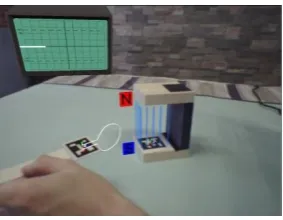
[image:3.595.96.238.80.190.2]To do so, pupils have two tangible interfaces: two wires at the end of which a marker is placed enabling several types of turn to be displayed (circular turn or rectangular turn) and a magnet on the base of which a marker is placed enabling different magnet configurations to be selected (constant or variable magnetic field). We can visualize in figure 4 a circular turn and a magnet with a constant magnetic field:
Fig 4: our tangible interfaces
The pupils choose a turn, position it inside the magnetic field subjecting it to precise movements (horizontal, vertical, rotation clockwise) so as to exert a variation in the magnetic field on the turn. They also choose the magnet and in the case of a magnet with a variable magnetic field they can vary its intensity.
Below in figure 5 we can see a successful exercise. The pupil creates a current whose direction is positive and reproduces a sine-wave voltage by rotating the turn clockwise.
Like in any other successful exercise, pupils were ask to produce different voltage values (variable amplitudes). This is done by making the intensity of the magnetic field vary by adjusting the oscilloscope’s sensitivity without having to move the turn.
Fig 6: Another successful exercise
The exercise in figure 7 cannot succeed. To generate a square signal, the pupils should have chosen a rectangular turn, and placed it in front of the magnetic field by moving it horizontally forwards and backwards.
It is worth noting that the new style of game created is located at a halfway point between reality and virtuality, and is difficult to label as an augmented reality application or an augmented virtuality application. This type of relationship between reality and virtual reality is observed by O. Nannipieri and P. Fuchs [16] as a third path: that of a hybrid world where virtuality is immanent to reality, where reality and virtuality combine to create new realities. This involves the compossibility between reality and virtuality. Along the same lines as the debate to better define the feeling of presence in a virtual environment [12] [13] [22] [18] [7] [19], it has to be acknowledged that here we manage to feel present in both universes and evolve simultaneously without any major difficulties.
3.
SCIENTIFIC EXPERIMENTATION
AND AUGMENTED REALITY
Secondly, we endeavoured to use augmented reality for scientific experiments. To do so, we revisited the famous experiments by French physicist Bernard Léon Foucault using new possibilities available thanks to technological developments.
[image:3.595.351.500.273.399.2]Fig 5: Successful exercise
[image:3.595.54.280.306.394.2]Fig 8: Foucault pendulum (Wikipedia animation)
The most well-known experiment is the famous Foucault pendulum. We use augmented reality to memorise and visualise the rotation of the pendulum’s oscillations over time by printing their successive movements on the ground (figure 8). Rotation occurs around the axis formed by the pendulum at rest with the centre of the earth. The pendulum shows oblate ellipses whose trajectories can be visualised. We can also illustrate the forces present: gravity, the wire’s tension and the Coriolis effect. The latter points towards the right in the northern hemisphere and towards the left in the south hemisphere, which explains the pendulum’s direction of rotation towards the right around its rest axis in the northern hemisphere and towards the left in the southern hemisphere.
In 1862 Foucault was also able to calculate the speed of light thanks to a rotating mirror. We use augmented reality to visualise the light’s path, the mirror’s rotation with a value angle during the outward movement of light and the deviation of the light wave equal to twice the value of angle when the light is reflected by the mirror. We better understand under these conditions how the value of the speed of light could be approximated based on a simple trigonometrical calculation.
Simulation systems, thanks to their ability to present learners with relatively realistic information, are being increasingly used in education and training. In particular, simulations are resorted to when it is not possible to carry out real experiments because they are too expensive, too long or unethical. We also resort to simulations when we need to highlight intangible items or items which cannot be seen by the naked eye, eg. in the event of a chemical reaction which generates colourless and odourless gases, such as carbon monoxide or nitrogen.
On the other hand, it is important to underline the fact that a simulation is not always an exact replica of a phenomenon and is often a simplification of the former by omitting, changing or adding details or features [8]. In order to simulate physical phenomena based on a model (equation) which requires complex calculations, Avradinis & al. [9], Kim & al. [10] use simulations based on simplified models. The idea studied in this paper is to use augmented reality to design scientific experiments where virtuality confronts reality.
and enrich simulation models for the design phase. During this phase, we increasingly design our high-tech products based on digital models and simulation tests, thus reducing the number of physical models required and a product’s development process. In the test phase, it would be interesting, thanks to augmented reality, to be able to juxtapose the results of the simulation in a single video flow with true tests so as to obtain “feedback” with regard to the design and enrich simulation models. This is true for complex technological products and simulations of equally complex physical phenomena such as the flow of fluids. It is also simpler to study physical phenomena for educational purposes, eg. in the case of a falling body we could juxtapose in a single video flow the fall of a more or less heavy ball with a semi-transparent ball whose kinematics are determined based on the law of universal attraction.
4.
LEARNING A SKILL USING
AUGMENTED REALITY
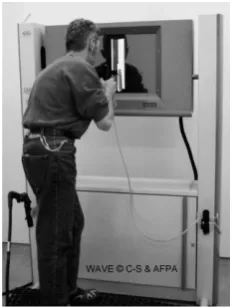
Finally, qualifying is an important stake in today’s society, which is why for our final framework of application for active learning we targeted skill learning simulators which are well-known for delicate tasks (welding, cutting, etc). A great deal of work [2] has been carried out on performing skills using virtual reality: medical skills, technical skills, maintenance work, sports skills, etc. With regard to learning technical skills, such as welding, there are industrial products on the market like the CS WAVE virtual welding platform (figure 9), which is the fruit of close collaboration between AFPA’s Sector-Based Industry Department, The National Association for the Vocational Training of Adults and the Immersion Society. This is an example of a virtual reality technology used for a real educational project [4][20][15].
Fig 9: Learning to weld. CS WAVE.
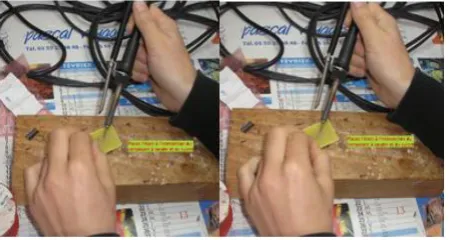
[image:4.595.370.487.486.640.2]HeadWorn Displays (HWD) or Head Mounted Displays (HMD) are all helmet or goggle type devices which are worn by users. These helmets are labelled as “See-Through” to enable users to perceive the real world , either in direct or indirect vision. They are worn on the user’s head since augmentations are presented either on one eye (monocular system) or both eyes (biocular system if the images presented to both eyes are identical, a binocular system if they are different and form a stereoscopic pair). HWD’s are classed according to the way they combine views of reality and virtuality. Some devices are less intrusive than others. “Optical-See-Through” (OST) type devices provide direct vision of the real world in which the virtual content is overlaid. Some masks are already being studied by display device manufacturers [17]. The figure below illustrates an augmented reality welding simulator:
Fig 10: Assisted training for learning to weld
Augmentations are added to show where welding should be done, at the intersection of the component to be welded and the copper, and how the welds should be done (curved and non rounded weld, concave and non convex angle).
5.
DEVELOPMENT PROCESS OF
AUGMENTED REALITY
APPLICATIONS
To design our augmented reality applications, we started with the approach highlighted by Hugues when creating his SIGMA system [25]. The approach consists of combining the Sebillotte situation analysis method with the UML (“Unified Modelling Language”) [11]software specification and design method. The first method is suitable for analysing human activities with a view to extracting their relevant features to be taken into account in a system, whilst the object-based approach is suitable for designing simulation software (software family to which training simulators belong). Indeed, although the Sebillote method proposes a graphic illustration of modellisation relatively close to that which is proposed in UML diagrams, it is complex and in any case is still unusual for developing the building bricks of a programme without the help of UML formalisation. The major stages for analysing situations are:
1. Defining situations to be observed;
2. Observing and maintaining these situations;
(a) Observing real task situations;
(b) Expressing tasks by interviews outside situations;
3. Analysing these observations and interviews;
4. Creating a model by using an analytical description method (ADM);
5. Determining the information required to complete tasks;
6. Developing the functionality enabling information identified in the previous stage by a UML analysis of user cases to be provided;
7. Test phase based on user feedback.
The analysis of situations is a basically functional approach. Task models closely resemble diagrams of UML method activities. We start with task models and the information required to complete tasks to describe objects present and cases where technical skill training software is used.
6.
ACKNOWLEDGMENTS
Our thanks to Rémi Gonzalez student at ESTIA high school who have contributed towards development of the demonstrator.
7.CONCLUSION
Generally, we aimed to find out in this paper whether Augmented reality could be part of an active learning approach. To do so, we proposed several augmented reality systems for a more efficient form of learning through games, scientific experimentation and skills which, when performed, required great skill. We think we have shown their relevance.
Scientific and technological teaching and learning are extremely vast fields and the subject of this paper was not to propose an exhaustive insight. We can however conclude that, as stated by [6], the recurrent problem of assisted learning systems is their determinist nature. These systems prove to be either “rigid” (everything is planned in advance) or “simplistic” (poor reasoning). Although it seemed beneficial to replace trainers by the computer tool a few years ago at the dawn of “interactive” computing, today our ambitions in terms of quality and efficient learning lead us to develop smart but often cumbersome systems which are difficult to implement when involving collective courses such as practical school or university work. In this respect, systems using augmented reality can provide a semi-determinist aspect where technology is easy to implement whether from a software or hardware point of view as we presented in the first part of this paper. We also observed that this category of systems is located at a halfway point between reality and virtuality, difficult to be labelled as augmented reality or augmented virtuality, but rather creating hybrid universes.
Sebillotte situation analysis method and the UML software specification and design method.
7.
REFERENCES
[1] Du Jeu vidéo au Serious Game : approches culturelle, pragmatique et formelle. Thèse spécialité science de la communication et de l'information. Toulouse : Université" de Toulouse II (Le Mirail), Université de Toulouse III (Paul Sabatier), décembre 2007, 445 p. [2] Burkhardt J.M., Lourdeaux D. et Mellet-d’Huart D. : La
réalité Virtuelle pour l’apprentissage humain. Chapitre II du volume 4, les applications de la Réalité Virtuelle, du traité de la Réalité Virtuelle. Arnaldi B., Fuchs P., Guitton P., Moreau G. Les Presses de l'Ecole des Mines de Paris.
[3] Increasing the expressive power of task analysis: Systematic comparison and empirical assessment of tool-supported task models, Interacting with Computers 22 (2010) 569–593
[4] L. D. Dalto, O. Balet, J. Duchon, and D. Mellet-d’Huart. Cs wave : Virtual reality for welders. In IEEE VR 2005, Workshop on Virtuality Structure (2005), Bonn, Germany, March 12-16, 2005.
[5] Hovig Ter Minassian et Samuel Rufat, « Et si les jeux vidéo servaient à comprendre la géographie ? », Cybergeo : European Journal of Geography, Science et Toile, 2008.
[6] Thouvenin, I. M. Interaction et connaissance : construction d’une expérience dans le monde virtuel. Habilitation à Diriger des Recherches, Université de Technologie de Compiègne 978-2-913923-28-7 (Mai 2009), 1–78.
[7] Witmer, B. & Singer, M. (1998). Measuring presence in virtual environments: A Presence Questionnaire. Presence: Teleoperators and Virtual Environments, 7(3), 225-240.
[8] Grabe, M. et C.Grabe. Integrating technology for meaningful learning, 4eme edition, New York, Houghton Mifflin Company
[9] Nikos Avradinis, Spyros Vosinakis, Themis Panayiotopoulos, Using Virtual Reality Techniques for the Simulation of Physics Experiments
[10]Jong-Heon Kim, Sang-Tae Park, Virtual Reality Simulations in Physics Education, 2001
[11]UML, Unified Modeling Language. www.uml.org
[12]Hendrix, C., & Barfield, W. (1996a). Presence within virtual environments as a function of visual display parameters. Presence: Teleoperators and Virtual Environments, 5(3), 274-289.
[13]Hendrix, C., & Barfield, W. (1996b). The sense of presence within auditory environments. Presence: Teleoperators and Virtual Environments, 5(3), 290-301. [14]www.immersion.fr/
[15] D. Mellet-d’Huart and G. Michel (2005a). Faciliter les apprentissages avec la réalité virtuelle. In P. Pastré, editor, Approche par la simulation : de l’analyse du travail aux apprentissages professionnels. Octarès, Toulouse.
[16] Nannipieri, O., and Fuchs, P. Pour en finir avec la réalité : une approche "socio-constructivisme" de la réalité virtuelle. Revue des Interactions Humaines Médiatisées 10, 1 (2009).
[17]www.laster.fr/
[18]Slater, M., Usoh, M. and Steed, A. (1994). Steps and ladders in virtual reality. ACM Proceedings of VRST '94 – Virtual Reality Software and Technology. Singapore: World Scientific Publishing Company.
[19]Slater, M. (In Press). Measuring Presence: A response to the Witmer and Singer Presence Questionnaire. Presence: Teleoperators and Virtual Environments. [20]D. Steib, L. D. Dalto, and D. Mellet-d’Huart. Apprendre
le geste du soudage avec cs-wave : l’expérimentation de l’afpa. In First International VR-Learning Seminar (2005), Laval, France April 20-21 2005.
[21]http://www.3ds.com/products/3dvia/3dvia-virtools/ [22]Sheridan, T. (1992). Musings on telepresence and virtual
presence. Presence: Teleoperators and Virtual Environments, 1(1), 120-125.
[23]R. Azuma, Y. Baillot, R. Behringer, S. Feiner, S. Julier, and B. MacIntyre. Recent advances in augmented reality. IEEE Computer Graphics and Applications, 21(6):34- [24] Sébastien Bottecchia, Jean-Marc Cieutat, Christophe
Merlo, Jean-Pierre Jessel. A new AR interaction paradigm for collaborative teleassistance system: the POA. Dans : International Journal on Interactive Design and Manufacturing, Springer, Vol. 3 N. 1, 2009