Munich Personal RePEc Archive
Post-Soviet Globalization
van der Hoek, M. Peter
Erasmus University Rotterdam
September 2001
Online at
https://mpra.ub.uni-muenchen.de/6038/
Post-Soviet Globalization
M. Peter van der Hoek
Erasmus University, Rotterdam, Netherlands and
Academy of Economic Studies, Bucharest, Romania
1. Introduction
The fall of the Berlin Wall in 1989 and the collapse of the Soviet Union in 1991 are the most important events of the late 20th century. Few observers foresaw these events. As late as in February 1989 fugitives trying to escape Eastern Germany were shot. In December 1990, when I was in Tallinn, Estonia, I discussed the situation in the Soviet Union with someone who had been correspondent in Moscow for a Swedish newspaper for over ten years. Thus, he knew the Soviet Union very well. Yet, he believed that the Baltics would not be able to secede from the Soviet Union, certainly not before the turn of the century. Only nine months later, however, this was exactly what happened after the failed coupe of August 1991. The Soviet Union collapsed and the Baltics regained their independence. This illustrates that predictions are very difficult to make even for those who are well informed.1
In this paper I will not make predictions. However, I will not ignore the future either. I will focus on the current situation with regard to globalization from a historical perspective, while I will also look at possible future developments. The term globalization appeared in a dictionary for the first time in 1961, but the concept of globalization is not always clear (Ro-drik, 2001). In the literature concepts of globalization can be found that sometimes seem fuzzy. According to Levitt (1993) a global corporation “operates (…) as if the entire world (or major regions of it) were a single entity; it sells the same things in the same way everywhere”. This seems to describe a problem of a number of US companies operating in foreign markets rather than to define the concept of globalization in a meaningful way. Some US companies try to sell products that were developed for the home market in foreign markets. This is a far different approach compared to many Japanese companies, which develop products for for-eign markets and try to sell them in these markets. An example is the Lexus, a car that is widely sold in the US market.
Emotional feelings seem sometimes more important than facts and rational arguments. When interviewed demonstrators against globalization do not always appear able to provide a meaningful definition. At the G8 meetings in Genoa in July 2001 a variety of protest groups marched on the streets to protest against globalization. Protesters also voice their opinions on the Internet.2 They seem to have some influence on official institutions as well as companies. The next G8 meeting will most likely be held in some remote place. World Bank development projects have been abandoned. Starbucks has promised to sell “fair trade” coffee beans in its coffee shops. Clothing importers in the USA settled after they had been sued over working conditions in the American commonwealth of Saipan in the Pacific. The Internet has proved an important tool in organizing protest groups, which seem to have globalized faster than their target enterprises. However, a crucial question is who elected them? The governments they fight are in the end accountable to voters, but who holds the protest groups accountable?
Globalization is sometimes used as synonymous to internationalization, which could be interpreted as increasing international interdependence. Globalization is also defined as a
1
According to Rodrik (2001) economists rank second to astrologers in their predictive abilities. 2
One example is www.destroyimf.orgadvertising itself as “a web resource for all those mobilising to end the
development towards relations acquiring relatively distanceless and borderless qualities (Scholte, 1997). I interpret globalization as economic integration of countries in the world economy on the basis of open markets and free movement of goods, services, workers, and capital. This implies that products are sold across countries irrespective of distances and bor-ders between the various outlets. Global products comprise a wide range of products includ-ing food (e.g., Kellogg's cereals), beverages (e.g., Coca-Cola), stimulants (e.g., Marlboro cig-arettes), clothes (e.g., Levi's jeans), pharmaceuticals (e.g., Bayer aspirin), music recordings (e.g., Madonna), office equipment (e.g., Xerox copiers), transport vehicles (e.g., Ford), and travel services (e.g., Holiday Inn). However, this is a qualitative characterization rather than a quantitative and precise account of global products. The role of governments is limited with regard to this concept of globalization.
Market principles have gained popularity in the last decades of the 20th century. In western countries this occurred in the 1980s. Leading politicians including President Reagan in the USA and prime minister Thatcher in the UK heavily emphasized the market as the or-ganizing principle. Privatization became a key word. In the 1990s, market principles also gained popularity in developing countries and former communist countries. After the collapse of the Soviet Union and the end of the Cold War profound changes occurred in Central and Eastern European societies. A major shift from principles of planning and control to market principles could be observed. The omnipresent fist of the centrally planned economy was re-placed with the invisible hand of the market economy in a relatively short period of time. The economic consequences of these upheavals proved to be very large. In the 1990s, GDP in Central and Eastern European countries fell dramatically. In 2000, real GDP in the Common-wealth of Independent States (CIS) - the former Soviet republics except the three Baltic states - amounted to 55 per cent of its 1989 level. In the former East bloc - Central and Eastern Eu-rope, the Baltics and the CIS - this figure amounted to 68 per cent (EBRD, 2000). Given the notorious allocative inefficiency of the centrally planned economies in Central and Eastern Europe, however, a fall of real GDP is not identical to a decline in the standard of living. A decrease of the production of weapons and barbed wire does not necessarily reduce the wel-fare of individuals. Nonetheless, the transition from centrally planned to market economies has proved to be painful.
2. Globalization over time
Over time the world economy has greatly benefited from globalization. Economic theory ex-plains that mutual gains can result from international trade if there are comparative advantag-es in the production of goods between nations. Dutch experience from 1850 to the end of the Napoleonic wars provides a dramatic demonstration of the way in which Western Europe in-teracted with the world economy in that epoch. In the mid-18th century Britain removed all trade and tariff restrictions unilaterally. In 1860 it had concluded reciprocal treaties for freer trade with France and other European countries, which had most-favored nation clauses (Maddison, 2001). Historically, the first half of the 20th century was an interruption of the move towards free trade. World War I shattered the old liberal order and international trade collapsed. This was a result of increasing protectionism during the Great Depression and the beggar-thy-neighbor policies. Only after World War II the move towards free trade resumed giving rise to a sustained period of high economic growth.
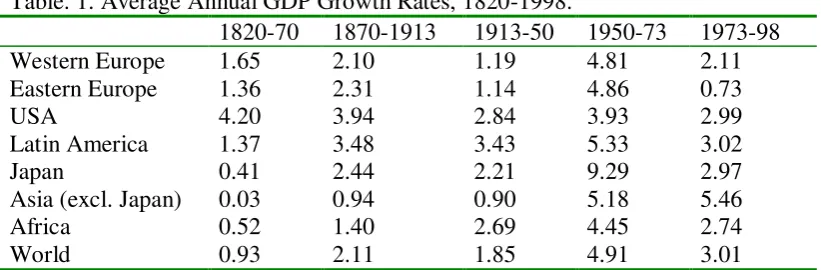
Western Europe with the exception of the period 1973-1990, when Eastern Europe lagged be-hind. Fourth, economic growth in Japan was exceptionally high in 1950-1973, when the Japa-nese economy grew two times as fast as the economies in the western world. Fifth, in the 19th century economic growth in Africa exceed that in Asia, but lagged behind with the western world. In the first half of the 20th century, however, economic growth in Africa was consider-ably higher than in Western Europe and at the same level as in the USA. In 1950-1973 eco-nomic growth in Africa was comparable to that in the western world. In this period African growth exceeded somewhat economic growth in the USA, while it was only a little bit lower than in Europe. Sixth, economic growth in Asia was the lowest in the world until the mid-20th century. Until 1950 the annual growth rate was lower than 1 per cent, but in the post-war pe-riod it was over 5 per cent.
Table. 1. Average Annual GDP Growth Rates, 1820-1998.
1820-70 1870-1913 1913-50 1950-73 1973-98 Western Europe 1.65 2.10 1.19 4.81 2.11 Eastern Europe 1.36 2.31 1.14 4.86 0.73
USA 4.20 3.94 2.84 3.93 2.99
Latin America 1.37 3.48 3.43 5.33 3.02 Japan 0.41 2.44 2.21 9.29 2.97 Asia (excl. Japan) 0.03 0.94 0.90 5.18 5.46 Africa 0.52 1.40 2.69 4.45 2.74 World 0.93 2.11 1.85 4.91 3.01 Source: Maddison (2001).
Globalization is not a new phenomenon. On the contrary, it already occurred centuries ago. Mussa (2000) points out that the extent of global economic integration through interna-tional trade today is, by some key measures, not much greater than it was a century ago. Around 1900, however, roughly two-thirds of GDP was in the goods producing sector of the typical industrial country. Now that situation is reversed, and roughly two-thirds of GDP is in the service sector of the typical industrial country. If trade shares are measured as ratios of international trade of goods to the output of goods production, then those shares are soon to have increased significantly from a century ago. Therefore, Mussa (2000) stresses that this supports the view that international integration of markets for goods is significantly greater today than a century ago.
Table 2. Exports as a percentage of GDP, 1913-1998.
1913 1929 1950 1973 1998 USA 3.7 3.6 3.0 4.9 10.1 Japan 2.4 3.5 2.2 7.7 13.4 France 7.8 8.6 7.6 15.2 28.7 Germany 16.1 12.8 6.2 23.8 38.9 UK 17.5 13.3 11.3 14.0 25.0 Netherlands 17.3 17.2 12.2 40.7 61.2 World 7.9 9.0 5.5 10.5 17.2 Source: Maddison (2001).
History offers thus an unambiguous positive correlation between globalization and convergence. Williamson’s detailed analysis of the pre-World War I years leads him to the conclusion that the correlation seems to be causal. He concludes that globalization was the
critical factor promoting economic convergence (Williamson, 1996).
Before the collapse of the Soviet Union Central and Eastern European countries formed an almost closed trading bloc. Trade within the Council for Mutual Economic Assis-tance (CMEA) dominated their international trade relations and only a small share of trade was conducted with the rest of the world. In particular the Soviet Union was a closed econo-my with a share of trade with other CMEA countries of 90 per cent (EBRD, 1999). Exports of Eastern Europe and the former Soviet Union were not significant. In 1913, the region's share in world exports was nearly the same as its share in the world population. Its share in the world population steadily declined, whereas its share in world exports initially increased. Seven years after the collapse of the Soviet Union, however, its share in world exports was at the same level as in 1913. Thus, the relative importance of Eastern Europe and the former So-viet Union in terms of exports was equally small at the end and in the beginning of the 20th century.
Table 3. Share of Eastern Europe’s exports and population in world total, 1913-1998.
1913 1950 1973 1998
Exports 4.1 5.0 7.5 4.1
Population 4.4 3.5 2.8 2.0
Source: Madison, 2001.
Seven years after the collapse of the Soviet Union and the CMEA the CIS countries were still to a large extent dependent on trade links with other transition countries, in particu-lar Russia. Yet, the liberalization of external trade in the early 1990s led to a reallocation of trade flows away from the CMEA towards the European Union. This holds in particular for Estonia, the Czech Republic and Hungary, where exports to the European Union stood at some 50 per cent of GDP (EBRD, 2001). Trade with the rest of the world also increased, but by much less. Therefore, regionalization seems to reflect developments in Central and Eastern Europe after the collapse of the Soviet Union more accurately than globalization.
[image:5.595.67.486.477.522.2]Middle East regional trade agreements are growing (WTO, 2001). This growing trend of re-gionalization may give rise to a tripolar view of the world, with the USA, Japan and the Euro-pean Union being the three poles. However, trade groupings are not always stable in the long run. The system of British Commonwealth Preferences and the COMECON, for example, have collapsed, while some regional trade groupings in Africa and the Caribbean have co l-lapsed or merged with others (Lloyd, 1992). Moreover, the European Union is the only region where the share of intra-regional merchandise trade exceeds 50 per cent. Thus, with a share of intra-regional trade of 69 per cent trade among European Union member states trade within the European Union is more important than trade between the European Union and the rest of the world. In Asia the share of intra-regional trade amounts to 47 per cent and in North Amer-ica 40 per cent (WTO 2000). Asia and North AmerAmer-ica are thus to a lesser extent closed econ-omies than the European Union.
3. Scenarios for further globalization
One may look into the future without making any predictions by describing how develop-ments in future could be. This is the scenario approach. The Central Planning Bureau (1999) has identified four scenarios that address the globalization process in various ways. For that purpose it has used WorldScan, an applied general equilibrium model for the world economy focusing on economic growth in the long run and trade patterns between 12 regions.3
The first scenario identified is the Schumpeterian World, which is optimistic on eco-nomic progress and developing regions. It emphasizes globalization tendencies and market-oriented policies in the world economy. It is based on the idea that when developing countries grow fast the linkages between OECD and non-OECD countries intensify. OECD countries specialize relatively more in high-skilled labor-intensive goods such as capital goods and ser-vices, whereas non-OECD countries specialize in consumer goods that are low-skilled labor intensive. Rapid development outside the OECD area and complete liberalization of goods and capital markets produce closer economic integration of rich and poor countries. The non-OECD share in world production increases from 23 per cent in 1995 to 42 per cent in 2020, while the ratio of trade to GDP nearly doubles. Liberalization of goods, services and capital allows countries to specialize, exploit economies of scale, and create competition. Moreover, open markets encourage dissemination of modern technologies in developing regions. Tech-nology is particularly important for transition countries to help restructure their inefficient production processes inherited from the communist past.
The second scenario is the Malthusian scenario. It assumes that developing regions are unable to pursue market- and outward-oriented policies. The political situation is unstable and leads to an inward-looking attitude. The lack of trade liberalization and neglect of infrastruc-ture and education hurts economic growth substantially in these regions. In this scenario, people in developing regions tend to migrate to the OECD area and the trend towards globali-zation is reversed. Despite the unfavorable market circumstances in non-OECD countries their growth rates exceed those in the OECD area. This reflects the enormous potential of these countries. However, the non-OECD share in world production shows only a modest in-crease to 28 per cent in 2020. The trade restrictions imposed by non-OECD countries hamper trade significantly and the ratio of trade to GDP lowers in these countries. Japan and Western Europe reinforce their positions in the production of intermediate goods, while all OECD countries can maintain their position in the production of consumer goods. Most developing
3
regions lose the opportunities to export agricultural goods to the OECD. China shifts to the production of consumer goods, because it faces less competition from its Asian neighbors.
The third scenario that the Central Planning Bureau (1999) identifies is the Developing
scenario, which is less rosy than the first two scenarios. Growth perspectives for OECD coun-tries are bleak, while non-OECD councoun-tries grow fast at high environmental costs. The lack of flexibility on the labor and product markets within the OECD keeps unemployment levels high and economic crises inside the OECD strengthen protectionist sentiments. Disagreement on free trade issues on agriculture and services between the USA, the European Union and Japan withholds all globalization tendencies in the OECD. Producers reduce investment, curb research and development, and technological progress slows down. The developing countries do not face these problems. They really catch up with the developed countries. Their policies are outward oriented and they go further in opening up and strengthening their markets, there-by creating their own trade blocs. They invest in infrastructure and education and copy at a fast pace technologies from the OECD countries. The non-OECD share in world production doubles to nearly 50 per cent As in the Schumpeterian scenario, the transition countries have to rely on technical progress, which pushes up economic growth substantially. The other re-gions also benefit from the increase in labor productivity by schooling and labor reallocation.
The fourth scenario is the Ecological scenario, in which producers and consumers val-ue environmental quality and put less emphasis on economic growth. People valval-ue the con-sumption of local products of their own culture. Globalization is thus not important in this re-spect and there are few incentives to eliminate trade barriers. The main reason for low eco-nomic growth is the lack of technological progress. The trade to GDP ratio hardly increases in the OECD area and remains constant in the non-OECD countries. Most of the production con-tinues to occur in the OECD area and the shift to non-OECD regions is modest. The Ecologi-cal scenario differs from the other scenarios in that the rise in demand for energy is very mod-est. As a result, the total emissions of CO2 are about 40 per cent lower than in the Developing
scenario. Emissions in the OECD area do not even increase. The OECD and transition coun-tries agree to reduce the emissions according to the Kyoto protocol, while the non-OECD countries limit the growth of energy demand by energy-efficiency improvements in produc-tion and a reducproduc-tion in consumer demand. Curbed demand for energy hurts the energy-exporting regions. The share of energy in total exports by the Middle East and North Africa, Sub-Saharan Africa and the former Soviet Union declines significantly. They diversify their exports to capital goods, services, and intermediate goods. The traditional exporters of agri-cultural goods, the USA and the Rest of the OECD, improve their positions in this sector in response to the partial trade liberalization. Asian regions now dominate the market for con-sumer goods. They specialize in these goods because of the relative abundant supply of low-skilled labor. The shift in the export mix is possible due to a shift of low-low-skilled labor from agriculture to consumer goods. The former Soviet Union is the biggest loser in this sector and its export share vanishes.
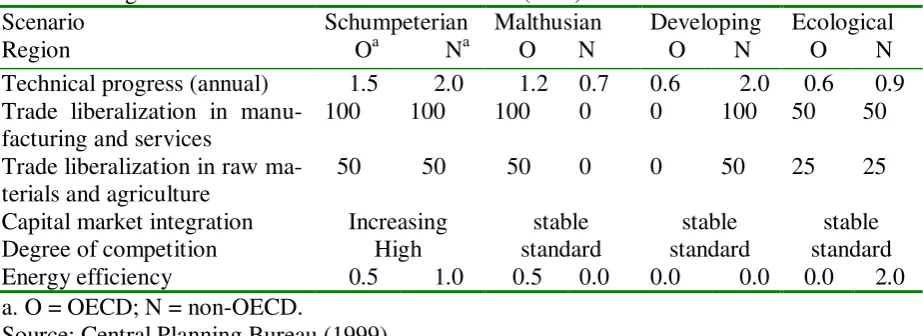
remains limited. The Schumpeterian scenario also features increasing capital market integra-tion, while the extent of competition is assumed to be larger than in the other scenarios. In all scenarios with high economic growth sustainable production is only possible if energy-efficient technologies are introduced. Therefore, OECD countries save 0.5 per cent annually on energy per unit of production in the Schumpeterian and Malthusian scenarios. Non-OECD countries even save 1.0 per cent in the Schumpeterian scenario. In the Ecological scenario the environmental awareness of non-OECD countries is much higher. As a result, the energy sav-ing amounts to 2 per cent per year with much lower dissemination of technology from the OECD countries. OECD countries save less in the Ecological scenario because technical progress is slow, which makes it more difficult to implement energy-saving technologies. The reduction in energy demand is realized by introducing energy taxes that the OECD countries impose according to the Kyoto protocol. They even agree to reduce the emissions further by 1 per cent per year after 2010. In the Ecological scenario industrial and transition countries can trade in emission rights in order to realize the emission targets. The other non-OECD coun-tries do not participate because the OECD and transition councoun-tries are mainly responsible for the abatement.
Table 4. Exogenous trends in the scenarios until 2020 (in %). Scenario
Region
Schumpeterian Oa Na
Malthusian O N
Developing O N
Ecological O N Technical progress (annual) 1.5 2.0 1.2 0.7 0.6 2.0 0.6 0.9 Trade liberalization in
manu-facturing and services
100 100 100 0 0 100 50 50
Trade liberalization in raw ma-terials and agriculture
50 50 50 0 0 50 25 25
Capital market integration Increasing stable stable stable Degree of competition High standard standard standard Energy efficiency 0.5 1.0 0.5 0.0 0.0 0.0 0.0 2.0 a. O = OECD; N = non-OECD.
Source: Central Planning Bureau (1999).
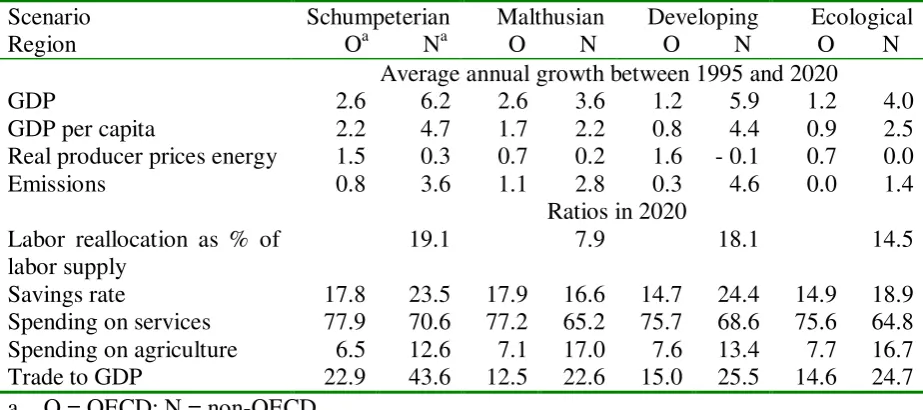
Table 5. Summary of scenario results until 2020. Scenario
Region
Schumpeterian Oa Na
Malthusian O N
Developing O N
Ecological O N Average annual growth between 1995 and 2020
GDP 2.6 6.2 2.6 3.6 1.2 5.9 1.2 4.0 GDP per capita 2.2 4.7 1.7 2.2 0.8 4.4 0.9 2.5 Real producer prices energy 1.5 0.3 0.7 0.2 1.6 - 0.1 0.7 0.0 Emissions 0.8 3.6 1.1 2.8 0.3 4.6 0.0 1.4 Ratios in 2020
Labor reallocation as % of labor supply
19.1 7.9 18.1 14.5
Savings rate 17.8 23.5 17.9 16.6 14.7 24.4 14.9 18.9 Spending on services 77.9 70.6 77.2 65.2 75.7 68.6 75.6 64.8 Spending on agriculture 6.5 12.6 7.1 17.0 7.6 13.4 7.7 16.7 Trade to GDP 22.9 43.6 12.5 22.6 15.0 25.5 14.6 24.7 a. O = OECD; N = non-OECD.
Source: Central Planning Bureau (1999).
Trade only flourishes if all countries reduce their trade barriers. Since OECD countries are endowed with high-skilled labor and capital and non-OECD countries are endowed with low-skilled labor, specialization will increase if trade barriers between these regions are re-duced or eliminated. This occurs in the Schumpeterian scenario. OECD countries have similar endowments of high-skilled labor and capital, while non-OECD countries have similar en-dowments of low-skilled labor. Specialization within the OECD and non-OECD regions will thus be less pronounced than between OECD and non-OECD countries given the level of ag-gregation in the model. Therefore, the trade to GDP ratios are fairly low in the Malthusian and Developing and also the Ecological scenarios. The high trade to GDP ratio in the Schumpete-rian scenario depends on trade liberalization and the degree of international competition.
High economic growth harms the environment. In the Schumpeterian and Malthusian scenarios emissions grow substantially but do not accelerate, due to energy-saving technolo-gies. In the Ecological scenario demand for energy is stable due to strict environmental legis-lation in the OECD area. As a result, the global increase in CO2 emissions is about 20 per
cent, which seems very modest given the economic development in non-OECD regions. Moreover, at the end of the scenario period emissions do not increase at all. In the Developing scenario growth of emissions does accelerate due to rapid growth in developing regions, which ignore environmental quality. As a result, emissions double in the scenario period. If energy growth is not allowed for at all, economic growth has to be low - as in the Ecological scenario - or a more strict environmental legislation is necessary. The differences in emission growth in the non-ecological scenarios are not very pronounced. In these scenarios emissions grow substantially. Whether this growth is sustainable or not is hard to say. First, the quant ita-tive effects of pollution on the environment are unclear. Second, simulation paths of 25 years are relatively short to analyze emission paths.
4. Summary
dependent on Russia, liberalization of external trade in the early 1990s led to a reallocation of trade flows away from Central and Eastern Europe towards the European Union.
The Central Planning Bureau (1999) has explored possible future developments by apply-ing a general equilibrium model for the world economy. It has identified four scenarios: 1. The Schumpeterian World, a scenario that is optimistic on economic progress and
develop-ing regions emphasizdevelop-ing globalization tendencies and market-oriented policies in the world economy.
2. The Malthusian scenario, which assumes that developing regions are unable to pursue market- and outward-oriented policies.
3. The Developing scenario assuming bleak growth perspectives for the OECD area, but high growth in non-OECD countries at high environmental costs.
4. The Ecological scenario, in which producers and consumers value environmental quality and put less emphasis on economic growth.
Because of the differences in underlying assumptions the scenarios produce different outcomes. The results are not predictions, but descriptions of possible future developments on the basis of an applied general equilibrium model of the world economy and various exogen-ous trends that have been assumed. There seems considerable scope for CIS countries to inte-grate in the world economy. Continued globalization may further economic growth, while high economic growth harms the environment. However, energy-saving technologies and en-vironmental legislation may affect the outcomes.
References
1. CENTRAL PLANNING BUREAU (1999) Globalization, International Transport and
the Global Environment: four quantitative scenarios, Working Paper No. 110, The
Ha-gue: CPB.
2. EUROPEAN BANK FOR RECONSTRUCTION AND DEVELOPMENT (1999)
Transi-tion Report 1999, London: EBRD.
3. EUROPEAN BANK FOR RECONSTRUCTION AND DEVELOPMENT (2000)
Transi-tion Report 2000, London: EBRD.
4. EUROPEAN BANK FOR RECONSTRUCTION AND DEVELOPMENT (2001)
Transi-tion report update April 2001, London: EBRD.
5. LEVITT, T. (1993) “The globalization of markets”, in: Robert Z. Aliber and Reid W. Click (eds.), Readings in International Business: A Decision Approach, Cam-bridge/London: The MIT Press.
6. Lloyd, P.J. (1992) “Regionalisation and World Trade”, OECD Economic Studies, No. 18: 7-43.
7. MADDISON, A. (2001) The World Economy: A Millenial Perspective, Paris: OECD. 8. MUSSA, M. (2000) Factors Driving Global Economic Integration,
http://www.imf.org/external/np/speeches/2000/082500.htm.
9. RODRIK, D. (2001) “How Far Will International Economic Integration Go?”, Journal of
Economic Perspectives, 14(1): 177-186.
10. SCHOLTE, J.A. (1997) Globalization: A Critical Introduction, Basingstoke: Macmillan. 11. WILLIAMSON, J.G. (1996) “Globalization, Convergence and History”, Journal of
Eco-nomic History, 56(2): 277-306.
12. WILLIAMSON, J.G. (1997) “Globalization and Inequality, Past and Present”, The World
Bank Research Observer, 12(2): 117-135.
13. WORLD TRADE ORGANIZATION (2000) International trade statistics 2000, Geneva: WTO.