24
Optimized
Image Resizing using Piecewise Seam
Carving
K. Thilagam
Ph. D. Research Scholar, Karpagam University, Coimbatore,
India.
S. Karthikeyan
Assistant Professor, Department of IT, College of Applied Sciences,
Sohar, Sultanate of Oman
ABSTRACT
Seam Carving, the popular content aware image resizing technique removes seams of low energy iteratively without considering the global visual impact of the image. It is computation intensive. Sometimes seams unavoidable pass through the ROIs and distort their geometric shapes. The ROIs of low energy cannot sustain seam carving. We proposed a piecewise approach which can preserve the ROIs of low energy and minimize shape distortions. It can take advantage of parallel algorithms to improve speed. It is further optimized by using a saliency map to automatically identify the ROIs and segment the image, in addition with the interactive one. It is hybridized with a shift map editing approach to adjust structure deformations.
General Terms
Image Processing, Image Resizing.
Keywords
oPSC - Optimized Piecewise Seam Carving, ROI – Region Of Interest, Saliency map, Shift map.
1.
INTRODUCTION
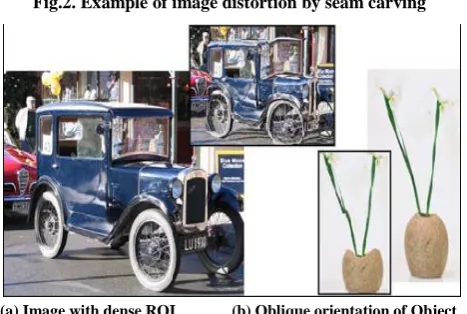
Image retargeting is becoming popular with the availability of too many display devices of varying architecture and resolutions in the market. It is desirable to preserve the visually prominent regions of an image while altering the image size for retargeting. Seam Carving[1] has gained much popularity recently as a content aware image resizing method as opposed to traditional image resizing techniques such as Scaling, Cropping and Warping which are not intelligent to image saliency. Non homogenous scaling and stretching [2], Fish eye view warps [3] adopts variation of scaling techniques and suffers the same drawbacks as scaling. Figure (1) compares the result of seam carving with scaling, cropping and warping. Seam Carving resizes the image by removing less noticeable pixels and preserves the regions of interest (ROIs). However extensive carving and/or denser image contents lead to distortion of ROIs, spoiling the global visual impact of the image. Seams unavoidably pass through obliquely oriented objects thereby causing artifacts. It also fails to preserve the geometric shapes. Figure 2 shows image distortion caused by
Seam Carving. As the energy function in [1] computes optimal seams by finding pixels that contribute minimum energy to the image, ROIs of low energy cannot sustain from being carved out. Seam carving is a discrete method acts on individual pixels of image and applies dynamic programming to compute seams. This involves complex computation. An overview of Seam carving is presented in Section 2.1. Many attempts were made to improve the efficiency of seam carving either its computation speed or quality of output produced. It is also hybridized with other resizing methods to efficiently use the positive aspects and minimize the negative impact of each other. Some of these techniques are discussed in section 2.2. We have proposed a piecewise approach[4] to interactively decompose the image into several segments and apply seam carving to each segment in varying proportions based on the ROIs present in it. The PSC and its limitations are briefed in section 3.1. In section 3.2 we describe several modifications made to PSC to further improve its efficiency which we call as oPSC. In addition it is hybridized with shift map image editing[5] to preserve the geometric shapes and rectify the artifacts caused by seam carving. Parallelizing PSC would much improve the speed of resizing. The results are presented in Section 4 and are compared with similar techniques. A conclusion is derived in Section 5 based on discussion of results presented, and the scope for future enhancements is also stated.
2.
RELATED WORK
2.1
An Overview of Seam Carving
Seam carving[1], alters the size of an image by generously removing or duplicating low energy pixels in an image called seam. Seam is an optimal 8-connected monotonic path of pixels on an image from top to bottom (vertical seam), or left to right (horizontal seam). Removal / Insertion of such a seam do not cause much visual attention. Repeated carving/ insertion of seams would change the aspect ratio of an image or retarget the image to a new size. The optimality of pixels is defined by an image energy function
e1 I = ∂x∂ I + ∂y∂ I
…(1)
Let I be an image of size n x m then a vertical seam is defined as:
sx= {s
ix}i=1n = { x i , i }i=1n , s. t. ∀i, x i − x i − 1 ≤ 1,
where x is a mapping x:[1,….,n] → [1,….m]. …(2)
Similarly a horizontal seam is defined to be: sy = {s
jy}j=1m = { j, y j }j=1m , s. t. ∀j, y j − y j − 1 ≤ 1,
where y is a mapping y:[1,….,m] → [1,….n]. …(3)
Seam cost = Sum of Energy of pixels constituting the seam. E s = E Is = ∑i=1n e(I si ) …(4)
Optimal seam s* with min cost is found using dynamic programming.
s∗= min
s∑i=1n e(I si ) …(5)
Seam carving proves efficient over other traditional methods of image resizing, however it is not without drawbacks. It suffers several limitations as stated below:
[image:2.595.54.288.424.581.2]i) Seam carving iteratively removes or inserts low energy pixels until the desired image size is achieved, without considering the real visual effect. ii) It cannot preserve ROIs of relatively low energy which cannot sustain from being carved out. iii) Denser regions of interest (ROI) in the image and sometimes the orientation of the image make it unavoidable that the seams bypass the important regions thereby distorting it. iv) Seam Carving is a discrete method, that performs pixel by pixel computation and the energy map is recomputed after each seam is carved/inserted, making seam carving a time consuming process.
Fig.2. Example of image distortion by seam carving
(a) Image with dense ROI (b) Oblique orientation of Object
2.2
Optimization of Seam Carving
Many attempts were made to improve the efficiency of SC either its computation speed or quality of output produced. To well preserve the visual contents of an image an importance diffusion method was used [6] to propagate the importance of removed pixels to their neighbors. Saliency maps[3][7][8] that determine the visual importance of pixels were constructed using the global saliency of pixels and colour features to preserve the visually prominent regions in the image and to avoid distortion of shape features while retargeting images. Alternatively a visibility map [9] was used that defines image editing as a graph labeling problem and applies a greedy optimization technique on pixel energy for optimal SC. A fuzzy logic[10] based segmentation coupled with skin detection was used to preserve the human features and to manipulate the energy image, so as to preserve the low energy object from
being affected. Attempting to preserve the geometric structures a mesh was constructed to capture the underlying image structures and a constrained mesh parameterization[11] was applied to minimize distortion of salient features in the image. In [12] similarity errors were measured and a mesh deformation was used to ensure that important regions undergo a similarity transform to retain its shape while retargeting. Handles were defined [13] to describe the geometric object and the conformal energy used in geometric processing was applied on them to measure distortion caused and diffuse it in all directions. Instead of applying a uniform scaling factor a non-homogeneous[14] retargeting based on image contents benefit structure preservation. Techniques such as SC, that manipulate individual pixel are however computation intensive. Some researches were done to improve the computational efficiency of SC. Linear dynamic programming technique used in SC is replaced by quadratic programming[15]. Graph based [9][10]16] approach was used to improve SC to retarget images and videos, by compromising the completeness of the image. Graph cuts remove a group of seams instead of single seam, and are used to remove an entire object from the image/video. Stream carving[17] overrules the monotonic pixel constrain of SC, in which seams of multiple pixel width are applied. Parallelized algorithms[18][19] were used to effectively utilize the 4 or 8 core processors in modern computers to improvise speed of SC.
Several continuous methods like scaling, warping and cropping were used in combination with SC to take advantage of their positive aspects and minimize their negative impacts, so as to achieve better retargeting. Two operators, SC and scaling were combined in [20] in which after each seam is removed, the current image is scaled to the target size and the distance to the original image is computed. The resized image with the minimum distance to the original image is the final result. In [21] a multidimentional (3x2) resizing space was defined with 3 resizing operators (cropping, scaling and SC) along 2 directions,(width and height). An optimal multioperator sequence in this space defines a directed path with positive (negative) coordinates that monotonically enlarges (reduces) the size of the image. Seam cost[1] and an objective function were defined to find the optimal paths. A non symmetric patch based Bi-Directional Warping (BDW), was used to compare and evaluate the results. In [22] same three operators were applied with Image Euclidean Distance (IMED) [20][22], dominant color descriptor (DCD) and seam energy variation to quantify and evaluate the quality of resizing. An objective function was also formulated to optimize the resizing process. Moreover, a new optimization algorithm was proposed, which dramatically increased the speed of multioperator resizing without damaging the visual quality. Figure 3 shows that the results of Multioperator methods are very impressive than that of single operator techniques.
3.
PROPOSED METHODOLOGY
3.1
Piecewise Seam Carving
The Piecewise approach decomposes the image into several segments and allows seams in each segment in a ratio desired by the user. The user may choose the direction of segmentation (vertical or horizontal) and therefore the direction of the seams. The user interactively selects some points on the image along which the image is segmented in the direction specified and its segment limits (Xmin,Xmax / Ymin,Ymax) marked. The image
matrix Inxm is decomposed into v subarrays. Segment numbers
(Gk) are allotted incrementally. The seams are computed with
26 Fig 4. Removing 100 horizontal seams from (a). Notice the artifacts in (b). Circled in red
(a) Original Image b) Seam Carving c) PSC
Fig. 5 (a) Original Image b) Seam Carving c) PSC the user. The size of the image is altered in the direction
opposite to the seam direction. When a vertical segmentation is opted the image is segmented vertically along the selected pixel.
Segment number is been allocated from left to right, Xmin and
Xmax of each segment Gk defines their segment limit. Segments
are then carved (vertical seams removed) individually to a user specified size. Removing vertical seams reduce horizontal size (i.e width) of the image. Similarly for a horizontal segmentation, the Ymin and Ymax are the segment limits. Seams
carved along horizontal direction would change the height of the image.
Let Inxm be the image segmented vertically into v segments. For
a segment Gk where k=1...v, let p= Xmin(Gk) and q= Xmax(Gk),
the size of the segment zx(Gk) = q – p. And let u be the number
of seams allowed in segment Gk, where u < zx(Gk). So we
modify the equation (2) to add an additional constraint that the seam lays within the segment limit.
A vertical seam within this segment is defined to be: sx = {s
ix}i=1u = { x i , i }i=pq , s. t. ∀i, x i − x i − 1 ≤ 1,
where x is a mapping x:[p,….,q] → [1,….m]. …(6)
And similarly if there are h horizontal segments, for every segment Gk where k=1…h let b = Ymin(Gk)and d = Ymax(Gk),
and the size of the segment zy(Gk) = d - b. Let u be the number
of seams opted in segment Gk, where u < zy(Gk). We modify
equation (3) to define a horizontal seam as: sy= {s
jy}j=1u = { j, y j }j=bd , s. t. ∀j, y j − y j − 1 ≤ 1,
where y is a mapping y:[b,….,d] → [1,….n]. …(7) PSC preserves the ROIs of low energy and help to overcome the distortions caused due to orientation of objects. Figure 4 and 5 compares the result of Seam Carving with that of PSC. However it has several limitations. Segmentation and number of seams removed are decided by the user. So efficient resizing depends on the user efficiency. Semantic relationship of objects in different segments is not preserved as the segments are not uniformly resized. Structure deformation of less salient objects as in the parent method spoils the global visual impact. To
overcome these limitations we propose several optimization techniques and combine PSC with shift map editing to produce better results.
3.2
Optimizations:
Researches have reveals several optimizations on seam carving which also shall be generalized to PSC. We propose to use a forward energy computation to replace the backward energy. Leaving the tedious task of segmenting the image and selecting number of seams to the user is not so attractive. So we design a semi automated interface based on saliency map to identify the ROI and decompose the image into segments. Seam Number is also computed based on saliency content of the segment and orientation of the ROIs. Seam carving individual segments independently shall profit from parallel programming algorithms. To maintain the semantic relationship between the objects and to preserve structure distortions a shift map editing process is adopted.
3.2.1
Forward Energy
In [1] pixel energy based measure shown in equation (1) is used to evaluate pixel importance in computing seams for removal or insertion. To compute an optimal seam the gradient image is obtained from which the energy map image is calculated. An optimal seam is a monotonic 8-connected path of low energy pixels vertically/horizontally. Removal of seam increases / decreases the energy of the neighboring pixels. So the energy map is recalculated after every seam is removed. However removal of low energy pixels increases the average energy level of the image. Backward energy computation [1] does not account the energy inserted into the image after each seam is removed. So we replace it by forward image energy [22]which computes seams that are not necessarily minimal in energy but inserts minimal energy into the image and produce better results of resizing. The loss of information during resizing is accounted using the energy function shown in equation (8), a L2 form of the gradient.
3.2.2
Automatic segmentation:
An interactive method used to segment the image in PSC is not much attractive, as the effectiveness of retargeting relies on the efficiency of the user. Here we use a significance map[2] which is a product of saliency measure [7] and image gradient magnitude[1], to determine the attractiveness of regions so as to automatically identify the ROIs. To compute the saliency map of the image we use the implementations of J.Harel. Both GBVS[8] and simpsal shall be used, but for sake of simplicity we use the simpsal implementation. In addition an interactive interface is provided for the user to select or deselect the ROIs. The ROIs are then segmented to find the object boundaries. The minimum and maximum x and y values define the extremes of the object in horizontal and vertical directions respectively, and this is used to define the segment limits. Seam computation uses these limits to ensure that the seams lie within a segment.
3.2.3
Seam Number:
Boundaries of ROI are used to compute the orientation of the object and to estimate its saliency. The maximum of zx(Gk),
zy(Gk) specifies the orientation of the object. If zx(Gk) is the
maximum the object has a horizontal orientation and the segments containing it is assigned high affinity for horizontal seams than the vertical seams which would bypass them. Similarly if zy(Gk) is the maximum the ROI is oriented
vertically and can permit more vertical seams than horizontal. The ratio of number of pixels in the bounding box of ROI to the total number of pixels in the segment is used to assign a saliency magnitude. These two measures are used to estimate the number of seams (Sv,Sh), where Sv and Sh are seam along
the vertical and horizontal directions respectively. This may also be manually adjusted by the user if desired.
3.2.4
Parallelization:
In[1] the energy map is recalculated after every seam is removed which involves all m x n pixels of the image. In PSC[4] the seams lie within the segment and energy map is recalculated for those pixels in a particular segment which is a subset of the image. Therefore the speed of resizing is much improved. The independent application of seam carving to each segment can also take advantage of parallel programming algorithms. In [18] energy and minimum path calculations are parallelized, as they need intense computation. A number of processors are involved to work on a specified number of columns in the image. But each of them has to depend on the other processors working on adjacent columns. In [19] parallel algorithms are used to find multiple seams simultaneously. In our method as the segments are seam carved independent of the other, it eliminates the need for inter processors communication. Time taken for seam carving a segment depends on two factors i) number of pixels in the segment and ii) the number of seams removed from it. Assuming that each image segment is assigned to a processor, the maximum time to resize the image is therefore equal the maximum of resizing the individual segments.
In PSC[4] 𝑇 𝐼𝑣 = ∑𝑣𝑘=1𝑡(𝐺𝑘) but in (proposed) optimized PSC 𝑇 𝐼𝑣 = max 𝑡 𝐺𝑘 , where T(Iv) is the time taken to
resize the image along the vertical direction, t(Gk) is time to
resize the kth segment where k= 1 .. v, v is the number of segments.
3.2.5
Shift Map adjustments:
The piecewise approach allows resizing each segment to varying proportions. This help to preserve the important objects from being carved out. Avoiding seam in segments containing the ROI may even retain the structure of ROIs intact. But the semantic relationship between the objects may not be preserved especially objects that extend into multiple segments undergo structure distortions. So a shiftmap[5] adjustment is applied to post process the resized image. The subarrays that constitute the segments are combined to reproduce the resized image. A shiftmap is defined to ensure smooth blending of pixels in different segments and rectify the structure distortions. It is a graph labeling problem, where the pixels in the output image are the nodes and each node has a label defined by a shift (tx,ty). The output image R(u,v) is derived from the input Image
I(x,y) by applying a translation transformation I(u + tx, v + ty).
Shiftmap is used in content aware image resizing but it lacks in completeness of image as it omits some parts of the original image. Figure 6 shows partial omission of image by shift map editing and is compared with Seam Carving and PSC. Here the image is resized with PSC and is post processed with shift maps to enable smooth blending of pixels and to rectify the deformations caused in some objects.
3.2.6
Pixel Averaging:
In PSC[4] the subarrays constituting the segments are combined to reconstruct the entire target image, where a visible line is seen between the segments due to the energy variation caused by varied number of seams carved from each segments. Replacing the energy function in [1] by forward energy computation [22], minimize this artifact. We also use a pixel averaging technique to diffuse the energy variation between the pixels of adjacent segments. Prior to this, shiftmap editing is used to adjust structure deformations.
4.
RESULTS AND DISCUSSION
The idea of segmenting the image for retargeting was proposed by Setlur in [23][24] to preserve the functional realism than the photo realism. He removes the ROIs from the background and fills the resulting gap, resizes the background region to fit into small display devices and then pastes the ROI at its centroids. He applied a scaling and cropping techniques for resizing the background image. Here we decompose the image into vertical or horizontal segments containing the ROIs and each segment is resized in different proportional based on their saliency contents using the popular seam carving method. This is a non homogeneous resizing approach, preserves seams in some segments and applies extensive carving in another. It also can preserve the ROI of low energy. Optimizations on seam carving can well be generalized to PSC. We adopt the forward
28 energy for seam computation to enhance the quality of output.
As some experts suggested, leaving the tedious task of segmenting to the user was not so attractive, we adopt a saliency map to automatically identify the ROIs. In addition to it we provide an interactive interface so that the low energy ROIs that are ignored by saliency map can be interactively selected by the user and shall be preserved while resizing. Once the segmentation is over, the numbers of seams in the segments are automatically computed and distributed based on their information content. This also provides an optimal measure for size reduction/magnification. Also the user can adjust the seam numbers manually. Each segment is processed independent of the other which allows a multicore processor to resize segments in parallel, significantly improving the speed of resizing. For seam carving using dynamic programming the time complexity is polynomial to change in size of the image. The time taken to seam carve the image using PSC is the sum of time taken to seam carve the individual segments. In multioperator dynamic programming algorithms, reducing width of the image I by m pixels, using n operators, the time and space complexities are O(mn), which is polynomial in the amount of size change, while exponential in the number of operators to be used. In our approach, if we assume that there are as many processors as the number of segments then time taken to seam carve the image is the maximum of time taken to seam carve individual segments.
When the resizing is over the sub arrays that constitute the segments are combined into a single matrix. To enable smooth blending of segments pixel averaging technique is applied and to preserve the structure deformations a shift map image editing is done. This further improves the visual quality of the image.
5.
CONCLUSION AND FUTURE SCOPE
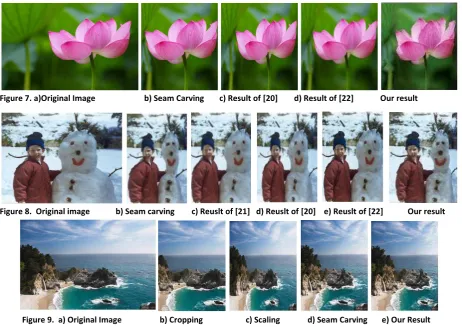
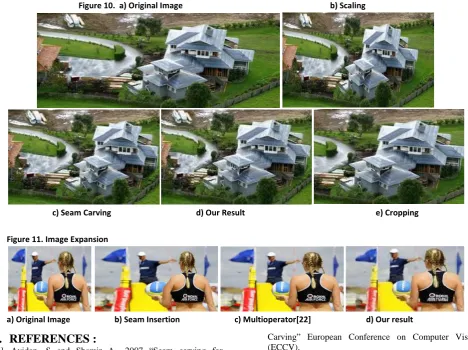
Our Piecewise approach appears to be beneficial over other existing methods in terms of the quality of output and computation time as well. Clever segmentation and shift map editing overcomes the distortion caused by oblique orientation of objects. It preserves the ROIs of low energy; however user interaction is needed to locate ROIs of less visual attraction. Visually prominent ROIs are automatically identified by saliency map. Better resizing results are obtained by forward energy computation than the energy function used in [1]. Figure 7 to 10 compares our results of image size reduction with various other resizing techniques. Figure 11 compares the result of image enlargement. Our approach suffers some limitations as stated in (i) to (iv) some of which are managed by post processing the resized image by shift map editing. (i)Segmenting the image in both directions subsequently would result in a matrix of segments. Carving each segment individually fail to preserve the relationship of object in adjacent segments and would produce a poor visual impact. In PSC[4] resizing along one direction is completed and then it is done in the other direction. Here shiftmap editing is applied to rectify structure deformation and restore the semantic relationship between objects. (ii) We simply copy the subarrays that constitute the segments, into the entire array so as to merge the segments to form the resized image. But visual artifact is seen between segments. Pixel averaging technique and shiftmaps are defined to enable smooth blending of pixels between adjacent segments. (iii) Dense image content is still a challenge to PSC which would result in extensive segmentation, and reduce the retargeting ratio. (iv)We have not tested the efficiency of this algorithm in parallel processing which we propose to do in future.
Figure 7. a)Original Image b) Seam Carving c) Result of [20] d) Result of [22] Our result
Figure 8. Original image b) Seam carving c) Reuslt of [21] d) Reuslt of [20] e) Reuslt of [22] Our result
[image:5.595.59.522.427.754.2]6.
REFERENCES :
[1] Avidan. S and Shamir A., 2007 “Seam carving for content-aware image resizing”. ACM SIGGRAPH, 26(3). [2] Yu-Shuen Wang, Chiew-Lan Tai, Olga Sorkine, Tong-Yee Lee., 2008 “Optimised scale-and-stretch for Image Resizing” in ACM Transactions on Graphics, Vol.27(5).
[3] Liu, F., And Gleicher, M., 2005 “Automatic Image Retargeting with Fisheye-View Warping.” in ACM UIST, 153–162.
[4] Thilagam.K and Karthikeyan.S, 2011. “An Efficient Method For Content Aware Image Resizing Using PSC”, in International Journal of Computer Technology and Applications, Vol 2(4 ), 807-812,.
[5] Pritch, Y., Kav-Venaki, E., and Peleg, S., 2009. “Shift-map image editing,” in IEEE International Conference on Computer Vision, 151–158.
[6] Sunghyun Cho, Hanul Choi, Yasuyuki Matsushita, and Seungyong Lee, 2009. ”Image Retargeting Using Importance Diffusion”, in IEEE International Conference on Image Processing, 977-980.
[7] Itti,L., Koch,C., & Niebur, E, 1998. “ A Model of saliency based visual attention for rapid scene analysis”, in IEEE Transactions on Pattern Analysis and Machine Intelligence, 20,1254-1259.
[8] J. Harel, C. Koch, and P. Perona, 2006. "Graph-Based Visual Saliency", Proceedings of Neural Information Processing Systems (NIPS).
[9] Alex Mansfeld, Peter Gehler, Luc Van Gool and Carsten Rother, 2010. “Visibility Maps for Improving Seam
Carving” European Conference on Computer Vision (ECCV).
[10]Sushil Subramanian, Kundan Kumar, Bibhu Prasad Mishra, Animesh Banerjee and Debdutta Bhattacharya, 2008. ” Fuzzy Logic based Content Protection for Image Resizing by Seam Carving” in IEEE Conference on Soft Computing in Industrial Applications.
[11]Yanwen Guo, Feng Liu, Jian Shi, Zhi-Hua Zhou, and Michael Gleicher, 2009. “Image Retargeting Using Mesh Parametrization”, IEEE Transactions on Multimedia, Volume 11 (5).
[12]Dong Wang, Xuhong Tian, Yun Liang, Xinchun Qu, 2010. “Saliency-driven Shape Preservation for Image Resizing”, Journal of Information & Computational Science 7(4) 807–812.
[13]Guo-Xin Zhang1 Ming-Ming Cheng, Shi-Min Hu, Ralph R. Martin, 2009. “A Shape-Preserving Approach to Image Resizing” Computer Graphics forum(online).
[14]Wolf, L., Guttmann, M., And Cohen-Or, D. 2007. “Nonhomogeneous content-driven video-retargeting.” in Proceedings of the Eleventh IEEE International Conference on Computer Vision (ICCV ’07), 1–6.
[15]Renjie Chen, Daniel Freedman, Zachi Karni, 2010, “Content-Aware Image Resizing by Quadratic Programming” in IEEE Conference on Computer Vision and Pattern Recognition Workshops, pg1-8,.
[image:6.595.61.530.82.432.2][16]Michael Rubinstein , Shamir, Shai Avidan 2009. “Improved Seam Carving for Video Retargeting” in ACM Trans. Graph.27, 3
Figure 10. a) Original Image b) Scaling
c) Seam Carving d) Our Result e) Cropping
Figure 11. Image Expansion
30 [17]Domingues.D, Alahi.A, and Vandergheynst.P, 2010.
“Stream carving: An adaptive seam carving algorithm”, IEEE Confenrence on Image Processing, Pg: 901-904. [18]Jacob Stultz, Prof Alan Edelman, “Seam Carving:
Parallelizing a novel new image resizing algorithm”, Project Report (Online)
[19]Chen-Kuo Chiang Shu-Fan Wang Yi-Ling Chen Shang-Hong Lai, 2009. “Fast JND-Based Video Carving With GPU Acceleration for Real-Time Video Retargeting”.In IEEE Transactions on Circuits and Systems for Video Technology, Volume: 19(11), P: 1588- 1597.
[20]Dong W., Zhou N., Paul J.-C., Zhang X, 2009. “Optimized image resizing using seam carving and scaling”. ACM Trans. Graph. 28, (5) Pg 125
[21]Rubinstein M., Shamir A., Avidan S, “Multioperator media retargeting”. ACM Trans. Graph. 28, 3 (2009), 23
[22]Weiming Dong, Xiaopeng Zhang, Ning Zhou, Jean-Claude Paul, 2010. “Fast Multi-Operator Image Resizing”, LIAMA Technical Report 2009. Volume 29 (2).
[23]Vidya Setlur, Saeko Takagi, Ramesh Raskar, Michael Gleicher, and Bruce Gooch. 2005 “Automatic image retargeting”. In International Conference on Mobile and Ubiquitous Multimedia.
[24]Vidya Setlur, Tom Lechner, Marc Nienhaus, Bruce Gooch, 2007 “Retargeting Images and Video for preserving Information Saleicy” in IEEE Compute Graphics and Applications.
AUTHORS PROFILE
Thilagam K has completed MCA., M.Phil. and currently pursing Ph.D., in Computer Science at Karpagam University, Coimbatore. She has been working as lecturer in various colleges and at present she is with Karpagam University as an Assistant Professor. She has presented more than 10 papers in national/International conferences and journals. Her research interests include digital image processing, data compression and steganography.