http://dx.doi.org/10.4236/abc.2014.46042
How to cite this paper: Hsu, T.-H., Ning, Y. and Gwo, J.-C. (2014) AFLP-SSCP: A Useful AFLP-Based Method for Informative SNPs Discovery in Non-Model Organisms. Advances in Biological Chemistry, 4, 376-381.
http://dx.doi.org/10.4236/abc.2014.46042
AFLP-SSCP: A Useful AFLP-Based Method for
Informative SNPs Discovery in Non-Model
Organisms
Te-Hua Hsu1, Yue Ning2, Jin-Chywan Gwo1*
1Department of Aquaculture, National Taiwan Ocean University, Taiwan 2Fisheries Research Institute of Fujian, Xiamen, China
Email: *[email protected]
Received 18 July 2014; revised 6 September 2014; accepted 23 September 2014 Copyright © 2014 by authors and Scientific Research Publishing Inc.
This work is licensed under the Creative Commons Attribution International License (CC BY).
http://creativecommons.org/licenses/by/4.0/
Abstract
Single nucleotide polymorphisms (SNPs) are the most common type of genetic variation among individuals of a species. Recently, in spite of the development of high-throughput genotyping technologies, SNPs have been applied as markers for population genetic and high-density genetic mapping. However, the high costs of SNPs discovery and genotyping assay limit the applications of SNP markers in non-model organisms. In this study, we present a cheap and convenient AFLP- based (Amplified fragment length polymorphism) strategy that is highly efficient for developing informative SNP markers without any prior information. We developed SNP markers in a non- model and economic aquaculture species Asian Seabass (Lates calcarifer), and discussed the po-tential use of the combinations of AFLP and AFLP-SSCP.
Keywords
AFLP, SNPs, Molecular Marker, SSCP
1. Introduction
discovery and genotyping assay limit the applications of SNP markers [1] [3] [4]. To find cheap and highly effi-cient method for SNPs discovery and genotyping assay is necessary [3] [4].
Despite the limitations of SNP marker in non-model organisms, the AFLP (amplified fragment length poly-morphism) has proven to be a previously useful tool. Due to the advantages of no prior information required, universal and modifiable protocol and a large number of markers per analysis, AFLP has been widely applied in plants, fungi, bacteria and animals [5] [6]. AFLP is ideal for non-model organisms in various short-term re-searches such as species (strain, subspecies or hybrids) identification, population genetic, shallow phylogenetic reconstructions and genetic mapping [5]-[7].
Although AFLP shows many advantages, it still has some prior shortcomings for the further applications such as the dominant marker, not locus-specific and hardly comparable. In order to save this problem, many studies have tried to converse AFLP markers into simple PCR markers (ex. STS, CAPS or dCAPS markers) [8]-[10]. Nevertheless, this conversion efficiency severely reduced when AFLP markers that typically involve SNPs in the restriction sites or selective primer sites. It will be difficult to design new pairs for locus-specific amplifica-tion from the unknown flanking sequence [10] [11].
Nicod and Largiader (2003) [4] developed a SNP isolation strategy that consists of direct sequencing of AFLP bands. Many polymorphic AFLP bands were sequenced without cloning. It provided a rich resource for the SNPs discovering. However, in Nicod and Largiader (2003) [4] study, there is low efficiency that only 10 of the 29 successfully sequenced bands (34%) contained SNPs.
In this study, we present an AFLP-based SNPs discovery strategy that is highly efficient and economic for developing informative SNP markers without any prior information. Additionally, this method can exclude SNPs that involved in the restriction sites or selective primer sites, and increase the conversion efficiency. We used Single-strand conformation polymorphism (SSCP) to detect SNPs from monomorphic AFLP bands, and named it AFLP-SSCP. This method was examined in Asian Seabass (Lates calcarifer), a non-model and eco-nomic aquaculture species, for stock specific SNPs development.
2. Material and Methods
2.1. Sample Collection and DNA Extraction
The Asian Seabass samples used in this study were collected from different stock in Taiwan (10 specimens), Indonesia (20 specimens) and Thailand (15 specimens), respectively. Ethanol-preserved tissue samples were stored at −20˚C until genomic DNA could be isolated from the dorsal fin of each sample by standard phenol- chloroform method. DNA concentration was measured with an UV spectrophotometer (NanoDrop ND-1000, Thermo, USA). The quality of extracted DNA was assessed by 1.0% agarose gel electrophoresis with ethidium bromide.
2.2. AFLP Reactions
2.3. Electrophoresis and Silver Staining
The PCR products were mixed with 6× loading dyes (99% formamide, 10 mM EDTA, 0.05%. bromophenol and 0.05% xylene cyanol). The product mixtures were denatured and concentrated at 94˚C for 10 min, and quickly cooled in an ice bath after denaturation. For standard AFLP, a 5% denaturing polyacrylamide gel (4.75% acry-lamide, 0.25% bisacryacry-lamide, 7 M urea and 1× TBE) was prerun at 1800 V for 30 min. Each well was loaded with 1.0 μl of sample. The gel was electrophoresed for 2.5 h in an ATTO (Type AE6155, Tokyo, Japan) DNA sequencing cell (38 × 50 cm) at 1800 V and 50˚C. For AFLP-SSCP, a 6% non-denaturing polyacrylamide gel (4.875%, 0.125% bisacrylamide, 5% glycerol and 1× TBE) was used at as prerun at 300 V for 30 min. The gel was electrophoresed for 16 h at 300 V and room temperature (25˚C). After electrophoresis, the gel was fixed in 1% ethanoic acid for at least 30 min. The gel was rinsed in distilled water and stained with a mixture of 0.1% silver nitrate and 0.007% benzene sulphonic acid for 30 min. The stained gel was rinsed again with distilled wa-ter and immersed in a developing solution (2.5% sodium carbonate, 0.037% formaldehyde and 0.002% sodium thiosulphate). The development was subsequently stopped with 1% ethanoic acid when bands were visible and reached desirable intensity. Band sizes were estimated using a standard AFLP.
2.4. Band Re-Amplification and Sequencing
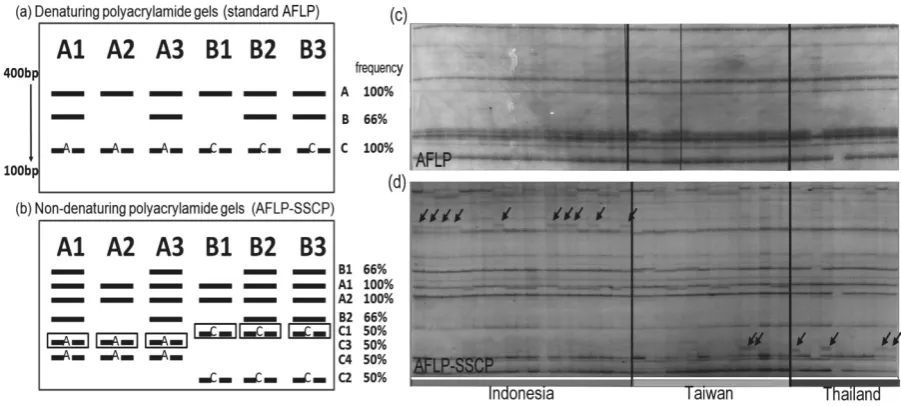
Comparison of AFLP-SSCP profile with AFLP fingerprinting patterns, there were 1.5 - 2 times more bands in AFLP-SSCP. If the frequencies of polymorphic bands between AFLP and AFLP-SSCP were different, it means that the polymorphic bands of AFLP-SSCP were generated by SNPs differences inside the bands (Figure 1). Dried gels were lined up using nicks to isolate targeted AFLP-SSCP bands. A sharp, clean razor blade was used to excise the selected piece of gel. The gel was washed by ddH2O and then transfer to a 0.2 ml tube with 50 ul ddH2O. The band was eluted from the gel by incubation at 4˚C for 24 hours. The tubes were centrifuged at 14,000 rpm for 5 min, and then the supernatant was transferred to a new tube for PCR. The PCR amplifications were conducted on 1ul of supernatant in 20-mL reactions with the following composition: 1× Go Taq Flexi buf-fer, 2.0 mM MgCl2, 0.2 mM each dNTP, 2 pmol each of corresponding selective AFLP primers and 0.1 units Taq (Promega). Cycling parameters were 94˚C for 3 min, followed by 35 cycles of 94˚C for 1 min, 52˚C for 1 min, and 72˚C for 1 min, followed by 72˚C for 2 min. The final products were checked by using 2% agarose gel electrophoresis and purified with QIAquick PCR purification kit (Qiagen, USA). Single strand sequencing was done either with EcoRI-core primer or MseI-core primer by sequencer ABI 3100 (Applied BioSystems, USA). Finally, the sequence data were alignment and checked by BioEdit 7.0 [14].
3. Results
The seven pairs of primer sets yielded a total of 142 scorable bands (size range 100 - 400 bp). Eighty-five bands (59.9%) were monomorphic, and the other 57 polymorphic. Three AFLP selective amplified products (E-ATG/ M-CTA; E-ATC-M-CGT and E-ACT/M-CGC) which contained more monomorphic bands (88.9%, 91.7% and 88.9%) were used in AFLP-SSCP. These three AFLP selective amplified products yielded a total of 35 mono-morphic bands in 39 scorable bands. Fifteen informative AFLP-SSCP bands were obtained from 35 monomor-phic bands (excluding the bands were unclear, too closed to other bands and the frequency below than 5%). Fourteen of 15 AFLP-SSCP bands were success re-amplification and only one band failure to get clear and spe-cific band (Table 1; Figure 2). Ten of 14 re-amplification bands were success to get sequences (Table 1).
4. Discussion
Figure 1. The profile of AFLP and AFLP-SSCP fingerprinting patterns. The PCR products were electrophoresed on 5% de-naturing polyacrylamide gels in (a) and (c) (standard AFLP) and were electrophoresed on 6% non-dede-naturing polyacryla-mide gels in (b) and (d) (AFLP-SSCP), respectively. The band C including SNP was monomorphic in (a), but polymorphic in (b). By comparison of bands frequency, the bands including SNPs could be found. Forty-five samples of Asian Seabass from three different stocks (Indonesia, Taiwan and Thailand) were used in AFLP (c) and AFLP-SSCP (d) analysis. No useful marker for stock discriminating in AFLP fingerprint profile (c); in contrast, two markers (black arrow) were found in AFLP-SSCP fingerprint profile (d). The polymorphic AFLP-SSCP bands were generated by SNPs differences.
Figure 2. The profile of re-amplification bands from AFLP-SSCP bands. Lanes A1 - A12 and Lanes B1 - B6 were obtained from the same AFLP-SSCP band but different individuals, re-spectively. Lanes C - H were garnered from different AFLP-SSCP bands. The white arrows indicate the specific amplifications.
Table 1. Summary of SNPs discovered in sequenced from AFLP-SSCP method.
No. of total AFLP bands 39
No. of monomorphic AFLP bands 35
No. of informative AFLP-SSCP bands 15
No. of success of re-amplification from AFLP-SSCP bands 14
Success of sequencing bands 10
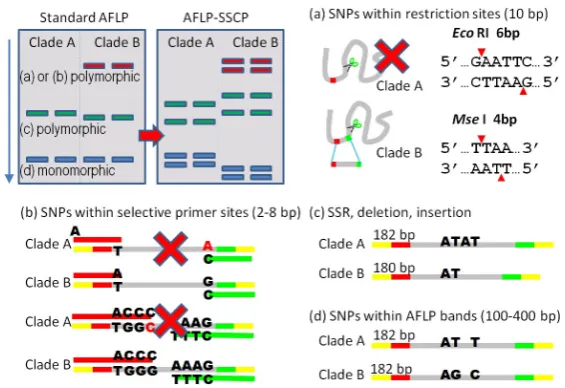
Therefore, useless AFLP markers (low polymorphic and monomorphic bands) could increase detection ability of genetic variation through AFLP-SSCP analysis (Figure 3).
[image:4.595.146.484.570.650.2]Figure 3. Four genetic variation types of standard AFLP and AFLP-SSCP. Genetic variation in AFLP and AFLP-SSCP: (a) SNPs within restriction sites (EcoRI: 6 bp and MseI: 4 bp); (b) SNPs within selective primer sites (EcoRI-ANNN: 1 - 4 bp and
MseI-CNNN: 1 - 4 bp); (c) SSR, deletion and insertion within AFLP bands; (d) SNPs within AFLP bands (band size: 100 - 400). (a), (b) and (c) were polymorphic in stan-dard AFLP and AFLP-SSCP. (d) was monomorphic in stanstan-dard AFLP but polymorphic in AFLP-SSCP.
considered as “informative”. Additionally, all mutations could not be detected by using one electrophoresis con-dition in SSCP analysis [15]. There are many parameters that have been found empirically to affect the sensitiv-ity of SSCP analysis [15]. Therefore, more mutations can be detected by a combination of 2 - 3 different condi-tions [15].
Fourteen of 15 AFLP-SSCP bands were success re-amplification and only one band failure to get clear and specific band (Table 1;Figure 2). The non-specific amplification easily presented in this step, but it usually would be saved by cutting and re-amplifying from multiple copies (each AFLP-SSCP band was cut and re-amplified from at least 5 individual bands). Ten of 14 re-amplification bands were success to get sequences (Table 1). One of the non-specific amplification and 4 failure sequencing re-amplification bands might cause by the multiple size homoplasy templates. Caballero et al. (2008) [16] report that average 10% to 15% of homop-lasy existed in the AFLP analysis, and the significant impact of AFLP homophomop-lasy on its effectiveness. In our experience, using one or two plus four nucleotides selective primers (EcoRI-ANNN and MseI-CNNN) were useful to reduce the AFLP homoplasy.
In the case of directly sequencing of the AFLP-SSCP bands, 71.43% (10 of 14) were generated. Good quality and identical sequence data were obtained for at least 2 additional individual. The size range of the sequenced bands was between 100 - 400 bp. The ten sequences were long enough to design primers, and could be used to re-amplify and sequenced for the genomic DNA sample. These results show that the directly sequencing is available for the conversion of AFLP-SSCP markers into simple PCR markers without cloning. It is also re-ported by Nicod and Largiader (2003) [4].
5. Conclusion
Acknowledgements
We thank Dr. C.-L. Chang (Fisheries Research Institue, TAIWAN) for providing samples and Dr. Z.-Y. Wang (Ji-Mei University, Xiamen, PROC) for technical advice. The work described in this paper was fully supported by grants from the center for Marine Bioscience and Biotechnology (CMBB), National Taiwan Ocean Univer-sity, TAIWAN.
References
[1] Morin, P.A., Luikart, G., Wayne, R.K. and Grp, S.W. (2004) SNPs in Ecology, Evolution and Conservation. Trends in Ecology & Evolution, 19, 208-216. http://dx.doi.org/10.1016/j.tree.2004.01.009
[2] Kim, S. and Misra, A. (2007) SNP Genotyping: Technologies and Biomedical Applications. Annual Review of Bio-medical Engineering, 9, 289-320. http://dx.doi.org/10.1146/annurev.bioeng.9.060906.152037
[3] Garvin, M.R., Saitoh, K. and Gharrett, A.J. (2010) Application of Single Nucleotide Polymorphisms to Non-Model Species: A Technical Review. Molecular Ecology Resources, 10, 915-934.
http://dx.doi.org/10.1111/j.1755-0998.2010.02891.x
[4] Nicod, J.C. and Largiadèr, C.R. (2003) SNPs by AFLP (SBA): A Rapid SNP Isolation Strategy for Non-Model Organ-isms. Nucleic Acids Research, 31, e19. http://dx.doi.org/10.1093/nar/gng019
[5] Bensch, S. and Akesson, M. (2005) Ten Years of AFLP in Ecology and Evolution: Why So Few Animals? Molecular Ecology, 14, 2899-2914. http://dx.doi.org/10.1111/j.1365-294X.2005.02655.x
[6] Meudt, H.M. and Clarke, A.C. (2007) Almost Forgotten or Latest Practice? AFLP Applications, Analyses and Ad-vances. Trends in Plant Science, 12, 106-117. http://dx.doi.org/10.1016/j.tplants.2007.02.001
[7] Liu, Z.J. and Cordes, J.F. (2004) DNA Marker Technologies and Their Applications in Aquaculture Genetics. Aqua-culture, 238, 1-37. http://dx.doi.org/10.1016/j.aquaculture.2004.05.027
[8] Shan, X., Blake, T.K. and Talbert, L.E. (1999) Conversion of AFLP Markers to Sequence-Specific PCR Markers in Barley and Wheat. Theoretical and Applied Genetics, 98, 1072-1078. http://dx.doi.org/10.1007/s001220051169
[9] Meksem, K., Ruben, E., Hyten, D., Triwitayakorn, K. and Lightfoot, D.A. (2001) Conversion of AFLP Bands into High-Throughput DNA Markers. Molecular Genetics and Genomics, 265, 207-214.
http://dx.doi.org/10.1007/s004380000418
[10] Brugmans, B., van der Hulst, R.G.M., Visser, R.G.F., Lindhout, P. and van Eck, H.J. (2003) A New and Versatile Me-thod for the Successful Conversion of AFLP Markers into Simple Single Locus Markers. Nucleic Acids Research, 31, e55. http://dx.doi.org/10.1093/nar/gng055
[11] Zhang, Z.Z., Guo, M.L. and Zhang, J.D. (2009) Identification of AFLP Fragments Linked to Hydroxysafflor Yellow A in Flos Carthami and Conversion to a SCAR Marker for Rapid Selection. Molecular Breeding, 23, 229-237.
http://dx.doi.org/10.1007/s11032-008-9228-9
[12] Vos, P., Hogers, R., Bleeker, M., et al. (1995) AFLP—A New Technique for DNA Fingerprinting. Nucleic Acids Re-search, 23, 4407-4414. http://dx.doi.org/10.1093/nar/23.21.4407
[13] Wang, Z.Y., Tsoi, K.H. and Chu, K.H. (2004) Applications of AFLP Technology in Genetic and Phylogenetic Analysis of Penaeid Shrimp. Biochemical Systematics and Ecology, 32, 399-407. http://dx.doi.org/10.1016/j.bse.2003.10.006
[14] Hall, T.A. (1999) BioEdit: A User-Friendly Biological Sequence Alignment Editor and Analysis Program for Windows 95/98/NT. Nucleic Acids Symposium Series, 41, 95-98.
[15] Nataraj, A.J., Olivos-Glander, I., Kusukawa, N. and Highsmith, W.E. (1999) Single-Strand Conformation Polymor-phism and Heteroduplex Analysis for Gel-Based Mutation Detection. Electrophoresis, 20, 1177-1185.
http://dx.doi.org/10.1002/(SICI)1522-2683(19990101)20:6<1177::AID-ELPS1177>3.0.CO;2-2