http://dx.doi.org/10.4236/jamp.2015.37106
An Algorithm for Medical Imagining
Compression That Is Oriented to
ROI-Characteristics Protection
Renjun Shuai, Yang Shen, Jing Pan
Department of Electronic & Information Engineering, School of Technology, Nanjing Tech University, Nanjing, China
Email: [email protected]
Received 20 May 2015; accepted 12 July 2015; published 15 July 2015
Copyright © 2015 by authors and Scientific Research Publishing Inc.
This work is licensed under the Creative Commons Attribution International License (CC BY). http://creativecommons.org/licenses/by/4.0/
Abstract
In order to protect the ROI (region of interest) characteristics while greatly improving medical imaging compression ratio, we are proposing an algorithm for medical imagining compression that is oriented to ROI-characteristics protection. Firstly, an improved ROI segmentation algo-rithm is put forward based on the analysis of the ROI segmentation. Then, after the ROI segmented, the ROI edge is extracted and encoded with Freeman chain coding. Finally, the ROI is compressed by lossless compression with shearlet; the ROB (region of background) is compressed by the me-thod of high ratio lossy compression combining with Wavelet and Fractal. Simulation results show that the ROI is segmented precisely. It holds edge integrity and has high quality reconstruction processed by the presented method, helping protect ROI characteristics while greatly improving the compression ratio.
Keywords
Medical Imaging Compression, ROI Characteristics Protecting, Segmentation, Chain Coding, Shearlet
1. Introduction
JEPG2000 is the basic method in current medical imaging compression for PACS. The most important thing it did was to support the ROI compression. For example, [1] used a bit-plane lifting algorithm. The quantized ROI wavelet coefficient was coded by SPIHT coding according to bit-planes, improving the quality of the ROI reconstruction quality. After [2] improved [1], the wavelet coefficient was advanced based on the different in-terest level of ROI, reaching the balance between reconstruction quality and compression ratio. Both [1] and [2] acted on the regular rectangular space domain, but imaging segmentation region was often irregular. So [3] pro-posed the plane fitting method, which was simple and easy. And [4] aimed at the different importance of ROI and ROB. ROI and ROB were processed by different methods. The handling targeted had increased compres-sion ratio as well as the PSNR. Nevertheless, these methods did not protect the ROI characteristics. The worst had inaccurate segmentation; the edges were not protected; the reconstruction quality was low; and most of the algorithm was carried out with near-lossless or lossless compression. Therefore, these methods cannot meet the need for high-speed transmission and mass storage of explosive growth of medical imaging [1]-[4].
To solve the above problem, first of all, ROI should be accurately segmented. For this purpose, an improved ROI segmentation algorithm is proposed based on ITTI visual attention model and wavelet analysis. Secondly, to protect the edge of the ROI, freeman chain coding is used to encode ROI edge obtained at the last step of ROI segmentation. Thirdly, in order to improve the compression ratio while maintaining imaging reconstruction quality, ROI and ROB are compressed with different processes; ROI is compressed lossless with shearlet to maintain the integrity of the ROI; and ROB is compressed combining wavelet and fractal method to improve compression ratio. Finally, edge-coded information and ROI and ROB coded information are reconstructed to gain the whole recovery image.
2. ROI Segmentation Analysis and Improvement
There are many ways to segment ROI. The main ways include feature point segmentation, human interaction segmentation, and segmentation based on visual attention mechanism. Among them, feature point segmentation method is applied only to the imaging having a certain type of characteristic. Although human interaction seg-mentation method has a better result, it is strongly influenced by subjective factors. Besides, its efficiency is low, not good for PACS as a large library.
2.1. Fundamental of Segmentation Based on Visual Attention Mechanism
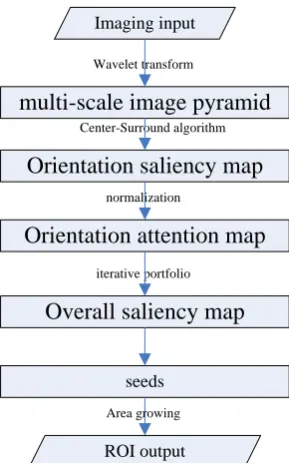
ITTI, proposed by Laurent ITTI on the basis of feature integration theory, is currently the most widely used vis-ual attention model. Firstly, ITTI model structures multi-scale image pyramid by Gaussian filtering method. Then finding the significant point through a series of treatment containing the Center-Surround algorithm, nor-malization, iterative portfolio, RSM (returns suppression mechanism) and WTA (Winner take all) network. Fi-nally it gets ROI by salient points grown [5] [6].
But the multi-scale image pyramid structured by Gaussian filter method is not consistent with the image processing model constructed by the mechanism of human visual attention. Moreover, there is a huge amount of calculation to be done to structure the multi-scale image pyramid with Gaussian filtering method, which is time- consuming.
2.2. Improved ROI Segmentation Algorithm
Wavelet transform is a tool for time-frequency analysis. Multy-resolution feature is its most impeccable property, and wavelet multi-resolution feature is consistent with the human visual system. Therefore it matches the human visual attention mechanism. Comparison of Wavelet and Gaussian image pyramid is shown in figure [1].
As can be seen fromFigure 1, the wavelet image pyramid is visible to human eyes because of the strong con-trast. However, Gaussian image pyramid is round, look vague. And the Gaussian running time is 0.155 s while wavelet is only 0.048 s. Efficiency is improved by 30.97%. Therefore, this paper uses wavelet instead of Gaus-sian to split ROI. Its frame is shown inFigure 2. Comparison of ITTI and Improved algorithm ROI segmenta-tion is shown in figure [3].
(a) (b) (c)
Figure 1. Comparison of Wavelet and Gaussian image pyramid. (a) Source image; (b) Wavelet image pyramid; (c) Gaussian image pyramid.
Imaging input
multi-scale image pyramid
Wavelet transform
Orientation saliency map
Center-Surround algorithm
Orientation attention map
normalization
Overall saliency map
iterative portfolio
seeds
Area growing
[image:3.595.175.457.82.195.2]ROI output
Figure 2. Improved algorithm framework of ROI segmentation.
(a) (b) (c)
Figure 3. Comparison of ITTI and Improved algorithm ROI segmentation. (a) Source image; (b) ITTI segmentation; (c) Improved algorithm segmentation.
80.8%. It has more desired result.
3. Freeman Edge Protection Based on Former ROI Segmentation
[image:3.595.240.385.229.461.2] [image:3.595.173.458.491.605.2]information is transmitted as a component of the compressed information. Finally the code stream has two parts including edge information and transform compressed information of ROI and ROB. Decoder integrated the two parts to get imaging with well protected edge.
3.1. Edge Obtaining Based on Former ROI Segmentation
Traditional way of obtaining edge often uses operator of edge detection, but the detector operators are too sensi-tive to noise (e.g. Prewitt operator and Sobel operator) although they have certain smoothing effect and they have removed part of the pseudo-edge to leave out the real edge. At the same time, the positioning accuracy is not high. Robert operator is not ideal for the imaging with familiar Gaussian noise. The processed edge will be disconnected. In this paper, we get ROI through significant point growing. So obtaining processing can be fi-nished by just preserving the pixels that does not meet region growing criteria. It is convenient and advanced. In this paper, we discuss growing with the 8 neighborhoods, setting the threshold value T as 80, and preserving the pixels t in the storage E [8].
3.2. Freeman Chain Coding
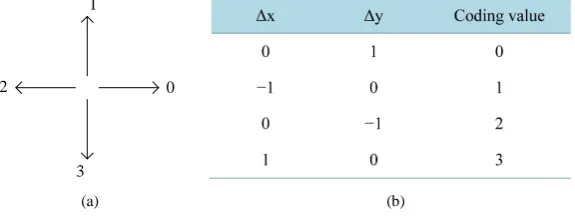
Freeman chain coding is a lossless compression algorithm of image edge. It could use only a small amount of data to store much information. But its criterion is difficult to meet because the criterion is sensitive to noise. However, because of the adequate application of wavelet and its filter characteristic, this paper can use Freeman chain coding to encode edge [9]. The seed was randomly selected from E, using Freeman4 direction chain cod-ing, the Freeman4 direction of the order and Freeman4 Chain code definitions as shown in Figure 4(a) and Figure 4(b)below.
4. The Principle of Compression Algorithms in This Paper
4.1. Compression of ROI
Shearlet was born as a new tool to overcome the limitations of wavelet. Although it has not distributed three high frequency detail sub-image and a low frequency profile sub-image, its image information can be concen-trated on the sub-picture containing the larger coefficient. According to this good sparse features, ROI was compressed based on shearlet in this paper [10]. Furthermore, we found Huffman suitable for the statistical cha-racteristics of ROI significant transform coefficients. So we select shearlet and Huffman to compress ROI to protect the ROI characteristics and improve its reconstruction quality. This article introduces the following steps in the algorithm of ROI the specific compression:
Step 1. Shearlet transform.
Four levels of shearlet are transformed on ROI. Each level generates 10 directional sub-image. Step 2. Quantization.
Threshold of 10 direction transform coefficients, calculates the average value, using the coefficients sum of maximum average value to approximate source image, which is the initial step of compression and de-noising.
Step 3. Entropy coding.
Huffman entropy coding of the selected coefficient [11].
1
2
3
0
[image:4.595.170.458.586.694.2]
(a) (b)
4.2. Compression of ROB
Aiming at these problems that the wavelet compression ratio is not high and the Fractal needs long encoding time. Wavelet and Fractal were combined to compress ROB with high compression ratio and within only a little time. So we just encode low frequency sub-image while eliminating the high-frequency sub-images directly with fractal because imaging energy is always concentrated on those areas after Wavelet transform. The following are the algorithm steps of the ROB specific compression:
Step 1. Four levels of wavelet are transformed on ROB to produce 12 high-frequency sub-image and a low- frequency sub-image. For the wavelet base in this step, a D9/7 wavelet is chosen on the basis of the confirmed experiment [12];
Step 2. High frequency sub-image information is filtered out. The low-frequency sub-image is reconstructed. Fractal encodes the reconstructed image [13] [14].
5. Simulation
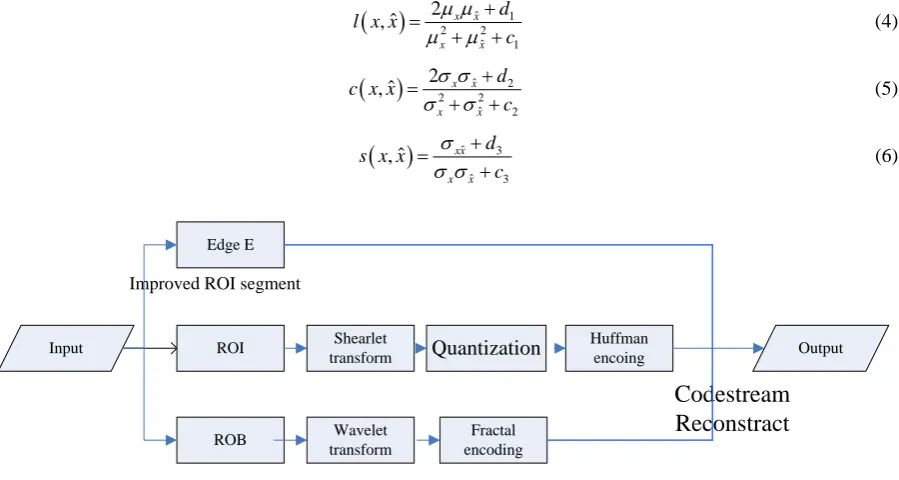
The overall framework of the algorithm is shown inFigure 5. To verify the effectiveness of the proposed me-thod, it is necessary to perform a simulation experiment on the CT imaging of the DICOM standard brain lesion. The Nanjing Health Information Center provide CT imaging, the simulation environment is MATLABR2012b. PSNR and MSSIM are used to make sure the evaluation is objective. The definitions of MSN and PSNR are
( ) ( )
1 1 2
0 0 1
ˆ
MSN , ,
M N
i j
x i j x i j M N
− −
= =
= −
∗
∑ ∑
(1)255 255 PSNR 10 lg
MSN ∗
=
(2)
In the formula, x i jˆ ,
( )
and x i j( )
, are the imaging pixel values of the reconstructed image and the original.MN is the image size. Let x and ˆx be structural similarity,
( )
ˆ( )
ˆ( )
ˆ( )
ˆSSIM x x, = l x x, γ c x x, η s x x, µ (3)
In the formula, µ η γ, , are used to adjust the structure, contrast, and brightness weight factor. The l x x
( )
,ˆ is brightness function, c x x( )
,ˆ is the contrast function, and s x x( )
,ˆ is the structural function. Their definitions are( )
ˆ 12 2
ˆ 1
2 ˆ
, x x
x x
d l x x
c
µ µ
µ µ
+ =
+ + (4)
( )
ˆ 22 2
ˆ 2
2 ˆ
, x x
x x
d c x x
c
σ σ
σ σ
+ =
+ + (5)
( )
ˆ 3ˆ 3
ˆ
, xx
x x
d s x x
c
σ σ σ
+ =
+ (6)
Input ROI ROB Edge E Shearlet transform Quantization Huffman encoing Wavelet transform Fractal encoding Output Improved ROI segment
[image:5.595.89.539.467.707.2]Codestream
Reconstract
where σxxˆ is the covariance. And µx, µxˆ are respectively the standard deviation of x, ˆx. The d d d1, 2, 3 is constant. All SSIM to obtain mean values to get MSSIM is defined as
( )
( )
1 1
ˆ ˆ
MSSIM , SSIM ,
k
i
x x x x
K =
=
∑
(7)K is the number of sub-image.
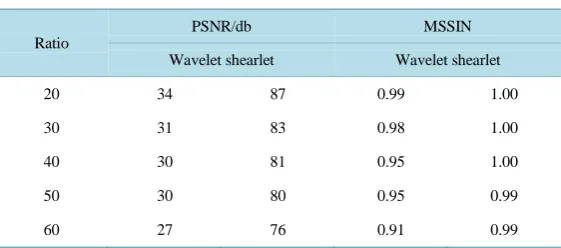
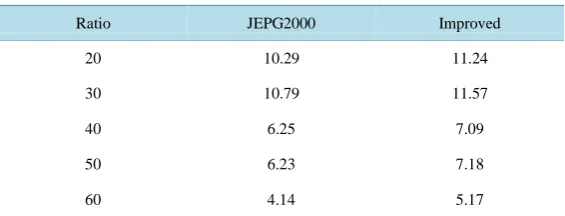
ROI and the whole image were carried out on the compression simulation. As for ROI, comparing classic wavelet with the shealet is used in this article. For the whole image, this paper compares classical JEPG2000 algorithm of PACS with proposed algorithm [15], and records the PSNR and MSSIM value. Compression effect is shown in Figure 6andFigure 7. The results are shown inTable 1 andTable 2, carrying out time comparison is shown inTable 3.
It can be seen inTable 1, Table 2 and Table 3 that although improved algorithm average need 0.9s more carrying out time than JEPG2000, it is worth sacrifice. Because the characteristics of ROI were completely pro-tected. When the ROI compression in low compression ratio, the PSNR value of shearlet is higher than average wavelet’s 51 dB, and the MSSIM value of shearlet is as high as 1.0, ROI information is completely restored, and
Ratio = 40, psnr = 83 db; Ratio = 40, psnr = 31 db; Ratio = 60, psnr = 80 db; Ratio = 60, psnr = 30 db
[image:6.595.86.543.287.534.2](a) (b) (c) (d) (e)
Figure 6. Results of ROI compression. (a) ROI source image; (b) Shearlet; (c) Wavelet; (d) Shearlet; (e) Wavelet.
Ratio = 40, psnr = 38 db; Ratio = 40, psnr = 32 db; Ratio = 60, psnr = 34 db; Ratio = 60, psnr = 31 db
(a) (b) (c) (d) (e)
[image:6.595.93.539.429.546.2]Figure 7. Results of the whole image compression. (a) Whole source image; (b) Improved; (c) JEPG2000; (d) Improved; (e) JEPG2000.
Table 1. ROI compression results contrast.
Ratio
PSNR/db MSSIN
Wavelet shearlet Wavelet shearlet
20 34 87 0.99 1.00
30 31 83 0.98 1.00
40 30 81 0.95 1.00
50 30 80 0.95 0.99
[image:6.595.174.455.594.718.2]Table 2. Whole image compression results contrast.
Ratio
PSNR/db MSSIN
JEPG2000 improved JEPG2000 improved
20 33 41 0.991 0.998
30 32 38 0.978 0.984
40 31 34 0.973 0.982
50 31 34 0.968 0.979
60 30 31 0.949 0.973
Table 3. Time comparison of JEPG2000 and the improved algorithm/s.
Ratio JEPG2000 Improved
20 10.29 11.24
30 10.79 11.57
40 6.25 7.09
50 6.23 7.18
60 4.14 5.17
the reconstruct quality is high. When the whole image compression under the same compression ratio, in the proposed algorithm, the values of PSNR and MSSIM are higher than those of JEPG2000 classic algorithm.
Because theFigure 7 results of the whole image compression can be seen, the reconstructed imaging of com-pression algorithm in this paper is clear, especially the characteristics of the ROI. The segmentation is accurate, and the edge protection is complete.
6. Conclusion
This paper introduced wavelet to ITTI model, whose segmentation accuracy reached to 80.8%. We used the Freeman chain coding to encode the edge of ROI. This method significantly protected the edge, because of the good spare characteristic of shearlet. We also used shearlet to compress ROI. The PSNR value of shearlet was higher than average wavelet’s 51 dB, and the MSSIM value of shearlet was as high as 1.0. In general, the cha-racteristics of ROI were completely protected. Because of the application of the wavelet and its filtering proper-ties, the algorithm in this paper has the noise robustness suitable to mass storage of medical image compression for PACS.
References
[1] Nister, D. and Christopoulos, C. (1998) Lossless Region of Interest with a Naturally Progressive Still Image Coding Algorithm. IEEE Transactions on Image Processing, 3, 856-860. http://dx.doi.org/10.1109/icip.1998.727388
[2] Tahoces, P.G., Varela, J.R. and Ladoetal, M.J. (2008) Image Compression: Maxshift ROI Encoding Options in JPEG2000. Computer Vision and Image Understanding, 109, 139-145. http://dx.doi.org/10.1016/j.cviu.2007.07.001
[3] Ameer, S. and Basir, O. (2009) Image Compression Using Plane Fitting with Inter-Block Prediction. Image and Vision Computing, 27, 385-390. http://dx.doi.org/10.1016/j.imavis.2008.06.005
[4] Li, P., Jiang, H.Q., Yang, X.P. and Liu, Y.M. (2013) Medical Image near Lossless Compression Applicable to PACS. China Image and Graphics, 18, 699-705.
[5] Itti, L. and Kouch, C. (2001) Computational Modeling of Visual Attention. Nature Reviews Neuroscience, 2, 194-230.
http://dx.doi.org/10.1038/35058500
[7] Yang, D.H. (2002) A New Image Compression Algorithm Based on Wavelet Transform and Human Visual System. Chongqing University, Chongqing.
[8] Yu, M. and Pi, Y.Q. (2012) A Extraction Method of the Region of Interest. Electronic Design Engineering, 20, 160- 162.
[9] Liu, Y.K. (2001) The Study of Freeman Chain Code Compression Algorithm. Journal of Computers, 24, 1294-1298. [10] Guo, Q. (2010) Research on Shearlet-Based Statistical Model for Images and Its Applications. Shanghai University,
Shanghai.
[11] Wang, F.X. and Zhou, K. (2008) Huffman Coding to Achieve File Compression and Decompression. Wuhan Poly-technic University, 46-49.
[12] Hu, H. (2010) Research on Medical Image Compression Based on Wavelet Transform. Wuhan University of Technol-ogy, Wuhan.
[13] Tan, Y.S. and Zhou, X.M. (2003) A New Improved Algorithm of Fractal Image Compression. Electronics Technology,
11, 1739-1742.
[14] Yang, Q. and Wang, H.J. (2013) Medical Image Fractal Compression Method Study Based on Multi-Wavelet Trans-form. Science Technology and Engineering, 24, 1671-1815.