http://dx.doi.org/10.4236/ajps.2014.526403
How to cite this paper: Passaia, G., Margis-Pinheiro, M., Fialho, F.B., Sbeghen, F., Porto, D.D. and Revers, L.F. (2014) Cha-racterization of an Early Berry Development Grapevine Somatic Variant (Vitis labrusca L. cv. Isabel Precoce). American Journal of Plant Sciences, 5, 3848-3865. http://dx.doi.org/10.4236/ajps.2014.526403
Characterization of an Early Berry
Development
Grapevine Somatic Variant
(
Vitis labrusca
L. cv. Isabel Precoce)
Gisele Passaia1,2, Márcia Margis-Pinheiro1, Flavio Bello Fialho2, Fernanda Sbeghen2, Diogo Denardi Porto2, Luís Fernando Revers2*
1Laboratory of Plant Molecular Biology, Genetics Department, Federal University of Rio Grande do Sul,
Porto Alegre, Brazil
2Laboratory of Plant Molecular Genetics, Embrapa Grape and Wine, Bento Gonçalves, Brazil
Email: *[email protected]
Received 29 October 2014; revised 28 November 2014; accepted 7 December 2014
Copyright © 2014 by authors and Scientific Research Publishing Inc.
This work is licensed under the Creative Commons Attribution International License (CC BY). http://creativecommons.org/licenses/by/4.0/
Abstract
Over the past 10 years significant advances have been made towards the description of genetics and molecular mechanisms controlling grapevine berry growth. Regardless of this, many aspects of early fruit morphogenesis and its development control remain to be elucidated. In an attempt to understand gene expression patterns associated with the berry growth development, the con-trasting phenotype between the cv. Isabel (Vitis labrusca L.) and its early berry development mu-tant “Isabel Precoce” has been explored by a candidate gene approach. “Isabel Precoce” (Vitis la-brusca L.) was confirmed as an EDV (Essentially Derived Variety) of Isabel, with a 30 - 35-day re-duction in the berry growth phase when compared to the wild type and thus, it constitutes an in-formative model to investigate many aspects of fruit growth and development. Phenotypic analy-sis showed that “Isabel Precoce” develops fruits that are smaller in diameter and volume despite of following similar development kinetics. The expression of many genes associated with plant
growth and development (MIKCC-type MADS box genes), sugar transport and with the control of
flavonoid biosynthetic pathway have been evaluated. The majority of the genes presented a re-markably similar transcription profile. However, a higher induction of transcript accumulation for some genes has been observed in the “Isabel Precoce” genetic background.
Keywords
Fruit Development, Gene Expression, Molecular Biology, Grapevine
1. Introduction
Grapevine produces a fleshy fruit that is initially developed from two carpels separated by a septum, which re-sults from the fusion of both carpels from the central tissue. After fertilization, the grape berry develops in two growth phases, which last approximately 30 and 50 days, respectively, separated by a 10 - 20-day lag phase. The initial growth phase during the first 15 - 30 days is characterized by intense cell division and enlargement asso-ciated with tartaric and malic acid accumulation. The second growth phase results exclusively from cell en-largement associated with the accumulation of hexoses during ripening [1]. Grapes are non-climacteric fruits and given their economic importance, berry ripening has been extensively investigated in the past decade, espe-cially after its genomic sequence was made publicly available [2]. In spite of the advances and efforts made in grape genetics and genomics, little is known about the regulation of its ripening-related genes [3]-[12]. At the molecular level, significant advances have recently been made on the identification of genes involved in the grapevine fruit and flower development [1] [13]-[17]. Boss et al. [18] studied a mutant derived from the cultivar Pinot Meunier, which produces flowers where tendrils are normally formed, and identified a gene homologous to the gibberellic acid insensitive (GAI) from Arabidopsis related to the phenotype. Kobayashi et al. [19] dem-onstrated that the insertion of a retrotransposon in the promoter region of the gene VvMYBA1 is responsible for the absence of colour in white grapes. Fernandez et al. [16] [20] described a “fleshless berry” (Flb) mutant and identified five genes: a specific tissue protein 2, ATH13, a BURP domain protein, PISTILLATA and YABBY2, as candidate genes potentially involved with the phenotype. More recently, the same authors demonstrated that an insertion of a miniature inverted-repeat transposable element in the promoter region of the PISTILLATA-like (VvPI) gene results in a mis-expression pattern of the VvPI gene, impairing proper fruit development in grape-vine [21]. Chatelet et al. [16] also characterized somatic variants that display different abnormal grape flower formation and development; Reiterated Reproductive Meristems (RRM) shows flower clusters with exacerbated ramification causing a delay in flower meristem specification. The RRM mutant phenotype is a result from the VvTFL1A cis-activation caused by an insertion of a class-II transposon in its promoter region, enhancing its ex-pression [22]. Multiple Perianth Whorls (MPW) is impaired in the specification of anther and carpel identity [16]. CLS (Carpel-less) Mouvèdre variant exhibited alterations in the innermost whorls with the development of carpelloid structures. In this analysis, VvMADS1, VvMADS2, VvMADS3, putative orthologues of Arabidopsis
flowering genes AG, SEP and AGL13 respectively, were evaluated by reverse transcription-quantitative PCR and showed differential expression (induction or repression) between the somatic variants compared with wild-types. VvMADS1 was strongly reduced in those somatic variants [16]. A recent detailed review made by Torregrosa et al. [23] describes the sources and the possible mechanisms involved in the somatic variations that have been observed in grapevine and describes other interesting grapevine somatic variants.
The present study describes the characterization of aspects of fruit growth and development from an “Early Berry Development” grapevine mutant known as cv. Isabel Precoce (Precocious Isabel), in which the time of fruit development is 30 - 35 days shorter, when compared to the wild type. “Isabel Precoce” is commercially cultivated in wine-growing regions of Southern Brazil and has agronomic advantages over “Isabel”, such as shorter life cycle, reduced fungicide applications, and less exposure to adverse weather conditions that may compromise yield and quality of the harvest. It is shown here that “Isabel Precoce” cultivar shares the microsa-tellite profile of “Isabel”, indicating that it can be considered as an Essentially Derived Variety (EDV) from “Isabel”. In an attempt to better characterize the early berry development phenotype of “Isabel Precoce”, com-parison of physical and biochemical aspects and gene expression profiles during fruit development were inves-tigated. Transcriptional profiles of a range of genes from different functional classes that are involved in flower and fruit morphogenesis as well as in ripening metabolism were used (e.g. MIKCC-type MADS box genes, sugar transport and control of flavonoid biosynthetic pathway). The results suggest that “Isabel Precoce” develops smaller fruits in diameter and volume, despite of following similar development kinetics and that gene expres-sion profiles in developing berries of “Isabel” and “Isabel Precoce” are remarkably similar. Nevertheless, some differences in gene expression of the two cultivars have been identified, with a higher induction of transcript accumulation being observed in “Isabel Precoce”.
2. Material and Methods
2.1. Plant Material
following the Meier scale [24] or chronologically, when “Isabel” and its EDV “Isabel Precoce” show their marked differences. Individual plants grown under a parral trellis conduction and controlled management at Embrapa Uva e Vinho were used as biological replicates. “Isabel” and “Isabel Precoce” plants were sampled in three growing seasons as described below. In the growing season of 2008/2009, berry samples following the Meier scale at Stage 57 (inflorescences fully developed, flowers separated), Stage 71 (fruit set: young fruits be-ginning to swell, flower remains loose), Stage 75 (berries pea-sized, bunches start to hang) and Stage 81 (begin-ning of ripe(begin-ning: berries begin to brighten in colour—véraison) were harvested and promptly frozen in liquid ni-trogen just after picking in the field. At stage 81, berry samples before (with no color developed) and after onset of ripening (beginning of color development) were collected separately. Samples at Stage 81 were made on dif-ferent days, because “Isabel Precoce” begins ripening early than “Isabel” (Figure 1). Berries were also collected chronologically in the growing season of 2005/2006 at fruit set (FS), 10, 40 and 80 days after fruit set (DAFS), and in the growing season of 2007/2008 at fruit set (FS), 15, 30 and 90 DAFS. For sampling at 80/90 DAFS, “Isabel Precoce” was close to harvest, while “Isabel” was still at véraison. The three types of sampling were used for Real-Time PCR experiments.
The vineyards received, on average, two applications of fungicide per month. The average weather data of the berry growing season, from August to February, was: 921 hours of sunlight, wind speed of 6.6 m/s, 75% air rel-ative humidity, 52 days of precipitation, 588.8 mm of rainfall and air temperature ranging from 16.8˚C to 22.8˚C.
2.2. Physical and Biochemical Aspects of Berry Growth
Berries from three plantsof each cultivar (“Isabel” and “Isabel Precoce”) were harvested for biochemical and molecular analysis at 15, 30 and 90 DAFS in the summer of 2007-2008. For physical analysis, berries were measured twice a week after fruit set until 90 DAFS in the 2007/2008 season. Ten berries from the middle of each of three bunches per plant were randomly selected, measured for diameter (mm) and volume (mm3). Total soluble solids (SST) were also measured using a Palette Atago Pr-101 (0% - 45%) refractometer. Anthocyanins were also quantified as described by the following protocol. Berry skins from samples at the beginning and at the end of maturation were used for phenolic compounds extraction in 4 volumes (weight/volume) of hydroal- coholic solution (12% ethanol, 5.5 g tartaric acid, pH 3.2) during 36 hours at 28% and 100 rpm in absence of light. The samples were centrifuged for 5 min at 10.600 xg and a 2 ml aliquot of the supernatant was filtered in a Millipore HVLP 0.22 µm filter. For all samples, 20 µl was used for the HPLC injection. The anthocyanin quan-tification was done by HPLC using a Shimadzu binary pump system model LC10-AD, an UV-VIS array diode detector model SPD-M10A and a Rheodyne injector. The set was controlled by CLASS LC10 software from the same manufacturer. A C18 reverse phase column was used as the stationary phase and the mobile phase was composed by a gradient of the solvents A (acidified water with 5% formic acid v/v) and B (acidified methanol with 5% formic acid v/v). The solvent flow was 0.8 ml/min. The proportion of solvent B was added linearly from 20% to 100% in 50 minutes. The anthocyanins were identified by comparing retention time and the order of elution using malvidin chloride 3,5-diglucoside (Fluka) as standard. The anthocyanin quantification was de-termined by comparing the peak areas and expressed as total area percentage to all peaks.
Berry diameter and volume data were modeled using the Gompertz growth function, commonly used to de-scribe growth curves [25]-[27]. In order to allow a double sigmoid curve and use parameters of easy interpreta-tion, two Gompertz functions were added and the result was reparameterized into the function given by the equ-ation:
( )
1* exp(
exp(
*(
1)
1)
)
2* exp(
exp(
*(
2)
2)
)
G x =M − K x−P U +M − K x−P U
where:
M1, M2 = maximum size, in mm (diameter) or mm³ (volume) in each of the two phases (total maximum size =
M1 + M2)
P1, P2 = precociousness, in number of days from fruit set to the two inflection points of the curve, where berry size is 36.8% of M1 or M2
U1, U2 = growth period, in days, from the moment when berry size is 10% of M1 or M2 until it reaches 90% of
M1 or M2
K = −3.0844 (constant used to adjust U1 and U2)
x = time, in days after fruit set
M1, M2, P1, P2, U1 and U2 are the six parameters of the model, estimated using field data. Two separate curves were plotted, one for each cultivar. Because data collection ended before cv. Isabel reached vérasion, a simple sigmoid curve was used for that cultivar, by removing the second term of the function (setting M2 = 0, making
P2 and U2 irrelevant). The significance of the difference between the two curves was asserted by testing this two-curve model with an F-test against an alternate model of a single curve combining both cultivars (see Sup-plementary Figure 1).
Statistical analysis was done using the R (2013) software, using non-linear model analysis, comparing curves with an F-test.
2.3. SSR-Based Genetic Identification Analysis
EDV “Isabel Precoce” was verified by genotyping nine microsatellite loci: VVMD36, VVMD27, VVMD8, VVMD7, VVMD7, VVMD6, VVS2, VVS4, VRZAG62, VRZAG72 as described by [30]. The estimated proba-bility of identity between “Isabel” and “Isabel Precoce” was obtained as described by Paetkau et al. [31] using the Identity software [32].
2.4. Selection of Candidate Genes for Real-Time PCR Analysis
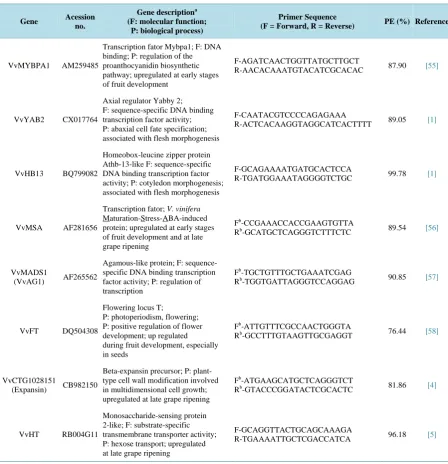
[image:5.595.86.535.258.723.2]In order to compare the normal “Isabel” and precocious “Isabel Precoce” phenotypes, the expression pattern of a range of genes from different functional classes that are potentially involved in flower and fruit morphogenesis as well as in ripening metabolism were screened from the literature and selected for real-time PCR analysis. Transcriptional profiles of the selected genes were then investigated during fruit development between both cul-tivars. The selected candidate genes and their correspondent functional classes are listed in Table 1.
Table 1. Selected genes evaluated between “Isabel” and “Isabel Precoce” fruit development and primers employed in (RT)- qPCR analysis.
Gene Acession
no.
Gene descriptiona
(F: molecular function; P: biological process)
Primer Sequence
(F = Forward, R = Reverse) PE (%) Reference
VvMYBPA1 AM259485
Transcription fator Mybpa1; F: DNA binding; P: regulation of the proanthocyanidin biosynthetic pathway; upregulated at early stages of fruit development
F-AGATCAACTGGTTATGCTTGCT
R-AACACAAATGTACATCGCACAC 87.90 [55]
VvYAB2 CX017764
Axial regulator Yabby 2; F: sequence-specific DNA binding transcription factor activity; P: abaxial cell fate specification; associated with flesh morphogenesis
F-CAATACGTCCCCAGAGAAA
R-ACTCACAAGGTAGGCATCACTTTT 89.05 [1]
VvHB13 BQ799082
Homeobox-leucine zipper protein Athb-13-like F: sequence-specific DNA binding transcription factor activity; P: cotyledon morphogenesis; associated with flesh morphogenesis
F-GCAGAAAATGATGCACTCCA
R-TGATGGAAATAGGGGTCTGC 99.78 [1]
VvMSA AF281656
Transcription fator; V. vinifera Maturation-Stress-ABA-induced protein; upregulated at early stages of fruit development and at late grape ripening
Fb-CCGAAACCACCGAAGTGTTA
Rb-GCATGCTCAGGGTCTTTCTC 89.54 [56]
VvMADS1
(VvAG1) AF265562
Agamous-like protein; F: sequence- specific DNA binding transcription factor activity; P: regulation of transcription
Fb-TGCTGTTTGCTGAAATCGAG
Rb-TGGTGATTAGGGTCCAGGAG 90.85 [57]
VvFT DQ504308
Flowering locus T;
P: photoperiodism, flowering; P: positive regulation of flower development; up regulated during fruit development, especially in seeds
Fb-ATTGTTTCGCCAACTGGGTA
Rb-GCCTTTGTAAGTTGCGAGGT 76.44 [58]
VvCTG1028151
(Expansin) CB982150
Beta-expansin precursor; P: plant- type cell wall modification involved in multidimensional cell growth; upregulated at late grape ripening
Fb-ATGAAGCATGCTCAGGGTCT
Rb-GTACCCGGATACTCGCACTC 81.86 [4]
VvHT RB004G11
Monosaccharide-sensing protein 2-like; F: substrate-specific transmembrane transporter activity; P: hexose transport; upregulated at late grape ripening
F-GCAGGTTACTGCAGCAAAGA
Continued
VvERE TT282A08 Ethylene responsive element; upregulated at late grape ripening
F-TTCAAGTGGACAGCAACACC
R-CATTATGGAGCCTGAGCAGAG 88.22 [5]
VvSP2 BQ796621
Organ-specific protein S2-like; unknown classification; associated with flesh morphogenesis
F-TTGAAGCAGGTACAAGTGGTCT
R-CAATTCACACTCCACACTTCAA 92.03 [1]
VvBURP1 BQ799859 Burp domain-containing protein; associated with flesh morphogenesis
F-AAGGCCAAAACGGAGATAGG
R-TTCAGAGTAGGCCTCGGAAC 54.58 [1]
VvGRIP4 AJ237982
Enhances the cell wall resistance during rapid cell expansion; highly induced during late berry ripening
F-ATGTATACCGACGCCACAA
R-CTCATGGACTACAAGCAAAGAA 92.02 [59]
VvCHS AB066274
Chalcone synthase; F: naringenin- chalcone synthase activity; P: regulation of anthocyanin biosynthetic process; involved in grape berry skin coloration; EC:2.3.1.74
F-TCGGCTGAGGAAGGGCTGAA
R-GGCAAGTAAAGTGGAAACAG 91.16 [60]
VvF3H CX127443
Flavanone 3-hydroxylase; F: naringenin 3-dioxygenase activity; P: flavonoid biosynthetic process; involved in grape berry skin coloration; EC:1.14.11.9
F-GGAGCTTGCTAGGCTCAAGA
R-AGCAGGAGGAGTGGACAAAA 92.82 [20]
VvPAL CX127428
Phenylalanine ammonia-lyase; F: phenylalanine ammonia-lyase activity; P: anthocyanin biosynthetic process; differentially expressed during berry ripening; EC:4.3.1.5
F-TCTGGTGGAAGGAATCCAAG
R-CAAAGTGCCACCAGGTAGGT 90.40 [20]
VvADH2 AF194174
Alcohol dehydrogenase 2; F: S- (hydroxymethyl) glutathione dehydrogenase activity; upregulated at the inception of fruit ripening; EC:1.1.1.1
F-ATTCCAGTCGGCATAAGTGT
R-TTGCAACTGCATAGACATTGTT 92.56 [59]
VvBS1 -
MADS-box sequence-specific DNA binding transcription factor; P: ovule development; P: regulation of double fertilization forming a zygote and endosperm; P: anthocyanin accumulation in tissues in response to UV light; upregulated during berry ripening
Fb-CAAGATGTACCACTGGATTAAGGA
Rb-TCTTGAAGGTGGGGTTGAGT 70.08 [50]
VvBS2 -
MADS-box sequence-specific DNA binding transcription factor; P: regulation of proanthocyanidin biosynthetic process; P:seed development; P:regulation of cell shape; upregulated during berry ripening
Fb-ATATGCCATTGGGAAAAGCA
Rb-TACTGGAGGGTGAGGTCCTG 101.95 [50]
VvSEP3 AF373603
MADS-box sequence-specific DNA binding transcription factor F: DNA binding; F: protein dimerization activity; P:regulation of transcription; upregulated during berry ripening
Fb-TGGGTATCCACGTTTCCCC
Continued
VvAG2 TC62522
Agamous-like Protein; P:carpel development; P: maintenance of floral organ identity; F: protein dimerization activity; P: stamen development; F: MADS-box sequence-specific DNA binding transcription factor; upregulated during berry ripening
Fb-GAACTCATGCCATCTCAGCA
Rb-GAAGAGCTGGTTGGTCTTGG 102.78 [50]
VvAG3 AF373604
Agamous-like Protein; F: MADS-box sequence-specific DNA binding transcription factor; P:regulation of transcription; P:ovule development; F:protein dimerization activity; upregulated during berry ripening
Fb-CATCTGGGCATTTCGATTTT
Rb-GGAGATGAAGTTGGCGGATA 110.25 [50]
VvAGL15.1 -
AgamousMADS-box protein Agl15- like; P:negative regulation of floral organ abscission; P:negative regulation of seed maturation; P:negative regulation of flower development; P: fruit abscission; P: gibberellins catabolic process; P: somatic embryogenesis; F: sequence-specific DNA binding transcription factor activity; P: fruit dehiscence; upregulated during berry ripening
Fb-TGAGGAGCTTCGAGGTTTGG
Rb-TCAGTGGGAAGCCCTAACTG 58.45 [50]
VvAGL15.2 -
Agamous MADS-box protein Agl15-like; P: negative regulation of floral organ abscission; P: negative regulation of seed maturation; P: negative regulation of flower development; P: fruit abscission; P: gibberellin catabolic process; F: sequence-specific DNA binding transcription factor activity; P: fruit dehiscence; upregulated during berry ripening
Fb-GCTCAAGAAGTCCAGGATGC
Rb-GTGTCGGAGCCTCCTCTTTC 132.64 [50]
VvAGL17.1 -
MADS box; P:developmental growth; P: xylan biosynthetic process; P: cell adhesion; P:actin nucleation; P: glucuronoxylan metabolic process; P: organ morphogenesis; F: sequence- specific DNA binding transcription factor activity; upregulated during berry ripening
F-GAGCTACAAAACTGGGGTAATT
R-TCTGCTGCAATTTCAAAGGGAAA 77.09 [50]
VvPI DQ059750
MADS-box transcription fator; F: sequence-specific DNA binding transcription factor activity; P: multicellular organismal development; upregulated during berry ripening
F-AGAGCTGTGAGGGACTACAA
R-GGGTAATGGCTGAAGGAGAATA 94.05 [50]
VvTUBULINAα EC930869
Alpha Tubulin; P: microtubule- based movement; F: structural molecule activity; used as reference gene for RT-qPCR analysis
F-CAGCCAGATCTTCACGAGCTT
R-GTTCTCGCGCATTGACCATA 122.63 [33]
VvACT EC969944
Actin; P: cell division;
F: ATP binding; used as reference gene for RT-qPCR analysis
F-CTTGCATCCCTCAGCACCTT
R-TCCTGTGGACAATGGATGGA 82.03 [33]
a
2.5. Total RNA Isolation and Real-Time PCR Analysis
Total RNA was isolated from 100 - 150 mg of ground frozen tissues from pooled berries (whole berries, includ-ing skin and seeds) with Pure link® Plant RNA Reagent (Invitrogen), following the manufacturer’s protocol. The quality of RNA was verified by agarose gel electrophoresis and by the absorbance ratio A260/280 range from 1.8 to 2.0. Total RNA (0.5 μg) from all samples was treated with DNase I, followed by immediate double-strand cDNA synthesis using the SMART cDNA Synthesis Kit (Clontech) according to manufacturer’s instructions. Complementary DNA samples (10 μl, 100× diluted) from stages 57, 71 and 81 (2008/2009); 15, 30 and 90 DAFS (2007/2008) and 10, 40 and 80 DAFS (2005/2006) were added to each PCR reaction mix containing, 4 μM each primer, 1× SYBR Green, 50 µM dNTP, 1× PCR reaction buffer, 2 mM MgCl2 and 0.25 U Platinum Taq DNA Polimerase (Invitrogen) in a final volume of 20 μl. Thermocycling conditions were as follows: an ini-tial enzyme activation of 5 min at 95˚C, followed by 40 cycles of denaturation for 15 s at 94˚C, anneling for 10 s at 60˚C, and extension for 15 s at 72˚C. The samples were kept at 40˚C for 120 s, followed by a melting point assay from 55˚C to 99˚C. The real-time PCR reactions were carried out in an Applied Biosystems StepOne Plus Real-Time PCR System. All templates were run in technical quadruplicates and three biological replicates. Sample values were normalized using the corresponding expression level of actin (VvACT), α-tubulin (Vv
αTUBULIN) (data not shown) and expressed as the average standard deviation [33]. Specificity of the PCR product generated for each set of primers was tested by the melting gradient. The difference between the cycle threshold (Ct) of the target gene and the Ct of the constitutive genes established was used to obtain the norma-lized expression of the target genes, which corresponds to 2−ΔΔCt [34]. The statistical analyses were made by means of the Student t test with p < 0.05. The relative expression of each gene was gene-wise normalized using Genesis software [35]. Hierarchical clustering of gene expression data was performed using the Pearson correla-tion tool of the same software. Primer efficiencies were estimated according to Ramakers et al. [36] and Ruijter
et al. [37] added to Table 1.
3. Results and Discussion
3.1. Description and Confirmation of Cultivar Clonal Identity
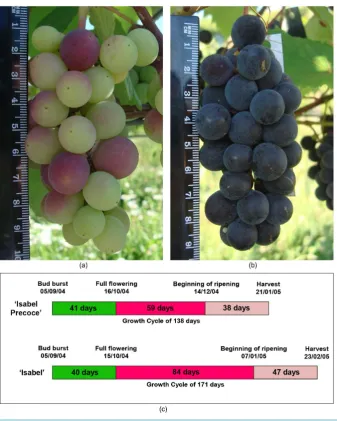
“Isabel Precoce” was identified in 1993 in a vineyard in Farroupilha, Rio Grande do Sul (Brazil; latitude: 29˚13′30″S, longitude: 51˚20′52″W) on a grapevine (Vitis labrusca L., cv Isabel) plant as a spontaneous somatic variant. The original plant was maintained in situ and cuttings were later grafted and propagated at Embrapa Uva e Vinho, in Bento Gonçalves (latitude: 29˚09′44″S, longitude: 51˚30′50″W), Rio Grande do Sul, Brazil, under the germplasm bank registration code 2526 [38]. “Isabel Precoce” plants were then followed for five pro-duction seasons to verify their phenotype, morphological and biochemical characteristics. As a result, the “Isabel Precoce” plants showed the same general phenotypic traits of “Isabel” and confirmed its early-ripening pheno-typic stable feature, with an average harvest date of 33 days before its parental cultivar “Isabel” [38]. The growth cycle reduction occurs between flowering and harvest, particularly between flowering and the beginning of ripening (véraison—stage 81), when “Isabel Precoce” shows an accelerated early green berry development (see Figure 1(c)). “Isabel Precoce” was also cultivated in a semi-commercial scale in tropical areas of Brazil and demonstrated the same stable characteristics as in the south, where the climate is sub-tropical. Additionally, “Isabel Precoce” presents a remarkably even ripening of bunches when compared to “Isabel”, which ripens un-evenly, with frequent occurrence of green berries in otherwise ripe bunches. The precociousness and uniform ripening of “Isabel Precoce” is greatly appreciated by farmers since the grapes can reach higher economic value.
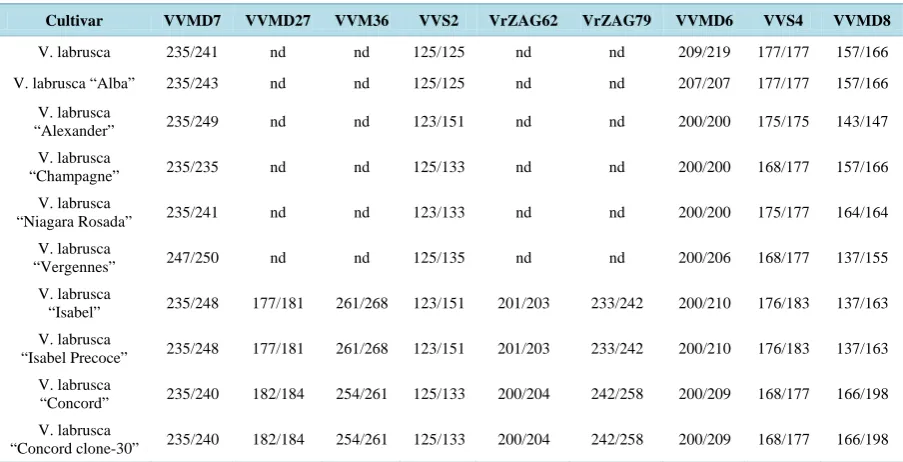
Table 2.Microssatelite allele profiles of Vitis labrusca cultivars compared with “Isabel” and “Isabel Precoce”. Allele sizes are indicated in base pairs. nd = not determined.
Cultivar VVMD7 VVMD27 VVM36 VVS2 VrZAG62 VrZAG79 VVMD6 VVS4 VVMD8
V. labrusca 235/241 nd nd 125/125 nd nd 209/219 177/177 157/166
V. labrusca “Alba” 235/243 nd nd 125/125 nd nd 207/207 177/177 157/166
V. labrusca
“Alexander” 235/249 nd nd 123/151 nd nd 200/200 175/175 143/147
V. labrusca
“Champagne” 235/235 nd nd 125/133 nd nd 200/200 168/177 157/166
V. labrusca
“Niagara Rosada” 235/241 nd nd 123/133 nd nd 200/200 175/177 164/164
V. labrusca
“Vergennes” 247/250 nd nd 125/135 nd nd 200/206 168/177 137/155
V. labrusca
“Isabel” 235/248 177/181 261/268 123/151 201/203 233/242 200/210 176/183 137/163
V. labrusca
“Isabel Precoce” 235/248 177/181 261/268 123/151 201/203 233/242 200/210 176/183 137/163
V. labrusca
“Concord” 235/240 182/184 254/261 125/133 200/204 242/258 200/209 168/177 166/198
V. labrusca
“Concord clone-30” 235/240 182/184 254/261 125/133 200/204 242/258 200/209 168/177 166/198
3.2. Physical and Biochemical Changes during Fruit Development
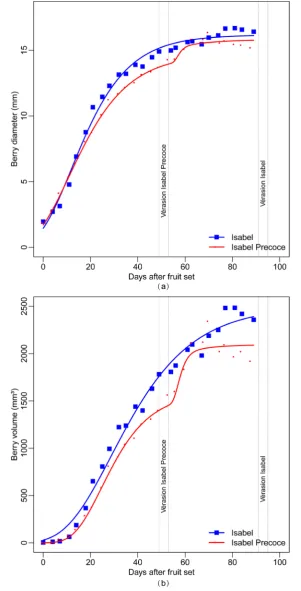
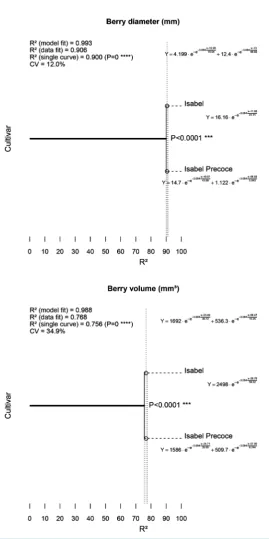
In order to monitor fruit development differences between “Isabel” and “Isabel Precoce”, berries diameter and volume were measured. As shown in Figure 2, the Gompertz growth curves model berry growth adequately, both as diameter (R2 = 0.993) and volume (R2 = 0.988).
In the general comparison of the growth curves (both volume and diameter), a significant difference was de-tected (p < 0.0001) between both cultivars. Maximum diameter and volume estimated by the model were, re-spectively, 16.16 mm and 2498 mm3 for Isabel after the first growth phase, and 15.82 mm and 2096 mm3 for Isabel Precoce after both growth phases. It is expected that after the second growth phase, diameter and volume of Isabel will be even greater, emphasizing the smaller fruit size of Isabel Precoce. Maximum diameter and vo-lume growth speed in the first phase were reached at 11.9 and 28.8 days after fruit set for Isabel, and 11.0 and 24.7 days for Isabel Precoce, respectively. Maximum growth speeds in the second phase of Isabel Precoce were reached at 56.8 days for diameter and 57.0 days for volume. The main growth period (10% to 90% of total growth) of diameter and volume of the first phase lasted 41.7 and 59.3 days for Isabel, and 44.0 and 36.0 days for Isabel Precoce, respectively. Although the diameter results apparently conflict with the volume results, graph analysis combined with the small difference between cultivars suggests that the lag phase between the two growth phases is larger in Isabel than in Isabel Precoce. The growth curves of Isabel Precoce are always similar or below the growth curves of Isabel, as seen in Figure 2. This suggests that the precociousness of “Isabel Pre-coce” is not related to accelerated berry growth. The main growth period of the second phase of Isabel Precoce lasted 5.0 days for diameter and 6.7 days for volume. The experiment ended with the harvest of Isabel Precoce, which occurred before vérasion in Isabel, therefore data for the second growth phase of Isabel is not available. Historic phenological data (Figure 1) has shown that, regardless of environmental conditions, the harvest point of Isabel Precoce has always been between 25 and 30 days before Isabel.
The content of total soluble solids (TSS) was also monitored for both cultivars. The TSS for “Isabel Precoce” was around 17.5˚Brix at 90 days after fruit set (ready for harvest). For “Isabel”, the content of total soluble sol-ids at 90 DAFS—33 days before harvest—was around 14.9˚Brix. This difference in the TSS at the same time for both cultivars indicates that an accelerated biochemical process takes place earlier in “Isabel Precoce” when compared with “Isabel”. This parameter indicates a physiological difference between both cultivars, suggesting that precocity may be more closely related to changes in metabolic and biochemical characteristics. However, this difference is not clearly reflected in the diameter and volume parameters, as seen inFigure 2, which shows approximately the same development cycle for both cultivars. In both time scale (DAFS) and development scale [24] sampling, the same pattern of early berry development of “Isabel Precoce” was observed in biochemical and metabolic characteristics and also in gene expression profiles.
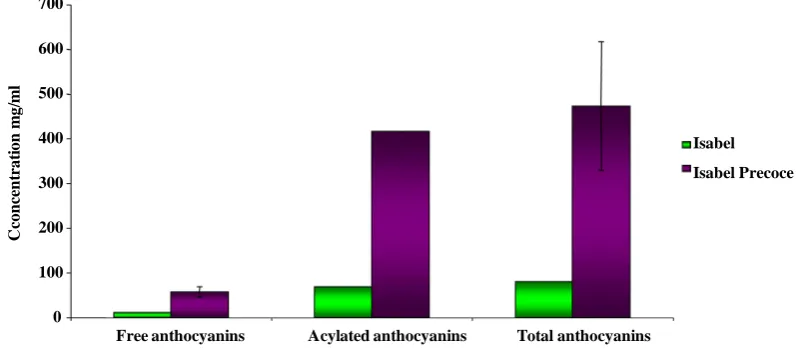
Anthocyanin content was measured using HPLC for both cultivars (SupplementaryFigure 2). “Isabel Precoce” berry skin contains, on average, ten times more anthocyanins (A520 = 473.252 mg/ml fresh weight) than Isabel (45.304 mg/ml fresh weight) at 90 DAFS, confirming that the early anthocyanin accumulation marks the begin-ning of véraison in colored cultivars. Total anthocyanin accumulation were similar to other colored vinifera-type cultivars [20], with Malvidin being the preferential predominant form. Acylated forms were predominant in the berry skin extracts from both cultivars. At 90 DAFS, when “Isabel Precoce” is ready to be harvested and “Isabel” is at véraison, “Isabel Precoce” had a free anthocyanin accumulation average of 57 mg/ml and 416 mg/ml of acylated anthocyanins. Isabel accumulated an average of 11 mg/ml of free anthocyanins and 69 mg/ml of acy-lated anthocyanins. Malvidin was the predominant free anthocyanin in “Isabel Precoce” extract, representing about 75% of total anthocyanins, whereas in “Isabel”, the most abundant free anthocyanin was cyanidin (36.8%).
3.3. Expression Profiles of Candidate Genes by Real-Time PCR
Analyses of gene expression under field conditions represents a challenge, since variation in environmental con-ditions can influence gene expression and ultimately grape berry ripening [46]-[49]. To compare and partially avoid environmental effects, two sampling strategies were used. The first was based on monitoring develop-mental stages and the second was time dependent. Individual plants grown under a parral trellis conduction and managed with controlled fertilization were used as biological replicates. The same plants were sampled as pre-viously described in the materials and methods section.
In order to compare the ripening process of “Isabel” and “Isabel Precoce”, the expression patterns of a range of genes from different functional classes selected from the literature (listed in Table 1) were evaluated. The se-lection of the candidate genes followed a strategy based on gene description and its known association with dis-tinct berry ripening phases and processes. Thus, since development of the berry skin color is the most remarka-ble phenotypic difference observed, three genes (VvMYBPA1, VvCHS and VvPAL) belonging to the phenyl-propanoid metabolic pathway were selected (see Table 1). In an attempt to cover all the ripening phases, genes associated with flesh morphogenesis, cell expansion and known to be upregulated at early or late berry ripening stages were also selected, totalizing twenty five genes.
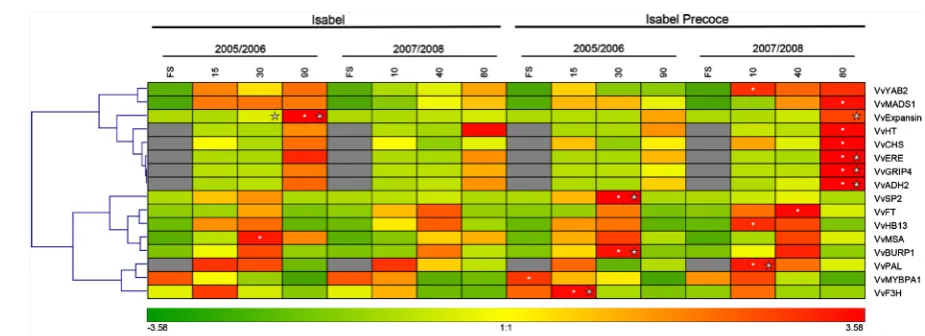
Initially, the gene expression analyses were performed using time-dependent sampling points collected during two different growing cycles (2005/2006 and 2007/2008 seasons), using a set of sixteen genes as shown in Fig-ure 3. Genotypic and environmental effects were analyzed in order to detect differences in expression patterns between growing seasons and cultivars.
Hierarchical clustering analysis of gene expression patterns allowed the identification of two major clusters of transcription profiles that corresponded to genes preferentially expressed during in early and late stages of the berry development. At late ripening stages, the first cluster groups eight genes (VvExpansin, VvGRIP4, VvERE, VvADH2, VvCHS, VvMADS1, VvYAB2 and VvHT) with conserved expression patterns in both seasons and between cultivars. This cluster of genes presented the expected expression pattern as described in the literature referred on Table 1, being upregulated in the late stage of berry ripening, where important ripening metabolic processes (VvERE, VvCHS, VvADH2 and VvHT) and rapid cell expansion (VvExpansin, VvYAB2, VvMADS1, VvGRIP4) takes place.
Figure 3. Hierarchical clustering analysis of gene expression in “Isabel” and “Isabel Precoce” during fruit development for selected candidate genes (see Table 2 for details). Average intensity values are represented by a color scale for samples cor-responding to fruit set (FS), 15, 30 and 90 DAFS for the growing season of 2005/2006 and fruit set (FS), 10, 40 and 80 DAFS for the growing season of 2007/2008. Expression analyses were performed by real-time PCR and relative gene pression data were normalized with VvActin and VvGAPDH. White points indicate the sample with absolute maximum ex-pression for a gene measured in the experiment. Stars indicate statistical difference (p ≤ 0.05) between cultivars for the cor-respondent sample. Grey boxes indicate absence of gene expression.
development (Figure 1(c)). The observed transcription profiles for these genes are in accordance to the literature description, as referred in Table 1. The maximum absolute level of transcription was generally observed in Isa-bel Precoce samples, especially at the late stages of berry ripening, in agreement with the phenotypic characte-rization (Figure 1(c) and Figure 3).
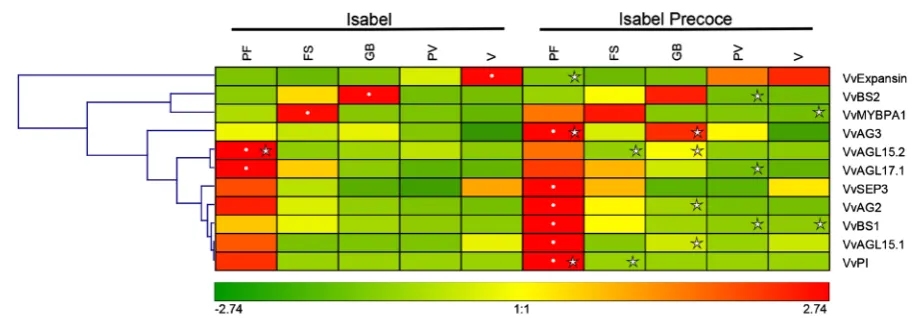
Genome-wide expression analyses of MIKCC-type MADS Box genes during grapevine development sug-gested the recruitment of specific genes to regulate the development of specific grapevine organs, such as tendrils and berry fruits [50]. Therefore, gene expression profiles of seven MIKCC-type subfamily members were inves-tigated: VvBS, VvSEP, VvAG, VvAGL15, VvAGL17.1, VvPI and VvAP3. In total, nine genes were evaluated in five representative stages of berry development during the growing season of 2008/2009. These genes were chosen because they are related to the establishment of the identity of floral meristems and were also identified during fruit development without a defined function [50]. For this analysis, VvMYBPA1 and VvExpansin genes were used as internal references, since their expression profiles are known to be upregulated at early and late stages of fruit development, respectively [4] [13] (and Figure 3). As shown in Figure 4, cluster analysis of gene expression profiles identified a main cluster of seven genes (VvBS1, VvSEP3, VvAG2, VvAG3, VvAGL15.1, VvAGL15.2, VvAGL17.1 and VvPI) that showed the highest expression levels at the pre-flowering (PF) stage for both cultivars, with a relevant downregulation in the following stages (FS, GB, PV and V), while VvBS2 presented a reverse kinetics. VvAG3 showed a distinct transcription profile between the cultivars, being signifi-cantly upregulated at pea-sized green berries (GB) in “Isabel Precoce” when compared to “Isabel”. Except for VvPI, VvAG2, VvAG3 and VvAGL15.2, the gene expression profiles observed for VvAGL15.1, VvBS1, VvBS2, VvSEP3 and VvAGL17.1 in our experiments followed an inverse kinetics across the developmental stages analyzed, when compared to the data reported by Riaz-Riquelme et al. [50]. This may be the result of inter- specific variation between V. labrusca (“Isabel” and “Isabel Precoce”) and the V. vinifera cultivar cv. Tempra-nillo. The VvAG3 contrasting transcription profiles observed between “Isabel” and “Isabel Precoce” (Figure 4), combined with literature information, prompted us to better investigate its possible association with the preco-cious phenotype from “Isabel Precoce”. The grapevine gene VvAG3 (also known as VvAGL11) is homologous
to Arabidopsis gene AGL11 [18] that was shown to be expressed in developing ovules [51]. These genes are
Figure 4.Hierarchical clustering analysis of gene expression in “Isabel” and “Isabel Precoce” during fruit development for selected candidate genes (seeTable 2 for details). Average intensity values are represented by a color scale for samples cor-responding to flowers (F), fruit set (FS), pea-sized green berries (GB), pre-véraison (PV) and véraison (V). Expression ana-lyses were performed by real-time PCR and relative gene expression data were normalized with VvActin and VvGAPDH. The white dots denote the maximum average level of gene expression for the different development stages in the experiment. Stars indicate statistical difference (p≤ 0.05) between cultivars at same stage of fruit development. Grey boxes indicate ab-sence of gene expression.
[54]. Therefore, it is tempting to speculate that the higher expression observed for VvAG3 gene in “Isabel Pre-coce” may help the seeds to follow a more uniform maturation process, which can result in synchronized and accelerated fruit development, mediated by smaller variations in hormonal production by the seed. This alterna-tive interpretation is supported by the remarkable even ripening of the “Isabel Precoce” bunches, when com-pared to “Isabel”.
In the perspective of the data generated by this work, comparing physical and biochemical aspects and gene expression profiles during fruit development between “Isabel” and its derived mutant “Isabel Precoce”, we were able to describe an unique early berry development somatic variant in grapevine. In summary, the results sug-gest that “Isabel Precoce” develops smaller fruits and that transcriptional profiles of selected candidate genes in developing berries of “Isabel” and “Isabel Precoce” are remarkably similar. However, some differences in gene expression between the two cultivars have been identified, with a general higher induction of transcript accumu-lation being observed in “Isabel Precoce” (Figure 3 andFigure 4). The data obtained here provide the initial clues to guide the generation of additional knowledge associated with the early berry development phenotype. We are currently performing a genetic analysis approach in order to evaluate the heritability of this trait and to narrow the search for genes and genomic regions associated with the precocious berry development.
Acknowledgements
We are grateful to M.Sc. Umberto Almeida Camargo for providing us information and data from “Isabel Pre-coce” which were used to guide our experiments. This work was supported by CAPES (Coordenação de Aper- feiçoamento de Pessoal de Nível Superior), CNPq (Conselho Nacional de Desenvolvimento Científico e Tecnológico Proc. 475440/2004-8), FAPERGS (Fundação de Amparo à Pesquisa do Estado do Rio Grande do Sul Proc. 04/1184.6) and Embrapa.
References
[1] Fernandez, L., Torregrosa, L., Terrier, N., Sreekantan, L., Grimplet, J., Davies, C., et al. (2007) Identification of Genes Associated with Flesh Morphogenesis during Grapevine Fruit Development. Plant Molecular Biology, 63, 307-323.
http://dx.doi.org/10.1007/s11103-006-9090-2
[2] Jaillon, O., Aury, J.M., Noel, B., Policriti, A., Clepet, C., Casagrande, A., et al. (2007) The Grapevine Genome Se-quence Suggests Ancestral Hexaploidization in Major Angiosperm Phyla. Nature, 449, 463-467.
http://dx.doi.org/10.1038/nature06148
[4] Goes, F., Iandolino, A., Al-kayal, F., Bohlmann, M.C., Cushman, M.A., Lim, H., et al. (2005) Characterizing the Grape Transcriptome Analysis of Expressed Sequence Tags from Multiple Vitis Species and Development of a Com-pendium of Gene Expression during Berry Development. Plant Physiology, 139, 574-597.
http://dx.doi.org/10.1104/pp.105.065748
[5] Terrier, N., Glissant, D., Grimplet, J., Barrieu, F., Abbal, P., Couture, C., et al. (2005) Isogene Specific Oligo Arrays Reveal Multifaceted Changes in Gene Expression during Grape Berry (Vitis vinifera L.) Development. Planta, 222, 832-847. http://dx.doi.org/10.1007/s00425-005-0017-y
[6] Waters, D.L.E., Holton, T. A., Ablett, E.M., Slade, L. and Henry, R.J. (2006) The Ripening Wine Grape Berry Skin Transcriptome. Plant Science, 171, 132-138. http://dx.doi.org/10.1016/j.plantsci.2006.03.002
[7] Zamboni, A., Minoia, L., Ferrarini, A., Tornielli, G.B., Zago, E., Delledonne, M., et al. (2008) Molecular Analysis of Post-Harvest Withering in Grape by AFLP Transcriptional Profiling. Journal of Experimental Botany, 59, 4145-4159.
http://dx.doi.org/10.1093/jxb/ern256
[8] Zamboni, A., Di Carli, M., Guzzo, F., Stocchero M., Zenoni, S., Ferrarini, A., et al. (2010) Identification of Putative Stage-Specific Grapevine Berry Biomarkers and Omics Data Integration into Networks. Plant Physiology, 154, 1439-1459. http://dx.doi.org/10.1104/pp.110.160275
[9] Zenoni, S., Ferrarini, A., Giacomelli, E., Xumerle, L., Fasoli, M., Malerba, G., et al. (2010) Characterization of Tran-scriptional Complexity during Berry Development in Vitis vinifera Using RNA-Seq. Plant Physiology, 152, 1787-1795.
http://dx.doi.org/10.1104/pp.109.149716
[10] Lijavetzky, D., Carbonell-Bejerano, P., Grimplet, J., Bravo, G., Flores, P., Fenoll, J., et al. (2012) Berry Flesh and Skin Ripening Features in Vitis vinifera as Assessed by Transcriptional Profiling. PLoS One, 7, e39547.
http://dx.doi.org/10.1371/journal.pone.0039547
[11] Tornielli, P.M., Zamboni, A., Zenoni, S. and Delledonne, M. (2012) Transcriptomics and Metabolomics for the Analy-sis of Grape Berry Development. In: Geros, S.D.H. and Chavez, M.M., Eds., The Biochemistry of the Grape Berry, Bentham Science Publishers, Sharjan, 218-240.
[12] Fasoli, M., Dal Santo, S., Zenoni, S., Tornielli, G.B., Farina, L., Zamboni, A., et al. (2012) The Grapevine Expression Atlas Reveals a Deep Transcriptome Shift Driving the Entire Plant into a Maturation Program. Plant Cell, 24, 3489- 3505. http://dx.doi.org/10.1105/tpc.112.100230
[13] Boss, P.K., Sensi, E., Hua, C., Davies, C. and Thomas, M.R. (2002) Cloning and Characterisation of Grape Vine (Vitis vinifera L.) MADS-Box Genes Expressed during Inflorescence and Berry Development. Plant Science, 162, 887-895.
http://dx.doi.org/10.1016/S0168-9452(02)00034-1
[14] Boss, P.K., Vivier, M., Matsumoto, S., Dry, I.B. and Thomas, M.R. (2001) A cDNA from Grapevine (Vitis vinifera L.), Which Shows Homology to AGAMOUS and SHATTERPROOF, Is Not Only Expressed in Flowers but Also throughout Berry Development. Plant Molecular Biology, 45, 541-553. http://dx.doi.org/10.1023/A:1010634132156
[15] Carmona, M.J., Cubas, P. and Martínez-Zapater, J.M. (2002) VFL, the Grapevine FLORICAULA/LEAFY Ortholog Is Expressed in Meristematic Regions Independently of Their Fate. Plant Physiology, 130, 69-77.
http://dx.doi.org/10.1104/pp.002428
[16] Chatelet, P., Laucou, V., Fernandez, L., Sreekantan, L., Lacombe, T., Martinez-Zapater, J.M., et al. (2007) Characteri-zation of Vitis vinifera L. Somatic Variants Exhibiting Abnormal Flower Development Patterns. Journal of Experi-mental Botany, 58, 4107-4118. http://dx.doi.org/10.1093/jxb/erm269
[17] Fernandez, L., Romieu, C., Moing, A., Bouquet, A., Maucourt, M., Thomas, M.R., et al. (2006) The Grapevine Flesh-less Berry Mutation. A Unique Genotype to Investigate Differences between Fleshy and Nonfleshy Fruit. Plant Physi-ology, 140, 537-547. http://dx.doi.org/10.1104/pp.105.067488
[18] Boss, P.K. and Thomas, M.R. (2002) Association of Dwarfism and Floral Induction with a Grape “Green Revolution” Mutation. Nature, 416, 847-850. http://dx.doi.org/10.1038/416847a
[19] Kobayashi, S., Goto-yamamoto, N. and Hirochika, H. (2004) Retrotransposon-Induced Mutations in Grape Skin Color.
Science, 304, 982. http://dx.doi.org/10.1126/science.1095011
[20] Ageorges, A., Fernandez, L., Vialet, S., Merdinoglu, D., Terrier, N. and Romieu, C. (2006) Four Specific Isogenes of the Anthocyanin Metabolic Pathway Are Systematically Co-Expressed with the Red Color of Grape Berries. Plant Science, 170, 372-383. http://dx.doi.org/10.1016/j.plantsci.2005.09.007
[21] Fernandez, L., Chaïb, J., Martinez-Zapater, J.M., Thomas, M.R. and Torregrosa, L. (2013) Mis-Expression of a
PISTILLATA-Like MADS Box Gene Prevents Fruit Development in Grapevine. Plant Journal, 73, 918-928.
http://dx.doi.org/10.1111/tpj.12083
[22] Fernandez, L., Torregrosa, L., Segura, V., Bouquet, A. and Martinez-Zapater, J.M. (2010) Transposon-Induced Gene Activation as a Mechanism Generating Cluster Shape Somatic Variation in Grapevine. Plant Journal, 61, 545-557.
[23] Torregrosa, L., Fernandez, L., Bouquet, A., Boursiquot, J.M., Pelsy, F. and Martínez-Zapater, J.M. (2011) Origins and Consequences of Somatic Variation in Grapevine. In: Kole, C., Ed., Genetics, Genomics, and Breeding of Grapes, Science Publishers, Enfield, 68-92.
[24] Meier, U. (2001) Growth Stages of Mono and Dicotyledonous Plants. BBCH Monograph, Federal Biological Research Centre for Agriculture and Forestry, Bonn.
[25] Fialho, F. (1999) Interpretação da Curva de Crescimento de Gompertz. Embrapa Suínos e Aves. Comunicado técnico, Concórdia, 237.
[26] Gompertz, B. (1825) On the Nature of the Function Expressive of the Law of Human Mortality, and on a New Mode of Determining the Value of Life Contigencies. Philosophical Transactions of the Royal Society of London, 115, 513-583.
http://dx.doi.org/10.1098/rstl.1825.0026
[27] Windsor, C.P. (1932) The Gompertz Curve as a Growth Curve. Proceedings of the National Academy of Sciences of the United States of America, 18, 1-8. http://dx.doi.org/10.1073/pnas.18.1.1
[28] Lodhi, M.A., Ye, G.N., Weeden, N.F. and Reisch, B.I. (1994) A Simple and Efficient Method for DNA Extraction from Grapevine Cultivars and Vitis Species. Plant Molecular Biology Report, 12, 6-13.
http://dx.doi.org/10.1007/BF02668658
[29] Lefort, F. and Douglas, G.C. (1999) An Efficient Micro-Method of DNA Isolation from Mature Leaves of Four Hard-wood Tree Species Acer, Fraxinus, Prumus and Quercus. Annals of Forest Sciences, 56, 259-263.
http://dx.doi.org/10.1051/forest:19990308
[30] This, P., Jung, A., Boccacci, P., Borrego, J., Botta, R., Costantini, L., et al. (2004) Development of a Standard Set of Microsatellite Reference Alleles for Identification of Grape Cultivars. Theoretical and Applied Genetics, 109, 1448- 1458. http://dx.doi.org/10.1007/s00122-004-1760-3
[31] Paetkau, D., Calvert, W., Stirling, I. and Strobeck, C. (1995) Microsatellite Analysis of Population Structure in Cana-dian Polar Bears. Molecular Ecology, 4, 347-354. http://dx.doi.org/10.1111/j.1365-294X.1995.tb00227.x
[32] Wagner, H.W. and Sefc, K.M. (1999) Identity 1.0. University of Agricultural Sciences, Vienna.
[33] Reid, K.E., Olsson, N., Schlosser, J., Peng, F. and Lund, S.T. (2006) An Optimized Grapevine RNA Isolation Proce-dure and Statistical Determination of Reference Genes for Real-Time RT-PCR during Berry Development. BMC Plant Biology, 6, 27. http://dx.doi.org/10.1186/1471-2229-6-27
[34] Livak, K.J. and Schmittgen, T.D. (2001) Analysis of Relative Gene Expression Data Using Real-Time Quantitative PCR and the 2−∆∆CTMethod. Methods, 25, 402-408. http://dx.doi.org/10.1006/meth.2001.1262
[35] Sturn, A. and Quackenbush, J. (2002) Genesis: Cluster Analysis of Microarray Data. Bioinformatics, 18, 207-208.
http://dx.doi.org/10.1093/bioinformatics/18.1.207
[36] Ramakers, C., Ruijter, J.M., Deprez, R.H.L. and Moorman, A.F. (2003) Assumption-Free Analysis of Quantitative Real-Time Polymerase Chain Reaction (PCR) Data. Neurosciense Letters, 339, 62-66.
http://dx.doi.org/10.1016/S0304-3940(02)01423-4
[37] Ruijter, J.M., Ramakers, C., Hoogaars, W.M., Karlen, Y., Bakker, O. and van den Hoff, M.J. (2009) Amplification Ef-ficiency: Linking Baseline and Bias in the Analysis of Quantitative PCR Data. Nucleic Acids Research, 37, e45.
http://dx.doi.org/10.1093/nar/gkp045
[38] Camargo, U.A. (2004) Isabel Precoce: Alternativa Para a Vitivinicultura Brasileira. Comunicado técnico 54, Embrapa Uva e Vinho, Bento Gonçalves.
[39] Aradhya, M.K., Dangl, G.S., Prins, B.H., Boursiquot, J.M., Walker, M.A., Meredith, C.P., et al. (2003) Genetic Struc-ture and Differentiation in Cultivated Grape, Vitis vinifera L. Genetical Research, 81, 179-192.
http://dx.doi.org/10.1017/S0016672303006177
[40] Franks, T., Botta, R. and Thomas, R. (2002) Chimerism in Grapevines: Implications for Cultivar Identity, Ancestry and Genetic Improvement. Theoretical and Applied Genetics, 104, 192-199. http://dx.doi.org/10.1007/s001220100683
[41] Riaz, S., Garrison, K.E., Dangl, G.S., Roi, G. and Meredith, C.P. (2002) Genetic Divergence and Chimerism within Ancient Asexually Propagated Winegrape Cultivars. Journal of the American Society for Horticultural Science, 127, 508-514.
[42] Vignani, R., Bowers, J.E. and Meredith, C.P. (1996) Microsatellite DNA Polymorphism Analysis of Clones of Vitis vi-nifera Sangiovese. Sciencia Horticulturae, 65, 163-169. http://dx.doi.org/10.1016/0304-4238(95)00865-9
[43] Ibánez, J. and Vélez, M. (2007) A Microsatellite Based System for the Protection of Grapevine Varieties. Bulletin De L'OIV, 914-916.
[45] Symons, G.M., Davies, C., Shavrukov, Y., Dry, I.B., Reid, J.B. and Thomas, M.R. (2006) Grapes on Steroids. Brassi-nosteroids Are Involved in Grape Berry Ripening. Plant Physiology, 140, 150-158.
http://dx.doi.org/10.1104/pp.105.070706
[46] Grimplet, J., Deluc, L.G., Tillett, R.L., Wheatley, M.D., Schlauch, K.A., Cramer, G.R., et al. (2007) Tissue-Specific mRNA Expression Profiling in Grape Berry Tissues. BMC Genomics, 8, 187.
http://dx.doi.org/10.1186/1471-2164-8-187
[47] Fortes, A.M., Agudelo-Romero, P., Silva, M.S., Ali, K., Sousa, L., Maltese, F., et al. (2011) Transcript and Metabolite Analysis in Trincadeira Cultivar Reveals Novel Information Regarding the Dynamics of Grape Ripening. BMC Plant Biology, 11, 149. http://dx.doi.org/10.1186/1471-2229-11-149
[48] Deluc, L.G., Quilici, D.R., Decendit, A., Grimplet, J., Wheatley, M.D., Schlauch, K.A., et al. (2009) Water Deficit Al-ters Differentially Metabolic Pathways Affecting Important Flavor and Quality Traits in Grape Berries of Cabernet Sauvignon and Chardonnay. BMC Genomics, 10, 212. http://dx.doi.org/10.1186/1471-2164-10-212
[49] Castellarin, S.D., Pfeiffer, A., Sivilotti, P., Degan, M., Peterlunger, E. and Di Gaspero, G. (2007) Transcriptional Reg-ulation of Anthocyanin Biosynthesis in Ripening Fruits of Grapevine under Seasonal Water Deficit. Plant, Cell & En-vironment, 30, 1381-1399. http://dx.doi.org/10.1111/j.1365-3040.2007.01716.x
[50] Díaz-Riquelme, J., Lijavetzky, D., Martínez-Zapater, J.M. and Carmona, M.J. (2009) Genome-Wide Analysis of MIKCC-Type MADS Box Genes in Grapevine. Plant Physiology, 149, 354-369.
http://dx.doi.org/10.1104/pp.108.131052
[51] Rounsley, S.D., Ditta, G.S. and Yanofsky, M.F. (1995) Diverse Roles for MADS Box Genes in Arabidopsis Develop-ment. Plant Cell, 7, 1259-1269.
[52] Colombo, L. (1997) Downregulation of Ovule-Specific MADS Box Genes from Petunia Results in Maternally Con-trolled Defects in Seed Development. Plant Cell Online, 9, 703-715. http://dx.doi.org/10.1105/tpc.9.5.703
[53] Mejía, N., Soto, B., Guerrero, M., Casanueva, X., Houel, C., Miccono, M.D.L.Á., et al. (2011) Molecular, Genetic and Transcriptional Evidence for a Role of VvAGL11 Stenospermocarpic Seedlessness in Grapevine. BMC Plant Biology,
11, 57. http://dx.doi.org/10.1186/1471-2229-11-57
[54] Conde, C., Silva, P., Fontes, N., Dias, A.C.P., Tavares, R.M., Sousa, M.J., et al. (2007) Biochemical Changes throughout Grape Berry Development and Fruit and Wine Quality. Food, 1, 1-22.
[55] Bogs, J., Jaffé, F.W., Takos, A.M., Walker, A.R. and Robinson, S.P. (2007) The Grapevine Transcription Factor VvMYBPA1 Regulates Proanthocyanidin Synthesis during Fruit Development. Plant Physiology, 143, 1347-1361.
http://dx.doi.org/10.1104/pp.106.093203
[56] Çakir, B., Agasse, A., Gaillard, C., Saumonneau, A., Delrot, S. and Atanassova, R. (2003) A Grape ASR Protein In-volved in Sugar and Abscisic Acid Signaling. Plant Cell, 15, 2165-2180. http://dx.doi.org/10.1105/tpc.013854
[57] Boss, P.K., Vivier, M., Matsumoto, S., Dry, I.B. and Thomas, M.R. (2001) A cDNA from Grapevine (Vitis vinifera L.), Which Shows Homology to AGAMOUS and SHATTERPROOF, Is Not Only Expressed in Flowers but Also throughout Berry Development. Plant Molecular Biology, 45, 541-553. http://dx.doi.org/10.1023/A:1010634132156
[58] Skreekantan, L. and Thomas, M.R. (2006) VvFT and VvMADS8 the Grapevine Homologues of the Floral Integrators
FT and SOC1, Have Unique Expression Patterns in Grapevine and Hasten Flowering in Arabidopsis. Functional Plant Biology, 33, 1129-1139. http://dx.doi.org/10.1071/FP06144
[59] Tesniere, C., Davies, C., Skreekantan, L., Bogs, J. and Thomas, M.R. (2006) Analysis of the Transcript Levels of
VvAdh1, VvAdh2 and VvGrip4, Three Genes Highly Expressed during Vitis vinifera L. Berry Development. Vitis, 45, 75-79.
Supplementary
Figure 2. Quantification of anthocyanins in Isabel and Isabel Precoce cultivars. Sampling performed at 80 DAFS during the 2008/2009 season.
0 100 200 300 400 500 600 700
Free anthocyanins Acylated anthocyanins Total anthocyanins
C
co
n
ce
n
tr
a
ti
o
n
m
g
/m
l
Isabel