© 2017, IRJET | Impact Factor value: 5.181 | ISO 9001:2008 Certified Journal | Page 1783
Seismic Base Isolation of RC Frame Structures With and Without Infill
Sunil Shirol
1, Dr. Jagadish G. Kori
21
PG student, Dept. of Civil Engineering, Government Engineering College, Haveri, Karnataka, India
2Head of Department, Dept. of Civil Engineering, Government Engineering College, Haveri, Karnataka, India
---***---Abstract
–Many of the buildings subjected to earthquakesuffer severe damage. Hence it is necessary to prevent the structures from the earthquake. Base isolation is one such type of method used to prevent the damage to the structure. The pain principle behind base isolation is to separate substructure from superstructure. In present study a G+6 storey model with and without masonry infill are considered. Lead rubber bearing and friction type isolators were used. The infill was modeled as single diagonal strut. The static and response spectrum analysis are carried out using ETABS-2016. From the study it was concluded that provision of isolators increased the natural time period which eliminates the probability of resonance. The base shear and the storey drifts got reduced significantly while the displacement increased which is due to the flexibility imparted to the structure. The consideration of infill action increased the base shear while the displacement and inter storey drifts showed decreasing trend.
Key Words: Base Isolation, Infilled wall, Lead rubber Isolator, Friction Type Isolator, Static Analysis, Response Spectrum.
1. INTRODUCTION
Earthquake is a natural calamity which has caused severe damage to life and property from past till today. However earthquake forces are of shorter duration but causes severe damage. Hence seismic design has gained importance now a day. In low to medium rise buildings the natural frequency is much lower as compared to that of earthquake frequency. Hence the building acts as amplifier and the acceleration of each floor will increase to the top. Due to this effect member stresses and drifts increases. The columns are subjected to larger loads and moments. The
increasing acceleration causes severe damage to the structure and its occupants. This acceleration can be kept in limit by increasing the rigidity of the structure but it is uneconomical and not suitable for practical conditions. Hence the techniques like base isolation, provision of shear wall etc are getting more importance.
Many of the comparative studies have been done on seismic base isolation and the masonry infill. Some of them are discussed below. Mohammed Asim Khan et al. [1] studied the influence of base isolation and the infill masonry (masonry modeled as shells) on behavior of L-shape plan irregularity buildings. A total 9 no of models asymmetrical in plan are considered for the analysis. The modeling of structure is carried out in SAP2015 by using LRB isolation system and the infill masonry. He concluded that use of LRB isolator reduced displacement of top storey and storey shears, while modal time period of structure increased.
© 2017, IRJET | Impact Factor value: 5.181 | ISO 9001:2008 Certified Journal | Page 1784 Static and Response spectrum method of analysis. The
provision of LRB isolator reduced storey drifts, storey acceleration and base shear.
Rahul P. Rathi et al. [4] investigated the effect of central and end openings in infill on response of RC building. A 4 storey building model is prepared in STAD-PRO. The method analysis used is Static method of analysis. The infill is modeled by using Mainstone’s empirical formula for with and without opening. The comparison of results like deflection, axial force and moments is carried out. From this study he they concluded that Compared to building having opening at centre the building with end opening shows lower deflection values.
Mohammad H. Jinyal et al. [5] studied the effect of stiffness variation of masonry infill for linear static and nonlinear dynamic analysis by diagonal strut modeling of infill. A G+9 storey building is modeled in ETABs considering various stiffness values. Both static and dynamic analysis was carried out and it was observed that the infill masonry will alter the response of building and the soft storey effect can be minimized by providing periphery wall.
The masonry infill has considerable effect on the behavior of structure but generally this effect has been neglected. But in some of the literature above they have considered the infill action and base isolation separately. Hence there is a need to study the effect of base isolation along with infill action. The present case aims at the investigation of base isolation effect on bare frame and frame with infilled wall.
1.1 Base Isolation
The main concept of base isolation is separation of superstructure from sub-structure which is in direct contact with ground. The main aim of providing isolation is to minimize the vibrations produced in the structure. When the base isolation system is provided in the structure two important phenomenons are observed, first time period shift of building which increases the natural time period of buildings thus reducing the base shear. The reduction in base shear is dependent on fixed base time period of
building and nature of earthquake. The second is dissipation of energy through mechanics which results in increased damping of building. The increased damping results in lesser deformation of the structure. The time period shift is shown in Fig-1.
Fig-1 Effect of base isolation on spectral acceleration
1.2 Lead Rubber Bearing
It is an elastomeric type of bearing made up of successive layers of low damping rubber and steel plates. A cylindrical lead core is provided at centre as an energy dissipating device as shown in Fig-2. The lead core is provided to take care of shear and to provide initial rigidity against ground motion. The steel plates are provided to give large plastic deformation. This type of system results in lesser deformations lateral direction as compared to other systems because of its energy dissipation.
© 2017, IRJET | Impact Factor value: 5.181 | ISO 9001:2008 Certified Journal | Page 1785 The concept of sliding bearing is also combined with the
concept of a pendulum type response, obtaining a conceptually interesting seismic isolation system known as friction pendulum system FPS as shown in Fig-3. In FPS [6] isolation is achieved by means of an articulated slider on spherical, concave chrome surface.
Fig-3 Friction Pendulum System Isolator [6]
1.2 Infill Frame
The RC frames are commonly analyzed as bare frame even with presence of infill. The infill panel is considered as non-structural element and hence they are neglected in design process due to incomplete knowledge on behavior of infill with RC frame. The presence of infill wall alters the load transfer mechanism from frame action in to truss action (shown in Fig-2) which reduces the member forces and moments. The infill acts as a tie member between beam and columns. Hence compressive forces transfer from joint to joint and thus load transfer mechanism is altered. The infills may be integral or non integral part of the structural system.
Fig-4 load transfer mechanism of frame system having with and without infill.
2. OBJECTIVES
The prime objective of the present work is to analyze a G+6 storey structure and to carry out the comparison of results for Time period, Base shear, Displacement and inter storey drifts for
1. Bare frame buildings with base fixed & base isolated.
2. Infill frame buildings with base fixed & base isolated.
3. MODEL DESCRIPTION
The plan of the building used in the analysis is given below.
© 2017, IRJET | Impact Factor value: 5.181 | ISO 9001:2008 Certified Journal | Page 1786 A (G+6) storey building placed in Zone IV on hard soil is
taken and analysis of structure including seismic evaluation is done as per IS 456: 2000 and IS 1893 (part 1): 2002 using ETABS 2016 software. Plan is of 4 no of bays in both directions. The bay size in X direction is 5m and along Y direction it is 4m.
Table-1 Building data considered
Parameter Value
Typical floor height 3.5m
Size of beams 230mm x 450mm
Column size 300mm x 600mm
Thickness of slab 150mm
Wall thickness 230mm
Concrete grade M-30
Steel grade Fe -500
Seismic zone IV (0.24)
3.1 Loads considered
The dead load of the structure includes the self weight of members i.e. beam, columns and slab and also the floor finishes. The dead loads are calculated on the basis of unit weights of materials given in IS 875 (Part I). The dead loads on the structure include the self weight of beams, columns, slabs, walls and other permanent members. Imposed loads are assumed in accordance with IS 875(Part II).
Table-2 Loads considered
Loading Floor Terrace
Live load 3.0 KN/m2 1.5 KN/m2
Floor finish 1.5 KN/m2 1.5 KN/m2
Wall load 16 KN/m 4 KN/m
Percentage of live load
taken 50 % (As per IS: 1893 (Part-ɪ) – 2002)
3.2 Properties of Isolators
The lead rubber isolator and the friction type isolators were used in the study. The properties of lead rubber isolator system are provided in the table-3.
Table-3 Properties of lead rubber Isolator
Property Value
Effective horizontal stiffness kh 1416 kN/m
Post yield stiffness Ku 11940 kN/m
Vertical stiffness kv 530000 kN/m
Short term yield force 46 kN
Post yield stiffness ratio 0.1
Effective damping 0.1
Similarly the properties of the friction type isolator are given in table-4
Table-4 Properties of friction type Isolator
Property Value
Effective horizontal stiffness kh 2000 kN/m
Post yield stiffness Ku 15000 kN/m
Vertical stiffness kv 600000 kN/m
Friction factor (min) 3%
Friction factor (max) 5%
Radius of sliding surface 1.5m
© 2017, IRJET | Impact Factor value: 5.181 | ISO 9001:2008 Certified Journal | Page 1787 The figure-4 shows the 3-D view of the building with lead
rubber bearing isolation systems at the base of column.
Fig-4 3-D view of lead rubber isolated structure
The fig-5 shows the 3-D view of structure with friction pendulum system of isolation provided at the base of the columns.
Fig-5 3-D view of friction type isolated structure
The fig-6 shows the structure with masonry infill modeled in ETABS. The masonry infill is modeled as diagonal strut. The Mainstone’s equation was used to find the width of diagonal strut.
Fig-6 3-D view of infilled frame structure
Analysis of the structures: Two basic methods of analysis are adopted for the models considered. Equivalent Static and response spectrum analysis were carried out and the results were obtained for the two methods respectively.
3.3 Static Analysis
The design lateral force is first computed for the structure as a whole. This design lateral force shall then be distributed to various floor levels. The overall design seismic force thus obtained at each floor levels shall then be distributed to various lateral load resisting elements.
The design base shear can be estimated as per IS 1893 (part ɪ): 2002, clause 7.5.3,
The design horizontal seismic coefficient for a structure shall be determined as per IS 1893 (part ɪ): 2002, clause 6.4.2,
The fundamental natural period of vibration considering without brick infill panels and with brick infill panels for a moment-resisting frame building is estimated as per the clause 7.6.1 and 7.6.2 of IS 1893 (part ɪ):2002.
© 2017, IRJET | Impact Factor value: 5.181 | ISO 9001:2008 Certified Journal | Page 1788
3.4 Response Spectrum Analysis
[image:6.595.306.561.114.399.2]It is a plot of maximum response of the earthquake of SDOF as behavior of its frequency or natural period for a given value of damping. Response spectrum may be performed either by design spectrum or by site design spectrum. It is a linear dynamic analysis method. The earthquake design spectrum should satisfy certain requirements for any elastic system. The spectrum unevenness is due to the differences in the frequency of the ground during excitation. ETABS gives the response spectrum for the input ground motion giving to the structure and also the structure response for the earthquake motion. The typical response spectrum for 5% damping for three types of soil according to IS 1893 (part 1): 2002, is as shown.
Fig -5 Response spectrum as per IS 1893 (part 1): 2002.
4. RESULTS AND DISCUSSIONS
The results for time period, base shear, displacement and storey drifts are obtained and they are tabulated below. LRB- Lead rubber bearing isolated structure
FS- Friction sliding type isolated structure
4.1 Natural time period
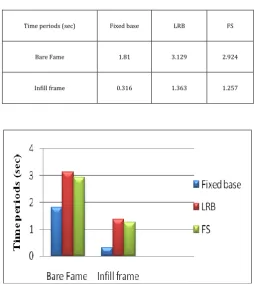
[image:6.595.41.272.376.551.2]The Table-4 and Table-5 below show the natural time period of fixed base and base isolated structure for both bare frame and masonry infilled structures.
Table-4 Comparison of Natural time period
Time periods (sec) Fixed base LRB FS
Bare Fame 1.81 3.129 2.924
Infill frame 0.316 1.363 1.257
[image:6.595.311.557.474.733.2]Chart-1 Natural time period for fixed and isolated structures
Table-5 Comparison of Time period for bare and infill frames
Modal time periods (sec) Bare frame Infill frame
Mode 1 1.81 0.316
Mode2 1.453 0.276
Mode3 1.419 0.217
© 2017, IRJET | Impact Factor value: 5.181 | ISO 9001:2008 Certified Journal | Page 1789 From chart-4 and chart-5 it is clear that the provision of
isolation system increases the natural time period of the structure thus minimizing the possibility of resonance effect. It can be said that the time period of isolated structure was increased by 45% for LRB isolation and 42% for FPS isolation in bare frame structure and by 75% for LRB isolation and 70% for FPS isolation in infill frame structure.
4.2 Base shear
The chart-3 to chart-5 shows the values of base shear and the comparison of the base shear for bare frame and infill frame with different isolation systems.
Chart-3 Variation of base shear for bare & isolated models
Chart-4 Variation of base shear for infill & isolated models
Chart-5 Variation of base shear for bare & infill models
From chart-3 and chart-4 it is clear that the introduction of base isolation system reduces the base shear by 50% in bare frame and 70 % for in filled frames. The consideration of infill increased the base shear by50% which is due to the increase in the mass of the structure.
4.3 Storey displacements
The storey displacement for the isolated building increases due to the increase in the flexibility of the building. The variation of displacement for bare and infill frame models is shown in the below charts.
1-A fixed base model by static method
2-A fixed base model by response spectrum method 1-B LRB base model by static method
2-B LRB base model by response spectrum method 3-A FPS base model by static method
3-B FPS base model by response spectrum method
© 2017, IRJET | Impact Factor value: 5.181 | ISO 9001:2008 Certified Journal | Page 1790
Chart-7 Variation of displacement for infill frame
Chart-8 Variation of displacement for bare & infill frame
From the above chart it can be seen that the provision of isolation system increases the displacement at the base but the variation of displacement from bottom storey to top storey is reduced hence all the floors undergo relatively same displacement.
4.4 Storey drifts
The charts from chart-9 to chart-10 shows the variation of the inter storey drifts for fixed base and base isolated structures for bare frame and infill frame models. Chart-11 shows the variation of storey drift for bare frame and infill frame structures by static and dynamic analysis.
Chart-9 Variation of storey drift for bare frame model by static and response spectrum method
Chart-10 Variation of storey drift for infill frame model by static and response spectrum method
© 2017, IRJET | Impact Factor value: 5.181 | ISO 9001:2008 Certified Journal | Page 1791 The inter storey drifts of bare frame and infill models got
reduced when the base isolation is provided. The presence of infill reduced the inter storey drifts when compared to bare frame due to increase in the stiffness. The storey drift is maximum between base and the first storey where the isolation systems are provided and decreases as the storey level increases from bottom storey to top storey.
4. CONCLUSIONS
The time period of the structure increases in every model for base isolated case when compared to fixed base condition.
The natural time period increases by 1.319 and 1.114 sec for lead rubber isolator and friction isolator respectively in bare frame structure. In infilled structure the time period increased by 1.047 and 0.941 sec respectively
The base shear reduces by 50% for bare frame models and 70% for models with masonry infill in static method. The base shear reduces by 46 % and 42% in bare frame and by 71% and 65% for infill structure for rubber isolator and friction isolator respectively by response spectrum method.
The value of base shear is high in case of infill structure, which is due to the increase in mass of the structure.
The increase in the flexibility of the bare and infill frame structures with isolation has increased the displacement of the structure at base. The increase in displacement at base is by 21.334 mm and 16.159 for LRB and FPS in static analysis and 19.38 mm and 14.48mm for LRB and FPS isolator respectively for response spectrum analysis. But the variation of displacement from bottom storey to top is reduced.
With the base isolation system, inter – story drifts are reduced or almost negligible. This reduced story drifts enables both bare and infill frame structures to behave ideally stiff resulting in less damage to the
structural and non structural parts. The story-drifts obtained for various models are well within the limit as per IS 1893 (Part -ɪ): 2002, clause 7.11.1.
The presence of infill reduces the values of storey displacement and storey drifts when compared to bare frame structure.
REFERENCES
1. Mohammed Asim Khan, Prof. Shaik Abdulla (2014), “Non-linear Static Analysis of 3-D Framed Asymmetric Buildings with Lead Rubber Isolator using SAP2000”, International Journal of Engineering Research & Applications, Vol-4, Issue-9, pp 87-91.
2. Nitya M, Arathi S (2016), “Study on Earthquake Response of a RC Building with Base Isolation”, International Journal of Science and Research, Vol-5, Issue-7, pp 1002-1005.
3. Shameena Khannavar, M. H Kolhar (2016), “Seismic Analysis of RC Structure Using Base Isolation Technique”, International Research Journal of Engineering and Technology, Vol-3, Issue-7, pp 2320-2327.
4. Rahul P Rathi, Dr. Pagade (2012), “Study of Masonry Infilled RC Frames With and Without Opening”, International Journal of Scientific and Engineering Research, Vol-3, Issue-6, pp 1-7.
5. Mohammad H Jinyal, V R Patel (2014), “Analysis of RC Frame With and Without Infill with Different Stiffness with Central Opening”, International Journal of Research in Engineering and Technology, Vol-3, Issue-6, pp 76-83.
© 2017, IRJET | Impact Factor value: 5.181 | ISO 9001:2008 Certified Journal | Page 1792 7.
Alurwad Rajeshwarreddy R, Prof. Arshad Hashmi,
Prof. Kulkarni V. P(2013), “Seismic Behavior of Reinforced Concrete Frame With Infill Walls”, International Journal of Engineering Research and Application, Vol-3, Issue-4, pp 1419-1423.
8. Dia Eddin Nassani, Mustafa Wassef Abdulmajeed(2015), “Seismic Base Isolation In Reinforced Concrete Structures”, International Journal of Research Studies in Science, Engineering and Technology, Vol-2, Issue-2, pp 1-13.
9. Mohammed Salman Maniyar, Mehaboob Baig Inamdar (2016), “Seismic Evaluation of High Rise Building With and Without Base Isolation”, International Journal for Scientific Research and Development, Vol-3, Issue-3, pp 1584-1587. 10. Prof. R. B Ghodke, Dr. S. V Admane (2015), “Effect of
Base Isolation for Building Structures”, International Journal of Science, Engineering and Technology, Vol-4, Issue-4, pp 971-974.
BIOGRAPHIES
Sunil Shirol pursuing his M.Tech. in Civil Strutures from Government Engineering College, Haveri & obtained B.E. Civil from KLECET Chikodi.