Munich Personal RePEc Archive
E-Governance of Universities: A
Proposal of Benchmarking Methodology
Raposo, Mario and Leitão, João and Paco, Arminda
16 October 2006
E-GOVERNANCE OF UNIVERSITIES: A PROPOSAL OF
BENCHMARKING METHODOLOGY
Mário Raposo, Full Professor at University of Beira Interior
Department of Management and Economics, Estrada do Sineiro, 6200-209 Covilhã, PORTUGAL Phone: 00351 275 319 639; Fax: 00351 275 319 601
E-mail: [email protected] URL: http://www.dge.ubi.pt/mraposo/
João Leitão, Assistant Professor at University of Beira Interior
Department of Management and Economics, Estrada do Sineiro, 6200-209 Covilhã, PORTUGAL Phone: 00351 275 319 653; Fax: 00351 275 319 601
E-mail: [email protected] URL: http://www.dge.ubi.pt/jleitao/
Arminda do Paço, Project Consultant at University of Beira Interior
Department of Management and Economics, Estrada do Sineiro, 6200-209 Covilhã, PORTUGAL Phone: 00351 275 319 639; Fax: 00351 275 319 601
E-mail: [email protected]
Mário Lino Barata Raposo, Ph.D. in Management (UBI, Portugal) is Full Professor, Vice-chancellor and Director of several centres at the University of Beira Interior. He is also President of the Cyber centre of Covilhã and member of the scientific council of the technological park PARKURBIS. For the last years he has been a researcher in the fields of marketing, strategy and competitiveness and entrepreneurship. He is the author of several publications and communications which are presented both in journals and proceedings of national and international conferences.
João Carlos Correia Leitão, Ph.D. in Economics (UBI, Portugal) is Assistant Professor at the University of Beira Interior and teaches disciplines in the areas of Microeconomics and Marketing. He participates in several editorial boards, namely the "Revista Portuguesa e Brasileira de Gestão", Portugal and Brazil, since 2006; the "International Review on Public and Non Profit Marketing", Spain, since 2004; the "South African Journal of Information Management", South Africa, since 2002; and The New Economics Papers (NEP), United Kingdom, in the areas of Microeconomics, Marketing, Public Economics, Sports and Economics, and Education Economics, since 2001. He is the author of several publications and communications which are presented both in journals and proceedings of national and international conferences.
E-GOVERNANCE OF UNIVERSITIES: A PROPOSAL OF BENCHMARKING
METHODOLOGY
Abstract
This paper aims to provide a benchmarking proposal related to the area of e-governance of
universities. An e-governance tool is proposed in order to disseminate both the mission
and the institutional culture of each University into a formal scheme of benchmarking
tools. A brief review of the literature related to e-governance models is made in order to
justify the importance of e-business practices in universities. Some studies developed in
the field of benchmarking in the universities were also selected, using different
methodologies. Through the analysis of the most relevant studies, a set of indicators was
built in order to evaluate the benchmark related to e-governance. In what concerns the
electronic governance of universities the benchmark comes from the development of a
manual of benchmarking that comprises new evaluation and control areas of the
performance of universities, in terms of their contribution for the development of the
regions where they are located. The creation of a manual of benchmarking applied to
universities, is proposed. In order to validate, or even to improve the manual, it’s
necessary to test it not only in universities, but also in other related stakeholders that take
part of the institutional networks of universities. Once implemented, the proposed
benchmark provides a better way to evaluate the current practices and to identify the best
practices. It could also improve the performance of universities in what concerns the
e-governance systems.
Keywords – Benchmarking, E-Governance, University.
INTRODUCTION
The present economic, social and global competitive context has caused important
changes at the competitive base of the countries. These changes led to the creation of
different governmental functions, in terms of external and internal relationships. For its
turn, this global conjecture has reinforced the demand for conditions and new skills, in
order to incorporate quick changes both in the organizations and in the society in general.
According to Goddard et al. (2006), the universities have played a strategic role in the
economic and social development of the country and of the regions where they are
located. The University is a relevant actor in the social system, in what concerns the
development of human capital, through the supply of new professionals that have
universalistic skills which provide a better identification of social and economic
responsibilities.
In this sense, the universities should be able to give answers which are suitable to its social
and public responsibility, through the prosecution of four main objectives: (i) Education
and learning; (ii) Commercialization of the research; (iii) Cooperation and partnerships
with the industry; and (iv) Cooperation with external institutions and centers.
This paper aims to reveal the importance of benchmarking for universities through its
contribution both to carry out more effective evaluations and to detect organizational
problems that should be subsequently improved and surpassed. We are now developing a
framework about e-governance systems in order to propose some benchmarks that can be
ELECTRONIC GOVERNANCE
The concept of governance applied to the University is related to the exercise of
controlling the power of different centers and departments which are part of the
University.
This kind of exercise is based on the drawing of an adequate system which executes
different levels of institutional and relational power. These are integrated in a model of
electronic governance (e-governance), which is structured in different Internal Information
Systems (IIS).
Those systems make use of data warehouses that consist of information that is extracted
from the users’ profile. The full operation of these new digital e-governance platforms
implies the transposition of e-business models into the institutional organizational and
relational networks of the Universities.
Traditionally, the effectiveness of the governance can be measured through the extent of
the responsibility of the governments to the citizens. In what concerns this item, it should,
however, not be neglected the way the power of the governance is exercised, as well as the
way the citizens express their opinion, and the way the decision-making operates in
different public fields (Keefer, 2004).
In this sense, the governance models embrace public institutions and processes of
decision-making that not only include the citizens but also demand for a growing civil
The exercise of a governance model must include independent but interconnected units,
whose activities should be clear, accountable, responsible, and especially regular in order
to reduce the inequalities in terms of access to the services that are made available by
public institutions.
The most of the entrepreneurial governance plans of the Nations in general and public
institutions in private should make use of the broadest spectrum of electronic platforms
possible in order to guarantee greater levels of public services governance, taking into
consideration the intrinsic potential of using Information and Communication
Technologies (ICT).
An ideal model of e-governance can be executed by the implementation of four main
dimensions (Leitner, 2003): (i) Adaptation and coordination of the public policies; (ii)
Participatory democracy (of the most representative players in what concerns to the
services supply); (iii) Creation of cooperative networks (for the implementation of public
policies for development); (iv) Access to clear and open informative systems of
governance.
According to Klazar et al. (2005), the users of e-governance services can be classified into
five basic groups: (1) The non users of the Internet service (to obtain information or
transact with the Government); (2) The Transactors (that make payments by credit card or
banking transference); (3) The Suppliers (that supply personal information or household
information to the Government); (4) The Information Seekers (that use Internet to obtain
information from a website of the government); (5) The Consultants (that use Internet to
In the opinion of Backus (2001) the formal mechanisms of e-governance should be more
than the creation of an online presence. These mechanisms include the use of electronic
tools that simplify operations and procedures according to the following aims: (a) to create
interaction between the Government and the citizens; (b) to establish interrelations
between the Government and the units of business; and (c) to manage internal operations
of the Government in a more efficient way.
The most common mechanism of e-governance includes three fundamental kinds of
interrelations: G2C, G2B and G2G (Figure 1).
Take in Figure 1
According to Backus (2001) the implementation of a model of e-governance can include
four interaction phases: (i) Information; (ii) Interaction; (iii) Transaction; and (iv)
Transformation.
The initial informative phase is based on the creation of a web presence, through the
availability both of the information that is considered relevant for citizens (G2C), and the
units of business (G2B). At an internal level, the first phase allows the creation of
e-governance mechanisms (G2G) that are directed to the dissemination of information
through dynamic electronic tools.
The second interactive phase is related to the establishment of interactive relations and
between the Government and the units of business (G2B), through the availability of
e-mails, search engines, forms, and documents for downloading. In terms of internal
relations (G2G) the Governments implement intranets that are intended to be both internal
communication and exchange data networks.
In what concerns to the third transactional phase, which is related to transaction, the
keywords are complete transactions, which means that the value given by the users of the
service (G2C and G2B) is progressively higher. In this phase, a higher degree of
complexity arises. This is essentially due to security and personal issues that are
associated with the supply of electronic services (for example, the use of digital signature
and the implementation of e-procurement systems with units of business). At the internal
level, the redesign of the offering of electronic services (G2G) is also performed. This
procedure requires adequate legislation and a higher simplification of the internal
activities of the Government.
In what concerns the fourth transformative phase, the key-terms are integration and
change. It corresponds to the full integration of the information systems that provide the
supply of services (G2C and G2B) by making the access to an available virtual corner.
The basic idea is to provide a point of exclusive contact that is centralized for the totality
of the users. Furthermore, the rhythm of drastic changes should be intensified in terms of
culture, processes and responsibilities of e-governance of the institution (G2G). It must
also be stressed that this last phase should provide greater levels of efficiency through the
establishment of relational networks which should be characterized both by the reduction
BENCHMARKING METHODOLOGY
Reference Manuals
According to Jackson and Lund (2000, p. 6) «Benchmarking is, first and foremost, a
learning process structured so to enable those engaging in the process to compare their
services/activities/products in order to identify their comparative strengths and weaknesses
as a basis for self-improvement and/or self-regulation».
In terms of literature review, it was possible to find some research projects that were
developed in the field of benchmarking in the universities by the use of different
methodologies. The most relevant manuals were developed by Mckinnon et al. (2000),
Charles and Benneworth (2000), and Garlick and Pryor (2004).
McKinnon et al. (2000) developed a manual of benchmarking for Australian universities.
In their perspective, the benchmarking for the University attends both to provide to its
alternative forms of administration in order to evaluate the performance of the institution
and to implement improvements in its different activities. It can also be used to compare
performances and to evaluate its competitive position comparing to other universities.
This manual seems to provide a template-driven approach to assess rather than to improve
the performance of the University.
For its turn, Charles and Benneworth (2000) presented a benchmarking approach in order
to evaluate the regional impact of a higher education institution in the United Kingdom.
evaluate the regional impact of the University, in terms of number of new firms,
development of entrepreneurship, formation of human capital, innovation and preservation
of the territorial and cultural identity.
Methodologically, the main challenge of this tool is not to point out the linear relations
between a University and its region, since it comprises a broader set of strategic
interactions. The strategic priorities for the regional development should result in the
development of processes that connected, for example, to the economic and cultural
development, or both to the regeneration of the community and to the creation of new
firms provide value added to the activities that are developed inside the university
departments (Charles and Benneworth, 2000).
Taking the Australian case as a reference, Garlick and Pryor (2004), have pointed out that
the main aims of the benchmarking tools are related to the evaluation of the global quality
and performance of the organizational practices. The benchmarking must be seen as a
learning process, which should be structured in a way that makes it possible to evaluate
the products/services and the strengths/weaknesses of an organization. Therefore, it
corresponds to a systematic and continuous process that provides the measurement and the
comparison of the working processes of an organization with the ones that are
implemented by the reference organization.
According to Garlick and Pryor (2004), the benchmarking tool provides a better
evaluation of the quality and performance of the organizational practices. The proposed
methodology is based on learning, collaboration, revision and leadership processes that are
In this revision work about the reference manual, other applications of benchmarking
methodology can also be mentioned. For example, Endut et al. (2000) develop some
researches that are related to the topic of benchmarking institutions of higher education.
They studied the existence of similarities between the universities in study, by comparing
their missions, objectives, critical success factors and the best practices.
Yorke (1999) developed a benchmarking study about the academic standards that are
observed in the United Kingdom. The main results have revealed that in this academic
specific context benchmarking needs to be approached differently from benchmarking in
industrial and commercial contexts, since it requires combining comparative studies and
professional judgments, in order to validate the results in an adequate way. The author
also reveals that the complexity associated to academic standards makes it difficult to
propose new standards that should be adequate to a set of international and national
institutions of higher education.
Benchmarking Manual for Universities: A Proposal
The elaboration of the present “Benchmarking Manual for Universities” is integrated in
one of the execution phases of the international research project OBSEREGIO. This
research project involves two Portuguese universities, the University of Beira Interior and
the University of Évora, and two Spanish universities, the University of Salamanca and
According to the “Programme on Institutional Management in Higher Education” (OECD,
1999), the higher education institutions should design and implement strategies in order to
better engage with this influence region.
This benchmarking manual1 has the generic aim of evaluating the impact of the University
on the reinforcement both of the competitiveness and the territorial identity. In terms of
the specific aims, it intends to evaluate the impact of the University on the influence
region including the following areas: (A) Competitiveness of the regional influence area;
(B) Development of the human capital; (C) Development of entrepreneurial activities; (D)
Activities of research, development, innovation and transference of knowledge; (E)
Governance of the university for sustainability; and (F) Social support, re-conversion and
cultural development of the region.
Taking into consideration the manual that was developed by Charles and Benneworth
(2000), the methodology proposed in the Manual includes five phases: (i) the
identification of the study areas; (ii) the formation of the team; (iii) the identification of
the partners; (iv) the collection and analysis of data; and (v) the action.
According to Ribeiro (2004), the beginning of a benchmarking model that is defined as an
evaluation model of the performance of the higher education institutions is based on a
structure of indicators that is developed in order to evaluate the performance in terms of a
set of critical factors. Thus, the first step, which corresponds to the development of the
model, consists in the selection of the areas that will be studied, and that should be
1
A broad set of benchmarks, grouped in six areas, is presented in the benchmarking manual titled “Manual de Benchmarking para as Universidades - Instrumento de Reforço da Competitividade e da Identidade Territorial” (Raposo
characterized in terms of: (i) the current practices; (ii) the critical factors; and (iii) the
evaluation practices procedures. In this case, we design a set of indicators to describe and
evaluate each proposed benchmark.
BENCHMARK PROPOSAL: CREATION OF E-GOVERNANCE SYSTEMS
The example of benchmark that is included in the present article belongs to the area (E)
Governance of the University for Sustainability. It considers the participation of the
University in the creation of e-governance systems. This area assumes a great importance
since the long term institutional development strategy should be based on processes that
aim to reach the sustainability. Thus, we consider a set of indicators grouped according to
the following layout (Table I) for each benchmark that is presented in the benchmarking
manual.
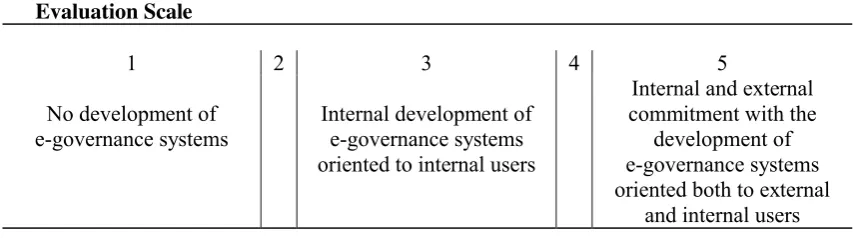
Take in Table I
We describe and evaluate the benchmark that is proposed in Table II and Table III,
respectively.
Take in Table II
CONCLUSIONS
The mechanisms of e-governance assume a special importance in terms of developing
governance strategies that are oriented to the sustainability of public institutions, in
general, and of University, in particular.
This growing importance is justified by the creation of digital platforms that offer distinct
services. On the one hand, they make the internal relations (G2G) more efficient and, on
the other hand, they contribute to the establishment of new kinds of external relations
(G2B and G2C).
The existence of this kind of platforms should be integrated in an institutional information
system in order to facilitate the adoption and the subsequent control of the best
institutional practices, both at internal and external level. Additionally, these platforms
should be adequate to the proposal of benchmarking tools that are now presented and
applied in the University.
These benchmarking tools help the University to identify both their strengths and
weaknesses at an internal level, and to face threats and opportunities at the external level,
in order to improve the global quality of services and of the efficiency. This will
contribute to the improvement of the global performance of the institution, through the
The use of benchmarking tools also provides a means of assessing the regional impact of
the University, namely in what concerns the business creation, entrepreneurship, human
capital and innovation processes.
REFERENCES
Backus, M. (2001), “E-governance in Developing Countries”, IICD Research Brief, Nº 1, March.
Charles, D.; Benneworth, P. (2000), The Regional Contribution of Higher Education: A Benchmarking Approach to the Evaluation of the Regional Impact of a HEI, Centre for Urban & Regional Development Studies (CURDS).
Endut, W.; Abdullah, M.; Husain, N. (2000), “Benchmarking Institutions of Higher Education”, Total Quality Management, Vol. 11, Nos 4-6, pp. 796-799.
Garlick, S.; Pryor, G. (2004), Benchmarking the University: Learning about Improvement, Australian Government, Department of Education, Science and Training.
Goddard, J.; Etzkowitz, H.; Puukka, J.; Virtanen, I. (2006), Supporting the Contribution of Higher Education Institutions to Regional Development, Peer Review Report, The Jyväskylä Region of Finland.
Jackson, N.; Lund, H. (2000), Benchmarking for Higher Education, The Society for Research into Higher Education and Open University Press, Buckingman.
Leitner, C. (Ed.) (2003), eGovernment in Europe: The State of Affairs, European Institute of Public Administration, Maastricht, Holandsko.
Keefer, P. (2004), “A Review of the Political Economy of Governance: From Property Rights to Voice”, World Bank Policy Research Working Papers, Nº 3315, May.
Mckinnon, K.; Walker, S.; Davis, D. (2000), A Manual for Australian Universities, Department of Education, Training and Youth Affairs, Australia.
OECD (1999), The Response of Higher Education Institutions to Regional Needs, Programme on Institutional Management in Higher Education.
Raposo, M.; Paço, A.; Leitão, D.; Ferreira, J.; Leitão J.; Silva, M.; Rodrigues, R.; Serrasqueiro, Z. (2006), Manual de Benchmarking para as Universidades - Instrumento de Reforço da Competitividade e da Identidade Territorial, Publisher Team, Lisboa.
Ribeiro, L (2004), Aplicação do Benchmarking na Indústria de Manufactura: Desenvolvimento de uma Metodologia para as Empresas de Fundição, Doctoral Thesis in Metallurgical and Materials Engineering, Faculdade de Engenharia da Universidade do Porto.
Table I. Set of indicators for each benchmark
Profile
The role played by the University will depend on the nature of the benchmark and on the degree of participation. It may result in assuming simultaneous roles:
- Leader: commanding and coordinating the parts which are involved in the implementation of the benchmark;
-Partner: congregating the parts which are interested in the consecution of common objectives and joint work;
-Promoter: fomenting or determining; -Propellant: transmitter of movement.
Justification
Adequate description of the reasons why that element is important and what is really being evaluated.
Data Sources
Kind of data source (it must be credible and reliable).
Good Practice
Precise and observable description of the good practices. In this way, the universities will be able to evaluate the implementation of good practices.
Operational Mechanism
The way how the benchmark should be implemented.
Generic Indicators
Indicators that will serve as reference to the benchmark evaluation.
Evaluation:
Retrospective:
An evaluation based on the past performance, which is measured by several indicators.
Qualitative:
In this item, we usually ask users to identify its performance, taking as reference a five points scale.
Evaluation Scale:
1 2 3 4 5
Levels of the scale:
1 – No participation
2 – No substantial participation
3 – Internal participation
4 – Internal participation and no external substantial participation
5 – Substantial participation, both at external and internal level
External:
Table II. Benchmark: Creation of e-governance systems
Profile Promoter.
Justification
Electronic governance implies the use of Information and Communication Technologies (ICT), which can assume the form of local nets of computers, the internet, the mobile computation and the wireless networks. The University electronic governance systems aim to simplify and improve the supply of services to its publics, through the use of new technologies. Furthermore, it aims the simplification and transparency in the relationships, the economy of costs, and the development of a modern service directed to the customer.
Data Sources
Primary sources of data (evidences of the electronic governance system and databases of the University).
Good Practice
- Creation of mechanisms that facilitate the obtaining and share of several kinds of information and knowledge, from any place and in the most convenient way;
- Availability of all basic services, in an online basis;
- Availability of search mechanisms to all agents that interact with the University;
- Use of ICT in e-learning systems of the University in order to increase the quality of the education and the information flows;
- Availability of virtual corners for teachers, members of staff and students, with the aim of simplifying academic and administrative processes;
- Implementation of an account information system based on a digital platform that provides search mechanisms about economic and financial information in order to support the strategic decision-making of the University;
- Training for the use of ICT for teachers, staff, and students of the University in order to increase the penetration rate of the e-governance systems;
- Creation of adequate conditions for the development of telematic work and long distance education format at a postgraduate level.
Generic Indicators
- Number of virtual corners;
- Number of Internal Information Systems (IIS) of the University; - Number of e-learning platforms;
- Index of simplification of the administrative and academic service (Number of documents used in e-governance systems/Number of documents used in traditional governance systems);
- Number of activities of telematic work;
- Number of post-graduations supplied in a long distance education format;
Table III. Evaluation form of the benchmark proposal
Evaluation
Retrospective:
- Number of virtual corners;
- Number of Internal Information Systems (IIS) of the University; - Number of e-learning platforms;
- Index of simplification of the administrative and academic service (Number of documents used in e-governance systems/Number of documents used in traditional governance systems);
- Number of activities of telematic work;
- Number of post-graduations offered in a long distance education format;
- Number of national and international research projects related with the development of systems or components to support the e-governance of the University.
Qualitative:
Evaluation Scale
1 2 3 4 5
No development of e-governance systems
Internal development of e-governance systems oriented to internal users
Internal and external commitment with the
development of e-governance systems oriented both to external
and internal users
Levels of the scale:
1 – No participation
2 – No substantial participation
3 – Internal participation
4 – Internal participation and no external substantial participation
5 – Substantial participation, both at external and internal level
External:
Figure 1. Inter-relations in the field of e-governance
Source: Adapted from Backus (2001, p. 2)
Central G2G
G2G Local