Munich Personal RePEc Archive
Globalization and Environment: Can
Pollution Haven Hypothesis alone
explain the impact of Globalization on
Environment?
Dinda, Soumyananda
S. R. Fatepuria College, Beldanga, Murshidabad, WB, India, ERU,
Indian Statistical Institute, Kolkata, India
15 August 2006
Globalization and Environment: Can Pollution Haven Hypothesis alone explain the impact of Globalization on Environment?
Soumyananda Dinda*
S. R. Fatepuria College, Beldanga, Murshidabad, WB, India. Economic Research Unit, Indian Statistical Institute, Kolkata, India.
First Preliminary Draft: October 15, 2006
Abstract
The economic literature on trade and environment seeks empirically test hypotheses
about how trade affects the environment that is crucial for resolving current policy
debates. Applying panel data technique we examine the impacts of globalization on
pollution level, pollution intensity and relative change of pollution for the developed
(OECD) and developing (Non-OECD) country groups and the world as a whole. This
paper examines the factor endowment and pollution haven hypotheses that predict how
trade affects the environment. Interaction effects also play a crucial role to determine the
impact of globalization on environment. In this study we use CO2 emission and observe
that the impact of globalization on environment heavily depends on the basic
characteristics of a country and its dominating comparative advantage. The empirical
results suggest that globalization increases CO2 emission, which is the main culprit of the
global warming.
JELClassification Number: Q00, F1
Key Words: Globalization, pollution haven hypothesis, factor endowment hypothesis, and interaction effect.
---*C/o, Dipankor Coondoo, Economic Research Unit, Indian Statistical Institute, 203, B. T. Road, Kolkata –
1. Introduction
Economic development through rapid industrialization and growing
environmental consciousness together have generated a heated debate on how economic
development (or growth) is linked with environment. The linkage of environmental
quality with economic development evoked much discussion in the last decade (i.e.,
1990s). The World Development Report (World Bank 1992) presented cross-sectional
evidences on the relationship between different indicators of environmental quality and
per capita national income across countries. Other studies (e.g. Grossman and Krueger,
1991; Selden and Song, 1994; Rothman, 1998; Suri and Chapman, 1998; etc)
documented an inverted U-shaped relationship between environmental degradation and
income. The common point of all these studies is the assertion that environmental
degradation increases initially, reaches a maximum level and after that declines as an
economy develops. This systematic inverted-U relationship has been termed as the
Environmental Kuznets Curve (EKC) following the work of Kuznets (1955), who
postulated a similar relationship between income inequality and economic development.
The EKC relates to the issue of the impacts of economic growth or development on the
environment of a country.
Now automatically one important question arises whether cross border integration
(i.e., globalization) helps or hurts this process. This is indeed the primary motivation for
this study. The aim of this paper is to explore whether globalization hurts the
environment. Applying panel data technique we examine the impacts of globalization on
pollution level, pollution intensity and relative change of pollution for the developed
study we use CO2 emission and observe that the impact of globalization on environment
heavily depends on the characteristics of the economy. The basic characteristics of a
country and its dominating comparative advantage determine how trade liberalization
influences its sectoral composition and consequently environmental outcomes.
This analysis has been done mostly by applying the technique of panel data
analysis to a cross-country panel data set on per capita income and CO2 emission. In what
follows, we explain first the background of this study, methodological framework and
then present the empirical results of our analysis. The paper is organized as follows:
Section 2 presents the background of this study and ideas develop how the globalization
links up environmental quality. Section 3 describes the data set. The empirical results are
presented in Section 4. Finally, in Section 5 some concluding observations have been
drawn.
2. Background of this study
Environmental quality could decline through the scale effect as increasing trade
volume (especially export) would expand the size of the economy thereby increasing the
extent of pollution. Thus, trade might be a cause of environmental degradation, ceteris
paribus. Many economists have long argued that trade is not the root cause of
environmental damage (Birdsall and Wheeler 1993, Lee and Roland-Host 1997, Jones et
al. 1995). However, free trade has the contradictory impacts on environment, both
increasing pollution and motivating reductions in it. Antweiler et al. (2001) and Liddle
(2001) argue that trade may be good for environment. Trade may improve the
environmental quality through technological effect. As income rises through trade,
trade relates one country with international communities, one underdeveloped economy
may rely on technology transfer through foreign direct investment that may reduce
pollution.
However, globalization, by increasing competition for investment, may trigger the
environmental race to bottom (Wheeler (2000)). Poor economies may be able to improve
their environmental quality as investment raise their income levels. Thus, globalization
may facilitate pollution reduction. In fact, the bottom rises with economic growth. Tisdell
(2001) points out that globalization can be a driving force for global economic growth.
Yet opinion is divided about the benefits of this process. The global economy raises the
issue of potential conflicts between two powerful current trends – viz., the worldwide
acceptance of market oriented economic reform process on the one hand, and
environmental protection on the other.
It should be mentioned that a polluting activity in a high-income country normally
faces higher regulatory costs1 than its counterpart in a developing country (Mani and
Wheeler (1998)). Under these circumstances the pollution intensive industries will have a
natural tendency to migrate to countries with weaker environmental regulations
(Copeland and Taylor (1995)). This is referred to as the Pollution Haven Hypothesis
(PHH) (See, Bommer (1999), Cole (2003, 2004)). The PHH refers to the possibility that
polluting industries concentrate in developing countries with low environmental
standards. The pollution haven hypothesis (PHH) predicts that, under free trade,
multinational firms will relocate the production of their polluting goods to developing
1
countries, taking advantage of the low environment monitoring in these countries.
Developing countries will develop a comparative advantage in pollution-intensive
industries and become ‘haven’ for the world’s polluting industries. Thus, developed
countries are expected to benefit in terms of environmental quality from trade, while
developing countries will lose (See Figure 1). In other words, the PHH basically
suggests that countries having stricter environmental standard will lose all the dirty
industries and poor countries (i.e., those having poorer environmental standard) will get
them all. It is also true that the differences in the consumer preferences for a cleaner
environment in rich and poor countries also induce the displacement hypothesis and/or
PHH.
It is observed that changes in the structure of production in developed economies
are not accompanied by equivalent changes in the structure of consumption. This could
be explained by the EKC, which actually record the shifting of dirty industries to less
developed economies. As Rothman (1998) speculates, what appears to be an
improvement in environmental quality may in reality be an indicator of increased ability
of consumers in wealthy nations to distance themselves from the environmental
degradation associated with their consumption. The mechanisms through which such
distancing take place may include both moving sources of pollution away from the
people and moving people away from pollution sources2. Thus, in general, the
phenomenon of distancing may be a possible source of EKC results. Hettige et al (1992)
observe that toxic intensity grew rapidly in high-income countries during the 1960s and
this pattern was sharply reversed during the 1970s and 1980s, after the advent of stricter
2
environmental regulations in the OECD countries. Concurrently, toxic intensity in LDC
manufacturing grew quickly. Lucas et al (1992), Low and Yeats (1992) also confirm this
displacement hypothesis.
Agras and Chapman (1999) and Suri and Chapman (1998) analyse the
composition of international trade and observe that manufacturing goods exporting
countries tend to have higher energy consumption. They find the poor and rich countries
to be net exporters and net importers of pollution-intensive goods, respectively.
Therefore, the inverted U-shaped EKC curve might partly be the result of changes in
international specialization under which poor countries engage in dirty and energy
intensive production while rich countries specialize in clean and service intensive
production, without effectively any change in the consumption patterns.
On the contrary the PHH, the factor endowment hypothesis (FEH) asserts that in
free trade the differences in endowments (or technology) determine trade between two
countries. The FEH suggests that the capital abundant country exports the
capital-intensive goods that stimulate its production and thereby raising pollution in the capital
abundant country. The effects of trade on the environment depend on the comparative
advantages enjoying a country. Under this view capital-abundant countries tend to export
capital-intensive goods, regardless of differences in environmental policy (Copeland and
Taylor 2004). According to the FEH3 polluting industries will concentrate in affluent
countries, which also tend to be capital abundant. This is because polluting industries are
3
typically also capital intensive, and thus affluent capital-abundant countries have a
comparative advantage in these industries (Copeland and Taylor 2004). In this context, it
should be noted that the differences in environmental policy and differences in factor
endowments might jointly determine the comparative advantage in trade. It is clear that
effects of trade liberalization on environmental quality depend on, among other factors,
jointly by differences in pollution policy and differences in factor endowments, which
leads to two competing theories in question.
3. The Data and Methodology
In the present exercise we have used annual per capita real GDP (PCGDP), capital per
worker (capital–labour (i.e., K/L) ratio), trade intensity and annual per capita CO2
(PCCO2) emission as the measure of the income, K/L ratio, openness and the emission
variable, respectively. It should be noted that globalization is the proxy measurement in
terms of openness, which is measured as export plus import to GDP. This openness is
also termed as trade intensity. The basic country-level time series data PCGDP
(expressed in 1985 international prices, i.e., PPP dollars) for the period 1965-1990 were
taken from the RGDPCH series of the Penn World Table (Mark 5.6) available at the web
site http://www.nber.org/pwt5.6. As mentioned, for the present exercise we have used
cross-country panel data on Openness (in per centage), capital per worker (K/L), PCGDP
and other economic variables compiled by Summers and Heston (viz., the Penn World
Table). Corresponding panel data set on PCCO2 (measured in metric tons) was obtained
from the web site of Carbon Dioxide Analysis Information Center (CDAIC), Oak Ridge
National Laboratory of the U. S. A. Combining these data sets, we compiled a panel data
countries for the time period 1965 - 1990 (see Coondoo and Dinda (2002)). For the
purpose of the exercise, we grouped the countries into 3 major country groups, viz.,
developed (OECD), less developed (Non-OECD) and the world as whole.
The empirical exercise has been done separately for each of these country groups
based on these panel data sets for the individual country groups. Panel data analyses offer
different ways to deal with the possibility of country-specific variables. Fixed Effect (FE)
model is a suitable estimation approach that treats the level effects as constants, whereas
Random Effect (RE) model is suitable to capture the level effect. It should be mentioned
that RE model treats the level effects as uncorrelated with other variables, while FE
model does not. In this analysis we estimate both FE and RE models. Now the estimating
equations are
(1) Eit =α+β1lnYit +β2(lnYit)2+β3lnKLit +β4(lnKLit)2+β5lnPit +λOPit +θt+uit
(2) lnEit =α+β1lnYit +β2(lnYit)2 +β3lnKLit +β4(lnKLit)2 +β5lnPit +λOPit +θt+u'it
(3) it v it OP it RI it OP it RI it OP it RKL it OP it RKL t it OP it P it KL it KL it Y it Y it E + + + + + + + + + + + + = ) * 2 ( 4 ) * ( 3 ) * 2 ( 2 ) * ( 1 ln 5 2 ) (ln 4 ln 3 2 ) (ln 2 ln 1 η η η η θ λ β β β β β α (4) ' ) * 2 ( 4 ) * ( 3 ) * 2 ( 2 ) * ( 1 ln 5 2 ) (ln 4 ln 3 2 ) (ln 2 ln 1 ln it v it OP it RI it OP it RI it OP it RKL it OP it RKL t it OP it P it KL it KL it Y it Y it E + + + + + + + + + + + + = η η η η θ λ β β β β β α
Where Eit is the pollution measured in country i at time t; similarly Y, KL, P, OP, RI, RKL
and t denote income per capita, capital labour ratio, population, openness, relative
4. Results
We first estimate equations (1) – (2). Later we estimate equations (3) – (4), which include
the openness interaction with country characteristics. The conditioning the impact of
openness on country characteristics is the important determining factors through which
trade affects the pollution intensity of national output.
Our central focus is in λ, the coefficient of openness (or proxy of globalization).
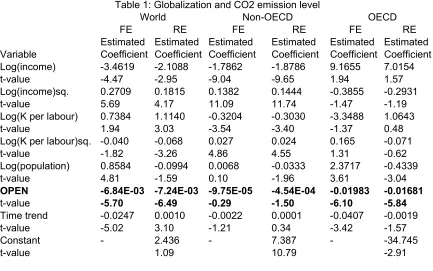
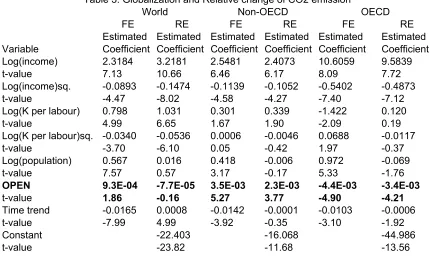
Table 1, Table 2 and Table 3 present the estimated results of the impact of globalization
on emission level, emission intensity and relative change of emission, respectively. For
per capita CO2 emission level, Table 1 shows that the coefficient of openness is negative
for all three groups and statistically significant except Non-OECD country group. This
suggests that globalization help to reduce pollution in developed country not in
developing country. In case of CO2 emission intensity per dollar (Table 2) and relative
change of CO2 emission per capita (Table 3), the coefficients of openness are
significantly negative in OECD and the World but positive in Non-OECD country group.
Thus, unambiguously globalization helps developed countries to reduce emission (or
pollution) while it increases in under developed country. Table 2 and Table 3 point out
that globalization promotes to increase emission (pollution) intensity and relative change
of emission and thereby liberalization or openness hurts the environment of developing
country and improves the environment of developed country. Thus, these empirical
findings (Table 1 – 3) support the pollution haven hypothesis (PHH). This finding
support the earlier studies (Low and Yeats (1992), Agras and Chapman (1999) and Suri
intensive goods while less developed countries produce more and more
pollution-intensive goods.
However, conventional trade theory suggests that capital abundant countries
export the capital-intensive goods, (which is also energy intensive,) which increases
pollution in capital abundant country4. So, it seems that the PHH and FEH contradict.
Actually, the differences in environmental policy (PHH) and differences in factor
endowments (FEH) might interact and jointly may determine the comparative advantage
in trade. The possible interaction effects are incorporated in our last two equations i.e.,
eq. (3)-(4). Now we present the estimates from our equations (3) – (4) allowing for the
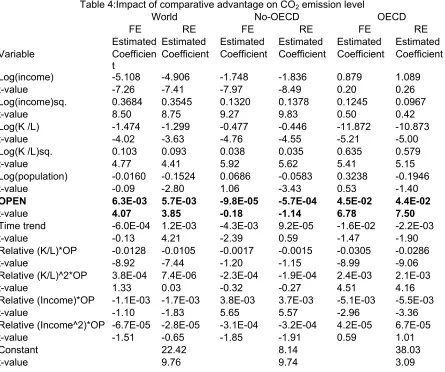
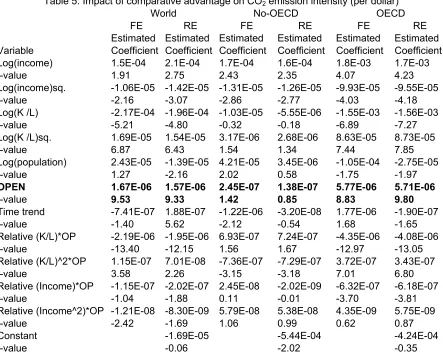
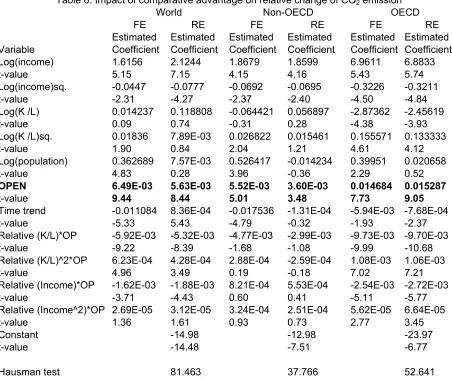
interaction of country characteristics with a measure of openness. Table 4, Table 5 and
Table 6 present the estimated results of the impact of comparative advantage (interaction
with country characteristics) on emission level, emission intensity and relative change of
emission, respectively. The results are dramatically changed. Table 4, Table 5 and Table
6 present that the coefficient of openness is positive and significant for all three measures
of pollution for all three groups, except negative and insignificant λ(coeff. Of openness)
for emission level in Non-OECD country group. It should be noted that adding the
country characteristics show to have made a large difference to the impact openness has
on CO2 emission. The signs of the coefficient of openness change dramatically opposing
the previous results (i.e., PHH) with high significant level. This result differs from the
findings of Antweiler et al. (2001), and Copeland and Taylor (20045). The interaction
terms with country characteristics are also highly significant. The interaction term on
4
Globalization helps to concentrate on the capital-intensive industry and thereby raising pollution. 5
openness and relative capital-labour ratio is negative and its square term is positive in
most of the cases except in Non-OECD for emission intensity (see Table 4 - 6). Now we
observe the interaction terms (on relative capital and openness) are negative and positive
for all three measures in the world and OECD. Therefore, if a country has sufficiently
high capital-labour ratio relative to the rest of the world, further openness makes this
country cleaner. Relatively rich and poor country would be cleaner and dirtier6,
respectively. This implies that rich capital abundant country diverts one part of their
capital and labour to produce clean and knowledge-based technology. The results of
interaction on openness and relative income are also similar to that of capital-labour ratio.
Net impact of globalization on emission depends on the relative strength of the factor
endowments and policy regulations. Globalization raises emission in the world while it
reduces emission marginally in OECD and increases in Non-OECD countries. These
empirical findings suggest that globalization increases the pollution, particularly CO2
emission, and thereby help to rise the global warming.
5. Conclusion
The aim of this paper is to explore whether globalization helps or hurts the
environment. Using panel data technique we examine the impacts of globalization on
pollution level, pollution intensity and relative change of pollution for the developed
(OECD) and developing (Non-OECD) country groups and the world as a whole. This
paper examines the factor endowment and pollution haven hypotheses that predict how
international trade affects the environment. In this study we use CO2 emission, which is
6
the mail culprit of the global warming, and observe that the impact of globalization on
environment heavily depends on the basic characteristics of a country and its dominating
comparative advantage. The empirical results suggest that globalization help developed
countries to reduce CO2 emission while developing countries to rise CO2 emission. Net
impact of globalization increases the global worming.
References
• Agras, J. and D. Chapman (1999): “A dynamic approach to the Environmental
Kuznets Curve hypothesis”, Ecological Economics 28(2), 267 - 277.
• Antweiler, W., B. R. Copeland and M. S. Taylor (2001): “Is Free Trade Good for the Environment?”, American Economic Review 91(4), 877 – 908.
• Baltagi, B. H. (1999): Econometric Analysis of Panel Data, John Wiley & Sons, New York.
• Bommer, Rolf (1999): “Environmental Policy and Industrial Competitiveness: The Pollution Haven Hypothesis Reconsidered”, Review of International Economics 7(2), 342 – 355.
• Brock, W. A. and M. S. Taylor (2004): “Economic Growth and the Environment: A
Review of Theory and Empirics”, NBER Working Paper 10854.
• Cole, M. A. (2004): “Trade, the pollution haven hypothesis and the environmental
Kuznets curve: examining the linkages”, Ecological Economics 48 (1), 71-81.
• Coondoo, D. and S. Dinda (2002): “Causality between income and emission: a country group-specific econometric analysis”, Ecological Economics 40 (3), 351 -367.
• Copeland, B. R., and M. S. Taylor (2004): “Trade, Growth and the Environment”,
Journal of Economic Literature XLII, 7 – 71.
• Copeland, B. R., and M. S. Taylor (1995): “Trade and environment: a partial synthesis”, American Journal of Agricultural Economics 77, 765 - 771.
• Dinda, S., and D. Coondoo (2006): “Income and Emission: A Panel Data based
Cointegration Analysis”, Ecological Economics 57(2), 167 - 181.
• Grossman, G. M. and A. B. Krueger (1991): “Environmental impacts of the North
American Free Trade Agreement”, NBER working paper 3914.
• Hettige, H., R. E. B. Lucas and D. Wheeler (1992): “The Toxic Intensity of Industrial Production: Global patterns, Trends and Trade Policy”, American Economic Review
82, 478 - 481.
• Hettige, H., M. Mani and D. Wheeler (2000): “Industrial pollution in economic
development: the environmental Kuznets curve revisited”, Journal of Development Economics 62, 445 - 476.
• Kuznets, Simon (1955): “Economic Growth and income inequality”, American Economic Review 45, 1 - 28.
• Liang, F. H., (2006): “Does Foreign Direct Investment Harm the Host Country’s
Environment? Evidence from China”, UC Berkeley, mimeo.
• Liddle, B. (2001): “Free trade and the environment-development system”, Ecological Economics 39, 21 – 36.
• Lopez, R. (1994): “The environment as a factor of production: the effects of economic growth and trade liberalization”, Journal of Environmental Economics and management 27, 163 - 184.
• Low, P. and A. Yeats (1992): “Do ‘dirty’ industries migrate?” In P. Low (ed.),
International Trade and environment., World Bank., Washington, D.C.
pollution: 1960 – 1988”, in P. Low (ed.) International Trade and the Environment, World Bank discussion paper 159, World Bank., Washington, D.C.
• Mani, M. and D. Wheeler (1998): “In search of pollution havens? Dirty industry in the world economy: 1960 – 1995”., Journal of Environment and Development 7(3), 215 - 247.
• Mukhopadhyay, K., Chakraborty, D. and Dietzenbacher, E., (2005): “Pollution Haven
and Factor Endowment Hypotheses Revisited: Evidence from India”, paper presented in the Fifth International Input-Output Conference at Renmin University in Beijing, China, during June 27 – July 1.
• Oak Ridge National Laboratory, CDIAC, Environmental Science Division, 1998, Estimates of global, regional and national CO2 emissions from fossil fuel burning,
cement manufacturing and gas flaring: 1755 – 1996, available at
http://www.cdiac.esd.ornl.gov/epubs/ndp030/global97.ems, (updated 2000).
• Rothman, D. S. (1998): Environmental Kuznets curve- real progress or passing the
buck?: A case for consumption-base approaches, Ecological Economics 25, 177-194.
• Summers, R. and A. Heston (1994): “Penn World Table (Version 5.6): An Expanded Set of International Comparisons:1950–1992”, NBER, PWT5.6, available at
http://www.nber.org/pwt5.6.
• Suri, V. and D. Chapman (1998): Economic growth, trade and the energy:
implications for the environmental Kuznets curve, Ecological Economics 25, 195 -208.
• Temurshoev, U., (2006): “Pollution Haven Hypothesis or Factor Endowment Hypothesis: Theory and Empirical Examination for the US and China”, CERGE-EI,
Working paper 292.
• Tisdell, C. (2001): “Globalisation and sustainability: environmental Kuznets curve
and the WTO”, Ecological Economics 39, 185 -196.
• Wheeler, D. (2000): “Racing to the Bottom? Foreign Investment and Air Pollution in
Developing Countries”, World Bank Development Research Group Working Paper
No. 2524.
Table 1: Globalization and CO2 emission level
World Non-OECD OECD
FE RE FE RE FE RE
Estimated Estimated Estimated Estimated Estimated Estimated Variable Coefficient Coefficient Coefficient Coefficient Coefficient Coefficient Log(income) -3.4619 -2.1088 -1.7862 -1.8786 9.1655 7.0154
t-value -4.47 -2.95 -9.04 -9.65 1.94 1.57
Log(income)sq. 0.2709 0.1815 0.1382 0.1444 -0.3855 -0.2931
t-value 5.69 4.17 11.09 11.74 -1.47 -1.19
Log(K per labour) 0.7384 1.1140 -0.3204 -0.3030 -3.3488 1.0643
t-value 1.94 3.03 -3.54 -3.40 -1.37 0.48
Log(K per labour)sq. -0.040 -0.068 0.027 0.024 0.165 -0.071
t-value -1.82 -3.26 4.86 4.55 1.31 -0.62
Log(population) 0.8584 -0.0994 0.0068 -0.0333 2.3717 -0.4339
t-value 4.81 -1.59 0.10 -1.96 3.61 -3.04
OPEN -6.84E-03 -7.24E-03 -9.75E-05 -4.54E-04 -0.01983 -0.01681
t-value -5.70 -6.49 -0.29 -1.50 -6.10 -5.84
Time trend -0.0247 0.0010 -0.0022 0.0001 -0.0407 -0.0019
t-value -5.02 3.10 -1.21 0.34 -3.42 -1.57
Constant - 2.436 - 7.387 - -34.745
t-value 1.09 10.79 -2.91
Table 2: Globalization and CO2 emission intensity (per dollar)
World Non-OECD OECD
FE RE FE RE FE RE
Estimated Estimated Estimated Estimated Estimated Estimated Variable Coefficient Coefficient Coefficient Coefficient Coefficient Coefficient Log(income) 4.1E-04 6.4E-04 2.4E-04 2.3E-04 2.9E-03 2.5E-03
t-value 4.37 7.38 3.87 3.71 5.72 5.19
Log(income)sq. -2.6E-05 -4.1E-05 -1.7E-05 -1.7E-05 -1.7E-04 -1.5E-04
t-value -4.49 -7.74 -4.46 -4.29 -5.95 -5.48
Log(K per labour) 1.3E-04 1.9E-04 2.6E-05 2.7E-05 -4.2E-04 -1.3E-05
t-value 2.71 4.22 0.91 0.98 -1.59 -0.05
Log(K per labour)sq. -5.5E-06 -1.0E-05 7.8E-07 5.0E-07 2.4E-05 2.7E-06
t-value -2.04 -4.04 0.45 0.29 1.76 0.21
Log(population) 1.5E-04 -7.5E-06 2.6E-05 1.6E-06 1.8E-04 -5.7E-05
t-value 6.83 -1.05 1.26 0.28 2.51 -4.09
OPEN -4.5E-07 -5.8E-07 3.3E-07 2.5E-07 -3.2E-06 -2.5E-06
t-value -3.06 -4.25 3.14 2.58 -9.18 -8.09
Time trend -4.2E-06 1.6E-07 -8.6E-07 -2.8E-08 -1.5E-06 -1.7E-07
t-value -6.92 4.55 -1.51 -0.46 -1.15 -1.42
Constant - -3.1E-03 - -9.0E-04 - -9.9E-03
Table 3: Globalization and Relative change of CO2 emission
World Non-OECD OECD
FE RE FE RE FE RE
Estimated Estimated Estimated Estimated Estimated Estimated Variable Coefficient Coefficient Coefficient Coefficient Coefficient Coefficient Log(income) 2.3184 3.2181 2.5481 2.4073 10.6059 9.5839
t-value 7.13 10.66 6.46 6.17 8.09 7.72
Log(income)sq. -0.0893 -0.1474 -0.1139 -0.1052 -0.5402 -0.4873
t-value -4.47 -8.02 -4.58 -4.27 -7.40 -7.12
Log(K per labour) 0.798 1.031 0.301 0.339 -1.422 0.120
t-value 4.99 6.65 1.67 1.90 -2.09 0.19
Log(K per labour)sq. -0.0340 -0.0536 0.0006 -0.0046 0.0688 -0.0117
t-value -3.70 -6.10 0.05 -0.42 1.97 -0.37
Log(population) 0.567 0.016 0.418 -0.006 0.972 -0.069
t-value 7.57 0.57 3.17 -0.17 5.33 -1.76
OPEN 9.3E-04 -7.7E-05 3.5E-03 2.3E-03 -4.4E-03 -3.4E-03
t-value 1.86 -0.16 5.27 3.77 -4.90 -4.21
Time trend -0.0165 0.0008 -0.0142 -0.0001 -0.0103 -0.0006
t-value -7.99 4.99 -3.92 -0.35 -3.10 -1.92
Constant -22.403 -16.068 -44.986
Table 4:Impact of comparative advantage on CO2 emission level
World No-OECD OECD
FE RE FE RE FE RE
Estimated Estimated Estimated Estimated Estimated Estimated Variable Coefficien
t
Coefficient Coefficient Coefficient Coefficient Coefficient
Log(income) -5.108 -4.906 -1.748 -1.836 0.879 1.089
t-value -7.26 -7.41 -7.97 -8.49 0.20 0.26
Log(income)sq. 0.3684 0.3545 0.1320 0.1378 0.1245 0.0967
t-value 8.50 8.75 9.27 9.83 0.50 0.42
Log(K /L) -1.474 -1.299 -0.477 -0.446 -11.872 -10.873
t-value -4.02 -3.63 -4.76 -4.55 -5.21 -5.00
Log(K /L)sq. 0.103 0.093 0.038 0.035 0.635 0.579
t-value 4.77 4.41 5.92 5.62 5.41 5.15
Log(population) -0.0160 -0.1524 0.0686 -0.0583 0.3238 -0.1946
t-value -0.09 -2.80 1.06 -3.43 0.53 -1.40
OPEN 6.3E-03 5.7E-03 -9.8E-05 -5.7E-04 4.5E-02 4.4E-02
t-value 4.07 3.85 -0.18 -1.14 6.78 7.50
Time trend -6.0E-04 1.2E-03 -4.3E-03 9.2E-05 -1.6E-02 -2.2E-03
t-value -0.13 4.21 -2.39 0.59 -1.47 -1.90
Relative (K/L)*OP -0.0128 -0.0105 -0.0017 -0.0015 -0.0305 -0.0286
t-value -8.92 -7.44 -1.20 -1.15 -8.99 -9.06
Relative (K/L)^2*OP 3.8E-04 7.4E-06 -2.3E-04 -1.9E-04 2.4E-03 2.1E-03
t-value 1.33 0.03 -0.32 -0.27 4.51 4.16
Relative (Income)*OP -1.1E-03 -1.7E-03 3.8E-03 3.7E-03 -5.1E-03 -5.5E-03
t-value -1.10 -1.83 5.65 5.57 -2.96 -3.36
Relative (Income^2)*OP -6.7E-05 -2.8E-05 -3.1E-04 -3.2E-04 4.2E-05 6.7E-05
t-value -1.51 -0.65 -1.85 -1.91 0.59 1.01
Constant 22.42 8.14 38.03
Table 5: Impact of comparative advantage on CO2 emission intensity (per dollar)
World No-OECD OECD
FE RE FE RE FE RE
Estimated Estimated Estimated Estimated Estimated Estimated Variable Coefficient Coefficient Coefficient Coefficient Coefficient Coefficient Log(income) 1.5E-04 2.1E-04 1.7E-04 1.6E-04 1.8E-03 1.7E-03
t-value 1.91 2.75 2.43 2.35 4.07 4.23
Log(income)sq. -1.06E-05 -1.42E-05 -1.31E-05 -1.26E-05 -9.93E-05 -9.55E-05
t-value -2.16 -3.07 -2.86 -2.77 -4.03 -4.18
Log(K /L) -2.17E-04 -1.96E-04 -1.03E-05 -5.55E-06 -1.55E-03 -1.56E-03
t-value -5.21 -4.80 -0.32 -0.18 -6.89 -7.27
Log(K /L)sq. 1.69E-05 1.54E-05 3.17E-06 2.68E-06 8.63E-05 8.73E-05
t-value 6.87 6.43 1.54 1.34 7.44 7.85
Log(population) 2.43E-05 -1.39E-05 4.21E-05 3.45E-06 -1.05E-04 -2.75E-05
t-value 1.27 -2.16 2.02 0.58 -1.75 -1.97
OPEN 1.67E-06 1.57E-06 2.45E-07 1.38E-07 5.77E-06 5.71E-06
t-value 9.53 9.33 1.42 0.85 8.83 9.80
Time trend -7.41E-07 1.88E-07 -1.22E-06 -3.20E-08 1.77E-06 -1.90E-07
t-value -1.40 5.62 -2.12 -0.54 1.68 -1.65
Relative (K/L)*OP -2.19E-06 -1.95E-06 6.93E-07 7.24E-07 -4.35E-06 -4.08E-06
t-value -13.40 -12.15 1.56 1.67 -12.97 -13.05
Relative (K/L)^2*OP 1.15E-07 7.01E-08 -7.36E-07 -7.29E-07 3.72E-07 3.43E-07
t-value 3.58 2.26 -3.15 -3.18 7.01 6.80
Relative (Income)*OP -1.15E-07 -2.02E-07 2.45E-08 -2.02E-09 -6.32E-07 -6.18E-07
t-value -1.04 -1.88 0.11 -0.01 -3.70 -3.81
Relative (Income^2)*OP -1.21E-08 -8.30E-09 5.79E-08 5.38E-08 4.35E-09 5.75E-09
t-value -2.42 -1.69 1.06 0.99 0.62 0.87
Constant -1.69E-05 -5.44E-04 -4.24E-04
Table 6: Impact of comparative advantage on relative change of CO2 emission
World Non-OECD OECD
FE RE FE RE FE RE
Estimated Estimated Estimated Estimated Estimated Estimated Variable Coefficient Coefficient Coefficient Coefficient Coefficient Coefficient Log(income) 1.6156 2.1244 1.8679 1.8599 6.9611 6.8833
t-value 5.15 7.15 4.15 4.16 5.43 5.74
Log(income)sq. -0.0447 -0.0777 -0.0692 -0.0695 -0.3226 -0.3211
t-value -2.31 -4.27 -2.37 -2.40 -4.50 -4.84
Log(K /L) 0.014237 0.118808 -0.064421 0.056897 -2.87362 -2.45619
t-value 0.09 0.74 -0.31 0.28 -4.38 -3.93
Log(K /L)sq. 0.01836 7.89E-03 0.026822 0.015461 0.155571 0.133333
t-value 1.90 0.84 2.04 1.21 4.61 4.12
Log(population) 0.362689 7.57E-03 0.526417 -0.014234 0.39951 0.020658
t-value 4.83 0.28 3.96 -0.36 2.29 0.52
OPEN 6.49E-03 5.63E-03 5.52E-03 3.60E-03 0.014684 0.015287
t-value 9.44 8.44 5.01 3.48 7.73 9.05
Time trend -0.011084 8.36E-04 -0.017536 -1.31E-04 -5.94E-03 -7.68E-04
t-value -5.33 5.43 -4.79 -0.32 -1.93 -2.37
Relative (K/L)*OP -5.92E-03 -5.32E-03 -4.77E-03 -2.99E-03 -9.73E-03 -9.70E-03
t-value -9.22 -8.39 -1.68 -1.08 -9.99 -10.68
Relative (K/L)^2*OP 6.23E-04 4.28E-04 2.88E-04 -2.59E-04 1.08E-03 1.06E-03
t-value 4.96 3.49 0.19 -0.18 7.02 7.21
Relative (Income)*OP -1.62E-03 -1.88E-03 8.21E-04 5.53E-04 -2.54E-03 -2.72E-03
t-value -3.71 -4.43 0.60 0.41 -5.11 -5.77
Relative (Income^2)*OP 2.69E-05 3.12E-05 3.24E-04 2.51E-04 5.62E-05 6.64E-05
t-value 1.36 1.61 0.93 0.73 2.77 3.45
Constant -14.98 -12.98 -23.97
t-value -14.48 -7.51 -6.77
Clean goods
P Figure 1: Pollution Haven Hypothesis
B
A
Q
C
D
O P Q Dirty goods