Munich Personal RePEc Archive
Decreasing of Oil Extraction:
Consumption behavior along transition
paths
Bazhanov, Andrei
8 October 2006
Online at
https://mpra.ub.uni-muenchen.de/469/
Decreasing of Oil Extraction: Consumption Behavior
Along Transition Paths
Andrei V. Bazhanov
∗†‡October 08, 2006
∗Institute of Mathematics and Computer Science, Far Eastern National University, Vladivostok, Russia,
e-mail: [email protected] or Department of Economics, Queen’s University, Kingston, ON K7L 3N6, Canada, phone: 1-(613)-533-2270, fax: 1-(613)-533-6668, e-mail: [email protected]
†Thanks to the Good Family Visiting Faculty Research Fellowship for
financial support.
Abstract A normative analysis of the problem of optimal extraction of a non-renewable resource is considered. The economy depends on the essential non-renewable resource and the rate of the resource extraction increases over time. At some instant the government gradu-ally switches to a sustainable (in sense of non-decreasing consumption over time) pattern of the resource extraction. Different approaches are offered for the construction some curves of switching to decreasing paths of the resource depletion. Consumption paths have diverse be-havior patterns along these curves, including a path of unlimited growth. A new approach to the Rawlsian maximin criterion which allows for growth of consumption is offered.
Keywords Non-renewable resource · Intergenerational justice · Hartwick rule · Optimal path of extraction· Generalized Rawlsian criterion
1
Introduction
Theories are developing, governments are changing, and the criteria for the optimality of growth
can change from time to time. Wassily Leontief [27] described the dynamic inconsistency of
economic growth as follows: “...while each step, being determined by a conscious act of choice,
satisfies certain maximizing conditions, ... sequence as a whole does not. Its path can be
com-pared to the course of a dog running across a field toward his master, while the master walks
along the road. The dog’s path will usually describe a gentle arc, while the fastest way of joining
his master would be to run along a straight, properly aimed intercepting line”. In a number
of applications we present examples, for which we will observe “regime shifts” where we must
switch to a different path which is optimal according to new and different criteria or to diff
er-ent constraints. The problem offinding the optimal transition paths is standard in highway or
railroad construction and in other engineering applications (see, e.g., [22]). The problem also is
associated with so-called transition economics, as in [5], “...excess speed of closure” the public
enterprises for developing private sector “...may slow down transition because of output
con-traction effects”. And of course the construction of a transition path toward a sustainable path
is a concern of resource and environmental economics. For example, C. Fisher, C. Withagen,
and M. Toman [11] analyze a simple model which captures the main effects of the properties of
a transition path from “dirty” to “clean” (but more costly) technology. W.D. Nordhaus in his
works (see, e.g., [34]) considers a problem of optimal (in sense of utilitarian criterion) transition
to economy with less emission of greenhouse gases for the case of a Cobb-Douglas aggregate
technology. K. Farmer and R.Wendner [10] consider responses in a general two-sector model to
qualitatively different behavior (damped oscillation besides overshooting) for the model with
heterogeneous capital in comparison with the case of homogenous capital.
We are going to consider the problem of transition path construction for a case of changing
the growth path for world oil extraction for the Solow [43] model. Assume that we are not sure
if it is possible to find perfect substitutes for non-renewable resource use and come up with
alternative technologies during the period of the resource abundance. Then we must consider
the problem of construction the optimal resource extraction path from the point of view of
intergenerational justice. We show the existence of such a path in an example drawn from the
class of rational functions. In the future we are going to examine when it might be appropriate
to use such kind of curves as a way of switching smoothly to a sustainable extraction path (for
example, Hartwick’s curve). The aim of this paper is to examine consumption behavior along
the transition path itself. The main result (Proposition 2) shows that depending on parameters
of the path, consumption can decline to zero in finite time, asymptotically approach a
non-negative constant, or grow to infinity. The second case we argue is “asymptotically optimal” in
sense of Rawlsian maximin principle. There have been numerous attempts to reconcile Rawls’s
idea of supporting the least advantaged with the possibility of economic growth. Also there are
other criteria which imply different patterns of consumption growth as the optimal behavior1.
We present a new modification of Rawlsian criterion (Generalized Rawlsian Criterion, GRC)
which implies a different interpretation of the “relevant social positions” for the comparison of
persons or generations, and as a result implies growth of consumption. The main idea does
not contradict various versions of the maximin criterion for intergenerational problems and we
1Different approaches to reconcile Rawls’ principle with economic growth can be found, e.g., in [1], [6], [15],
can deal with overlapping generations or maximin in combination with the utilitarian criterion
and possibly other desiderata. The basic assumption of our approach postulates that utility
must depend not only on a current vector of static indicators of consumption but also on the
prehistory (derivative) of individual consumption. History is involved in the personal estimation
of an individual’s consumption level. This postulate can be applied either to problems of
intra-or intergenerational justice and so apparently it can help to solve the anomalous situation,
namely when very attractive and plausible principles can not be extended (as Rawls confirms
by himself [38], p.291) to intertemporal situations. We show with simple examples that
GRC-optimal consumption can exhibit limited growth (or limited decline) and unlimited growth
depending on the properties of the utility function. Thus, in general, transition paths of
essential resource extraction can be adjusted to different optimality criteria but the constraints
represented by difficulties in changing from oil-based technologies and from existing patterns
of saving do not allow the system to switch rapidly. Since we do not know the estimations of
parameters of such constraints, we do not consider them in our examples.
The social planner solves the Gray-Hotelling problem [13],[19] of maximization of the total
utility from the resource use during the finite period T of the resource existence:
T
0
U(r(t))dt→max
r(t) .
For the case of the resource essential to production Solow [43] considered Rawlsian justice
principle for the resource allocation between generations as a limiting special case of utilitarian
criterion:
max
r(t) t∈min(0,∞)U(r(t)),
John Hartwick [17] showed the savings for the Solow [43] model must involve investing
current exhaustible resource returns in reproducible capital in order to maintain constant per
capita consumption over time. We review this for the case of a Cobb-Douglas technology. For
the case with zero population growth, no capital depreciation, no technological progress, and
zero extraction cost, we have output q = f(k, r) = kαrβ where k is produced capital, r
-current resource use, r =−S, S˙ - resource stock, α, β ∈ (0,1) are constants. Prices of capital
and the resource are fk = αkq, fr = βqr. Per capita consumption is c = q−k.˙ The Hartwick
savings rule implies c=q−rfr or, substituting forfr, c=q(1−β), which means that instead
of c˙= 0 we can checkq˙= 0.
From Hotelling rule frfr˙ =fk we have αβkq+ rr˙(β−1) =fk =αqk which in turn yields
˙
r r =−
αq
k . (1)
Then
˙
q q =α
˙
k k +β
˙
r r =β(
αq k +
˙
r
r) = 0, (2)
which means that we really haveq˙=c˙= 0.
Since from (2) q =const and then rfr =βq =const, we have k˙ =βq =const for deriving
k(t) and we have (1) forr(t). We can find two constants of integration k0 for k(t) = k0 +βqt
and the constant of equation
˙
r r =−
1
k0
αq +
β αt
using initial conditions r(0) = r0 and s(0) = s0, where s0 is the given resource stock which
must be used for production over infinite time: s0 = 0∞r(t)dt. Then we have
r(t) =r0 1 +
r0β
s0(α−β)
t
−αβ
where α>β (Solow condition) and
˙
r(t) =−¨s(t) =− αr
2 0
s0(α−β)
1 + r0β s0(α−β)
t
−(α+ββ)
. (4)
Since we assume that our economy depends on the resource essentially, we obtain path
r(t), asymptotically approaching zero and the path of extraction changes r(t)˙ (or negative
acceleration of stock s(t) diminishing) also approaching zero, but starting from the negative
valuer˙0 =− αr
2 0
s0(α−β).
2
Assuming that our economy has some “additional” savings, besides resource rent, it is
possible to relax the assumption of zero population growth (as in J. Stiglitz [44] and G. Asheim,
W. Buchholz, J. Hartwick, T. Mitra, and C. Withagen [3] papers), or zero capital depreciation.
But in any case, if we assume, that
1) economy at every instant of time depends on resource (even if we gradually introduce
substituting technologies and this dependence asymptotically approaches zero), and
2) we really want to maintain nondecreasing per capita consumption,
then rate of extraction r(t) must tend to zero.
Capital - resource substitution is a fundamental topic in energy economics and there are
some empirical evidences (see, e.g., [33], [36]) which can support the assumption that the
elasticity of substitution between natural resources and capital exceeds unity. This implies
that resource can be inessential. Though other investigations (e.g., [12], [30], and partly in
[16]) show that energy and capital are rather strong complements than substitutes (elasticity
is less than unity) and some researches find that this value is rather close to unity (e.g., [14],
2Path (3), asymptotically approaching zero, is necessary, but not sufficient condition of following Hartwick
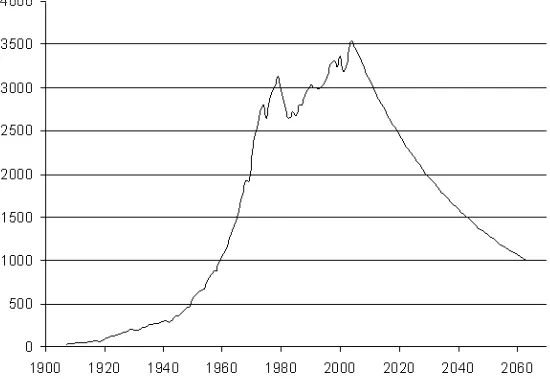
Figure 1: World oil extraction (mln.t./year)
[36]). In any case empirical evidences are not a proof and as P. Dasgupta and G. Heal noted
“Past evidence may not be a good guide for judging substitution possibilities for large values of
k/r”([7], p. 207). And so, we can assume that for the world economy oil is essential, especially
taking into account that no adequate immediate substitutes are available for transportation
fuels, a main area of oil use (see, e.g., [18], [31]). However, as we can see, for example, from oil
extraction data in December issues of Oil and Gas Journal, rates of extraction are in fact both
growing on the world level (see Fig. 1) and for the leading oil producers, not declining.
Assume that the government of our economy after period of oil-rent consumption and
grow-ing rate of extraction decided to conform to the intergenerational justice principle and switch
at t0 to some sustainable path of saving, e.g., to the Hartwick rule. An example with α = 0.3
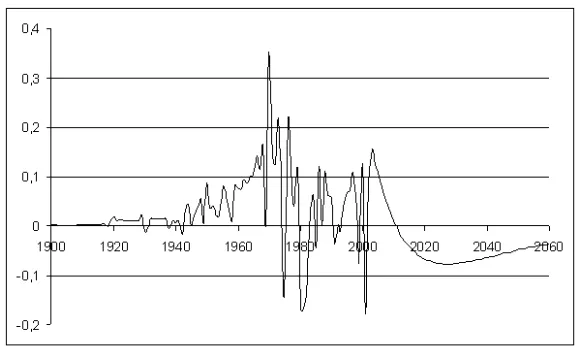
andβ = 0.05gives us behavior of r(t) andr(t)˙ for world oil extraction in Fig. 2 and Fig. 3.
An abrupt switch to the Hartwick rule means that people in oil-producing countries must
re-Figure 2: Historical data and Hartwick curve
[image:10.612.174.434.435.591.2]structure their living style. Moreover, countries must instantly reorganize their economies,
because of the sharp decrease of consumption, which in turn leads to a decrease in production,
a possible increase in unemployment, and a further decrease of demand and so on. Thus, for
an economy not following the Hartwick rule, the sudden invocation of intergenerational justice
creates the dilemma of choosing between two awkward futures: diminishing consumption to zero
in the future because of the inevitable and increasing shortage of essential exhaustible resources
or diminishing consumption to a sustainable level right from the moment of switching to the
Hartwick rule.
Solow’s model implies that oil-rent is invested from the very beginning and that there is
no time gap between the moment of oil extraction and correspondent increase of reproducible
capital according to the Hartwick rule. We can consider it as an adequate model if we assume
that reproducible capital is a fund of some high-return securities and oil profit can be instantly
invested in some shares or bonds. But suppose that money bills are not able to substitute
gasoline in engines of our cars when we have shortage of oil. And the shortage will be the
inevitable result of growing demand because of economic growth and decreasing, according to
(3), supply of oil. It means, that in order to sustain non-decreasing output with the same
struc-ture, we must invest at least part of oil profit into development of oil-substituting technologies.
In other words, we must create an “anti-oil market” with the oil rent. And under this
assump-tion the model of instant investment can not be really adequate because of the difficulties of
a rapid re-structuring. Historical examples show that the development and the introduction
of coal-based technologies took decades despite the obvious benefit of the new technologies for
economy. The same can be said about the switch from a coal to an oil economy. Now we must
they are economically more preferable but just because of anticipated shortage of profitable
but exhaustible raw materials. And this process will occur over decades, not months.
The second dimension of the impossibility of an instant switch to the Hartwick rule is
the awkward requirement of an abrupt and very substantial change of saving patterns for oil
producing countries. As an illustration we can compare non-renewable resource profit only
from oil with the total amount of investments for a selection of countries. For example, oil
gives Kuwait about 50% of GDP but grossfixed investments are only 6.6% of GDP. For Saudi
Arabia these numbers are 45% and 16.3%, United Arab Emirates - 30% and 20.7%, Venezuela
- 33% and 23.8%.3 From leaders of oil producers only Norway can boast almost coinciding
numbers (about 18.6%4), because of investing oil rent to Petroleum Fund.5
However, the well-known empirical research of Simon Kuznets [24] tells us that consumer
behavior is very persistent over time despite changes of governments and government policy.
Subsequent analyses, for example, the work of Duesenberry [9], tried to explain this
phenom-enon, and later papers examined why consumers do not react on “natural experiments” such
as the Reagan cuts in taxes [37]. In any case, there is evidence that at least in the short run
saving rate is very stable, and it is much more difficult to change it instantly, than to change
a government policy toward maximin.
Hence, the problem of switching to sustainable path of essential resource extraction must
take into account the next factors:
1) the curve must have a transition period, or period of a gradual slow-down in the rate of
extraction;
3Source of information:
http://www.cia.gov/cia/publications/factbook/docs/profileguide.html (March 2006)
4Source of information: http://www.ssb.no/en/indicators/ (March 2006)
2) there is a time lag between the moment of resource rent investment and correspondent
increase in capital;
3) there is a non-zero period length for changing saving patterns from resource rent
con-sumption to resource rent investment.
In this paper we suppose, for simplicity, that the third problem is already solved (as in
Norway), and also we will temporarily neglect the influence of the second factor. So, we will
concentrate on the question of the construction the trajectories for the transition period using
various optimality criteria and examine consumption behavior along the paths.
2
Formulation of the problem
We have assumed that the technical restrictions do not allow us to change the rates of oil
extraction instantly. The government’s policy (a criterion of optimal extraction) can be changed
much faster than the rates of extraction. The changes in the patterns of savings can also have
their own rate since the reasons of these changes do not coincide with the reasons and the
mechanisms of the oil-extraction rates changes. These differences in the speeds and in the
patterns of changes can cause a deviation from an efficient path of extraction as a result of
a policy shock. For example, if we follow the Hartwick savings rule and start to pursue the
constant consumption criterion, and at the same time the rates of oil extraction grow, we
surely follow an inefficient path of extraction. This is because an efficient path must satisfy the
Hotelling rule ([7], pp. 213-219). In turn, Hotelling rule and Hartwick savings rule yield the
unique path of extraction (3) which is decreasing for all t≥0(Fig. 2).
Hence, if we are going to change policy and we do not want to urge people to change the
we are going to analyze the case (“the worst case”) when some reasons cause the deviation
from an efficient path of extraction and we mustfind the optimal path across inefficient curves.
We set down these assumptions below in the definitions 1 - 4, and the Proposition 1.
Definition 1 Anintertemporal program f(t), c(t), k(t), r(t) ∞t=0 is a set of paths f(t), c(t),
k(t), r(t), t≥0such that f(t) =f[k(t), r(t)]andc(t) =f(t)−k(t).˙
Definition 2 For positive initial stock of capital and resource (k0, s0) 0 the set of the
programs F = {< f(t), c(t), k(t), r(t) >∞
t=0} is a feasible sheaf at t = 0 and each of the paths
f(t), c(t), k(t), r(t) is a feasible path if any program< f(t), c(t), k(t), r(t) >∞
t=0 from F for all
t≥0 satisfies the conditions:
1) (f(t), c(t), k(t), r(t)) 0;
2) r(t), k(t), c(t) are continuously differentiable and supt|r(t)˙ |≤r˙max<∞;
3) f(t) is twice continuously differentiable;
4) t∞r(t)dt ≤s(t);
5) k(0) =k0, c(0) =c0, r(0) =r0,r(0) =˙ A0 ≤r˙max.
Definition 1 is based on the definition of the interior feasible path in [3]. The differences
reflect our assumptions: a) population is constant; b) the speed of change of the extraction rate
˙
r is limited and continuous for all t including t = 0. Henceforth, a “program” and a “path”
will refer to a feasible program and a feasible path.
Definition 3 ([7], p.214) A feasible program < f(t), c(t), k(t), r(t) >∞t=0 from F is
in-tertemporally inefficient if there exists a program< f(t), c(t), k(t), r(t)>∞
t=0 from F such that
c(t)≥c(t) for all t≥0 andc(t)> c(t)for some t.
Definition 4 ([7], p.214) A set of feasible programs E = {< f(t), c(t), k(t), r(t) >∞t=0}
is a set of efficient programs if all the programs < f(t), c(t), k(t), r(t) >∞
inefficient.
Proposition 1 If f˙r(0)/fr(0) =fk(0) then F ∩E =∅.
Proof. Since f(t)is twice continuously differentiable at t= 0, then there existsε>0such
that for anyt∈[0,ε)and for any feasible program< f(t), c(t), k(t), r(t)>∞
t=0∈F the Hotelling
rule is not satisfied: f˙r(t)/fr(t) = fk(t). Necessity of the Hotelling rule for the efficiency of a
program (see, e.g., [3], [7]) follows the assertion of the Proposition.
Since there is a mutual dependence of GDP percent change and oil extraction and supply, we
can try to construct a path of extraction which asymptotically approaches zero and minimizes
the maximum negative shock represented by GDP percent change. Generally, the technical
aspects of a transition path must be considered as restrictions on the optimization problem.
But for simplicity we can suppose that these restrictions are satisfied along the optimal path
or, in other words, they are inactive. For the case when the optimal path violates some of the
restrictions, we can project it on the set of feasible solutions (method of constraints relaxation).
According to (2) GDP percent change for our economy is
˙
q q =α
˙
k k +
β
rr.˙
If in thefirst period all resource rent was being consumed, thenk˙ = 0 and
˙
q q =
β
rr.˙ (5)
If we assume that in the second period oil rent is invested in oil-substituting technologies, then
there is a time lag between the moment of oil extraction and the moment of capital increase.
So, there must be a non-zero time period when despite the investment of oil rent in reproducible
Assume that the government “does its best” and manages to extract all oil profit from
consumption and completely invests it in long-return technologies. Then, according to (4), in
the beginning (t0 = 0) of period 2 GDP percent change is
˙
q
q 0 =−αβ r0
s0(α−β)
. (6)
For α = 0.3, β = 0.05, and world oil reserves and extraction on January 1, 2005:6 r
0 =
70,899 [1,000 bbl/day] ×365 = 25,878,135 [1,000 bbl/year] (or 3.54495 bln t/year); s0 =
1,277,701,992[1,000 bbl] (or 175.0277 bln t7) we obtain the aggregate decline q˙
q 0 ≈ −0.0012
or−0.12% (annual).8
In this situation, when the growth of output in period 1 was based on non-renewable
re-source consumption, we can not already speak about intergenerational equity, because future
generations will be worse offin any case - due to approaching shortage of the depleting resource,
or because of the switch to the sustainable pattern of consumption. But we can consider the
question of mitigating the negative consequences of the switch to a sustainable path. The
amount of output decline in the second period, according to (5), is defined by the value of
negative acceleration in the process of switching to the sustainable approach to extraction.
Then we can try tofind a path, which incorporates the gradual switch or “smooth breaking” of
growing extraction, and along which the peak of negative acceleration A(t) = r(t)˙ is minimal
6Worldwide Crude Oil and Gas Production // Oil&Gas Journal, Dec. 12, 2005, p.72. 7We use coefficient 1 ton of crude oil = 7.3 barrel.
8For growing rate of extractionr(t)and diminishings(t)in thefirst period, the “cost” of switch to Hartwick
in absolute value. So we can consider the problem offinding such a function r∗(t), for which
min
t A
∗(t) = max
r(t) mint A(t), (7)
s.t. r(0) = r0,
∞
0
r(t)dt = s0,
where the last condition means that resource is essential.
3
Solving the problem
A solution of (7) can be found in the same class of rational functions as the Hartwick curve
(3). The difference is in the numerator, which must depend on t with a different (negative)
coefficient to control “smooth breaking” in the neighborhood of t = 0. Namely, we must find
A(t) in the form of
A(t, b, c, d) = A0+bt
(1 +ct)d, (8)
where b < 0, c > 0, d > 1 (for convergence A(t) → −0 with t → ∞), and then problem (7)
resembles a problem offinding suchb∗, c∗, d∗,that
min
t A(t, b
∗, c∗, d∗) = max
b,c,d mint A(t, b, c, d), (9)
s.t. r(0) = r0,
∞
0
r(t)dt = s0.
Thefirst order condition on t gives us (taking into account (1 +ct)>0)
and the minimum value of A (maximum negative acceleration) is
A(t∗, b, c, d) = b cd·
b(1−d) d(A0c−b)
d−1
. (10)
Corresponding to (8)r(t)has a dependence on b, c,and d in9
r(t) = − 1
c(d−1) A0+ b
c(d−2) + b
c(2−d)t /(1 +ct)
d−1,
then r0 =−c(d1−1) A0+c(db−2) ,which can be used to express b:
b=−c(d−2) [r0c(d−1) +A0], (11)
and then the least acceleration (LA) curve has a dependence on c andd in
r(t) =r0 1 + c(d−1) +
A0
r0
t /(1 +ct)d−1. (12)
Coefficient c can be expressed from the condition that resource is finite and essential s0 =
∞
0 r(t)dt:
s0
r0
=
∞
0
(1 +ct)1−ddt+ c(d
−1) + A0 r0
∞
0
t
(1 +ct)d−1dt
= 1
c(d−2)+
r0c(d−1) +A0
r0c2(d−3)(d−2)
,
which means that cis a solution of quadratic equation
s0
r0
c2− 2
d−3c−
A0
r0(d−3)(d−2)
= 0.
The only relevant root (because we are looking forc > 0) is
c(d) = 1 s0
r0
d−3 +
r2 0
(d−3)2 +
s0A0
(d−3)(d−2) . (13)
9Constant of integration for r˙(t) = A(t) must be zero for the convergence of ∞
0 r(t)dt, and also for the
Substituting (13) into (11) and then from b(d) and c(d) in (10) we have a dependence of
the minimum value of A(t∗) ond:
A(t∗) =−[r0c(d)(d−2) +A0]·
(d−2)[r0c(d)(d−1) +A0]
d[r0c(d)(d−2) +A0] d
Denotef(d) ={·}. Then the first order condition on dis:
Ad=−r0[cd(d)(d−2) +c(d)]f(d)d−[r0c(d)(d−2) +A0]f(d)d lnf(d) +d
fd(d)
f(d) = 0.
Note, that f(d) > 0, because d > 2, r0 >0, c > 0, A0 > 0. Then by dividing this equation
through by the −r0f(d)d we have the equation for d:
[cd(d)(d−2) +c(d)] + c(d)(d−2) +
A0
r0
lnf(d)+dfd(d)
f(d) = 0. (14)
A numerical example based on data for recent world oil extraction gives a single positive
root of equation (14)d=12.845. Thenc=0.00527385, b=-0.019793 and plots ofr(t)andA(t)
are on Fig. 4 and Fig. 5.
Maximum negative acceleration along the LA curve is A∗
LA =-0.07604549 att∗ =22.81939,
which is less in absolute value than maximum negative acceleration of the Hartwick curve
A∗
H =-0.08466 right from the very start att∗ = 0.
4
Consumption Along Transition Curves
We are going to examine, for simplicity, the case when all resource rent is always invested in
capital and there are no time lags between the moments of investment and the corresponding
capital increase. The only reason for change the pattern of extraction is that sustainable (in
sense of constant consumption) path of the essential resource extraction must be decreasing
Figure 4: The least acceleration curve of the world oil extraction (from 2005)
[image:20.612.161.451.425.598.2]Note, that constant per capita consumption is the result of
1) total investment of oil rent in capital (with no time lag) and
2) fulfillment of the Hotelling rule.
The LA curve (12) satisfies only the first condition unlike the Hartwick curve (3) which is
derived from the Hotelling rule and so satisfies it identically. Hence, to examine consumption
behavior along some path we should check the fulfillment of the Hotelling rule along this curve.
In common case q˙ = fkk˙ +frr.˙ Then f˙r = βd qr /dt = β fkkr˙ +frrr˙ − βrqr˙2. Dividing on
fr =βqr we have ˙ fr fr =
rβ βq
αk˙ kr +
βqr˙ r2 − ˙
r r =α
˙ k
k−(1−β) ˙ r r or ˙ fr fr
=fk
˙
k q −
(1−β)kr˙
αqr . (15)
Just to check, we can see, that for the Hartwick curve[·]≡1,because r˙ r =−
αq
k andk˙ =βq.
Hence, if[·]<1, thenq >˙ 0,because frf˙r < fk,which follows−rr˙ < αkq or αkq+rr˙ >0.And the
latter, using expression in the left hand side of (2), meansq >˙ 0.In the same way,[·]>1follows
˙
q <0 and, in general, sgnq˙=sgn{1−[·]}. So, to examine long-run consumptionc= (1−β)q
along the LA curve, we can check asymptotic behavior of [·].
Proposition 2 If an economy with technology q=kαrβ is such that
1) resource rent is completely invested in capital;
2) there is no time lag between the moment of investment and correspondent increase in
capital;
3) rate of extraction r(t) is such that
˙
r(t) = A0+bt
then the output q asymptotic behavior for different β is:
lim
t→∞sgnq(t) =˙
−1, β(d−2)≥1,
sgn 1− r |b|(1−α)β
0αρc[1−β(d−2)] , β(d−2)<1,
(16)
where ρ=c(d−1) +A0/r0, A0 =r(0), r˙ 0 =r(0).
Proof of the proposition is in the appendix.
5
Numerical Examples
For the example with given α = 0.3,β = 0.05, r0, A0 for the world oil extraction, and optimal
(in sense of minimal negative output shock)d∗, b(d∗), andc(d∗)
L(d,α,β) = |b(d)|(1−α)β r0αρc(d)[1−β(d−2)]
= 2.764>1,
which means, that consumption and output decrease in the long run along the LA curve (Fig.
6 and Fig. 7).
For α = 0.2,β = 0.05 (estimations from [33]) we haveL(d,α,β) = 1.543 which also means
decreasing to zero consumption infinite time. We can see from (16) that there are sets ofαand
βfor which, given optimal values ofd∗, b(d∗),andc(d∗),we haveL(d∗,α,β) = 1or consumption
tends to a constant along the LA curve. For example,L(d∗,0.325,0.03) =L(d∗,0.4337,0.04) =
1.
Selection of different values for (α,β) for which limt→∞c˙ = 0 makes some sense if we wish
to get a feeling of how far can some real extraction path be from the stable one, given that
we don’t know true values of α and β. In fact it is unrealistic to speak about short-term
regulation of these magnitudes by the government’s decisions. Our examples make the path of
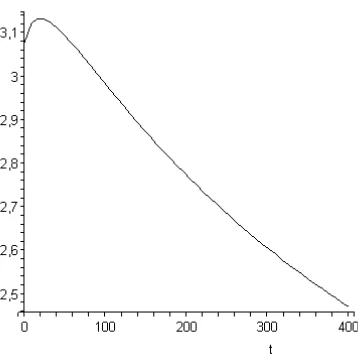
Figure 6: Consumption decrease along the LA curve t∈(0,400)
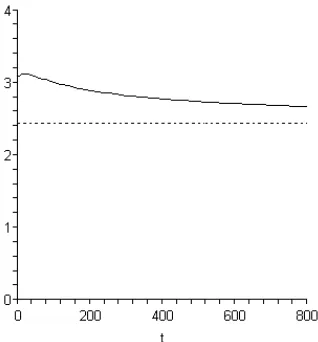
[image:23.612.215.399.442.623.2]Figure 8: Consumption along the TCC or LD curve
recalculatec(d) andb(d)using our main criterion - constant consumption over time in the long
run (asymptotically constant consumption) instead of the least negative output shock during
transition period. In other words we should solve a system of equations: L(d,α,β) = 1 plus
equations for b(d) and c(d) ((11) and (13)). An example with α = 0.3 andβ = 0.05 gives us
d = 8.0, c = 0.01022, b = −0.023196. In this case the maximum negative output shock takes
place a little bit earlier (tmax = 20.1) in comparison with tmax = 22.82 for the LA curve; the
value of the shock is larger (Amax =−0.0767) in comparison withAmaxLA =−0.07605,but the
shock is weaker than for the curve (3), for which Amax=−0.08466.
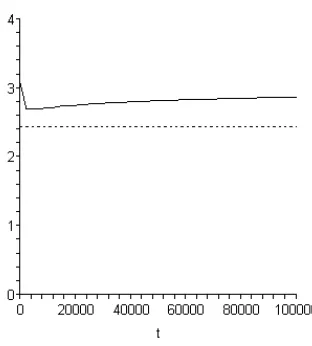
To check that the level of consumption along this curve, which we can call the “Transition
Constant Consumption” (TCC) curve, is far enough from zero, we can solve numerically
dif-ferential equation fork(t)10 and then plotc(t)(Fig. 8). The value of constant consumption for
thet, big enough, is around cconst = 2.42801.
The maximum value along the TCC curve is cmax = 3.126 at t = 16.6. As we can see,
cconst < c0 = 3.078,11 but rather far from zero. Since we have bounded decrease of consumption
along this curve, we can call it also the “Limited Decline” (LD) curve.
6
Consumption
Growth,
Transition
Curves,
and Generalized Rawlsian Criterion
Another interesting case is the behavior of infinitely growing consumption whenL(d,α,β)<1.
What is the “cost” of this growth? And can it be “optimal” in some sense or is it just a result
of overinvestment? An example with L(7.5671,0.3,0.05) = 0.9 gives us the long-run growing
consumption (Fig. 9) with the same c0, but cmax = 3.1248 at t = 16.2 and cmin = 2.6817 at
tmin = 3035. Consumption exceeds c0 aftert = 1.144·106. The dash line is the asymptote for
the LD curve (Fig. 8).
Negative effects or the “cost” of the long-run consumption growth along this curve,
com-pared with the TCC or LD curve are:
1) cmax is a little bit less, than for the LD curve (3.1248 vs. 3.126);
2) peak of negative shock on output is a little bit stronger (-0.0769 vs. -0.0767) and takes
place on 6 months earlier (t= 19.65vs. t= 20.1).
The example is an illustration of the answer to the question “what is worse”: a small
decrease of consumption in the present or the depriving of oneself and (or) one’s descendants of
any prospects for improving their lives in the future. According to Rawls’s maximin principle, it
is obviously a pattern of overinvestment. But actually Rawls objected to applying his maximin
principle (or as he call it “difference principle”) to the questions of justice among generations
11G.B. Asheim [2] considers a theoretical example where the consumption decreases to a sustainable level
Figure 9: Long-run consumption growth for L(d,α,β) = 0.9
because of unacceptable consequences: “The principle is inapplicable and it would seem to
imply,... that there be no saving at all”([38], p.291). As a solution of the problem Rawls suggests
that the difference principle must be restricted by the additional, “just savings principle”([38],
p.285). But Rawls challenges the possibility of its construction in a precise form: “I believe
that it is not possible... to define precise limits on what the rate of savings should be. How
the burden of capital accumulation and of raising the standard of civilization and culture is to
be shared between generations seems to admit of no definite answer” ([38], p. 286). And there
is a question: why such a plausible and attractive principle for intragenerational questions can
not be extended to problems of intergenerational justice? And why we can not deduce the just
savings principle from the main principle? Where is the essential source of this contradiction?
According to Rawls it is very important to define precisely relevant positions of persons (or
generations) for which we will test different theories of justice: “...selection of relevant positions
person holds two relevant positions: that of equal citizenship and that defined by his place in
the distribution of income and wealth”([38], p. 96). Income and wealth (exchangeable goods)
are used by Rawls as indicators of relevant position in his successive works also (e.g., [39], p. 58,
[40], p.76, p. 181). A.K. Sen [42] has suggested adding some not exchangeable goods such as
measures of development of personal capacities, and, as T. Scanlon has offered, “the avoidance
of chronic physical pain” ([41], p. 41). But there are a number of contributions supporting
the idea that for estimating utility and, consequently, relevant position, it is not enough to
calculate some vector of measurable static indicators. “We can ask,... how well a person’s life
is going and whether that person is...better offthan he or she was a year ago” ( [41], p. 18).
And there is evidence that has “...documented the claim that people are relatively insensitive
to steady states, but highly sensitive to changes...” and “...the main carriers of value are gains
and losses rather than overall wealth” ([20], p. 148). We just can consider, e.g., two persons
with identically the same level of consumption and other not exchangeable goods but the first
one was a billionaire, who lost her fortune just yesterday and the second was a poor peasant,
who improved her live due to a good luck or (and) diligence and a good education. Each will
surely evaluate the quality of her life currently differently. And having no information about
her position in society (“behind a veil of ignorance” [38], pp. 136-142), it looks quite plausible
that any person will choose a theory according to which she will count on a maximum support
from society in a most desperate situation and this “reflex” does not necessarily imply that she
would base her “claim” on the worst static indicators in the current period.
An important element in Rawls’s approach to defining the least advantageous person is
that actually she is not a single person but rather a representative of the “least fortunate
(time-component of the theory) we should consider the least advantageous generation as
rep-resented by a person who stands for the group in the “least fortunate period”. This means
that the person must live during some finite period of time and she doesn’t know how long
this period is. Alternatively if we consider this person as a model of all generations then we
can assume that she lives infinitely. In either case it must be the same person; in the same
way as when we compare utilities of contemporaries, we pick up them from the same time
period. When we consider the dimension “people” we don’t consider the dimension “time” and
vise versa. And since estimation of a person’s utility depends on her “progress”, and only her
“prehistory part” of this progress is available to affect this estimation, the question of savings
can be solved within this period without considering representatives of other generations. We
want to stress that the question of just savings can (not must) be solved within one generation
and this means that we can introduce overlapping generations as an added complication in
order to examine additional effects. Indeed there are persons who have no children but they
do savings to buy a car or a house, there are families who have children but they frankly think
that it will be much better for their children to be self-supporting, and nevertheless they also
do savings to improve their own progress or prevent decline. And we can not say that these
examples exhibit irrational behavior.
Hence, evaluation of one’s life quality should include not only calculations of some static
indicators, but rather such indicators combined with time-changes of variables (growth or
re-cession) or differences in consumption from previous years. Assume, for simplicity, that utility
from consumption has the formu(c) =c. For discrete time and taking into account the
evalua-tion of some prehistory, the generalized Rawlsian criterion maximizes the minimal over all time
wheren+1is a length of a “memory interval” (each person lives at leastn+1periods), the sum
n
i=0wi(ct−i−ct−i−1) is thought of as the person’s memory of earlier utility levels or the
“his-torical benchmark level” ([4] , p. 1257) and distribution ofwi over time ( wi = 1, wi ∈[0,1])
depends on individual adjustment to changes in consumption. This form of individual welfare
is close to K.J. Arrow [1], P. Dasgupta [6], J. Lane and T. Mitra [25], and N.V. Long [28]. The
two differences are: 1) we take into account not the consumption of descendants (ct+1) but the
past consumption of the same person; 2) we evaluate past consumption not in absolute value
but as a component in the process of comparing the past with our present condition (gains and
losses). We want now to show that even for such an “egoistic” model, the generalized Rawlsian
principle can imply intertemporal consumption growth. Taking into account “past experience”
in its simplest form and making use of continuous time and following Rawls strictly12, the
corol-lary of the Generalized Rawlsian Criterion for intertemporal distribution (c(t) is continuously
differentiable) can be written, e.g.13, as:
wc(t) + (1−w)c(t) =˙ γ =const for any t, w∈[0,1], (17)
It means (forc >˙ 0) that a person in the future with higher consumption and less growth must
“feel the same emotional evaluation” or have the same utility level of her “position” as she
feels in the present with less consumption and higher value of c(t).˙ Note that for γ < c0w we
have a case of generalized “fair Rawlsian decline”;14 a person in the present has not only higher
12We assume, according to Rawls, the fulfillment of hisfirst principle (“Each person is to have an equal right
to the most extensive total system of equal basic liberties compatible with a similar system of liberty for all”) and we will apply the second principle in absolutely the same way (“Social and economic inequalities are to be arranged so that they are...to the greatest benefit of the least advantaged...” [38], p. 302), but maximize the minimal value of some combinationc(t)withc˙(t).
13The author introduced an example of utility in form (17) independently of N.V.Long ([28], p.17) andc˙here
has a different meaning. It is an estimation of person’s “prehistory” which influences her evaluation of current consumption, rather then expected future consumption as it is in N.V. Long’s interpretation.
14We have no proof that present economic growth is not a pattern of overshooting and so we must define not
level of consumption but also higher rate of decline, than she has in the future, so that the
weighting according to (17) yields the same utility for each period. In the long run it reminds
the consumption behavior along the LD curve after the point of maximum (Fig. 8).
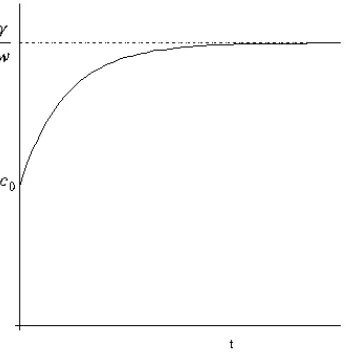
Expressing c(t)from (17) with c0 =c(0) we have
c(t) = 1
w γ−e
− w
1−wt(γ−c
0w) (18)
with
˙
c(t) = 1 1−we
− w
1−wt(γ−c
0w),
and then the path of net investment N(t)is a corollary of the Rawlsian “difference principle”.
For utility in form (17) N(t) was obtained by N.V. Long [28]:
N(t) =c(t)g(t),˙
where
g(t) =
∞
t
e− tτ[ w
1−w+fK(s)ds]dτ >0.
Observe that limt→∞c(t) = 0˙ or we have a case of limited growth (Fig. 10) for γ > c0w
(even without overlapping generations as in [35] and without discounting of maximin as in [21])
and this curve isdesirable in a sense “...that an extra bit of consumption at t is more valuable
than the sameextra bit att+ 1, since individuals will, in any case, have more consumption at
t+ 1.” ([7] p. 284) But observe also that we have limited decline forγ < c0w, and identically
constant consumption (as in the Hartwick rule) forγ =c0w.
So, for the LD curve we have the consumption behavior, which in the long run is “close”
Figure 10: Generalized “fair Rawlsian growth” (18), w= 0.5
“cost” of the impossibility of an instantaneous switch to the Hartwick curve is an infinite but
limited decline of consumption to the value which is less than c0. In the sense of (17) this is
the path which is “close” to optimal, except for the rate of its decline15. The value of w is
supposed to be defined by the government. We do not claim that everybody favors this type
of just path, particularly when it is apparent that rather small sacrifices in present can bring
slow but unlimited growth in the long run (Fig. 9).
For those, who prefer this form of intertemporal distribution, the more appropriate
consump-tion utility funcconsump-tion would be the funcconsump-tion with essential factors and the constant elasticities
of marginal utility, e.g., the Cobb-Douglas case. Then the rule of intertemporal distribution is
cwc˙1−w =γ =const, (19)
which forw= 1 is also the corollary of the regular Rawlsian principle. Integration of (19) gives
us
c(t) =c0(1 +μt)ϕ (20)
where
c0 =c(0),μ=
1 1−w
γ
co
1 1−w
,ϕ= 1−w
or a pattern of unlimited (quasi-arithmetic, [3], p. 5) growth which (forwclose to 1) looks like
the part of the curve on Fig. 9 after the point of minimum.
Utility can be written more generally as a CES function, or as a function with a variable
elasticity where the elasticity of factor substitution andware to be chosen by the government.16
Then the specific just savings principle can be deduced for the specific utility function and the
extraction path (transition curve) can be adjusted to approach as close as possible (depending on
constraints) the asymptotically optimal (in the long run) pattern of intertemporal distribution
of consumption.
Rawls holds the asymmetry of intergenerational relations to be the reason for being unable
to apply his maximin principle: “It is now clear why the difference principle does not apply
to the savings problem. There is no way for later generations to improve the situation of the
least fortunate first generation. The principle is inapplicable and it would seem to imply, if
anything, that there be no saving at all. Thus, the problem of saving must be treated in
another fashion” ([38], p. 291). Indeed intergenerational asymmetry influences the process of
just intergenerational allocation. That is why Rawlsian just distribution among contemporaries
allows inequality in utility unlike intergenerational allocation which implies the same utility (for
16And in turn, our moral evaluation of government activity in maintaining some rate of economic growth
the combination of consumption and “progress”) for the same person but generally not the same
level of consumption and not a zero net saving rate. So using this approach for a definition of a
person’s relevant position we “reduce” the problem of just savings to the problem of the choice
of a proper form of the utility function.
The choice of utility function involves another important problem, namely the problem of
dynamic inconsistency. This means that for an infinitely lived person we do have a rather
“good” function like (18) or (20). But if we reformulate the problem as a set of problems
each of which is solved by a member of the overlapping or subsequent generations, we
(de-pending on concrete form of utility function) can obtain a path which is continuous, but has
points of discontinuous derivatives at the moments of time where another generation chooses
its own optimal path using the same approach. And the resulting combination of these paths
will generally not coincide with the path of an infinitely lived person. Or if we assume that
an infinitely lived person will check and recalculate her path at each moment of time then we
will observe that she always changes her preferences and this seems to contradict the usual
assumptions of rational behavior. Therefore, for models with always rational agents we must
pick a form of the utility function which 1) induces dynamically consistent paths (constraint);
2) in the best way reflects real agents’ preferences (criterion). But then our agenda becomes
extremely complicated. From our perspective dynamic inconsistency needs a separate
consid-eration.17 Moreover since preferences can often change over time even for rational agents [8]
and in addition we have uncertainties with initial conditions (e.g., estimation of initial stock
S0), the optimal path of extraction will generally need a correction and an adjustment of the
17One of thefirst works on dynamic inconsistency was a paper of R. Strotz [46], for non-renewable resources
parameters of the transition curve from time to time. And then the resulting path apparently
will not be a “globally optimal” curve but rather will “...be compared to the course of a dog
running across a field toward his master, while the master walks along the road”[27].
7
Concluding Remarks
It deems natural for the government, committed to switching to sustainable path, to consider
the problem of minimizing the short-run negative consequences of moving to such a path. We
observe that the so-called optimal short-run transition path involves an interval of zero
con-sumption and this runs counter to the government’s primary goal of pursuing intergenerational
justice principle in the long run.
Consideration of the long-run consumption behavior along possible transition curves shows
that even for inefficient curves there is a path of extraction with asymptotically constant
(sep-arated from zero) consumption over time. The short-run negative shock along this transition
path is small for our numerical example based on observed world oil extraction data. Moreover,
a “worsening ” of the short-run situation (shortening the period of transition and introducing
a stronger negative shock on output) yields the possibility of slow, but unlimited growth of
consumption in the long run. In other words the transition curve (to be exact, the single free
parameter -d) can be fitted to satisfy desirable qualitative behavior of consumption in accord
with the various optimality criteria in the long run. And it again raises the long-standing
ques-tion about the fairest ethical theory for the distribuques-tion of consumpques-tion across generaques-tions. If
decreasing the rate of oil extraction is really necessary, which criterion we must follow? 18
Aside from equivocation on our main welfare criterion there are some other questions and
limitations of the model we have presented.
(1) We examined transition curve as interior solution neglecting restrictions imposed by
technical possibilities and difficulties connected with the saving rate changing. Constraints
on the speed of changing savings behavior can restrict us from implementing even the path
of extraction with asymptotically constant consumption not speaking of paths with unlimited
growth in the long run (questions of optimal path existence and uniqueness).
(2) There is an interesting question of the optimal program stability with respect to initial
conditions.
(3) There is one more interesting question of the comparative estimation of the consumption
behavior, considered in this paper with the consumption behavior along the efficient transition
paths.
(4) Transition curve can be constructed in different class of functions, e.g., as a solution of
calculus of variation problem.
We also assumed that:
(5) Cost of extraction is zero and population is constant though it would be interesting to
consider the problem of transition when these values are variables.
(6) There is no time lag between the moment of oil extraction and correspondent increment
of man-made capital which is not true if we invest oil rent in the development of alternative
technologies.
(7) All oil rent is invested into reproducible capital. In general, this is not observed and we
should consider some period of increasing investments along some smooth (maybe
hysteresis-like) curves and examine the influence of this curve on long-run consumption behavior.
position though there is evidence that “Losses loom larger than gains...” ([20], p. 148).
We think that all these questions need special careful consideration in separate papers.
References
[1] Arrow K.J. (1973), Rawls’ Principle of Just Saving // Swedish Journal of Economics. Vol.
75, No 4.
[2] Asheim G.B. (1994), Net National Product as an Indicator of Sustainability // The
Scan-dinavian Journal of Economics. Vol. 96, No 2.
[3] Asheim G.B., Buchholz W., Hartwick J.M., Mitra T., Withagen C. (2005), Constant
Sav-ings Rates and Quasi-Arithmetic Population Growth under Exhaustible Resource
Con-straints. CESifo Working Paper No 1573, October 2005.
[4] Barberis N., Huang M. (2001), Mental Accounting, Loss Aversion, and Individual Stock
Returns // Journal of Finance. Vol. 56, No. 4.
[5] Castanheira M., Roland G. (2000), The Optimal Speed of Transition: A General
Equilib-rium Analysis // International Economic Review. Vol. 41, No 1.
[6] Dasgupta P. (1974), On Some Alternative Criteria for Justice Between Generations //
Journal of Public Economics. Vol. 3, No 4.
[7] Dasgupta P., Heal G. (1979), Economic Theory and Exhaustible Resources. Digswell Place:
Cambridge University Press.
[8] Dasgupta P., Maskin E. (2005), Uncertainty and Hyperbolic Discounting // American
[9] Duesenberry J. (1949), Income, Saving and Theory of Consumer Behavior. Cambridge
MA: Harvard University Press.
[10] Farmer K., Wender R. (2003), A Two-Sector Overlapping Generations Model with
Het-erogeneous Capital // Economic Theory. Vol. 22, No 4.
[11] Fisher C., Withagen C., Toman M. (2004), Optimal Investment in Clean Production
Ca-pacity // Environmental and Resource Economics. Vol. 28, No 3.
[12] Fuss M. A. The Demand for Energy in Canadian Manufacturing // Journal of
Economet-rics. Vol. 5, No 1.
[13] Gray L.C. (1914), Rent Under the Assumption of Exhaustibility // Quarterly Journal of
Economics. Vol. 28, No 3.
[14] Griffin J.M., Gregory P.R. (1976), // The American Economic Review. Vol. 66, No 5.
[15] Grout P. (1977), A Rawlsian Intertemporal Consumption Rule // The Review of Economic
Studies. Vol. 44, No 2.
[16] Halvorsen R., Ford J. (1979), Substitution among Energy, Capital and Labor Inputs in
American Manufacturing. In: Advances in the Economics of Energy and Resources. Vol.
1. Ed.: R. Pindyck. Greenwich, Conn.: JAI Press.
[17] Hartwick J.M. (1977), Intergenerational Equity and the Investing of Rents from
Ex-haustible Resources // The American Economic Review. Vol. 67, No 5.
[19] Hotelling H. (1931), The Economics of Exhaustible Resources // The Journal of Political
Economy. Vol. 39, No 2.
[20] Kahneman D., Varey C. (1991), Notes on the Psychology of Utility. In: Interpersonal
Com-parisons of Well-Being. Eds.: J. Elster and M.S. McPherson. NY: Cambridge University
Press.
[21] Kaganovich M. (2000), Decentralization of Intertemporal Economies with Discounted
Max-imin Criterion // International Economic Review. Vol. 41, No 4.
[22] Kimia B.B., Frankel I., Popescu A.M. (2003), Euler Spiral for Shape Completion //
Inter-national Journal of Computer Vision. Vol. 54, No 1-3.
[23] Konow J. (2003), Which Is the Fairest One of All? A Positive Analysis of Justice Theories
// Journal of Economic Literature. Vol. 41, No 4.
[24] Kuznets S. (1946), National Product Since 1869. New York: National Bureau of Economic
Research.
[25] Lane J., Mitra T. (1981), On Nash Equilibrium Programs of Capital Accumulation under
Altruistic Preferences // International Economic Review. Vol. 22, No 2.
[26] Leininger W. (1985), Rawls’ Maximin Criterion and Time-Consistency: Further Results
// The Review of Economic Studies. Vol. 52, No 3.
[27] Leontief W. (1959), Time-Preference and Economic Growth: Reply // The American
Economic Review. Vol.49, No 5.
[29] Long N.V. (2006), A Mixed Bentham-Rawls Criterion for Intergenerational Equity.
Man-uscript. McGill University.
[30] Magnus J.R. (1979), Substitution between Energy and Non-Energy Inputs in the
Nether-lands 1950-1976 // International Economic Review. Vol. 20, No 2.
[31] Nemoto K. (2005), High Oil Prices Dampening Asia-Pacific Product Demand // Oil &
Gas Journal. Vol. 103, No 46.
[32] Newbery D.M.G. (1981), Oil Prices, Cartels, and the Problem of Dynamic Inconsistency
// The Economic Journal. Vol. 91, No 363.
[33] Nordhaus W.D., Tobin J. (1972), Is Economic Growth Obsolete? In: Economic Growth,
5th Anniversary Colloquium, V, National Bureau of Economic Research, New York.
[34] Nordhaus W.D. (1993), Rolling the ’DICE’: An Optimal Transition Path for Controlling
Greenhouse Gases // Resource and Energy Economics. Vol. 15, No 1.
[35] Phelps E.S., Riley J.G. (1978), Rawlsian Growth: Dynamic Programming of Capital and
Wealth for Intergeneration “Maximin” Justice // The Review of Economic Studies. Vol.
45, No 1.
[36] Pindyck R.S. (1979), Interfuel Substitution and the Demand for Energy: An International
Comparison // Review of Economics and Statistics. Vol. 61, No 2.
[37] Poterba J. (1988), Are Consumers Forward Looking? Evidence from Fiscal Experiments
[38] Rawls J. (1971), A Theory of Justice. Cambridge: Belknap Press of Harvard University
Press.
[39] Rawls J. (2001), Justice as Fairness. Cambridge: Belknap Press of Harvard University
Press.
[40] Rawls J. (2005), Political Liberalism. NY: Columbia University Press.
[41] Scanlon T.M. (1991), The Moral Basis of Interpersonal Comparisons. In: Interpersonal
Comparisons of Well-Being. Eds.: J. Elster and M.S. McPherson. Cambridge: Cambridge
University Press.
[42] Sen A.K. (1982), Equality of What? In: Choice, Wefare and Measurement. Cambridge
MA: MIT Press, pp. 353-372.
[43] Solow R.M. (1974), Intergenerational Equity and Exhaustible Resources // The Review
of Economic Studies. Vol. 41. Symposium on the Economics of Exhaustible Resources.
[44] Stiglitz J.E. (1974), Growth with exhaustible natural resources: efficient and optimal
growth paths // The Review of Economic Studies. Vol. 41. Symposium on the Economics
of Exhaustible Resources.
[45] Stollery K.R. (1991), Capital-Resource Substitution and the Discount Effect in Depletable
Resources // Southern Economic Journal. Vol. 58. No 2.
[46] Strotz R.H. (1955), Myopia and inconsistency in dynamic utility maximization // Review
8
Appendix (proof of the Proposition 2)
For the economy with a Cobb-Douglas production function q = kαrβ and investment covered
by resource rent in k˙ =βq, expression [·] in the right hand side of (15) is
˙
k q −
(1−β)
α
k q
˙
r
r =β−(1−β) k
αq
˙
r r.
In the long run r <˙ 0and(1−β), k,α, q, r > 0. Then we can rewrite the last equation as
[·] =β+ (1−β) k
αq
|r˙|
r ,
which means that [·] = 1 if and only if k
αq |r˙|
r = 1,and generally
sgn{1−[·]}= sgn 1− k
αq
|r˙|
r .
So, in order to examine the behavior ofq(t)andc(t),we can compare k
αq |˙r|
r or 1
αk1−αr−(1+β)|r˙|
to unity where k(t) is an unknown function. An attempt to find k(t) from the differential
equationk˙ =βkαrβ gives us k1−α =β(1−α)I(t), where
I(t) = r(t)βdt=r0β
(1 +ρt)β
(1 +ct)β(d−1)dt=r
β
0I1(t),
and ρ = c(d−1) +A0/r0. The integral I1(t) can be expressed in elementary functions using
Chebyshev substitutions if we setd= 12 and β = 0.1,0.2,0.3, and so on. Thus, for β = 0.2
k10.2−α(t) =β(1−α)r
β
0a1c−10β
ρ(p+ 1) (ac+bc)
(p+1)
− ac
1 +ρt+bc
(p+1) +k1−α
0 , (21)
whereac= 1− ρc, bc= ρc, p=β(1−d). And forβ = 0.3
k0.31−α(t) = β(1−α)r
β
0a1c−10β
× (ac+bc)(p+1)[ac(p+ 1)−bc]−
ac
1+ρt+bc
(p+1) ac(p+ 1)
1 +ρt −bc +k
1−α
0 .
k0 must be the same for any curve, and so it can be evaluated for our economy using equation
(1) for the Hartwick curve in terms of output q0 =q(0) :
k0 =−
αq0r0
A0H
,
where q0 can be set equal to unity and A0H = r˙Hart < 0 for the Hartwick curve. We can
use (21) and (22) for a detailed analysis of capital (e.g., asymptote for t → ∞), output, and
consumption along some transition curve. We must restrict attention to the cases β = 0.2 or
β = 0.3. The expression for k(t), given β = 0.1 is lengthier than (21) or (22) and we will not
consider it here. We are interested in cases with β < 0.1 in which according to Chebyshev
theoremk(t) can be expressed in elementary functions for relatively large values of d.19
However we can consider the asymptotic behavior of expression k1−αr−(1+β)|
˙
r|. Note, that
limt→∞k1−α(t) =∞,sincek˙ =βq >0for anyt≥0.And the asymptotic behavior ofr−(1+β)|r˙|
is
lim
t→∞r
−(1+β)|
˙
r| = lim
t→∞
(1 +ct)d−1
r0(1 +ρt) 1+β
A0+bt
(1 +ct)d
= 1 r0
1+β
lim
t→∞
(1 +ct)(d−1)(1+β)
(1 +ct)d ·
|A0+bt|
(1 +ρt)1+β (23)
= 1 r0
1+β
lim
t→∞
1 +ct 1 +ρt
β
· |A0+bt|
1 +ρt ·(1 +ct)
β(d−2)−1
= 1 r0 1+β · c ρ β
· |b|
ρ ·tlim→∞(1 +ct)
β(d−2)−1
19An integral τβ(a
c+bcτn)pdτ, where τ = 1 +ρt,can be expressed in elementary functions only in cases
1)p- integer; 2) β+1
n - integer; 3)
β+1
n +p- integer. In our casep=β(1−d)and forβ∈(0,1) andn= 1we
can use the third case. Then we have a condition: β(2−d) + 1 =N must be an integer. From thefiniteness of the resource we have constraint d >3or N <1−β and so, the minimum feasible (N = 0) value of dfor
or
lim
t→∞r
−(1+β)|
˙
r|=
⎧ ⎪ ⎨ ⎪ ⎩
0, β(d−2)<1,
1 r0 1+β c ρ β
|b|
ρ, β(d−2) = 1,
∞, β(d−2)>1.
This means that forβ(d−2)≥1we have our output and consumption asymptotically
decreas-ing:
lim
t→∞sgn{1−
1
αk
1−αr−(1+β)|
˙
r|}= lim
t→∞sgnq˙=−1
or the first expression in statement (16) of the proposition. The most interesting case is when
β(d−2)<1.Then using (23) we have
lim
t→∞k
1−αr−(1+β)|
˙
r|=∞·0 = lim
t→∞
k1−α
1/(r−(1+β)|r˙|) =
∞ ∞
= lim
t→∞
d[k1−α]/dt
d[1/(r−(1+β)|r˙|)]/dt
= 1 r0 1+β c ρ β
|b|
ρ tlim→∞ (1−α)k
−αk/˙ d (1 +ct)−β(d−2)+1
dt = 1 r0 1+β c ρ β
|b|
ρ
1−α
c[1−β(d−2)]tlim→∞
βrβ
(1 +ct)−β(d−2)
= 1 r0 1+β c ρ β
|b|
ρ
(1−α)βr0β c[1−β(d−2)]tlim→∞
(1 +ρt)β
(1 +ct)β(d−1) ·(1 +ct)
β(d−2)
= 1 r0 1+β c ρ β
|b|(1−α)βrβ0
ρc[1−β(d−2)]tlim→∞
1 +ρt 1 +ct
β
.
Andfinally we have
lim
t→∞k
1−αr−(1+β)|
˙
r|= |b|(1−α)β r0ρc[1−β(d−2)]
,
where b=b(c(d), d) (see (11)) andc=c(d) (see (13)). Thus forβ(d−2)<1
lim
t→∞sgnq˙= limt→∞sgn 1−
1
αk
1−αr−(1+β)|
˙
r| = 1− |b|(1−α)β r0αρc[1−β(d−2)]
,