Political Science Dissertations Department of Political Science
Spring 5-10-2014
A Transformative Effect of Migration on Tolerance? Theory
A Transformative Effect of Migration on Tolerance? Theory
Building on Democratic Learning with Empirical Investigation in
Building on Democratic Learning with Empirical Investigation in
Romania
Romania
Raluca Miller
Follow this and additional works at: https://scholarworks.gsu.edu/political_science_diss
Recommended Citation Recommended Citation
Miller, Raluca, "A Transformative Effect of Migration on Tolerance? Theory Building on Democratic Learning with Empirical Investigation in Romania." Dissertation, Georgia State University, 2014. https://scholarworks.gsu.edu/political_science_diss/32
THEORY BUILDING ON DEMOCRATIC LEARNING WITH EMPIRICAL INVESTIGATION IN ROMANIA
by
RALUCA VIMAN MILLER
Under the Direction of Dr. William Downs
This study investigates the reciprocal relationships between tolerance and democracy. It examines how
tolerance influences democracy and how democratic socialization influences tolerance. The concept of
tolerance often becomes most important when it is weakened or missing. Intolerance presents a prob-‐
lem not only to less democratic countries but to established democracies as well. Its effects are visible
in many ways, including support for illiberal political parties that, where sufficiently influential, can es-‐
tablish rejectionist and exclusionary policies. While threats to tolerance as a hallmark of liberal democ-‐
racy appear in different forms across a wide range of countries, the present study analyzes contempo-‐
rary European cases. There in/tolerance has an especially important place in political communication,
with xenophobia fueling the success of influential parties in old and new democracies alike. Based on
contemporary theoretical and empirical debates, this study’s first goal is to analyze causal connections
between (in)tolerance, satisfaction with democracy, party system characteristics, type of electoral sys-‐
tem, partisan preferences, and democracy. A second and necessary purpose of this study is to identify
the importance of a previously unexplored potential contributor to tolerance: temporary migration.
This dissertation offers an original test of the impact of temporary migration on tolerance. It confirms
through empirical evidence that migration to more democratic countries than one’s country of origin
enhances tolerance via the process of democratic socialization. The findings of this dissertation are
based on a blend of primary and secondary sources and uses a multi-‐method empirical approach in or-‐
der to investigate the research questions posed.
A TRANSFORMATIVE EFFECT OF MIGRATION ON TOLERANCE?
THEORY BUILDING ON DEMOCRATIC LEARNING WITH EMPIRICAL INVESTIGATION IN ROMANIA
by
RALUCA VIMAN MILLER
A Dissertation Submitted in Partial Fulfillment of the Requirements for the Degree of
Doctor of Philosophy
in the College of Arts and Sciences
Georgia State University
THEORY BUILDING ON DEMOCRATIC LEARNING WITH EMPIRICAL INVESTIGATION IN ROMANIA
by
RALUCA VIMAN MILLER
Committee Chair: Dr. William Downs
Committee: Dr. Henry Carey
Dr. Charles Hankla
Electronic Version Approved:
Office of Graduate Studies
College of Arts and Sciences
Georgia State University
DEDICATION
ACKNOWLEDGEMENTS
The end of this long journey would have never been possible without the contribution of many individu-‐
als who I strive to thank and acknowledge in this brief thank you note. I apologize if I forgot to mention
anyone. I would not be writing this note if it wasn’t for the resources and training received in the Politi-‐
cal Science Department at Georgia State University. Most of all, I want to thank Dr. William Downs, the
chair of my committee, whom I met as a professor and now I know as the Associate Dean for the Social
and Behavioral Sciences. Without his support I would have been lost in the field of Political Science. I
want to thank him for being my protector. Sometimes it took awhile for me to comprehend some of his
decisions, but in the end I consider that his decisions were always to my benefit. His abundant com-‐
ments on my numerous drafts were vital to the shape of my project. It was also important to me that he
took a few minutes to wonder about the welfare of the human being sitting in the chair across the table
from him.
Dr. Hankla and Dr. Carey, the other two dissertation committee members have been extraordi-‐
nary supporters of the entire process. I am grateful for their flexibility and desire to work with a very
tight timetable. Besides fulfilling his role as a committee member Dr. Hankla has been a great teacher
throughout the entire process, always available for advice and open to offer suggestions and guiding me
through from the comprehensive examination process. Dr. Carey always offered guidance and profes-‐
sional advice, invited me to collaborate on various projects and opened new research horizons. I want to
thank them both for their support and their trust in me. I also want to thank all of my professors who
helped form me and whose expertise encouraged me to develop my own interests. Thank you, Dr. Alli-‐
son Calhoun-‐Brown, Dr. John Duffield, Dr. Carrie Manning and Dr. Jennifer McCoy. All of you thought
me a lot and your contribution to my formation is greatly appreciated. Special thanks to Dr. Amy Stei-‐
push through at times when I would have considered slowing down. My peers have also had a tremen-‐
dous impact on my formation. I felt part of a great community with my fellow students in the depart-‐
ment and I want to thank ‘the bunch’ for all those encouraging words and for all those wonderful and
memorable moments. I want to thank Kathie Barrett for her help with numerous tasks at hand and Van-‐
ja Petricevic for encouragements and support. You are all so wonderful.
My research benefited tremendously from the help and support of former colleagues and dear
friends from the Political Science Department at Babes-‐Bolyai University in Cluj Napoca, Romania.
Without their welcoming attitude my fieldwork would have been less successful and entirely less enjoy-‐
able. Thank you “401” for offering me your logistical support, your class time to apply questionnaire,
your network of acquaintances within the university, your personal homes, your office space and your
resources but I want to say that I am mostly grateful for your friendship. Thank you Dr. Gabriel Badescu,
Dr. Cosmin Marian, Dr. Bogdan Radu, Dr. Florin Fesnic, Dr. Irina Kantor, Dr. Remus Anghel, Dr. Petruta
Teampau, Dr. Daniela Angi and Carmen Greab. I am also grateful to the old friends and colleagues in
leadership positions in the Department of Political Science who offered me lodging, advice and logistical
support at each step on the way. Thank you Dr. Catalin Baba, Dr. Calin Hintea, and Dr Dacian Dragos.
You made me feel home there again. I also want to thank Dr. Ron King and Dr. Paul Sum, my former
professors and mentors for all their trust and the opportunities to improve my professional career. I
must thank all those students who took time to fill in the questionnaire and answer the qualitative in-‐
terviews. Without their participation my data gathering would have been a disaster.
Last but not least I want to make sure that I underline the tremendous support of my family and
friends who put up with me and trusted that I will be one day again their family member and friend not
a perpetual PhD student. I have the most wonderful parents and brother who I thank for being so sup-‐
TABLE OF CONTENTS
ACKNOWLEDGEMENTS ... v
LIST OF TABLES ... ix
LIST OF FIGURES ... xi
1.
THE PROBLEM OF (IN)TOLERANCE IN A GLOBAL SOCIETY ... 1
1.1
The research question: the causes and consequences of (in)tolerance ... 3
1.2
Dissertation overview ... 17
1.3
Importance of this study ... 20
2
Critical Evaluation of the Extant Literature: ... 23
2.1
Tolerance and Democracy in Comparative Perspective ... 24
2.2
Extreme right versus radical right parties ... 25
2.3
Micro and Macro Determinants of Tolerance, Partisanship, and Democracy: Previous Research 27
2.3.1
Tolerance and Voting ... 27
2.3.2
Individual determinants of tolerance, partisanship and voting ... 28
2.3.3
Ideological unity and voting ... 32
2.3.4
Satisfaction with democracy and voting ... 35
2.3.5
Voting, Electoral Systems, and Party Format ... 37
2.3.6
Party System Format on Democracy ... 42
2.3.7
The Impact of Democracy on Tolerance ... 47
2.4
Conclusion ... 51
3
Explanatory Model, Data, Methods, and Operationalization of Variables ... 53
3.1
The study of tolerance: a theoretical roadmap ... 53
3.2
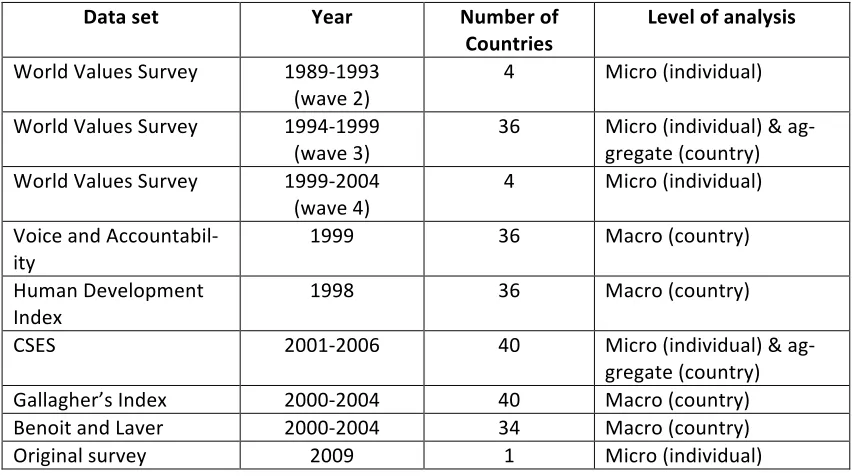
The datasets employed in this study ... 62
3.3
Methods employed ... 65
3.4
Operationalization of variables ... 74
3.5
Conclusion ... 82
4
Macro-‐ and Micro-‐Level Determinants of Support for Radical Right Parties ... 83
4.1
Determinants of electoral support for radical right, macro-‐level ... 84
4.1.1
Bivariate linear regression ... 84
4.1.2
Multivariate linear regression ... 106
4.2
Determinants of electoral support for radical right, micro-‐level ... 113
4.3
Conclusion ... 116
5
Tolerance, party system and democracy: four case studies ... 122
5.1.1
French party system ... 123
5.1.2
Radical Right ... 128
5.2
Austria ... 134
5.2.1
Austrian Party System ... 134
5.2.2
Radical right ... 138
5.3
Romania ... 141
5.3.1
Romanian Party System ... 141
5.3.2
Radical Right ... 145
5.4
Hungary ... 150
5.4.1
Party system ... 150
5.4.2
Radical Right ... 154
5.5
Conclusion ... 156
6
Individual-‐level analysis of tolerance, party system and democracy; four case studies ... 158
6.1
Conclusion ... 180
7
Transformative Experience of Migration? Evidence from an Original Survey of Work Study Students ... 183
7.1
Migration and political tolerance: evidence from an original survey, the quantitative approach ... 186
7.2
Migration and political tolerance: evidence from an original survey, the qualitative approach 192
7.2.1
The post American experience: political and social tolerance ... 195
7.2.2
The pre American experience (knowledge and expectations) ... 207
7.2.3
The American experience ... 212
7.3
Conclusion ... 223
8
Conclusions ... 225
Bibliography ... 233
Annexes ... 244
Annex 1. Variables used in chapter 6 ... 244
Annex 2. Qualitative interview questions ... 245
Annex 3. Survey questions/Questionnaire ... 246
LIST OF TABLES
1.1 Immigration in the United States by country of origin (top nine countries) ……….…………..…... 15
2.1. Ideological differences between mainstream, radical right and extreme right-‐wing parties………..26
2.2. Major Electoral Systems ……… 38
3.1. Datasets used in this research……….62
3.3. Bivariate Correlations………67
3.4. Assessing the impact of Work and Travel experience: a quasi-‐experiment ……….72
3.5. The list of variables and their operationalization………...….75
4.1. Predictors of the electoral support for the radical right parties………107
4.2. Predictors of the percentage seats in the legislative chambers for the radical right parties……….110
4.3. The impact of the electoral support for the radical right and electoral system on the number of seats gained by the radical right in the legislative chamber ……….…. 111
4.4. The impact of individual-‐level variables on party choice………..114
5.1. French party system ………125
5.2. Austrian Party System………135
5.3. Romanian Party System………142
5.4. Hungarian Party System………152
6.1. Predictors for the support for radical right parties in Romania wave 2………..160
6.2. Predictors for the support for radical right parties in Romania wave 3………..162
6.3. Predictors for the support for radical right parties in Romania wave 4………..163
6.4. Total effect longitudinal Romania……….165
6.5. Predictors for the support for radical right parties in Hungary wave 2………166
6.6. Predictors for the support for radical right parties in Hungary wave 3………167
6.7. Predictors for the support for radical right parties in Hungary wave 4………169
6.8. Total effect longitudinal Hungary………..171
6.9. Predictors for the support for radical right parties in France wave 2………172
6.10. Predictors for the support for radical right parties in France wave 4……….173
6.11. Total effect longitudinal France………174
6.12. Predictors for the support for radical right parties in Austria wave 2………175
6.13. Predictors for the support for radical right parties in Austria wave 4………177
7.1. Varimax orthogonal rotated factor matrix of the six variables distinguishing social and political
tolerance, original survey ………..….. 187
7.2. Democratic exposure, social and demographic variables, and their impact on political and social tolerance ………..………… 188
7.3 Longitudinal analysis; the impact of Work and Travel and Western experience………191
7.4. Qualitative interviews; demographic characteristics………195
7.5. Qualitative Interviews summaries……….222
LIST OF FIGURES
1.1. The model of the impact of political and social tolerance on democracy, and the impact of
democracy on tolerance ………..……… 5
1.2. International migration, 1960-‐2010, by destination: less developed versus highly developed countries ………..……….. 12
1.3. Top Twenty Countries of Origin for Immigration in OECD Countries (By number of migrants) ……….……… 14
2.1. Political and social tolerance of French partisan constituencies (by vote in the first round of the 2002 presidential election) ………..………. 45
3.1. The reciprocal relation between democracy and tolerance………54
3.2. Migration and political tolerance: a recursive model……….70
4.1. The impact of political tolerance on support for radical right parties……….86
4.2. The impact of social tolerance on support for radical right parties ……… 88
4.3. The impact of development on radical right voting……….90
4.4. The impact of ideological distance on support for radical right parties……….92
4.5.The impact of the level of satisfaction with democracy on radical right voting……….93
4.6. The impact of radical right voting on percent seats for radical right parties………..95
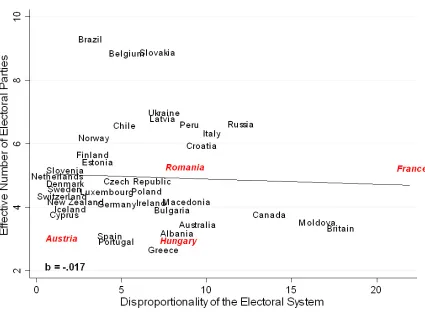
4.7. The impact of the electoral system on the effective number of electoral parties………..97
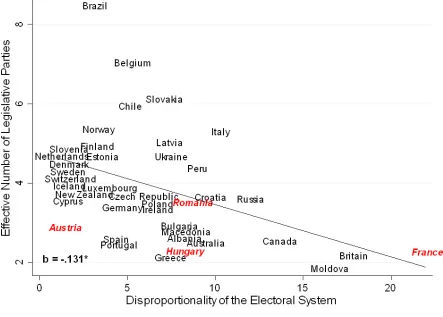
4.8. The impact of the electoral system on the effective number of legislative parties………98
4.9. The impact of the electoral system on the percent votes for radical right parties………..100
4.10. The impact of the electoral system on the percent seats won by radical right parties ………….. 102
4.11. The impact of support for radical right on democracy ……….103
4.12. The impact of percentage seats for radical right on democracy ………105
1. THE PROBLEM OF (IN)TOLERANCE IN A GLOBAL SOCIETY
Previous research has shown an apparent causal relationship between tolerance and democracy
(c.f., Stouffer 1955; Huntington 1991; Inglehart 1997). Given empirical validation of such a relationship,
an important and enduring imperative for political scientists is to investigate tolerance and its determi-‐
nants. The essential question is: What makes people more tolerant? Some researchers focus on the
impact of micro-‐level variables such as education, while others analyze the impact of macro-‐level varia-‐
bles such as democracy – i.e., the relation between tolerance and democracy works both ways. This
dissertation provides an analysis of how tolerance, via the party system, impacts democracy, on the one
hand, and how democracy, via the process of democratic socialization, impacts tolerance, on the other.
The study of tolerance becomes even more important in the light of current findings and events.
Modernization theory predicts that, as countries develop, attitudinal change follows, by bringing in
more tolerant, pro-‐democratic citizens (Stouffer 1955; Inglehart 1997; Fish 2005). Relatedly, previous
research appeared to indicate that, beyond a certain threshold of economic development, democratic
backsliding is no longer possible (Przeworski et al. 2000). New developments, however, appear to chal-‐
lenge both assertions. To illustrate, recent surveys conducted in Romania indicate that the youngest
cohorts are less tolerant and less pro-‐democratic than older cohorts (Fesnic 2010). In Hungary, consid-‐
ered a success story of democratization in the post-‐Communist region during the 1990s and 2000s, we
witness a significant reversal of this evolution since 2010 with Viktor Orban’s return to power.1
Accordingly, this dissertation investigates the reciprocal relationships presumed to exist be-‐
tween tolerance and democracy. At issue is how tolerance influences democracy and, in turn, how
democratic socialization influences tolerance. Tolerance, as an object of study for political science, of-‐
ten becomes most important when it is diminished or absent.2 Intolerance presents a problem not only
to less democratic countries but to established systems as well. Its effects manifest in many forms, in-‐
cluding support for illiberal political parties that where sufficiently powerful, can translate into rejection-‐
ist and exclusionary national policies. While threats to tolerance as a hallmark of liberal democracy ap-‐
pear in different guises across a wide range of states, the present study restricts the analysis to contem-‐
porary European cases. There in/tolerance occupies an especially important place in political discourse,
with xenophobia fueling the fortunes of influential parties in old (e.g., France, Austria) and new (e.g.,
Hungary, Romania) democracies alike.
Emerging from ongoing theoretical and empirical debates, this study’s first goal is to analyze
causal connections between (in)tolerance, satisfaction with democracy, party system characteristics
(e.g., policy distance between mainstream right and radical/extreme right3), type of electoral system,
partisan preferences, and democracy. A second and necessary goal is to isolate the influence of an over-‐
looked potential contributor to tolerance. To this end, this dissertation offers an original test of the im-‐
pact of temporary migration on tolerance. It seeks empirical confirmation for the argument that migra-‐
tion to more democratic countries than one’s country of origin enhances tolerance via the process of
democratic socialization. This first chapter presents an overview of the theoretical questions raised by
2 Gibson (1992, 560) referring to the measurement of tolerance versus intolerance finds that “traditional predictors of intoler-‐
ance perform very similar irrespective of which of the tolerance measures are used. Since substantive conclusions about the origins of intolerance are insensitive to the index employed, this study argues that future tolerance research can profitably uti-‐ lize either measurement approach.”
3 The distinction between radical right and extreme right parties will be analyzed in detail in Chapter 2 of this dissertation.
the issues mentioned above, the results of the research conducted so far, and what problems still need
to be addressed.
1.1 The research question: the causes and consequences of (in)tolerance
A democratic country (more specifically, a liberal democracy) needs a democratic citizenry.
Democratic citizens must accept the views and political participation of others, particularly when they
feel threatened by, or disagree with these other groups’ views (Stouffer 1955; Inglehart 1997; Fish
2005). Building on previous studies, the working definitions for this research is that tolerance equals the
acceptance of worldviews, people and behaviors that one dislikes. Tolerance is multidimensional: it has
a political and a social component. Political tolerance refers to refusing to impose limits to the expres-‐
sion of ideas (for instance, Communism or fascism) or the rights of people (for instance, ethnic minori-‐
ties) that are disliked. Social tolerance refers to a refusal to legislate behaviors (such as homosexuality
or prostitution) that not liked.
In the end, individual level intolerance translates into institutionalized limitations on political
rights or civil liberties (Guerin, Petry and Crete 2004). Such gap of democratic principles makes the poli-‐
ty less democratic, even when we use a simple, purely institutional definition of democracy. But more
subtle forms of intolerance, which may be present only at the level of the attitudes of some members of
society, can be a threat to democracy. In these scenarios, parties with an intolerant agenda can join the
government or the electoral advance of such parties is avoided only at the cost of mainstream politi-‐
cians and parties moving themselves in a more extreme position by embracing, even if only partially, the
with an intolerant agenda tend to have intolerant voters. Thus, the different forms of intolerance are
politically consequential, and therefore it is essential to study them.
Thus, tolerance has an indirect impact, and it is manifested in part through the party system. At
the most basic level, the purported causal path proceeds as follows: intolerant citizens vote for radical
or extreme right-‐wing parties. Greater support for these parties translates, ceteris paribus, into less democratic institutions and policies. Alternatively, more tolerant citizens should marginalize extremist
parties, reinforce support for more democratic institutions, and encourage liberal policies. If this essen-‐
tial calculus is indeed accurate, then political scientists—of both normative and empirical preoccupa-‐
tions—should have a vested interest in mapping the processes whereby citizen tolerance can be in-‐
creased. This study proposes temporary migration to a more democratic society as one such source of
democratic socialization capable of enhancing tolerance. Citizens from less democratic countries mi-‐
grating temporarily to a more democratic country will be socialized in this new environment and as a
result become more tolerant, with the key catalyst being exposure to new information through immer-‐
sion.
This dissertation’s focus on temporary migration as an informational source capable of altering
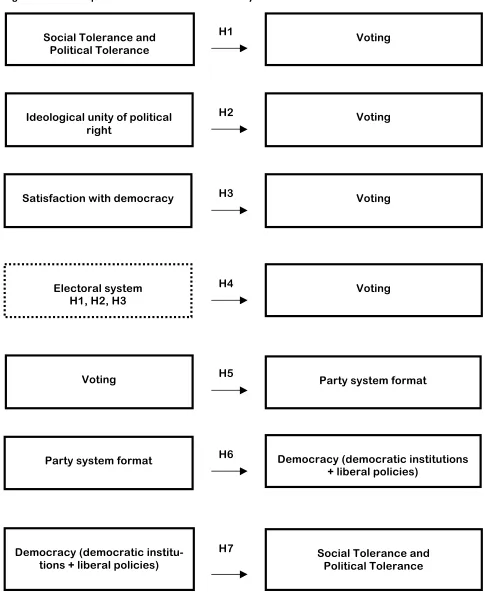
individual-‐level degrees of tolerance is nested within a much larger causal model (Figure 1.1). Tolerance
is antecedent to democracy. It impacts democracy in a multitude of ways, and this study focuses on the
dynamic interactive relationships connecting attitudes, preferences, and democratic quality. It recog-‐
nizes the important intervening effects of party and electoral systems, and it highlights the critical
“feedback loop” dominated by exposure (or denial) to new information. These are brief introductions
that will be detailed in a later chapter. The core components of this model are elaborated below:
Figure 1.1. The model of the impact of political and social tolerance on democracy, and the impact of democracy on tolerance
1. The impact of tolerance on voting is shaped by the level of support for radical/extreme right-‐ wing parties. Lawson (1980) defines parties as the link between government and society. Parties are
seen as “agencies for forging links between citizens and decision makers” (Von Beyme 1985, 13). They
shape voters’ preferences and implement their desired policy choices. Goodwin (2011) finds that sup-‐
port for what he calls Populist Extremist Parties (PEP) comes from those who share profound hostility
towards immigration, multiculturalism and diversity in general. They tend to frame members of differ-‐
[image:19.612.89.513.112.481.2]
vote for mainstream parties, while intolerant citizens vote for radical/extreme right-‐wing parties
(Kitschelt 1995, Norris 2005).
2. The ideological unity of the political right influences voting by creating an opening in the par-‐ ty system for radical right parties. While extreme left parties can also be intolerant, they have in many
countries become at best politically marginalized since 1989 March (2008). Moreover, their radicalism is
mostly economic. Therefore, the focus of this dissertation will be on radical and extreme right parties.
Kitschelt (1995) advances the hypothesis that, as the distance between the mainstream ideological par-‐
ties is reduced, the opened space is filled by the radical right. This hypothesis is challenged by Norris
(2005) who does not find evidence to back the claim that radical right parties perform better electorally
when mainstream parties converge. Art (2006, 2007) argues that the evolution of radical right parties is
path dependent and hinges on different historical interpretations of the past. He shows major differ-‐
ences between how Germany and Austria approached their political past, which in turn shaped the po-‐
litical present. Germany chose to assume its past and employ a “culture of contrition” to the Nazi past.
This approach prevented the radical right from strengthening its roots in post-‐unification Germany. In
contrast, Austria assumed a culture of “victimization” which allowed the far right to compete successful-‐
ly with mainstream parties and make significant electoral gains.
3. Satisfaction with democracy influences voting. Previous research concludes that citizens who
vote for mainstream parties are more satisfied with democracy and the democratic processes compared
to the citizens who vote for radical right parties (Ignazi 1992; Betz 1994; Billiet and De Witte 1995; Lub-‐
bers et al. 2002). These studies show that the level of satisfaction with democracy is an important pre-‐
dictor for the radical right support: the stronger the dissatisfaction with democracy, the greater the like-‐
4. The impact of all these determinants of support for radical right parties is mediated by the electoral system. The degree to which actual support translates into votes is a function of the permis-‐
siveness of the electoral system. Dow (2001; 2010) demonstrates that the type of electoral system
makes a difference in voting behavior: majoritarian electoral systems place parties and candidates closer
to the center compared to proportional representation. Ezrow (2010) contends that in addition to the
traditional approach, that compares the impact of the electoral system on party system format in a
number of countries, a longitudinal analysis employed in countries that have experienced a change in
the electoral system can offer additional valuable insight on the impact of the electoral system on party
polarization.
5. Voting impacts party system format. This can happen in two scenarios – though these two
are not mutually exclusive. The first scenario is one in which there is high electoral support for a radical
right-‐wing party and this party ends up in the government (such as the Austrian Freedom Party). A se-‐
cond scenario is when the moderate right moves away from the center in an attempt to capture radical
right votes and consequently modifies its policy positions to answer the needs of this new electorate (as
it happened in 2007 and 2012 in France with Sarkozy and his UMP). At this point of the analysis, voting
behavior becomes the independent variable, impacting party system format (the dependent variable).
6. The party system format biases the production of il/liberal policies. The hypothesis here is
that greater support for moderate parties translates into the rejection of radical right-‐wing policies.
Conversely, if radical right parties gain representation in the legislature, or even in the government (as in
Austria or Hungary), they have a platform for promoting or implementing illiberal and exclusionary poli-‐
cies. In other cases (e.g., France), mainstream parties and politicians may implement such policies as a
component of democracy, which requires that all citizens (and, for that matter, even non-‐citizens) must
be treated equally.
7. Democratic exposure. If the electoral system artificially dilutes citizen support for extremist parties or blocks the translation of votes into representation, then it can diminish democratic quality. If
intolerance breeds support for extremist parties, and the state’s response is to limit such parties’ institu-‐
tional voice through the electoral rules rather than to address the underlying causes of intolerance, then
system quality is imperiled. Likewise, where the mainstream right is tempted to close the gap in the pol-‐
icy space between itself and its far right flank, then the medicine may prove to be as deadly as the dis-‐
ease. Instead, from a normative perspective, a much better remedy is to increase the underlying indi-‐ vidual-‐level tolerance which, in turn, should translate into decreased support for extremist parties.
More tolerant citizens move away from extremist parties neither because the electoral system makes it
more difficult to support the extremes, nor because the mainstream parties have moved towards the
extreme, but simply because they are tolerant. Even if extremist parties would develop, they would find
little support in the electorate. According to such logic, democracy is defended not by restricting the
supply of intolerant alternatives but by decreasing the demand of intolerant attitudes in the electorate.
If one demand-‐side remedy is exposure to new information, then researchers must systematically ex-‐ plore opportunities for such exposure. Recognizing temporary migration as one of many possible op-‐
portunities, it is probable here to envision gains in tolerance deriving from extended travel to more
democratic countries. If a genuine feedback loop does indeed exist, then a kind of democratic remit-‐
tance process may be said to take place after temporary migrants return home.
Obviously, this research does not exhaust the list of potential explanatory variables. There are
many other candidates and to give just a few examples, previous regime type, educational system or the
specifically, the educational system is entrusted with forming the citizens of tomorrow. In the case of
Germany students are socialized to acknowledge the negative repercussions of the Nazi regime while
this is not the case in Austria (Art 2007). In Hungary history teachers teach civic culture. They have a
tendency to present the glorious past of the Hungarian state in a very subjective and nationalist fashion.
The role of the dominant church can also constitute a predictor since the Orthodox Church in a compar-‐
ative perspective is considered to authoritarian and non-‐democratic. Between the Catholic Church and
the Protestant church, the later is considered more authoritarian and intolerant. Church can play a cru-‐
cial role in forming citizens’ views. Regime type can also dictate the contemporary political realities.
France has a recent colonial past; Romania was included in a special theoretical category because of the
brutality of the Communist system (Linz and Stepan 1996) and Hungary despite its perceived more open
and liberal Communist system did not liberalize politically (like Poland) but economically.
In some of the analyses presented in this study, democracy is the dependent variable. In others,
such as the assessment of the impact of transition to democracy on the political and social tolerance of
the population, democracy is the independent variable. The older the democracy the better the chanc-‐
es that its citizens are more tolerant because through the process of democratic learning these citizen
were exposed to democratic values. The dual direction of causal arrows is characteristic of a dynamic
model such as the one proposed here.4 In either case, the working definition of democracy is based on
Dahl’s (1971, 1-‐9) conceptualization of liberal democracy as requiring both inclusiveness and contesta-‐
tion. In view of that, the World Bank’s “Voice and Accountability” scores are an appropriate measure for
democracy (“accountability” for the liberal dimension, or contestation, and “voice” for the democratic
dimension, or inclusiveness).
The new democracies in the East had a relatively short period of time to expose their citizens to
the democratic learning process. The new generations exposed to this process are among the first to
learn democratic values in the newly democratized countries. In the more democratic West, many more
generations of citizens were exposed to the process of democratic learning producing a more democrat-‐
ic citizenry. Previous research by Viman-‐Miller and Fesnic (2010) indicates that, on average, citizens
from the more developed Western countries are significantly more tolerant, politically and socially,
compared to their Eastern counterparts and this is reflected in their better democratic scores. Nonethe-‐
less, it would be imprudent to conclude that these countries have reached a point of no return, where
their protection against the ills of intolerance is foolproof. That this is not the case is illustrated by the
examples of France, where Jean-‐Marie Le Pen, the then-‐leader of the authoritarian and xenophobic
Front National, finished second in the 2002 presidential runoff, and Austria, where the extreme right-‐
wing Freedom Party entered the national government in 2000. Clearly, these results are a symptom of
an increase in intolerance in these polities, as shown, for instance, by the recent anti-‐Roma policies im-‐
plemented in France or in Austria laws that drastically tightened the immigration policies and reduced
the number of asylum applications.5
The European Union harshly criticized France’s then-‐president Nicolas Sarkozy, and the Europe-‐
an Parliament formally reprimanded him and denounced France’s anti-‐Roma policies in the summer of
2010. According to the official figures, France expelled 977 Roma and demolished 128 squatter camps.
The criticism underlined the fact that these Roma populations, known as Gypsies or Travelers, are EU
citizens and enjoy certain legal rights which were ignored by French authorities. The European Union
blamed Sarkozy for putting short-‐term, narrow partisan interests above the core principles of liberal
democracy and, by doing this, France broke EU laws regarding freedom of movement and anti-‐
discrimination.6 This seems to be a more generalized phenomenon than initially expected. Although
France and Austria are prime examples of the danger faced by democratic societies that have to con-‐
tend with radical right parties, Romania is a different case that raises similar questions. The Romanian
leading coalition7, a center-‐left alliance, fell into similar temptations and it is criticized for enacting non-‐
democratic policies in order to gain and maintain voters positioned in the extreme.8
Another way to test the impact of political regime on tolerance is to see whether travel (i.e., ex-‐
posure through temporary immersion) from a less democratic to a more democratic country has any
transformative influence on the values of temporary migrants. As a core component of globalization,
migration is an increasingly important phenomenon (Figure 1.2). Whether the focus is on permanent or
temporary migration, each may entail significant social, economic and political consequences, for both
the countries of origin and the countries receiving the migrants.
6 Ian Traynor, “French ‘anti-‐Gypsy policy’ denounced by European parliament.” The Guardian, September 9, 2010,
<http://www.guardian.co.uk/world/2010/sep/09/french-‐anti-‐gypsy-‐european-‐parliament>, accessed May 8, 2011.
7 A center-‐right coalition led Romania’s government at the time but a center-‐left coalition replaced them in June 2012.
8 Voices in Romanian national media argued that the center-‐right PNL (part of the governing coalition) radicalized its discourse
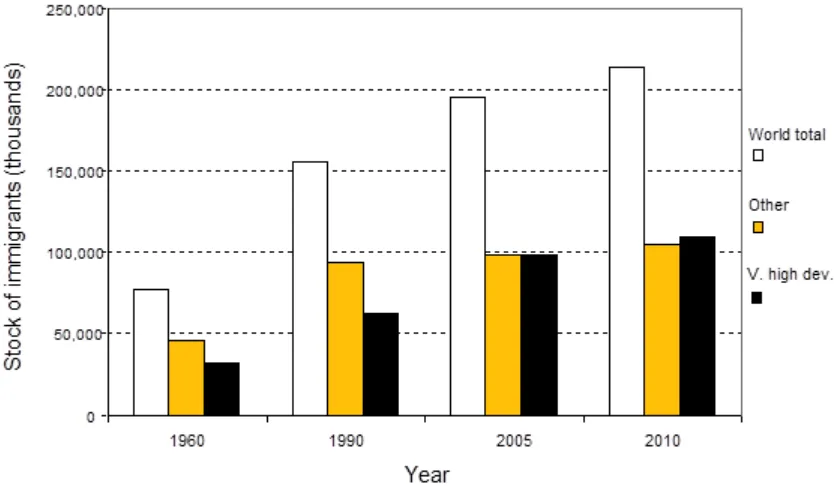
Figure 1.2. International migration9, 1960-‐2010, by destination: less developed versus highly devel-‐ oped countries
“World total”: total number of immigrants in the world (“other” + “v. high dev.”)
“V. high dev.”: countries with a Human Development Index score of .900 or above (2010) “Other”: countries with a Human Development Index score of less than .900 (2010)
Data source: UNDP (“Human Development Report 2010, Statistical Tables,”
<http://hdr.undp.org/en/media/HDR_2009_Tables_rev.xls>; Accessed April 23, 2010).
The driving force behind the migratory phenomenon is primarily economic; among the most im-‐
portant pull factors are: personal satisfaction or benefit, an increase in the economic opportunities in
the receiving countries, and individual’s decision to maximize income (Lewis 1952; Todaro 1969; Borjas
1989; Mayda 2005). Neoclassical economic analysis sees migration as an individual decision seeking to
maximize benefits, while the economics of migration sees migration as a family decision influenced not
9 UNDP defines international migration as, “human movement across international borders, resulting in a change of country of
residence.” The data includes statistics for foreign-‐born individuals, as enumerated by the censuses of each country (UNDP, “Human Development 2009. Overcoming Barriers: Human mobility and development”,
[image:26.612.97.514.128.371.2]only by the labor market, but also by the market conditions in the receiving country (Stark 1991). There-‐
fore, in the absence of any other pushing agents such as war or extreme natural disasters, the economic
factors seem to prevail. Consequently, the countries with the highest levels of socioeconomic develop-‐
ment receive a disproportionate share of the world’s total number of immigrants (Figure 1.2), while the
majority of migrants come from less developed countries (Figure 1.3). However, the strong correlation
between socioeconomic development, on the one hand, and democracy, on the other, means that these
immigrants are also exposed to the influence of more democratic institutions, and interact with people
who are more tolerant, politically and socially, and have more democratic attitudes, in comparison to
the institutions and the people of the migrants’ home countries.
Figure 1.3. Top Twenty Countries of Origin for Immigration in OECD Countries (By number of migrants10)
Source: OECD, “A Profile of Immigrant Populations in the 21st Century: Data from OECD Countries,” <http://www.oecd.org/dataoecd/15/60/40647145.xls>. Accessed March 23, 2010.
In light of the above argument, it is not surprising to see that the main migration influx is from
less developed and less democratic countries to more developed and more democratic countries, as
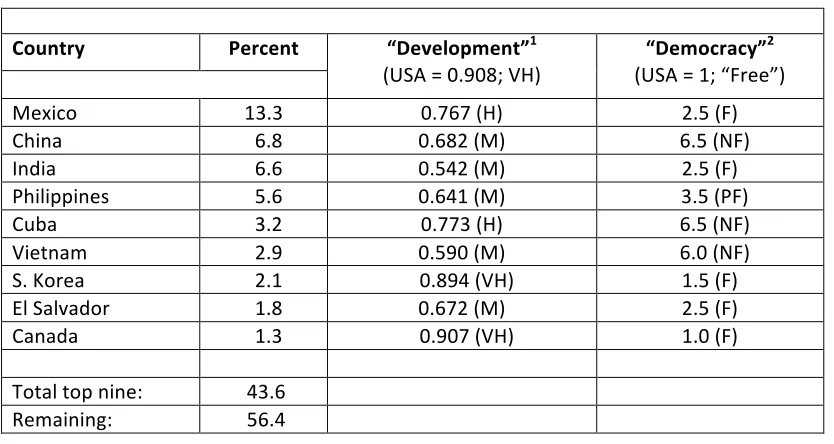
Figure 1.3 indicates. This is further illustrated by Table 1.1, which offers data on immigration into the
United States of America. There are several reasons for choosing the US to illustrate this phenomenon.
10
[image:28.612.78.531.107.443.2]First, the United States has an established tradition as a receiving country.11 Second, it is by far the larg-‐
est country among the most democratic (countries having a maximum democratic score on Freedom
House’s rankings, 1.0), and therefore, in a sense, the most “representative.” Last, but not least, the final
part of this study is using an original survey seeking to capture the impact of democratic socialization on
the values of students who spent time in the US in the Work and Travel program.
Table 1.1 Immigration in the United States by country of origin (top nine countries)
Country Percent “Development”1
(USA = 0.908; VH) “Democracy” 2
(USA = 1; “Free”)
Mexico 13.3 0.767 (H) 2.5 (F)
China 6.8 0.682 (M) 6.5 (NF)
India 6.6 0.542 (M) 2.5 (F)
Philippines 5.6 0.641 (M) 3.5 (PF)
Cuba 3.2 0.773 (H) 6.5 (NF)
Vietnam 2.9 0.590 (M) 6.0 (NF)
S. Korea 2.1 0.894 (VH) 1.5 (F)
El Salvador 1.8 0.672 (M) 2.5 (F)
Canada 1.3 0.907 (VH) 1.0 (F)
Total top nine: 43.6
Remaining: 56.4
1 Socioeconomic Development is operationalized using the UNDP’s Human Development Index; VH: very
high HDI (900 and above), H: high HDI (800-‐899), M: medium HDI (500-‐799), L: low HDI (500 and below)
2 “Democracy” is measured using Freedom House scores (the average for civil liberties and political
rights); NF: not free, PF: partially free and F: free
The data are for 2000 in order to match the rest of the data available for the forthcoming analysis.
Table 1.1 shows the profile of the immigrants into the United States. The Human Development
Index informs us about the economic status of the sending countries, and Freedom House illustrates the
[image:29.612.79.496.223.445.2]
level of democratization for these countries of origin.12 The data from 2010 show that immigrants make
up 13.5% of the total population of the US; the top sending countries to the United State (by number of
migrants) are Mexico, China, the Philippines, India, Puerto Rico, Vietnam, El Salvador, the Republic of
Korea, Cuba, and Canada; these nations amount to 43.6% of the total migration.13 The numbers under-‐
score the fact that, with the exceptions of Canada and South Korea, the rest of the countries are not
comparable to the United States’ level of economic wellbeing and democracy. Canada and South Korea,
the more developed nations, add up to a meager 3.4% of the total number, compared to the rest of the
sending nations which add up to more than 40%. Even though the data are only available for the top
sending countries, a reasonable expectation is that the remaining half will mirror this pattern, with most
immigrants coming from countries less economically and politically developed than the US.
Romania is a good example of a country whose workforce did not escape this migratory trend, a
phenomenon accelerated by the process of political and economic integration of the country in the EU.
The number of Romanian migrants to Western countries is significant, whether we measure it in abso-‐
lute numbers or as a percentage of the total population. Some estimates put this figure as high as two
million people, or around ten percent of its workforce.14 Researchers can therefore test whether the
migration of Romanians to more developed (and especially more democratic) countries has a trans-‐
formative effect on their values, making them more tolerant.
12 Immigration data are available for all of the selected countries at
http://www.migrationinformation.org/datahub/countrydata/data.cfm.
13 http://siteresources.worldbank.org/INTPROSPECTS/Resources/334934-‐1199807908806/UnitedStates.pdf. Consulted Febru-‐ ary 27, 2012.
14 “By 2014, all restrictions on the free movement of people within the EU will have been removed, thus, contributing to anoth-‐
er wave of labor migration from Romania. Between 2006 and 2020, Romania’s population is expected to decrease by 5.7% from 21.6 million to 20.4 million: although Romanian wages are rising, they will remain lower than those in Western European
countries, so that migration incentives will remain high for Romanians” (Media Eghbal, “Romanian migration raises concerns
over labour shortage”; September 3, 2007.