Business Administration Dissertations Programs in Business Administration
Fall 5-8-2014
Information Sharing Tears of Irony: An Exploratory Study of the
Information Sharing Tears of Irony: An Exploratory Study of the
Information Sharing Paradox in the Intelligence Community
Information Sharing Paradox in the Intelligence Community
Kevin Odom Sr.
Follow this and additional works at: https://scholarworks.gsu.edu/bus_admin_diss
Recommended Citation Recommended Citation
Odom, Kevin Sr., "Information Sharing Tears of Irony: An Exploratory Study of the Information Sharing Paradox in the Intelligence Community." Dissertation, Georgia State University, 2014.
https://scholarworks.gsu.edu/bus_admin_diss/35
PERMISSION TO BORROW
In presenting this dissertation as a partial fulfillment of the requirements for an advanced degree from Georgia State University, I agree that the Library of the University shall make it available for inspection and circulation in accordance with its regulations governing materials of this type. I agree that permission to quote from, to copy from, or publish this dissertation may be granted by the author or, in his/her absence, the professor under whose direction it was written or, in his absence, by the Dean of the Robinson College of Business. Such quoting, copying, or publishing must be solely for the scholarly purposes and does not involve potential financial gain. It is understood that any copying from or publication of this dissertation which involves potential gain will not be allowed without written permission of the author.
NOTICE TO BORROWERS
All dissertations deposited in the Georgia State University Library must be used only in accordance with the stipulations prescribed by the author in the preceding statement.
The author of this dissertation is:
Kevin Odom, Sr. 9406 Del Mar Circle San Antonio, TX 78251
The director of this dissertation is:
Dr. Richard L. Baskerville
Department of Computer Information Systems J. Mack Robinson College of Business
Georgia State University Post Office Box 4015
Information Sharing Tears of Irony: An Exploratory Study of the Information Sharing Paradox in the Intelligence Community
BY
Kevin Odom, Sr.
A Dissertation Submitted in Partial Fulfillment of the Requirements for the Degree
Of
Doctor of Philosophy
In the Robinson College of Business
Of
Georgia State University
GEORGIA STATE UNIVERSITY ROBINSON COLLEGE OF BUSINESS
Copyright by Kevin Odom, Sr.
ACCEPTANCE
This dissertation was prepared under the direction of the Kevin Odom Dissertation Committee. It has been approved and accepted by all members of that committee, and it has been accepted in partial fulfillment of the requirements for the degree of Doctoral of Philosophy in Business Administration in the J. Mack Robinson College of Business of Georgia State University.
H. Fenwick Huss, Dean
DISSERTATION COMMITTEE
Dr. Richard Baskerville Dr. Nathan Bennett
ABSTRACT
Information Sharing Tears of Irony: An Exploratory Study of the Information Sharing Paradox in the Intelligence Community
BY
Kevin Odom, Sr.
May 8, 2014
Committee Chair: Dr. Richard L Baskerville
Major Academic Unit: Business
The sharing of information across government intra- and inter-agencies provides enormous benefits to Intelligence operations, but it also poses risks to Intelligence organizations’ operational capability. These benefits and risks of sharing information within Intelligence Communities introduce a paradox that disturbs decision-making abilities and affect existing and future relationships with local and national Intelligence partners. With this paradox, there exist particular forces that affect the paradox, such as organizational factors and the behavior of an information sharer, the responsible actor that decides on how, when and with whom to share the information. Combining the two can produce a positive (desired) outcome that leads to
v
TABLE OF CONTENTS
CHAPTER 1: INTRODUCTION ... 1
1.1 RESEARCH DOMAIN ... 1
1.2 RESEARCH PERSPECTIVE ... 9
1.3 RESEARCH APPROACH ... 12
1.4 SUMMARY…… ... 16
CHAPTER 2: LITERATURE REVIEW ... 19
2.1 INFORMATION ... 19
2.2 PARADOXES…. ... 20
2.3 INFO SHARING PARADOX ... 22
2.4 GOVERNMENT INTER- AND INTRA-AGENCY INFO SHARING ... 27
2.5 INTER- AND INTRA-AGENCY INFO SHARING BENEFITS, RISK AND BARRIERS……. ... 31
CHAPTER 3: THEORY OF PLANNED BEHAVIOR ... 39
3.1 KEY CONSTRUCTS OF THEORY OF PLANNED BEHAVIOR ... 39
3.2 APPLICATIONS OF THEORY OF PLANNED BEHAVIOR ... 39
3.3 THEORY OF PLANNED BEHAVIOR AND DECISION-MAKING ... 41
CHAPTER 4: RESEARCH DESIGN ... 45
4.1 SUBJECTS…….. ... 45
4.2 INFORMATION THEORY ADAPTATION ... 48
4.3 RESEARCH METHODOLOGY ... 58
4.3.1 DATA COLLECTION ... 59
4.3.2 DATA ANALYSIS METHOD ... 60
CHAPTER 5: DATA ANALYSIS ... 65
5.1 RESULTS……… ... 65
5.1.1 RESULTS DATA ANALYSIS ... 70
CHAPTER 6: DISCUSSION ... 75
6.1 INTUITION……. ... 76
6.1.1 RELATIONSHIPS AND BELIEFS ... 76
vi
You can position the text box anywhere in the document. Use the Drawing Tools tab to change the formatting of the pull quote text box.] You can position the text box anywhere in the document. Use the Drawing Tools tab to change the formatting of the pull quote text box.]
7.1 CONTRIBUTIONS ... 83
7.2 LIMITATIONS ... 94
7.2.1 GENERALIZABILITY ... 96
7.2.2 VARIANCE ... 96
7.3 CONCLUSION ... 97
CHAPTER 8: APPENDICES ... 99
APPENDIX A: THEORY OF PLANNED BEHAVIOR AND INFORMATION SHARING PARADOX CONSTRUCTS ... 99
APPENDIX B: INTERVIEW GUIDE ... 101
vii
LIST OF TABLES
viii
You can position the text box anywhere in the document. Use the Drawing Tools tab to change the formatting of the pull quote text box.] You can position the text box anywhere in the document. Use the Drawing Tools tab to change the formatting of the pull quote text box.]
LIST OF FIGURES
ix
ABBREVIATIONS
List of Abbreviations (in Alphabetical Order)
CIA……...…..Central Intelligence Agency DIA………….Defense Intelligence Agency DNI………….Director of National Intelligence DoD…………Department of Defense
FBI…………..Federal Bureau of Investigations IC………Intelligence Community
ICD………….Intelligence Community Directive IED………….Improvised Explosive Device Info Share…...Information Sharing or Info Sharing IA…………...Intelligence Analysts
IS…………....Information Security IS(s)…………Information Systems IT………Information Technology JDAM……….Joint Direct Attack Munitions PEOU……….Perceived Ease of Use
PU………... Perceived Usefulness
PWM……….. Prototype-Willingness Model NGA……….. National Geospatial Agency NRO……….. National Reconnaissance Office NSA………... National Security Agency
ODNI………. Office of Director of National Intelligence TPB………… Theory of Planned Behavior
x
ABSTRACT
The sharing of information across government intra- and inter-agencies provides enormous benefits to Intelligence operations, but it also poses risks to Intelligence organizations’ operational capability. These benefits and risks of sharing information within Intelligence Communities introduce a paradox that disturbs decision-making abilities and affect existing and future relationships with local and national Intelligence partners. With this paradox, there exist particular forces that affect the paradox, such as organizational factors and the behavior of an information sharer, the responsible actor that decides on how, when and with whom to share the information. Combining the two can produce a positive (desired) outcome that leads to successful mission accomplishment or negative (inadvertent) outcome that leads to loss of information disclosed or intentional loss of valuable information. An inadvertent outcome could result in an impact to the national defense of the United States. Do Intelligence Analysts share information when the risks outweigh the benefits? This research examines how understanding the paradox of information sharing is a critical element in understanding the behavior of Intelligence Analysts’ decision-making in Intelligence operations.
1
INTRODUCTION
1.1 Research Domain
This research study investigates the paradox of information (info) sharing. First, there
are two important definitions regarding info sharing: non-electronic and electronic info sharing.
Javernpaa and Staples (2000) define non-electronic info sharing as the volitional conveyance of
information generated or obtained by one entity to another entity, whereas electronic info sharing
occurs via computing and communication technologies. In addition, there are competing
definitions and different ways to understand government info sharing and integration. Ramon
Gil-Garcia, Soon Ae, and Janssen (2009) define information integration as “the forming of a
large unit of organization entities, temporary or permanent, for the purpose of merging processes
or sharing information” (p. 2). Within the literature, there are definitions that highlight the
social and political nature, while other definitions focus more attention on info sharing and
integration from technical aspects. Davenport and Prusak (1997), Pardo, Cresswell, Thompson,
and Zhang (2006), Richardson and Asthana (2006), and Benjamin, Rockart, Morton, and Wyman
(1984) suggest that research that highlights the social aspects of government integration focuses
on info sharing, inter-agency collaboration, and coordination mechanisms. In contrast, research
that deals with the technical aspects focuses on topics such as interoperability and the integration
of data by means of various technologies, including standards-based document sharing,
middleware applications, data warehouses, and consolidated information systems (Dawes, 1996;
Larence, 2008; Lips, O'Neill, & Eppel, 2011; Luo, Zhang, & Leung, 2001; Miranda, 2003). The
focus of this research study is towards the social aspects of government integration focusing on
info sharing, inter-agency and intra-agency collaboration, coordination mechanisms, and the
You can position the text box anywhere in the document. Use the Drawing Tools tab to change the formatting of the pull quote text box.] You can position the text box anywhere in the document. Use the Drawing Tools tab to change the formatting of the pull quote text box.] integration and info sharing is the 2004 U.S. Intelligence Reform and Terrorism Prevention Act
(IRTPA). The IRTPA authorized the president to create an Info Sharing Environment (ISE) for
the sharing of terrorism information in a manner consistent with national security and with
applicable legal standards relating to privacy and civil liberties. The plan of the ISE highlights
sharing of terrorism prevention-related information among all ISE participants, in the forms of
federal-to-state, state-to-state, state-to-locality, government-to-industry, and even federal
government-to-foreign ally.
Next, since this research investigates the paradox of info sharing, it is important to
understand and explain the meaning of paradox. Leaders in inter- and intra-agency
organizations, including the military, are given responsibilities to increase efficiency, reduce
budgets, foster innovation, and build teams for creativity, and are expected to think globally and,
at the same time, to think locally. It has become common to suggest these types of everyday
responsibilities are paradoxical in nature and it has become a cliché to managers and leaders.
Handy (1994) argues that paradox is both overused and underspecified; thus, simply labeling
something as a paradox does not necessarily advance the understanding of it. On the other hand,
other researchers often avoid defining paradox altogether (e.g., Westenholz (1993), which does
not advance the comprehension of paradox either. Although the term paradox provokes
numerous and various meanings, Hampden-Turner (1981) and Schneider (1990) suggest that it
begins with philosophers from the ancient Greeks to Existentialists who have viewed human
existence as paradoxical with the understanding of its position in tensions between life and death,
good and evil, self and other. Equally, psychologists have long stressed the cognitive nature of
paradox, examining its impacts of tensions on creativity and mental health or using paradoxical
3 [Type a quote from the document or the summary of an interesting point. You can position the text box anywhere in the document. Use the Drawing Tools tab to change the formatting of the pull quote text box.] [Type a quote from the document or the summary of an interesting point. You can position the text box anywhere in the document. Use the Drawing Tools tab to change the formatting of the pull quote text box.] Wartzawick, Weakland, & Fisch, 1974). In organizational studies, researchers have defined
paradox as contradictions embedded within a statement, human emotions, or organizational
practices (Eisenhardt & Westcott, 1988; Murnighan & Conlon, 1991; Vince & Broussine, 1996).
Conversely, others describe paradox as an observation that counters common beliefs or as an
unintended consequence (Davis, Maranville, & Oblog, 1997; Sitkin & Bies, 1993). The
approach of this research study is from the perspective of Koot, Sabelis, and Ybema (1996),
which argues for using the notion of one of the great philosophers, Ludwig Wittgenstein, which
suggests paradox as something surprising. In addition, the most useful definition is from Quinn
and Cameron (1988), authors of one of the leading books in the field of paradoxes; to wit,
“embracing clashing ideas, paradox . . . involves contradictory, mutually exclusive elements that
are present and operate equally at the same time.” They argued the importance of understanding
the complexity, diversity, and ambiguity of organizational life and highlighted the insightfulness
paradox offers the potentially powerful framework for examining the impacts of plurality and
change, adding understanding of divergent perspectives and disruptive experiences. Therefore,
the paradoxical view of this research is from Quinn and Cameron (1988) definition combined
with Ford and Backoff (1988) perspective, which defines paradox as some thing that denotes a
wide variety of contradictory, yet interwoven elements; i.e., perspectives, feelings, messages,
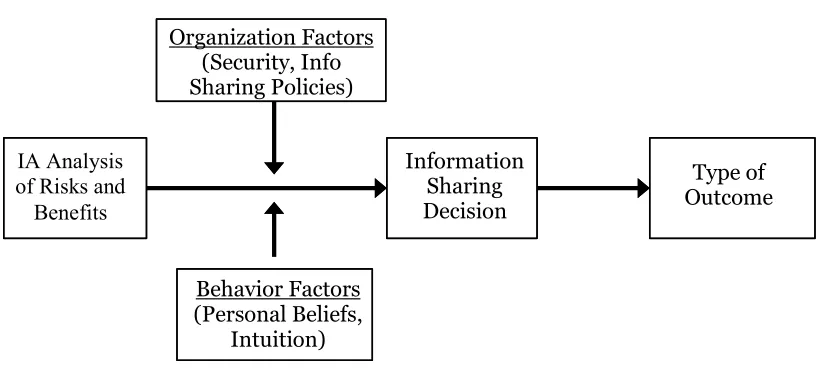
demands, identities, interests, or practices. The paradox construct is between the benefits and
risks in sharing information which is influence by two organizational factors: security policies
and info sharing policies and Intelligence Analysts’ (IA) behaviors: attitude and intuition, as
actors attempting to make sense of an increasingly intricate, ambiguous, and ever-changing IT
You can position the text box anywhere in the document. Use the Drawing Tools tab to change the formatting of the pull quote text box.] You can position the text box anywhere in the document. Use the Drawing Tools tab to change the formatting of the pull quote text box.] reveals the seemingly absurd and irrational coexistence of the actual benefits and inherent risks
to info sharing.
In adopting the social aspect of info sharing, this research focuses on Information
Technology (IT) users of electronic info sharing that occurs via computing and communication
technologies. These particular IT users are both IA who have access to electronic information
and decision-makers when using communication technologies and deciding to share information.
Every day this unique group of IT users confronts the paradox: a mystery or consummate blend
of opposites on the systems they use to communicate with one another. This paradox becomes
apparent in the info sharing decision based on the IA knowledge of the organization’s security
and info sharing policies and the conflict that exists within them because of their personal
behavior, attitude and intuition, and their subjective normative beliefs. They must internally
analyze the benefit versus risk tradeoff propositions, which are impacted by the organization’s
security and info sharing policies and the individual’s beliefs, typically influenced by an actor’s
background factors that influence his/her behavior intention. One key factor to understand
within the paradox of info sharing in the organization is the inherent risk taker, not the
individual. The organization position would always assume the optimum cost-benefit analysis,
but the decision-maker, the IA, does not necessarily have all the information and can’t possible
consider all the variables in a cost-benefit analysis, which may very well conflict with the
organization’s security and info sharing policies. Would the government consciously hire risky
IA to share Intelligence data? We know that technology systems drive policy every bit as much
as policy drives technology systems. Policy and technology face paradoxes specifically where
policymakers appear to be comfortable with paradoxical situations, and even reap value from its
5 [Type a quote from the document or the summary of an interesting point. You can position the text box anywhere in the document. Use the Drawing Tools tab to change the formatting of the pull quote text box.] [Type a quote from the document or the summary of an interesting point. You can position the text box anywhere in the document. Use the Drawing Tools tab to change the formatting of the pull quote text box.] & Sauser, 2008). On the other hand, technology developers prefer less ambiguity and more
clear-cut specifications. John et al. (2008), suggest that the IT users’ preference for
unambiguous languages, like mathematics, desire for encyclopedic knowledge of prioritized
requirements, and occasional reluctance to buck the engineering community’s “conventional
wisdom” limits the IT users’ problem-solving approaches. Thus, there is conflict in the IT users’
decision-making when sharing information from an organizational versus an individual behavior
perspective.
Finally, in the info sharing domain, it is clear that, for an info sharing entity to survive, it
must develop and maintain long-term relationships with the entities it decides to share with in the
relationship. To this end, for the Intelligence Community (IC) to survive, it also depends on vast
quantities of information to build rapport with each other that attracts the attention of national
partners. Info sharing among government agencies gained considerable attention in the
aftermath of the September 11 terrorist attacks, Hurricane Katrina, and mass shooting rampages,
such as the one involving Fort Hood gunman Nidal Hassan who killed 13 people on a U.S.
military post. Feldman-Stewart et al. (2007) argued that there was “near universal agreement”
that fighting terror would require deeper data exchanges than ever existed before between inter-
and intra-agencies, including our military forces. The improvement of info sharing among
government agencies has become one of the highest priorities of decision-makers, and the lack of
info sharing has been identified as a major point of failure leading to and responding to these
horrific events (Akbulut-Bailey, 2011).
Today, many international and U.S. political leaders place great emphasis on the purpose
of national and foreign policies that should establish a systematic bias in favor of much more
You can position the text box anywhere in the document. Use the Drawing Tools tab to change the formatting of the pull quote text box.] You can position the text box anywhere in the document. Use the Drawing Tools tab to change the formatting of the pull quote text box.] importance (Awad & Krishnan, 2006). One of the objectives of the IC is to be an integrated
network of agencies that work together to protect our nation’s defense. To this end, the
Intelligence Community Directive (ICD) Number 501, addresses the mandates in the IRTPA of
2004 to strengthen the sharing, integration, and management of information within the IC, and
establishes policies for discovery, dissemination or retrieval of intelligence, and
intelligence-related information collected or analysis produced by the IC. The objective of ICD 501 is
threefold: 1) to foster an enduring culture of responsible sharing and collaboration with an
integrated IC; 2) to provide an improved capacity to warn of and disrupt risks to the U.S.
homeland, and U.S. persons and interests; and 3) to provide more accurate, timely, and insightful
analysis to inform decision-making by the president, senior military commanders, national
security advisers, and other executive branch officials. Sharing information across
inter-agencies, like foreign national partners, or intra-inter-agencies, like the IC, is usually presented by the
potential gains that government agencies could obtain from their participation in the inter- or
intra-agency information exchange initiative. Some examples are to detect national security
threats around the world, increasing government transparency and accountability; reducing costs
and duplication; a more efficient agency or governmental organization; and improved
decision-making for government officials and public servants. According to (Dawes, 1996), government
info sharing offers a real opportunity to share databases and make sharper decisions based on
more information that is complete.
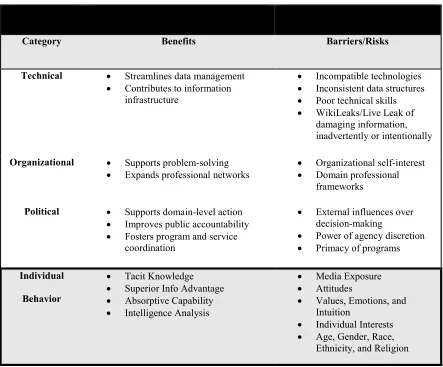
Although there are number of potential benefits to sharing information, there are perhaps
an equal number of challenges, barriers, and risks not to share information; thus, a paradox
exists. The reasons not to share information, as highlighted within the literature, begin with the
7 [Type a quote from the document or the summary of an interesting point. You can position the text box anywhere in the document. Use the Drawing Tools tab to change the formatting of the pull quote text box.] [Type a quote from the document or the summary of an interesting point. You can position the text box anywhere in the document. Use the Drawing Tools tab to change the formatting of the pull quote text box.] organizational, legal, and technical challenges (Gil-Garcia et al. (2009); Gil-Garcia,
Chengalur-Smith, and Duchessi (2007); (Luna-Reyes & Gil-Garcia, 2003; Luna-Reyes, Gil-Garcia, & Cruz,
2007). This may include lack of political support, lack of financial resources, individual privacy,
confidentiality, and secrecy concerns; WikiLeaks’ and Live Leaks’ release of damaging
information inadvertently or intentionally; and poor technical skills. Given the benefits and
challenges, this research suggests a gap exists which ends with a challenge not addressed by
using the technologies and other processes that creates the current paradox. This research
conjectures that the info sharing decisions of highly skilled or smart info sharers would reflect
superior decisions on the information to share, while the decisions of relatively less skilled or
risky info sharers are more likely to be induced by behavioral biases. This inference is motivated
by recent research in behavioral economics (Frederick (2005); Benjamin, Brown, and Shapiro
(2013); and Dohmen, Falk, Huffman, and Sunde (2010)), which finds that lower levels of
smartness are associated with more anomalous preferences and stronger emotional behavioral
biases. The studies show that smart individuals exhibit lower levels of risk aversion and greater
patience (Korniotis & Kumar, 2011).
Within the literature, the fact that information has value in terms of monetary
importance is well known, and there are several information models to measure it; however, one
of the non-financial values of information where the preconception is not necessarily
straightforward for information is the value of power (Ahituv & Carmi, 2007). According to
Ahituv and Carmi (2007), the relationship between information and power in inter- or
intra-agencies can pertain to many issues that senior officials are challenged with, such as knowledge
management and info sharing. Specifically, the implication of these issues that senior officials
You can position the text box anywhere in the document. Use the Drawing Tools tab to change the formatting of the pull quote text box.] You can position the text box anywhere in the document. Use the Drawing Tools tab to change the formatting of the pull quote text box.] of power within the agency due to a change in the information distribution. However, on the
other hand, the introduction of these issues is a process that involves interested parties
intentionally using their power, deriving partly from the information they have, to affect the
nature of the agency and to obtain more power by obtaining more information. To this end,
Ahituv and Carmi (2007) postulate that this effect exists because there is a positive connection
between information and power.
Moreover, there are strong political pressures on inter- and intra-agencies to engage in
info sharing; however, in practical application, how consistently this is done really depends on
our foreign partners’ discretion as well as our inter-agencies’ application of the Office of the
Director of National Intelligence (ODNI) policies. There is plenty of guidance within the IC on
info sharing; in fact, each agency has its own policies and supplements to national policies on
whether information should be shared, and, if so, what information, to whom, and to some
extent, the information shared is decided on a case-by-case basis. Our national partners also have
their own info sharing policies on what information should be shared, most importantly, with
whom, and may also decide to share, based on their nation’s interest, on a case-by-case basis.
Another concern for the IC’s mission in national defense is sharing of information that may lead
to classified information being mistakenly shared, resulting in information leakage, intentionally
or unintentionally. Intentional information leakage may be the result of espionage. On the other
hand, unintentional informational leakage can occur from inferences. Inferences occur when
extrapolated classified information is from different sources of unclassified shared information.
Inferences exist because of the inherent engineering relationships between different pieces of
information and have a major impact on national defense. One inference that is occurring more
9 [Type a quote from the document or the summary of an interesting point. You can position the text box anywhere in the document. Use the Drawing Tools tab to change the formatting of the pull quote text box.] [Type a quote from the document or the summary of an interesting point. You can position the text box anywhere in the document. Use the Drawing Tools tab to change the formatting of the pull quote text box.]
1.2 Research Perspective
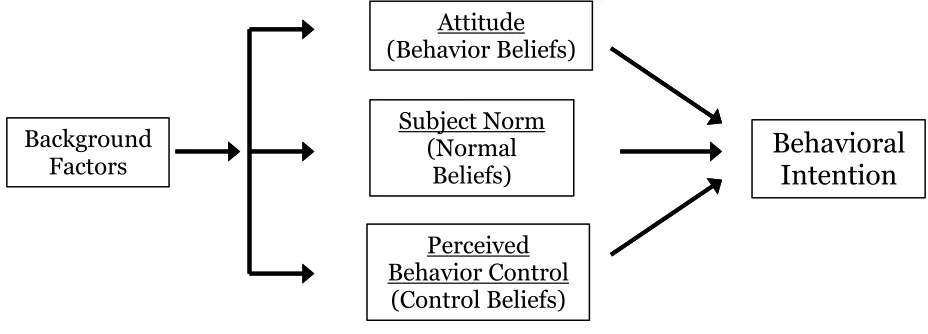
This study will use the adaptation of the Theory of Planned Behavior (TPB) which is an
extension of Theory of Reasoned Action (TRA) (Ajzen, 2011, 2012; Fishbein & Ajzen, 2005) to
inform this research in capturing the paradox in the info sharing decision of an IA analysis of the
risks and benefits influenced by the organization’s security and info sharing policies as well as
his/her attitude and intuition. Although IA navigate the paradox of the benefits and risks in
sharing information, the influences as mentioned, impacts the decision to share on not share
information. These influences result in factors that drive behavior intentions of IA. An
intriguing factor is that an IA’s attitude and intuition may conflict with the organization’s
security and info sharing policies. Adaptation of the TPB to inform this research allows
examination and further understanding of the process of IA behavior that deals with the relations
among beliefs (attitudes and intuitions) and the intentions of sharing decisions. Perceived
Behavioral Control (PBC) is added as a construct to TPB to solve the problem of explaining
behaviors in which the actor does not have full volitional control (Fen & Sabaruddin, 2008).
TPB, when applied to a wide range of behaviors in order to understand why individuals behave
in a certain way, is one of the best-supported social psychological theories with respect to
predicting human behavior (Sommer, 2011). According to (Smith, Manstead, Terry, & Louis,
2007), the central premise is that behavioral decisions are the result of a reasoned process in
which the behavior is influenced by attitudes, norms, and perceived behavior control. With roots
in a social psychological approach to behavior, TPB and TRA postulate that changing behavior
is a matter of changing the cognitive structure underlying the behavior in question. The theories
are a series of four hypotheses. The first hypothesis relates to behavior assumed primarily to be
You can position the text box anywhere in the document. Use the Drawing Tools tab to change the formatting of the pull quote text box.] You can position the text box anywhere in the document. Use the Drawing Tools tab to change the formatting of the pull quote text box.] the intention to perform the behavior as a function of the weighted combination of two factors; a
personal factor that is the attitude toward the behavior and a social factor that is the subjective
norm. Thus, in this hypothesis, the attitude toward the behavior is the feeling of favorableness
toward the behavior and the subjective norm suggests the perception that people of importance
think that the individual should or should not perform the behavior. The third hypothesis
suggests that underlying the attitude toward the behavior is an underlying cognitive structure of
behavioral beliefs that performing the behavior will lead to certain outcomes and the evaluation
of these outcomes. Finally, the last hypothesis suggests the subjective norm is an underlying
cognitive structure of normative beliefs that particular individuals or groups think that one
should or should not perform the behavior and the individual’s motivation to comply with each
of these significant others.
In using information for decision-making, the information processing perspective argues
that individuals make decision based on the amount of information available to them and the
effort they expend to arrive at their decisions. It is impossible to imagine that every IA will have
all information available on a topic or complete understanding of the organization’s behavior
when deciding to share information with a given entity. Some researchers (Bettman, 1979;
Bettman & Park, 1980) argue that individual decision-making strategies vary on a continuum
from being completely rational normative to purely heuristic. This suggests that, where all the
necessary information and resources are available, an individual makes a rational-normative
decision for arriving at an accurate optimal decision. Conversely, in the situations where the
context is novel and the information available is limited, individuals resort to heuristic
decision-making style, through which they draw generalizations and projections to arrive at an appropriate
11 [Type a quote from the document or the summary of an interesting point. You can position the text box anywhere in the document. Use the Drawing Tools tab to change the formatting of the pull quote text box.] [Type a quote from the document or the summary of an interesting point. You can position the text box anywhere in the document. Use the Drawing Tools tab to change the formatting of the pull quote text box.] Therefore, to understand an individual’s behavior in info sharing decision-making, and perhaps
to help the practitioners more successfully manage ways to identify, seek, assess, use and share
information, the research will endeavor to answer the question: How do IA navigate the paradox
between the benefits and risks affected by individual behaviors and organization factors that
inhibit info sharing decisions?
The adaptation of the TPB is used to inform this research study in analyzing an
individual’s behavior intention in making the decision to share information with others, either
within the government inter- or intra-agency organizations or publicly with other individuals.
However, the research study will also use an exploratory approach from a grounded theory
perspective. Charmaz (2010) argues this approach and method bring surprises, spark ideas, and
foster seeing data in fresh ways and exploring ideas about the data through early analytic writing.
It also offers flexible guidelines for collecting and analyzing qualitative data to construct theories
grounded in the data themselves (Charmaz, 2010, p. 2). Thus, the data form the foundation of
the theory and the analysis of the data generates the concepts that are constructed. In this
approach, one attends to what he/she hears, sees, and senses during the interview. Using this
approach, this research will take a constructivist approach to the exploratory study. Charmaz
(2010) also argues a constructivist approach places priority on the phenomena of study and sees
both data and analysis as created from shared experiences and relationships with participants and
other sources of data. A critical element in the constructivist approach is that it studies the how
and sometimes the why participants may construct meaning and actions in specific situations.
Moreover, Charmaz (2010) argues constructivist grounded theorists take a reflexive stance
toward the research process and products and consider how their theories evolve, from which she
You can position the text box anywhere in the document. Use the Drawing Tools tab to change the formatting of the pull quote text box.] You can position the text box anywhere in the document. Use the Drawing Tools tab to change the formatting of the pull quote text box.] justification for building a theory as opposed to only using existing theory, Bartunek, Rynes, and
Ireland (2006) argue for research that builds theory from cases are often regarded as the “most
interesting” research and are among the most highly cited pieces in the Academy of Management
Journal, with impact disproportionate to their numbers (Eisenhardt & Graebner, 2007). With the
understanding that sound empirical research begins with strong grounding in related literature,
which identifies a research gap and proposes research questions that address the gap, theory
building from cases requires researchers to take an added step of justifying why theory building
rather than theory-testing better addresses the research question. The critical point to the
justification in building theory in this study is to convince readers that the research question is
crucial for organizations and/or theory, and demonstrate that the existing research either does not
address the research question at all, or does so in a way that is inadequate or likely to be untrue
(Eisenhardt & Graebner, 2007).
1.3 Research Approach
Using an exploratory approach from a grounded theory perspective and employing the
constructivist grounded theorist perspective allows for a set of principles and practices, not as
prescriptions or packages, but emphasizes flexible guidelines, according to Charmaz (2010).
Therefore, it is also important to understand additional approaches, methodological rules,
recipes, and requirements to dealing with the how and howquestions in research studies. (Van
de Ven, 2007a) suggests there are two basic epistemologies that underlie the different approaches
that are necessary to study research questions dealing with what and how. Bruner (1986), p.
147), distinguished them as representing two basic types of human intelligence: the
paradigmatic, logical-scientific (variance) mode of thought and the narrative (process) mode of
13 [Type a quote from the document or the summary of an interesting point. You can position the text box anywhere in the document. Use the Drawing Tools tab to change the formatting of the pull quote text box.] [Type a quote from the document or the summary of an interesting point. You can position the text box anywhere in the document. Use the Drawing Tools tab to change the formatting of the pull quote text box.] There are two modes of cognitive functioning, two modes of
thought, each providing distinctive ways of ordering experience, of constructing reality. The two (though complimentary) are irreducible to one another…. Each of the ways of knowing, moreover, has operating principles of its own and its own criteria of well-formedness. They differ radically in their procedures for verification. (Bruner, 1986: 11)
Bruner highlights that we have relatively little knowledge about how narrative understanding
works compared to the vast literature on paradigmatic thinking and its methods. Although recent
research in many fields is filling this void, much remains to be done. Aldrich (2001)
distinguishes the what and how questions in terms of outcome-driven and event-driven research,
as follows:
Outcome-driven explanations are built backward, from an awareness of observed outcomes to prior casually significant events. Two related problems are introduced with this strategy. First, it often leads to investigators’ selecting on the dependent variable, a well-known research bias. Second, even though we might include all organizations—those that have experienced the event and those that have not—we still observed them at only one point in time (Aldrich 2001: 118). Conversely, event driven explanations are built forward, from observed or recorded events to outcomes. (Aldrich 2001: 118).
Aldrich (2001) notes that researchers often run into trouble by not making explicit
distinctions between event-driven and outcome-driven studies of organizational and other social
processes. His argument is based on two different definitions of process used within the
literature: 1) a category of concepts or variables that pertain to actions and 2) activities and a
narrative describing how things develop and change (Van de Ven, 1992). The research question
of this study is: How do IA navigate the paradox between the benefits and risks affected by
individual behaviors and organizations factors that inhibit info sharing decisions? While the
research question could fall in the category of the second definition, which typically takes an
You can position the text box anywhere in the document. Use the Drawing Tools tab to change the formatting of the pull quote text box.] You can position the text box anywhere in the document. Use the Drawing Tools tab to change the formatting of the pull quote text box.] events (Abbott, 1988; Pentland, 1999; Poole, 1983; Tsoukas, 2005), this study will use the first
definition, which is associated with a variance model with an outcome driven explanation.
According to Mohr (1982), when the first definition is used, process is typically associated with
a variance model where an outcome-driven explanation examines the degree to which a set of
independent variables statistically explain variations in some outcome criteria (dependent
variables).
Mohr (1982) and Poole (1983) distinguished variance and process approaches to social
scientific research. A variance model explains change in terms of relationships among
independent variables and dependent variables, while a process model explains how a sequence
of events leads to some outcome. The common thread running through both works is the
difference between scientific explanations cast in terms of independent variables causing
changes in a dependent variable, and explanations that tell a narrative or story about how a
sequence of events unfolds to produce a given outcome. In this particular study, the variance
method will seek to explain continuous change driven by deterministic causation, with
independent variables acting upon and causing changes in dependent variables.
The research will closely examine the paradox confronting the IA when sharing, more
specifically, the reasons the IA may be willing to share information with others, even when the
risks may outweigh the benefits. The researcher will also closely examine the behaviors of the
IA in their decision analysis of intelligence operational mission-based info sharing events.
Although the intelligence mission scenarios are theoretic, they are possible mission events that
will serve as the basis for examining a user’s behavior in deciding to share information. The
security and info sharing policies are independent variables as well as attitude and intuition. In
15 [Type a quote from the document or the summary of an interesting point. You can position the text box anywhere in the document. Use the Drawing Tools tab to change the formatting of the pull quote text box.] [Type a quote from the document or the summary of an interesting point. You can position the text box anywhere in the document. Use the Drawing Tools tab to change the formatting of the pull quote text box.] accurate information that is collected and shared among other reliable forces, but not the enemy.
However, although each entity may share information with trusted partners, each side faces
variations of information leakage, espionage, and political strife that affect the decision to share
information, and that makes the information valuable in terms of power or less valuable over
time in terms of diminishing return on investment. The researcher has selected to use
intelligence mission scenarios because they examine the actor’s decision and behavior intention.
How will he/she evaluate risk (consequences) versus benefits, consider the security and info
sharing policies, and will his/her personal or subjective norm be the controlling factors to the
sharing decision? These similarities and differences will allow the researcher to combine literal
and theoretical replication logic (Yin, 2009). While this will not ensure generalizability of the
study, it will hopefully add to the robustness and confidence in the findings (Yin, 2009). To
deepen the understanding and to help achieve satisfactory validity, the researcher will collect
data from several sources using different data collection methods, including formal interviews
with Intelligence community users, analysis of email correspondence, observations of recent
events, and review of archival documents.
To improve its relevance to practice, this study will utilize the pluralistic methodology of
engaged scholarship (Van de Ven, 2007b; Van de Ven & Poole, 1995) as a participative
approach involving the perspectives of various stakeholders in order to understand complex
problems (Van de Ven, 2007, p. 9). Although the researcher will remain in control and direct all
research activities, advice and feedback will be solicited from various key stakeholders and
informants, such as public users, information security managers, military IA and other
researchers, in each step of the research process, including research design, theory building,
You can position the text box anywhere in the document. Use the Drawing Tools tab to change the formatting of the pull quote text box.] You can position the text box anywhere in the document. Use the Drawing Tools tab to change the formatting of the pull quote text box.] follow data analysis procedures and display methods suggested by Miles and Huberman (1994b)
for qualitative case studies using three concurrent flows of activity: data reduction, data display,
and conclusion drawing and verification.
As a result, this research will make five valuable contributions: 1) describe the paradox
of the info sharing decision of an IA analysis of the benefits and risks influenced by the
organization’s security and info sharing policies and an individual’s behavior intention; 2)
explain the decision-making behavior of people’s willingness to share information with others,
even when the risks may outweigh the benefits (to better understand how we might go about
modifying behavior in a desirable direction); 3) demonstrate how TPB may be used as an
analytical framework that describes how past behavior of users decisions to share information
with others in the IC; 4) develop a conceptual framework to evaluate adherence to info sharing
decision-making in the IC; and 5) provide practical guidance for improving IA decision-making
in the presence of the paradox.
1.4 Summary
The subsequent chapters of this dissertation proposal detail the arguments underpinning the research as follows:
17 [Type a quote from the document or the summary of an interesting point. You can position the text box anywhere in the document. Use the Drawing Tools tab to change the formatting of the pull quote text box.] [Type a quote from the document or the summary of an interesting point. You can position the text box anywhere in the document. Use the Drawing Tools tab to change the formatting of the pull quote text box.] owning the information. The review reveals that few qualitative variance studies exist
that explore the paradox in info sharing; specifically, the inconsistencies between the IA’s behavioral intentions to share information and the organization’s security and info sharing policies to actually release information that results in a positive or negative outcome based on the value of the data alone or the value of information when aggregated with other information. Why would the IA decide to share certain information with little regard for the risk in doing so and for little return (cost-benefit), while the disclosure of that same data puts the organization at risk and, doing so, affects national interest, meaning greater risk and a higher return?
Chapter 3 Theory of Planned Behavior: This chapter provides a description of the Theory of Planned Behavior (TPB), its applications in prior case studies, and its constructs of a person’s behavioral, normative and control beliefs. This review helps to illustrate how TPB, with its central focus on the background factors that may influence the beliefs people hold and how these factors are expected to influence intentions and behavior indirectly by their effects on the IA’s decisions to share information. Therefore, the researcher’s approach is to use the adaptation of the TPB to inform this research study in analyzing the decisions of the IA’s info sharing decision-making risks outcomes using intelligence operational mission-based events that are interesting because of what they reveal about the common sense, everyday layman’s view of the world.
You can position the text box anywhere in the document. Use the Drawing Tools tab to change the formatting of the pull quote text box.] You can position the text box anywhere in the document. Use the Drawing Tools tab to change the formatting of the pull quote text box.]
Chapter 5 Data Analysis: This chapter outlines the data collection strategy that will follow the three recommended principles of data collection for case studies in order to deepen understanding and improve validity through data triangulation: (1) using multiple sources of evidence; (2) creating a case study database; and (3) maintaining a chain of evidence. It also details the methods used in analyzing this qualitative data consisting of three concurrent flows of activity: data reduction, data display, and conclusion drawing and verification.
Chapter 6 Discussion: This chapter discusses why people share information with others; primarily, what influences the individual’s decision that drives him/her to violate security and info sharing policies. The understanding of IA behaviors allows a better understanding of how one might go about modifying behavior in a desirable direction. The results provide support that background factors do influence the beliefs people hold.
19
LITERATURE REVIEW
2.1 Information
Information is a ubiquitous label whose meaning is almost never specified. According to
McKinney Jr and Yoos Ii (2010), virtually all the extant IS literature fails to explicitly specify
meaning for the very label that identifies information and, more important, that this is a vital
omission, because without defining what we are talking about, we can hardly know it. Since IS
has nominated a plethora of attributes, such as relevant, accessible, timely, accurate, variable,
flexible, and complete to describe information, Newman (2001), argues that it is important to
produce what information means, its scope or the implication of the various definitions. Since
the pursuit of a more coherent understanding of information has become the subject of a new
domain, the philosophy of information, McKinney and Yoos Ii (2010) present a taxonomy of
information that secures the term.
From a token view, McKinney and Yoos Ii (2010)posit that information and data are both
tokens manipulated by processes. There is a widespread view in IS on this understanding,
particularly from Majchrzak, Rice, Malhotra, King, and B. (2000), who studied a virtual team’s
use of collaborative software. The software allowed team members to create, store, retrieve,
distribute, and analyze data, a process that manipulates tokens. In the syntax view, information is
the measureable relationship among tokens that reduces entropy. The tokens in this view are
mental states; the effectiveness measure of information quantifies the change in mental states. In
the representation view, information is meaning. Meaning emerges from a sign that stands for
an object to a particular observer. An example from IS research is the personal information
construct in privacy research. Personal information (sign) about an individual (object) gives
You can position the text box anywhere in the document. Use the Drawing Tools tab to change the formatting of the pull quote text box.] You can position the text box anywhere in the document. Use the Drawing Tools tab to change the formatting of the pull quote text box.] assumptions are introduced to explain how information is created by a system (e.g., person,
organization). Information is created when a system perceives differences in its environment,
which alters that system. Understanding the taxonomy of information is important to this
research study because, as posited by McKinney Jr and Yoos Ii (2010, p. 339), “it purports to
represent what information really is.” To understand this leads to the value of information and
its power in military operations and to Intelligence Operators who decide to share information.
2.2 Paradoxes
Quinn and Cameron (1988) define paradox, also referred to as antinomy, as a real or
apparent contradiction between equally well-based assumptions or conclusions. They argue that,
when considered separately, the arguments supporting paradoxical propositions appear sound;
however, considered together, the arguments appear contrary or even contradictory. Within the
literature, much effort has been devoted to resolving or understanding paradoxes, because they
reveal inconsistencies in our logic or assumptions (Quinn & Cameron, 1988). Paradoxes can
arise either from theoretical inconsistencies or from limited frames of reference. They often
require us to alter our assumptions, to shift perspectives, to pose problems in fundamentally
different ways, and to focus on different research questions. According to Quinn and Cameron
(1988), when studying paradoxes, we are forced to ask very different questions and to come up
with answers that stretch the boundaries of current theories. They postulate that the resulting
formulations are likely to be of interest not only to organizational scholars, but also to all
scholars of social process; therefore, addressing organizational paradoxes is both exciting and
challenging and inspires new ideas and creative theory.
Within the literature, contingency theory is an alternative approach that is used as a
21 [Type a quote from the document or the summary of an interesting point. You can position the text box anywhere in the document. Use the Drawing Tools tab to change the formatting of the pull quote text box.] [Type a quote from the document or the summary of an interesting point. You can position the text box anywhere in the document. Use the Drawing Tools tab to change the formatting of the pull quote text box.] the late 1960s inspired decades of research exploring how contexts influence the effectiveness of
opposing alternatives (Smith & Lewis, 2011). However, according to Smith and Lewis (2011),
the paradoxical studies approach to tensions and conflict involves exploring how organizations
can attend to competing demands simultaneously as opposed to contingency theory, which
explores conditions by selecting among competing demands. They argue that, although choosing
among competing tensions or conflict might aid short-term performance, a paradox perspective
argues that long-term sustainability requires continuous efforts to meet multiple, divergent
demands (Cameron, 1986; Lewis, 2000). Within the literature, Wendy K. Smith and Marianne
W. Lewis (2011) found, after surveying over the past 20 years across several different
management journals, not only have scholars increasingly adopted a paradox perspective, but
there also has been an increase in the research in studies of organizational phenomena and levels
of analysis. Their framework, built on four categories of paradox, represents core activities and
elements of organizations: learning, belonging, organizing, and performing. The most
interesting of the four are organizing and performance paradoxes. Smith and Lewis (2011)
suggest that organizing paradoxes surface as complex systems, which create competing designs
and process to achieve a desired outcome. These include tensions between collaborating and
competing (Murnighan and Conlon (1991), empowerment and direction (Denison, Hooijberg, &
Quinn, 1995), or routine and change (Flynn & Chatman, 2001; Gittell, 2004). Performing
paradoxes stem from the plurality of stakeholders and result in competing strategies and goals.
Tensions surface between the differing, and often conflicting, demands of varied internal and
external stakeholders (Donaldson & Preston, 1995).
In summary, the literature highlights the richness and scope of a paradox perspective.
You can position the text box anywhere in the document. Use the Drawing Tools tab to change the formatting of the pull quote text box.] You can position the text box anywhere in the document. Use the Drawing Tools tab to change the formatting of the pull quote text box.] organizational phenomena as well across differing levels of analysis. The literature suggests
tensions and conflict at the level of the individual (Markus & Kitayama, 1991), dyad (Argyris,
1988), group (Smith & Berg, 1987), project (Van Marrewijk, Clegg, Pitsis, & Veenswijk, 2008),
and, most important, the organization (Cameron & Quinn, 1988). According to Cameron and
Quinn (1988), there are four strategic approaches that can be used to resolve paradoxes and that
each represent a different way of transforming research theories and ways of thinking. First,
even with accepting the paradox and learning to live with it, we learn that it has a cost to bear.
To accept a paradox is to acknowledge that things need not be consistent and that the seemingly
opposed viewpoints can inform one another and our models are just models, incapable of fully
capturing the conflict, no matter how strongly our logical arrogance tries to convince us
otherwise. All the other strategies suggest resolving the tension or conflict between the contrary
positions. Bertrand Russell’s (1970) approach, which is the most interesting, attempts to resolve
this by clarifying levels of reference and the connections among them. According to Cameron
and Quinn (1988), level distinctions, such as part-whole, micro-macro, or individual-society,
have proven extremely useful for social research, and to carry out this analysis, it is necessary to
specify as precisely as possible how the levels interrelate. Supporting this approach is Reese and
Overton's (1978) formulation where one side of the paradox may influence the conditions under
which the other will operate.
2.3 Info Sharing Paradox
As a starting point, the info sharing paradox in this research study refers to the conflict
between the benefits and risks confronted by the IA. This conflict is also influenced by the
organization’s security and info sharing polices as well as the attitude and intuition of the IA.
23 [Type a quote from the document or the summary of an interesting point. You can position the text box anywhere in the document. Use the Drawing Tools tab to change the formatting of the pull quote text box.] [Type a quote from the document or the summary of an interesting point. You can position the text box anywhere in the document. Use the Drawing Tools tab to change the formatting of the pull quote text box.] a positive or negative outcome based on benefits and risks. Why would the IA decide to share
certain information with little regard for the risk in doing so and for little return (cost-benefit),
while that same data disclosed puts the organization at risk and doing so affects national interest;
meaning greater risk and a higher return? Paradoxes are well-established concepts in many
fields of the social sciences, even though the precise contours and cases of the paradox are quite
controversial. There are opposing forces in the info sharing paradox between the benefits and
risks influenced by the organization’s security and info sharing policies as well as the IA’s
behavior all compete with one another and affect the outcome of the info sharing decision
exchange. Another conjecture of this research is the IA’s knowledge, smart info sharer, of the
organization’s info and sharing policies that facilitate sharing information appropriately with
others. However, while navigating the conflict of the benefits and risks, the IA’s knowledge,
risky info sharer, may be biased when influenced by an IA’s attitude and intuition. Some
decisions to share information may put the organization at higher risks because of IA behaviors,
which could result in little regard for benefits, whether the intentions are inadvertently or
intentionally.
The info sharing paradox, weighting the benefits versus the risks, is based on the superior
information advantage that exists from the organization’s analysis that the IA has complete
understanding of all the variables and associated risks (cost-benefit analysis) to sharing the
information as well as his/her behavior. The organization’s approach of optimal sharing trends
is based on the principle that every IA completely believes in and understands the derived policy
on the different classifications of the information; inter- and intra-agency relationships; and
continuous internal meetings and agreements with national partners and the sharing of
You can position the text box anywhere in the document. Use the Drawing Tools tab to change the formatting of the pull quote text box.] You can position the text box anywhere in the document. Use the Drawing Tools tab to change the formatting of the pull quote text box.] alleviate the information asymmetry between the IA and the organization’s assessment
(cost-benefit analysis) of the risk and other organizational characteristics that will result in a more
accurate risk decision to the sharing of information.
In the IS literature, there is a considerable body of academic research on the privacy
paradox, similar to the info sharing paradox, which is premised on the assumption of rational
choice (John, Acquisti, & Loewenstein, 2011). The work has been characterized by the
following assumptions: 1) people make sensible and consistent trade-offs between privacy and
other concerns (Derlega, Metts, Petronio, & Margulis, 1993; Petronio, 2000; Posner, 1981;
Rosenfeld, 2000) and 2) there are reliable differences between individuals in concern for privacy
(Laudon, 1996). This holds true for the info sharing paradox as well. An IA’s decision to share
information is based on the assumption of a rational choice with sensible trade-offs between the
benefits and risks associated with sharing information. The argument is based on the consistency
and the reliable difference between the IA’s behavior (attitude and intuition) and the
organization’s security and info sharing policies when considering the benefits and risks
trade-offs. It has been argued that disclosure decisions are made by balancing “the usefulness of
privacy with the utility of openness” (Petronio, 2000, p. 37) and that people engage in
“disclosure management,” such that they disclose information only when they expect a “net
benefit” (White, 2004, p. 48).
The similarities in the privacy and info sharing paradox are based on the trade-offs of the
benefits and risks in disclosure of information. In the privacy paradox, active and willing
participants are seen as individuals in the market for personal information and viewed as
consumers or rational economic agents who are either fully informed or who based their
25 [Type a quote from the document or the summary of an interesting point. You can position the text box anywhere in the document. Use the Drawing Tools tab to change the formatting of the pull quote text box.] [Type a quote from the document or the summary of an interesting point. You can position the text box anywhere in the document. Use the Drawing Tools tab to change the formatting of the pull quote text box.]
paradox, these active and willing participants are the IA who are the individuals in the market
for privilege information (secrecy or aggregated) and are certainly viewed as the rational
economic agents in the IC. As in the privacy paradox, an important factor in the info sharing
paradox is that the IA are agents who are either fully informed or who based their decisions on
probabilities also coming from known random distributions. In the privacy paradox, consumers
not only have the right to manage the privacy trade-offs without regulative intervention, they
also can use that right in their own best interest. Unlike the privacy paradox, in the info sharing
paradox, the IA must manage the benefits and risks of sharing info with regulative intervention;
however, like the privacy paradox, they often may use their right in their own best interest.
According to Canada (2012), the reason this exists in the privacy paradox is individuals concern
about privacy is not absolute. The argument is the same for the info sharing paradox; info
sharing is not absolute. He further explains that consumers are willing to knowingly trade off
privacy concerns for economic benefits. He argues that, in some cases, private information is
consciously exchanged for convenience, personalization, or merely the ability to use a website.
How does this relate to the info sharing paradox? The argument in the privacy paradox is the
very same in the info sharing paradox. Is there appropriate value or return on investment in the
trade-off, for the disclosure or share of information? Therefore, theorists argue that what must
be considered is the deviation between attitudes about sharing info and the actual behavior in the
handling of sharing the info.
Weighing the risks and benefits in the privacy paradox are the same in the info sharing
paradox. Often the IA does not have all the information for complete assessment of the risks and
benefits when sharing info and consumers are faced with the same challenge. For example, in an
You can position the text box anywhere in the document. Use the Drawing Tools tab to change the formatting of the pull quote text box.] You can position the text box anywhere in the document. Use the Drawing Tools tab to change the formatting of the pull quote text box.] and benefits in sharing info. The consumer is not fully aware of the nature and existence of
privacy invasion. In other words, data collection by third parties may be taking place without the
knowledge of the consumer. In considering the risks and benefits to sharing the privacy
information, the consumer lacks complete information regarding the alternative or the ease of not
only protective technologies, but also understanding how the disclosed information will be used
by the collecting agent or the third party. Canada (2012) argues that most people do find it
difficult enough just to find and understand a company’s privacy policy, much less to monitor
the company’s use of personal information and detect when violations have occurred. In info
sharing, the IA constantly navigates the paradox of the benefits and risks that are influenced by
the organization’s security and info sharing policies. This is relevant to the IA’s decision of
sharing info based on the concept of bounded rationality. The concept bounded rationality refers
to our inability to acquire, memorize, and process information that is relevant to the
decision-making process and applies to both the info sharing and privacy paradoxes. Specifically in the
privacy context, John, Acquisti, and Loewenstien (2011) define bounded rationality as the
inability to calculate and compare the magnitudes of the payoffs associated with various
strategies the individuals may choose in privacy situations. He also suggest that it refers to the
inability to process all the stochastic, meaning non-determinative, information related to risks
and probabilities of events leading to privacy costs and benefits. Theorist arguments suggest
even the most privacy-concerned individuals are not informed and cannot inform themselves
about privacy risks, even when that information is available because they simple cannot process
that amount of information. Therefore, individuals resort to simplified mental models,