Georgia State University
ScholarWorks @ Georgia State University
Marketing Dissertations Department of Marketing
Fall 12-18-2010
The Drivers of a Successful Corporate Sponsorship
and the Quantified Financial Impact: Applying the
Attitudinal Triad of Cognition, Affect, and
Conation and Customer Lifetime Value to
Corporate Sponsorships
David Nickell Georgia State University
Follow this and additional works at:https://scholarworks.gsu.edu/marketing_diss
Part of theMarketing Commons
This Dissertation is brought to you for free and open access by the Department of Marketing at ScholarWorks @ Georgia State University. It has been accepted for inclusion in Marketing Dissertations by an authorized administrator of ScholarWorks @ Georgia State University. For more information, please [email protected].
Recommended Citation
Nickell, David, "The Drivers of a Successful Corporate Sponsorship and the Quantified Financial Impact: Applying the Attitudinal Triad of Cognition, Affect, and Conation and Customer Lifetime Value to Corporate Sponsorships." Dissertation, Georgia State University, 2010.
PERMISSION TO BORROW
In presenting this dissertation as a partial fulfillment of the requirements for an advanced degree from Georgia State University, I agree that the Library of the University shall make it available for inspection and circulation in accordance with its regulations governing materials of this type. I agree that permission to quote from, to copy from, or publish this dissertation may be granted by the author or, in his/her absence, the professor under whose direction it was written or, in his absence, by the Dean of the Robinson College of Business. Such quoting, copying, or publishing must be solely for the scholarly purposes and does not involve potential financial gain. It is understood that any copying from or publication of this dissertation which involves potential gain will not be allowed without written permission of the author.
NOTICE TO BORROWERS
All dissertations deposited in the Georgia State University Library must be used only in accordance with the stipulations prescribed by the author in the preceding statement.
The author of this dissertation is:
David Nickell 3270 Jett Ferry Ct. Atlanta, GA 30350
The director of this dissertation is:
Wesley Johnston
The Drivers of a Successful Corporate Sponsorship and the Quantified Financial Impact: Applying the Attitudinal Triad of Cognition, Affect, and Conation and Customer Lifetime Value to Corporate
Sponsorships
BY
David Kenneth Nickell II
A Dissertation Submitted in Partial Fulfillment of the Requirements for the Degree
Of
Doctor of Philosophy
In the Robinson College of Business
Of
Georgia State University
GEORGIA STATE UNIVERSITY ROBINSON COLLEGE OF BUSINESS
Copyright by David Kenneth Nickell II
ACCEPTANCE
This dissertation was prepared under the direction of the David Nickell’s Dissertation Committee. It has been approved and accepted by all members of that committee, and it has been accepted in partial fulfillment of the requirements for the degree of Doctoral of Philosophy in Business Administration in the Robinson College of Business of Georgia State University.
H. Fenwick Huss, Dean
DISSERTATION COMMITTEE
ABSTRACT
The Drivers of a Successful Corporate Sponsorship and the Quantified Financial Impact: Applying the Attitudinal Triad of Cognition, Affect, and Conation and Customer Lifetime Value to Corporate
Sponsorships
BY
David Kenneth Nickell II
December 2010
Committee Chair: Wesley Johnston
Major Academic Unit: Department of Marketing
While the volume of research on corporate event sponsorships as a marketing tool has increased markedly over the past decade, the results have done little to help marketers to justify sponsorship spending. Not only do marketers have little knowledge of a sponsored event’s financial return, they also struggle to demonstrate any impact on consumer behavior at all.
Using multi-wave survey data, we quantified the financial impact of a sponsorship. We predicted the number of new buyers based upon changed brand attitudes, consistent with a hierarchy of effects model. We then established the financial return on the sponsorship spending by estimating the customer lifetime value (CLV) of these new buyers.
We collected the data around a major college football bowl game. Six phases of data collection were used to determine purchasing behavior and brand attitudes of attendees before and after the sponsored event, in comparison to television viewers of the event and the general public. We applied Lavidge and Elrick’s (1961) attitudinal constructs as the independent variables in a logistic regression to predict future purchase. The final data collection was used to validate the model’s prediction.
The findings show that the model accurately predicted the number of new customers after one buying cycle for the sponsor’s products. We also quantified the positive impact of the sponsorship on the CLV of existing customers within the same time frame.
Literature Review Synthesis, Propositions, and Conceptual Model
Introduction
Sponsorship literature is a relatively new stream of research (Dolphin, 2003), only
gaining traction in the last ten to 15 years. The increase in sponsorship research parallels
its growth in industry. Worldwide spending on sponsorship was estimated to reach
US$37 billion in 2007 (IEG, 2007). This represents a remarkable growth over the
previous 25 years as spending on sponsorship was at US$0.5 billion in 1982 – an increase
of 7500% (IEG, 2007). Clearly, sponsorship is one of the fastest growing means of
marketing communications in the world (IEG, 2005), and almost two-thirds of
sponsorship spending is directed toward sports marketing (Madill and O’Reilly, 2009).
Regardless of the event, consumers are likely to be inundated with organizations
competing for their consideration (Kover, 2001).
So why has there been such growth in sponsorship spending? Interest in sports,
music and the arts has correspondingly increased, and the means to communicate and
broadcast these events has advanced exponentially (Erdogan & Kitchen, 1998). It is no
coincidence that the rise in sponsorship spending began when restrictions were placed on
the advertising of tobacco and alcohol (Meenaghan 1991; Carrigan & Carrigan, 1997).
As a result, these tobacco and alcohol firms were forced to shift money away from
traditional advertising and toward one of the few places left for product promotion –
event sponsorships.
Growth in sponsorships is also a reflection of the decreasing effectiveness of
traditional media (Wohlfeil and Whelan, 2006) resulting from the increased
(Shimp, 1997; Madrigal, 2001; Quester and Thompson, 2001; Roy and Cornwell, 2003).
Wohlfeil and Whelan (2006) make the point that, because of this evolving media market,
it is increasingly difficult for companies to differentiate their brands. Consumers have
adapted to the old model of top-down communications from advertiser to consumer by
avoiding and disengaging from the message (Wohlfeil and Whelan, 2006). As a result,
advertisers are adjusting to this new media environment with fresh and innovative means
of communicating the brand message through an interactive dialogue with consumers
(Wohlfeil and Whelan, 2006). Roy and Cornwell (2003) observe that firms are viewing
corporate sponsorships as a means to cut through the advertising clutter and engage
consumers in a conversation about the brand. The association of the sponsor with a
property allows consumers to see the brand through the context of an event in which they
are actively engaged (Roy and Cornwell, 2003).
Consumers are also becoming more involved with the internet and video gaming
(Meenaghan 1998), and traditional media is suffering as result. Van den Bulck (2004)
found that the number of hours per week of television viewing done by secondary school
students is decreasing, while internet use is on the rise. From 1999 to 2003, the number
of hours per week watching television declined from 23 to 21. Over the same period,
internet usage for this group increased from 19 hours per week to 30 (Van den Bulck,
2004). Nie and Erbring (2000) report that the more hours that people spend on the
internet, the resulting television viewing and newspaper use of these same people
decreased proportionally. Internet users who are online for only two hours a week
reported a 25% decrease in television viewing (Nie and Erbring 2000). Chaney et al.
corresponding amount less of television. In addition, they found that gaming is becoming
more prevalent and that the demographic profile of a gamer is becoming closer to that of
the general population (Chaney et al. 2004). Chaney et al. (2004) advises that marketers
should take into account the changing media consumption patterns when planning their
marketing communications strategy. Digital video recorders (DVRs) have also emerged
as a threat to traditional media (Fortunato and Windels 2005). DVRs, in which the
company TiVo is the predominate manufacturer in the industry, allow television viewers
to record shows onto an accompaning hard drive. DVRs also allow viewers to pause live
television and, more importantly to marketers, skip commercials. Nielsen Media
Research reports that as of April 2010, over one out of six U.S. households have a DVR.
These numbers are higher in metro areas where the penetration rate of DVRs reaches as
high as 25% in some markets (Nielsen Media Research, 2010). As Fortunato and
Windels (2005) ominously warn, DVRs are a disruptive technology to traditional
advertisers. Those marketers who do not adapt to the rapid changes in entertainment
technology risk losing the attention of their markets.
Sponsorship Definition. As of yet, there is no one agreed upon definition of
sponsorship (Walliser, 2003). Nevertheless, there are two common themes across the
many attempts to define the sponsorship phenomenon. One theme is the exchange
between sponsor and the sponsored property where both parties earn some benefit. The
second is the association between the sponsor and sponsored property (Meenaghan
2001a; Crompton 2004; Cornwell et al 2006). Table 1 shows some of the definitions put
Table 1
Definitions of Sponsorship
Source Definition
Meenaghan, 1983 " … can be regarded as the provision of assistance either financial or in-kind to an activity by a commercial organization for the purpose of achieving commercial objectives"
Gardner and Shuman, 1987
"Sponsorship is investments in causes or events to support corporate objectives (e.g., enhance company image) or marketing objectives (e.g., increase brand awareness), and are usually not made through traditional media-buying channels"
Sandler and Shani, 1989 “The provision of resources (e.g., money, people, equipment) by an organization directly to an event or activity in
exchange for a direct association to the event or activity. The providing organization can then use this direct association to achieve either their corporate, marketing, or media
objectives”
Meenaghan, 1991 “… sponsorship is an investment, in cash or in kind, in any activity, in return for access to the exploitable commercial potential associated with that activity”
Cornwell 1995 “… the orchestration and implementation of marketing activities for the purpose of building and communicating an association (link) to a sponsorship”1
International Events Group 1999
“… a cash and/or in-kind fee paid to a property (typically a sports, entertainment, non-profit event or organization) in return for access to the exploitable commercial potential associated with that property”
Mullin, Hardy, and Sutton, 2000
“… the acquisition of rights to affiliate or directly associate with a product or event for the purpose of deriving benefits related to that affiliation or association”
Researchers have suggested that sponsorship is an effective means for firms to
differentiate themselves from their competitors and gain advantages in the marketplace
1
(Bennett, 1999). Managers are finding that sponsorships are a more efficient means for
communicating with consumers (Meenaghan 1998; Lyberger and McCarthy 2001).
Bennett (1999) questioned fans of three London-based soccer teams along with a control
group about their recollection of sponsoring brands. Their study found that, while many
had not yet purchased the products, the respondents’ intent to buy from the sponsoring
firms was significantly higher than for the control group.
Moreover, sponsorships allow firms to meet their marketing objectives i.e.,
building brand awareness and influencing consumer attitudes. Pope (1998) studied
sponsors from five Australian industries, breakfast cereals, beer, automobiles, banks, and
insurance companies, to determine the impact of sponsorship awareness on brand
attitudes. He found that event sponsors can effectively influence brand attitudes when
these firms target the specific values influencing the attitudes (Pope, 1998).
Sponsorships give the sponsor and sponsored property the benefits of image
transfer, where the associations that consumers have of either party can transfer to the
other because of the sponsorship association (Meenaghan 1991; Gwinner 1997;
Meenaghan and Shipley, 1999; McDaniel 1999; Walliser, 2003; Woodside, Summers et
al. 2006). For example in one study, Gwinner and Eaton (1999) tested whether the image
of a sponsored property will transfer to the sponsoring organization. They found that
based on the strength of the perceived similarities between the two parties (their
congruence), that image transfer exists and is greater among sponsors and properties
Yet, there are more players involved in the sponsorship relationship than just the
sponsor and property. Obviously the spectators and participants have a stake in the
relationship, otherwise the event may not exist; but there are other parties with a vested
interest. O’Sullivan and Murphy (1998) list three types of stakeholders in the
sponsorship relationship: primary, indirect, and secondary. The primary stakeholders are
directly invested in the sponsorship through some type of contractual, official or formal
capacity (O’Sullivan and Murphy, 1998). Those players with an indirect stake in the
sponsorship have a vested interest in the event, but no formal relationship. Figure 1
illustrates all the stakeholders in O’Sullivan and Murphy’s (1998) model.
Figure 1
The Three Levels of Sponsorship Stakeholder
Sponsorship Expectations. A frequent topic of sponsorship research is
determining the factors that drive sponsorship results (Madrigal, 2001; Meenaghan
2001b). These factors have often been difficult to detect and measure (McCarville,
Flood, and Froats, 1998), and sponsors often question the benefits of their investments
(Chien, Cornwell, et al, 2005). Speed and Thompson (2000) and Cornwell, Weeks, and
Roy (2005) identified factors that they argue drive sponsorship outcomes. Speed and
Thompson (2000) developed a framework for sponsorship evaluation with the customer’s
exposure to the sponsorship being mediated by event factors (status of the event, personal
liking for the event), sponsorship factors (congruency between sponsor and sponsored
property), and sponsor factors (attitude toward the sponsor, sincerity and ubiquity of the
sponsor) on sponsorship outcomes. Cornwell, Weeks, and Roy (2005) reframed this
perspective and argued that market, individual/group, and management factors are
mediated by the attendees’ processing mechanisms (i.e., mere exposure, articulation, etc.)
on the outcomes. The sponsorship outcomes vary, but there is a forming consensus that
positive changes to consumer attitudes are the most desired outcome (Hansen and
Scotwin 1995; Speed and Thompson, 2000; Madrigal 2001; Cornwell, Weeks, and Roy,
2005; Koo, Quarterman, and Flynn 2006).
Pyun (2006) proposed a model to explain consumer attitudes toward sports
advertising. The author employed Pollay and Mittal’s (1993) comprehensive model of
attitudes toward advertising and adopted it specifically to sports advertising. The model,
shown in figure 2, consists of three personal utility components and four socioeconomic
Figure 2
Attitude toward Advertising through Sport
Source: c.f. Pyun (2006)
The original model proposed by Pollay and Mittal (1993) consisted of only three
personal utility components (product information, social role and image, and
hedonism/pleasure) and four socioeconomic components (good for the economy,
materialism, value corruption, and falsity/no sense) (Pyun, 2006). However, Pyun (2006)
found that there was little discrimination between value corruption and materialism in
factor analysis and decided to combine the two factors. Pyun (2006) also included an
additional factor under the personal utility components − annoyance/irritation. There has
been research suggesting that an annoyance/irritation component is an adequate predictor
The sponsorship literature has evolved in its search to define what drives these
changes in consumer attitudes. McDonald (1991) has observed that the media attention
gained through sponsorship has been thought to be the key benefit to the sponsor. Yet he
posits that evaluating sponsorships by the publicity the event generates misses a key
attribute of the promotion − that of the goodwill that consumers attribute to the sponsor
(McDonald, 1991). Gwinner (1997) discussed the image transfer from the sponsored
property to the sponsor and its positive influence on the sponsoring brand. Specifically,
he proposed that effective image transfer is most likely to occur when: a stronger degree
of similarity exists between the sponsor and the sponsored property, a higher level of
exclusivity exists between the sponsor and sponsored property, and the more frequently
the sponsored event occurs (Gwinner, 1997). Carrigan and Carrigan (1997) took a
slightly different perspective on the image transfer, addressing the improved customer
goodwill toward the sponsor. Nevertheless, Carrigan and Carrigan (1997) warn that a
certain aspect of sponsorship can exist and that can lead to a negative impact on
consumer attitudes. The sponsor must manage the event to reduce the negative and
enhance the positive side of event sponsorship (Carrigan and Carrigan, 1997).
Another line of research regarding sponsorship outcome tends to be more
functional. Meenaghan (1983) categorized sponsorship objectives into three groups:
broad corporate objectives that deal with building and sustaining the brand’s image,
marketing objectives that involve activities concerning brand perception and sales
impact, and media objectives that strive for effective media coverage and reaching
targeted market segments. Pope (1998) suggested that sales and marketing objectives are
these functional outcomes, such as segmentation and targeting (Bennett, 1999; Kambitsis
et al., 2002), co-branding (Motion, et al., 2003), and offering direct points of product
distribution (Mansourpour 2007). Kambitsis et al., (2002) in an Australian study
conducted around the Sydney Summer Olympics, suggested that associating brands with
to a sports-oriented audience who are already “trained” to respond to sport identities can
more easily recognize the sports property being sponsored. A target market that is more
fitness-oriented however, identifies with the overall healthy image of a sports property
whether it is identifiable or not. Kambitsis et al., (2002) further found that sponsors
tended to use (Australian) football to promote food supplements, while companies
promoting high-end or luxury items were found to sponsor sporting events like golf and
tennis. Motion, et al., (2003) conducted a case study on Adidas and one of the premier
teams in the New Zealand Rugby Union – the All Blacks, to analyze the effects of
co-branding between the sponsor and the property. The authors of the study established that
a co-branding partnership can be used by the sponsoring firm to enhance brand equity,
subtly reposition the brand, and redefine the identity of the brand itself.
Sponsorship as Marketing Communications. As noted earlier, one of the
challenges facing marketers is that of media clutter and market fragmentation
(Meenaghan, 1983). Sponsorships offer companies the means to cut through the noise of
pervasive advertising by targeting specific segments of buyers and giving sponsors the
venue to involve these buyers with the brand (McDaniel, 1999; Meenaghan, 2001a; Fan
& Pfitzenmaier, 2002; Roy & Cornwell, 2004, Smith, 2004). That said, there are a great
many similarities between sponsorships and advertising (Meenaghan, 2001a). Walliser
look to achieve its goals through different means. Advertising is an easier means of
marketing communications to manage, while sponsorships can surmount the limitations
of one-way communications (Walliser, 2003). Meenaghan (2001b) points out that
consumers tend to view advertisements cynically, while sponsorships are seen as more
altruistic, thus the context of advertisement and sponsorship are important when defining
objectives. So where some view sponsorships as another form of marketing
communication, others see sponsorships as an extension of the discipline (Tripodi, 2001).
Nevertheless, managers should view sponsorship as a unique component of marketing
communications (Meenaghan, 1991; Javalgi, Traylor, Gross & Lampman, 1994; Tripodi,
2001). Unlike advertising, sponsorships, especially when leveraging and activations are
employed, strongly link the message and the medium together (Meenaghan, 1996). This
occurs because the sponsored property draws attendees while communicating its values
and, as a result, transfers these values to the sponsor (Madrigal, 2001).
At this point, we should define what we mean by leveraging and activations, as
there is some confusion in the sponsorship literature and we often find that these terms
are used interchangeably. For our purposes, we use Weeks, Cornwell, and Drennan’s
(2008) definitions. Thus, sponsorship leverage is “the act of using collateral marketing
communications to exploit the commercial potential of the association between a sponsee
and sponsor,” and activations, which they define as a subset of sponsorship leverage, are
the “communications that promote the engagement, involvement, or participation of the
sponsorship audience with the sponsor.” Conversely, these same authors define
non-activational messaging as “communications that promote the sponsorship association, but
leveraging can be broken into two subparts: activational, which is more interactive, and
non-activational, where the communications engages attendees passively.
An important distinction to make is the financial relationship between the money
invested into leveraging and activations, and the rights to sponsor an event. We stated
earlier that worldwide spending on sponsorships exceeded $37 billion by 2007.
However, this figure only represents the purchase of the rights to sponsor an event; it
does not include the money invested in the pre-event leveraging nor the activations that
occur during the event (Cornwell 2008). The rights fees that a sponsor pays only provide
a vehicle in which to communicate its brand (Crompton 2004). Several authors have
cited a rule-of-thumb statistic that for every $1 spent for the rights to sponsor a property,
an additional $3 should be invested into leverage and activation (Kearney 2003;
Crompton 2004; Woodside et al. 2006). Yet, Weeks, Cornwell and Drennan (2008) cite a
2007 IEG study that shows sponsors are actually spending an average of $1.90 on
leverage for every $1.00 spent on right’s fees. Whether companies are under-investing in
sponsorship leveraging or the 3:1 ratio is too high, investing in leverage and activational
activities is imperative to realize the firm’s marketing objectives (Kearney 2003, Fahy et
al 2004). The significance of sponsorship leveraging and activation has been emphasized
repeatedly by scholars in conceptual and empirical studies (e.g., Woodside, Summers,
and Morgan, 2006; (Cornwell et al. 2001; Farrelly and Quester 1997; Quester and
Farrelly 1998; Quester and Thompson 2001). As Crimmins and Horn (1996) stated:
“If the brand cannot afford to spend to communicate its sponsorship, then
There are a variety of means for companies to leverage a sponsorship. As
illustrated in Figure 3, a 2007 IEG study shows the wide range of communication tools
incorporated by firms in their sponsorship leveraging and the percentage of companies
that used the techniques (c.f. Weeks et al. 2008).
Figure 3
Types of Sponsorship Leverage
These leveraged communication methods lead to greater cognitive recall of the sponsor
by consumers. Wakefield, Becker-Olsen et al., (2007) cited four crucial factors that
affected sponsor recall: sponsor relatedness, sponsor prominence, consumer exposure to
the brand at the event, and consumer exposure to the brand “due to individual
involvement or identification with the sport and team.” Their first factor, sponsor
79%
76%
71%
67%
61%
56%
51%
49%
41% traditional advertising
public relations activities
internal communications
hospitality
direct marketing
business-to-business communications
internet tie-ins
on-site sampling
relatedness, is the perceived connection between the sponsor and the sponsored property
(Wakefield, Becker-Olsen et al., 2007). Nike and track are seemingly related because
Nike makes running shoes. Head & Shoulders sponsoring American football probably
are not viewed by most as being related. Their next factor was sponsor prominence
where the consumer’s are likely to associate prominent brands with sponsorship.
Wakefield, Becker-Olsen et al., (2007) cite a Pham and Johar (2001) study to illustrate
that consumer’s rely on certain assumptions when recalling event sponsors. For example,
following the 2008 Beijing Olympic Games, 1,330 Chinese citizens were surveyed via an
online questionnaire. Fifty percent of the respondents incorrectly identified Nike as a
sponsor (Beijing Olympics Sponsors Hit Gold! 2009), yet Nike was not an official
sponsor of the games that year. SINOPEC, aka, China Petroleum & Chemical
Corporation, who was an official sponsor of the games, was correctly identifies as a
sponsor by only 43% of respondents (Beijing Olympics Sponsors Hit Gold! 2009).
Nike’s prominence as a sponsor of multiple events led to the incorrect recall. Wakefield,
Becker-Olsen et al., (2007) next factor was consumer exposure. The level of consumer
exposure to the brand during the event is a function of Zajonc’s (1968) mere exposure
effect. In essence, the more signage for the sponsor’s brand at the event, the more likely
one is to remember the brand. The fourth aspect of Wakefield, Becker-Olsen et al.,
(2007) crucial factors that affect sponsor recall is driven by the strength of the association
between the individual and the sponsored property. The intensity and frequency of the
individual’s relationship with the property will drive the level of recall of the property’s
There have been several studies on the influence of large amounts of marketing
communications leading to higher awareness (e.g., Aaker and Biel 1993; Cobb-Walgren,
Ruble et al. 1995; Cornwell, Roy et al. 2001). Cornwell, Roy et al. (2001) interviewed
fifty managers to ascertain how they perceived the impact of their organizations’
sponsorship for the brand. The authors report that the amount of resources invested in the
marketing communications surrounding the event led managers to believe that their brand
achieved higher awareness, more pronounced differentiation from competitors, and
greater financial returns for the firm (Cornwell, Roy et al. 2001). Accordingly, sponsors
expect to see higher levels of awareness for their companies resulting from their
leveraging activities. Sneath, Finney, and Close (2005) conducted a study during a
five-city, six-day sporting event that was sponsored by an automobile manufacturer. They
discovered that when the sponsor allowed attendees to interact with the brand, in this case
by interacting with the vehicle and speaking with company representatives, attendees
tended to find the sponsor more attractive and to be more likely to buy the sponsor’s
products/services. Furthermore, sponsors engaging consumers through activations,
perhaps by giving away samples of the product, were found to be much more effective in
improving brand image than when sponsors relied solely on non-activational, passive
communications, such as signage posted about an event’s venue (Weeks, Cornwell and
Drennan 2008).
There is a dearth of research regarding the investment into events outside of the
purchased rights to sponsor. The discipline’s lack of knowledge in the area of event
activations has limited our ability to determine the effectiveness and impact of
sponsorship-linked marketing (Cornwell 2008). Therefore, we need to conduct additional
research to better understand how activations influence consumer attitudes towards the
brand (Woodside et al. 2006). Stotlar (2004) discusses different techniques used by
organizations to evaluate the impact of corporate sponsorships. He provided some
examples of how firms are attempting to evaluate their sponsorships. For instance,
Samsung conducted a global recall and recognition research project following its
sponsorship of the Salt Lake City 2002 Winter Olympic Games (Stotlar, 2004). At the
same Olympic Games, VISA conducted qualitative interviews and concluded that 65% of
consumers were aware of their sponsorship (Stotlar, 2004). NASCAR has found through
its extensive use of focus group sessions that its fans are more likely to purchase the
sponsor’s products (Stotlar, 2004). Coca-Cola, in studying its sales data, saw that after
their sponsorship of the 2002 Winter Olympic Games, their sales increased by over 5% in
the U.S., Mexico, Germany, and Japan during the same quarter that the games were held
(Stotlar, 2004). Yet Stotlar (2004) points out that most companies do not attempt to
measure their sponsorship results because of the lack of certainty in what exactly should
be measured.
Numerous scholars have concluded that the effect of event sponsorship should
result in an improvement of consumer attitudes towards the brand (e.g., Hansen and
Scotwin 1995; Speed and Thompson, 2000; Madrigal 2001; Cornwell, Weeks, and Roy,
attitudes towards the sponsor were driven by the congruity between the sponsor and the
property, whether the firm’s sponsorship was seen as sincere, how prominent and
numerous the organization’s sponsorship activities are, and consumers’ pre-existing
brand attitudes. Madrigal (2001) learned in his study regarding student’s beliefs,
attitudes, and intentions toward sponsor’s products associated with their school’s sports
teams, that those who had strong identification with the school’s teams were more likely
to buy than those who had little to no identification with the teams. Madrigal (2001)
concludes that identification with the team influences the students’ likelihood to purchase
regardless of their feelings towards the behavior.
Several studies have suggested that when examining attitude, we should consider
it a latent variable comprised of an individual’s actions and beliefs (Green, 1954;
Fishbein, 1967; Kim, 2003; Pyun 2006). Therefore, we can measure attitude by
determining one’s beliefs and or intended behavior because, as Green (1954) points out,
intentions and attitudes are the antecedent to behavior. For our purposes, we consider
attitude within three dimensions: cognition, affect, and conation (Breckler 1984; Eagly
and Chaiken 1993) or, in other words, thinking, feeling, and doing, where cognition
represents the rational response of attitude, affect reflects the emotional response, and
conation is the behavior response (Vakratsas and Ambler 1999). As illustrated in figure
4, a person forms an attitude towards a stimulus and reacts to it mentally, emotionally,
and behaviorally (Rosenberg and Hovland, 1960).
Figure 4
Source: Rosenberg and Hovland (1960)
Thus, the consumers’ beliefs are captured by cognition and affect, and actions are
captured by conation. This perspective on attitude is not unique in the sponsorship
literature. Two of the most cited and influential sponsorship publications to date,
Cornwell, Weeks, and Roy (2005), and Speed and Thompson (2000), use the thinking,
feeling, doing dimensions of attitudes as the dependent variables in their models of
sponsored events. Moreover, the same approach has been used to examine the
effectiveness of advertising. Beerli and Santana (1999) analyzed numerous methods that
researchers have used to evaluate consumer attitudes towards advertisements and
concluded that cognition, affect, and behavior were the best means for its evaluation.
While advertising is not sponsorship, both are a means to communicate the brand
attributes to a market segment for commercial gain (Meenaghan 1991; Witcher et al.
1991; Poon and Prendergast 2007). Therefore, evaluating consumer attitudes towards
sponsorship should be similar to how we evaluate attitudes towards advertising.
Stimuli Attitude
Cognition
Affect
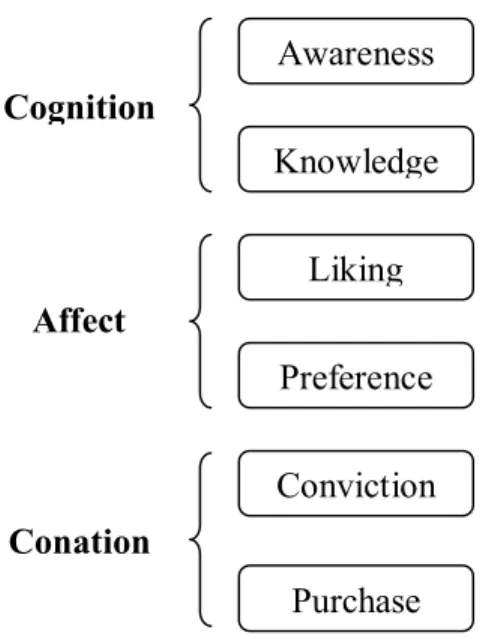
Lavidge and Steiner (1961) first introduced the cognitive, affect, and behavioral
components of attitude into the marketing literature (Barry 1987). These authors argued
that consumers formed attitudes towards marketing communications in a hierarchical
order, where cognition required the lowest consumer involvement and, as such, was the
first step in attitude formation. Affect requires more consumer involvement than
cognition and purchase behavior requires the most involvement (Lavidge and Steiner
1961). Lavidge and Steiner (1961) went a step further in proposing that each of these
attitudinal constructs can be further refined. Thus, as shown in figure 4, they proposed
that brand awareness and knowledge forms cognition – where awareness suggests brand
name recognition and knowledge is and understanding of what the brand does ; that brand
liking and preference shape affect – where liking denotes that the brand is seen positively
and preference means the brand is considered the best of alternative options; and that
brand conviction and purchase comprise conation – where conviction represents a believe
that the brand can meet a need (Lavidge and Steiner 1961). Lavidge and Steiner (1961)
also contend that affect mediates the relationship between cognition and conation. Other
scholars have also found that this relationship exists (Edell and Burke, 1987; Holbrook
and Batra, 1987; Morris, Woo et al., 2002). Droge (1989) contends that the relationship
between cognition and conation is fully mediated by affect, that cognition does not
Figure 4
Hierarchy of Effects
Source: adapted from Lavidge and Steiner (1961)
Poon and Prendergast (2007) suggest that cognition has the lowest level consumer
resistance, meaning that the advertisers can influence awareness and knowledge with the
least amount of effort and making cognition attitude the easiest to influence. Consumer
affect is harder to influence that cognition, as this typically requires an emotional
response. Advertising is least effective on inducing behavior. Extending the
hierarchy-of-effects framework to analyzing the question of how sponsorship-linked marketing
impacts consumer attitudes, we can infer that sponsorships will have the most impact of
cognition, followed by affect, and with the least influence on conation.
Nevertheless, the relative impact of each attitudinal type is dependent on the
brand’s strength on each of the dimensions of attitude. For example, Coca-Cola likely
has close to 100% awareness. As a result, the impact that sponsorship-linked marketing
can have on Coke’s cognition level is negligible. While we should expect that cognition
Affect Cognition
Conation
Conviction Preference
Liking Knowledge Awareness
is the most easily influenced attitudinal dimension, we should also expect that a time
element is involved as well. (Pitts and Slattery 2004) measured awareness levels of
several brands over a period of time. Using the data from their study, we can see that
there is an increasing utility to the brand’s level of awareness to a point. Afterwards, the
marginal utility decreases. The graph in figure 5 illustrates the phenomenon.
Figure 5
Comparison of pre-study awareness and post-study awareness increase
Source: Pitts and Slattery (2004)
From the Pitts and Slattery (2004) findings, a logical extension is that the impact
that sponsorship-linked marketing has on cognition levels is an increasing rate of return
overtime until the inflection point is reached, then a decreasing rate. The resulting graph
would be an S-shaped curve as shown in figure 6.
Figure 6 0% 5% 10% 15% 20% 25% 30%
0% 20% 40% 60% 80% 100%
P e rc e n ta ge p o in t in cr e a se in a w ar e n e ss
Hypothesized relationship between pre and post-sponsorship cognition levels
If we extend this same logic to the two other dimensions of attitude – affect and
conation – then a similar S-shaped pattern should emerge. Yet, if cognition is the most
easily influenced attitudinal dimension, followed by affect and conation, we can further
extend the logic to conclude that the impact to affect will happen later than cognition, and
later still for conation. The time dimension influence on post-attitudinal levels is shown
in figure 7.
Figure 7
Hypothesized relationship among attitudinal levels over time
0% 100% P o st -S p o n so rs h ip C o gn it io n L e ve ls
Pre-Sponsorship Cognition Levels
As such, we propose that:
P1: Sponsorship-linked leveraging will change consumer attitudes towards the
brand.
P2: Sponsorship-linked leveraging will increase the marginal utility of consumer
attitudes to a point, then have diminishing returns as attitudes reach their optimal point.
P3: Sponsorship-linked leveraging will have the greatest initial impact on
consumers’ cognition, followed next by affect and will have the latest impact on
behavior.
P4: Sponsorship-linked activations will change consumer attitudes towards the
brand.
P5: Sponsorship-linked activations will increase the marginal utility of consumer
attitudes to a point, then have diminishing returns as attitudes reach their optimal point. 0%
100%
A
tt
it
u
d
in
al
L
e
ve
l
Time
cognition
affect
P6: Sponsorship-linked activations will have the greatest initial impact on
consumers’ cognition, followed next by affect and will have the latest impact on
behavior.
One of the unique benefits of sponsorship is the opportunity the sponsor has to
encourage consumers to interact or experience the brand (McDaniel, 1999; Meenaghan,
2001a; Fan & Pfitzenmaier, 2002; Roy & Cornwell, 2004, Smith, 2004). Yet there are a
variety of ways that a firm can use the opportunities of a sponsorship to promote their
brand. It would not be atypical for a sponsorship agreement to include the use of the
sponsored property’s logos and trademarks, tickets to the event, signage at the event,
appearances with featured celebrity/athletes, media spots during the event, and booths at
the event. The question for the marketing manager is how best to leverage these
opportunities to encourage buyers to purchase the brand.
A firm’s overall sponsorship strategy should include defined objectives where the
sponsorship, through its leverage and activations, helps define the firm’s brand image
Amis et al (1999) found that, in a study of 28 Canadian firms involved in national and
international marketing, general sponsorship by itself can lead to greater awareness. Yet
the authors argue that to obtain optimal results and to achieve meaningful financial
results, sponsorships require active management to create a holistic brand experience
experience should correspond with one another. Their qualitative study of companies
with strong brand identities in New Zealand suggests that sponsorship can serve as the
focal point of the firm’s brand strategy. A sustained sponsorship campaign will build
brand equity when leveraging and activations are employed (Cliffe and Motion 2005).
Thus, by implementing sponsorship-linked marketing, the firm can improve the brand’s
image and loyalty through enticing prospective buyers to “experience” the brand
(Dolphin 2003; Nicholls, et al. 1999). This makes the sponsorship opportunity unique as
event attendees can interact with the brand. Sponsorship activations that do not involve
the brand, for example an autograph session with a celebrity representing the sponsored
property, in and of itself, has little to do with brand experience and does not enhance
brand equity. As Berry (2000) pointed out, it is the consumers’ experience, the actual
interaction with the brand that builds equity.
P7: Sponsorship-linked activations that are more brand-centric will be more
effective in improving the consumer’s cognition of the sponsor’s brand.
P8: Sponsorship-linked activations that are more brand-centric will be more
effective in improving the consumer’s affect towards the sponsor’s brand.
P9: Sponsorship-linked activations that are more brand-centric will be more
effective in improving the consumer’s conation towards the sponsor’s brand.
Sponsorship Relationships. The primary players in any sponsorship are the
often begins with the property soliciting potential sponsors for investment into the
program or event. This occurs because the demand for sponsoring firms is much greater
than that for events to be sponsored (Amis, et al. 1999, Carlson and Taylor 2003). One
exception is established events, where a third party brings the prospective sponsors and
event properties together (O’Reilly et al, 2008).
When approached by properties, managers must decide the type of event to
sponsor. Some have suggested that the decision of what or who to sponsor parallels the
decision in choosing a celebrity endorser (Gwinner, 1997; McDaniel, 1999; Smith, 2004).
McCraken (1989) suggested that the attributes that consumers bestow upon the celebrity
would become associated with the brand being endorsed. He argues that there is a
“symbolic property” associated with the endorser that transfers first to the brand and then
to the consumer. The celebrity who endorses the brand represents a quality that the brand
wants associated with it, and that the resulting brand quality is identified with the
consumer (McCraken, 1989). Keller (1993) used a similar argument when describing
benefits to the sponsor from the sponsored property. Keller (1993) spoke to the idea of
consumer reactions to elements of the marketing mix of an established property is more
effective than the same marketing mix associated with an unknown or fictious property
(Keller, 1993). The intention in both cases is that the enthusiasm that consumers have for
the one (endorser or sponsored) will shift to the other (i.e., the firm’s brands).
Several studies have pointed out the importance of congruity or fit between the
two parties (Cornwell et al. 2006; Fleck and Quester 2007; Gwinner and Eaton 1999;
event are “well matched” (Jagre, Watson et al. 2001; Rifon, Choi et al. 2004; Chien,
Cornwell et al. 2005; Simmons and Becker-Olsen 2006). When the perceived “fit” is
good between the sponsor and the event, consumers have greater perception (McDaniel
1999), and recall and affinity (Johar and Pham 1999; Cornwell, Humphreys et al. 2006)
with the sponsor. Speed and Thompson (2000) showed a positive relationship between
perceived fit and intent to buy. Furthermore, the stronger the perceived congruence
between sponsor and event, the stronger the likelihood for purchase becomes (Davies,
Veloutsou et al. 2006).
McDonald (1991) wrote about ‘product relevance’ when investigating fit and
suggested that incongruity between product and event leads to a negative reaction from
consumers. In extending McDonald’s work (1991), Gwinner and Eaton (1999) talked of
two types of product relevance: function-based, in which the product is used in the course
of the event by the participants, and image-based, in which the brand seems to belong
with the event. Nike gear worn by athletes during a sporting event illustrates
function-based relevance, since there gear is a functional component of the event (Gwinner 1997).
An imaged-based example might be FedEx sponsoring a track meet, as both represent
speed to the marketplace. Both parties must be cognizant of the need for congruency
between the sponsoring firm and sponsored event. Indeed, the strength of the congruency
is a key to the success of the sponsorship (Crimmins and Horn 1996).
There has been research that suggests, however, that highly incongruent pairings
between sponsor and property can lead to greater cognition among consumers. Jagre,
process an individual would give to the relationship making it more memorable. They
suggest that congruency is the expectation and thus, will require less effort to absorb the
communication – perhaps to the point of little conscious processing (Jagre et al. 2001).
Other research has also shown that consumers remembered more messaging that lacked
congruency (Srull, 1981; Hastie, 1980). Yet Jagre, Watson, and Watson (2001) also
contended that an extremely incongruent relationship would lead to negative reactions.
Nevertheless, their argument of negative reactions towards high incongruency does not
dissuade from the likelihood of higher consumer cognition. On the other hand, the
majority of sponsorship literature supports the proposition that congruency drives
cognition (Cohen, 1982; Fiske, 1982; Fiske & Pavelchak, 1986; Misra & Beatty, 1990,
(Koo et al. 2006). If one was to take the position that both arguments are logical, then the
relationship between congruency and consumer cognition would not be linear. As shown
in figure 8, we propose this relationship is U-shaped, where both very low and very high
congruency between sponsor and property will lead to greater cognitive attitude.
Figure 8
Thus, we propose that:
P10: The level of congruity between the sponsor and the sponsored property and
cognition of the sponsor is U-shaped where the highest and lowest levels of congruity
lead to the strongest consumer cognition of the sponsor’s brand.
P11: The stronger the perceived congruity between the sponsor and the sponsored
property, the stronger the consumer’s affect towards the sponsor’s brand.
P12: The stronger the perceived congruity between the sponsor and the sponsored
property, the stronger the consumer’s conation towards the sponsor’s brand.
When companies sponsor the same events and venues, over time their names
become intertwined with the events in the public’s mind (Cornwell and Coote 2005).
The Tostitos Fiesta Bowl, the Buick Invitational, and Phillips Arena are just a few
Le
ve
l o
f
C
o
gn
it
io
n
examples of this phenomenon. The continuity and tenure of the sponsorship have a
greater impact on the attitudes toward the sponsor (Cornwell, Roy et al. 2001), and these
benefits are likely enhanced with time (Gilbert 1988). Cornwell, Roy et al. (2001)
concluded that a continuing sponsorship relationship is important because ongoing event
sponsorships act similarly to ongoing advertising campaigns in that they both reinforce
the message over time. Moreover, managers can optimize the impact of the sponsorship
as they gain experience from repeated events (Cornwell, Roy et al. 2001). Additionally,
as the sponsor’s relationship with the event lengthens, the cognitive association becomes
more defined (Keller 1993; Johar and Pham 1999), and the emphasis of the firm will shift
from awareness building and to building an emotional connection with consumers
(Armstrong 1988).
P13: The longer the relationship between the sponsor and the sponsored property,
the stronger the consumer’s cognition of the sponsor’s brand.
P14: The longer the relationship between the sponsor and the sponsored property,
the stronger the consumer’s affect towards the sponsor’s brand.
P15: The longer the relationship between the sponsor and the sponsored property,
the stronger the consumer’s conation towards the sponsor’s brand.
A threat to the relationships built between sponsor and sponsored is that of
ambush marketing. Sandier and Shani (1989) define ambush marketing as "a planned
order to gain at least some of the recognition and benefits that are associated with official
sponsorship". The sponsorship can be ambushed through any activity that implies the
‘ambusher’ has a connection to the event when such a connection does not exist (Payne,
1998). For example, a non-sponsoring firm could ambush a property by sponsoring the
event’s media coverage, or increasing the amount of advertising during the event. A case
involving American Express and Visa around the 1992 Barcelona Olympic Games
illustrates the point. An American Express commercial featured scenes of Barcelona and
a statement saying that you don’t need a visa to go to Spain. Visa, who was an official
Olympic sponsor that year, objected to the advertisement claiming it was ambushed.
American Express countered that there was no reference to the Olympic Games and was
not ambushing (Chadwick and Burton, 2010).
It is not illegal to conduct ambush marketing (Euore, 1993) but event managers
still try to combat ambushers through stricter use of official licensing, associations, logos,
or phrases (Meenaghan, 1998). For example, media firms that broadcast the Olympic
Games are now required by the International Olympic Committee to offer first refusal for
commercial time to official sponsors. Host cities must guarantee that they will legislate
against ambush marketing, will allow no street vending, and will regulate advertising
with public transit and outdoor ads for two weeks prior to the games and until the games
are concluded (Chadwick and Burton, 2010). Nevertheless, the use of ambush marketing
continues to grow, because sponsors place the burden on the event managers to control
ambushers. When the event managers fail to control ambush marketing, the
sponsor-sponsored property relationship is threatened. Surprisingly, even with the negative
ambush marketing tactics in place of paying the required rights fees to sponsor the event
(Moore, 2008).
P16: The presence of ambush marketers will decrease the consumer’s cognition of
the sponsor’s brand.
P17: The presence of ambush marketers will decrease the consumer’s affect
towards the sponsor’s brand.
P18: The presence of ambush marketers will decrease the consumer’s conation
towards the sponsor’s brand.
The propositions introduced leads to a conceptual model of sponsorship’s
influence on consumer attitudes. The model is presented in figure 8. Because of the
influence that the brand message has on the impact of the sponsorship leveraging, we
suggest that brand centric messaging moderates the effect of sponsorship leveraging and
activations has on consumer attitudes. Berry (2000) suggests that it is the consumer’s
interaction with the brand that improves consumer attitudes. The remaining main effects
fall directly from the propositions.
Figure 8
Discussion
While sponsorship research has increased significantly over the past ten to 15
years, our understanding of what drives a successful sponsorship is still developing. The
propositions advanced in this paper are premised on the idea that improving brand
attitudes among targeted consumers will ultimately lead to improved profitability and
stronger brand equity. There is building consensus among researchers around this view
that improved brand attitudes should be the organization’s goal when sponsoring an event
(e.g., Hansen and Scotwin 1995; Speed and Thompson, 2000; Madrigal 2001; Cornwell,
Weeks, and Roy, 2005; Koo, Quarterman, and Flynn 2006). As such, the sponsor should
engage in activities that drive positive brand attitudes and avoid those activities that do
This study has presented an argument that sponsorship success is predicated on
the success of the leveraging and activational activities of the sponsor. Foremost, these
activities require organizations to invest more into the sponsorship that the rights fees.
There have been several rules of thumb on how much firms should invest into the
leveraging and activations of their sponsorships. Nevertheless, as Crimmins and Horn
(1996) suggested, if the sponsor cannot afford to invest in leveraging and activations,
they cannot afford the sponsorship. Without it, the sponsorship fees amount to nothing
more than a charitable donation.
In addition to the literature review and introduction of sixteen propositions, this
paper is also intended to introduce the remaining two papers of the dissertation – one a
sponsorship model and the other on sponsorship ROI.
The sponsorship model paper empirically tests a model regarding the influence
that sponsorship leveraging and activations have on consumer attitudes towards the
sponsored property and the sponsor’s brand. The overarching theory that drives the
model is Fritz Heider’s (1946, 1958) balance theory. Balance theory suggests the need of
individuals to maintain balance in their relationships. If two objects (people, ideas,
properties) are somehow linked and you have opposing opinions toward them, then
balance theory suggests that the opinion toward one must eventually match the other.
The theory allows us to explain image transfer from property to sponsor. We used
structural equation modeling to test the fit of the proposed model. The event used to
regarding the event were solicited from two independent groups of attendees. Each group
provided us a different set of data in which to compare our models. Our proposed
hypotheses were then tested within the framework of the overall model. In addition, we
also compared the proposed model to theoretically supported alternative models from
MacKenzie et al. (1986) paper on attitudes towards the ad. Each of the alternative
models were then tested to determine whether the competing models were better suited to
the data.
The sponsorship ROI paper develops an attitudinally based means to determine
the financial impact of a sponsorship. We have argued in this paper that the desired
outcome for sponsors should be improved customer attitudes towards the brand.
Extending the research on consumer attitudes, we developed a logistic regression model
to predict the number of new buyers based upon the changed attitudes of consumers that
resulted from attending or viewing the sponsored event. We then apply customer lifetime
value to the number of new buyers to calculate the financial gain the sponsor should
expect to obtain. These results are validated with an independent group of attendees after
one buying cycle. In addition, a set of hypotheses are proposed and tested consistent with
References
Amis J, T Slack, and T Berrett (1999), “Sport Sponsorship as Distinctive Competence”
European Journal of Marketing, 33(4): 250-72.
Armstrong, C (1988). "Sports Sponsorship: A Case-Study Approach to Measuring Its
Effectiveness" European Research16(2): 97-103.
Barry, TE (1987). "The Development of the Hierarchy of Effects: An Historical
Perspective," Current Issues and Research in Advertising10(2): 251-295.
Beijing Olympics Sponsors Hit Gold! (2009). Adoimagazine.com. Retrieved April 18,
2010, from
http://www.adoimagazine.com/newhome/index.php?option=com_content&view=article
&id=3120:beijing-olympics-sponsors-hit-gold&catid=1:breaking-news&Itemid=5
Bennett, R (1999), "Sports Sponsorship, Spectator Recall and False Consensus"
European Journal of Marketing, 33(4): 291.
Berry, Leonard, 2000, “Cultivating Service Brand Equity”, Journal of the Academy of
Marketing Science, 28(1): 128-137.
Carlsen J, and A Taylor (2003), “Mega-Events and Urban Renewal: The Case of the
Carrigan, M and J Carrigan (1997), "UK Sports Sponsorship: Fair Play or Foul?”
Business Ethics: A European Review, 6(2): 59-64.
Chadwick, S and N Burton (2010, January 25), Ambushed! The Wall Street Journal
On-Line, Retrieved April 18, 2010, from
http://online.wsj.com/article/SB10001424052970204731804574391102699362862.html
Chaney, IM, KH Lin, and J Chaney (2004), "The effect of billboards within the gaming
environment," Journal of Interactive Advertising, 5 (1), 54-69.
Chien, PHM, TB Cornwell, R Stokes, and S Purchase (2005), "A Theoretical Framework
for Analysis of Image Transfer in Multiple Sponsorships," in Australia & New Zealand
Marketing Academy Conference (ANZMAC): The University of Western Australia.
Cornwell, TB (1995), “Sponsorship-Linked Marketing Development,” Sport Marketing
Quarterly, 12(4): 13-24.
Cornwell, TB and L Coote (2005), “Corporate Sponsorship of a Cause: The Role of
Identification in Purchase Intent,” Journal of Business Research58(3): 268-276.
Cornwell, TB, MS Humphreys, AM Maguire, CS Weeks, and CL Tellegen (2006),
“Sponsorship-Linked Marketing: The Role of Articulation in Memory,” Journal of
Consumer Research, 33(3): 312-321.
Cornwell, TB, SW Pruitt, and JM Clark (2005), “The Relationship Between
Major-League Sports’ Official Sponsorship Announcements and the Stock Prices of Sponsoring
Cornwell, TB, DP Roy, EA Steinard, and RJ Faber (2001), “Exploring Managers'
Perceptions of the Impact of Sponsorship on Brand Equity,” Journal of Advertising,
30(2): 41-52.
Cornwell, TB, CS Weeks, and DP Roy (2005). “Sponsorship-Linked Marketing: Opening
the Black Box,” Journal of Advertising34(2): 21-42.
Crimmins, J and M Horn (1996), “Sponsorship: From Management Ego Trip to
Marketing Success,” Journal of Advertising Research36(4): 11-21.
Crompton, JL (2004), “Conceptualization and Alternate Operationalizations of the
Measurement of Sponsorship Effectiveness in Sport,” Leisure Studies, 23(3), 267-81.
Davies, Fiona, Cleopatra Veloutsou, and Andrew Costa (2006), “Investigating the
Influence of a Joint Sponsorship of Rival Teams on Supporter Attitudes and Brand
Preferences,” Journal of Marketing Communications, 12(1): 31-48.
Dröge, Cornelia (1989), “Shaping the Route to Attitude Change: Central versus
Peripheral Processing through Comparative versus Noncomparative Advertising,”
Journal of Marketing Research26(2): 193-204.
Edell, Julie A. and Marian C. Burke (1987), “The Power of Feelings in Understanding
Advertising Effects,” Journal of Consumer Research14(3): 421-433.
Erdogan, BZ and P Kitchen (1998), “Managerial Mindsets and the Symbiotic
Relationship between Sponsorship and Advertising,” Marketing Intelligence and
Evans, M, L O'Malley, and M Patterson (2004), Exploring Direct and Customer
Relationship Marketing (2nd ed.). London: Cengage Learning Business Press.
Fan, Y and N Pfitzenmaier (2002), “Event Sponsorship in China,” Corporate
Communication: An International Journal, 7(2): 110-16.
Fleck, ND and P Quester (2007), “Birds of a Feather Flock Together ... Definition, Role
and Measure of Congruence: An Application to Sponsorship,” Psychology and
Marketing, 24(11): 975-1000.
Fortunato, JA and DM Windels (2005), "Adoption of Digital Video Recorders and
Advertising: Threats or Opportunities," Journal of Interactive Advertising, 6 (1), 137-48.
Gardner, MP and PJ Shuman (1987), “Sponsorship: An Important Component of the
Promotions Mix,” Journal of Advertising, 16(1): 11-17.
Gilbert, D (1988), “Sponsorship Strategy is Adrift.” Quarterly Review of Marketing
14(1): 6-9.
Gwinner, KP (1997), “A Model of Image Creation and Image Transfer in Event
Sponsorship,” International Marketing Review, 14(3): 145-158.
Gwinner, KP and J Eaton (1999), “Building Brand Image Transfer through Event
Sponsorship: The Role of Image Transfer,” Journal of Advertising, 28(4): 47-57.
Hansen, F and L Scotwin (1995), “An Experimental Enquiry into Sponsoring: What
Hastie, R. (1980). Memory for Information which Confirms or Contradicts a General
Impression. In Hastie, R. (Ed.), Person Memory: The Cognitive Basis of Social
Perception, Hillsdale, NJ: Lawrence Erlbaum Associates.
Holbrook, Morris B. and Rajeev Batra (1987), “Assessing the Role of Emotions as
Mediators of Consumer Responses to Advertising,” Journal of Consumer Research
14(3): 404-420.
IEG (2005). “’06 Outlook: Sponsorship Growth Back To Double Digits,” IEG
Sponsorship Report, 24: 4–5.
IEG. Sponsorship spending to total 14.93 million in 2007. Retrieved on June 26, 2009
from
http://www.sponsorship.com/About-IEG/Press-Room/Sponsorship-Spending-To-Total-$14.93-Billion-In-20.aspx.
Jagre, E, JJ Watson, and JG Watson (2001), “Sponsorship and Congruity Theory: A
Theoretical Framework for Explaining Consumer Attitude and Recall of Event
Sponsorship,” Advances in Consumer Research, 28: 439-45.
Javalgi, RG, MB Traylor, AC Gross, and E Lampman (1994), “Awareness of
Sponsorship and Corporate Image: An Empirical Investigation,” Journal of Advertising,
23(4): 47-58.
Johar, G and M Pham (1999), “Relatedness, Prominence, and Constructive Sponsor
Kambitsis, C, Y Harahousou, N Theodorakis, and G Chatzibeis (2002), “Sports
Advertising in Print Media: The Case of 2000 Olympic Games,” Corporate
Communications, 7(3): 155-161.
Keller, K (1993), “Conceptualizing, Measuring, and Managing Customer-Based Brand
Equity,” Journal of Marketing57(1): 1-22.
Koo, G, J Quarterman, and L Flynn (2006), “Effect of Perceived Sport Event and
Sponsor Image Fit on Consumers' Cognition, Affect, and Behavioral Intentions,” Sport
Marketing Quarterly, 15(2): 80-90.
Kover, AI (2001), “The Sponsorship Issue,” Journal of Advertising Research, 41: 5–15.
Lyberger, M and L McCarthy (2001), “An Assessment of Consumer Knowledge of,
Interest in, and Perceptions of Ambush Marketing Strategies,” Sport Marketing Quarterly
10(3): 130-137.
Madrigal, R (2001), “Social Identity Effects in a Belief-Attitude-Intentions Hierarchy:
Implications for Corporate Sponsorship,” Psychology and Marketing, 18(2): 145-65.
Mansourpour, S (2007), "An Investigation into the Use of Sports Sponsorship as a
Marketing Tool," Cranfield University.
McCarville, RE, CM, Flood, and TA Froats (1998), “The Effectiveness of Selected
Promotions on Spectators' Assessments of a Non-Profit Sporting Event Sponsor,”
McCracken, G (1989), “Who is the Celebrity Endorser? Cultural Foundations of the
Endorsement Process,” Journal of Consumer Research, 16(December): 310-21.
McDaniel, SR (1999), “An Investigation of Match-Up Effects in Sport Sponsorship
Advertising: The Implications of Consumer Advertising Schemas” Psychology and
Marketing, 16(2): 163-184.
McDonald, C (1991), “Sponsorship and the Image of the Sponsor,” European Journal of
Marketing, 25(11): 31–38.
Meenaghan, T (1983), “Commercial Sponsorship,” European Journal of Marketing, 7(7):
5-71.
Meenaghan, T (1991), “The Role of Sponsorship in the Marketing Communications
Mix,” International Journal of Advertising,10: 35-47.
Meenaghan, T (1998), “Ambush Marketing: Corporate Strategy and Consumer
Reaction,” Psychology and Marketing15(4): 305-322.
Meenaghan, T (2001a), “Sponsorship and Advertising: A Comparison of Consumer
Perceptions,” Psychology and Marketing, 18(2): 191-215.
Meenaghan, T (2001b), “Understanding Sponsorship Effects,” Psychology and
Marketing, 18(2), 95–122.
Meenaghan, T and D Shipley (1999), “Media Effect in Commercial Sponsorship,”
Moore, Patricia (2008, July 1), “Brand Leverage through Sponsorship: Leverage and the
Dark Art,” AdMedia
Morris, Jon D., Chongmoo Woo, James A. Geason, and Jooyoung Kim (2002). “The
Power of Affect: Predicting Intention,” Journal of Advertising Research42(3): 7-18.
Motion, J, S Leitch, and RJ Brodie (2003), “Equity in Corporate Co-Branding,”
European Journal of Marketing, 37(7/8): 1080-94.
Mullin, B, S Hardy, and W Sutton (2000), Sport Marketing. Champaign, IL: Human
Kinetics.
Nicholls, J.A.F; Roslow, Sydney and Dublish, Sadipa, (1999), “Brand recall and brand
preference at sponsored golf and tennis tournaments”, European Journal of Marketing,
33(3/4) 365-86.
Nie, NH and L Erbring (2000), "Internet and society," Stanford Institute for the
Quantitative Study of Society.
OReilly N, M Lyberger, L McCarthy, B Seguin, and J Nadeau (2008),
“Mega-special-event promotions and intent-to-purchase: a longitudinal analysis of the Super Bowl,”
Journal of Sport Management, 22(4): 392–409.
O'Sullivan, P. & Murphy, P. (1998), “Ambush Marketing: The Ethical Issues,”