Original Article
A meta-analysis study on XRCC1 Arg399Gln
polymorphism and hematological malignancies
Xuewen Yang, Limin Ma, Xiaoqiang Zhao, Haiping Yang, Linhai Ruan
The First Affiliated Hospital, College of Clinical Medicine of Henan University of Science and Technology, Luoyang 471003, China
Received March 6, 2015; Accepted September 2, 2015; Epub October 15, 2016; Published October 30, 2016
Abstract: Background: Many previous studies have investigated the correlation between the Arg399Gln polymor-phisms in X-ray repair cross-complementing group 1 (XRCC1) gene and hematological malignancies. However, their results were not incomplete agreement. Methods: 29 studies were included and dichotomous data are presented
as the odds ratio (OR) with a 95% confidence interval (CI). Results: The results of our study indicate that XRCC1 399Gln allele among the pooled Asian population were more likely to show high risk of hematological malignan
-cies development. For further analysis, the results indicated XRCC1 399Gln polymorphism could increase the sus-ceptibility to leukemia (allele model: pooled OR=1.174, P=0.006; Recessive model: pooled OR=1.324, P=0.002), especially in Acute Lymphoblastic Leukemia (allele model: pooled OR=1.279, P=0.005; Recessive model: pooled OR=1.439, P=0.007), but no association with lymphoma was found. Conclusion: The XRCC1 399Gln polymorphism could increase the risk of developing hematological malignancies susceptibility, especially in Asians and Leukemia.
Keywords: XRCC1 gene, hematological malignancies, polymorphism, meta-analysis, leukemia
Introduction
Hematological malignancies are tumors that affect blood, bone marrow, and lymph nodes, which may derive from either of the two major blood cell lineages: myeloid and lymphoid cell lines. The myeloid cell line normally produces granulocytes, erythrocytes, thrombocytes, ma- crophages and mast cells; the lymphoid cell line produces B, T, NK and plasma cells. Lymphomas, lymphocytic leukemias, and mye- loma are from the lymphoid line, while acute and chronic myelogenous leukemia, myelodys-plastic syndromes and myeloproliferative dis-eases are myeloid in origin [1]. DNA repair genes are being increasingly studied in genetic association studies because of their critical role in maintaining genome integrity. Sequence variants in DNA repair genes are thought to modulate DNA repair capacity and consequent-ly have been associated with altered cancer risk and the response of cancer cells to anti-cancer drugs. Deficiencies in the DNA repair system may affect genome integrity, leading to the development of malignancies, including hematological malignancies [2]. Recently, many
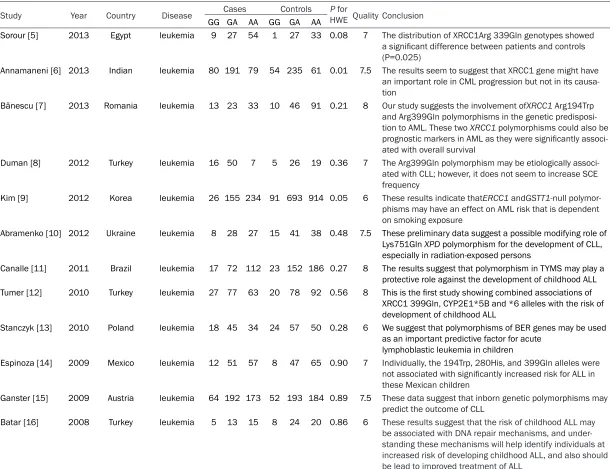
some DNA repair genes could affect the func-tion of DNA repair and play an important role in tendencies to certain diseases [3, 4]. To date, numbers of studies have investigated gene XRCC1 Arg399Gln polymorphisms on suscepti-bility to hematological malignancies, but the single study remained incomplete agreement. We have summarized those individual studies finds in Table 1. Meta-analysis is a powerful method for quantitatively summarizing the results from single study, which can increase the sample size and reduce the probability of random error. Therefore, the goal of this meta-analysis was to quantitatively assess the asso-ciation of XRCC1 Arg399Gln polymorphism with hematological malignancies.
Materials and methods
Literature search strategy
Table 1. Findings of the studies included in this meta-analysis
Study Year Country Disease Cases Controls HWE Quality ConclusionP for GG GA AA GG GA AA
Sorour [5] 2013 Egypt leukemia 9 27 54 1 27 33 0.08 7 The distribution of XRCC1Arg 339Gln genotypes showed a significant difference between patients and controls (P=0.025)
Annamaneni [6] 2013 Indian leukemia 80 191 79 54 235 61 0.01 7.5 The results seem to suggest that XRCC1 gene might have an important role in CML progression but not in its causa-tion
Bănescu [7] 2013 Romania leukemia 13 23 33 10 46 91 0.21 8 Our study suggests the involvement ofXRCC1 Arg194Trp and Arg399Gln polymorphisms in the genetic predisposi-tion to AML. These two XRCC1 polymorphisms could also be prognostic markers in AML as they were significantly associ -ated with overall survival
Duman [8] 2012 Turkey leukemia 16 50 7 5 26 19 0.36 7 The Arg399Gln polymorphism may be etiologically associ -ated with CLL; however, it does not seem to increase SCE frequency
Kim [9] 2012 Korea leukemia 26 155 234 91 693 914 0.05 6 These results indicate thatERCC1 andGSTT1-null polymor-phisms may have an effect on AML risk that is dependent on smoking exposure
Abramenko [10] 2012 Ukraine leukemia 8 28 27 15 41 38 0.48 7.5 These preliminary data suggest a possible modifying role of Lys751Gln XPD polymorphism for the development of CLL, especially in radiation-exposed persons
Canalle [11] 2011 Brazil leukemia 17 72 112 23 152 186 0.27 8 The results suggest that polymorphism in TYMS may play a protective role against the development of childhood ALL Tumer [12] 2010 Turkey leukemia 27 77 63 20 78 92 0.56 8 This is the first study showing combined associations of
XRCC1 399Gln, CYP2E1*5B and *6 alleles with the risk of development of childhood ALL
Stanczyk [13] 2010 Poland leukemia 18 45 34 24 57 50 0.28 6 We suggest that polymorphisms of BER genes may be used as an important predictive factor for acute
lymphoblastic leukemia in children
Espinoza [14] 2009 Mexico leukemia 12 51 57 8 47 65 0.90 7 Individually, the 194Trp, 280His, and 399Gln alleles were not associated with significantly increased risk for ALL in these Mexican children
Ganster [15] 2009 Austria leukemia 64 192 173 52 193 184 0.89 7.5 These data suggest that inborn genetic polymorphisms may predict the outcome of CLL
Batar [16] 2008 Turkey leukemia 5 13 15 8 24 20 0.86 6 These results suggest that the risk of childhood ALL may
be associated with DNA repair mechanisms, and
Deligezer [2] 2007 Turkey leukemia 30 121 103 29 101 96 0.76 6 To our knowledge, this is the first study to investigate the role of any XRCC1 polymorphism in CML and our findings do not support a role of codon 399Gln polymorphism in CML
Pakakasama
[17] 2007 Thailand leukemia 9 60 39 18 124 175 0.51 6.5 The XRCC1 194Trp allele and haplotype B showed a protective effect against development of childhood ALL. In contrast, individuals with the XRCC1 399Gln allele and hap-lotype C were associated with increased risk for this disease Matullo [18] 2006 Mixed leukemia 28 74 67 128 482 484 0.63 7 XRCC1-399 Gln/Gln variant homozygotes [odds ratios
(OR)=2.20, 95% confidence intervals (CI)=1.16-4.17] and XRCC3-241 Met/Met homozygotes (OR=0.51, 95% CI=0.27-0.96) and leukemia
Joseph [16] 2005 India leukemia 16 46 55 9 33 75 0.06 6 The risk of ALL was higher in males with codons 194 and 399 polymorphisms than in females
Zhang [19] 2005 China leukemia 12 39 48 7 37 55 0.82 7 XRCC 1 399 homozygotes was associated with leukemia
Zhu [19] 2005 China leukemia 16 44 45 7 39 62 0.79 9 XRCC 1 399 homozygotes was associated with leukemia Seedhouse [20] 2002 UK leukemia 24 57 52 47 76 55 0.54 8 Our data provide evidence of a protective effect against AML in individuals with at least one copy of the variant
XRCC1 399Gln allele compared with those homozygous for the common allele
Ozdemir [21] 2011 Turkey leukemia and
lymphoma 15 42 33 15 50 34 0.62 7 There was also statistically increased risk for severe mucositis in patients with XRCC1Arg399Gln polymorphism -Li [22] 2014 China Lymphoma 16 101 165 12 89 130 0.51 8.5 Combined genotype analyses of XRCC 399-280-194 results
showed that the combined genotype was not associated with risk of NHL overall
Monroy [23] 2011 USA Lymphoma 20 106 73 10 53 37 0.15 6.5 We observed that, in combination, allelic variants in the XPC Ala499Val, NBN Glu185Gln, XRCC3 Thr241Me, XRCC1 Arg194Trp and XRCC1 399Gln polymorphisms modify the risk for developing HL
Kim [24] 2010 Korean Lymphoma 26 155 234 91 693 914 0.05 9 XRCC1 showed very strong linkage disequilibrium (LD)
and consisted of one haploblock. The frequency of XRCC1 haplotype A (194Arg-280Arg-399Arg) was significantly lower
in DLBCL patients compared to controls (OR, 0.60-95% CI, 0.15-0.81; P=0.001)
Barıs [25] 2009 Turkey Lymphoma 5 13 15 8 24 20 0.89 7 XRCC1 194Trp allele may be associated with a protective effect against development of childhood B-cell lymphoma Liu [26] 2009 China Lymphoma 15 88 118 11 98 145 0.26 6 When stratified by smoking status, however, the XRCC1Arg
Smedby [27] 2006 Denmark and
Sweden Lymphoma 56 206 166 75 269 249 0.85 8 We conclude that polymorphic variation in the XRCC3 gene, but not in ERCC2 or XRCC1, may be of importance for susceptibility to follicular lymphoma, perhaps primarily in current smokers
Matsuo [28] 2004 Japan Lymphoma 11 94 155 30 183 287 0.91 7.5 These data suggest that XRCC1 Gln399Arg polymorphism plays a limited role in lymphomagenesis
Cifci [29] 2011 Turkey Multiple
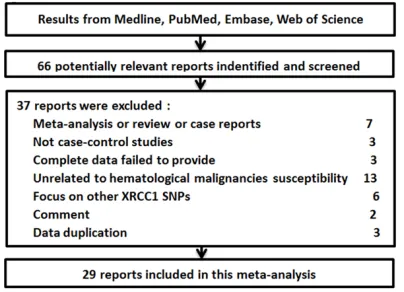
ma”, “polymorphism” or “mutation”, “XRCC1” or “X-ray repair cross-complementing group 1”). All searched studies were retrieved and only published studies with full-text articles were included. When 2 or more publications with duplicate samples, only the newest study was included in this research. The flow chart of the study including process was shown in Figure 1. Inclusion and exclusion criteria
The inclusion criteria was as follows: (1) the study was about the XRCC1 polymorphisms and susceptibility to any type of hematological malignancies; (2) a case-control study; (3) non-cancer patients or healthy subjects as controls; (4) the data that study provided was fit to this meta-analysis; (5) the frequencies of genotype or allele in case and control groups could be collected. The exclusion criteria were: (1) ani-mal studies; (2) the reported data did not meet this study needed; (3) the reported data was not adaptable for our pooled study; (4) the study focused on other cancers.
Data extraction
Based on the selection criteria, two reviewers, Xuewen Yang and Limin Ma, extracted and inte-grated the data independently (including c
on-trol type, study design, first author’s name, pub
-lication year, and the frequencies of genotype
or allele in case and control groups). The quali-ty scoring system was first reported by Tha-kkinstian: total scores ranged from 0 (lowest) to
10 (highest). Articles with scores equal to or higher than 7 were considered “high-quality” studies, whereas those with scores less than 7
were considered “low-quality” studies. The pre
-defined criteria were shown in Appendix 1.
Statistical analysis
Allele frequencies at the XRCC1 Arg399Gln SNPs from the respective studies were deter-mined by the allele counting method. Dicho- tomous data are presented as the odds ratio (OR) with a 95% confidence interval (CI). St- atistical heterogeneity was measured using the Q-statistic (P≤0.10 was considered to be repre-sentative of statistically significant heterogene-ity) by χ2-based Q-test. We also quantified the
effect of heterogeneity using the I2-statistic,
which measures the degree of inconsistency in the studies by calculating what percentage of the total variation across studies is due to het-erogeneity rather than by chance. The I2 takes
values between 0% and 100%, with higher val-ues denoting greater degree of heterogeneity (I2 = 0% to 25%, none heterogeneity; I2 = 25% to
50%, moderate heterogeneity; I2 = 50% to 75%,
large heterogeneity; I2 = 75% to 100%, extreme
heterogeneity). A fixed effects model was used when there was no heterogeneity of the results of the studies. Otherwise, the random effects model was used. Dependent on the results of heterogeneity test among individual studies, the fixed effect model (Mantel-Haenszel) or random effect model (DerSimonian and Laird) was selected to summarize the combined OR and their 95% CI. To establish the effect of clini-cal heterogeneity between studies on meta-analyses’ conclusions, subgroup analysis was conducted on the basis of race. Visual inspec-tion of asymmetry in funnel plots was conduct-ed. Begg’s rank correlation method and Egger weighted regression method were also used to statistically assess the publication bias (P≤0.05 was considered to be representative of statisti-cally significant publication bias). All the statis-tical analysis was conducted by using STATA statistical package (version 10, STATA, College Station, TX, USA) and P≤0.05 was considered to be statistically significant.
Main results
Characteristics of studies
[image:5.612.89.291.72.218.2]There were 29 relevant studies with 4847 cases and 8485 controls were involved in the meta-analysis. Among those studies, 21 stud-ies were about leukemia, 7 studstud-ies were about Figure 1. A flow diagram of the study selection pro
Lymphoma, 1 study was about leukemia and Lymphoma, and only 1 study was about multi-ple myeloma. The characteris-tics of each study were pre-sented in Table 1.
Quantitative data synthesis
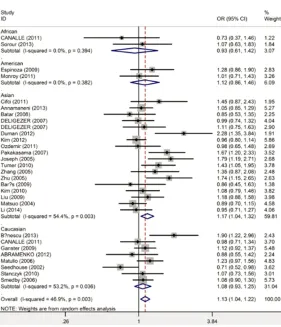
[image:6.612.89.524.85.361.2]Hematological malignancies cases and controls were com-pared to investigate the re- lationship between XRCC1 Ar- g399Gln polymorphism and hematological malignancies. As Table 2 and Figure 2 sh- own, the carriers of the XRCC1 399Gln allele were more likely to have Hematological malig-nancies than 399Arg allele in the over-all group and the Asians subgroup but not in the other ethnicity people (P<0.05). Meantime, we found the similar results in Recessive model, that XRCC1 399 Gln/ Gln genotype was associated with risk of Hematological malignancies in over-all group Table 2.XRCC1 Arg399Gln polymorphisms and hematological malignancies
Comparisons Stratification Subgroups n OR (95% CI) Homogeneity
Publication Bias
OR CI P value Q P I² (%) PB PE
Allele model (Gln vs. Arg) over-all - 30 1.125 1.035-1.223 0.005 54.66 0.003 46.9 0.805 0.918 Subtypes leukemia 21 1.174 1.048-1.317 0.006 47.88 0.001 58.2 0.231 0.182 lymphoma 7 1.027 0.924-1.141 0.622 2.97 0.812 0.0 0.532 0.371 Ethnicity Africans 2 0.927 0.607-1.416 0.725 0.73 0.394 0.0 0.343 0.433 Americans 2 1.119 0.860-1.456 0.403 0.76 0.382 0.0 0.783 0.832 Asians 18 1.170 1.041-1.316 0.008 37.26 0.003 54.4 1.000 0.276 Caucasians 8 1.076 0.927-1.250 0.336 14.97 0.036 53.2 0.49 0.558 Dominant (Gln/Gln+ Gln/
Arg vs. Arg/Arg) Subtypesover-all leukemia- 3021 1.1191.175 0.997-1.3840.997-1.255 0.0560.054 52.2857.30 0.0010.001 61.749.4 1.000 0.8290.621 0.733
lymphoma 7 1.026 0.896-1.175 0.710 2.61 0.855 0.0 0.763 0.652 Ethnicity Africans 2 0.673 0.399-1.135 0.138 0.58 0.448 0.0 0.368 0.350 Americans 2 1.148 0.805-1.638 0.447 0.49 0.484 0.0 0.230 0.558 Asians 18 1.194 1.004-1.420 0.045 44.92 0.001 62.2 0.176 0.163 Caucasians 8 1.084 0.939-1.252 0.272 7.95 0.337 11.9 0.133 0.277 Recessive (Gln/Gln vs.
Arg/Arg+ Gln/Arg)
over-all - 30 1.248 1.094-1.424 0.001 32.41 0.30 10.5 0.133 0.115 Subtypes leukemia 21 1.324 1.109-1.580 0.002 27.11 0.132 26.2 0.368 0.350 lymphoma 7 1.063 0.833-1.356 0.624 2.87 0.824 0.0 0.230 0.558 Ethnicity Africans 2 2.720 0.732-10.104 0.135 1.23 0.268 18.5 0.721 0.975 Americans 2 1.210 0.659-2.221 0.539 0.48 0.487 0.0 0.49 0.729 Asians 18 1.310 1.110-1.545 0.001 15.24 0.578 0.0 0.297 0.269 Caucasians 8 1.155 0.879-1.517 0.301 12.95 0.073 46.0 0.368 0.346
[image:6.612.92.373.375.702.2]and the Asians subgroup (P<0.05) other non-Gln/Gln genotype. The results of subtype analy-sis indicated XRCC1 Arg399Gln polymorphism could increase the susceptibility to leukemia (allele model: pooled OR=1.174, 95% CI=1.048-1.317, P=0.006; Recessive model: pooled OR=1.324, 95% CI=1.109-1.580, P=0.002), but not lymphoma.
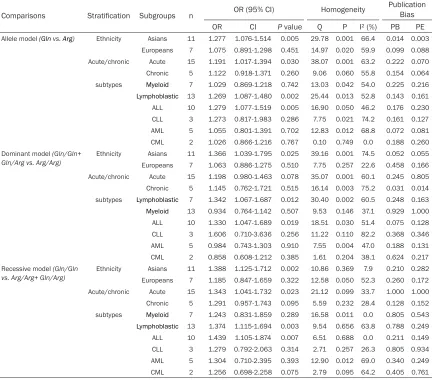
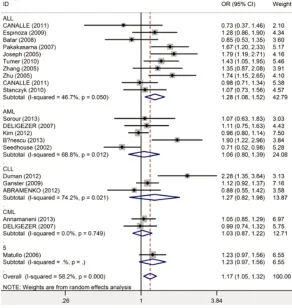
[image:7.612.90.522.87.467.2]We performed more detailed subgroup analysis according to 2 main subtypes of Hematological malignancies, leukemia and lymphoma. As Table 3 and Figure 3 shown, XRCC1 399Gln was associated with risk of leukemia in Asi- an people but not Europeans in Allele and Recessive models (allele model: pooled OR= 1.277, 95% CI=1.076-1.514, P=0.006; Re- cessive model: pooled OR=1.388, 95% CI= 1.125-1.712, P=0.002). In the stratified analy-sis according to acute/chronic leukemia and
Myeloid/Lymphoblastic, we found XRCC1 399Gln was only associated with acute leu- kemia and Lymphoblastic leukemia (acute leukemia: allele model: pooled OR=1.191, 95% CI=1.017-1.39, P=0.030; Recessive model: pooled OR=1.343, 95% CI=1.041-1.732, P= 0.023. Lymphoblastic leukemia: allele model: pooled OR=1.269, 95% CI=1.087-1.480, P= 0.002; Recessive model: pooled OR=1.374, 95% CI=1.115-1.694, P=0.003). In the subtype analysis of Acute Lymphoblastic Leukemia (ALL), Chronic Lymphoblastic Leukemia (CLL), Acute Myeloid Leukemia (AML) and Chronic Myeloid Leukemia (CML), XRCC1 Arg399Gln polymorphisms revealed statistically significant different only in Acute Lymphoblastic Leukemia (allele model: pooled OR=1.279, 95% CI=1.077-1.519, P=0.005; Recessive model: pooled OR=1.439, 95% CI=1.105-1.874, P=0.007). Table 3.XRCC1 Arg399Gln polymorphisms and leukemia
Comparisons Stratification Subgroups n OR (95% CI) Homogeneity
Publication Bias
OR CI P value Q P I² (%) PB PE
Allele model (Gln vs. Arg) Ethnicity Asians 11 1.277 1.076-1.514 0.005 29.78 0.001 66.4 0.014 0.003 Europeans 7 1.075 0.891-1.298 0.451 14.97 0.020 59.9 0.099 0.088 Acute/chronic Acute 15 1.191 1.017-1.394 0.030 38.07 0.001 63.2 0.222 0.070 Chronic 5 1.122 0.918-1.371 0.260 9.06 0.060 55.8 0.154 0.064 subtypes Myeloid 7 1.029 0.869-1.218 0.742 13.03 0.042 54.0 0.225 0.216
Lymphoblastic 13 1.269 1.087-1.480 0.002 25.44 0.013 52.8 0.143 0.161 ALL 10 1.279 1.077-1.519 0.005 16.90 0.050 46.2 0.176 0.230 CLL 3 1.273 0.817-1.983 0.286 7.75 0.021 74.2 0.161 0.127 AML 5 1.055 0.801-1.391 0.702 12.83 0.012 68.8 0.072 0.081 CML 2 1.026 0.866-1.216 0.767 0.10 0.749 0.0 0.188 0.260 Dominant model (Gln/Gln+
Gln/Arg vs. Arg/Arg)
Ethnicity Asians 11 1.366 1.039-1.795 0.025 39.16 0.001 74.5 0.052 0.055 Europeans 7 1.063 0.886-1.275 0.510 7.75 0.257 22.6 0.458 0.166 Acute/chronic Acute 15 1.198 0.980-1.463 0.078 35.07 0.001 60.1 0.245 0.805 Chronic 5 1.145 0.762-1.721 0.515 16.14 0.003 75.2 0.031 0.014 subtypes Lymphoblastic 7 1.342 1.067-1.687 0.012 30.40 0.002 60.5 0.248 0.163
Myeloid 13 0.934 0.764-1.142 0.507 9.53 0.146 37.1 0.929 1.000 ALL 10 1.330 1.047-1.689 0.019 18.51 0.030 51.4 0.075 0.128 CLL 3 1.606 0.710-3.636 0.256 11.22 0.110 82.2 0.368 0.346 AML 5 0.984 0.743-1.303 0.910 7.55 0.004 47.0 0.188 0.131 CML 2 0.858 0.608-1.212 0.385 1.61 0.204 38.1 0.624 0.217 Recessive model (Gln/Gln
vs. Arg/Arg+ Gln/Arg) Ethnicity EuropeansAsians 117 1.388 1.125-1.7121.185 0.847-1.659 0.3220.002 10.86 0.36912.58 0.050 52.37.9 0.210 0.2820.260 0.172
Acute/chronic Acute 15 1.343 1.041-1.732 0.023 21.12 0.099 33.7 1.000 1.000 Chronic 5 1.291 0.957-1.743 0.095 5.59 0.232 28.4 0.128 0.152 subtypes Myeloid 7 1.243 0.831-1.859 0.289 16.58 0.011 0.0 0.805 0.543
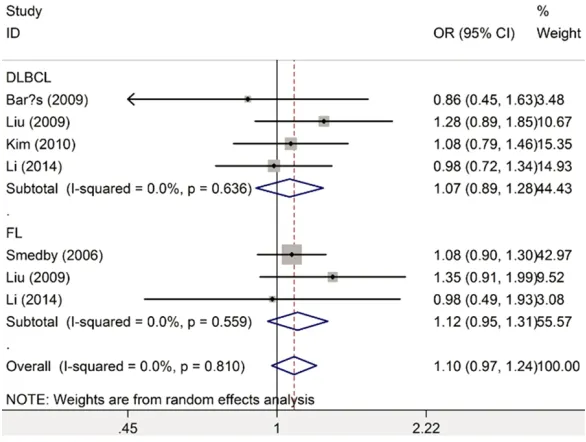
As Table 4 and Figure 4 shown, no association of XRCC1 Arg399Gln polymorphisms and non-Hodgkin lymphoma was found, not only in over-all group, but also in diffuse large B cell lympho-mas and follicular lympholympho-mas.
Heterogeneity
The heterogeneity was reckoned between each of the studies using the Q statistic. We found heterogeneity exist in some subgroups-analy-sis, but was not serious. So random-model was used to pool the single result.
Sensitivity analysis
“Trim and Filled” and “Influence Meta-analysis” were conducted to reflect the influence of the individual dataset to the pooled ORs. The test results indicated that our results were statisti-cally robust.
Publication bias
Begg’s funnel plot and Egger’s test were per-formed to access the publication bias of
litera-genes is associated with development of can-cer due to impairment of DNA repair capacity [31], such as lung cancer [32], gastric cancer [33], colon cancer [34] and so on. Because of the important role of maintenance of genome integrity, single-nucleotide polymorphisms (SNP) have aroused great public concern in genetic study filed [35]. In XRCC1 gene, there are common non-synonymous SNPs which could lead to amino acid substitutions at codons 194 (exon 6, C to T, Arg to Trp), 280 (exon 9, G to A, Arg to His) and 399 (exon 10, G to A, Arg to Gln) has been studied hotly. The codon 399 polymorphism is localized in the BRCT-1 domain through which it interacts with DNA ligase III (11) and poly (ADPribose) poly-merase, and the mutation could to affect DNA repair capacity.
[image:8.612.89.381.80.388.2]In the present study, we hypothesized that the XRCC1 Arg399Gln polymorphisms might play an important role in the hematological malig-nancies risk. The results of this study shown that the XRCC1 399Gln polymorphism could increase the risk of developing hematological Figure 3. Forest plot of the XRCC1 Arg399Gln polymorphism and leukemia by
subtypes (Gln allele vs Arg allele).
tures, and no publication bias was found.
Discussion
malignancies susceptibility, especially in As- ians. Previous study had found that the fre-quency of the 399Gln allele was different in dif-ferent races, approximately 35% among people from Europe, 26% from Asia and 13% among Africans [36]. More detailed investigation fo- und XRCC1 399Gln polymorphism was asso- ciated with Acute Lymphoblastic Leukemia but not in Chronic Lymphoblastic Leukemia, Acute Myeloid Leukemia, Chronic Myeloid Leukemia or non-Hodgkin lymphoma. While more re- search or large sample size study is needed to verify this results, because only 2 and 3 papers were on Chronic Lymphoblastic Leukemia and
by statistical method, so those factors might lead to confound bias.
In conclusion, the XRCC1 399Gln polymor-phism could increase the risk of developing hematological malignancies susceptibility, es- pecially in Asians and Leukemia.
Disclosure of conflict of interest
None.
[image:9.612.90.525.86.241.2]Address correspondence to: Dr. Linhai Ruan, The First Affiliated Hospital, College of Clinical Medicine of Henan University of Science and Technology,
Table 4. XRCC1 Arg399Gln polymorphisms and non-Hodgkin lymphoma
Comparisons Subgroups n OR (95% CI) Homogeneity
Publication Bias
OR CI P value Q P I² (%) PB PE
Allele model (Gln vs.
Arg) overallDLBCL 54 1.029 0.921-1.148 0.6161.070 0.894-1.281 0.461 2.96 0.706 0.01.71 0.636 0.0 0.510 0.3330.321 0.333 FL 3 1.117 0.951-1.312 0.177 1.16 0.559 0.0 0.645 0.288 Dominant (Gln/Gln+
Gln/Arg vs. Arg/Arg) overallDLBCL 54 1.043 0.834-1.305 0.7121.027 0.892-1.183 0.711 2.61 0.760 0.01.85 0.605 0.0 0.397 0.5890.360 0.535 FL 3 1.113 0.952-1.301 0.130 0.77 0.681 0.0 0.480 0.324 Recessive (Gln/Gln
vs. Arg/Arg+ Gln/Arg) overallDLBCL 54 1.069 0.828-1.380 0.6101.269 0.823-1.959 0.281 2.85 0.722 0.00.50 0.918 0.0 0.696 0.3320.510 0.650 FL 3 1.088 0.771-1.534 0.632 0.86 0.652 0.0 0.321 0.333 DLBCL, diffuse large B cell lymphomas; FL, follicular lymphomas.
Figure 4. Forest plot of the XRCC1 Arg399Gln polymorphism and lymphoma by
subtypes (Gln allele vs Arg allele).
Chronic Myeloid Leukemia respectively.
[image:9.612.89.382.273.494.2]Luoyang 471003, China. Tel: +86-379-64830481;
E-mail: [email protected]
References
[1] Villafuerte-Gutierrez P, Villalon L, Losa JE, Hen
-riquez-Camacho C. Treatment of febrile neutro -penia and prophylaxis in hematologic malig-nancies. a critical review and update. Adv Hematol 2014; 2014: 986938.
[2] Deligezer U, Akisik EE, Dalay N. Lack of asso
-ciation of XRCC1 codon 399Gln polymorphism
with chronic myelogenous leukemia. Antican-cer Res 2007; 27: 2453-6.
[3] Papaefthymiou MA, Giaginis CT, Theocharis
SE. DNA repair alterations in common pediat-ric malignancies. Med Sci Monit 2008; 14: RA8-15.
[4] Hoeijmakers JH. Genome maintenance
mech-anisms are critical for preventing cancer as
well as other aging-associated diseases. Mech Ageing Dev 2007; 128: 460-2.
[5] Sorour A, Ayad MW, Kassem H. The genotype distribution of the XRCC1, XRCC3, and XPD DNA repair genes and their role for the devel
-opment of acute myeloblastic leukemia. Genet Test Mol Biomarkers 2013; 17: 195-201.
[6] Annamaneni S, Gorre M, Kagita S, Addepalli K, Digumarti RR, Satti V, Battini MR. Association of XRCC1 gene polymorphisms with chronic myeloid leukemia in the population of Andhra
Pradesh, India. Hematology 2013; 18: 163-8. [7] Banescu C, Duicu C, Trifa AP, Dobreanu M.
XRCC1 Arg194Trp and Arg399Gln polymor
-phisms are significantly associated with short -er survival in acute myeloid leukemia. Leuk Lymphoma 2014; 55: 365-70.
[8] Duman N, Aktan M, Ozturk S, Palanduz S,
Ca-kiris A, Ustek D, Ozbek U, Nalcaci M, Cefle K. Investigation of Arg399Gln and Arg194Trp polymorphisms of the XRCC1 (x-ray cross-com -plementing group 1) gene and its correlation to
sister chromatid exchange frequency in pa -tients with chronic lymphocytic leukemia.
Gen-et Test Mol Biomarkers 2012; 16: 287-91.
[9] Kim HN, Kim NY, Yu L, Tran HT, Kim YK, Lee IK, Shin MH, Park KS, Choi JS, Kim HJ. Association of GSTT1 polymorphism with acute myeloid
leukemia risk is dependent on smoking status. Leuk Lymphoma 2012; 53: 681-7.
[10] Abramenko I, Bilous N, Chumak A, Kostin A,
Martina Z, Dyagil I. DNA repair polymorphisms
in B-cell chronic lymphocytic leukemia in suf
-ferers of Chernobyl Nuclear Power Plant acci -dent. J Radiat Res 2012; 53: 497-503. [11] Canalle R, Silveira VS, Scrideli CA, Queiroz RG,
Lopes LF, Tone LG. Impact of thymidylate syn -thase promoter and DNA repair gene polymor-phisms on susceptibility to childhood acute
lymphoblastic leukemia. Leuk Lymphoma 2011; 52: 1118-26.
[12] Tumer TB, Yilmaz D, Tanrikut C, Sahin G, Ulu -soy G, Arinc E. DNA repair XRCC1 Arg399Gln polymorphism alone, and in combination with
CYP2E1 polymorphisms significantly contrib
-ute to the risk of development of childhood
acute lymphoblastic leukemia. Leuk Res 2010; 34: 1275-81.
[13] Stanczyk M, Sliwinski T, Cuchra M, Zubowska M, Bielecka-Kowalska A, Kowalski M, Szemraj J, Mlynarski W, Majsterek I. The association of
polymorphisms in DNA base excision repair
genes XRCC1, OGG1 and MUTYH with the risk of childhood acute lymphoblastic leukemia.
Mol Biol Rep 2011; 38: 445-51.
[14] Meza-Espinoza JP, Peralta-Leal V,
Gutierrez-Angulo M, Macias-Gomez N, Ayala-Madrigal ML, Barros-Nunez P, Duran-Gonzalez J, Leal-Ugarte E. XRCC1 polymorphisms and haplo-types in Mexican patients with acute lympho-blastic leukemia. Genet Mol Res 2009; 8: 1451-8.
[15] Ganster C, Neesen J, Zehetmayer S, Jager U,
Esterbauer H, Mannhalter C, Kluge B, Fo -natsch C. DNA repair polymorphisms associat-ed with cytogenetic subgroups in B-cell chronic lymphocytic leukemia. Genes Chromosomes Cancer 2009; 48: 760-7.
[16] Batar B, Guven M, Baris S, Celkan T, Yildiz I.
DNA repair gene XPD and XRCC1
polymor-phisms and the risk of childhood acute lym -phoblastic leukemia. Leuk Res 2009; 33: 759-63.
[17] Pakakasama S, Sirirat T, Kanchanachumpol S, Udomsubpayakul U, Mahasirimongkol S, Kit
-poka P, Thithapandha A, Hongeng S. Genetic polymorphisms and haplotypes of DNA repair
genes in childhood acute lymphoblastic leuke-mia. Pediatr Blood Cancer 2007; 48: 16-20. [18] Matullo G, Dunning AM, Guarrera S, Baynes C,
Polidoro S, Garte S, Autrup H, Malaveille C,
Peluso M, Airoldi L, Veglia F, Gormally E, Hoek G, Krzyzanowski M, Overvad K,
Raaschou-Nielsen O, Clavel-Chapelon F, Linseisen J,
Boe-ing H, Trichopoulou A, Palli D, Krogh V, Tumino
R, Panico S, Bueno-De-Mesquita HB, Peeters PH, Lund E, Pera G, Martinez C, Dorronsoro M,
Barricarte A, Tormo MJ, Quiros JR, Day NE, Key TJ, Saracci R, Kaaks R, Riboli E, Vineis P. DNA
repair polymorphisms and cancer risk in non-smokers in a cohort study. Carcinogenesis 2006; 27: 997-1007.
[19] Huang Y, Xie D, Tang N, Wang J, Zeng X, Zhao P,
He L. XRCC1 Arg399Gln variation and
leuke-mia susceptibility: evidence from 2,647 cases and 5,518 controls. Tumour Biol 2014; 35:
799-808.
[20] Seedhouse C, Bainton R, Lewis M, Harding A,
-tion of the XRCC1 gene indicates a role for base excision repair in the development of
therapy-related acute myeloblastic leukemia. Blood 2002; 100: 3761-6.
[21] Ozdemir N, Celkan T, Baris S, Batar B, Guven
M. DNA repair gene XPD and XRCC1
polymor-phisms and the risk of febrile neutropenia and
mucositis in children with leukemia and lym-phoma. Leuk Res 2012; 36: 565-9.
[22] Li SX, Zhu HL, Guo B, Yang Y, Wang HY, Sun JF,
Cao YB. [Association of XRCC1 genetic poly
-morphism with susceptibility to non-Hodgkin’s
lymphoma]. Zhongguo Shi Yan Xue Ye Xue Za Zhi 2014; 22: 982-7.
[23] Monroy CM, Cortes AC, Lopez M, Rourke E, Et-zel CJ, Younes A, Strom SS, El-Zein R. Hodgkin
lymphoma risk: role of genetic polymorphisms
and gene-gene interactions in DNA repair path-ways. Mol Carcinog 2011; 50: 825-34. [24] Kim IS, Kim DC, Kim HG, Eom HS, Kong SY,
Shin HJ, Hwang SH, Lee EY, Kim S, Lee GW.
DNA repair gene XRCC1 polymorphisms and
haplotypes in diffuse large B-cell lymphoma in a Korean population. Cancer Genet Cytogenet
2010; 196: 31-7.
[25] Baris S, Celkan T, Batar B, Guven M, Ozdil M,
Ozkan A, Apak H, Yildiz I. Association between genetic polymorphism in DNA repair genes and
risk of B-cell lymphoma. Pediatr Hematol Oncol
2009; 26: 467-72.
[26] Liu J, Song B, Wang Z, Song X, Shi Y, Zheng J, Han J. DNA repair gene XRCC1 polymorphisms and non-Hodgkin lymphoma risk in a Chinese population. Cancer Genet Cytogenet 2009; 191: 67-72.
[27] Smedby KE, Lindgren CM, Hjalgrim H, Hum
-phreys K, Schöllkopf C, Chang ET, Roos G, Ry
-der LP, Falk KI, Palmgren J, Kere J, Melbye M, Glimelius B, Adami HO. Variation in DNA repair genes ERCC2, XRCC1, and XRCC3 and risk of follicular lymphoma. Cancer Epidemiol Bio -markers Prev 2006; 15: 258-65.
[28] Matsuo K, Hamajima N, Suzuki R, Andoh M, Nakamura S, Seto M, Morishimae Y, Tajima K. Lack of association between DNA base exci -sion repair gene XRCC1 Gln399Arg
polymor-phism and risk of malignant lymphoma in Ja -pan. Cancer Genet Cytogenet 2004; 149: 77-80.
[29] Cifci S, Yilmaz M, Pehlivan M, Sever T, Okan V,
Pehlivan S. DNA repair genes polymorphisms in multiple myeloma: no association with XRCC1 (Arg399Gln) polymorphism, but the
XRCC4 (VNTR in intron 3 and G-1394T) and
XPD (Lys751Gln) polymorphisms is associated
with the disease in Turkish patients. Hematol -ogy 2011; 16: 361-7.
[30] Shen M, Purdue MP, Kricker A, Lan Q, Grulich A E, Vajdic CM, Turner J, Whitby D, Chanock S, Rothman N, Armstrong BK. Polymorphisms in DNA repair genes and risk of non-Hodgkin’s
lymphoma in New South Wales, Australia. Hae-matologica 2007; 92: 1180-5.
[31] De Ruyck K, Szaumkessel M, De Rudder I, De
-hoorne A, Vral A, Claes K, Velghe A, Van Meer
-beeck J, Thierens H. Polymorphisms in
base-excision repair and nucleotide-base-excision repair genes in relation to lung cancer risk. Mutat Res 2007; 631: 101-10.
[32] Sun BB, Wu JZ, Li YG, Ma LJ. Association
be-tween the -77T>C polymorphism in the DNA
repair gene XRCC1 and lung cancer risk. Genet Mol Res 2014; 13: 10223-30.
[33] Xu W, Chen Q, Wang Q, Sun Y, Wang S, Li A, Xu S, Roe OD, Wang M, Zhang R, Yang L, Zhou J.
JWA reverses cisplatin resistance via the
CK2-XRCC1 pathway in human gastric cancer cells. Cell Death Dis 2014; 5: e1551.
[34] Ruzzo A, Graziano F, Galli F, Giacomini E, Flori-ani I, Galli F, Rulli E, Lonardi S, Ronzoni M,
Mas-sidda B, Zagonel V, Pella N, Mucciarini C, Labi
-anca R, Ionta MT, Veltri E, Sozzi P, Barni S, Ricci V, Foltran L, Nicolini M, Biondi E, Bramati A, Turci D, Lazzarelli S, Verusio C, Bergamo F,
Sobrero A, Frontini L, Magnani M. Genetic
markers for toxicity of adjuvant oxaliplatin and fluoropyrimidines in the phase III TOSCA trial in
high-risk colon cancer patients. Sci Rep 2014; 4: 6828.
[35] Ramadan RA, Desouky LM, Elnaggar MA,
Moaaz M, Elsherif AM. Association of DNA Re
-pair Genes XRCC1 (Arg399Gln), (Arg194Trp) and XRCC3 (Thr241Met) Polymorphisms with the Risk of Breast Cancer: A Case-Control Study in Egypt. Genet Test Mol Biomarkers
2014; 18: 754-60.
[36] Hu Z, Ma H, Chen F, Wei Q, Shen H. XRCC1 polymorphisms and cancer risk: a
Appendix 1.Scale for quality assessment
Criteria Score
Representativeness of cases
Selected from nephropathy registry or multiple nephropathy center sites 2
Selected from nephropathy department or nephropathy institute 1
Selected without clearly defined sampling frame or with extensive inclusion/exclusion criteria 0 Source of controls
Population or community based 2
Both population-based and hospital-based/healthy volunteers blood donors 1.5
Hospital-based controls without DN 1
DN-free controls without total description 0.5
Not described 0
Ascertainment of DN
Histologically or pathologically confirmed 2
Diagnosis of DN by patient medical record 1
Not described 0
Sample size
>1000 2
200-1000 1
<200 0
Quality control of genotyping methods
Clearly described a different genotyping assay to confirm the data 1
Not described 0
Hardy-Weinberg equilibrium
Hardy-Weinberg equilibrium in controls 1
Hardy-Weinberg disequilibrium in controls 0.5