Universal Dependencies are hard to parse – or are they?
Ines Rehbein♣, Julius Steen?, Bich-Ngoc Do?, Anette Frank? Leibniz ScienceCampus
Institut f¨ur Deutsche Sprache Mannheim♣ Universit¨at Heidelberg?
Germany
{rehbein,steen,do,frank}@cl.uni-heidelberg.de
Abstract
Universal Dependency (UD) annotations, despite their usefulness for cross-lingual tasks and semantic applications, are not optimised for statistical parsing. In the paper, we ask what exactly causes the decrease in parsing accuracy when train-ing a parser on UD-style annotations and whether the effect is similarly strong for all languages. We conduct a series of ex-periments where we systematically mod-ify individual annotation decisions taken in the UD scheme and show that this re-sults in an increased accuracy for most, but not for all languages. We show that the en-coding in the UD scheme, in particular the decision to encode content words as heads, causes an increase in dependency length for nearly all treebanks and an increase in arc direction entropy for many languages, and evaluate the effect this has on parsing accuracy.
1 Introduction
Syntactic parsing, and in particular dependency parsing, is an important preprocessing step for many NLP applications. Many different parsing models are available for many different languages, and also a number of annotation schemes that dif-fer with respect to the linguistic decisions they take. One of them is the Universal Dependencies (UD) scheme (Nivre et al., 2016) that has been developed to support cross-lingual parser transfer, and cross-lingual NLP tasks in general, and to pro-vide a foundation for a sound cross-lingual evalu-ation.
While the value of the UD framework for mul-tilingual applications is beyond doubt, it has been discussed that the annotation decisions taken in the UD framework are likely to decrease pars-ing accuracies, as most dependency-based parsers
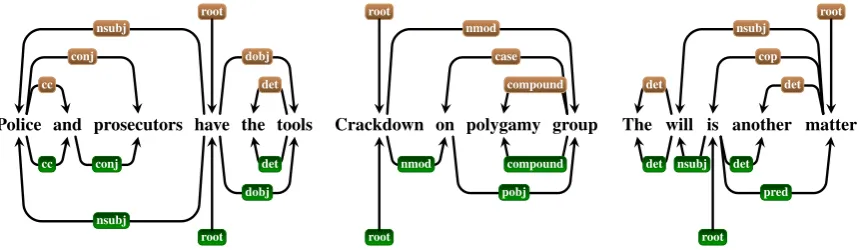
do prefer a chain representation of shorter depen-dencies over the UD-style encoding of dependen-cies where content words are heads, with function words attached as dependent nodes (content-head encoding). This is especially relevant for the en-coding of coordinations, copula, and prepositions (Marneffe et al., 2014) (see figure 1). Several studies have addressed this problem and presented experiments on converted trees, offering evidence that a function-head encoding might increase the learnability of the annotation scheme (Schwartz et al., 2012; Popel et al., 2013; Silveira and Manning, 2015; Rosa, 2015; Versley and Kirilin, 2015; Ko-hita et al., 2017).
Evaluating the learnability of annotation frame-works, however, is not straightforward and at-tempts to do so have often resulted in an apples-to-oranges comparison as there are multiple fac-tors that can impact parsing performance, includ-ing the language, the annotation scheme, the size of the treebank, and the parsing model. Even text-intrinsic properties such as domain and genre of the texts that are included in the treebank can in-fluence results (Rehbein and van Genabith, 2007). It is not possible to control for all of them and this has made it extremely difficult to come to conclu-sions concerning the learnability of syntactic rep-resentations for different languages or annotation frameworks.
In the paper, we show that the design decisions taken in the UD framework have a negative impact on the learnability of the annotations for many lan-guages, but not for all. We do this by evaluating three important design decisions made in the UD scheme and compare their impact on parsing ac-curacies for different languages.
The contributions of the paper are as follows. We test the claim that content-head dependencies are harder to parse, using three parsers that imple-ment different parsing paradigms. We present a conversion algorithm that transforms the
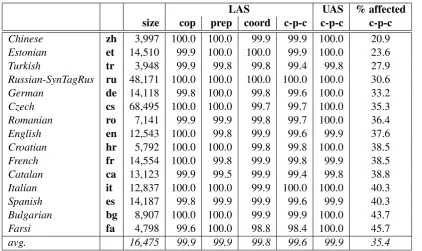
head encoding of the UD treebanks for coordi-nation, copula constructions and for prepositions into a function-head encoding and show that our conversion algorithm yields high accuracies (be-tween 98.4% and 100%) for a back-and-forth con-version ofgoldtrees.
We run parsing experiments on the original and the converted UD treebanks and compare the learnability of the annotations across 15 different languages, showing that language-specific prop-erties play a cruicial role for the learning pro-cess. We further show that the changes in depen-dency lengththat result from the different encod-ing styles are not responsible for the changes in parsing accuracy.
The paper is structured as follows. We first re-view related work (§2) and present our conversion algorithm (§3). The data and setup for our experi-ments as well as the results are described in section §4. After a short discussion (§5) we conclude (§6).
2 Related work
It is well know from the literature that the linguis-tic framework used for a parlinguis-ticular task has a great impact on the learnability of the annotations. Sev-eral studies have tried to evaluate and compare an-notation schemes for syntactic parsing of one lan-guage (K¨ubler, 2005; Schwartz et al., 2012; Hu-sain and Agrawal, 2012; Silveira and Manning, 2015) or across languages (Mareˇcek et al., 2013; Rosa, 2015; Kohita et al., 2017), or have investi-gated the impact of a particular parsing model on the learnability of specific phenomena encoded in the framework (McDonald and Nivre, 2007; Gold-berg and Elhadad, 2010).
Popel et al. (2013) present a thorough crosslin-gual investigation of different ways to encode co-ordination in a dependency framework. They did, however, not address the issue of learnability of the different encodings. This has been done in Maraˇcek et al. (2013), who reach the somewhat disenchanted conclusion that the observed results of their experiments are “unconvincing and not very promising” (Mareˇcek et al., 2013).
Versley and Kirilin (2015) look at the influence of languages and annotation schemes in universal dependency parsing, comparing 5 different parsers on 5 languages using two variants of UD schemes. They state that encoding content words as head has a negative impact on parsing results and that PP attachment errors account for a large portion of
the differences in accuracy between the different parsers and between treebanks of varying sizes.
Recent work by Gulordava and Merlo (2016) has looked at word order variation and its impact on dependency parsing of 12 languages. They fo-cus on word order freedom and dependency length as two properties of word order that systematic-ally vary between different languages. To as-sess their impact on parsing accuracy, they mod-ify the original treebanks by minimising the de-pendency lengths and the entropy of the head-direction (whether the head of dependentdepcan be positioned to the left, to the right, or either way), thus creating artificial treebanks with sys-tematically different word order properties. Pars-ing results on the modified treebanks confirm that a higher variation in word order and longer depen-dencies have a negative impact on parsing accura-cies. These results, however, do not hold for all languages.1
The work of Gulordava and Merlo (2016) can not be used to compare the impact of different encoding schemes on the learnability of the an-notations, as the modifications applied by the au-thors do result inartificialtreebanks and cannot be traced back to specific design decisions, thus mak-ing the results hard to interpret for our purposes.
Kohita et al. (2017) overcome this problem by providing a conversion algorithm for the three functional labels case, dep, mark from the UD scheme. They convert the representations for those labels into function-head encodings and present parsing experiments on 19 treebanks from the UD project. Their results corroborate earlier findings and show that the conversions improve re-sults for 16 out of 19 languages, using two graph-based parsers (MST and RBG) with default feature templates.
Our work is similar in spirit to the one of Ko-hita et al. (2017). We do, however, address partly different linguistic phenomena, namely the encod-ing of adpositions, copula verbs and coordina-tions. In contrast to Kohita et al. (2017), we do not back-transform the parser output but evaluate the converted trees against a converted version of the gold trees, as it has been shown that the back-conversion results in error propagation, which is reflected in lower parsing accuracies (Silveira and
Police and prosecutors have the tools root
nsubj
cc
conj dobj
det
cc conj
nsubj
dobj det
root
Crackdown on polygamy group root
nmod
case
compound
nmod
pobj compound
root
The will is another matter root
det
nsubj
cop
det
det nsubj det
pred
[image:3.595.79.509.61.186.2]root
Figure 1: Dependency trees for conversion of coordination (left), prepositions (middle) and copula (right); UD encoding (brown, above) and modified trees with function words as heads (green, below).
Manning, 2015).2
Another difference to Kohita et al. (2017) con-cerns the parsers used in the experiments. While Kohita et al. (2017) use two graph-based parsing algorithms, we choose three parsers that represent different parsing paradigms, namely a transition-based parser, a graph-transition-based parser and a head-selection parser. The latter is a neural parsing model that simply tries to find the best head for each token in the input. While the first two parsers use rich feature templates (and thus might be bi-ased towards one particular encoding scheme), the head-selection parser does not use any pre-defined feature templates but learns all information di-rectly from the input (§4.1).3
This allows us to test whether the previous re-sults hold for parsers implementing different pars-ing paradigms and, crucially, whether they are in-dependent of the feature templates used by the parsers. Finally, we are interested in the interac-tion between language, parser bias, and encoding scheme.
3 Conversion algorithm
The phenomena we consider in our experiments concern the encoding of copula verbs, coordina-tions and adposicoordina-tions. All three address an im-portant design decision taken in the UD project, namely to encode content words as heads.
We choose these because they are highly fre-quent in all the languages considered here and there is preliminary work discussing their impact
2The main goal of Kohita et al. (2017) was to increase parsing accuracy for UD parsing, thus making a back-conversion necessary. We, instead, are interested in a com-parison of the learnability of the different schemes and thus can skip the back-conversion step.
3We do not use pretrained word embeddings in the exper-iments but learn the embeddings from the training data.
on statistical parsing (Schwartz et al., 2012; Marn-effe et al., 2014), claiming that encoding content words as heads has a negative impact on parsing accuracy, as has the UD way of encoding coordi-nations.
To compare the impact on parsing scores across different languages, we develop a conversion algo-rithm that transforms the original UD trees (figure 1, trees above) into a function-head style encoding (figure 1, trees below).4 We first use our conver-sion algorithm to transform the encodings for in-dividual constructions (copula, prepositions, co-ordinations) and the combination of all the three (c-p-c) and then transform the converted trees back to the original encoding, using our conver-sion method. We then evaluate the trees that have been converted back and forth between UD style and function-head style against the original UD gold trees.
Table 1 shows results for a back-and-forth con-version of the original gold UD trees for 15 lan-guages. Languages are ordered according to how many tokens in the test set are affected by the con-version. This ranges from 20.9% for Chinese (zh) to 45.7% for Farsi (fa), with an average of 34.7% over all 15 languages.5 We can see that at least for gold trees, our conversion algorithm is able to transform between the two encodings without sub-stantial loss of information.6
Errors in the back-conversion are partly due to inconsistencies in the annotations that are not al-ways compliant with the UD scheme. Some of these issues have already been addressed in the
4
Our code is available for download at http://wisscamp.de/en/research-2/resources.
5For comparison, the average ratio of converted tokens in the study of Kohita et al. (2017) is 6.3%.
LAS UAS % affected size cop prep coord c-p-c c-p-c c-p-c Chinese zh 3,997 100.0 100.0 99.9 99.9 100.0 20.9 Estonian et 14,510 99.9 100.0 100.0 99.9 100.0 23.6 Turkish tr 3,948 99.9 99.8 99.8 99.4 99.8 27.9 Russian-SynTagRus ru 48,171 100.0 100.0 100.0 100.0 100.0 30.6 German de 14,118 99.8 100.0 99.8 99.6 100.0 33.2 Czech cs 68,495 100.0 100.0 99.7 99.7 100.0 35.3 Romanian ro 7,141 99.9 99.9 99.8 99.7 100.0 36.4 English en 12,543 100.0 99.8 99.9 99.6 99.9 37.6 Croatian hr 5,792 100.0 100.0 99.8 99.8 100.0 38.5 French fr 14,554 100.0 99.8 99.9 99.8 99.9 38.5 Catalan ca 13,123 99.9 99.5 99.9 99.4 99.8 38.8 Italian it 12,837 100.0 100.0 99.9 100.0 100.0 40.3 Spanish es 14,187 99.8 99.9 99.9 99.6 99.9 40.3 Bulgarian bg 8,907 100.0 100.0 99.9 99.9 100.0 43.7 Farsi fa 4,798 99.6 100.0 98.8 98.4 100.0 45.7
[image:4.595.90.513.60.311.2]avg. 16,475 99.9 99.9 99.8 99.6 99.9 35.4
Table 1: LAS (excluding punctuation) on the test sets after round-trip conversion for individual trans-formations and for the combination of all (c-p-c: copula, prep, coord), evaluated against the original UD trees, and UAS for all conversions (c-p-c) (languages are ordered according to the amount of tokens affected by the combination of all conversions; zh: 20.9% – fa: 45.7%).
new release of the UD 2.0.7 Other errors are due to language-specific constructions. A case in point are compositional preposition in Cata-lan (e.g. per a) where both parts are attached to the same head, while other sequences of preposi-tions have a chain-like attachment. Our conver-sion algorithm does not pay attention to language-specific properties that are neither encoded on the pos level nor in the dependency labels. It would, however, be straightforward to extend the algo-rithm to include these.
A final cause of errors in the back-conversion concerns coordinations with more than two juncts, where we have embedded coordinated con-stituents of the type(A and B and (C and D)). Here the back-conversion from the chain-like represen-tation to UD looses information. In practice, how-ever, these structures are not very frequent. For instance, in the English test set less than 0.8% of all sentences include a coordination of that partic-ular type.
4 Experiments
We now want to use our conversion method to assess the impact of the content-head encoding in general and of individual, construction-specific
7The sixth release of the Universal Dependencies tree-banks, v2.0, is available at http://universaldependencies.org.
encodings on parsing accuracies across different languages. In contrast to Kohita et al. (2017), our objective is not to improve UD parsing ac-curacies by using the conversion before parsing to increase the learnability of the representations and then convert theparser outputback to the UD scheme. Our main goal is to use the conversion on gold trees in order to compare the impact it has for different languages and thus learn more about how to encode languages with different ty-pological properties to improve monolingual de-pendency parsing results.
To rule out the influence of extrinsic factors such as data size or text type, we do not compare results across different treebanks and languages but modify specific annotation decisions and com-pare parsing accuracies for the original treebanks with the ones obtained on modified versions of the sametreebank. Figure 1 illustrates the UD encod-ing (trees above) and the modified trees with func-tion words as heads and a chain-like encoding of coordinations (trees below).
4.1 Data and setup
LAS CNC
IMS RBG HSEL IMS RBG HSEL
germanic de 84.3 83.8 82.0 79.7 78.9 77.1 en 86.4 86.3 86.0 82.8 82.2 82.3 iranian fa 83.4 83.1 83.9 80.5 79.5 80.8
romance
ca 89.5 88.8 89.1 84.0 82.7 83.6 es 85.6 85.2 85.2 78.6 77.5 78.0 fr 85.6 84.4 85.2 79.4 77.6 78.6 it 89.6 88.8 89.3 84.3 82.9 83.9 ro 79.9 79.6 78.6 75.4 74.6 73.3
slavic
[image:5.595.172.425.60.236.2]bg 86.9 84.9 85.6 83.7 80.8 81.7 cs 87.8 86.1 85.7 86.1 83.9 83.5 hr 79.9 80.7 78.1 77.2 77.6 74.9 ru 89.5 89.5 86.8 88.0 87.8 84.4 sinitic zh 81.8 79.4 80.4 80.6 77.9 79.1 finnic et 84.1 83.9 75.3 83.0 82.6 73.0 turkic tr 73.5 75.1 62.5 71.9 73.4 59.1
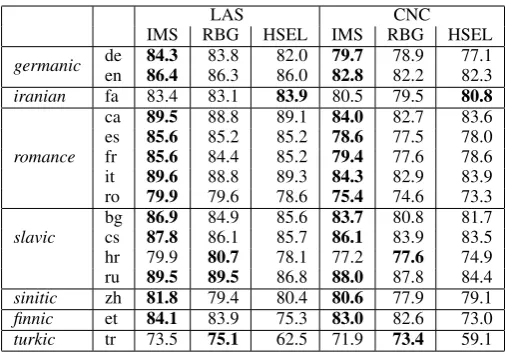
Table 2: LAS (excluding punctuation) and CNC (content dependencies only) on the test sets of the original treebanks.
choose three different non-projective parsers to as-sess the impact of specific parsing frameworks on the results, namely the graph-based RBG parser (Lei et al., 2014), the transition-based IMSTrans parser of Bj¨orkelund and Nivre (2015) (IMS), and our reimplementation of the head-selection parser of Zhang et al. (2017) (HSEL).
The RBG parser uses tensor decomposition and greedy decoding and the IMSTrans parser imple-ments the (labeled) ArcStandard system, including a swap transition that can generate non-projective trees. The head-selection parser generates unla-beled trees by identifying the most probable head for each token in the input and then assigns labels to each head-dependent pair in a post-processing step. In contrast to the other two parsers, the head-selection parser does not use any predefined feature templates but selects the most probable head for each token based on word representa-tions learned by a bidirectional long-short mem-ory model (LSTM) (Hochreiter and Schmidhuber, 1997). Despite its simplicity and the lack of global optimisation, Zhang et al. (2017) report compete-tive results for English, Czech, and German.
For the first two parsers, we use default set-tings and the provided feature templates (for the RBG parser we use the standard settingwithout pretrained word embeddings), with no language-specific parameter optimisation.8 We use the coarse-grained universal POS (Petrov et al., 2012) for all languages. The RBG and IMSTrans parser
8Please note that our goal is not to improve, or compare, results for individual languages but to assess the impact of different encoding decisions on the parsing accuracy for one language.
are trained on gold POS and morphological fea-tures provided by the UD project, the head-selection model is trained without morphologi-cal information, using word and POS embeddings only.
We choose the head-selection model to test whether a potential positive impact of the conver-sion might simply be a bias introduced by the fea-ture templates, which might favour one particular encoding scheme. If we see the same improve-ments for all three parsers, we can be sure that the results are robust and not just an artefact of the feature templates used in the experiments.
For our experiments we systematically modify the input data and run parsing experiments on the original and on the converted treebanks. We have 15 settings per language (3 parsers x 5 treebank versions x 15 languages), which results in a total of 225 experiments. We hypothesize that the dif-ferent modifications have a difdif-ferent effect on each language, which will be reflected in the changes in parsing accuracy when training and testing the parser on the different treebank versions.
4.2 Results for the original treebanks
IMS RBG HSEL
lang CNC ∆ CNC ∆ CNC ∆
ger de 81.0 1.3 81.2 2.3 78.0 0.9
en 83.6 0.8 83.4 1.2 83.6 1.3
ira fa 84.2 3.7 83.4 3.9 83.6 2.8
rom
ca 85.6 1.6 85.0 2.3 84.9 1.3
es 80.5 1.9 80.8 3.3 79.9 1.9
fr 81.9 2.5 80.7 3.1 80.4 1.8
it 86.1 1.8 86.1 3.2 85.5 1.6
ro 75.7 0.3 75.3 0.7 73.6 0.3
sla
bg 85.4 1.7 83.8 3.0 83.8 2.1
cs 87.3 1.2 85.2 1.3 84.2 0.7
[image:6.595.72.293.62.238.2]hr 77.4 0.2 77.3 -0.3 73.2 -1.7 ru 89.2 1.2 88.7 0.9 82.1 -2.3 sin zh 81.9 1.3 78.9 1.0 79.2 0.1 fin et 84.4 1.4 82.8 0.2 74.7 1.7 tur tr 71.6 -0.3 71.8 -1.6 58.3 -0.8
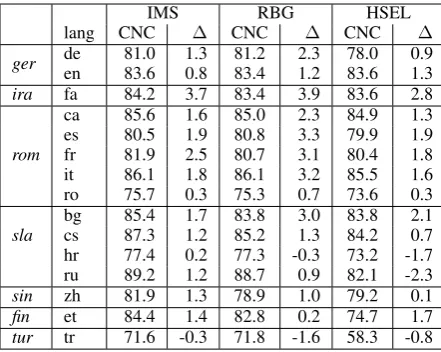
Table 3: CNC for the converted treebanks and dif-ferences ∆to the CNC obtained on the original treebanks.
languages.9Our evaluation does not provide a fair
comparison between the parsers, as the different parsers do not have access to the same informa-tion (the head-selecinforma-tion parser, for instance, has no access to morphological information) and were not optimised for specific languages. Instead, our goal is to test whether the results of our conversion are robust across different languages and parsing models.
From the table we can see that the parsers per-form differently well on the different treebanks. The transition-based parser provides best results for most languages and is only outperformed by the tensor-based RBG parser on Turkish (tr) and Croatian (hr) and by the head-selection parser on Farsi (fa), all three languages with rather small training sets.
It comes at not surprise that the head-selection parser, which has no access to morphological in-formation or subword representations, has prob-lems with Turkish (tr) and Estonian (et), which are both agglutinative languages. Despite the sim-plicity of the head-selection model, however, the parser produces competetive results for many lan-guages and even outperforms the other two parsers on Farsi (fa).10
9Please note that the CNC metric considers the same num-ber of tokens for evaluation in the original and converted tree-banks, which is crucial for comparability.
10
The head-selection model can easily be extended to in-clude character-based embeddings or morphological embed-dings, which will increase its performance on morphologi-cally rich languages, but this is out of scope of the present study.
metric orig cop prep coord c-p-c ∆ Turkish
with punc 77.4 76.9 76.6 76.7 76.4 -1.0 w/o punc 75.1 74.4 74.1 74.2 73.8 -1.3 CNC 73.4 72.9 72.6 71.9 71.8 -1.6 core 65.9 65.3 65.9 64.7 67.1 +1.2 non-core 75.5 74.9 74.4 73.9 73.2 -2.3 func 85.6 84.2 83.4 88.2 86.0 +0.4
Croatian
with punc 80.2 78.7 79.4 81.0 80.1 -0.1 w/o punc 80.7 79.0 80.0 81.5 80.5 -0.2 CNC 77.7 75.5 76.9 78.6 77.3 -0.4 core 81.1 81.5 81.0 81.7 81.9 +0.7 non-core 76.8 74.0 75.9 77.8 76.1 -0.9 func 88.5 87.9 87.9 89.1 88.7 +0.2
Table 4: Results for different label sets for Turkish and Croatian (RBG parser) and difference (∆) be-tween original and converted treebank (cop-p rep-coord).
4.3 Results for the converted treebanks
We now want to assess the impact of our conver-sions on the different languages. Table 3 shows CNC scores for the three parsers trained on the converted treebanks as well as the difference (∆) to the results we get when training on the original treebanks.11
Our results confirm previous results from the literature (Schwartz et al., 2012; Marneffe et al., 2014) and show that our conversions are beneficial for nearly all languages. One exception is Turkish where CNC scores for all three parsers decrease. For Croatian, we observe only a minor increase for the IMSTrans parser and a decrease in results for the other two parsers.
To better understand the results for Turkish, we compare accuracies for the different label sets for the RBG parser which obtained best results on the Turkish treebank (Table 4). Most interestingly, we see that our conversions do indeed increase results for the core arguments (+1.2% labelled accuracy; improvements for csubj and ccomp) and also for the function tags (+0.4%), but all three conver-sions result in lower scores for the non-core depen-dency labels, especially for coordinations. These results highlight the importance of a detailed er-ror analysis and show that overall parsing scores might be misleading.
Considering the small size of the Turkish tree-bank and the fact that the data has been converted automatically without manual correction, we can
[image:6.595.306.531.62.217.2]not rule out that the negative impact of the conver-sion on the non-core dependencies is merely an artefact of low data quality. This issue requires further investigation.
Looking at the results for Croatian, we see that the chain-like encoding of coordinations in our conversion experiments brings improvements for all subsets of grammatical functions. The other two conversions, however, result in a decrease in accuracy, which is also reflected in the re-sults for the combined conversion (c-p-c). While for Turkish all three conversions on their own seem to decrease results and only the combina-tion of all three converted encodings yields an improvement, for Croatian we get best results when changing the annotation of coordinations only and keeping the remaining representations in UD style. This increases CNC scores for RBG from 77.7% to 78.6% (+0.9). Our last finding sug-gests that a language-specific optimisation of an-notation schemes for parsing might be worthwhile, and that there is a complex interaction between en-coding styles, data properties (e.g. the size of the treebank) and language properties.
We also observe a correlation between language family and the degree to which the conversion improves performance. For all three parsers, we observe a similar ranking.12 At the top is Farsi which benefits most from the conversion, while for Croatian and Turkish the results decrease. In gen-eral, the romance languages (fr, es, it, ca) seem to profit more from the transformations than the ger-manic and slavic languages. Romanian, however, an easter romance language, seems to behave dif-ferent from the italo-western romance languages and shows only a slight increase in CNC.
In the next section, we turn to the question what it is that determines whether and how much a particular language will benefit from a specific choice of encoding. To that end, we focus on two language-specific properties, namely on de-pendency length and on the direction of the rela-tions, i.e. head-initial versus head-final dependen-cies.
4.4 Dependency length
Previous work has discussed the different fac-tors that might impact parsing accuracies across
12We obtain highly significant results for Spearman’s rank correlation, computed on the differences∆in CNC (see table 3), between all possible parser pairs (IMS-RBG, IMS-HSEL, RBG-HSEL) (allp <0.0006).
Lang orig cop prep coord c-p-c
ger de 3.4 0.98 1.01 1.03 1.03 en 2.9 1.00 1.04 1.03 1.07 ira fa 3.5 0.97 0.99 1.02 0.97
rom
ca 3.1 1.00 1.06 1.03 1.09 es 2.8 0.99 1.07 1.04 1.11 fr 2.8 0.99 1.07 1.03 1.09 it 2.7 1.00 1.05 1.02 1.08 ro 2.7 1.00 1.04 1.04 1.07
sla
[image:7.595.313.520.62.227.2]bg 2.5 1.01 1.05 1.02 1.08 cs 2.8 1.00 1.58 1.03 1.06 hr 2.8 1.00 1.03 1.04 1.08 ru 2.7 1.00 1.02 1.03 1.05 sin zh 3.6 1.00 0.98 1.01 1.00 fin et 2.6 1.00 1.00 1.03 1.02 tur tr 2.6 1.00 1.01 1.01 1.02
Table 5: Avg. dependency length in the original treebank and DLM ratio for each modification
languages, such as word order properties, the high amount of unknown words for morphologi-cally rich languages, ambiguity due to case syn-cretism, non-projectivity, ambiguity in head di-rection, and dependency length (Tsarfaty et al., 2010; Schwartz et al., 2012; Gulordava and Merlo, 2016).
Gulordava and Merlo (2016) have investigated the influence of dependency length and arc direc-tion entropy on parsing results, using artificially created treebanks. We adopt their measures to find out more about the impact of different encod-ings on natural languages. Following Gulordava and Merlo (2016), we compute the overall ratio of Dependency Length Minimisation (DLM) in the modified treebanks (as compared to the original treebanks), based on the data in the training set, as follows.
DLM Ratio=X s
DLs |s|2 /
X
s
M odDLs |s|2 (1)
The dependency length DL for each sentence sin the original treebank is calculated as the sum of the length of all arcs in the tree for sentence s,13andM odDLrefers to the dependency length in the modified treebank. A DLM ratio above 1 means that the treebank conversion resulted in a decreased dependency length in the data.14
13For the rightmost UD tree in Figure 1DL
sis 7 while the length for the modified tree (M odDLs) is 5.
14
We can see that the modifications have quite a different effect on the average dependency length in the different treebanks (Table 5). While for many languages the combination of all modifi-cations results in a minimisation of dependency length, this does not hold for Farsi and Chinese, and only slightly for Turkish, German and Esto-nian. It does not seem that the minimisation in dependency length is the responsible factor for the improvements in CNC. To test this, we fitted a lin-ear regression model to the data and, as expected, did not find a significant correlation between de-pendency length and the changes in CNC accuracy for any of the parsers (IMSTrans: p=0.604, RBG: p=0.463, HSEL:p=0.943).15
We were thus not able to replicate the findings of Gulordava and Merlo (2016) who optimised UD trees for dependency length, thus generating arti-ficial trees that were allowed to violate language-specific word order restrictions. They concluded that an increase in dependency length has, in gen-eral, a negative impact on parsing scores. This conclusion does not hold for our data. However, Gulordava and Merlo (2016) also found that min-imising dependency length e.g. for German did not improve parsing accuracies the same way as it did for other languages.
Even if our conversion does result in a minimi-sation of dependency length in the treebanks, we conclude that the improvements in parsing accu-racy are not due to the shorter dependencies. This raises the question what it is that makes the con-verted trees easier to learn and whether the differ-ences are due to typological properties or merely reflect idiosyncrasies in the treebanks.
4.5 Arc direction entropy
We now look at the variation in the linear ordering between a head and its dependent as a potential factor that might impact parsing accuracy. Lan-guages can be distinguished with regard to the pro-portion of head-initial versus head-final dependen-cies, which reflect typological differences between language families (Liu, 2010). Different treebank annotation schemes, however, can also influence the variation in arc direction, independent from the specific language of the treebank content.
To quantify this variation, we compute arc-direction entropy (ADE) (Gulordava and Merlo,
15We used R’s lm function to predict the changes in CNC for each modified treebank version, based on the DLMratio.
lang ∆cop ∆prep ∆coord ∆c-p-c
ger de -0.26 -0.03 0.03 -0.23
en -0.56 -0.19 -0.01 -0.72
ira fa -0.73 0.07 0.02 -0.60
rom
ca 0.09 0.07 -0.01 0.16
es -0.19 -0.19 0.02 -0.36
fr -0.16 -0.15 0.04 -0.27
it -0.22 -0.11 0.02 -0.29
ro -0.13 0.17 0.04 0.09
sla
bg -0.31 -0.10 0.05 -0.34
cs -0.30 0.20 0.07 0.03
hr 0.16 0.21 0.03 0.41
ru 0.17 0.19 0.05 0.41
sin zh -0.25 -0.00 0.03 -0.19
fin et -0.37 0.16 0.04 -0.16
[image:8.595.311.522.61.229.2]tur tr 0.19 0.28 0.03 0.50
Table 6: Difference (∆) between avg. unlexi-calised arc direction entropy (ADE) in the original treebank and in the modified treebanks
2016) in a treebank by iterating over all depen-dents in each individual arc and summing up the probability of the arc, represented by the POS of the dependent, the relation and the POS of the head, times the conditional entropy of the head direction, given the arc (Equation (2)).16 An in-crease in ADE means that a particular modifica-tion introduced more variamodifica-tion with respect to the linear order of head and dependent for a specific relation.
H(Dir|Rel, H, D) = X
rel,h,d
p(rel, h, d)H(Dir|rel, h, d)
(2)
For most languages, the conversion from content-head to function-head dependencies de-creases ADE (Table 6). For some languages, we see a slight increase (Czech, Romanian, Cata-lan) while for Croatian, Russian and Turkish, the increase in entropy is substantial with 0.4 and 0.5, respectively. When fitting a linear regression model to the data, this time we see a significant ef-fect on parsing accuracy (CNC) for the IMSTrans parser (p= 0.01) and the RBG parser (p= 004). For the head-selection parser, the correlation is even stronger withp= 0.0002.
We also experimented with lexicalised arc en-tropy but found no improvement over the unlex-icalised model, probably due to data sparseness (see the discussion in Futrell et al. (2015)).
16
5 Discussion
Our findings suggest that it is not so much an in-crease in dependency length that goes along with the content-head representation implemented in the UD treebanks, but rather the increase in en-tropy for the position of the head that causes the loss in parsing accuracy when training a parser on UD-style dependencies.
Kohita et al. (2017) also discuss another prop-erty, namely the head word vocabulary entropy, as a potential factor that impacts parsing scores. Their measure is an implementation of an idea de-scribed in Schwartz et al. (2012). However, Kohita et al. (2017) did not observe a significant corre-lation between improvements in parsing accuracy (obtained by the RBG parser) and head word vo-cabulary entropy.
Our results show that the improvements we get through the conversion of content-head to function-head dependencies are not only due to the feature templates used by the parsers, which might introduce a bias towards one particular en-coding, as we get similar improvements for the head-selection parser, a neural parser which does notuse any predefined feature templates but learns its features directly from the input representations.
6 Conclusions
We presented a systematic investigation of the im-pact of specific annotation design decisions for statistical dependency parsing. We showed that claims that have been made for English (Schwartz et al., 2012) also hold for many other languages, but that the effect strength varies considerably.
We also showed that the UD encoding of ad-positions, coordination and copula increases de-pendency length for all the languages we inves-tigated except Persian and Chinese. This increase, however, does not directly translate to lower pars-ing scores. Head direction entropy, on the other hand, seems to have a stronger impact on pars-ing. This finding is consistent with the observa-tions of Gulordava and Merlo (2016) obtained on artificially created data and their suggestion that at least for German, word order variability might have a higher impact on parsing difficulty than de-pendency length.
Finally, our results suggest that there is an inter-action between typological properties and the ef-fect strength of the improvments obtained by the treebank conversion. This provides interesting
av-enues for future research, as language generalisa-tions might help us to design treebank encoding schemes that are optimised for specific languages, without having to repeat the same effort for each individual language.
Acknowledgments
We would like to thank the anonymous review-ers for their valuable comments and suggestions. This research has been conducted within the Leib-niz Science Campus “Empirical Linguistics and Computational Modeling”, funded by the Leibniz Association under grant no. SAS-2015-IDS-LWC and by the Ministry of Science, Research, and Art (MWK) of the state of Baden-W¨urttemberg.
References
Anders Bj¨orkelund and Joakim Nivre. 2015. Non-deterministic oracles for unrestricted non-projective
transition-based dependency parsing. In
Proceed-ings of the 14th International Conference on Pars-ing Technologies, IWPT ’15, pages 76–86, Bilbao, Spain, July.
Richard Futrell, Kyle Mahowald, and Edward Gibson. 2015. Quantifying word order freedom in
depen-dency corpora. In Proceedings of the Third
In-ternational Conference on Dependency Linguistics, Depling 2015, pages 91–100.
Yoav Goldberg and Michael Elhadad. 2010. Inspect-ing the structural biases of dependency parsInspect-ing
al-gorithms. InProceedings of the Fourteenth
Confer-ence on Computational Natural Language Learning, CoNLL ’10, pages 234–242, Uppsala, Sweden.
Kristina Gulordava and Paola Merlo. 2016. Multi-lingual dependency parsing evaluation: a large-scale analysis of word order properties using artificial
data. Transactions of the Association for
Compu-tational Linguistics, 4:343–356.
Sepp Hochreiter and J¨urgen Schmidhuber. 1997. Long
short-term memory. Neural Computing, 9(8):1735–
1780.
Samar Husain and Bhasha Agrawal. 2012. Analyz-ing parser errors to improve parsAnalyz-ing accuracy and
to inform tree banking decisions. In The 10th
In-ternational Workshop on Treebanks and Linguistic Theories, TLT.
Ryosuke Kohita, Hiroshi Noji, and Yuji Matsumoto. 2017. Multilingual back-and-forth conversion be-tween content and function head for easy
depen-dency parsing. InProceedings of the 15th
Sandra K¨ubler. 2005. How do treebank annotation schemes influence parsing results? Or how not to
compare apples and oranges. In Proceedings of
Recent Advances in Natural Language Processing, RANLP ’05.
Tao Lei, Yu Xin, Yuan Zhang, Regina Barzilay, and Tommi Jaakkola. 2014. Low-rank tensors for
scor-ing dependency structures. In Proceedings of the
52nd Annual Meeting of the Association for Com-putational Linguistics, ACL ’14, pages 1381–1391.
Haitao Liu. 2010. Dependency direction as a means of word-order typology: A method based on
depen-dency treebanks. Lingua, 120(6):1567–1578.
David Mareˇcek, Martin Popel, Loganathan Ramasamy, Jan ˇStˇep´anek, Daniel Zeman, Zdenˇek ˇZabokrtsk´y, and Jan Hajiˇc. 2013. Cross-language study on in-fluence of coordination style on dependency parsing performance. Technical report, UFAL.
Marie-Catherine De Marneffe, Timothy Dozat, Na-talia Silveira, Katri Haverinen, Filip Ginter, Joakim Nivre, and Christopher D. Manning. 2014. Uni-versal Stanford dependencies: a cross-linguistic
ty-pology. InProceedings of the Ninth International
Conference on Language Resources and Evaluation, LREC ’14, Reykjavik, Iceland.
Ryan T. McDonald and Joakim Nivre. 2007. Charac-terizing the errors of data-driven dependency
pars-ing models. InProceedings of the 2007 Joint
Con-ference on Empirical Methods in Natural Language Processing and Computational Natural Language Learning, June 28-30, 2007, Prague, Czech
Repub-lic, EMNLP-CoNLL ’07, pages 122–131, Prague,
Czech Republic.
Joakim Nivre and Chiao-Ting Fang. 2017.
Univer-sal dependency evaluation. In Proceedings of the
NoDaLiDa 2017 Workshop on Universal Dependen-cies, pages 86–95, Gothenburg, Sweden.
Joakim Nivre, Marie-Catherine de Marneffe, Filip Gin-ter, Yoav Goldberg, Jan Hajic, Christopher D. Man-ning, Ryan McDonald, Slav Petrov, Sampo Pyysalo, Natalia Silveira, Reut Tsarfaty, and Daniel Zeman. 2016. Universal dependencies v1: A multilingual treebank collection. InProceedings of the Tenth In-ternational Conference on Language Resources and Evaluation, LREC ’16, Portoroˇz, Slovenia.
Joakim Nivre. 2016. Universal dependency evalua-tion. Technical report, Uppsala University, Sweden.
Slav Petrov, Dipanjan Das, and Ryan McDonald. 2012.
A universal part-of-speech tagset. In
Proceed-ings of the Eight International Conference on Lan-guage Resources and Evaluation, LREC ’12, Istan-bul, Turkey.
Martin Popel, David Marecek, Jan Step´anek, Daniel Zeman, and Zdenek Zabokrtsk´y. 2013.
Coordina-tion structures in dependency treebanks. InAnnual
Meeting of The European Chapter of The Associa-tion of ComputaAssocia-tional Linguistics, EACL ’13, pages 517–527.
Ines Rehbein and Josef van Genabith. 2007. Why
is it so difficult to compare treebanks? TIGER
and T¨uBa-D/Z revisited. InThe Sixth International Workshop on Treebanks and Linguistic Theories, TLT ’07, pages 115 – 126, Bergen, Norway.
Rudolf Rosa. 2015. Multi-source cross-lingual delexi-calized parser transfer: Prague or Stanford? In Pro-ceedings of the Third International Conference on Dependency Linguistics, DepLing ’15, pages 281– 290, Uppsala, Sweden.
Roy Schwartz, Omri Abend, and Ari Rappoport. 2012. Learnability-based syntactic annotation design. In Proceedings of the 24th International Conference on Computational Linguistics, COLING ’12, pages 2405–2422, Mumbai, India.
Natalia Silveira and Christopher D. Manning. 2015. Does universal dependencies need a parsing repre-sentation? an investigation of english. In Proceed-ings of the Third International Conference on De-pendency Linguistics, DepLing’15, pages 310–319, Uppsala, Sweden.
Reut Tsarfaty, Djame Seddah, Yoav Goldberg, San-dra K¨ubler, Marie Candito, Jennifer Foster, Yannick
Versley, Ines Rehbein, and Lamia Tounsi. 2010.
Statistical Parsing of Morphologically Rich
Lan-guages (SPMRL): What, How and Whither. In
Pro-ceedings of the first workshop on Statistical Parsing of Morphologically Rich Languages, SPMRL’10, Los Angeles, CA, USA.
Yannick Versley and Angelika Kirilin. 2015. What is
hard in universal dependency parsing? InThe 6th
Workshop on Statistical Parsing of Morphologically Rich Languages, SPMRL ’15.
Appendix A. Supplemental Material
IMS (LAS) IMS (CNC)
orig cop prep coord c-p-c orig cop prep coord c-p-c
germanic de 84.3 85.0 84.3 84.9 85.2 79.7 80.9 79.9 80.5 81.0 en 86.4 86.0 86.5 87.0 86.7 82.8 82.5 83.2 83.5 83.6
iranian fa 83.4 85.6 84.6 84.5 86.4 80.5 83.0 81.9 82.0 84.2
romance
ca 89.5 89.5 89.2 90.1 89.9 84.0 84.3 84.1 85.3 85.6 es 85.6 85.4 85.6 86.7 86.8 78.6 78.2 78.7 80.3 80.5 fr 85.6 86.1 85.3 86.1 87.0 79.4 80.6 79.2 80.2 81.9 it 89.6 89.9 90.1 90.7 90.5 84.3 85.0 85.1 86.0 86.1 ro 79.9 79.4 79.6 80.7 80.0 75.4 74.8 75.1 76.4 75.7
slavic
bg 86.9 87.6 87.0 87.5 88.0 83.7 84.8 84.0 84.5 85.4 cs 87.8 88.2 88.2 88.2 88.8 86.1 86.5 86.6 86.5 87.3 hr 79.9 79.8 79.5 82.2 80.4 77.2 77.0 76.8 79.3 77.4 ru 89.5 89.5 89.8 90.6 90.6 88.0 88.0 88.3 89.2 89.2
sinitic zh 81.8 81.5 82.3 82.1 82.9 80.6 80.5 81.1 80.9 81.9
finnic et 84.1 84.9 84.1 84.8 85.5 83.0 83.8 83.0 83.7 84.4
turkic tr 73.5 73.8 74.0 73.3 73.6 71.9 72.3 72.5 71.1 71.6
RBG (LAS) RBG (CNC)
orig cop prep coord c-p-c orig cop prep coord c-p-c
germanic de 83.8 84.2 84.0 84.0 85.4 78.9 79.6 79.3 79.0 81.2 en 86.3 86.0 86.2 86.4 86.8 82.2 82.1 82.5 82.5 83.4
iranian fa 83.1 84.6 83.8 83.3 86.1 79.5 81.2 80.6 79.9 83.4
romance
ca 88.8 88.6 88.9 89.4 89.6 82.7 82.5 83.6 83.9 85.0 es 85.2 85.4 85.9 85.8 86.8 77.5 77.9 78.9 79.0 80.8 fr 84.4 85.1 84.8 85.6 86.3 77.6 78.9 78.5 78.8 80.7 it 88.8 89.1 89.7 89.3 90.8 82.9 83.3 84.3 83.6 86.1 ro 79.6 79.1 79.3 79.8 79.9 74.6 74.1 74.4 74.9 75.3
slavic
bg 84.9 85.2 85.5 85.3 86.9 80.8 81.4 81.8 81.4 83.8 cs 86.1 86.0 86.3 85.9 87.1 83.9 83.9 84.2 83.8 85.2 hr 80.7 79.0 80.0 81.5 80.5 77.7 75.5 76.9 78.6 77.3 ru 89.5 88.8 89.4 90.0 90.1 87.8 87.1 87.8 88.3 88.7
sinitic zh 79.4 78.7 79.6 78.6 80.2 77.9 77.3 78.4 77.0 78.9
finnic et 83.9 83.3 83.4 84.2 84.1 82.6 81.9 82.2 83.0 82.8 turkic tr 75.1 74.4 74.1 74.2 73.8 73.4 72.9 72.6 71.9 71.8
HSEL (LAS) HSEL (CNC)
orig cop prep coord c-p-c orig cop prep coord c-p-c
germanic de 82.0 82.6 82.2 82.5 82.8 77.1 78.0 77.2 77.6 78.0 en 86.0 86.2 86.1 86.5 86.8 82.3 82.7 82.6 82.9 83.6
iranian fa 83.9 85.2 84.3 84.3 86.1 80.8 82.4 81.3 81.2 83.6
romance
ca 89.1 89.4 89.1 89.9 89.6 83.6 84.1 83.8 84.9 84.9 es 85.2 85.6 86.0 85.8 86.3 78.0 78.7 79.3 79.1 79.9 fr 85.2 86.2 85.3 85.7 86.2 78.6 80.1 78.8 79.5 80.4 it 89.3 89.5 89.4 89.7 90.4 83.9 84.0 83.8 84.3 85.5 ro 78.6 78.2 78.1 79.2 78.7 73.3 73.2 72.7 74.2 73.6
slavic
bg 85.6 86.5 85.9 86.0 87.0 81.7 83.3 82.2 82.6 83.8 cs 85.7 86.1 85.8 86.0 86.5 83.5 83.8 83.5 83.7 84.2 hr 78.1 75.4 77.9 79.6 76.8 74.9 72.4 74.9 76.7 73.2 ru 86.8 86.6 86.6 87.6 84.7 84.4 84.2 84.2 85.2 82.1 sinitic zh 80.4 79.7 80.7 79.7 80.4 79.1 78.5 79.4 78.6 79.2 finnic et 75.3 76.5 74.9 75.8 77.0 73.0 74.3 72.7 73.4 74.7
turkic tr 62.5 61.7 62.3 62.3 62.2 59.1 58.4 59.0 58.2 58.3